R E S E A R C H
Open Access
Listing all sorting reversals in quadratic time
Krister M Swenson
1,2*, Ghada Badr
3,4and David Sankoff
1Abstract
We describe an average-caseO(n2) algorithm to list all reversals on a signed permutationπ that, when applied to π, produce a permutation that is closer to the identity. This algorithm is optimal in the sense that, the time it takes to write the list isΩ(n2) in the worst case.
1 Introduction
In 1995 Hannenhalli and Pevzner [1] presented an algo-rithm to transform one genome into another in a mini-mum number of biologically plausible moves. They modeled a genome as a signed permutation and the move that they considered was the reversal: the order of a substring of the permutation is reversed, and the sign of each element in the substring is flipped. Since then many refinements and speed improvements have been developed [2-8].
In 2002 Siepel and Ajana et al. [9,10] showed how to list every parsimonious scenario of reversals, each sce-nario being a proposed candidate for the true evolution-ary history. Fundamental to their algorithms areO(n3) techniques for finding allsortingreversals; the reversals that at each step produce a permutation that is closer to the target permutation than the last. Ajana et al. [9] used these results to support the replication-directed reversal hypothesis. Lefebvre et al. [11] and Sankoff et al. [12] used similar methodology to gain insight into the distribution of reversal lengths between genomes. Algorithms that attempt to more succinctly represent all shortest-length scenarios [13,14] have also been developed.
In this paper we show how to list all sorting reversals in O(n2) time on average. This algorithm is optimal in the sense that there areΩ(n2) safe cycle-splitting rever-sals in the worst case. We later give a family of permu-tations that haveΩ(n2) unsafe reversals.
We implemented our algorithm in Java, and show experimentally that our algorithm is significantly faster than that of Siepel. This will afford a marked speedup of
the aforementioned methods [9-14], since listing all sorting reversals is the kernel of repeated computation in each of them, especially when applied to permuta-tions of sizes 3 × 10³to 3 × 10⁵(the size of bacterial or mammalian genomes).
After giving background material in Section 2 we introduce ominous substrings in Section 3. Section 4 describes how to detect the set of all ominous substrings of a permutation efficiently while Section 5 presents the algorithm. Section 6 shows the empirical speedup that our implementation affords. Finally, Section 7 gives a family of permutations that haveΩ(n2) unsafe reversals and discusses open problems.
2 Background
Take a signed permutation π=π1,..., πnon the integers
from 1 to n. Define a (signed) reversal r(i, j) as the signed permutation
1, 2, ..., (i−1),−j, . . .,−j, (j+ 1), ..., n.
That way, applying the reversal r(i, j) to permutation πgives
ρ(i,j)(π) =π ◦ρ(i,j) =π1, ..., πi−1,−πj, ..., −πi,πj+1, ...,πn.
Given signed permutations π1 andπ2, the reversal
dis-tance d(π1, π2) is the smallest ksuch thatπ2 =π1 ○r1 ○ r2 ○ ··· ○ rk. Since I=π2−1◦π1◦ ρ1◦ ρ1◦ · · · ◦ρk,
we consider π2 = I = 1, 2,..., n to be the identity
permutation.
In this paper, we describe our methods using circular permutations (when written on a line, the leftmost ele-ment follows the rightmost eleele-ment), as any sorting reversal on a circular permutation has its counterpart on a linear version of the permutation. Occasionally, however, we refer to thelinearizationof a permutation * Correspondence: [email protected]
1
Department of Mathematics and Statistics, University of Ottawa, Ontario, K1N 6N5, Canada
Full list of author information is available at the end of the article
π; this is a linear version of πthat maintains the same ordering as the clockwise ordering ofπbut has a left-most and a rightleft-most element.
2.1 All Sorting Reversals
A reversalris asortingreversal onπifd(π○r) = d(π) - 1. Although the definition is simple, a characterization of all sorting reversals requires effort; to do so we must introduce thebreakpoint graph [1]. Each elementπi of
permutation π has two vertices associated with it denoted by πi−andπi+(π
±
can denote either). Embed the graph on a circle as follows: place all 2nvertices on the circle so that:
1.πi+andπi−are adjacent on the circle,
2.πi−is before (in the clockwise direction)πi+if and only ifπiis positive, and
3. aπi±is adjacent to aπi±+1if and only ifπiandπi+1
are adjacent inπ.
For two vertices v1=πi±and v2=πj±(i=j)that are adjacent on the circle, add the edge (v1, v2)–areality
edge (also called a black edge); also add edges(π+
i,πi−+1)
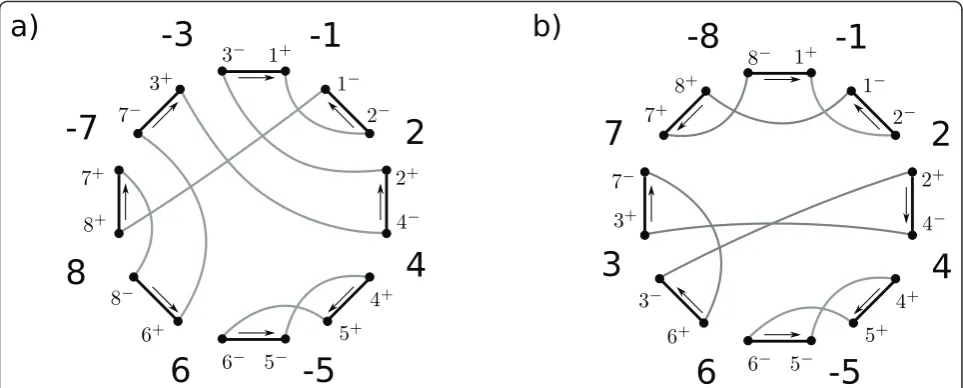
for alli and(πn+,π1−)–thedesireedges (also called gray edges). Figure 1(a) shows the breakpoint graph forπ= (-1 2 4-5 6 8-7-3). Note that every vertex has indegree 2 and outdegree 2, so the graph has a unique decomposi-tion into cycles of even length (alternating between rea-lity and desire edges).
A reversal r(i, j) is said to act on the reality edges
(πi±−1,πi±) and (πj±,πj±+1) because these are the only edges in the breakpoint graph of πthat are not in the graph ofπ○r(i, j). In Figure 1, the reversalr(6, 8) acts
on reality edges (3-, 1+) and (6+, 8-). Two reality edges on the same cycle are convergent if a traversal of their cycle visits each edge in the same direction in the circu-lar embedding; otherwise they aredivergent. The follow-ing definitions classify the action of a reversal on the cycles of the breakpoint graph [1].
Definition 1 (cycle-splitting reversal)A reversal that
acts on a pair of divergent reality edges splits the cycle to which the edges belong, so are called cycle-splitting reversals.
Conversely, no reversal that acts on a pair of conver-gent reality edges splits their common cycle. A reversal that acts upon a pair of reality edges in two different cycles merges the two cycles. The permutation of Figure 1(a) has 10 cycle-splitting inversions includingr(1, 2),r (4, 4), andr(6, 8). Notice that at most one cycle can be created by a reversal, yielding the inequality
d(π)≥n−c(π), (1) wherec(π) is the number of cycles in the breakpoint graph. Most cycle-splitting reversals are sorting reversals [15], but not all sorting reversals are cycle-splitting reversals, which indicates a gap between this lower bound and the reversal distance.
We must further explore structure in the permutation that allows us to predict the reversal distance when the lower bound is not realized.
Definition 2 (FCI [16]) Aframed common interval
(FCI) of a permutation (made circular by considering the first and last elements as being adjacent) is a substring of the permutation, as1s2 ...skb or-bs1s2...sk-a such that
•for each i, 1≤i≤k, |a| < |si| < |b|,and
Figure 1Two breakpoint graphs. The breakpoint graphs for a)π= (-1 2 4-5 6 8-7-3) and b)π○r(6, 8). The direction that reality edges are
•for each l, |a| <l< |b|,there exists a j with |sj| =l,
and
•it is not a concatenation of substrings satisfying the previous two properties.
So the substrings1s2...skis a (possibly empty) signed
permutation of the integers that are greater thanaand less thanb;aandb are theframeelements, while those of s1 ... sk aretrunk elements if they are not trunk
ele-ments of a smaller FCI. The framed interval is said to be common, in that it also exists as an interval (a(a+ 1) (a+ 2)...b) in the identity permutation.
A component of a permutation is comprised of the trunk elements of an FCI that are not trunk elements of a shorter FCI, plus the frame elements. The permutation of Figure 1(b) has three components: one framed by ele-ments 2 and 7, another framed by 4 and 6. The third is an interval in the circular sense, framed by elements 7 and 2 with the trunk comprised of elements 8 and 1; in the circular sense we have 7 < 8 < 1 < 2 here.
Definition 3 (bad component[16])Abad component
of a permutation is a component with at least 4 ele-ments, where the sign of every element is the same.
In Figure 1(b), the component (2 4 6 3 7) is bad. The existence of one or more bad components in a permuta-tion indicate exactly those situapermuta-tions where the lower bound cannot be met [1]. Siepel’s paper [10] describes in detail anO(n3) algorithm for finding the set of sorting reversals when bad components exist. While further exploration of Siepel’s characterization of sorting rever-sals in the presence of bad components could eventually lead to a worst-caseO(n2) algorithm, we do not address the issue here. Suffice it to say that the average-case complexity is O(n2) even when the trivial O(n3) algo-rithm –which in turn applies each of theO(n2) rever-sals and checks in linear time [17] if the distance has decreased–is used on permutations with bad compo-nents. The probability that a permutation chosen uni-formly at random has a bad component isO(n-2) [15,18] and we can detect the presence of bad components in linear time [16,17].
We focus on the bottleneck of sorting FCIs that do not correspond to bad components: cycle-splitting reversals that create bad components (cycle-splitting reversals that are not sorting reversals).
Definition 4 (bad reversal)Abadreversal is a
rever-sal that creates a bad component.
Definition 5 (unsafe reversal [1])Anunsafereversal
is a cycle-splitting reversal that is bad. In Figure 1(a), the reversalr(6, 8) is unsafe.
2.2 Outline
Known algorithms that list all sorting reversals check, one by one, if each of the potentiallyΩ(n2) cycle-splitting
reversals is unsafe by applying the reversal and then run-ning a linear time check as to whether it produced a bad (unoriented) component [9,10]. Instead of listing all cycle-splitting reversals and then checking them, we do the inverse: we predict which reversals may be unsafe (whether cycle-splitting or otherwise) and avoid listing them. We first characterize what we callominous sub-strings of the permutation, those subsub-strings that could be turned into a bad component with one reversal. Our algo-rithm searches for ominous substrings by doing the fol-lowing: for each element of the permutation we posit that it is a smallest element of a potential (after a reversal) bad component and continue by scanning the permutation to detect an ominous substring.
3 Ominous Substrings
Take any unsafe cycle-splitting reversal ron permuta-tionπ. Since it is unsafe, the permutationπ○rhas at least one bad component created by r. In this section we will show that there exists inπa particular pattern
– an ominous substring of π – indicating that r is unsafe. We first describe ominous substring of permuta-tions with a single component.
3.1 Permutations with a Single Component
A substring of a permutation isominousif and only if there exists some elementse and f such that the sub-string fits one of the following templates (or their reverse):
1. (eAX-f-B): whereA, -B, and X are substrings of the permutation.A has only positive while -B has only negative elements.
2. (eA-BCf): whereA, -B, andCare substrings of the permutation.A and Chave only positive while -B has only negative elements.
and A and B (and C if it exists) are comprised of exactly those elements with absolute valueifore<i<f.
Lemma 1 There is a one to one correspondence between bad reversals and ominous substrings.
ProofBy definition, there exists at least one reversal
that creates a bad component from an ominous sub-string. On the other hand, take a permutation π○ r that has a bad component –with frame elementseand f– created by the reversalr. Say that the elements of the bad component are positive, then e is on the left and f is on the right. Ifr includes both e andf, this implies that the bad component already exists in π, which is a contradiction. Now let us examine the other three possibilities. Ifrdoes not includeeandf, then the ominous substring in πcorresponds to template 2. If r includes only f, then the ominous substring inπ corre-sponds to template 1. Ifrincludes onlye, then the omi-nous substring in π corresponds to the reverse of template 1 where r acts upon the substring XBf (or equivalently, -A -eY, Y being the substring of π not matched by the reverse of template 1). If the elements of the bad component are negative then the negative analogue holds for each case. Since each ominous sub-string implies exactly one reversal dictated by theA, B, C, andX, we have the bijection.
3.2 Permutations with Multiple Components
We described ominous substrings on permutations with a single component. Since sorting reversals act only upon adjacencies in a single component [1], we adapt the techniques for single components to the case of multiple components in the following manner.
Consider a component of a permutation with some frame elements of a smaller FCI contained in it. We obtain the condensed version of the component by doing the following: for each smaller FCI contained in it, with pair of frame elements aand b (or -a and -b), we replace the FCI bya(resp. -a) and change the mag-nitudem of every element m>b in the component to be m- (b- a). The templates can be applied directly to the condensed component. For example, take the com-ponentC= (2 4 6 3 7) in Figure 1(b) where the compo-nent (4 -5 6) is contained in it. The condensed version ofCis (2 4 3 5). The condensed version of any compo-nent can be computed in linear time.
4 Detecting Ominous Substrings
We now turn to the task of detecting an ominous sub-string associated with a smallest elemente. The follow-ing methods can be adapted to detect the negative analogue of each template, so we only describe the detection of the templates as shown in Section 3.1. The general outline used in each of the following algorithms is the same: we visit the permutation starting with ele-mente, proceeding to element e+ 1, then e+ 2 and so on. At each step we maintain enough information to
check whether conditions that indicate we have found an ominous substring hold.
Call the set of elements that we visit through the first isteps Si(those with absolute value in the interval [e, e
+i]). Now consider the linearization of the circular per-mutation such that e is the leftmost positive element. To check for each template at step i (f= e+ i in this case) we maintain the indices of the following elements visited so far:
•Rightmost positive element: rp= max ({|π-1(|j|)| | jÎSi,j> 0})
•Leftmost positive element:lp = min ({|π-1(|j|)| |j ÎSi,j> 0})
•Rightmost negative element:rn= max ({|π-1(|j|)| | jÎSi,j> 0})
•Leftmost negative element: ln= min ({|π-1(|j|)| |j ÎSi,j> 0})
Template 1 (eAX-f-B) exists, with unsafe reversalr (rp+ 1,rn), if and only if the following conditions hold:
1.lp=π-1(|e|)
(eis the leftmost element visited) 2.ln>rp
(the negative elements are to the right of the positive)
3.rn-ln+rp-lp=i- 1
(the positive and negative elements are all contiguous)
4.π-1(|e+i|) =ln
(the last element visited is the leftmost negative element)
5.i≥3
(the FCI has at least 4 elements)
To check for template 2 we maintain another value neg= |{ j|jÎ Si, j< 0}|, the number of negative values
visited. We know that we have found template 2 (eA -BCf) with unsafe reversal r(ln, rn) if and only if all of the following conditions hold:
1.lp=π-1(|e|)
(eis the leftmost element visited) 2.ln>lp
(the negative elements are to the right of some positive)
3.rp>rn
(the negative elements are to the left of some positive)
4.rp-lp = i
(we have visited a contiguous substring) 5.rn-ln = neg- 1
6.π-1(|e+i|) =rp
(the last element visited is the rightmost element visited)
7.i≥3
(the FCI has at least 4 elements)
Note that if at some iterationiduring our scan condi-tions 1 or 2 for any of the templates are broken, we know thatecan no longer match that template.
5 The Algorithm
We begin by proving the following theorem.
Theorem 1For a permutation without a bad
compo-nent, there is an O(n2)algorithm for listing all sorting reversals.
Proof Use the methods of Section 4 to obtain a
blacklist of all ominous substrings associated with each possible smallest frame element e. Since the list of all ominous substrings associated with a single smallest frame element is obtained by a linear scan for all possible right endpoints f, the time to build the blacklist isO(n2). Each element of the list is associated with a bad reversal, the indices of which we mark in an n by n matrix; an entry r at row i and column j indicates that the bad reversal racts on elements from position i to position jin the permutation. Obtain the list of all cycle-splitting reversals in O(n2) time using the standard methods [1]. Finally, examine this list one reversal at a time, removing from the list any reversal that has a corresponding entry marked in the matrix.
The methods described so far are applicable to per-mutations with no bad components. Perper-mutations with bad components can be easily handled by combining our algorithm with that of Siepel [10] in the following way. First make a linear scan of the permutation to detect bad components [16,17]. If there are bad compo-nents, use theO(n3) algorithm of Siepel, otherwise, use our algorithm.
Theorem 2 Pick a signed permutation uniformly at
random, the expected time the above algorithm takes to list all sorting reversals is O(n2).
ProofThe probability of seeing a bad component in a
permutation taken uniformly at random from the set of all signed permutations is O(n-2) [15]. The bound fol-lows sincen3×n-2 <n2.
6 Empirical Results
We implemented our ominous substring algorithm in Java (code available from the authors upon request). Preliminary experiments were done comparing the per-formance of the Java implementation of Siepel’sO(n3) algorithm from the package baobabLuna [19] to our
average-case O(n2) algorithm. All tests were performed using a 2.16 GHz intel core 2 Duo processor with 1 GB of 667 MHz DDR2 SDRAM.
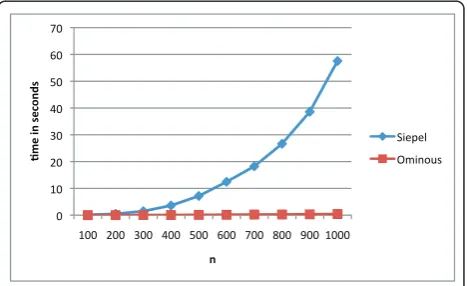
We generated permutations, chosen uniformly at ran-dom from the set of all signed permutations, with lengths ranging from n = 100 to n = 1000. For each value of n, 100 experiments were conducted and the average time was reported. Figure 2 shows the savings obtained by applying our new algorithm.
7 Conclusions
We presented the first quadratic time algorithm for list-ing all sortlist-ing reversals for a signed permutation. This pattern matching algorithm is simple in that it requires no special data structures. It is optimal in the sense that most permutations haveΩ(n2) sorting reversals [20,21] and since there exists the following family of permuta-tions that haveΩ(n2) unsafe reversals. Take a permuta-tion of lengthn= 2m(for anym) which is comprised of all the odd numbers positively oriented and in increas-ing order, followed by all the even numbers in decreas-ing order but negatively oriented:
(1 3 5. . .(n−3)(n−1)−n−(n−2). . .−6−4−2).
There are m - 2 reversals that are unsafe where 1 is the left endpoint of a bad component that is created, there are m- 3 reversals that are unsafe where 3 is the left endpoint of a bad component that is created, and so on. So there arem
i=2m−i∈θ(n
2)unsafe reversals for
the permutation of lengthn. This does not discount the possibility of an algorithm that runs in O(n+ k) time wherekis the number of sorting reversals, although it is currently unclear how to modify our algorithm to obtain this bound.
Figure 2 Running times. Average running times on random
8 Competing interests
The authors declare that they have no competing interests.
Acknowledgements
A preliminary version of this article appeared in the proceedings of WABI 2010. The authors would like to thank M.D.V. Braga for providing the Java source for the baobabLUNA software [19].
Author details
1Department of Mathematics and Statistics, University of Ottawa, Ontario,
K1N 6N5, Canada.2LaCIM, UQAM, Montréal Québec, H3C 3P8, Canada.3SITE,
School of Information Technology and Engineering, University of Ottawa, Ontario, K1N 6N5, Canada.4IRI - Mubarak city for Science and Technology,
University and Research District, P.O. 21934 New Borg Alarab, Alex, Egypt.
Received: 16 August 2010 Accepted: 19 April 2011 Published: 19 April 2011
References
1. Hannenhalli S, Pevzner PA:Transforming Cabbage into Turnip: Polynomial Algorithm for Sorting Signed Permutations by Reversals.J ACM1999, 46:1-27.
2. Bergeron A:A very elementary presentation of the Hannenhalli-Pevzner theory.Discrete Applied Mathematics2005,146(2):134-145.
3. Hannenhalli S, Pevzner P:Transforming mice into men (polynomial algorithm for genomic distance problems).Proc 36th Ann IEEE Symp Foundations of Comput Sci (FOCS’95)IEEE Press, Piscataway, NJ; 1995, 581-592.
4. Kaplan H, Shamir R, Tarjan R:Faster and simpler algorithm for sorting signed permutations by reversals.SIAM J Computing1999,29(3):880-892. 5. Kaplan H, Verbin E:Efficient data structures and a new randomized
approach for sorting signed permutations by reversals.Proc 14th Ann Symp Combin Pattern Matching (CPM’03), Volume 2676 of Lecture Notes in Computer Science, Springer Verlag, Berlin2003, 170-185.
6. Swenson KM, Rajan V, Lin Y, Moret BME:Sorting Signed Permutations by Inversions inO(nlogn) Time.Proc 13th Ann Int’l Conf Comput Mol Biol (RECOMB’09), Volume 5541 of Lecture Notes in Computer Science, Springer
2009, 386-399.
7. Tannier E, Bergeron A, Sagot MF:Advances on sorting by reversals.Disc Appl Math2007,155(6-7):881-888.
8. Tannier E, Sagot M:Sorting by reversals in subquadratic time.Proc 15th Ann Symp Combin Pattern Matching (CPM’04), Volume 3109 of Lecture Notes in Computer Science, Springer Verlag, Berlin2004, 1-13.
9. Ajana Y, Lefebvre JF, Tillier E, El-Mabrouk N:Exploring the set of all minimal sequences of reversals - An application to test the replication-directed reversal hypothesis.WABI‘02: Proceedings of the Second International Workshop on Algorithms in BioinformaticsLondon, UK: Springer-Verlag; 2002, 300-315.
10. Siepel A:An algorithm to find all sorting reversals.Proc 6th Ann Int’l Conf Comput Mol Biol (RECOMB’02)ACM Press, New York; 2002.
11. Lefebvre JF, El-Mabrouk N, Tillier E, Sankoff D:Detection and validation of single gene inversions.Proc 11th Int’l Conf on Intelligent Systems for Mol Biol (ISMB’03), Volume 19 of BioinformaticsOxford U Press; 2003, i190-i196. 12. Sankoff D, Lefebvre JF, Tillier ERM, Maler A, El-Mabrouk N:The Distribution
of Inversion Lengths in Bacteria.Proc 1st Workshop Comp Genomics (RECOMB-CG’04), Volume 3388 of Lecture Notes in Computer Science, Springer
2004, 97-108.
13. Baudet C, Dias Z:An improved algorithm to enumerate all traces that sort a signed permutation by reversals.SIGAPP‘10: Proceedings of the Twenty Fifth Symposium On Applied Computing2010.
14. Braga M, Sagot M, Scornavacca C, Tannier E:The solution space of sorting by reversals.Bioinformatics Research and Applications: Proceedings from ISBRA 2007, Springer2007.
15. Swenson K, Lin Y, Rajan V, Moret B:Hurdles hardly have to be heeded.
Proc 6th Workshop Comp Genomics (RECOMB-CG’08), Volume 5267 of Lecture Notes in Computer Science, Springer Verlag, Berlin2008, 239-249.
16. Bergeron A, Heber S, Stoye J:Common intervals and sorting by reversals: a marriage of necessity.Proc 2nd European Conf Comput Biol ECCB’022002, 54-63.
17. Bader D, Moret B, Yan M:A Linear-Time Algorithm for Computing Inversion Distance between Signed Permutations with an Experimental Study.J Comput Biol2001,8(5):483-491, [A preliminary version appeared in WADS’01, pp. 365-376].
18. Caprara A:On the tightness of the alternating-cycle lower bound for sorting by reversals.J Combin Optimization1999,3:149-182. 19. Braga MDV:baobabLUNA: the solution space of sorting by reversals.
Bioinformatics2009,25(14):1833-1835.
20. Yang Y, Székely LA:On the Expectation and Variance of Reversal Distance.Acta Univ Sapientiae, Mathematica2009,1:5-20.
21. Sankoff D, Haque L:The Distribution of Genomic Distance between Random Genomes.Journal of Computational Biology2006,13(5):1005-1012.
doi:10.1186/1748-7188-6-11
Cite this article as:Swensonet al.:Listing all sorting reversals in
quadratic time.Algorithms for Molecular Biology20116:11.
Submit your next manuscript to BioMed Central and take full advantage of:
• Convenient online submission
• Thorough peer review
• No space constraints or color figure charges
• Immediate publication on acceptance
• Inclusion in PubMed, CAS, Scopus and Google Scholar
• Research which is freely available for redistribution