Asian Journal of Pharmaceutical Research and Development
(An International Peer-Reviewed Journal of Pharmaceutical Research and Development)www.ajprd.com
ISSN 2320-4850
Research Article
INFLUENCE OF CASTING SOLVENT AND POLYMER ON
PERMEABILITY OF PROPRANOLOL HYDROCHLORIDE
THROUGH EUDRAGITRL100 AND EUDRAGIT RLPO FILMS
B.soujanya*, J.geethanjali, D.mounika,V.saikishore.
Department of Pharmaceutics, Bapatla College of Pharmacy, Bapatla-522101, India
Received: September 2014 Revised and Accepted: October 2014
ABSTRACT:
In the present work, eudragitL100and eudragitRLPO films were prepared and evaluated as rate controlling membrane for transdermal drug delivery systems. Dibutyl phthalate or propylene glycol at a concentration of 15w/w of the polymer was used as a plasticizer in the preparation of eudragitL100and eudragitRLPO films. Casting on mercury surface technique was employed for preparation of eudragitL100and eudragitRLPO films. The dry films were evaluated for physical appearance, water vapour transmission, drug diffusion and permeability coefficient. Both watervapour transmissions, drug diffusion rate followed zero-order kinetics. The mechanism of drug release was governed by peppas model. The diffusion exponent of releaseprofiles (slope) has a value of1.056-1.071 (n>1), which indicates supercase цtransport diffusion. The results obtained
in the present study thus indicate that the polymer and solvents used in the preparation of films have shown significant influence on thewater vapour transmission, drug diffusion and permeability of the films.
Keywords: polymer, solvents, watervapour transmissiondrug diffusion and permeability coefficient.
INTRODUCTION:
he development of transdermal drug delivery systems using polymeric materials has become popular for various reasons. Among various types of transdermal drug delivery systems developed, membrane controlledtype utilizes a thin polymeric film as a rate controlling membrane,which delivers the drug from the reservoir to the systemic circulation for an extended period of time. The permeability of drug through polymeric film dependent on characteristics of the polymer1- 2casting solvent3- 4and plasticizer5-6used.
Address for Correspondence: *Banavatsoujanya
Bapatlacollege of pharmacy, Bapatla, Guntur district, Pin- 522101. Andhra pradesh,
Mobile no: +91 9492525909 Email id: [email protected]
In the present work, eudragitL100 and eudragitRLPO films wereprepared and evaluated as rate controlling membranes for transdermal drug delivery systems. Propranolol hydrochloride7, which requires controlledrelease due to its short biological half life (3.9h), was used as a model drug.
EXPERIMENTL:
Materials and methods:
Propranolol hydrochloride was obtained as a gift sample from Natco Pharma; Hyderabad. Eudragit RLPO Natco Pharma; Hyderabad.
Eudragit RL100 (Himedia; Mumbai).
Acetone(Qualigens; Mumbai). Ethyl Acetate, Dichloromethane, Chloroform (S. D. fine-chem. Ltd.; Mumbai) Dibutyl Phthalate (Ranbaxy Laboratories; New Delhi) were obtained commercially. All materials were used as received.
Preparation of drug free fims:
Casting on mercury surface technique was employed in the present work for the preparation of Eudragit RL100and Eudragit RLPO films. In each case films were prepared using solutions of the polymer in various
solvents. Acetone, chloroform,
dichloromethane and ethyl acetate were used as solvents in the preparation of films. Dibutyl phthalate was included as a plasticizer in the preparation films at a concentration of 15% w/w of the polymer (or 8% w/v of the polymer solution) .8 ml of the polymer solution was poured in a glass bangle (6.4 cm diameter) placed on a mercury surface. The rate of evaporation was controlled by inverting a funnel over the Petri plate. After 24 hours the dried films were taken out and stored in a desiccator.
Evaluation of transdermal films:
All the films prepared were evaluated for Physical Appearance, Thickness uniformity,
Folding Endurance, Water vapour
Transmission and Drug Diffusion Study and Permeability Coefficient. The thickness of the films was measured by a ‘dial caliper’. The
mean of the five observations were calculated. The folding endurance was measured manually for the prepared films. A strip of film (2x2 cm) was cut evenly and repeatedly folded at the same place till it broke. The number of times the film could be folded at the same place without breaking gave the exact value of folding endurance8.
For the study of water vapour transmission (WVT) rate, vials of equal diameter were used as transmission cells. These cells were washed thoroughly and dried in an oven. About 1.0 g of Calcium chloride was taken in the cell and the polymeric films measuring 3.14 Cm2 area were fixed over the brim with the help of an adhesive. The cells were weighed accurately and initial weight is recorded, and then kept in a closed desiccator containing saturated solution of KCl (about 200 ml.). The humidity inside the desiccator was measured by a hygrometer, and it was found to be in between 80 –90 % RH. The cells were taken out and weighed after 18, 36, 54 and 72h.
From increase in weights the amount of water vapour transmitted and the rate at which water vapour transmitted were calculated by using the following formula9.
S WL (W.V.T) Rate
on Transmissi Vapour
Water
Where, W= Water vapour transmitted in gms.
L= Thickness of the film in cm.
S= Exposed surface area in cm2 .
Drug diffusion study10:
Drug diffusion study was conducted using Franz diffusion cell. The receptor compartment was filled with 15 ml of phosphate buffer having pH 7.4 as diffusion media. Polymeric film was mounted on the donor compartment with the help of an adhesive. 10 ml of the 0.25% W/V of drug solution was poured into the donor compartment. Magnetic stirrer was set at 100 rpm and whole assembly was maintained at 37 + 2 0C. The amount of drug released was determined by withdrawing 1 ml of sample at regular time intervals for 3 hours. The volume withdrawn was replaced with equal volume of fresh buffer solution. Samples were analyzed
for drug content using a U V
spectrophotometer at 290 nm11.
Permeability Coefficient:
From the drug diffusion data the Permeability Co efficient for various films was calculated using the equation
A H K Pm app.
Where, Kapp= Diffusion rate constant (mg/h)
calculated from the slope of the linear drug
(d/p) diffusion profiles. H = Thickness of the
film (cm), A = Surface area of the film (cm2).
equation,is LnQ=LnQ0-k1t,where k1is the release rate constant andHiguchi. Equation,Q=k2t1/2, where Q is the amount of drug releaseat time t, and k2 isthe diffusion rate
constant. The diffusion data was
furtheranalyzed to define the mechanismof drug release by applying the diffusion data
following the empirical
equation,M1/Mœ=ktn,whereMt/Mœ is the
fraction of the drug released at timet, K is a constant and n characterizes of the mechanism of drug release from the formulations during diffusion process.
Statistical Evaluation:
The relevance of difference in the in-vitro diffusion rate profile was evaluated statistically. The data were tested by one way analysis of variance (P<0.05) (ANOVA).
Skin Irritation Test:
A primary skin irritation test was performed on six healthy rabbits, weighing between 2 to 3.5 kg. The patch of area 3.14cm2was used as a test patch. The dorsal surface of rabbits was cleared well and the hair was removed by using a depilatory preparation. The skin was cleared with rectified spirit. The transdermal film was placed on the dorsal surface of the abdominal skin with the help of an adhesive tape. The patches were removed after 24 hr and the skin was examined for erythema and edema.
RSULTS AND DISCUSSION:
In the present work, Eudragit RL100 and Eudragit RLPO films showed good film forming properties. The method of casting on mercuric surface was found to be giving thin uniform films. The films prepared with polymer alone were found to be brittle. To prevent embrittlement a plasticizer, dibutyl phthalate was tried at various concentrations ranging from 5-15% w/w of the polymer. Preliminary experiments indicated that lower concentrations of dibutyl phthalate were found to give rigid and brittle films where as higher concentrations gave soft films. Dibutyl phthalate at a concentration of 15% w/w of the polymer was found to give good flexible films
dibutyl phthalate was included as a plasticizer in the preparation of eudragitL100, eudragitRLPO films at a concentration of 15%w/w of the polymer
All the films prepared were evaluated for uniformity of thickness, folding endurance, water vapour transmission and drug diffusion and permeability characteristics. Thickness measurements of films prepared in various solvents are given in table 1. Low standard deviation values in the film thickness measurements ensured uniformity of thickness in each film. The method of casting on mercuric surface was found to be given reproducible results with regard to film thickness. The folding endurance was measured manually and folding endurance was found to be high in Eudragit RLPO films compared with Eudragit RL100 films. Folding endurance is decreased in the order of films in various solvents is as follows.
Water vapour transmission studies indicated that all the films prepared (both Eudragit RL100 and Eudragit RLPO) were permeable to water vapour. Water vapour transmission throughthe films followed zero order kinetics. The results are given in table 2.And shown in fig1 and 2.The water vapour transmission (Q) was more in the case of cellulose acetate films when compared to ethyl cellulose. Water vapour transmission values indicating that the cellulose acetate films were more permeable to water vapour. The rate of water vapour transmission was decreased in the order of films in various solvents is as follows.
Ethyl acetate > acetone> dichloromethane> chloroform.
Drug diffusion through various films were studied with propranolol hydrochloride as a model drug by using Franz diffusion cell.
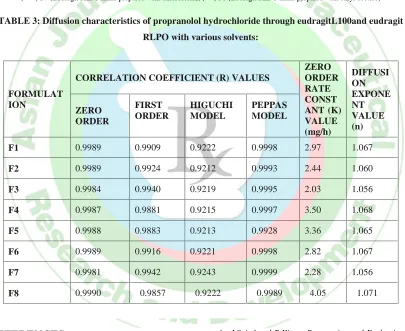
exponent of release profiles (slope) has a value of 1.056-1.071 (n>1), which indicates super case II transport diffusion13. Permeability coefficient values (Pm) of the films towards the propranolol hydrochloride was calculated from the drug diffusion data and the results were given in table 3. The rate of permeability coefficient was decreased in the order of films in various solvents is as follows.
Ethyl acetate > acetone> dichloromethane>
chloroform.
The relevance of difference in the in-vitro diffusion rate profile was evaluated statistically. Statistical analysis by using One-way analysis of variance (P<0.05) proves that films prepared with various polymers and casting solvents have significant difference in diffusion of Proponolol Hydrochloride. Skin Irritation studies were conducted according to
the procedure described earlier. The examination of applied area indicated neither erythema nor edema. Hence it was concluded that the transdermal gels were free from skin irritation. The results obtained in the present study thus indicated that the solvent used has significant influence on the water vapour transmission, drug diffusion and permeability of the films.
Shown high Permeability coefficient values (Pm) of the Eudragit RLPO films towards the propranolol hydrochloride was high when compared to the Permeability coefficient values of Eudragit RL100 films. Among all the films, Eudragit RLPO films prepared with Ethylacetate shown high Permeability when compared to other films. Among all the films, Eudragit RLPO films prepared with Ethylacetate Permeability when compared to other films.
Table 1: Mechanical Properties of Transdermal Films:
POLYMER FORMULATION CASTING
SOLVENT
THICKNESS FOLDING ENDURANCE
E
U
D
R
A
G
IT
R
L
1
0
0
F1 Acetone 37.8 111
F2 Dichloromethane 40.2 107
F3 Chloroform 37.0 105
F4 Ethyl Acetate 39.6 136
E
U
D
R
A
G
IT
R
L
P
O F5
Acetone 28.0 120
F6 Dichloromethane 41.4 110
F7 Chloroform 42.8 116
Table 2: Mechanical Properties of Transdermal Films:
POLYMER FORMULATION CASTING SOLVENT WATER VAPOUR TRANSMISSION
,(Qgm/cm2.24h)
Permeability coefficient (Pm x 10 mg/cm.hs )
EUDRAGIT
RL100
F1 Acetone
3.1419 8.218
F2 Dichloromethane
3.14942 8.685
F3 Chloroform
2.2624 7.957
F4 Ethyl Acetate
3.960 8.613
EUDRAGIT
RLPO
F5 Acetone
2.478 6.061
F6 Dichloromethane
3.0454 8.996
F7 Chloroform
2.7806 9.205
F8 Ethyl Acetate
3.915 8.201
0 0.1 0.2 0.3 0.4 0.5 0.6 0.7 0.8 0.9 1
0 10 20 30 40 50 60 70 80
Time(hr)
A
m
ou
nt
o
f
w
at
er
v
ap
ou
r
tr
an
sm
itt
ed
(g
)
Fig.1: Water VapourTransmission Profiles of Eudragit RL100 Films Casted With Various Solvents
(-♦-) F1 (Eudragit RL100 films prepared with acetone) , (-■-) F2 (Eudragit RL100 films prepared with dichloromethane) (-▲-) F3 (Eudragit RL100 films prepared with chloroform), (-×-) F4 (Eudragit RL100 films prepared with ethyl acetate)
0 0.2 0.4 0.6 0.8 1 1.2
0 10 20 30 40 50 60 70 80
Time(hr)
A
m
ou
nt
o
f w
at
er
v
ap
ou
r
tr
an
sm
itt
ed
(g
)
Fig 2 Water VapourTransmission Profiles of Eudragit RLPO Films Casted With Various Solvents
-2 0 2 4 6 8 10 12
0 0.5 1 1.5 2 2.5 3 3.5
Time(h)
A
m
ou
nt
o
f p
ro
po
no
lo
l
hy
dr
oc
hl
or
id
e
di
ffu
se
d
(m
g)
Fig 3: Diffusion Profiles of Propronolol Hydrochloride through Eudragit RL100 Films Prepared With Various Solvents
(-♦-) F1 (Eudragit RL100 films prepared with acetone),(-■-) F2 (Eudragit RL100 films prepared with dichloromethane) (-▲-) F3 (Eudragit RL100 films prepared with chloroform), (-×-) F4 (Eudragit RS 100 films prepared with ethyl acetate)
(♦-) F5 (Eudragit RLPO films prepared with acetone), (-■-) F6 (Eudragit RLPO films prepared with dichloromethane) (-▲-) F7 (Eudragit RLPO films prepared with chloroform), (-×-) F8 (Eudragit RLPO films prepared with ethyl acetate)
TABLE 3: Diffusion characteristics of propranolol hydrochloride through eudragitL100and eudragit
RLPO with various solvents:
FORMULAT ION
CORRELATION COEFFICIENT (R) VALUES
ZERO ORDER RATE CONST ANT (K) VALUE (mg/h)
DIFFUSI ON EXPONE NT VALUE (n) ZERO
ORDER
FIRST ORDER
HIGUCHI MODEL
PEPPAS MODEL
F1 0.9989 0.9909 0.9222 0.9998 2.97 1.067
F2 0.9989 0.9924 0.9212 0.9993 2.44 1.060
F3 0.9984 0.9940 0.9219 0.9995 2.03 1.056
F4 0.9987 0.9881 0.9215 0.9997 3.50 1.068
F5 0.9988 0.9883 0.9213 0.9928 3.36 1.065
F6 0.9989 0.9916 0.9221 0.9998 2.82 1.067
F7 0.9981 0.9942 0.9243 0.9999 2.28 1.056
F8 0.9990 0.9857 0.9222 0.9989 4.05 1.071
REFERENCES:
1. S.J.Lee and S.W.Kim,Temperature and pH-Response Swelling Behavior of poly(2-ethyl-2-oxazoline)/Chitosan Interpenetrating polymer Network Hydrogels,J.control release,1987, 82:3 2. H.Arwidson and Johanson Application of Intrinsic
Viscosity and Interaction Constant as a formulation Tool for Film Coating.Int.J.Pharm.,1991,76;91. 3. S.S.M.Abdul Aziz and W.Anderson the Influence of
Casting Solvent Composition on Copolymer Films. Structure and Permeability of Acylic-Methacrylic Ester Copolymer Films.J.Pharm.Pharmacol. 1976, 28(11), 801.
4. J.Spitel and R.Kinget Preparation and Evaluation of Free Films: Influence of and Solvent Composition of Method of Preparation upon the Permeability, Pharma. Act Helv. 1977, 52(3), 47.
5. R.R.Crawford and O.K.Esmerin,Effect of Plasticizers on some physical properties of Cellulose Acetate Phthalate Films,J.Pharm.Sci.,1971,60,312 6. J.Spitael and R.Kinget, Preparation and Evaluation
of Free Films: Influence of Plasticizer and Filler upon the permeabilityPharma. ActHelv. 1977, 52(5), 106.
7. F.Murad In;A.G.Gliman,W.T.Rall,S.A.Nies and P.Taylor.Eds.,Good man and Gilman’s of
International, McGraw Hill Co.,Inc.,Newyork,1996;762.
8. R.Khuran, A.Ahuja and R.K.Khar, Development and Evaluation of Mucoadhesive Films of Miconazole Nitrate, Indian.J.Pharm.sci, 2000, 62(6), 447. 9. R.Kulkani, H.Doddayya, S.Marihal, C.Patil and
P.Habbu, Comparative Evaluation of Polymeric Films for Transdermal Applications. Eastern Pharmacist, 2000, 43,109.
10. K.L.K.Paranjyothy and P.P Thampi,Development of Transdermal Patches of Verapamil Hydrochloride using sodium Carboxymethyl Guar as a Monolithic
Polymeric Matrix and their in- vitroRelease Studies.Indian J.Pharm.Sci, 1997,52(2), 49.
11. Indian Pharmacopoeia, Vol, 4thEdn, The Controller of Publications, New Delhi, 1996; 54.
12. C.J.Salmon,S.A.Bravo and M.A.Lamas,in-vitro Studies of Diclofenac Sodium Controlled- release from Biopolymeric Hydrophilic Matrices,J.Pharm.Pharmaceut Sci.,2002, 5(3): 213. 13. DonaldL.Wise, Hand Book of Pharmaceutical