GSJ: Volume 6, Issue 10, October 2018, Online: ISSN 2320-9186
www.globalscientificjournal.com
S
OLVING
E
CONOMIC
L
OAD
D
ISPATCH
P
ROBLEM
W
ITH
V
ALVE
P
OINT
LOADINF
EFFECT
USING
WHALE
OPTIMIZATION ALGORITHM
INTEGRAT-ED WITH
L
OACAL
S
EARCH
D
ETERMINISTIC
T
ECHNIQUES
Bilal Alam, Muhammad Naeem Arbab
Bilal Alam is currently pursuing master’s degree program in electric power engineering at University of Engineering & Technology Peshawar, Pakistan
E-mail: [email protected]
Co-Author name is Prof.Dr.Muhammad Naeem Arbab and is Professor in Department of Electrical Engineering at University of Engi-neering & Technology Peshawar, Pakistan.
Email: [email protected]
KeyWords
Active Set, Economic Load Dispatch, Evolutionary Programming, Improved Tabu search Algorithm, Interior
Point Algorithm, Modified Ant Colony Optimization Algorithm, Sequential Quadratic Programing, Valve Point
Loading Effect, Whale Optimization Algorithm.
ABSTRACT
To resolve the complicated problems of ELD a lot of work has been done in this area. Researchers utilized diverse intelligence algorithms & tried to decipher these complications around the globe. The exploration work by the researchers which they did in the area of Economic Load Dispatch is presented as follow.
Whale Optimization Algorithm has been applied to solve the complex problem of Economic Load Dispatch for reducing the price of fuel for electrical power generation.*1+. The deterministic methods such as lambda iteration, Gauss Jacobi etc. often fails to give global optimum results for Economic Load Dispatch problems. Different optimization problems are used for optimization in recent researches. An optimiza-tion problem may perform well in one optimizaoptimiza-tion problem but may not perform well in the other one. This statement is based on No Free Lunch theorem *2+. Considering the effects of valve point of modern generators another algorithm named Improved Tabu Search Algorithm for (iii), (vi) and (xiii) generators system is employed *3+ . The problem of economic dispatch is associated with some major problems. If we try to decrease the cost of fuel, we get an increase in emission of gases into our atmosphere and if we try to decrease the level of emission of gases into our surrounding atmosphere that results in very high prices of fuel and these problems cannot be solved simultaneously. With emission constrained this study is thus itemised mainly to lessen total fuel cost. Six generator system is analysed through Modified Ant Col-ony Optimization algorithm *4+. The inspiration of this algorithm are ants. Ants search for their food randomly. While searching for their food they leave traces for their fellow ants to follow them by dropping pheromone in their exploration track for their food. In this way other ants trail pheromone which clues them to their fellow ants and consequently to their food. Another algorithm is suggested called Modified Ant Colony Optimization algorithm for further refining of the obtained results. As compared to some other optimization problems seen or rec-orded in literature like the most common genetic algorithm and particle swarm optimization etc. this new modified Ant Colony Optimization algorithm technique resulted in much competitive results in economic dispatch problems. Another method for solving the conventional problems of economic dispatch is the Evolutionary Programming which is an effective optimization tool *5+. Slight amendments are done to elementary approaches that caused amplified convergence speed and consequently resulted in reduced calculating duration. The amend-ments done are divided in two fragamend-ments. For the amendment of first fragment scale cost has been adopted while for the amendment of second fragment Empirical learning rate is amendment technique in use. Gravitational Search Algorithm which is a new investigative meth-od of optimization problems is brought into use for analysing CEELD *6+. Four test systems are analysed using the proposed technique. Eco-nomic Load Dispatch problem is resolved by means of PSO *7+. But one problem with PSO is that it sticks in local optima and consequently resulting in premature convergence which is a problem of serious concern. For this reason, PSO is integrated with time variable acceleration coefficients. By the aforesaid integration the premature convergence is avoided results in global optimum.
2.
Characteristic Functions
2.1.
Economic Load Dispatch
Economic Load Dispatch schedules power generation of different power generators connected in an interconnected power system and gives an optimized cost of generation i.e. fuel cost and also fulfils the constraints that are associated with power systems. The expression of fuel cost in mathematical form can be written as.
(1)
Looking into above written equation NG shows total generating units. The coefficients for the fuel cost are represented by , the electrical power generated by each generator is shown by Pi and at the last FWOV(P) shows total fuel cost of electrical power generators in
dollars per hour or can also pe shown in rupees per hour. Recent advancement in technologies in the field of valves opening and closing according to power demend can be shown by adding a sinusoidal term in equation (1) and is shown below in equation (2). This sinusoidal term is called valve point loading effect.
(2)
2.2.
ELD Constraints
a.
Equality Constraint Of ELD
The electrical power generated by generators in a power generation station should meet the load demand of consumers and the transmission losses associated with power system. Another term which is often used for equality constraint is power balance con-straint. The expression for this constraint can me written in mathematical form as.
(3)
In the above expression PD shows the power requirement of consumers while PL represents the line losses. PL in above expression is considered zero in this research work.
b.
Inequality Constraint Of ELD
One more constraint associated with power system is the inequality constraint which states that each generator unit should generate with in its lower and upper bounds. It is often also called generation capacity constraint.
(4)
Pmin and Pmax are the generation limits defined for each generator.
3.
ELD problem solution through WOA
Different real world problems are solved through optimization techniques. One such real world problem is the Economic Load Dispatch. In this research work Whale Optimization Algorithm is used to solve the problem of Economic Load Dispatch [1]. Further WOA is hybridized with Sequential Quadratic Programing, Active Set and Interior Point Algorithm in order to further optimize results. Whales are very beauti-ful and intelligent creatures. The main cause of their intelligence is the spindle cells. Whales have much more spindle cells in brain than a full grown human. Whales have got a very unique way of hunting. Their hunting method is known as Bubble net hunting method. Hump-back whales feed on pray that are mostly near the surface of water i.e. krill & small fish. HumpHump-back whales dive around 12 meters in water and then starts to move towards the surface of water i.e. prey in an upward spiral of shape 9 and also creates bubbles while moving in this trajectory.
The following equations describes the positions changed by whales once the best agent or target prey is identified and All the remaining whales will update their position according to best search agent once defined.
Ⅾ
⃗⃗⃗⃗ = |С. 𝛸(𝑡) − 𝛸(𝑡)| (5)
𝛸(𝑡 + 1) = 𝛸(𝑡) − 𝐴.Ⅾ (6)
Looking into above equation ‘t’ is used for existing iteration, the coefficients vectors are represented by A and С. The situation vector of the
best result is represented by Χ*, X symbolises the situation vector. In each iteration X* is updated if there is a better solution present. The
expressions for vectors A & C are written as.
that with the the help of capricious vector ‘r’ any position or location can be reached while searching for prey. For mathematical modelling of the approach used by humpback whales i.e. bubble net feeding methods two methods are discussed and are presented as follow.
3.1.
Shrinking Surrounding:
This approach is achieved by reducing ‘a’ in equation 7. The decrease in ‘a’ also effects the value of A causing it to reduce its range. Fresh locality can be established anyplace among the prevailing finest agent locality and original locality of the search agent by describing capri-cious values of A in [-1, 1].
3.2.
Spiral Updating:
In this approach amid the locality of target and whale a spiral equation is created to reproduce the helix formed motion of whales.
(𝑡 + 1) = ⃗⃗⃗ . . 2 + ⃗⃗⃗⃗ (𝑡) (9)
= | ⃗⃗⃗⃗ (𝑡) − (𝑡)| postulates the distance amid ith whale and the prey, the profile of logarithmic spiral is defined by ‘c’ which is a con-stant, ‘l’ is a capricious figure in *-1, 1].
Humpback whales updates their localities towards the prey in spiral fashioned path and in shrinking approach at the same time. So we take
chance that there is fifty percent possibility of either approach and is shown below in mathematical form.
(𝑡 = 1) = { ⃗⃗⃗⃗⃗⃗ (𝑡) − 𝐴. .
⃗⃗⃗ . . 2 + ⃗⃗⃗⃗ (𝑡) . (10)
‘h’ designates a capricious figure in *0, 1+.
Humpback whales also hunt haphazardly. Consequently, by varying value of 𝐴 chase for target is completed. In order to make humpback
whales move away from a whale capricious values greater than one or less than ‘-1’ are to be used.
⃗⃗ = | . ⃗⃗⃗⃗⃗⃗⃗⃗ − | (11)
(𝑡 + 1) = ⃗⃗⃗⃗⃗⃗⃗⃗ − 𝐴 . ⃗⃗ (12)
WOA starts with a set of capricious results. In each repetition humpback whales update their localities w.r.t either a capricious whale or the prevailing finest result depending upon the value of 𝐴 1 or 𝐴 1. Similarly, reliant upon the value of ‘h’ WOA change between spiral or circular approach. Lastly, WOA is ended after meeting a termination criteria.
4.
Model Results
4.1.
Three Generators System
Units (MW) NO VPLE VPLE
Superlative Middling Poorest Superlative Middling Poorest
Unit i 398.991169 482.379308 325.792619 299.597265 403.329790 600.000000
Unit ii 335.534286 260.432851 324.207381 400.000000 246.670210 100.000151
Unit iii 115.474545 107.187841 200.000000 150.402735 200.000000 149.999849
PD 850 850 850 850 850 850
Fuel Charge 8194.630467 8218.549683 8230.811687 8234.445424 8305.924172 8386.799056
Table 1. Outcomes of WOA for Three Generators System (Total Power =850 MW)
(a) (b)
Fig. 1. WOA Convergence curves (a) No VPLE (b) VPLE.
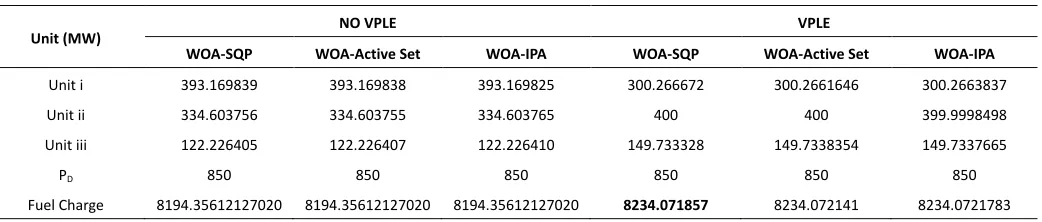
The results obtained were fed to local search methods like sequential quadratic programing, active set and interior point algorithm. The hybridization was performed for both with the effects of valve point loading and without the effects of valve point loading. The results are presented in below Table 2 for three generators system in terms of fuel charge. As can be seen in Table 2 hybridization resulted in almost same results i.e. 8194.35612127020 for the case of neglecting the effects of valve point loading while in case of with the effects of valve point loading WOA when combined with Sequential Quadratic programing presented improved result i.e. 8234.071857. The graphs of con-vergence for the hybridized results are shown below in Figures.
Table 2. Outcomes of Hybridized schemes of WOA with Some Deterministic techniques for three generators system.
Unit (MW) NO VPLE VPLE
WOA-SQP WOA-Active Set WOA-IPA WOA-SQP WOA-Active Set WOA-IPA
Unit i 393.169839 393.169838 393.169825 300.266672 300.2661646 300.2663837
Unit ii 334.603756 334.603755 334.603765 400 400 399.9998498
Unit iii 122.226405 122.226407 122.226410 149.733328 149.7338354 149.7337665
Fig. 2(a). WOA-IPA Convergence curves of hybridized scheme rejecting VPLE.
Fig. 2(c). WOA-SQP Convergence curves of hybridized scheme rejecting VPLE.
4.3.
Thirteen Generators Systems
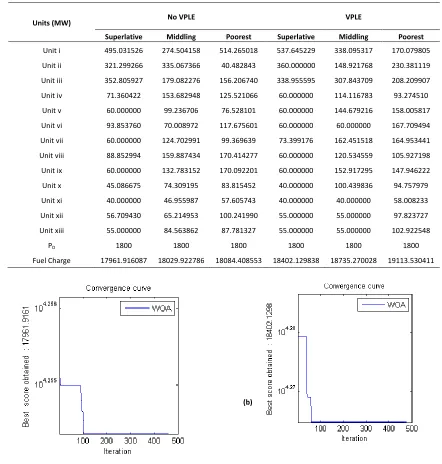
In this test system for the power requirement of 1800 MW the required coefficients for fuel cost and the minimum and maximum generation limits of generators are obtained from [6]. The losses associated with power transmission are over-looked for the three generators test system situation. The test system is analysed for the effects of VPL as well as without the effects of VPLE. The WOA is executed for 500 iterations in each independent run. The number of independent were kept 20. While executing the algorithm for without the effects of VPL the search agents were kept 13500 while for including the effects of VPL the search agents were kept 27000 respectively. The results obtained using WOA for the aforesaid pa-rameters are presented in Table 3 in the form as superlative, middling and poorest and fuel charge. The superlative results of WOA for the above stated parameters defined for thirteen generators system are also shown with convergence charac-teristics curve shown in Fig. 4 for both with the effects of valve point loading and without the effects of loading.
Table 3. Outcomes of WOA for Thirteen Generators System (Total Power =1800 MW)
Units (MW) No VPLE VPLE
Superlative Middling Poorest Superlative Middling Poorest
Unit i 495.031526 274.504158 514.265018 537.645229 338.095317 170.079805
Unit ii 321.299266 335.067366 40.482843 360.000000 148.921768 230.381119
Unit iii 352.805927 179.082276 156.206740 338.955595 307.843709 208.209907
Unit iv 71.360422 153.682948 125.521066 60.000000 114.116783 93.274510
Unit v 60.000000 99.236706 76.528101 60.000000 144.679216 158.005817
Unit vi 93.853760 70.008972 117.675601 60.000000 60.000000 167.709494
Unit vii 60.000000 124.702991 99.369639 73.399176 162.451518 164.953441
Unit viii 88.852994 159.887434 170.414277 60.000000 120.534559 105.927198
Unit ix 60.000000 132.783152 170.092201 60.000000 152.917295 147.946222
Unit x 45.086675 74.309195 83.815452 40.000000 100.439836 94.757979
Unit xi 40.000000 46.955987 57.605743 40.000000 40.000000 58.008233
Unit xii 56.709430 65.214953 100.241990 55.000000 55.000000 97.823727
Unit xiii 55.000000 84.563862 87.781327 55.000000 55.000000 102.922548
PD 1800 1800 1800 1800 1800 1800
Fuel Charge 17961.916087 18029.922786 18084.408553 18402.129838 18735.270028 19113.530411
(a) (b)
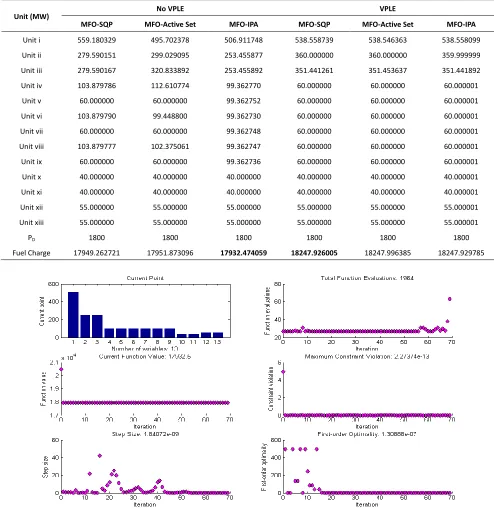
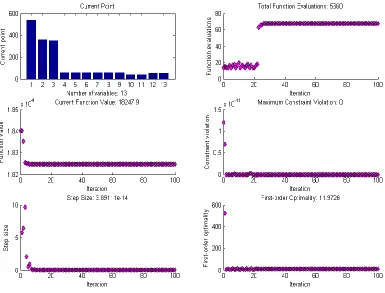
The results obtained were fed to local search methods like sequential quadratic programing, active set and interior point algorithm. The hybridization was performed for both with the effects of valve point loading and without the effects of valve point loading. The results are presented in below Table 4 for thirteen generators system in terms of fuel charge. As can be seen in Table 4 hybridization with IPA resulted in improved result i.e. 17932.474059 for the case of neglecting the effects of valve point loading while in case of with the effects of valve point loading WOA when combined with Sequential Quadratic programing presented improved result i.e. 18247.926005. The graphs of con-vergence for the hybridized results are shown below in Figures.
Table 4. Outcomes of Hybridized schemes of WOA with Deterministic techniques for thirteen generators system.
Unit (MW) No VPLE VPLE
MFO-SQP MFO-Active Set MFO-IPA MFO-SQP MFO-Active Set MFO-IPA
Unit i 559.180329 495.702378 506.911748 538.558739 538.546363 538.558099
Unit ii 279.590151 299.029095 253.455877 360.000000 360.000000 359.999999
Unit iii 279.590167 320.833892 253.455892 351.441261 351.453637 351.441892
Unit iv 103.879786 112.610774 99.362770 60.000000 60.000000 60.000001
Unit v 60.000000 60.000000 99.362752 60.000000 60.000000 60.000001
Unit vi 103.879790 99.448800 99.362730 60.000000 60.000000 60.000001
Unit vii 60.000000 60.000000 99.362748 60.000000 60.000000 60.000001
Unit viii 103.879777 102.375061 99.362747 60.000000 60.000000 60.000001
Unit ix 60.000000 60.000000 99.362736 60.000000 60.000000 60.000001
Unit x 40.000000 40.000000 40.000000 40.000000 40.000000 40.000001
Unit xi 40.000000 40.000000 40.000000 40.000000 40.000000 40.000001
Unit xii 55.000000 55.000000 55.000000 55.000000 55.000000 55.000001
Unit xiii 55.000000 55.000000 55.000000 55.000000 55.000000 55.000001
PD 1800 1800 1800 1800 1800 1800
Fig 6 WOA-SQP Convergence curves of hybridized scheme comprising VPLE.
5.
Conclusion
Whale Optimization Algorithm is inspired from the unique hunting method of humpback whales observed only in humpback whales. In this research work Whale Optimization Algorithm was tested on different test systems with different parameters and also hybrid-ized schemes with some local search techniques were used. Problems with Constraints such as power expectation, the reactive pow-er flow etc. can be solved with the proposed algorithm in future works and in many othpow-er optimization fields.
References
[1] Mirjalili, Seyedali, and Andrew Lewis. "The whale optimization algorithm." Advances in Engineering Software 95 (2016): 51-67.
[2] Mirjalili, Seyedali. "Moth-flame optimization algorithm: A novel nature-inspired heuristic paradigm." Knowledge-Based Systems 89 (2015): 228-249. [3] K. Senthil and K. Manikandan, "Economic thermal power dispatch with emission constraint and valve point effect loading using improved tabu search
algorithm," International Journal of Computer Applications, vol. 3, pp. 6-11, 2010.
[4] R. Gopalakrishnan and A. Krishnan, "An efficient technique to solve combined economic and emission dispatch problem using modified Ant colony optimization," sadhana, vol. 38, pp. 545-556, 2013.
[5] N. Sinha, R. Chakrabarti, and P. Chattopadhyay, "Evolutionary programming techniques for economic load dispatch," IEEE Transactions on evolutionary computation, vol. 7, pp. 83-94, 2003.
[6] U. Güvenç, Y. Sönmez, S. Duman, and N. Yörükeren, "Combined economic and emission dispatch solution using gravitational search algorithm," Scientia Iranica, vol. 19, pp. 1754-1762, 2012.