Kusuma. R et al., J. Sci. Res. Pharm. 2015, 4(1), 48-54
Journal of Scientific Research in Pharmacy
Research Article
Available online through
ISSN: 2277-9469
www.jsrponl
ine.com
Evaluation of Ipomoea Batata Starch as an Aiternative Tablet Excipient to Maize and Potato Starch:
Assessment by Preformulation and Formulation Studies
Kusuma. R1*, Venkat Reddy. P2, Samba Shiva Rao. A3
1Department of Pharmacognosy and Phytochemistry, Bojjam Narsimhulu College of Pharmacy, Hyderabad, Telangana, INDIA. 2Department of Pharmaceutical Analysis, Pratap Narender Reddy College of Pharmacy, RR District, Telangana, INDIA.
3Department of pharmaceutics, Sri Indu Institute of Pharmacy, Ibrahimpatnam, RR District, Telangana, INDIA.
Received on: 23-02-2015; Revised and Accepted on: 26-03-2015
ABSTRACT
S
tarch isolated from Ipomoea batata plant was studied as an alternative pharmaceutical excipient to maize&potato starch. The Ipomoea batata starch has been evaluated by series of tests as mentioned in Indian Pharmacopoeia before being used for evaluation. It was tested along with maize and potato starch as an alternative excipient by performing battery of preformulation and formulation tests. The results obtained for Ipomoea batata starch were comparable with maize and potato starch and the Ipomoea batata starch can be used as a pharmaceutical excipient in tablets preparation.Keywords: Ipomoea Batata, Starch, Binder, Excipient, Maize Starch, Potato Starch.
INTRODUCTION
V
ery often a drug is rarely administered in its original form. Most of the times a convenient dosage form is made using a formulation, which contains a number of excipients. Excipients are non-drug components of formulation pharmaceutical ingredients and are added to ensure acceptability, physicochemical stability during the shelf life, uniformity of composition, dosage and optimum bioavailability and functionability of the drug product. Despite their inertness and utility in the dosage form, excipients can influence absorption of drugs. Excipients used in the pharmaceutical industry includes diluents or fillers, binders or adhesives, disintegrants, lubricants, glidants or flow promoters, colors, flavors, sweeteners etc. All the excipients used in pharmaceutical industry should be acceptable to regulatory agencies, chemically stable and freeform viable micro-organisms including pathogens [1].Starch is a polysaccharide, widely used as binder, diluent, glidant and disintegrating agent in oral solid dosage formulations and also as dusting powder and lubricant. Commercially starch is obtained from maize (Zea mays), potato (Solanum tuberosum), rice (Oryza sativa), tapico (Manihot utilissima) and wheat (Triticum aestivum) [2, 3]. Many scientists working on various sources of starch and even onmodified forms, so as to present a form that will be more useful in pharmaceutical manufacturing. Hence, the search for new starches is a continuous ongoing process worldwide.
In this manuscript, we report the isolation of starch from a new plant source (Ipomoea batata) and its use as an alternative binder and disintegrant to maize and potato starch following an evaluation in preformulation and formulation studies.
Ipomoea batataLinn. isa prostrate annual herb belongs to family Convolvulaceaewith a long history of usage in traditional medicine in several countries across the world, especially in the tropical and subtropical regions. The herb has been known since ancient times for its curative properties and has been utilized for treatment of various ailments such as arthritis, diarrhea, internal hemorrhage, neurological disorders, and skin disorders [4, 5]. It is commonly known as sweet potato. The tubers are popularly used; commercially the plant is cultivated for tubers in various parts of
*Corresponding author:
Kusuma. RDepartment of Pharmacognosy and Phytochemistry,
Bojjam Narsimhulu College of Pharmacy Hyderabad, Telangana, INDIA. Contact: +91 9908301424.
*E-Mail: [email protected]
the country. The tuber is an important source of food. The tubers are excellent source of Proteins, Carbohydrate and Vitamin A&C [6-8s].
MATERIALS AND METHODS
P
aracetamol was purchased from Hychem Labs, Hyderabad, India. Maize and potato starch were purchased from S.D.Fine Chemicals, Mumbai, India. Talc was purchased from Accord Labs, Hyderabad. Magnesium stearate was purchased from Ottokemi, Mumbai. Aspirin was purchased from Oxford Laboratory, Mumbai.Collection of plant material and isolation of starch:
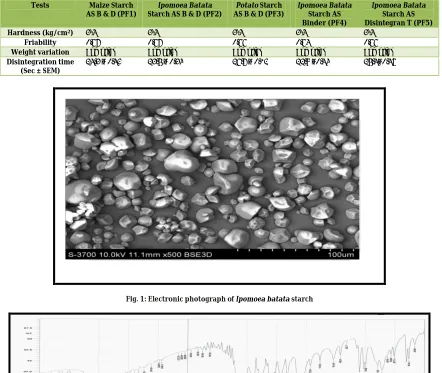
Fresh peeled tubers of Ipomoea batata (1kg) were sliced and homogenized in a blender. The homogenized solution was filtered through muslin cloth. The filtrate was allowed to sediment and the starch was washed with water until it is free from fibers. The purity of starch was confirmed by treating with iodine for homogeneity. The test was helped to confirm the isolated starch is pure and also free from fibers and tissues. The resultant pure starch is dried in air and packed in well closed container. The yield was (13.8%). Fig. 1 represents the electronic photograph of Ipomoea batata starch.
Evaluation ofIpomoea batata as per monograph:
TheIpomoea batata starch was evaluated for various parameters viz., description, solubility, identification, ash values (total ash, acid insoluble, water insoluble and sulphated ash), test for fluorescence, test for oxidizing substances, test for acidity, test for iron, loss on drying as described in Indian Pharmacopoeia for starch 8 and amylose content was determined as described by Martinez and Prodolliet [9].
Evaluation of Ipomoea batata starch by pre formulation studies:
Purified starch obtained from Ipomoea batata was subjected to preformulation studies like particle size, size distribution and flow properties, determination of moisture content and Compatability with drug before using it for formulation studies. Sieve analysis was done in order to determine the particle size distribution. 5 g ofIpomoea batata starch was weighed and placed on the sieve shaker (Jayanth, Industries, Hyderabad) arranged in size range of 80-1785 μm. The sieve shaker is shaken in a definite
Kusuma. R et al., J. Sci. Res. Pharm. 2015, 4(1), 48-54
Micrometry was done to determine the particle size ofIpomoea batata starch. The number of particles lying within a certain range is plotted against the size range/mean Particle Size known as frequency distribution curve.
The flow properties of Ipomoea batata starch were assessed by the Angle of repose, Compressibility index (CI) and Hausner’sratio (HR) methods. The angle of repose was determined by the funnel method as described in literature1 according to the relationship:
Tan Ø = 2h/d
where h is the height of the heap and d is the diameter of the heap.
To determine the density of the samples, the powder was gently poured in to 10 cm3graduated cylinder to a total volume of 10 cm3. The bulk density was calculated as the ratio between weight (g) and volume (cm3). To determine the ultimate tapped density the cylinder was tapped over 1.0 inch vertical drop, at 1 s interval, until no measurable change in volume was noticed. The CI and HR were determined from the bulk density and tapped density according to the relationships:
CI = [(Þt.Þb) Þt × 100] and HR = Þt / Þb
where Þt and Þb are the tapped density and bulk density, respectively.
Determination of bulk density was done on bulk density apparatus (Pathal Electrical Works, Mumbai).The obtained flow property (Angle of repose, CI and HR) values were compared with the standard values [13].
Compatibility of paracetamol and aspirin withIpomoea batata Starch was studied by IR spectra (Shimadzu FT-IR 8400S).
Formulation studies:
The effect of Ipomoea batata starch as a binder, disintegrant, binder & disintegrant was determined by dry and wet granulation techniques. Five types of paracetamol (wet granulation technique) and aspirin (dry granulation technique) tablets were prepared by usingIpomoea batata ,maize, potato starches in varying compositions in different formulations as binder, disintegrant, binder & disintegrant.Each batch consists of 50 tablets. The strength of paracetamol and aspirin in finished tablets was 500 and 350 mg, respectively. The composition of various formulations of paracetamol and aspirin tablets was given in Table 1 and 2respectively.
The tablets were compressed using a 10 stationed Rimek Minipress using D-11 caplet punches for paracetamol and aspirin tablets were prepared by D-12 round punches. The weight of each paracetamol tablet is 635 mg and aspirin is 445mg including all excipients. The effect of Ipomoea batata starch as excipient in preparation of tablets was compared with tablets prepared from maize and potato starch. Further the tablets were evaluated for weight variation, friability, hardness, and disintegration and dissolution tests as mentioned in the Indian Pharmacopoeia 8, 13. The disintegration tests were performed at 37 °C ± 20C in distilled water, using Campbell Electronics disintegrator. Similarly the dissolution tests were performed using V-Scientific dissolution (rotating paddle) apparatus. Assays were made in triplicate. The optimized formulations were subjected to accelerated stability studies as per WHO and ICH guidelines under zoneII, which are temperate and subtropical climatic zone were carried out [11].
RESULTS AND DISCUSSION
Evaluation ofIpomoea batata starch as per monograph:
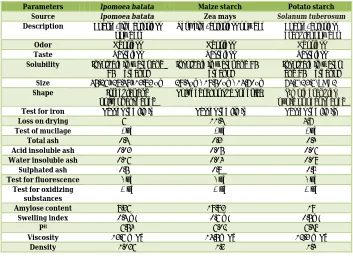
Ipomoea batatastarch is a colorless powder with no taste and no odour. The granules are Irregular and polygonal shaped and 10.5-26.3- 40.83 µm in size. The amylose content was 20.83%, which is less than amylose content of potato and maize starch and in other analyzed parameters the results were comparable to potato and maize starch (Table 3).
Evaluation of Ipomoea batata starch by preformulation studies: Sieve analysis: The size of particle is expressed by the sieve number, which describes diameter of spheres that passes through the sieve aperture as asymmetric particle. The percent distribution of particles was tabulated in Table 4 [8].
Micrometry: Table 5 shows the comparative particle size distribution ofIpomoea batatastarch with maize and potato starch. The comparative results shows that the 70% starch cumulative size distribution is ranging from 10-40 μm, which is similar to maize
starch, whereas potato starch major size distribution range is 40-70
μm [9].
Flow properties:The Angle of repose, CI and HR give qualitative assessment of the internal cohesive and frictional effects under low levels of external loading, as might be applied in powder mixing, or in the tablet die or capsule shell filling operations. The results were tabulated in Table 6. The results are similar to those obtained from maize starch and greater than potato starch [10].
Compatibility of paracetamol and aspirin withIpomoea batata,maize and potato starch was evaluated by IR spectra and found that both paracetamol and aspirin are compatible along with
Ipomoea batata,maize and potato starch (Fig 2).
Formulation studies:
Ipomoea batata starch possesses suitable rheological properties and compressibility, permitting its use in compression technology. There by, the design of paracetamol and aspirin tablets using Ipomoea batata, maize and potato starch in varying compositions as a binder, disintegrant, binder and disintegrant were performed [11, 19].
Both paracetamol and aspirin tablets were evaluated for weight variation, friability, hardness and disintegration test as per the Indian Pharmacopoeia and results were compile in Table 7 & 8. From these two tables it is evident that the prepared paracetamol and aspirin tablets weight variation content compiles the weight variation tolerance for uncoated tablets. Similarly, the percentage friability of all the formulations was within the limits of 0.5% and the hardness was within the scope of 3-4 kg/cm2 limits [1, 18].
Paracetamol tablets prepared by wet granulation using
Ipomoea batatastarch as binder and disintegrant possess higher disintegration time; however, the disintegration time is within the specified time of 30 min. Paracetamol tablets prepared from
Ipomoea batata starch as a disintegrant, is comparable with disintegration time of paracetamol tablets prepared from maize as binder and disintegrant. On the other hand the aspirin tablets prepared by dry granulation using various formulations had disintegration time in the range of 10-20 sec. The results of aspirin tablets prepared from Ipomoea batata starch either as binder, disintegrant and binder and disintegrant compiles with the results of aspirin tablets prepared from maize and potato starch [13].
Dissolution:
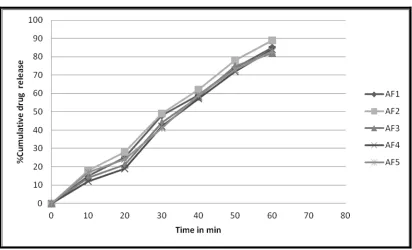
Following dissolution experiments, the cumulative and the comparative in vitro drug release of Paracetamol and aspirin in different formulations were illustrated in Table 7 and 8. The graphical representations of drug release in comparative to other formulations were depicted in Fig. 3 and 4. The results presented are the mean of triplicate readings. The results of dissolution studies indicate that 80% of paracetamol and aspirin were released from tablets within 60 min. The overall dissolution time indicated that the tablets prepared from Ipomoea batatastarch as binder, disintegrant, binder & disintegrant was significantly comparable with drug releasing time of paracetamol and aspirin tablets prepared from maize and potato starch [16, 17].
Stability studies evaluations under zone II, i.e. 40±20C;75±5% RH were carried out for six months, there is no changes in physical appearance of optimized tablets as well as the content uniformity and dissolution profile of tablets where within the limits of monograph [14, 15].
Table No. 1: Composition of Paracetamol Tablets
Ingredients Ingredients quantity in grams
F1 F2 F3 F4 F5
Paracetamol 0.5 0.5 0.5 0.5 0.5
Ipomoea batata starch (binder) - 0.05 - 0.05
Kusuma. R et al., J. Sci. Res. Pharm. 2015, 4(1), 48-54
Maize starch (binder) 0.05 - - - 0.05
Maize starch (disintegrant) 0.05 - - 0.05
-Potato starch (binder) - - 0.05 -
-Potato starch (disintegrant) - - 0.05 -
-Magnesium stearate 0.0025 0.0025 0.0025 0.0025 0.0025
Talc 0.005 0.005 0.005 0.005 0.0025
Table No. 2: Composition of Aspirin Tablets
Ingredients Ingredients quantity in grams
F1 F2 F3 F4 F5
Aspirin 0.350 0.350 0.350 0.350 0.350
Ipomoea batata starch (binder) - 0.035 - 0.035 -Ipomoea batata starch (disintegrant) - 0.035 - 0.035
Maize starch (binder) 0.035 - - - 0.035
Maize starch (disintegrant) 0.035 - - 0.035
-Potato starch (binder - - 0.035 -
-Potato starch (disintegrant - - 0.035 -
-Magnesium stearate 0.0017 0.0017 0.0017 0.0017 0.0017 Talc 0.0035 0.0035 0.0035 0.0035 0.0035
EVALUATION OF IPOMOEA BATATA STARCH
Table No. 3: Comparative results of Ipomoea Batata and Maize Starches
Parameters Ipomoea batata Maize starch Potato starch
Source Ipomoea batata Zea mays Solanum tuberosum
Description Coarse, fine colorless
powder Very fine, colorless powder granular powderCoarse, colorless
Odor Odorless Odorless Odorless
Taste Tasteless Tasteless Tasteless
Solubility Insoluble in water and
95% ethanol Insoluble in water and 95% ethanol Insoluble in water and 95% ethanol Size 45.26–28.49–13.83 µm 29.4µm- 19.50µm- 14.70µm 74.6-23.6-14 μm
Shape Irregular and
polygonal shaped Polyhedral or sub spherical ovoid or pear shapedSimple granules,
Test for iron Passes the limit Passes the limit Passes the limits
Loss on drying 6% 11.4% 4.7%
Test of mucilage +ve +ve +ve
Total ash 0.4% 0.3% 0.4
Acid insoluble ash 0.03% 0.05% 0.06
Water insoluble ash 0.16% 0.04% 0.08
Sulphated ash 0.5% 0.8% 0.5
Test for fluorescence - ve - ve - ve
Test for oxidizing
substances + ve + ve + ve
Amylose content 8.36% 19.83 % 19
Swelling index 0.4 ml 0.6 ml 0.5ml
PH 6.54 6.02 6.48
Viscosity 13.6 m Pa 14.5m Pa 12.3 m Pa
Density 1.036 1.3 1.4
Table No. 4: Size Distribution of I. Batata Starch by sieve analysis
Sieve no. Particle size
range (µm) spheres retainedAmount of % Weight retained Cumulative % retained
8/16 4000-2057 0.37 mg 7.4% 7.4%
16/30 2057-1003 1.56mg 31.2% 38.6%
30/60 1003-500 1.74 mg 34.8% 73.4%
60/100 500-250 0.480mg 9.6% 83%
100/150 250-150 0.11 mg 2.2% 85.2%
150/170 150-105 0.230mg 4.6% 89.8%
4.49mg 89.8% 89.8%
Values are mean of triplicate, 10.2% loss of material during sieving.
Table No. 5: Particle size Distribution of Starches by Micrometry
Mean size
range range(µm)Size Avg of 5 Maize starch Ipomoea batata starch samples % Cumulative% samplesAvg of 5 % Cumulative%
5 0-10 - - - 3 3 3
15 10-20 48 48 48 13 13 16
25 20-30 42 42 90 19 19 35
Kusuma. R et al., J. Sci. Res. Pharm. 2015, 4(1), 48-54
45 40-50 - - - 2 2 52
55 50-60 - - -
-65 60-70 - - -
-Table No. 6: Flow properties of Starches
Parameter Ipomoea Batata Starch Maize Starch Potato Starch
Moisture content (%) 6.0% 2.8% 5
Carr’s index 29.68 (Passable) 30.92 (Poor) 13.9
Hausner’s ratio 1.32 1.453 1.16
Angle of repose 31.9 37.3 25.6
Bulk density (gm/cm3) 0.462 0.43 0.74
Tapped density (gm/cm3) 0.657 0.625 0.86
Table No. 7: Post Evaluation Parameters of Paracetamol tablets
Tests Maize Starch AS B & D (PF1)
Ipomoea Batata
Starch AS B & D (PF2)
Potato Starch
AS B & D (PF3)
Ipomoea Batata
Starch AS Binder (PF4)
Ipomoea Batata
Starch AS Disintegran T (PF5)
Hardness (kg/cm2) 4.0 – 4.5 4.0 – 4.5 4.0 – 4.5 4.0 – 4.5 4.0 – 4.5
Friability 0.37 0.32 0.34 0.36 0.38
Weight variation Complies Complies Complies Complies Complies
Disintegration time (Sec ± SEM)
42.6 ±0.33 45.5 ±0. 47 44.6±0 .32 40.8±0. 21 44.6±0 .32
Table No. 8: Post Evaluation Parameters of Aspirin tablets
Tests Maize Starch
AS B & D (PF1) Starch AS B & D (PF2)Ipomoea Batata AS B & D (PF3)Potato Starch Ipomoea Batata Starch AS Binder (PF4)
Ipomoea Batata
Starch AS Disintegran T (PF5)
Hardness (kg/cm2) 3-4 3-4 3-4 3-4 3-4
Friability 0.67 0.67 0.66 0.64 0.66
Weight variation Complies Complies Complies Complies Complies
Disintegration time (Sec ± SEM)
24.3 ± 0.43 23.5 ± 0.34 26.7 ± 0.12 22.9 ±0.44 25.4±0.47
Fig. 1: Electronic photograph ofIpomoea batata starch
Kusuma. R et al., J. Sci. Res. Pharm. 2015, 4(1), 48-54
(b)
(c)
(d)
(e)
Kusuma. R et al., J. Sci. Res. Pharm. 2015, 4(1), 48-54
0
10
20
30
40
50
60
70
80
90
0
10
20
30
40
50
60
70
80
%
Cu
m
ul
at
iv
e
dr
ug
re
le
as
e
Time in mins
PF1
PF2
PF3
PF4
PF5
Fig. 3: Comparative in vitro release of Paracetamol from different formulations
Fig. 4: Comparative in vitro release of Paracetamol from different formulations
CONCLUSIONS
I
pomoea batatastarch was evaluated as an alternative natural starch along with maize and potato starch following its isolation from Ipomoea batataplant. The battery of tests done onIpomoea batatastarch met the specification mentioned in Indian Pharmacopoeia. Following this, the preformulation studies results suggest that Ipomoea batatastarch has similar properties like maize and potato starch. Besides it has shown compatibility with paracetamol and aspirin. Finally the dissolution results did not preclude us to state thatIpomoea batatabe used as an alternative pharmaceutical excipient (especially as a binder and disintegrant) to maize and potato starch for tablets preparation.
REFERENCES:
1. Lieberman HA, Lachmann L, Schwortz JB, editors. Pharmaceutical Dosage Forms: Tablets. 1st ed. Vol. 2.Marcel Dekker: New York; 1989; p. 151-70.
2. Wallis TE. Text book of Pharmacognosy. 5th ed. NewDelhi: CBS Publications andDistributor; 1985; p. 7-19.
3. Wade A, Weller PJ, editors. Hand book of Pharmaceutical Excipients. 2n d ed. Washington: American Pharmaceutical Association; 1994; p. 483-8.
4. Kiritikar KR and Basu BD, Indian Medicinal Plants, (International Book Distributors, Dehradun) III. pp. 1714-1729.
5. Anonymous The Wealth of India: A Dictionary of Indian Raw Materials & Industrial Products, (Council of Scientific &Industrial Research (CSIR) New Delhi), pp. 238-247.
Kusuma. R et al., J. Sci. Res. Pharm. 2015, 4(1), 48-54
7. Venkatesh S, Reddy GD, Reddy BM, Ramesh M, AppaRaoAVN. Antihyperglycemic activity of Carallumaattenuata.
Fitoterapia, 2003; 74: 274-9.
8. Anonymous. Indian Pharmacopoeia. Vol. 2, New Delhi: The Controller of Publications, Govt of India; 1996; p.A43-A109. 9. Martinez, Prodolliet. Determination of amylose in cereal and
non-cereal starches by a colorimetric assay:collaborative study. Starch 1996; 48: 81-5.
10. Lachman L, Lieberman HA, Kanig JL. The Theory and Practice of Industrial Pharmacy. 3rd ed. Bombay: Varghese Publication House; 1987; p.176-94.
11. Kokate CK. Practical Pharmacognosy, 4th ed. Delhi: Vallabh Prakshan; 2004; p. 113-4.
12. Schmidt PC, Rubensdorfer P. Evaluation of Ludipress as a 'Multipurpose Excipient' for direct compression. Part I: Powder characteristics and Tableting properties, Drug Dev. Ind. Pharm.,1994; 20: 2899-925.
13. Jennifer D, Johannes K, editors. Pharmaceutical Dissolution Testing. London: Taylor & Francis, 2005; p.315-40. 14. Christensen JT, Rhodes CT, editors. Drug Stability Principles
and Practices. 3rd ed. Vol 107, New York: Marcel Dekker, 2000; p.612-3.
15. Mazzo DJ, editor. International stability testing. Illinois: Interpharm Press, 1999; p.255-7.
How to cite this article:
Kusuma. R et al.,: Evaluation of Ipomoea Batata Starch as an Aiternative Tablet Excipient to Maize and Potato Starch: Assessment by Preformulation and Formulation Studies, J. Sci. Res. Phar., 2015; 4(1): 48-54.
Conflict of interest: The authors have declared that no conflict of interest exists.

![Fig. 2: IR spectas of Compatibility studies [a) IR spectra of paracetamol; b) IR spectra of aspirin; c) IR spectra of Ipomoea batata; d) IR spectra of Paracetamol with Ipomoea batata; e) IR spectra of with aspirin Ipomoea batata]](https://thumb-us.123doks.com/thumbv2/123dok_us/8400287.1686392/5.612.91.522.39.628/compatibility-studies-spectra-paracetamol-ipomoea-paracetamol-ipomoea-ipomoea.webp)