CA. Sri Ranjani et al. J Sci Res Pharm, 2017;6(10):112-116
World Inventia Publishers
J
ournal of
S
cientific
R
esearch in
P
harmacy
http://www.jsrponline.com/
Vol. 6, Issue 10, 2017 ISSN: 2277-9469
USA CODEN: JSRPCJResearch Article
QUANTITATIVE DETERMINATION OF HYDRAZINE HYDRATE CONTENT IN FORMOTEROL FUMARATE
DIHYDRATE BY GC-MS METHOD
Dr. S. Shobha Rani 1, CA. Sri Ranjani 2 *
1 Head and Assistant Professor, Institute of Pharmaceutical Sciences, CPS, IST, JNTUH, Hyderabad, Telangana, INDIA.
* 2Institute of Pharmaceutical Sciences, CPS, IST, JNTUH, Hyderabad, Telangana, INDIA.
Received on: 20-09-2017; Revised and Accepted on: 08-10-2017
ABSTRACT
A
Mass spectrometry is an important analytical tool routinely used in the fields of chemistry, biochemistry, pharmaceutical chemistry etc. In this thesis, the parts of mass spectrometer like various ionization sources, analyzers and detectors, and hyphenated techniques were discussed. This gives an idea about the methods involved in the using mass spectrometry based techniques for quantification of pharmaceutical impurities in active pharmaceutical ingredients and to develop simple rapid economic and reproducible sensitive Gas Chromatographic with mass spectrometry (GC-MS) method and validated it as per ICH guidelines for the determination of hydrazine hydrate content in formoterol fumarate dihydrate drug substance. Validation revealed the method is rapid, specific, accurate, precise, reliable, and reproducible. Calibration curve plots were linear over the concentration ranges 200-1000 ppm. Limits of detection (LOD) were 0.1μg/ml and limits of quantification (LOQ) were 0.2 μg/mL . The developed method validated in terms of linearity, accuracy, precision, LOD, LOQ and robustness. The proposed method is highly sensitive, precise, accurate and easy to perform and was successfully for the determination of hydrazine hydrate content by GC-MS method and the of content Hydrazine hydrate has been considered as a potential genotoxic impurity and hence GC-MS method for quantification was chosen To achieve lower level of detection on suitable capillary column using Electron Impact ionization (EI) in Selective Ion Monitoring (SIM) modeKeywords: GC-MS, Formoterol fumarate dihydrate, Validation, Quantification of Pharmaceutical Impurities, Hydrazine hydrate.
INTRODUCTION
F
ormoterol or formoterol (former BAN) is a long-acting β2 agonist (LABA) used in the management of asthma and COPD.It is marketed in three forms: a dry-powder inhaler, a metered-dose inhaler and an inhalation solution.
Fig. 1: Structure of formoterol fumarate dihydrate
Formoterol has an extended duration of action (up to 12 hours) compared to short-acting β2 agonists such as salbutamol
(albuterol), which are effective for 4–6 hours. LABAs such as formoterol are used as "symptom controllers" to supplement prophylactic corticosteroid therapy. A "reliever" short-acting β2 agonist (e.g.
salbutamol) is still required, since LABAs are not recommended for the
*Corresponding author:
CA. Sri Ranjani
Department of Pharmacy,
Institute of Pharmaceutical Sciences,
CPS, IST, JNTUH, Hyderabad, Telangana, INDIA. * E-Mail:[email protected]
treatment of acute asthma. Formoterol is an innovative, highly potent, β2-adrenoceptor-selective agonist combining the clinical
advantages of rapid onset of action with duration of action in excess of 12 h.
In vitro, formoterol is a potent airway smooth muscle relaxant with high efficacy, and very high affinity and selectivity for the β2-adrenoceptor.
MATERIALS AND METHODS
Experimental Apparatus:
The analysis was performed by using the Semi micro Balance- LCGC-RADWAG (XA 82/220/2X) weighing range: 20 mg - 200gm. Gas Chromatograph- Mass Spectroscopy- Gas Chromatograph- Mass Spectroscopy (Agilent). Data handling system (MSD Chemstation), Vertex - Spinix vertex shaker (speed- 3000RPM)
Gas chromatographic parameters:
Column: DB-624, Column length: 60 m, Film thickness: 1.8 mm, Inner diameter: 0.32 mm or equivalen.
Stationary phase: 6% Cynopropy phenyl 94% Dimethyl polysiloxane.
Column oven temperature (for standard):95°C for 5 minutes then increase 10°C per minute to 120°C hold for 0 minute. Increase 30°C per minute to 240°C hold for 5 minutes.
Column oven temperature (For Sample): 95°C for 5 minutes then increase 10°C per minute to 120°C hold for 0 minute. Increase 30°C per minute to 240°C hold for 30 minutes.
Detector: mass detectors.
Injector temperature: 200°c
Carrier Gas: Helium
Flow rate:2.0 mL/minute
Split ratio: 5:1
Mass parameters:
Acquisition type: SIM/scan
Ion mode: EI
Source temperature: 230°c
Quad temperature: 150 °c
Solvent delay: 7.00 min
SIM time segment: ion mass to charge: 56 & 112; dwell time: 100ms
Scan time segments: start mass: 20 amu
End mass: 200 amu
Threshold: 150
Reagents and solutions:
Pure dry powered sample of formoterol fumarate dihydrate and other ingredients such as Acetone (AR- GRADE), Formic acid (GR GRADE) are used.
Preparation of standard stock solution
Standard stock solution 1:
Accurately weigh about 25 mg of Hydrazine hydrate into a 100 mL volumetric flask containing about 30 mL of diluent, make up the volume with diluent and shake for 1 minute (250 ppm).
Standard stock solution 2:
Dilute 0.6 mL of standard stock solution 1 to 50 mL with diluent and shake for 1 minute (3 ppm).
Preparation of standard solution:
Dilute 5.0 mL of standard stock solution 2 to 100 mL with diluent and shake for 1 minute (0.15 ppm).
Preparation of sample solution:
Accurately weigh and transfer about 100 mg of the sample into a 10 mL stopper test tube. Add 1 mL of diluent, vortex for about 30 seconds. Centrifuge the solution for 20 minutes and inject the clear layer of solution.
Evaluation of blank:
Inject diluent into the gas chromatograph and record the chromatogram.
If interference observed, inject the diluent in triplicate and substract the mean area of diluent from area of standard solution and sample solution.
Evaluation of system suitability:
Inject standard solution six times into the gas chromatograph and record the chromatograms.
The system is suitable for analysis, if and only if;
a) % RSD of area of analyte from six injections of Standard solution should be less than 15%.
Optimization of GC-MS Method:
The GC-MS method was optimized and developed with Formoterol fumarate dihydrate respectively. The prepared standard stock solution (250ppm to 0.1ppm) using 0.5% formic acid in acetone was injected in GC-MS.
Dermination of Hydrazine Content in Formoterol Fumarate Dihydrate by GC-MS:
Hydrazine is widely used in pharmaceutical industry as hydrazine hydrate. In applications such as synthesis of intermediate for drug substances. Any impurity other than active moiety is to be controlled with suitable limits in the drug substance irrespective of its harmful nature as per international conference on harmonization (ICH) guideline on impurities,
However the analysis of hydrazine presents numerous distinctive challenges due to its low molecular weight. Various techniques were employed for the determination of hydrazine in drug substances.
Genotoxic impurities have the potential to induce genetic mutations, chromosomal aberrations and rearrangements and can cause cancer in humans.
These impurities may be introduced into the drug substances and drug products as residual starting materials and reagents, excipients, process related by-products or through drug substance degradation.
Hydrazine Hydrate Properties:
Hydrazine is genotoxic in nature and therefore warrants a control in the drug substances at appropriate levels such that the total intake of hydrazine or its derivatives does not exceed 1.5µg per day Hydrazine is an inorganic compound with chemical formula- NH2-NH2.
Fig. 2: Structure of Hydrazine
It is a colourless flammable liquid with ammonia like odour.
Hydrazine is a highly toxic and dangerously unstable handled in solution.
Hydrazine (NH2NH2) is a highly reactive reducing agent used as an
intermediate for synthesizing an experimental drug substance.
A gas chromatography-mass spectrometry method was developed as a limit test method for analyzing trace levels of hydrazine in the experimental drug substance.
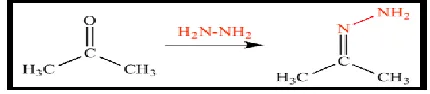
The gas chromatographic (direct injection) conditions provide good separation for the acetone-hydrazine derivative (acetone hydrazone): Reaction of acetone with hydrazine gives propan-2-ylidenehydrazine , a simple hydrazone from matrix interference, and mass spectrometric detection (selected ion monitoring mode, m/z 56) allows sufficient sensitivity for detecting 1 part per million hydrazine relative to the drug substance.
Fig. 3: Reaction of Acetone with Hydrazine
Method validation:
The method validation was done according to the ICH guidelines. The following validation characteristic parameters are system suitability, specificity, accuracy, precision, linearity, and specificity, LOD, LOQ and robustness.
Linearity and range:
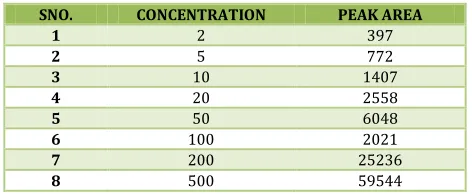
Linearity of the method was studied by the injecting the standard solutions with the concentration ranges from 250ppm to 0.15ppm were prepared and injected six times into the GC-MS system keeping the constant injection volume. The peak areas were plotted against the concentrations to obtain the linearity graphs (Table No. 3 & graph 1).
Precision:
The precision of the optimized method was evaluated by carrying out six independent assays of test sample with concentration range from 250ppm to 0.3 ppm, %RSD of six assay values was calculated. Intermediate precision was carried out the samples by using different column and with different analyst.
System suitability:
The system suitability parameters to assess the analyte unequivocally in presence of components which may be expected to be present were performed to ensure that if there is limited or no interference from impurities or analytes with each other.
Limit of Detection and Quantification:
By applying the visual evaluation method, LOD was expressed by establishing the lowest concentration at which the analyte can be detected. LOQ was considered as the lowest concentration of analytes that can be detected and quantified, with acceptable accuracy and precision.
Robustness:
Robustness was studied by evaluating the effect bynsmall variations in the chromatographic conditions. The conditions studied were flow rate altered by ±0.1ml/min, and temperature variations ±10°c. These chromatographic variations are evaluated for resolution of hydrazine hydrate content.
Specificity:
The specificity of the analytical method is the ability of the method to estimate the analyte response in the presence of additional components such as impurities, hydrazine hydrate content was assessed by comparing the Retention time of standard and sample, good correlation was obtained between the Retention time of standard and sample of formoterol fumarate dihydrate.
Accuracy:
Accuracy was carried out by applying the method to drug sample formoterol fumarate dihydrate to which known amounts of formoterol fumarate dihydrate standard corresponding to 50, 100 and 150 % of solution was added and determined by the system. The experiment was performed in triplicate and percentage recovery, % RSD was calculated.
RESULTS
T
he GC-MS procedure was optimized for simultaneous determination of Formoterol fumerate dehydrate. Good resolution of genotoxic impurity – hydrazine hydrate was obtained with Diluent:0.5% Formic acid in Acetone, column:HP-5MS COLUMN, Column length:
30m, Film thickness: 1.8 µm, Inner diameter: 0.25 mm or equivalent,
Stationary phase:6% Cynopropy phenyl 94% Dimethyl polysiloxane,
Column oven temperature (For Standard) : 95°C for 5 minutes then increase 10°C per minute to 120°C hold for 5 minute and Increase 30°C per minute to 240°C hold for 10 minute, Column oven temperature (For Sample): 95°C for 5 minutes then increase 10°C per minute to120°C hold for 5 minute. Increase 30°C per minute to 240°C hold for 10 minute.
Detector: Mass spectrometer, Injector temperature: 200°c, Carrier Gas:Helium, Flow rate:2.0 mL/minute – it was optimum, Split ratio:
5:1, Injection Volume:3 µL.
Hence, the parameters were determined empirically and have been found to be optimum.
The average retention time for hydrazine hydrate was found to be 5.95 min, respectively, and with high resolution.
The validation of developed method shows that the drug stability is well within the limits. Linear regression data for the calibration plots revealed good linear relationships between response and concentration over the ranges 2–2000 μg/mL solutions of formoterol fumerate, respectively. The linear regression equations were
y = 121.890x + 57.540 R² = 1.000 The plots obtained from linear regression analysis are given in graph:
The limits of detection and quantitation were found to be 2ng/ml and 2 μg/mL respectively,. This indicates the method is sufficiently sensitive. Acceptance criteria S/N ratio should not be less than 10.
The precision of the method was expressed as relative standard deviation (RSD, %). The results reveal high precision of the method.
The Accuracy limit is the % recovery should be in the range of 80-120% of hydrazine hydrate respectively. The validation of developed Method shows that the accuracy is well within the limit, which shows that the method is capable of showing good accuracy.
Table No. 1: System Suitability Parameters of GC-MS
PARAMETRS HYDRAZINE HYDRATE
Retention time ( tR) 5.95 min
Resolution (Rs) High
Fig. 4: Evaluation of Blank Fig. 5: Full Scan of Hydrazine Hydrate Content
in 2ppm Stock solution
Table No. 2: Linear regression analysis with concentration (μg/mL) and peak area (AU)
SNO. CONCENTRATION PEAK AREA
1 2 397
2 5 772
3 10 1407
4 20 2558
5 50 6048
6 100 2021
7 200 25236
9 1000 122541
10 2000 260165
Fig. 6: Linear regression analysis of Hydrazine hydrate content in stock solution of Formoterol Fumerate Dihydrate
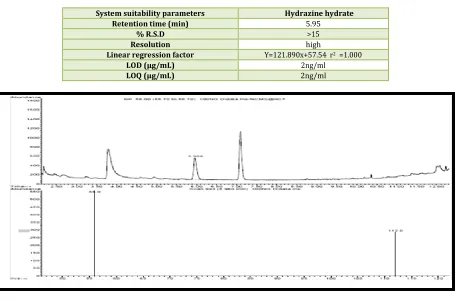
Table No. 3: System suitability parameters for determination of Hydrazine hydrate content in Formoterol Fumerate Dihudrate
System suitability parameters Hydrazine hydrate
Retention time (min) 5.95
% R.S.D >15
Resolution high
Linear regression factor Y=121.890x+57.54 r2 =1.000
LOD (μg/mL) 2ng/ml
LOQ (μg/mL) 2ng/ml
Fig. 7: Chromatogram and mass spectrum representing 2ng solution
Drug content determination: Content of residual solvent in sample solution
Calculation:
= 3970 / 39652 X 26.80 / 100 X 0.60 / 50 X 5 / 100 X 1 / 100.79 X 82.39 / 100 X 106
= 0.2 ppm (2ng)
Table No. 4: Hydrazine Hydrate content determination by GC-MS
Tests Results (PPM) Specifications (PPM)
Hydrazine hydrate content by GC-MS 0.2 NMT 1.5
The Guideline on the Limits of Genotoxic Impurities issued by the Committee for Medicinal Products (CHMP) and a more recent draft guidance document on limits of genotoxic and carcinogenic impurities issued by the US Food and Drug Administration recommend that an
CONCLUSION
T
he GC-MS method has been developed for the determination of hydrazine hydrate content in dry powder inhalation formulation of formoterol fumarate dihydrate. The developed method is simple, precise, and robust.Hence the present GC-MS method can be used in the pharmaceutical industry for the routine analysis of estimation of genotoxic impurities in pharmaceutical ingredients.
REFERENCE:
1. The Indian Pharmacopoeia. Ghaziabad: The Indian Pharmacopoeia Commission: 6thed., 2010; Vol-II: pp. 1382-1384,1386-1387.
2. British Pharmacopoeia. London Her Majestry’s Stationary Office:
2013; Vol-II: pp. 974-976, 984-986.
3. United States Pharmacopoeia 30. National Formulary 25. Rockville, USA, United States Pharmacopoeia Convention: 2013; Vol-II: pp. 3653-3657, 3669-3670.
4. European Pharmacopoeia 7.2. European Directorate for the Quality of Medicine and Healthcare: Vol-II: pp. 2059-2060, 2067-2069.
5. Bhangale P R, Jain H K, Spectrophotometric method for simultaneous estimation of formoterol fumarate and mometasone furoate in respicaps. Int Res J Pharm
2013;4(6):220-223.
6. Shah PD, Koradia S. Simultaneous Determination of Beclomethasone Dipropionate and Formoterol Fumarate in Rotacap Dosage Form Using Two Different Spectrophotometric Methods, World J Pharma and Pharma Sci 2014;3(5):611-623. 7. Ahmed S, Salem H, Abdelkawy M. New developed
spectrophotometric method for simultaneous determination of salmeterol xinafoate and fluticasone propionate in bulk powder and Seritide diskus inhalation, Bulletin of Faculty of Pharmacy, Cairo University. 2012;50(2):121–126.
8. NM. Gowekar et al. Int J PharmTech Res 2016;9(1):164-170. 170.
9. Kondawar MS, Shah RR, Waghmare JJ, Malusare MK, Shah ND. UV Spectrophotometric Method for Simultaneous estimation of Salmeterol xinafoate and Fluticasone propionate in Bulk and Dosage form. Int J PharmTech Res 2011;3(3):1801-1806. 10. Ahmed S, Salem H, Abdelkawy M, Simultaneous Determination
of Salmeterol Xinafoate and Fluticasone Propionate in Bulk Powder and Seritide Diskus using High Performance Liquid
Chromatographic and Spectrophotometric Method. Pharma Anal Acta 2012;3(8):1-7.
11. Nadarassan DK, Chrystyn H, Clark BJ, Khaled A. Validation of high-performance liquid chromatography assay for quantification of formoterol in urine samples after inhalation using UV detection technique. J Chromatography B 2007 ;850(1-2):31-7.
12. Akapo SO, Asif M. Validation of a RP-HPLC method for the assay of formoterol and its related substances in formoterol fumarate dihydrate drug substance. J Pharma and Biomed Anal
2004;33(5):935-45.
13. Kachave RN, Chaudhari SR, Kale M, Wagh RD. Simultaneous Estimation of Formoterol Fumarate and Tiotropium Bromide by RP-HPLC in Dry Powder Inhaler. Inventi Rapid: Pharm Analysis & Quality Assurance 2013;2013(4):1-4.
14. Katari S, Gorule V, Venkata Reddiah Ch and Venkata Krishna A. Validated Method Development for Estimation of Formoterol Fumarate and Mometasone Furoate in Metered Dose Inhalation Form by High Performance Liquid Chromatography. J Anal Bioanal Techniq 2012;3(7):1-4.
15. Parmar VK, Patel HN, Patel BK. Sensitive and robust methods for simultaneous determination of beclomethasone dipropionate and formoterol fumarate dihydrate in rotacaps. J Chromatogr Sci
2014;52(10):1255-66.
16. Pai N and Patil SS. Development and validation of RP-HPLC method for estimation of formoterol fumarate and budesonide in pressurised meter dose inhaler form. Der Pharmacia Sinica
2013;4(4):15- 25.
17. Sa Couto AR, Cardoso DE, Cabral-Marques HM. Validation of an HPLC Analytical Method for the Quantitative/Qualitative Determination of Fluticasone Propionate in Inhalation Particles on Several Matrices. Sci Pharm 2014;82(4):787-97.
18. Laugher L, Noctor TG, Barrow A, Oxford JM, Phillips T. An improved method for the determination of fluticasone propionate in human plasma. J Pharma and Biomed Anal
1999;21(4):749-758.
19. Mascher HJ, Zech K, Mascher DG. Sensitive simultaneous determination of ciclesonide, ciclesonideM1-metabolite and fluticasone propionate in human serum by HPLC–MS/MS with APPI. J Chromatogr B, 2008;869(1–2):84–92.
20. Kasaye L, Hymete A, Mohameda AMI. HPTLC-densitometric method for simultaneous determination of salmeterol xinafoate and fluticasone propionate in dry powder inhalers. Saudi Pharm J 2010;18(3):153–159.
21. Apperley DC, Harris RK, Larsson T, Malmstrom T. Quantitative Nuclear Magnetic Resonance Analysis of Solid Formoterol Fumarate and its Dihydrate, J Pharma Sci 2003;92(12):2487-94.
How to cite this article:
Dr. S. Shobha Rani, CA. Sri Ranjani. QUANTITATIVE DETERMINATION OF HYDRAZINE HYDRATE CONTENT IN FORMOTEROL FUMARATE DIHYDRATE BY GC-MS METHOD. J Sci Res Pharm 2017;6(10):112-116.
Conflict of interest: The authors have declared that no conflict of interest exists.