Achieving Security Assurance with
Assertion-based Application Construction
Carlos E. Rubio-Medrano
1, Gail-Joon Ahn
1,∗, Karsten Sohr
21Arizona State University, 699 S. Mill Avenue, Tempe, Arizona, 85282, USA 2Universität Bremen, Am Fallturm 1, 28359 Bremen, Germany
Abstract
Modern software applications are commonly built by leveraging pre-fabricated modules, e.g. application
programming interfaces (APIs), which are essential to implement the desired functionalities of software
applications, helping reduce the overall development costs and time. When APIs deal with security-related
functionality, it is critical to ensure they comply with their design requirements since otherwise unexpected
flaws and vulnerabilities may consequently occur. Often, such APIs may lack sufficient specification details,
or may implement a semantically-different version of a desired security model to enforce, thus possibly
complicating the runtime enforcement of security properties and making it harder to minimize the existence
of serious vulnerabilities. This paper proposes a novel approach to address such a critical challenge by
leveraging the notion of software assertions. We focus on security requirements in role-based access control
models and show how proper verification at the source-code level can be performed with our proposed
approach as well as with automated state-of-the-art assertion-based techniques.
Receivedon 02 March 2015;acceptedon 25 August 2015;publishedon 21 December 2015
Keywords:securityassurance,softwarespecification,softwareassertions,role-basedaccesscontrol,API,SDK
Copyright©2015 CarlosE.Rubio-Medranoetal.,licensedtoEAI.Thisisanopenaccessarticledistributedunderthe termsoftheCreativeCommonsAttributionlicense(http://creativecommons.org/licenses/by/3.0/),whichpermits unlimiteduse,distributionandreproductioninanymediumsolongastheoriginalworkisproperlycited.
doi:10.4108/eai.21-12-2015.150819
1. Introduction
In recent years, there has been an increasing interest in usingheterogeneouspre-fabricated software modules,
e.g. application programming interfaces(APIs) and
soft-ware development kits(SDKs), in order to not only reduce
the overall development costs and time in producing high-quality applications, but also minimize the num-ber of incorrect behaviors (bugs) observed in the final product. However, recent literature has shown that such modules often lack the proper specification details (in the form of formal or informal documentation) that are essential to guide how a module should be used correctly for implementing security-related function-ality [2] [3]. Common pitfalls include missing code assumptions or prerequisites, as well as the lack of foundation on a standardized, well-defined security
HA preliminary version of this paper appeared in the Proceedings of
the 2014 IEEE International Conference on Collaborative Computing: Networking, Applications and Worksharing (CollaborateCom) [1].
∗Corresponding author. Email: [email protected]
model that serves as a common reference to help devel-opers understand and correctly implement security-related code. Such a problem may potentially become the source of serious security vulnerabilities, as devel-opers may not be fully aware of the omissions and flaws they may introduce into their applications by failing to implement a security model in a proper way. In order to solve this problem, we propose an assertion-based approach to capture security requirements of security models and create well-defined representations of those requirements. This way, the security features could be effectively understood by all participants in the soft-ware development process, in such a way that they can leverage these features when implementing security-related functionalities for multi-module applications, at the same time they engage in a highly-collaborative environment. These assertion-based security specifica-tions would be used in conjunction with existing
state-of-the-art methodologies and tools to verify security
properties at the source-code level. In this paper, we choose the well-knownrole-based access control(RBAC) [4] as the security model to enforce access control
1 EAI Endorsed Transactions on
Collaborative Computing
122015|Volume1|Issue6 |e3
EAI
European Alliance for InnovationResearch
Article
EA
EAI Endorsed Transactions
requirements over an application that is in turn com-posed of several heterogeneous modules. Concretely, we show how the semantic variations, the lack of proper specification, and the absence of proper verification techniques can lead to the existence of non-trivial access control vulnerabilities in mission-critical applications such as banking applications. Moreover, we provide a well-defined description of RBAC based on the standard provided by the American National Standards Institute
(ANSI) [5]. We model this reference description by usingassertions which are later used to provide access control constraints. To inject assertions as part of the documentation devised for software modules, we also adoptdesign by contract(DBC) [6] paradigm. For such a purpose, we leverage theJava Modeling Language(JML) [7], a DBC-like specification language for Java, to serve as a vehicle for aproof-of-conceptimplementation of our approach. Also, we utilize existing tools to verify a set of security properties, thus providing a way to locate and possibly correct potential security vulnerabilities in software applications.
This paper is organized as follows: we start by providing some background on the topics addressed in this paper in Section 2. Next, we examine the general problem, as well as the problem instance addressed in this work in Section 3. We then present our approach in Section 4, and a case study depicting three Java-based software applications and our experimental results in Section 5. In Section 6, we provide some discussion on the benefits and shortcomings of our approach as well as some related work. Finally, Section 7 presents directives for our future developments and concludes the paper.
2. Background
Software assertions are commonly described as formal constraints intended to describe the behavior of a software system, e.g., what it is expected to do at runtime, and are commonly written as annotations in the system’s source code [8]. Using assertions, developers can specify what conditions are expected to be valid before and after a certain portion of code gets executed, e.g. the range of values that the parameter of a given function is allowed to take. Design by contract
(DBC) [6] is a software development methodology based on assertions and the assumption that the developers and the prospective users (clients) of a given software module establish acontractbetween each other in order for the module to be used correctly. Commonly, such a contract is defined in terms of assertions in the form of pre and post conditions, among other related constructs. Before using a DBC-based software module
M, clients must make sure that M’s preconditions hold. In a similar fashion, developers must guarantee that M’s postconditions hold once it has finished
1 public interface Account {
2
3 // @ public instance model double balance ;
4
5 // @ public invariant balance > 0.0;
6
7 /*@ public normal_behavior
8 @ requires amt > 0.0;
9 @ assignable balance ;
10 @ ensures balance == (\old( balance ) - amt );
11 @ */
12 public void withdraw (double amt )
13 throws SecurityException ;
14
15 }
Figure 1. AnExcerpt of a JML-annotatedBankingApplication.
execution, assuming its corresponding preconditions were satisfied beforehand. TheJava Modeling Language
(JML) [7], is a behavioral interface specification language
(BISL) for Java, with a rich support for DBC contracts. Using JML, the behavior of Java modules can be specified using pre- and postconditions, as well as class
invariants, which are commonly expressed in the form
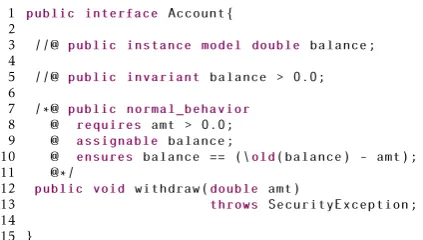
of assertions, and are added to Java source code as the form of comment such as //@ or /*@...@*/. Fig. 1 shows an excerpt of a Java interface named Account, which belongs to a banking application and has been annotated with JML specifications.
The contract for the withdraw method (shown in lines 7-11) makes use of the model field balance. In JML, it is possible to define model fields, methods and classes [9], which differ from their regular (concrete) counterparts in the sense they are used for specification purposes only, in an effort to better describe a given JML contract in a higher level of abstraction, without worrying about how it is implemented at the source code level. The model field balance, shown in line 3, is used to provide an abstract representation of the amount of money held by the bank account represented by interface Account. Following JML rules, a given class implementing interfaceAccountwill be required to provide a suitable implementation for it. The preconditions of methodwithdraw (defined by means of the requires keyword) require the value of the method parameteramtto be greater than zero, as shown in the assertion depicted in line 8. Postconditions for the same method, which are in turn defined by theensures
keyword, guarantee that the new value of model field
balance will be equal to its previous value before the method was executed (as denoted by the\oldkeyword) minus the value of the method parameter amt. The set of memory locations, e.g. instance variables, that are allowed to be modified by thewithdraw method is specified by means of the assignable clause (line 9). Line 5 depicts an assertion representing an invariant: the value of model fieldbalancemust be always greater than zero, before and after each method of interface
Account executes. Finally, specification contracts that are expected to terminate normally, that is, without
2 EAI Endorsed Transactions Collaborative Computingon
122015|Volume1|Issue6 |e3
diverging nor throwing exceptions at runtime, are defined by means of the normal behavior keyword (line 7). Conversely, contracts that allow a method to throw a runtime exception are specified by means of the exceptional behavior keyword. A summary of the JML features exercised in this paper can be found in [7] and [9].
In recent years, the American National Institute
of Standards (ANSI) released a standard document
that provides well-defined descriptions of the main components and functions that define RBAC [5], and it is mostly based on the well-known Z specification language [10]. In addition, a dedicated profile [11] has been introduced to provide support for expressing RBAC policies by taking both the aforementioned ANSI RBAC standard as a reference foundation as well as the well-knowneXtensible Access Control Markup Language
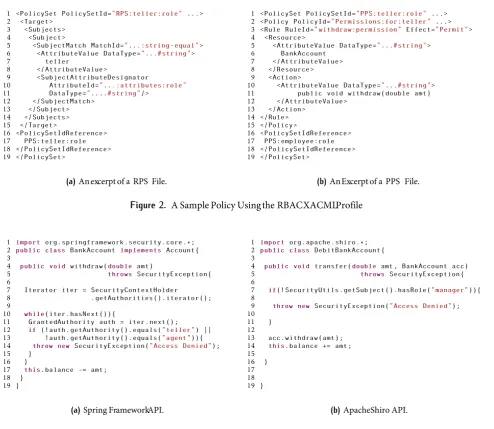
(XACML), which is a standard language for supporting the distributed definition, storage and enforcement of rich access control policies [12]. Fig. 2 shows an excerpt of an RBAC policy that has been written in the RBAC XACML profile: roles are encoded using so-calledrole
policy set(RPS) files (Fig. 2 (a)), which include the name
of the role (teller, lines 4-13) as well as a reference
to a permission policy set (PPS) file that includes the
set of access rights (permissions) authorized for such a role (lines 16-18), and is in turn shown in Fig. 2 (b). In the RBAC XACML profile, permissions are encoded as XACML rules and role hierarchies are established by allowing a PPS file P to reference other PPS files containing the permissions that are assigned to roles that happen to be junior to the roles whose RPS files reference P. For instance, Fig. 2 (b) (lines 16-18) references the PPS file defined for role employee (not shown in Fig. 2 (a)), which happens to be a junior role toteller.
3. Problem Description
As mentioned earlier, recent literature includes exam-ples showing that mission-critical applications, e.g., banking mobile applications, have suffered from seri-ous security vulnerabilities derived from an incorrect use of their supporting security APIs at the source-code level [2, 3]. Among the possible causes of this problem, insufficient software specifications, including the definition of prerequisites and hidden assumptions, as well as the existence of multiplesemanticvariations of a given security model, e.g., the lack of foundation on a standardized, well-defined model serving as a ref-erence, are cited as common sources of incorrect imple-mentations. Moreover, the problem gets aggravated by the lack of effective software verification procedures at the source-code level, which could affect the chances of identifying and potentially correcting security vulner-abilities exhibited by applications before deployment
to a production system. In this paper, we address an instance of this problem by choosing RBAC as the secu-rity model to enforce access control requirements in a software application that is in turn composed of several modules. In addition, each of these modules may imple-ment a different version of RBAC whose semantics may or may not strictly adhere to an existing RBAC reference model such as the ANSI RBAC [5]. We therefore aim to verify that such heterogeneous modules, when used to build a target application, correctly enforce a well-defined and consistenthigh-level RBAC policy, despite the differences they may exhibit with respect to their inner workings related to RBAC features, which could eventually result in security vulnerabilities.
As an illustrative example, Fig. 3 (a) and Fig. 3 (b) show a Java-based example where a high-level RBAC policy is enforced at runtime by placing authorization checks before performing security-sensitive operations. In both instances, a policy depicts a role manager
as a senior role to teller, and allows for users, who are assigned to roles that happen to be senior to
manager, to execute both the transfer and withdraw
operations, whereas users holdingtellerrole are allowed to execute the withdraw operation only, as shown in Fig. 2. Moreover, Fig. 3 (a) shows a Java class
BankAccount, which implements the interfaceAccount
described in Fig. 1 and leverages the Spring Framework API [13] for implementing an authorization check (lines 7-16). Similarly, Fig. 3 (b) shows another class
DebitBankAccount depicting an authorization check using the Apache Shiro API [14] (lines 7-11). In such a setting, it is desirable to evaluate the correct enforcement of the aforementioned RBAC policy as follows: first, the authorization checks depicted in both examples must correctly specify the roles that are allowed to execute each of the security-sensitive operations. For instance, the authorization check depicted in Fig. 3 (a) incorrectly allows for another
roleagentto also execute thewithdrawmethod, which
in turn represents a potential security vulnerability. Second, the role hierarchy depicted in the high-level policy must be correctly implemented at the source-code level by leveraging both APIs. As roles that happen to be senior to role manager should be allowed to execute both the transfer and withdraw methods, the role hierarchy must be correctly implemented by placing accurate authorization checks within the source code. In addition, the role hierarchy must be also defined correctly in the supporting API configuration files. as an incorrect implementation, e.g. missing role names within the XML files defined for the Spring API, may prevent users with the role manager
from executing the transfer method. A more serious problem may be originated if users with the role
teller are allowed to execute the transfer method.
Finally, if users with the role manager are allowed
3 EAI Endorsed Transactions Collaborative Computingon 122015|Volume1|Issue6 |e3
1 < PolicySet PolicySetId =" RPS:teller:role " ... >
2 < Target >
3 < Subjects >
4 < Subject >
5 < SubjectMatch MatchId ="... :string - equal ">
6 < AttributeValue DataType ="...# string ">
7 teller
8 </ AttributeValue >
9 < SubjectAttributeDesignator
10 AttributeId ="... :attributes:role "
11 DataType =".. ..# string "/ >
12 </ SubjectMatch >
13 </ Subject >
14 </ Subjects >
15 </ Target >
16 < PolicySetIdReference >
17 PPS:teller:role
18 </ PolicySetIdReference >
19 </ PolicySet >
(a)Anexcerpt of a RPS File.
1 < PolicySet PolicySetId =" PPS:teller:role " ... >
2 < Policy PolicyId =" Permissions:for:teller " ... >
3 <Rule RuleId =" withdraw:permission " Effect =" Permit ">
4 < Resource >
5 < AttributeValue DataType ="...# string ">
6 BankAccount
7 </ AttributeValue >
8 </ Resource >
9 < Action >
10 < AttributeValue DataType ="...# string ">
11 public void withdraw ( double amt )
12 </ AttributeValue >
13 </ Action >
14 </ Rule >
15 </ Policy >
16 < PolicySetIdReference >
17 PPS:employee:role
18 </ PolicySetIdReference >
19 </ PolicySet >
(b)AnExcerpt of a PPS File.
Figure 2. A Sample Policy Usingthe RBACXACMLProfile
1 import org . springframework . security . core .*;
2 public class BankAccount implements Account {
3
4 public void withdraw (double amt )
5 throws SecurityException {
6
7 Iterator iter = SecurityContextHolder
8 . getAuthorities () . iterator () ;
9
10 while( iter . hasNext () ){
11 GrantedAuthority auth = iter . next () ;
12 if (! auth . getAuthority () . equals (" teller ") ||
13 ! auth . getAuthority () . equals (" agent ")){
14 throw new SecurityException (" Access Denied ");
15 }
16 }
17 this. balance -= amt ;
18 }
19 }
(a)Spring FrameworkAPI.
1 import org . apache . shiro .*;
2 public class DebitBankAccount {
3
4 public void transfer (double amt , BankAccount acc )
5 throws SecurityException {
6
7 if(! SecurityUtils . getSubject () . hasRole (" manager ")){
8
9 throw new SecurityException (" Access Denied ");
10
11 }
12
13 acc . withdraw ( amt );
14 this. balance += amt ;
15
16 }
17 18
19 }
(b)ApacheShiro API.
Figure 3. Enforcingan RBACPolicy by LeveragingHeterogeneousSecurity Modules.
to execute the transfer method, but are disallowed from executing the withdraw method (Fig. 3 (b)) by incorrectly configuring the Spring API depicted in Fig. 3 (a), a given object of class DebitBankAccount
may be left in an inconsistent state, thus also creating a serious security problem.
4. Our Approach: Assertion-based Construction
In order to provide a solution to the problem described in Section 3, we propose an approach that combines the concepts of specification modeling and software assertions for describing security features at the source-code level. These so-called
assertion-based security modelsare intended to provide compact,
well-defined and consistent descriptions that may serve as a common reference for implementing security-related functionality. Our approach strives to fill in the gap between high-level descriptions
of security features, which are mostly abstract and implementation-agnostic, and supporting descriptions focused at the source-code level, which are intended to cope with both security-related and behavioral-based specifications, such as the ones described in Section 2. As it will be described in Section 6, previous work has also explored the use of software assertions and DBC-like contracts for specifying access control policies. However, our approach is intended to leverage the
modeling capabilities offered by software specification
languages using a well-defined reference description of a security model as a source, in such a way that it not only allows for the correct communication, enforcement and verification of security-related functionality, but it also becomes independent of any supporting APIs used at the source-code level, thus potentially allowing for its deployment over applications composed of several heterogeneous modules. Fig. 4 depicts our
4
EAI Endorsed Transactions on
Collaborative Computing
122015|Volume1|Issue6 |e3
proposed approach: an assertion-based security model is intended to be enforced over a target application that is in turn composed of two modules leveraging security APIs and two modules whose security-related functionality has been implemented from scratch. This way, the semantic differences exhibited by such modules, as shown in Section 3, can be effectively mitigated. Moreover, by leveraging state-of-the-art methodologies based on assertions, effective automated verification of security properties at the source-code level becomes feasible, thus providing a means for discovering and possibly correcting potential security vulnerabilities.
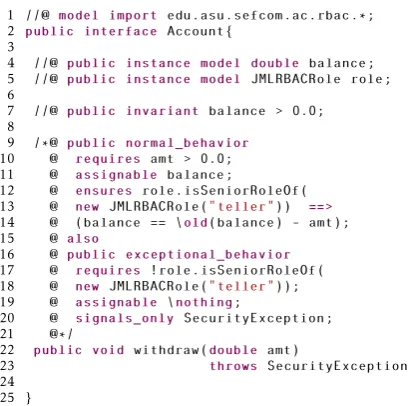
To address the problem instance discussed in this paper, we leverage the JML modeling capabilities, e.g. model classes [9], to describe the ANSI RBAC standard described in Section 2. Later on, these model classes are used to create assertion-based constraints, which are in turn incorporated into the DBC contracts devised for each module in an application. This way, a high-level RBAC policy can be specified at the source-code level by translating it into assertion-based constraints included in DBC contracts. Following our running example, Fig. 5 shows an excerpt of a model classJMLRBACRole, which depicts the role component and some of its related functionalities as devised in the ANSI RBAC standard, e.g. role hierarchies. Such a model class is leveraged in Fig. 7 to augment the JML-based contract depicted in Fig. 1 with security-related assertions restricting the execution of the withdraw method to users who activate a role senior to teller. We start by defining a model variable role, of type JMLRBACRole
(line 5), which is later used for defining access control constraints in the two specification cases depicted in Fig. 7: the first specification case, depicted in lines 9-14, allows one to properly execute the withdraw method, e.g. deducting from the balance of a given account, only if the object stored in therolevariable represents a role senior toteller1. The second specification case, shown in lines 16-20, allows for the withdrawmethod to throw a runtime exception if the aforementioned constraint is found to be false. In addition, such a specification case also prevents any modification to the state (e.g. private fields) of a given object of type BankAccount
from taking place.
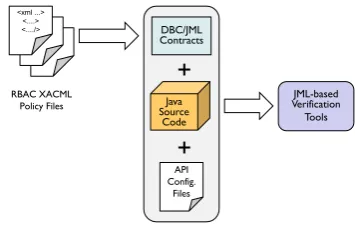
Fig. 6 depicts our approach: a high-level RBAC policy, which is encoded by means of the dedicated RBAC profile provided by XACML [11], is translated into a series of DBC contracts. Later on, such contracts, along with the source code for a given software application, are fed into JML-based automated tools for verification purposes. Since such an application may be in turn
1Following the ANSI RBAC standard, a given role is alwaysseniorto
itself.
Module1 (API1)
Module2 (API2)
Module3 Own Code
Software Application Assertion-based Security Model
Figure 4. Deploying Assertion-based Security Models over a
Multi-moduleApplication.
1 package edu . asu . sefcom . ac . rbac ;
2 public class JMLRBACRole
3 extends JMLRBACAbstractRole {
4
5 public boolean isSeniorRoleOf (
6 JMLRBACAbstractRole role ){
7
8 if(this. equals ( role )){ return true; }
9
10 return getAllJuniorRoles () . contains ( role );
11 }
12 }
Figure 5. AnExcerptof a JMLModel Class Depictingan ANSI
RBACRole Component.
<xml ...> <....> <..../>
Java Source
Code DBC/JML Contracts
+
RBAC XACML Policy Files
JML-based Verification Tools
API Config.
Files
+
Figure 6. A Frameworkfor Assertion-basedSecurity Assurance.
composed of heterogeneous modules and each of them possibly represents a different API for implementing security-related functionality, e.g. enforcing an RBAC policy, the configuration files for such APIs must be also taken into account when leveraging automated tools for verification, as described in Section 3. In order to automate the creation of DBC contracts such as the ones depicted in Fig. 7, we designed an automated tool that translates RBAC policies encoded in the RBAC XACML profile into JML-based specifications, thus relieving policy designers and software architects from crafting
5 EAI Endorsed Transactions Collaborative Computingon 122015|Volume1|Issue6 |e3
1 // @ model import edu . asu . sefcom . ac . rbac .*;
2 public interface Account {
3
4 // @ public instance model double balance ;
5 // @ public instance model JMLRBACRole role ;
6
7 // @ public invariant balance > 0.0;
8
9 /*@ public normal_behavior
10 @ requires amt > 0.0;
11 @ assignable balance ;
12 @ ensures role . isSeniorRoleOf (
13 @ new JMLRBACRole (" teller ")) == >
14 @ ( balance == \old( balance ) - amt );
15 @ also
16 @ public exceptional_behavior
17 @ requires ! role . isSeniorRoleOf (
18 @ new JMLRBACRole (" teller "));
19 @ assignable \nothing;
20 @ signals_only SecurityException ;
21 @ */
22 public void withdraw (double amt )
23 throws SecurityException ;
24
25 }
Figure 7. Enhancing a DBC contract with Access Control
Assertions.
1 import org . springframework . security . core .*;
2 public class BankAccount implements Account {
3
4 // @ public represents role <- mapRole () ;
5
6 /*@ public pure model JMLRBACRole mapRole () {
7 @
8 @ JMLRBACRole newRole = new JMLRBACRole ("");
9 @ RBACMonitor monitor = new RBACMonitor () ;
10 @
11 @ Iterator iter = SecurityContextHolder
12 @ . getAuthorities () . iterator () ;
13 @
14 @ while( iter . hasNext () ){
15 @ GrantedAuthority auth = iter . next () ;
16 @ if ( auth . getAuthority () . equals (" teller ")){
17 @ newRole = new JMLRBACRole (" teller ");
18 @ }
19 @ }
20 @
21 @ return newRole ;
22 @ }
23 @ */
24 ...
25 }
Figure 8. AnExcerpt Showinga JMLAbstraction Function.
such contracts manually and eliminating a potential source for errors.
AlgorithmPshows a procedure for translating a set of XACML files into a set of data structures depicting an ANSI RBAC policy. The algorithm takes as an input the set of RPS and PPS XACML files as introduced in Section 2 and produces the set R of roles, the set
P of permissions, the permission assignment PA ⊆ R
× P relation involving the last two, and the RH ⊆ R
× R relation depicting a role hierarchy between the roles included inR. The algorithm starts by initializing the sets/relations to be returned as a result as well as two auxiliary data structures:REF andROLE-DICT
(lines 1-3). Entries in the REF relation store the file references within PPS files that are used to establish a role hierarchy. As an example, an entry of the form (PPS:teller:role, PPS:employee:role) will be added to REF when the policy reference shown in Fig. 2 (b) (lines 16-18)) is processed. Conversely, theROLE-DICT
relation is introduced to keep a map between the names of the PPS files being referenced in the REF
relation and the actual role names depicted in their corresponding RPS files. As an example, an entry of the form (PPS:teller:role, teller) will added to ROLE-DICTwhen processing the RPS and PPS files belonging to the tellerrole depicted in Fig. 2. The first phase of AlgorithmPcontinues by retrieving the pair of RPS and PPS files depicting both the role declaration as well as the set of permissions that are assigned to such role. First, the RPS file is retrieved and the name for a role
r is extracted. Such a name is then used to populate the R set as well as to introduce an initial entry of the form (r,r) to the RH relation indicating that each role is alwaysseniororjuniorto itself (lines 5-7). Next, the PPS file corresponding to role r is retrieved, an entry to theROLE-DICTrelation is added, and each of the permissions included in such PPS file is parsed to populate the PA relation (lines 8-14). The first phase ends by processing each of the file references included in the PPS file and adding corresponding entries into theREFrelation as discussed before. The second phase of AlgorithmP (lines 18-20) focuses onexpanding the
RH relation by adding an entry for each pair of roles in R that are in a senior-junior role relationship. We model such calculation as agraph reachabilityproblem assumingRH to be adirectedgraph. With this in mind, implement adepth-first search(DFS) algorithm over all roles inR: each entry in theREFrelation is retrieved, the role name corresponding to the file acting as the senior role is obtained from ROLE-DICT and the auxiliary AlgorithmexpandRH is called. Such a algorithm takes an initial role r as an input and populates the RH
relation by recursively obtaining all entries inREFand
ROLE-DICT that belong to roles that happen to be
junior to a given roler. The runtime performance of the first phase of AlgoritmPcan be regarded to be O(|RPS|
+|PPS|)≈O(|R|+|P|)in the best case, which occurs when every permission in P is assigned to only one role in R. When several permissions inPare assigned to several different roles in R then the performance turns out to be O(|R|+|R| ∗ |P|)≈O(|R| ∗ |P|). In a similar fashion, performance of the second phase can be analyzed as follows: since the DFS algorithm is known to run in O(E)for a graph havingVnodes andEedges, our implementation may then run on O(V∗E)≈O(|R|
∗ |P|)in the best case when V= Rand E= P, which occurs when every permission inPis assigned to only
6 EAI Endorsed Transactions on
Collaborative Computing
122015|Volume1|Issue6 |e3
one role inR. In the case when the same permission is assigned to different roles inR, the running time may be regarded as O(V∗E)≈O(|R| ∗(|R| ∗ |P|))forV=R
andE=R×P.
Taking as an input the data structures produced by Algorithm P, Algorithm
T
produces DBC contracts written in a subset of the JML syntax defined in [15], like the one shown in Fig. 7, by leveraging a templatein the form of an abstract syntax tree (AST), which is shown in Fig. 9. The algorithm starts by exploring the
PArelation to obtain the entry depicting thejunior-most
role being assigned to every permission in P (lines 2-6). For such a purpose, line 4 of Algorithm
T
queries theRHstructure to determine if there exists aseniorityrelationship between two nodes ri and rj (i, j) in R. Such queries can be potentially answered in constant time (O(1)), as it suffices to locate the entry (ri, rj) in
RH, due to the expansionprocedure conducted by the second phase of Algorithm P. Finally, the algorithm produces a DBC/JML contract for each of the junior-most entries obtained in the previous step (lines 7-13). An alternative approach would include eluding the aforementionedexpansionprocedure carried on by Algorithm P and leaving any further algorithms, e.g., Algorithm
T
, with the duty of determining if a role happens to be senior to another one. Such an alternative approach may be beneficial in the case when only a few permissions in P happen to be assigned to more than one role in R, in such a way that the seniority relation between those roles may need to be determined when calculating the junior-most role only for such few permissions. In AlgorithmT
, since we potentially explore the entries in the PA relation twice, and such a relation may be of size |R| * |P| in the worst case, the runtime performance can be regarded as O(2∗ |R|∗ |P|) ≈ O(|R| ∗ |P|). We present an analysis of the correctness of our approach in Appendix A.
As described in Section 1, we aim to support the verification of security properties in mission-critical applications. For such a purpose, we leverage an approach based on automated unit testing [16] by adopting JET [16]: a dedicated tool tailored for providing automated runtime testing of Java modules with JML-based assertions, e.g. classes. Using JET, testers can verify the correctness of a Java module by checking the implementation of each method against their corresponding JML specifications. In addition, we also support the detection of potential security vulnerabilities by means of static techniques by leveraging the ESC/Java2 tool [7], which is based on a theorem prover and internally builds
verification conditions (VCs) from the source code
being analyzed, and its corresponding JML-based specifications, which the theorem prover then attempts to prove, thus allowing for the automated analysis of
AlgorithmP:Parsing RBAC XACML Files.
Data: SetsRPSandPPSof RBAC XACML files
Result: SetsRof roles,Pof permissions, and thePA
andRHrelations
1 Initialize R and P to empty sets;
2 InitializePAandRHto empty relations;
3 Initialize ROLE-DICT and REF to empty relations;
4 foreach file rps in RPSdo
5 r= Get role name fromrps;
6 R=R∪r;
7 RH=RH∪(r,r);
8 ref-pps= Get name of permissions file
referenced byr;
9 ROLE-DICT=ROLE-DICT∪(ref-pps, r);
10 pps= Get file fromPPSusingref-pps;
11 foreach permission p in ppsdo
12 ifp<Pthen
13 P=P∪p;
14 PA=PA∪(r, p);
15 JUNIOR-PPS= Get names of files referenced by
pps;
16 foreach junior-pps-name in JUNIOR-PPSdo
17 REF=REF∪(ref-pps,junior-pps-name);
18 foreach (senior-ref, junior-ref) in REFdo
19 (senior-ref, role)= Get fromROLE-DICTusing
senior-ref;
20 RH=expandRH(role, senior-ref,RH, REF,
ROLE-DICT);
21 returnR,P,PAandRH;
AlgorithmexpandRH :Constructing the RH of an RBAC Policy.
Data: A roler∈R, a Stringkeydepicting a file name, theRH,REFandROLE-DICTrelations
Result: TheRHrelation
1 InitializeJMandCto empty sets;
2 ENTRIES = Get entries fromREFusingkey;
3 foreach (senior-ref, junior-ref) in ENTRIESdo
4 (junior-ref, junior-role)= Get fromROLE-DICT;
5 if(role, junior-role)<RHthen
6 RH=RH∪(role, junior-role);
7 RH=expandRH(role, junior-ref, RH, REF,
ROLE-DICT);
8 returnRH;
whole code modules without running the applications. In particular, ESC/Java2 uses modular reasoning [17], which is regarded as an effective technique when used in combination with static checking since code sections can be analyzed and their JML-based specifications can
7 EAI Endorsed Transactions Collaborative Computingon
12 2015|Volume1|Issue6 |e3
Algorithm
T
: Transforming an RBAC Policy to DBC/JML Contracts.Data: ThePAandRHrelations depicting an ANSI RBAC Policy
Result: A SetCof DBC/JML Contracts
1 InitializeJMandCto empty sets;
2 foreach (r,p) in PAdo
3 (r’,p)= Get entry fromJMusingp;
4 if(r’, p),null and (r’,r)∈RHthen
5 JM=JM\(r’p);
6 JM=JM∪(r,p);
7 foreach (r,p) in JMdo
8 Createsignaturefromp;
9 GetcontractfromCusingsignature;
10 ifcontract is nullthen
11 contract= Create using AST andsignature;
12 C=C∪contract;
13 Addrto roles incontract;
14 returnC;
JMLNormalSpecCase
JMLMethodContract
JMLExceptionalSpecCase
JMLPrecondition JMLPostcondition
JMLMethodCallAssertion JMLTrueDefaultAssertion
JMLPrecondition JMLSignalsOnly
JMLMethodCallAssertion JMLAssignableNothing
Figure 9. A Sample AST templatefor ProducingJMLSyntax.
be proved by inspecting the specification contracts of the methods they call within their methodbodies.
Later, in Section 5, we present our findings on leveraging both techniques in a set of case studies depicting mission-critical Java applications. In order to support the verification process just described, proper constructs are needed to map the modeling features included in DBC contracts (as depicted in Fig. 7) and the implementation source code of each heterogeneous module. For such a purpose, we leverage the features offered by the JML abstraction functions [9], which allow for JML model features to be properly mapped
to source-code level constructs, thus providing a way to verify that each heterogeneous module implements a given high-level policy correctly. As an example, Fig. 8 shows an excerpt where a JML model method is used to map the source code implementing security features as provided by the Spring Framework API with the model features depicted in Fig. 7.
In general, the correct enforcement of a security model may involve the following cases: first, a high-level security policy, which is based on a well-defined security model definition, should be correctly defined and all policy conflicts must have been resolved, e.g.
Table 1. Distribution of Responsibilities for Enforcing an
Assertion-basedSecurity ModelIn a Collaborative Setting.
Actor Description of Tasks
Security DomainExperts Develop an assertion-based security model by using a precise definitio as a reference, e.g. using the ANSI RBACstandard.(See Fig. 5). Policy Administrators Instantiate the security modelto be
enforced,e.g. specificatio ofan RBAC policy based on the ANSI RBAC standard.(See Fig. 2).
SoftwareArchitects Incorporate the security policy into DBC constructs by specifying assertion-based constraints (See Fig. 7).
Code Developers Correctlyimplementthe DBC specifi cationsdefine by softwarearchitects (includingsecurity checks).Providea mappingbetween the security model and the securityAPIs used forimple-mentationpurposes(See Fig. 8). Code Testers Verify both the functional and the
security related aspects of a given software application based on their DBC specification (See Section 5).
evaluating a given RBAC policy by using techniques such as the ones discussed in [18]. Second, access to all protected resources within a given application, e.g. the withdraw operation depicted in Fig. 7, is
guardedby an authorization check (adhering to the
well-known principle of complete mediation). Following our example, authorization checks should depict the RBAC constructs defined in the overall policy, e.g. checking for the correct roles and/or permissions before executing any sensitive operation. Third, supporting components for the security model features are implemented correctly, e.g. RBAC role hierarchies. Finally, we also require that the detection of runtime policy violations is implemented properly, e.g. exception handling and data consistency. With this in mind, for the problem instance addressed in this paper, we make the following assumptions: first, the ANSI RBAC model is well-understood by all participants in the software development process, e.g. policy designers, software architects and developers. Second, the assertion-based specification of the security model is correct: in other words, it has been verified beforehand. Third, any supporting RBAC modules, including security APIs and SDKs, have been implemented correctly, even though their semantics with respect to RBAC may differ, as addressed in Section 3.
Finally, our approach is intended to be carried out by the different participants in the software development process, in such a way that the process of constructing vulnerability-free software becomes a collaborative
8 EAI Endorsed Transactions on
Collaborative Computing
122015|Volume1|Issue6 |e3
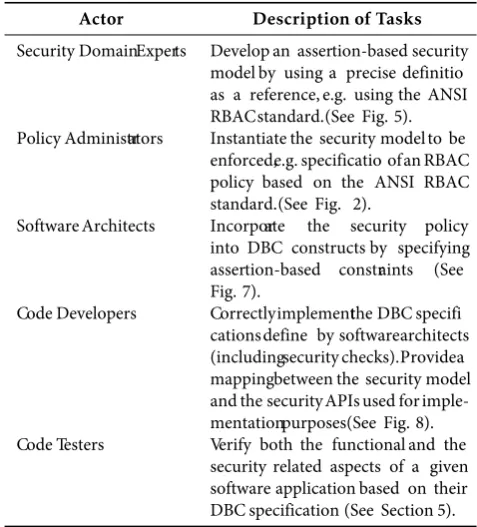
responsibility shared by all involved actors, obviously including the source-code level developers. Table 1 shows a summary of the tasks devised for each participant.
5. Case Study
In order to provide a proof-of-concept implementation of our approach, we developed a reference description of the security model under study by using a set of JML model classes based on the case illustrated in Fig. 5. Such a reference model contains 960 lines of code grouped in 17 Java classes, including 1,383 lines of JML specifications depicting the functionality desired for RBAC as described in the ANSI RBAC standard. For our case study, we leveraged a pair of open-source Java applications: OSCAR EMR [19], which is a rich web-based software platform tailored for handlingelectronic
medical records (EMR). It consists of approximately
35,000 lines of code organized into 110 classes and 35 packages. In addition, we also leveraged JMoney [20], a financial application consisting of 7,500 lines of code grouped into 45 classes. Moreover, we developed a banking application depicting the running examples shown in this paper. Such an application leverages the Apache Shiro and Spring Framework Security APIs, as well as our own RBAC monitor developed for implementing security-related functionality. It consists of 36 classes and contains 1,550 lines of code as well as 1,450 lines of JML specifications, which utilize our JML model classes in DBC contracts, as shown in Fig. 7.
In addition, we performed an evaluation over the automated translation tool described in Section 4 that takes as an input a set of XACML files depicting an ANSI RBAC policy and produces a set of DBC contracts in the JML language. Such a tool consists of 6,246 lines of code grouped in 25 classes in Java, and implements the Algorithms labeled as P,
T
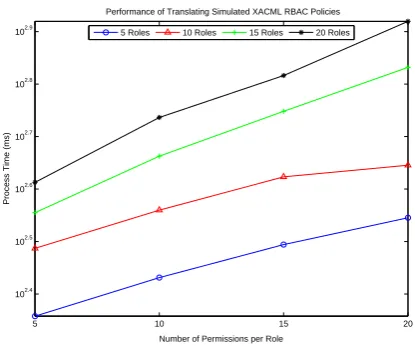
and expandRH, also shown in Section 4 as well as the AST structure shown in Fig. 9. In order to evaluate the effectiveness of the tool we designed an experiment tailored to measure the overall processing time in milliseconds taken by the tool to process XACML-based policies and produce their corresponding DBC/JML contracts. In such experiments, we varied the policysizeby varying the number of roles included in the policy as well as the number of permissions being assigned to each role. In addition, we controlled the number of different role hierarchies depicted by each policy as well as the number of permissions that were simultaneously assigned to the same role. Fig. 10 shows the results of our experimental approach when allowing the tool to process synthetically-created policies to produce DBC/JML contracts such as the one shown in Fig. 7. We produced 4 different policies varying the number of roles from 5 to 20, as well as the number of permissions5 10 15 20
102.4 102.5 102.6 102.7 102.8 102.9
Number of Permissions per Role Performance of Translating Simulated XACML RBAC Policies
Process Time (ms)
5 Roles 10 Roles 15 Roles 20 Roles
Figure 10. Runtimeperformanceof ourTranslationTool.
included on each role. All roles in the policy belonged to the same role hierarchy and the same permission was allowed to be assigned to at most two roles. As expected, the execution time depicted by our tool remains linear as the size of the policy given as an input is varied.
As described in Section 4, our approach is intended to identify inconsistencies in the implementation of security models that can eventually become security vulnerabilities. In the context of the security model addressed in this paper, an incorrect implementation of an RBAC policy may end up introducing non-trivial vulnerabilities to applications. Based on the description of RBAC depicted by the ANSI RBAC standard, inconsistencies on the implementation of RBAC policies can be described as follows: first, an incorrect mapping between access rights (permissions) and sensitive operations performed by applications. Sensitive operations should be properly guarded by permissions, in such a way that the execution of such operations is only allowed when the requesting entity is found to be granted the permissions devised for them. Failing to identify such sensitive operations as well as the need to secure them by properly requesting for the permissions, may also result in non-trivial security vulnerabilities. Following our running example, the
transfer operation featured in Fig. 3 (b) must be identified as security-sensitive and being guarded by a permission to be assigned only to users holding
the manager role. Second, failures in the assignment
of permissions to roles may exist. As an example, incorrect assignment of a given permissionPto a role
R may allow R and roles that happen to be senior to it to execute the unintended operations guarded
by P. On the other hand, unintended removal of P
from the list of permissions devised forRwill deprive such a role and all other roles senior to it from exercisingPand its related operations, possibly causing
an availability problem by restricting the number of
operations that such roles can execute in the context
9 EAI Endorsed Transactions Collaborative Computingon
122015|Volume1|Issue6 |e3
of a given application. Third, there may be failures in the implementation of role hierarchies. As an example, the introduction or removal of a role or a set of roles at a given level of the hierarchy may produce vulnerabilities: introduction of an unintended role R in a given hierarchy may allow for R to unintentionally inheritthe permissions assigned to all roles that happen to be junior to R, and it may also allow for senior roles toRto obtaining the permissions assigned to R. Conversely, removal of a role R in a given hierarchy may deprive roles senior to R from obtaining the permissions assigned to it, which can yield vulnerabilities such as the state inconsistency problem described at the end of Section 3. In the context of applications composed of heterogeneous modules, the aforementioned inconsistencies can be potentially introduced either in the source code of the application itself, or by incorrect configuration of policy files. As an example, failures in the implementation of authorization checks, as the ones depicted in Fig. 3, can be regarded as a common source of potential inconsistencies at the source code level. In addition, state-of-the-art security APIs, as the ones depicted throughout this paper, leverage text files for configuring security features. With respect to RBAC, our featured APIs provide configuration files depicting the assignment of permissions to roles. In summary, an incorrect configuration of those files may also introduce security vulnerabilities.
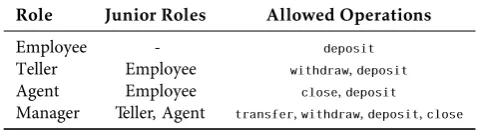
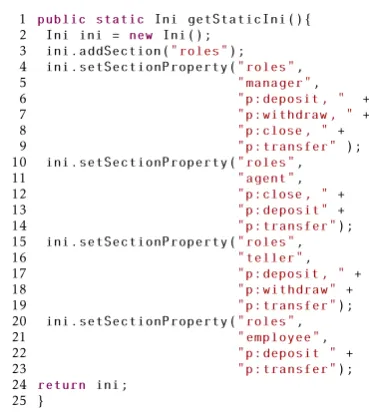
With this in mind, we modeled implementation inconsistencies of the RBAC security model by lever-aging an approach inspired by mutation testing [21]: we inserted variations (also known asmutants) in both the source code and the API configuration files of the applications considered in our study. As an example, Fig. 11 shows different mutants introduced to the RBAC policy shown in Table 2: first, the original policy is modified to add an unintended permission (transfer, (t)) to a roleemployee(Fig. 11 (a)). Such a modification creates a potential security vulnerability as it allows
employee, and all other roles senior to it, e.g. agent
and teller, to execute an operation that was originally
intended only for a role manager. A configuration file depicting such modification is shown in Fig. 12 (lines 14, 19, 23). Similarly, Fig. 11 (b) shows a permission
(deposit, (d)) being removed from theemployeerole. Such
a modification produces an inconvenience to such a role and all other roles that happen to be senior to it, as execution of the deposit operation will be denied at runtime. Fig. 11 (c) shows another example where the original role hierarchy of the RBAC policy is modified to introduce an unintended role (supervisor, (S)). This way, the newly-introduced role creates a pair of security vulnerabilities: first, it inherits the permissions from all junior roles in the hierarchy, thus allowing for the execution of unintended operations. Fig. 13 shows an
Table 2. A Sample RBACPolicy for EvaluationPurposes.
Role Junior Roles Allowed Operations
Employee - deposit
Teller Employee withdraw,deposit
Agent Employee close,deposit
Manager Teller, Agent transfer,withdraw,deposit,close
example depicting such modification (lines 6,7). Sec-ond, it also allows for a senior role in the hierarchy to obtain an extra permission (audit, (a)), thus possibly allowing them to perform unintended operations as well. Fig. 13 shows an excerpt of an XML configuration file depicting the role hierarchy modification shown in Fig. 11 (c) (lines 6-8). Finally, Fig. 11 (d) shows a case when a role is removed from a role hierarchy: teller
is left aside by removing the relationships with both
the manager (senior) and the employee (junior) roles.
It exposes an inappropriate permission revocation not only to users holding the role teller as it is prevented from getting the permissions of its junior roles (e.g.
deposit, (d)), but also to senior roles since revocation
prevented them from getting the permissions assigned
toteller(e.g.,withdraw, (w)) including all other
permis-sions that could be obtained from junior roles toteller. In the rest of this section, we describe the experimental procedure we have conducted on the sampled software applications by leveraging existing assertion-based tools to detect (kill) mutant-based inconsistencies in the implementation of RBAC policies like the ones described above, in an effort to show the suitability of our approach for the effective verification of security properties. In particular, we present the results when applying both the dynamic and the static approach to the aforementioned case-study applications. Later, in Section 6, we highlight some shortcomings we have identified in this experimental process, and propose some alternative solutions.
5.1. ApplyingDynamicAnalysisTechniquesto
Assertion-basedVerificatio
As described in previous sections, we aim to support the verification of security properties by leveraging an approach based on automatedunit testing [16] as well as the JML specifications depicting our assertion-based models that were introduced in Section 4. For such a purpose, we adopted JET [16], which is a dedicated tool tailored for providing automated runtime testing of Java modules with JML-based assertions, e.g. classes. Using JET, testers can verify the correctness of a Java module by checking the implementation of each method against their corresponding JML specifications. As an example, the contract of a given method M
is used as a test oracle, by first translating it into
10 EAI Endorsed Transactions Collaborative Computingon
122015|Volume1|Issue6 |e3
t
M
T
E t
w
d A
c
(a)Addinga Permission.
M
T
E t
w
d A
c
(b)Removinga Permission.
S
T
E
a
w
d A
c
M t
(c)Addinga Role.
M
T
E t
w
d A
c
(d)Removinga Role.
Figure 11. IntroducingMutants in the RBAC Policy shown
in Table 2: roles are labeled using their uppercase initial. Permissions are shownusing lowercaseinitials and dottedlines. E.g., in Fig. 11(a), roleManager is shownas a coloredcircle labeled as M. Permissiontransfer is shownas a white circle labeled as t. The assignmentof permissiontransfer to the role Manager is shownas a dottedline.
runtime assertion checking (RAC) code. Then, proper
values (of either primitive or reference data types) are
randomly created for each of M’s formal parameters,
and compared for compliance against the RAC code created forM’s precondition. If such a precondition is satisfied, avalidtest case is said to be created2, andM’s body is executed. If any exception not devised forMis thrown, the test case is regarded as failed. Otherwise, the RAC code forM’s postcondition is executed. If such a postcondition is satisfied, the test is regarded as a
success, otherwise, it is regarded asfailedas well. Many
different test cases can be created for M, as soon as different combinations of values forM’s parameters are created by JET.
Following the automated testing approach just described, we conducted a set of experiments to mea-sure the effectiveness of our assertion-based models, along with our enhanced DBC contracts, in detecting the mutations introduced into the applications tested in our case study. Such experiments were carried out on a PC equipped with an Intel Core Duo CPU running at 3.00 GHZ, with 4 GB of RAM, running Microsoft Win-dows 7 64-Bit Enterprise Edition. First, we measured the impact of our approach in the average execution time of the applications. In order to provide a mapping between the modeling features included in JML con-tracts (as depicted in Fig. 7) and the implementation code of each heterogeneous module, we leveraged the
2Otherwise, the test case is said to bemeaningless, so it is discarded.
1 public static Ini getStaticIni () {
2 Ini ini = new Ini () ;
3 ini . addSection (" roles ");
4 ini . setSectionProperty (" roles ",
5 " manager ",
6 "p: deposit , " +
7 "p: withdraw , " +
8 "p: close , " +
9 "p: transfer " );
10 ini . setSectionProperty (" roles ",
11 " agent ",
12 "p: close , " +
13 "p: deposit " +
14 "p: transfer ");
15 ini . setSectionProperty (" roles ",
16 " teller ",
17 "p: deposit , " +
18 "p: withdraw " +
19 "p: transfer ");
20 ini . setSectionProperty (" roles ",
21 " employee ",
22 "p: deposit " +
23 "p: transfer ");
24 return ini ;
25 }
Figure 12. Introducingmutantsinan ApacheShiroconfiguation.
1 <?xml ... >
2 < beans:bean id =" roleHierarchy " ...>
3 < beans:property name =" hierarchy ">
4 < beans:value >
5 manager > supervisor
6 supervisor > teller
7 supervisor > agent
8 teller > employee
9 agent > employee
10 </ beans:value >
11 ...
Figure 13. IntroducingMutantsin Spring Framework.
features offered by the JMLabstractionfunctions [9]: we enhanced our supporting tool described in Section 4 to also produce abstraction functions for the referred Spring Framework and Apache Shiro APIs. We then executed a sample trace of the Java methods exposed by our three applications and calculated the average execution time over 1,000 repetitions. Such a trace was created to contain representative operations for each application, e.g. the trace created for the OSCAR EMR application that contains Java methods used to update a patient’s personal data as well as information about medical appointments and prescriptions.
As shown in Table 3, the introduction of RAC code has a moderate impact on the performance, which is mostly due to the overhead introduced by the RAC code generated to process both the JML contracts as well as the abstraction functions. We then recorded the results obtained by our tool while attempting to detect (kill) the mutants introduced in both the configuration of the Security APIs as well as the authorization checks guarding each of the Java methods contained in our sample traces, following the approach depicted in Fig. 11. Table 3 shows a report on the number of generated test cases, including the number of
11 EAI Endorsed Transactions Collaborative Computingon
122015|Volume1|Issue6 |e3
Table 3. ExperimentalData UsingJET.
Banking JMoney OSCAR
Total methods 46 136 125
Analysistimeper method/s 4.56 17.32 15.4 Total analysis time/s 209.76 2355 1925 Runtimeoverhead/s 0.97 2.34 1.78 Generated test cases 1000 1000 1000 Meaningfultest cases 150 250 225
Table 4. ExperimentalData UsingESC/Java2.
Banking JMoney OSCAR
Analysistimeper method/s 0.43 2.07 0.5 Total analysis time/s 19.66 281.41 63.00
meaningfulones produced by the tool.3Ourmeaningful
test cases were able tokillall the mutants inserted into our case study applications.
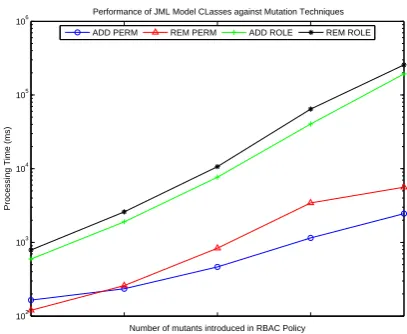
In an additional experiment, we compared the time taken by our JML model classes to detect each of the mutant generation techniques depicted in Fig. 11. Once again, we used a trace of Java methods depicting the main functionality for each application, and used the automated mutant-generation tool described before to generate different variations to an original RBAC policy. The results, as shown in Fig. 14, show that adding/removing a role to a given hierarchy is the most costly mutation to be detected by the RAC code through processing our assertion-based JML classes. This is mostly due to the way how role hierarchies are implemented in our JML classes, by using a series of java.util.ArrayList objects to store references to each senior/junior role in a given hierarchy, and allowing for such references to be inspected recursively when determining if there is a seniority relationship between two given roles.
5.2. ApplyingStatic AnalysisTechniquesto
Assertion-basedVerificatio
As mentioned in previous sections, we also leverage the ESC/Java2 tool for providing verification guarantees based on static analysis techniques and our proposed approach. However, despite the support provided for JML-based constructs by such a tool, some challenges must be addressed: first, in order to prove the correctness of a certain source code C
against its corresponding JML contracts, the tool additionally requires that the JML specifications of
3In JET, a test caseTfor a given methodMis said to bemeaningfulif
the tool is able to randomly create values forM’s formal parameters in such a way thatM’s preconditions involving such parameters are satisfied. OtherwiseTis said to bemeaningless.
102 103 104 105 106
Number of mutants introduced in RBAC Policy Performance of JML Model CLasses against Mutation Techniques
Processing Time (ms)
ADD PERM REM PERM ADD ROLE REM ROLE
Figure 14. Runtimeperformanceof ourVerificatio Approach.
each library called within C are available, including the specifications of additional libraries the original ones may eventually call later on. In some cases, such a requirement may notoriously increase the amount of VCs that need to be proved by the tool, so the verification process becomes prohibitively expensive, resulting in thespecification-creepproblem [17]. Second, an additional problem arises from the lack of support offered by the current tool for advanced JML concepts, such as the JML model classes introduced in Section 4 and the JML abstraction functions depicted in in Fig. 8, as the internally-produced VCs are too complex for the tool to handle, which limits the applicability of our assertion-based models.
Subsequently, we present an approach that addresses these challenges while still providing verification guarantees for our assertion-based approach. First, we addressed the specification-creep problem. In particular, as described in Section 4, we assumed the Security APIs leveraged within our case study have been implemented correctly and previously verified elsewhere. Therefore, there is no need to include their corresponding source code in our verification process. Based on this observation, we provided specification
stubsfor the leveraged Security APIs whose JML-based
annotations are trivially satisfied. Fig. 15 shows the translated JML specifications for the method hasRole
of class Subject, which implements an authorization check in the Apache Shiro API, as shown in Fig. 3 (b). One can see that a trivial method body has been provided; for the task of static checking a Shiro module only the contract and not the specification of hasRole is needed by ESC/Java2. The process of providing specification stubs can be carried out by security domain experts (see Table 1) for the Security APIs and must only be revised when new API versions are released.
Second, as mentioned before, the JML model classes, which are a core part of the approach shown in
12 EAI Endorsed Transactions Collaborative Computingon
12 2015|Volume1|Issue6 |e3
1 public class Subject {
2
3 /*@ public normal_behavior
4 @ requires true;
5 @ ensures \result == true || \result == false;
6 @ also
7 @ public exceptional_behavior
8 @ requires false;
9 @ assignable \nothing;
10 @ ensures true;
11 @ */
12 public /*@ pure @ */ boolean hasRole ( String r){
13 return true;
14 }
15 }
Figure 15. Specification Stubs for the ApacheShiro API.
1 public interface Account {
2
3 /*@ public normal_behavior
4 @ requires amt > 0.0;
5 @ assignable balance ;
6 @ ensures
7 @ ( SecurityUtils . getSubject ()
8 @ . hasRole (" teller ") ||
9 @ SecurityUtils . getSubject ()
10 @ . hasRole (" manager "))
11 @ == > ...
12 @ */
13 public void withdraw (double amt )
14 throws SecurityException ;
15 }
Figure 16. Translating ModelJMLClasses.
Section 4, are beyond the current capabilities of ESC/-Java2. To overcome this limitation, we provided JML specifications that do not employ the JML model classes and use low-level JML concepts instead. Table 5 shows the implementation-independent model classes and their corresponding low-level specifications for each framework. As an example, the aforementioned
hasRoleandgetAuthoritymethods are directly called rather than using JML model classes: the role hierarchy depicted in Table 2 and Fig. 7, which checks that the current user is granted a role senior to teller (e.g.
manager), can be translated into the JML contracts
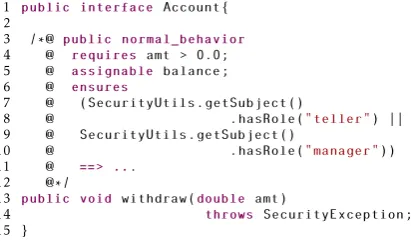
shown in Fig. 16 (lines 7-10): the references to the model class JMLRBACRolehave been substituted for the has-Rolemethod of classSubjectprovided by the Apache Shiro API, and are integrated together by using the operator||in JML, applied to all relevant senior roles (e.g., themanagerrole in line 10). We call this technique
unrolling the role hierarchy. It is also supported by
the JML-based translation tool described in Section 4 by automatically translating XACML policies to JML specifications suitable for ESC/Java2 and inserting them into the corresponding source code. This step relieves the software architect (see Table 1) from manually providing JML contracts, which is an error-prone process. Software architects can now leverage an automated tool for this purpose.
In addition, web-based Java software frameworks, e.g. Spring Framework, provide support for declarative
access control in addition to programmatic access control (e.g. by using authorization checks). Declarative authorization allows a developer to define role-based restrictions on access to certain protected resources such as a given Java method (see also Section 3). As an example, in the Spring Framework we can define access restrictions in an XML configuration file as follows:
< sec:protect method =" BankAccount . withdraw "
access =" teller "/ >
In the dynamic analysis approach described before, such declarative rules are implicitly considered because the Spring framework enforces this role assignment under the hood. However, in a static approach, we must also include such configuration files to obtain a complete picture about the access control features implemented in the web application. Otherwise, we would produce false positives because ESC/Java2 would falsely report that an authorization check is missing although it has been defined in the XML configuration file (and not in the code). To implement this additional feature, we parse the XML configuration files to retrieve the access control statements and insert their corresponding JML assume statements in the body of the referenced Java methods—the JML assume
statement lets ESC/Java2 unconditionally assume a constraint without checking it [17]. For instance, the XML configuration shown above can be translated into the following specification that is to be inserted in the implementation body of thewithdrawmethod of class
BankAccount(Fig. 8):
// @ assume GrantedAuthority . getAuthorities ()
// @ . contains (" teller ");
After the preparing steps, we applied our analysis technique to the applications under our case study, by following the mutation-based approach described before. All mutants were automatically detected by ESC/Java2 even if they were hidden within the many methods of the real-world case studies JMoney (125 methods) and OSCAR EMR (136 methods). As an example, in the following authorization check included in the JMoney application
if (! currentUser . hasRole (" accountant "))
throw new SecurityException (" Permission denied !");
a user with the acountant role is permitted to execute the method. If the user, however, has assumed a role senior to accountant (e.g. owner), a security exception is thrown, since the Apache Shiro library call has-Roleprovides no native support for implementing role hierarchies, which must be in turn encoded into a series of nested hasRole calls listing all the roles that are authorized to execute a given method.
We used a conventional Lenovo Thinkpad T510 lap-top (Intel Core i7-620M Processor, 2.66GHz, 8 GB
13 EAI Endorsed Transactions Collaborative Computingon
12 2015|Volume1|Issue6 |e3
Table 5. Mappingbetweenthe JMLRBACand Security-API-basedspecifications
JMLRBACRole.equals(new JMLRBACRole(r)) JMLRBACRole.isSeniorOf(new JMLRBACRole(r))
Spring Framework GrantedAuthority.getAuthorities().contains(r) GrantedAuthority.getAuthorities().contains(r) ||...||
GrantedAu-thority.getAuthorities().contains(mostSeniorRole)
Apache Shiro Subject.hasRole(r) Subject.hasRole(r) ||...|| Subject.hasRole(mostSeniorRole)
RBAC Monitor RBACMonitor.hasRole(r) RBACMonitor.hasRole(r) ||...|| RBACMonitor.hasRole(mostSeniorRole)
RAM) for our experiments with the static analysis tech-nique, in an effort to provide increased RAM capabil-ities to the theorem prover serving as a back-end for ESC/Java2. The runtime of the three applications under our case study is given in Table 4, which confirmed that the preparation steps enabled us to use ESC/Java2 efficiently. Specifically, we avoided the expensive anal-ysis of container classes, e.g. java.util.Collection, by applying the aforementionedspecification stub tech-nique. For example, the method getAuthorities()-.contains() uses a container class of the Java type
Collection and by leveraging the stub technique we succeeded in eliminating this problem.
6. Discussion and Related Work
In order for the approach presented in Section 4 to properly detect implementation flaws at the source-code level, a correct and sound translation from such a model into our assertion-based constructs is needed. With this in mind, a formal proof must include the following: first, only the access rights depicted in the original policy must be present in their JML-based counterpart, that is, no potential security vulnerabilities are introduced by adding extra access rights in the resulting specifications. Second, all access rights included in the original policy must be present in the translated specifications, that is, noinconveniences, e.g. preventing a legitimate access from taking place, are introduced by missing access rights included in the original policy. We present an sketch of such a proof in Appendix A.
The experimental results depicted in Section 5.1 and 5.2 support our claim that our approach can effectively expose the set of security vulnerabilities caused by the incorrect source-code level implementations of security models. In our approach, we have selected Java for our
proof-of-conceptimplementation due to its extensive use
in practice. Moreover, we have also chosen JML as the specification language for defining our assertion-based security models due to its enhanced tool support as well as its language design paradigm, which supports rich behavioral specifications. At the same time it strives to handle the complexity of using complex specification constructs, in such a way that it becomes suitable for average developers to use [7] (see Table 1).
We believe that our approach can be extended to other programming languages/development platforms.
For instance, Spec# [22] provides rich DBC-based specifications for the C# language, depicting an approach similar to JML. Moreover, our approach can be also applied to other Java-based frameworks such as JEE [23] or Android [24], which may help implement authorization checks for guarding access to its core system services.
Despite our success, some issues still remain in the verification process. In particular, ESC/Java2 may produce false positives (in case the built-in theorem prover cannot prove a VC) and false negatives (e.g., restrictions on loop unrolling). To deal with this situation, a possible solution may consider a runtime testing approach, like the one we have described using the JET tool, for all methods raising warnings by ESC/-Java2, thus showing a way in which both techniques can be used to provide stronger guarantees for the verification. Second, as shown in Table 3, the number
of meaningful test cases produced by the JET tool is
considerably less than the number of test cases created, which may affect the test coverage provided by the tool and could allow for potential security vulnerabilities to remain hidden during the verification process. This is mostly due to the limitations on the automated testing technique [16]. A possible solution would adopt a static approach for those methods whose test coverage is found to be below a given threshold. Finally, we have found that extended static checking is valuable when analyzing applications with respect to checking the implementation of an assertion-based access control model. In particular, we supported different concepts depicted in our model, which are in turn based on the ANSI RBAC standard, such as role hierarchies.
Furthermore, extended static checking represents a promising approach as there is no need to provide dedicated test cases nor implement a completerunning
system, as software modules can be tested in isolation by using modular reasoning techniques. Although ESC/Java2 is quite mature as a research prototype, some shortcomings still exist with respect to its current tools and development kits. As there are currently ongoing efforts for building a new extended static checker for Java within the OpenJML initiative4, we hope this approach can be applied to larger case studies in industrial contexts, supporting advanced
4http://jmlspecs.sourceforge.net/
14 EAI Endorsed Transactions Collaborative Computingon
12 2015|Volume1|Issue6 |e3