Asian Journal of Pharmaceutical Research and Development
(An International Peer-Reviewed Journal of Pharmaceutical Research and Development)www.ajprd.com
ISSN 2320-4850
Research Article
RP-HPLC METHOD DEVELOPMENT AND VALIDATION FOR
SIMULTANEOUS ESTIMATION OF RAMIPRIL AND S (-)
AMLODIPINE IN TABLET DOSAGE FORM
P.P. Vairagar 1, S.V. Mulgund1, S.P. Vassa*1, R.V. Korhale2
1Department of Quality Assurance Technique, Sinhagad College of Pharmacy, Vadgaon (Bk.), Pune-411 041,
Maharashtra, India.
2 Analytical departments, Emcure R & D Center, Bhosari, Pune-411026, Maharashtra, India
Received: 20 June 2013, Revised and Accepted: 16July 2013
ABSTRACT
The main objective of this study is to develop and validate a simple and rapid isocratic reversed-phase high-performance liquid chromatographic method (RP-HPLC) for the simultaneous estimation of S (-) Amlodipine besylate and Ramipril in combined dosage form. The HPLC system was operated isocratically at flow rate of 1ml/min at 40°C ± 0.5° C for 15 min. The mobile phase found to be most suitable for analysis was Acetonitrile: 0.02M Potassium dihydrogen ortho phosphate buffer (0.1 % of triethylamine, 0.1 % of 6-heptane sulphonic acid salt): 35:65% v/v, pH adjusted to 2.5 with O-phosphoric acid, detection was carried out at 210nm using Hypersil BDS C-18 (150*4.6mm) 5µ column with injection volume 20µ l. The retention time of Ramipril and S (-) Amlodipine Besylate were 5.61±0.3and 7.41±0.3 respectively. The proposed method was validated according to International Conference on Harmonization [ICHQ2 (R1)] and was found to be precise, accurate,
selective and rapid for the simultaneous determination of Ramipril and S (-) Amlodipine Besylate in bulk and tablet dosage forms. The linearity for Ramipril (r2=0.9914) and S (-) Amlodipine besylate (r2=0.9930) was established in the range of 25.14-75.41 and 25.46-76.38µg/mL respectively. This new developed method was found to be precise with satisfactory %RSD values for inter and intraday precision.
KEYWORDS: S (-) Amlodipine besylate, Antihypertensive, High Performance Liquid Chromatography, Ramipril, Validation
INTRODUCTION
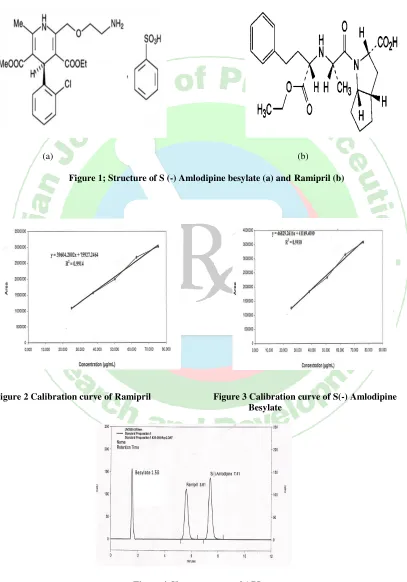
(-) Amlodipine besylate (Figure1a) belongs to the dihydropyridine group of calcium channel blocker used as an antihypertensive and antianginal agent [1]. S (-) Amlodipine besylate avoids the adverse effect of Amlodipine in racemic mixtures. S (-) Amlodipine besylate is an active and potent
*For Correspondence:
Mrs. Swetal P. Vassa
Department of Quality Assurance Technique, Sinhagad college of Pharmacy,
Vadgaon (Bk.), Pune-411 041, Maharashtra, India.
Email: [email protected] Contact no. - +919881143234
enantiomers of Amlodipine having IUPAC
name 3-ethyl
5-methyl2-[(2-aminoethoxymethyl]-(2-chlorophenyl)-l,
4-dihydro6-methy1-3, 5-pyridinedicarboxylate
[2, 3]. Ramipril (Figure 1b) is an angiotensin-converting enzyme (ACE) inhibitor, used in treatment of high blood pressure and congestive heart failure. It acts on the renin– angiotensin aldosterone system by inhibiting the conversion of the inactive angiotensin I to the highly potent vasoconstrictor, angiotensin II, and also reduces the degradation of bradykinin [4]. Ramipril having IUPAC name 2-[N-[(S)-1-(ethoxycarbonyl)-3-
phenylpropyl)]-L-alanyl]-(1S,3S,5S)-2-azabicyclo [3-3-0] octane carboxylic acid [5].
Various analytical methods were found for the determination of Amlodipine and Ramipril as single or in combination with other drugs [6-13]. Very few methods have been reported for quantitative estimation of Ramipril and
Amlodipine besylate in combination [14-16].
Hence, the aim of the present work is to develop a simple and rapid method for simultaneous estimation of S (-) Amlodipine besylate and Ramipril in bulk and tablet dosage form.
(a) (b)
Figure 1; Structure of S (-) Amlodipine besylate (a) and Ramipril (b)
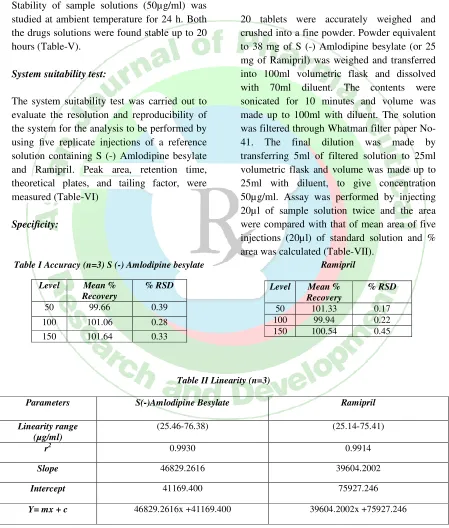
Figure 2 Calibration curve of Ramipril Figure 3 Calibration curve of S(-) Amlodipine
Besylate
MATERIAL AND METHODS
Chemicals and reagents:
Working standard of S (-) Amlodipine besylate and Ramipril were obtained from Emcure House, Bhosari, Pune. Acetonitrile and Methanol were obtained from RFCL
Limited, Mumbai, India. Potassium
dihydrogen orthophosphate, Tri-ethylamine and 6-heptane sulphonic acid salt were procured from Merck Chemicals, Mumbai, India. Purified water used was obtained from Milli Q.
Preparation of Phosphate buffer:
2.72 gram of Potassium dihydrogen
orthophosphate was accurately weighed and transferred into a 1000ml beaker, and dissolved with water. 1ml of triethylamine and 1gm of 6-heptane sulphonic acid salt were added and the contents were diluted up to 1000ml with purified water.
Preparation of mobile phase:
The mobile phase was prepared by addition of Phosphate buffer 650 ml (65%) and 350 ml of
Acetonitrile (35%).The pH of the solution was
adjusted to 2.5 with Orthophosporic acid,
degassed in ultrasonic water bath for 5 minutes. The solution was further filtered using 0.45 µ nylon filter.
Diluent Preparation:
Diluent was prepared by addition of 0.02M Potassium dihydrogen orthophosphate buffer 50% and Acetonitrile 50% then finally the resultant mixture was filtered using 0.45 µ nylon filter.
Standard preparation:
38mg S(-) Amlodipine besylate and 25mg Ramipril were accurately weighed and dissolved with 70 ml diluent into a 100ml volumetric flask. The contents were sonicated for about 10 minutes and then 5ml of above solution was transferred to 25ml volumetric flask, diluted with diluent to give a solution of 50µg/ml of both the drugs [S(-) Amlodipine and Ramipril].
Experimental Conditions:
The HPLC system was operated isocratically at the flow rate of 1ml/min at 40°C ± 0.5° C for 15 minutes. The mobile phase selected for analysis was Acetonitrile: 0.02M Potassium dihydrogen ortho phosphate buffer (0.1 %
triethylamine, 0.1 % 6-heptane sulphonic acid salt): 35:65% v/v, pH adjusted to 2.5 with O-phosphoric acid, detection was carried out at
210nm using Hypersil BDS C-18
(150*4.6mm) 5µ column with injection volume 20µl.
Validation procedure: Accuracy (% recovery):
The accuracy of the method was determined by calculating the recovery of S (-) Amlodipine besylate and Ramipril by the standard addition method. Known amounts of standard solution of S (-) Amlodipine besylate and Ramipril (25, 50, 75 µg/ml) were added to prequantified sample solutions of tablet dosage form. The amount of S (-) Amlodipine besylate and Ramipril was estimated by applying values of peak area to the regression equations of the calibration curve (Table-I).
Linearity:
Stock solution was prepared by dissolving 47.5mg S (-) Amlodipine besylate and 31.5mg Ramipril in 100ml diluent in volumetric flask. Aliquots were prepared in the range of 50-150 % by taking 2, 3, 4, 5, 6ml from standard stock solution to 5 different 25ml volumetric flasks, diluted to 25ml with diluent. Linearity was established by calibration curve (Fig-2, 3) and the date for regration analysis of the calibration was shown in Table II.
Precision:
Robustness:
Robustness of the method was studied by changing the flow rate (±0.1ml/min), column
temperature (±50C), mobile phase composition
(±5), wavelength (±2nm), and pH (±0.2) (Table-IV).
Solution stability:
Stability of sample solutions (50µg/ml) was studied at ambient temperature for 24 h. Both the drugs solutions were found stable up to 20 hours (Table-V).
System suitability test:
The system suitability test was carried out to evaluate the resolution and reproducibility of the system for the analysis to be performed by using five replicate injections of a reference solution containing S (-) Amlodipine besylate and Ramipril. Peak area, retention time, theoretical plates, and tailing factor, were measured (Table-VI)
Specificity:
Specificity is the ability of the method to measure the analyte response in the presence of its potential impurities and degradation products. The pharmaceutical formulation was subjected to forced degradation studies and no interferences of placebo as well as degradant was observed. Hence, the method was found to be specific.
Assay of Tablet formulation:
20 tablets were accurately weighed and crushed into a fine powder. Powder equivalent to 38 mg of S (-) Amlodipine besylate (or 25 mg of Ramipril) was weighed and transferred into 100ml volumetric flask and dissolved with 70ml diluent. The contents were sonicated for 10 minutes and volume was made up to 100ml with diluent. The solution was filtered through Whatman filter paper No-41. The final dilution was made by transferring 5ml of filtered solution to 25ml volumetric flask and volume was made up to 25ml with diluent, to give concentration 50µg/ml. Assay was performed by injecting 20µl of sample solution twice and the area were compared with that of mean area of five injections (20µl) of standard solution and % area was calculated (Table-VII).
Table I Accuracy (n=3) S (-) Amlodipine besylate Level Mean %
Recovery
% RSD
50 99.66 0.39
100 101.06 0.28 150 101.64 0.33
Ramipril Level Mean %
Recovery
% RSD
50 101.33 0.17 100 99.94 0.22 150 100.54 0.45
Table II Linearity (n=3)
Parameters S(-)Amlodipine Besylate Ramipril Linearity range
(µg/ml)
(25.46-76.38) (25.14-75.41)
r2 0.9930 0.9914
Slope 46829.2616 39604.2002
Intercept 41169.400 75927.246
Y= mx + c 46829.2616x +41169.400 39604.2002x +75927.246
Parameter S(-) Amlodipine besylate Ramipril Interday(%RSD) 0.34 0.38
Intraday(%RSD) 1.92 0.68
Table IV Robustness
Parameter Change Area %RSD of S(-) Amlodipine
besylate
%RSD of Ramipril Wavelength(±2) 208nm 0.27 0.84
212nm 0.56 0.45
Temperature(±5̊C) 35˚C 0.16 0.24
45˚C 0.71 0.60
Flow rate(±0.1) 0.9ml/min 0.20 0.34
1.1ml/min 0.50 0.49
pH(±0.2) 2.3 0.47 0.40
2.7 1.32 1.02
Mobile phase composition (±5%)
ACN:Buffer(30:70) 0.61 1.17
ACN:Buffer(40:60) 0.85 0.33
Table V Solution stability (at 50µg/ml)
Parameter Mean area SD %RSD S(-)Amlo-
Dipine besylate
Ramipril S(-) Amlo- Dipine besylate
Ramipril S(-) Amlo- Dipine besylate
Ramipril Initial 2349521 2006433 7212.82 8621.7 0.31 0.36
4th hr 2348675 2005325 23581.557 7292.478 1.01 0.46
8th hr 2345424 2002465 21089.535 9145.09 0.9 0.42
12th hr 2347685 2002818 27908.299 8486.975 1.19 0.4
16th hr 2349693 2003218 33909.889 7963.817 1.44 0.52
20th hr 2351751 2005391 40456.139 10477.705 1.71 0.79
24th hr 2385014 2019702 49788.224 48696.054 2.09 2.41
Table VI System Suitability
Parameter Ramipril S(-)Amlodipine besylate Area 1974987 2397606
SD 6422.977 20433.552
%RSD 0.33 0.85
RT(min) 5.61±0.3 7.41±0.3
Theoretical Plate 2240 3939
Table VII Assay of Marketed Formulation
Parameters S(-)Amlodipine besylate Ramipril Label Claim (mg) 2.5 2.5
Actual content found (mg) 2.512 2.49
% RSD 0.86 0.16
%Assay 100.48 99.6
RESULTS AND DISCUSSION
Selection of analytical wavelength was done with stock solutions of 50µg/ml in various organic solvents and scanned in UV range. Maximum absorbance of S (-) Amlodipine besylate and Ramipril was found at 232 nm and 210nm respectively so these wavelengths were taken for analysis but further study was done with 210nm because both the drugs chromatogram were seen at this wavelength. The initial method development was started with mobile phase of 0.05M Sodium phosphate buffer: Acetonitrile (50:50) with different pH values and columns. Further trials were done with 0.02M Phosphate dihydrogen
orthophosphate buffer: Acetonitrile
combinations (40:60, 50:50, 60:40, and 70:30v/v) and the column used was C8. The satisfactory peak area, asymmetry, theoretical plate, resolution factor were seen with final chromatographic conditions set for the method
were mobile phase of
Acetonitrile:0.02MPotassium dihydrogen
ortho phosphate buffer (0.1 % triethylamine, 0.1 % 6-heptane sulphonic acid salt) 35:65% v/v, pH adjusted to 2.5 with O-phosphoric acid with flow rate of 1 ml/min and temperature of
40 0C. The column used was Hypersil BDS
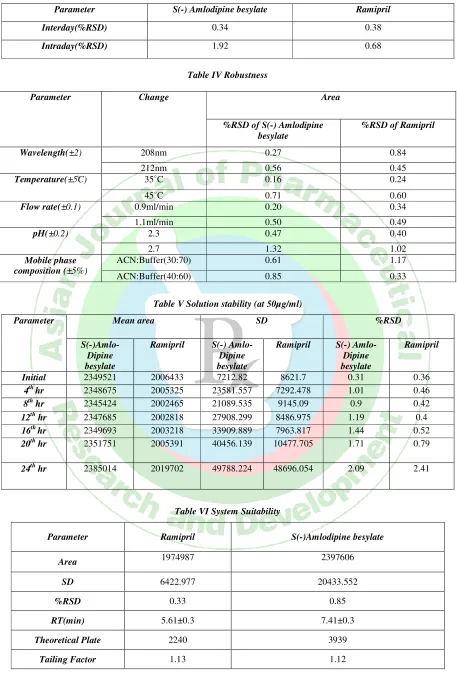
C-18 (150*4.6mm) 5µ with 20µl injection volume and detection was carried out at 210 nm (Fig-4). The calibration curve was
obtained by plotting area verses the
concentration of the solution and it was found linear for S (-) Amlodipine Besylate (r2= 0.9930) and Ramipril (r2= 0.9914) over the concentration range of 25.46-76.38 and 25.14-75.41µg/ml respectively. The %RSD values for accuracy, precision and robustness obtained were less than 2 which conclude that
developed method was accurate, precise and robust. Both the drugs show stability in solution form up to 20th h. Assay of marketed formulation was found to be within 98-102 %.
CONCLUSION
A new, simple and rapid RP-HPLC method has been developed for the estimation of S (-) Amlodipine Besylate and Ramipril in bulk and tablet dosage forms. This new method was validated and found to be simple, precise and accurate. It can be used for quantification of S (-) Amlodipine Besylate and Ramipril simultaneously in bulk and tablet dosage forms as well as for routine analysis in quality control.
ACKNOWLEDGEMENT
The authors would like to thank Emcure R&D Centre, Bhosari, Pune, India, for providing the chemicals and also the facilities for doing the project work. They would also like to convey thanks to Dr. K. N. Gujar, Principal, Sinhgad college of Pharmacy, Vadgaon (Bk.), Pune for providing constant support throughout the project work.
REFERENCES
1. Tripathi KD. Essential of medical pharmacology. New Delhi: Jaypee Brothers Medical Publishers (P) LTD; 2003; 6: 483-485,528-531
2. Maryadele J, Neil O. The Merck index. White House Station, NJ, USA: Merck and Co,2006; 14: 1561-1569
3. British pharmacopoeia, The Stationary Office, London, 2005;126
5. Indian Pharmacopoeia. New Delhi: The controller of publication Govt. of India 2007; 3:164
6. Kocyigit KB, Rollas S, Unsalan S. Determination and validation of Ketoprofen, Pantoprazoleand Valsartan together in human plasma by high performance liquid chromatography. Pharmazie 2006; 61: 586-589
7. Daneshtalab N, Lewanczuk RZ, Jamali F. High performance liquid chromatographic analysis of angiotensin II receptor antagonist Valsartan using a liquid extraction method. J Chromatogr B Analyt Technol Biomed Life Sci. 2002; 766: 345-359 8. Gonzalez L. Fast screening method for the
determination of angiotensin II receptor antagonists in human plasma by high-performance liquid chromatography with fluorimetric detection. J Chromatogr A 2002;949:49-60
9. Satana E. Simultaneous determination of Valsartan and Hydrochlorothiazide in tablets by first-derivative ultraviolet spectrophotometry and LC. J Pharm Biomed Anal 2001; 25:1009-1013
10. Tatar S, Saglik S. Comparison of UV and second derivative-spectrophotometric and LC methods for the determination of Valsartan in pharmaceutical formulation. J Pharm Biomed Anal 2002; 30: 371-375
11. Stanisz B, Kania L. HPLC method for estimation of Ramipril in human plasma. Acta. Pol. Pharm. 2006; 63, 471-476
12. Vachareau A, Neirinck L. Estimation of Ramipril by spectroscopy. Indian Drugs 2000; 37, 589-593. 13. Valiyare GR, Chandra A, Apte SK. HPLC method for
estimation of Ramipril, Indian Drugs 2004; 41, 36-39.
14. Babu KA, Kumar GV, Sivasubramanian L.
Simultaneous Estimation Of Ramipril And
Amlodipine In Pharmaceutical Dosage Form By RP-HPLC Method, International Journal of Pharmacy and Pharmaceutical Sciences 2011;4:196-198 15. Rajput PS, Kaur A, Gill NK, Mittal K, Sarma GS,
Simultaneous Estimation of Ramipril and Amlodipine in Bulk and tablet Dosage form by RP-HPLC Method, JAPS 2012; 02(07): 160-165