DETECTING ATTACKS AND PROTECTING FROM
SINGLE TO MULTI LEVEL APPLICATION
D S. N. Reddy
1, Srinivasula Reddy Doddam Reddy
2 1M.Tech Scholar (CS),
2Assistant Professor
Nalanda Institute of Technology (NIT), Siddharth Nagar, Guntur, (India)
ABSTRACT
In web base services contains a data relocate from different layer. Web services have different layer for the data
transmit and the sequence is difficult in the service. In service transferring data is contains intrusion from the
user communication in web base services to detect the intrusion in attentive basis and detect the intrusion in
both offline and online. The offline ready to act data previously contains attack basis it can be rectifies. The
online alert system data contains the interruption collect the intrusion in buffer and contrast with recent alert
system is called multilayer interruption detection system. The attentive results notice the fault in web based
document data using IDS system. From this analyse presentation of the web based services.
Keywords
:
Intrusion Detection System, Anomaly Detection, Web Server, Attacks, SQLIA,
Classification of SQLIA.
I.
INTRODUCTION
Web delivered armed forces and applications have enlarged in both complexity and popularity over the past few
years. Everyday tasks, find as travel, banking and social networking, are all done via the web. Such armed
forces characteristically use a web server front end that runs the application user crossing point logic as well as a
back end head waiter that consists of a database or file server. Appropriate to their all over the place use for
corporate and personal data, web services have constantly been the target of attacks. These attacks have just
become more different, as attention has moving from aggressive the front end to develop vulnerabilities of the
web function in arrange to dishonest the back end database system. A overabundance of Intrusion Detection
Systems currently scrutinize network packets independently within both the web server and the catalogue
system. However there is very little work organism perform on multi tiered Anomaly Detection systems that
engender models of network behaviour for both web and database complex interactions. Such case multitier
architectures, the back end database server is often secluded behind a firewall while the web servers are
distantly reachable over the Internet. Unfortunately, through they are cosseted from
II. ATTACKS IN WEBSITES
A overabundance of Intrusion Detection Systems (IDSs) currently examine network packets independently
surrounded by both the web server and the database system. Though, there is very little working human being
performed on multi-tiered Anomaly Detection (AD) systems that generate models of network behaviour for both
web and database network connections. In such multi - tiered architectures, the back-end database server is often
protected behind a firewall at the same time as the web servers are remotely available over the Internet.
Unfortunately, despite the fact that they are secluded from straight distant attacks, the back-end systems are
inclined to assault that use web requirements as a income to develop the back end.
2.1 Input Validation Attack
If hackers has put out of action java script validation then we can add more protection by providing server side
validation.
Fig: 2.Validation Attack
2.2 Directory Browsing Attack
Hackers can’t directly get list of files on web servers. Address list on the web server or applications are
characteristically locked down to avoid remote browsing when the information bank restrain documentation,
executables, text files or application-related install or arrangement materials. In such possessions either the
complete directory is configured to block admission, or access is granted on a per file basis, involve a exacting
demand to access objects in the fact list. Information bank listing can be banned in server design files, but may
also arise from susceptibility in a exacting application.
Achieve directory lists allows an assailant to map out the server's directory structure and identify potentially
susceptible files and sample appliance. An assailant will use the in progression gain from directory listings to
plan additional attacks in opposition to the server. Achieve directory lists is also functional because it make
available a means for formative if other vulnerabilities are current or whether meticulous application attacks are
successful.
Fig: 3.Directory Browsing Attack
2.3 Brute Force Attack
A password attack that does not attempt to decrypt any data but continue to try dissimilar passwords for
example, a brute force attack may have a dictionary of all words or a listing of normally used passwords. To try
again access to an account using a brute force attack, a program tries all available words it has to gain access to
the account. Another type of brute-force attack is a program that runs through all letters or letters and numbers
Fig: 4.Directory Browsing Attack
Although a brute force attack may be able to gain access to an account ultimately these attacks can take quite a
few hours, days, months, and even years to run. The quantity of time it takes to complete this attack is
dependent on how difficult the code word is and how well the attackers identify the intention. To help check
brute force attack a lot of systems will only allow a user to make a mistake in the direction of the inside their
username or password three or four times. If the user exceeds this venture, the system will either protection
device them out of the organization or prevent any prospect attempts for a set amount of time
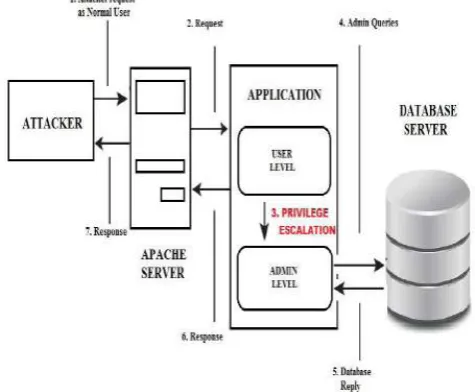
Fig 5: Privilege Escalation Attack
2.4 Hijack Future Session Attack
This class of attacks is primarily aimed at the web server side. A hacker frequently gets over the web server and
consequently hijacks all subsequent legitimate user sessions to instigate attacks. For occurrence, by hijacking
other user sessions, the attacker can overhear something, send spoofed drop and respond user requirements. A
session hijacking attack can be additional classified as a Spoofing Man-in-the-Middle attack, an excitement
attack, a Denial-of-Service / Packet Drop attack, or a Response attack. According to the charting (Mapping)
model, the web request should invoke some database queries, and then the irregular situation can be identified.
2.4 DDOS Attack
It validates the reasonable user based on the preceding history. Based on the information of detects distrustful
assembly. Once distinguish, a speed limiter and a scheduler are second-hand to demote service to the spiteful
users and to schedule the less distrustful session based on the system user’s trust and workload level.
2.5 AES Algorithm
We are using Advance Encryption Standard (AES) encryption algorithm for encryption and decryption of
information. We are already giving protection to our appliance but not for data. By using encryption we can
bit size. We are storing data into database in encrypted format. When user shopping, we get that sleeve perform
encryption by using encryption algorithm Advance Encryption Standard (AES). Following it gives encrypted
information and that information stored into database. When use upload information by using encryption
method we encrypt that information and store into database in encrypted format but when user click on view
information get that encrypted information from database perform decryption method on that information and
exchange it into original and decipherable format. Once information stored into database in encrypted format
then even if database got hacked by hacker, hacker cannot understand that information due to encrypted format.
2.6 Encryption
Given Input:- Attribute Value (At).
• Get Byte [] (B1) of that Attr. • Generate Key ().
• Perform Encryption on B1. • Convert B1 into string (EAt).
2.7 Decryption
Given Input:- Encrypted attribute value (EAt)
• Convert EAt into byte [](B2). • Generate Key.
• Perform Decryption on B2. • Convert B2 into string (DAt).
2.8 Deliverables
• Static Web site
In static website we can allocate user to upload and viewing information from web server.
• Dynamic Website
In dynamic website we can allow site guests to post, read and comment on commentary. Site visitor view blogs
by group wise and through calendar wise. Dynamic website like blogs necessitates regular updating of database.
Admin can achieve all activities of site visitor. Admin also perform edit, add, and deletes new group comment
and blog.
• How Attack happens
In this we are showing how assailant can attack to our system.
• Prevent website from attack
In this we are showing how our system can be check from those types of attack.
III. PROPOSED SYSTEM
In the designation propose Double Guard which is used to detecting attacks in multi tier web services. In Double
Guard the new container based web server architecture allows user to divide the dissimilar in sequence flows by
each discussion. This provides revenue of pathway the data flow from the web server to the database server for
each session. This approach also does not need for user to examine the source code or know the application
virtualization. Virtualization indicate that each client make use of its own virtual web server each client is
development by a dissimilar web server. Thus, extremely secure system is provided that as each customer
procedure is taken as divide session.
3.1 Mechanism of Proposed System
3.1.1 SQL Attack Module
We have evaluate the four attacks that normally takes place. These attacks are commandeering Future Session
Attack, freedom Escalation Attack, and Injection Attack Direct Data Base Attack. In Privilege acceleration
Attack, the attacker login as a ordinary user and activate admin queries so as to get hold of an administrator’s
data. Take control prospect session attack is class of assault is mostly meant at the web member of staff serving
at table side. An attacker generally takes in surplus of the web server and consequently hijacks all subsequent
valid user sessions to initiate Attacks. SQL injections do not require co-operation the web server. Attacker can
use available vulnerabilities in the web server reason to inject the data or threads satisfied that having the
exploits and then use the web server to communicate these develop to attack the back end database.
3.1.2 Prevention Module
The server is activated each user is instigated to use the service. Each user has its possess web member of staff
serving at table i.e. numerous practical mesh servers are fashioned in a single system using same service.
Consequently each user access through a virtual web server, in this way we can generate multiple occurrence of
server. Hence user can access a service through the web server which specifies the basic impression of Double
guard architecture. Once user is instigating it try to login to use the repair. Here we portray the avoidance
provided against the assailant. The four attacks has been recognized and shown how to overcome it. Here only
official user can login and use the blog. If an attacker login, his documented and blocked. No further
development can be done by them. Outstanding to the use of multiple web servers from time to time attacker get
confused about the innovative server and occurrence of the server.
3.1.3 Blog Creation Module
We contain showed both dynamic and Static website. Originally the users logon to his application. After
categorizing him as a genuine consumer, he can appointment the application. The Home page is a dynamic web
site because it can be changed and edited. The user can add his profile name or do any changes to his
application. After you click preview, you can see the static web site as all contents are static. Changes can’t be
made in that website. In the application you can type the content you want to do post and post. It is similar to all
web pages where user can post his application. After all work has done the user can logout from the website
which security his protection.
3.1.4 Traffic Capture Analysis Module
The traffic analysis captured between the user and web server and also between the database and server. It
makes available the overall data concerning the total small package sent, distance end to end of the packet and
time of in receipt of of packets. It provides particulars about the source IP, destination IP and captured time of
packet. It also give data about the Ethernet border, the procedure used TCP and IP etc and details about HTTP
protocol. It also make available graphical display of a variety of OSI layers similar to Application layer,
Network layer, etc. That is it supply visual situation of the usage levels of every layer of OSI layer. Using this
Impostor is notice and his activities have been noted. In general, by the information with reference to the
capture time of each container, last sent packet and its length can be identified. Accordingly analysing this in
general in sequence an interloper can be distinguished. Generally an intruder login and does all his activities.
This is stored in the database and can be used to identify the irregular usage. Consequent request can be noted
and an interloper can be identified. Based on the usage, A Network layer is depicted. It shows the graphical
practice pattern.
Algorithm for Double Guard
Step 1: Identify the input category of HTTP apply for whether
it is a query or a appeal.
Step 2: Stockpile the input values in hash table as for each
their category AQ for query and for request AR.
Step 3: This key in support of hash table access purpose be set
as the input itself.
Step 4: Advance AR and AQ to useful server to authenticate.
Step 5: Condition attack acknowledged then virtual system
automatically terminate the HTTP request.
Step 6: As well HTTP request is forward to the novel server.
Step 7: Display data or information.
Step 8: Exit.
IV. CONCLUSION
Double Guard is used to check the intrusions in multi tier web application. It is an application independent
system and used for both back-end as well as front-end. It is also used for dynamic and static web servers which
make available better protect for the information and web application. We are store up the vital information data
about the submission for which the system will work in encrypted and protected format. As well the
management particulars will be securely stored. And because the system itself works for the protection this data
will not be easily accessible according to our architecture. Member of staff serving at table on which
Application exist in is a divide one from the attendant where IDPS resides therefore it won’t change the rapidity
of the application. The control logic in the host controller selects the web server to satisfy the web requests.
Hence selection of a web server with minimal pending requests can be made and hence processing of the system
speeds up. In future we can retrieve information data from scan by means of our tone of voice as an alternative
of typing text. The user can search through voice the system will identify this tone and given essential
information data about a topic.
REFERENCES
[1] Meixing Le, Angelos Stavrou, Brent ByungHoon Kang. ”DoubleGuard: Detecting Intrusions In Multi-tier
Web Applications” IEEE transaction on dependable and secure computing vol.9 no.4 year 2012
[2] Openvz. http://wiki.openvz.org.
[3] Virtuozzo container http://www.parallels.com/ products/pvc45
[5] B. Parno, J. M. McCune, D. Wendlandt, D. G. Andersen, and A. Perrig. CLAMP:
[6] Practical prevention of large-scale data leaks. In IEEE Symposium on Security and Privacy. IEEE
Computer Society, 2009.
[7] http://web.nvd.nist.gov/view/vuln/detail?vulnId=CVE-2010-4332.
[8] http://web.nvd.nist.gov/view/vuln/detail?vulnId=CVE 2010-4333.
[9] Common vulnerabilities and exposures. http://www.cve.mitre.org/.
[10] Five common web application vulnerabilities.http://www.symantec.com/connect/articles/five-
common-webapplication- vulnerabilities.
AUTHOR PROFILE
B Rajesh Kumar Reddy is currently pursuing M.Tech in the Department of Computer
Science, from Nalanda Institute of Engineering & Technology (NIET), siddharth
Nagar, Kantepudi(V), Sattenapalli (M), Guntur (D), Andhra Pradesh , Affiliated to
JNTU-KAKINADA.
Srinivasula Reddy Doddam Reddy working as Assistant Professor at Nalanda
Institute of Engineering & Technology (NIET), siddharth Nagar, Kantepudi(V),