188 | P a g e
SEISMIC EVALUATION OF MULTISTORIED
BUILDING WITH AND WITHOUT FLOATING
COLUMN
Jayesh Rathi
1, Sharvari Dhepe
21,2
Department of Applied Mechanics, Government College of Engineering, Amravati (India)
ABSTRACT
Structural Engineering is that branch of Civil Engineering which deals with the analysis and the design of the
structures. The analysis and design of a building with floating column is typical. The various forces which are
developed in building have a discontinuous path in load transformation during seismic effect.
This paper deals with the analysis of a seven storey building. The analysis is done by dynamic method using
Response Spectrum Method. The various structural responses such as storey displacement, storey drift, and
storey forces have been calculated. The buildings are analyzed for two different zones i.e. zone III and zone V.
The analysis is done using the software ETABS.
Keywords: dynamic analysis, floating column, ETABS, response spectrum method
I.
INTRODUCTION
1.1 Introduction:- A column is supposed to be a vertical member starting from foundation level and
transferring the load to the ground. The term floating column is also a vertical member which at its lower level
rests on a beam which is a horizontal member. The beams in turn transfer the load to other columns below it [1].
The building can be categorized into two type, regular building and irregular building. Building containing
floating column comes into irregular type of building.
In India, now a days many multi-storeyed have keep their ground storey open as an unavoidable feature. The
main purpose of opening ground storey is to accommodate parking or reception lobby. This type of building is
mainly known as irregular building
When an earthquake occurs, the forces generated by earthquake need to be brought down through the height of
the building. In every building the load transfer takes from horizontal member (beams and slabs) to vertical
member i.e. columns and walls which transfer the load to the foundation [6]. So building with floating column,
there will be discontinuity in load transfer path. The forces which are generated will be transferred to the ground
through the shortest possible path. Figure1 shows the model of building with floating column and load transfer
path.
In this paper a normal building containing seven storeys is considered. In order to convert it into a building with
floating column, some of the columns at storey one is removed and two cases are considered. These buildings
were analysed for two different zones i.e. zone III & zone V. For this two cases the various parameters such as
189 | P a g e
Fig. 1 Model of building with floating column.1.2 Objective and scope
a) To study the effect of floating column on a building by considering two different cases for two different
zones i.e. Zone III and Zone V.
b) To compare the various structural parameters of a normal building with building containing floating column.
c) To study the dynamic effect on a normal building and building with floating column.
d) To compare which case is more superior with another in high seismic zone.
II.
MODELLING DETAILS
In present study, seven storey normal building is considered and in normal building columns of storey one are
removed with different arrangements to make it into building with floating column. For this evaluation two
different cases are considered along with normal building. These cases are evaluated for two different zones i.e.
zone III and zone V. Building has storey height of 3m.
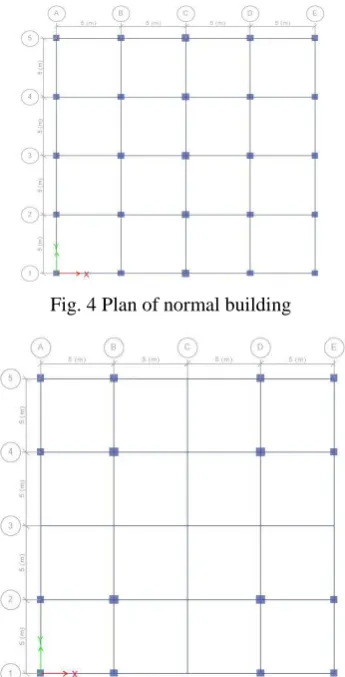
The building has plan area of 20m x 20m. The spacing of columns in X direction is 5m and spacing of columns
in Y direction is 5m. For building with floating column, two different cases are considered.
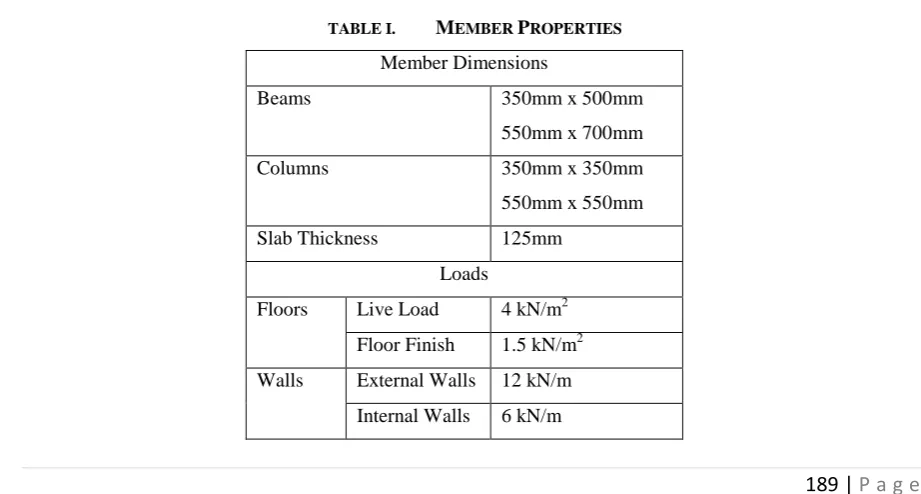
The building properties are shown in following table:
TABLE I. MEMBER PROPERTIES
Member Dimensions
Beams 350mm x 500mm
550mm x 700mm
Columns 350mm x 350mm
550mm x 550mm
Slab Thickness 125mm
Loads
Floors Live Load 4 kN/m2
Floor Finish 1.5 kN/m2
Walls External Walls 12 kN/m
190 | P a g e
Parapet 4.6 kN/mGrade
Concrete M – 35
Rebar HYSD 500
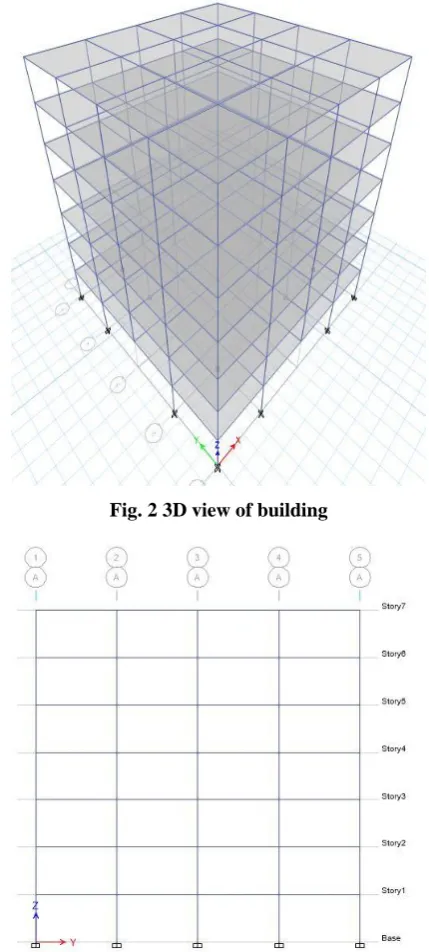
Building plan and elevation of normal building and building with floating column are shown in fig. 3 to fig. 6.
3D view of normal building is shown in following building.
Fig. 2 3D view of building
191 | P a g e
Fig. 4 Plan of normal buildingFig. 5Plan of building with floating column(case1)
Fig. 6 Plan of building with floating column (case2)
III.
RESULTS
AND
DISCUSSION
In this study a normal building and two cases of building with floating columns were analyzed for two different
zones and the results obtained were shown in tabular form and compared. The various structural parameters
such as Storey Displacement, Storey Drift, Storey Forces and Time Period were calculated.
Storey Displacement: Storey Displacement is defined as the lateral movement of the building which is caused
192 | P a g e
Following table shows Storey Displacement for building of Zone IIITABLE II. STOREY DISPLACEMENT FOR ZONE III
Storey Normal Case1 Case2
Base 0 0 0
Storey1 2 2.8 2.8
Storey2 5.3 5.9 6.1
Storey3 8.4 9 9.2
Storey4 11.1 11.6 11.8
Storey5 13.2 13.7 13.8
Storey6 14.7 15.2 15.3
Storey7 15.4 16 16
Following graph shows the comparison of Storey Displacement for Zone III
Fig.7Comparison of Storey Displacement for zone III
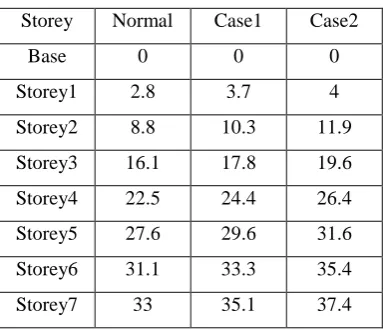
Following table shows Storey Displacement for building of Zone V
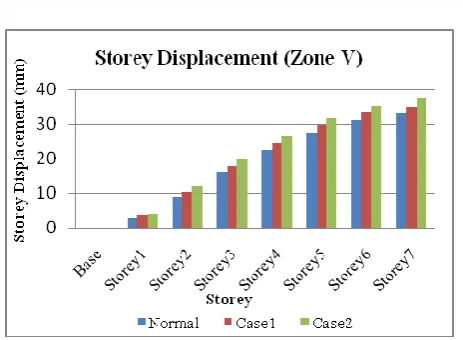
TABLE III. STOREY DISPLACEMENT FOR ZONE V
Storey Normal Case1 Case2
Base 0 0 0
Storey1 2.8 3.7 4
Storey2 8.8 10.3 11.9
Storey3 16.1 17.8 19.6
Storey4 22.5 24.4 26.4
Storey5 27.6 29.6 31.6
Storey6 31.1 33.3 35.4
Storey7 33 35.1 37.4
193 | P a g e
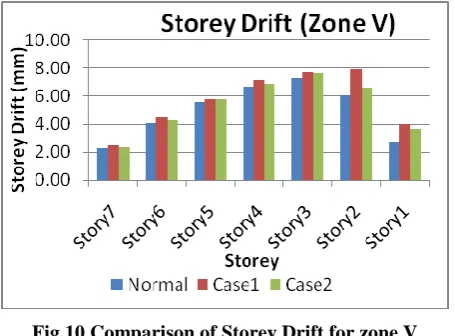
Fig. 8Comparison of Storey Displacement for zone VStorey Drift: Storey Drift is defined as the relative difference between the displacements of adjacent storey. As
storey displacement increases, storey drift also increases.
Storey Drift for normal building and both cases of building with floating column and their comparison are
shown below.
TABLE IV. STOREY DRIFT FOR ZONE III
Storey Normal Case1 Case2
Story1 2.386 2.799 2.826
Story2 2.785 3.111 3.294
Story3 3.18 3.211 3.12
Story4 2.802 2.875 2.745
Story5 2.319 2.327 2.271
Story6 1.689 1.695 1.65
Story7 0.933 0.957 0.903
Following graph shows the comparison of Storey Drift for Zone III
194 | P a g e
TABLE V. STOREYDRIFTFORZONEV
Storey Normal Case1 Case2
Story1 2.76 3.99 3.69
Story2 6.08 7.96 6.63
Story3 7.33 7.75 7.67
Story4 6.67 7.15 6.92
Story5 5.55 5.79 5.8
Story6 4.08 4.47 4.3
Story7 2.29 2.46 2.36
Following graph shows the comparison of Storey Drift for Zone V
Fig.10 Comparison of Storey Drift for zone V
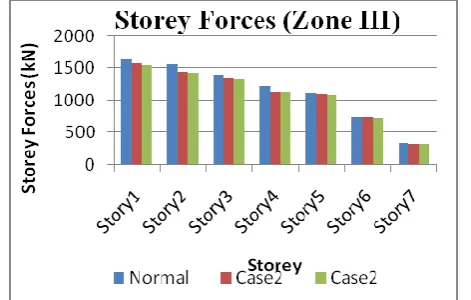
Storey Forces: The Forces which are induced at every storey during an earthquake is known as Storey Forces.
Storey Forces induces in a building with floating column will be less as compared to normal building since the
mass is less for building with floating column
TABLE VI. STOREY FORCES FOR ZONE III
Storey Normal Case2 Case2
Story1 1638 1576 1556
Story2 1564 1447 1437
Story3 1403 1357 1347
Story4 1220 1141 1135
Story5 1113 1102 1092
Story6 749 740 732
Story7 346 335 325
195 | P a g e
FIG. 11 COMPARISON OF STOREY FORCES FOR ZONE IIITABLE VII. STOREY FORCES FOR ZONE V
Following graph shows the comparison of Storey Forces for Zone V
Fig. 12 Comparison of Storey Forces for zone V
IV.
CONCLUSION
From the analysis done and the results obtained, the following conclusions were drawn:
a) Storey Displacement: With the introduction of floating column in the building, storey displacement
increases.
Storey Normal Case1 case2
Story1 4072 4000 3639
Story2 3893 3772 3459
Story3 3503 3383 3113
Story4 3051 2950 2716
Story5 2540 2474 2283
Story6 1868 1829 1703
196 | P a g e
b) Storey Drift: As storey displacement increases, storey drift also increases for a building with floatingcolumn.
c) Storey forces: Storey Forces in a building with floating column is less as compared to the normal building
since there is less number of columns.
d) Floating columns should be avoided the areas of high seismic zones because of its poor performance.
e) The performance of building can be improved by increasing the dimensions of beams and columns where
floating columns are provided.
f) The results obtained for Case 2 were more as compared than Case 1.
REFERENCES
[1]Shiwli Roy, GargiDanda de, “Comparitive Studies of Floating Column of Different Multistoried Building”, International
Journal for Research in Applied Science & Engineering Technology, ISSN: 2321 – 9653, Vol. 3 Issue VIII, August
2015
[2]Isha Rohilla1, S.M. Gupta2, BabitaSaini3 "Seismic Response Of Multi-Storey Irregular Building With Floating
Column", IJRET: International Journal of Research in Engineering and Technology, eISSN: 2319-1163, pISSN:
2321-7308.
[3]A.P. Mundada A. and S. G. Sawdatkar A, "Comparative Seismic Analysis of Multistorey Building with and without
Floating Column", International Journal of Current Engineering and Technology, E-ISSN 2277 – 4106, P-ISSN 2347 –
5161
[4]Ashwin Sanjay Balwaik, "Comparative Analysis of G+1 Structure With and Without Floating Column", International
Journal of Scientific & Engineering Research, Volume 6, Issue 6, ISSN 2229-5518 IJSER, June2015
[5]Kavya N, Dr. K.Manjunatha, Sachin. P. Dyavappanavar, "Seismic Evaluation Of Multistorey RC Building With And
Without Floating Column Kavya" International Research Journal of Engineering and Technology, (IRJET) e-ISSN:
2395 -0056 Volume: 02 Issue: 06| Sep-2015.
[6]SreekanthGandlaNanabala, Pradeep Kumar Ramancharla and Arunakanthi, "Seismic Analysis of A Normal Building
and Floating Column Building", International Journal of Engineering Research & Technology, (IJERT) ISSN:
2278-0181 Vol. 3 Issue 9, September- 2014
[7]SaritaSingla and Ashfi Rahman, "Effect of Floating Columns on Seismic Response of Multi-Storeyed RC Framed
Buildings", International Journal of Engineering Research & Technology, (IJERT) ISSN: 2278-0181 Vol. 4 Issue 06,
June-2010
[8]Srikanth M. K, YogeendraHolebagilu, “Seismic Response of Complex Buildings with Floating Column for Zone II and
Zone V”, International Journal of Engineering and Research, ISSN: 2321 – 7758, Vol 2. Issue 4, 2104
[9]PratyushMalviya, Saurav, “Comparitive Study of Effect of Floating Columns on the Cost Analysis of a Structure
Designed on STAAD PRO”, International Journal of Scientific & Engineering Research, Volume 5, Issue 5, May
2104.
[10] Sabari S, Praveen J. V, “Seismic Analysis of Multistorey Building with Floating Column”, International Journal of Civil
197 | P a g e
[11] Mahesha M, K. Lakshmi, “Comparitive Study on #D RC Frame Structure with and Without Floating Columns forStiffness Irregularities Subjected to Seismic Loading”, International Research Journal of Engineering and Technology,
Vol. 2 Issue 5, August 2015.
[12] Kavya N, K. Manjunatha, SachinDyavappanavar, “Seismic Evaluation of Multistorey RC Building with and without
Floating Column”, International Research Journal of Engineering and technology, ISSN: 2395 – 0056, Vol. 2 Issue 6,
September 25
[13] BadgireUdhav, Shaikh A. N, Maske Ravi, “Analysis of Multistorey Building with Floating Column”, International
Journal of Engineering Research, Vol. 4 Issue 9, pp 475-478, ISSN: 2319 – 6890, September 2015.
[14] Nakul Patil, Riyaz Shah, “Comparative Study of Floating and Non-Floating Columns with and without Seismic
Behavior”, International Journal of Research in Engineering Science and Technology, ISSN 2395 – 6453, Vol. 1, Issue