University of Pennsylvania University of Pennsylvania
ScholarlyCommons
ScholarlyCommons
Publicly Accessible Penn Dissertations
2019
Learning Probabilistic Generative Models For Fast
Learning Probabilistic Generative Models For Fast
Sampling-Based Planning
Based Planning
Jinwook Huh
University of Pennsylvania, [email protected]
Follow this and additional works at: https://repository.upenn.edu/edissertations
Part of the Artificial Intelligence and Robotics Commons, and the Robotics Commons
Recommended Citation Recommended Citation
Huh, Jinwook, "Learning Probabilistic Generative Models For Fast Sampling-Based Planning" (2019). Publicly Accessible Penn Dissertations. 3480.
https://repository.upenn.edu/edissertations/3480
This paper is posted at ScholarlyCommons. https://repository.upenn.edu/edissertations/3480
Learning Probabilistic Generative Models For Fast Sampling-Based Planning
Learning Probabilistic Generative Models For Fast Sampling-Based Planning
Abstract Abstract
Due to their simplicity and efficiency in high dimensional space, sampling-based motion planners have been gaining interest for robotic manipulation in recent years. We present several new learning
approaches using probabilistic generative models for fast sampling-based planning. First, we propose fast collision detection in high dimensional configuration spaces based on Gaussian Mixture Models (GMMs) for Rapidly-exploring Random Trees (RRT). In addition, we introduce a new probabilistically safe local steering primitive based on the probabilistic model. Our local steering procedure is based on a new notion of a convex probabilistically safety corridor that is constructed around a configuration using tangent hyperplanes of confidence ellipsoids of GMMs learned from prior collision history. For efficient sampling, we suggest a sampling method with a learned Q-function with linear function approximation based on feature representations such as Radial Basis Functions. This sampling method chooses the optimal node from which to extend the search tree via the softmax function of learned state values. We also discuss a novel constrained sampling-based motion planning method for grasp and transport tasks with redundant robotic manipulators, which allows the best grasp configuration and approach direction to be automatically determined. Since these approaches with the learned probabilistic models require large size data and time for training, it is essential that they are able to be adapted to environmental change in an online manner. The suggested online learning approach with the Dirichlet Process Mixture Model (DPMM) can adapt the complexity to the data and learn new Gaussian clusters with streaming data in newly explored areas without batch learning. We have applied these approaches in a number of robot arm planning scenarios and have shown their utility and effectiveness in simulation and on a physical 7-DoF robot manipulator. Degree Type Degree Type Dissertation Degree Name Degree Name
Doctor of Philosophy (PhD) Graduate Group
Graduate Group
Electrical & Systems Engineering First Advisor
First Advisor Daniel D. Lee Second Advisor Second Advisor Manfred Morari Keywords Keywords
Gaussian mixture model, Machine learning, Motion and path planning, Probabilistic generative model, Robotics, Sampling-based planning
Subject Categories Subject Categories
Artificial Intelligence and Robotics | Computer Sciences | Robotics
LEARNING PROBABILISTIC GENERATIVE MODELS
FOR FAST SAMPLING-BASED PLANNING
Jinwook Huh
A DISSERTATION
in
Electrical and Systems Engineering
Presented to the Faculties of the University of Pennsylvania
in
Partial Fulfillment of the Requirements for the
Degree of Doctor of Philosophy
2019
Supervisor of Dissertation
Daniel D. Lee, Professor of Electrical and Systems Engineering
Graduate Group Chairperson
Victor M. Preciado, Associate Professor of Electrical and Systems Engineering
Dissertation Committee
Manfred Morari, Professor of Electrical and Systems Engineering University of Pennsylvania
Frank Chongwoo Park, Professor of Mechanical and Aerospace Engineering Seoul National University
LEARNING PROBABILISTIC GENERATIVE MODELS
FOR FAST SAMPLING-BASED PLANNING
© COPYRIGHT
2019
Acknowledgments
I have been a graduate student at the University of Pennsylvania for the past five
years. During this time, I have received a lot of support and help from many people,
and I am grateful to those who have encouraged and assisted me during my studies.
My advisor, Prof. Daniel Lee, has supported me in various ways and provided me
with very insightful advice. He has given me challenging and dynamic opportunities
that have helped me grow as a researcher and increase my confidence along with my
capabilities. His invaluable advice will continue to guide me throughout my entire
professional life. I would like to thank Prof. Manfred Morari for his encouragement
and guidance for my dissertation. Prof. Morari was particularly gracious with his
time and attention. I am also grateful to Prof. Frank Park for his warm and genuine
support and keen advice for my dissertation. I am thankful as well to Prof. Maxim
Likhachev for his invaluable and insightful advice and assistance. I truly appreciate all
members of my committee for their advice which made my dissertation more fruitful
and complete. Thank you very much.
I want to express my appreciation to Dr. Yong Woon Park for his considerable
support and mentorship for my PhD program. Without the support from Dr. Park,
I would not have had a chance to start this program. I would also like to thank the
team members who worked with me at ADD. Although many of them expressed their
aversion to seeing me go, they also showed considerable encouragement to me for my
efforts. I am very sorry to leave them, but I thank them for their support.
During the five years, I also received a lot of help from good friends. I want to
thank Prof. Yungkyun Noh for his important support and mentorship. He gives me
we meet. I really appreciate him. I also appreciate Prof. Kwang Jin Yang and
Prof. Kee-Eung Kim for their mentorship for my dissertation. I would like to thank
¨
Om¨ur for our discussions every Wednesday. I have learned many things over the
two years that I have known him. Thank you very much. I would like to express my
gratitude to the Lee group members who helped me a lot in my research and school life.
Thanks to Steve, Bhoram, Heejin, Clark, Marcell, Xiang, Yongbo, Daewon, SJ, Chris,
Steven, Ty, and Arbaaz for the good relationships which I will always remember. I
would also like to thank my cubemate friends at GRASP, especially Ximing, Min,
and Konstantinos, with whom I often had lunch together and sometimes discussed
our research intensively. Thanks to my Korean friends, Sangdon, Kuk, Sooyong,
Seungwon, Elijah, and Jaehyung, who help me in my UPenn life. I would also like
to thank my colleagues at the Samsung AI Center who helped me a lot during my
internship. I also express my gratitude to Cindy and Dale who help my family adjust
to American life and my appreciation to Lizz for her help with my writing.
In fact, the sacrifice of my family was considerable during these five years. I am
grateful to my family in Jeju (my parents, Yunghong and Soonja, and my siblings,
Jeongsim, Suan, Jinil and Sunghee) and my family in Busan (my parents-in-law,
Hojong and Younghee, and siblings-in-law, Byungkook and Hyeonjin) for supporting
me. Thanks especially to my three children, Jeongyoon (Jeremy), Jaeyong (Jacob),
and Junwoo (Jayden) for growing up well in spite of their fathers absence. I dedicate
this dissertation to my wife, Yugene, who is always the most supportive person in my
ABSTRACT
LEARNING PROBABILISTIC GENERATIVE MODELS
FOR FAST SAMPLING-BASED PLANNING
Jinwook Huh
Daniel D. Lee
Due to their simplicity and efficiency in high dimensional space, sampling-based
motion planners have been gaining interest for robotic manipulation in recent years.
We present several new learning approaches using probabilistic generative models
for fast sampling-based planning. First, we propose fast collision detection in high
dimensional configuration spaces based on Gaussian Mixture Models (GMMs) for
Rapidly-exploring Random Trees (RRT). In addition, we introduce a new
proba-bilistically safe local steering primitive based on the probabilistic model. Our local
steering procedure is based on a new notion of a convex probabilistically safety
cor-ridor that is constructed around a configuration using tangent hyperplanes of
confi-dence ellipsoids of GMMs learned from prior collision history. For efficient sampling,
we suggest a sampling method with a learned Q-function with linear function
ap-proximation based on feature representations such as Radial Basis Functions. This
sampling method chooses the optimal node from which to extend the search tree via
the softmax function of learned state values. We also discuss a novel constrained
sampling-based motion planning method for grasp and transport tasks with
redun-dant robotic manipulators, which allows the best grasp configuration and approach
direction to be automatically determined. Since these approaches with the learned
probabilistic models require large size data and time for training, it is essential that
they are able to be adapted to environmental change in an online manner. The
sug-gested online learning approach with the Dirichlet Process Mixture Model (DPMM)
can adapt the complexity to the data and learn new Gaussian clusters with
stream-ing data in newly explored areas without batch learnstream-ing. We have applied these
approaches in a number of robot arm planning scenarios and have shown their utility
Contents
Contents vii
List of Tables x
List of Figures xi
1 Introduction 1
2 Related Work 7
2.1 Fast collision checking . . . 7
2.2 Efficient sampling . . . 9
2.3 Effective tree extension . . . 12
2.4 Constrained sampling-based planning. . . 15
2.5 Adaptive to changed environment . . . 17
2.6 Online learning . . . 19
3 Learning High-Dimensional Mixture Models for Fast Collision De-tection 21 3.1 GMM-based RRT . . . 23
3.1.1 Mapping to circular feature space for the GMM . . . 24
3.1.2 Incremental EM clustering of the GMM. . . 25
3.1.3 Collision check based on the GMMs . . . 26
3.1.4 Online learning of the GMM . . . 27
3.1.5 Random sampling using the GMM distribution . . . 29
3.2 Results . . . 30
3.2.1 The learning result of GMM parameters . . . 31
3.2.2 Comparison with other RRT approaches . . . 32
3.2.3 The result of online learning model . . . 33
3.2.4 GMM-based RRT with Webots simulation . . . 36
3.3 Discussion . . . 37
4 Efficient Node Selection and Sampling with Q-Learning 39 4.1 Q-Learning . . . 42
4.1.1 Temporal difference learning. . . 42
4.1.2 Optimal action selection . . . 43
4.2 Sampling for tree extension. . . 46
4.2.1 Openset . . . 47
4.2.2 Softmax node selection . . . 48
4.3 QS-RRT . . . 50
4.4 Nonholonomic QS-RRT . . . 51
4.4.1 Nonholonomic constraint for QS-RRT . . . 54
4.5 Results . . . 55
4.5.1 2D Navigation . . . 55
4.5.2 2DoF planar manipulator . . . 56
4.5.3 Resilience to environment changes . . . 58
4.5.4 Result with nonholonomic constraint . . . 62
4.5.5 7DoF manipulator. . . 62
4.5.6 Experimental result in the real environment . . . 64
4.5.7 Analysis of features . . . 66
4.5.8 Comparison with navigation functions . . . 67
4.5.9 Learning curve . . . 69
4.6 Discussion . . . 71
5 Robust Tree Extension with Safety Margin of Probabilistic Model 72 5.1 Probabilistically Safe Corridors . . . 74
5.1.1 Gaussian Mixture Modeling of C-spaces . . . 75
5.1.2 Probabilistically safe corridors . . . 80
5.1.3 Guided steering via safe corridors . . . 82
5.2 Results . . . 86
5.2.1 Learning Gaussian Mixture Models . . . 87
5.2.2 2DoF planar manipulator . . . 88
5.2.3 7DoF manipulator in 3D space . . . 90
5.2.4 Physical robot experiments . . . 91
5.3 Discussion . . . 91
6 Constrained Sampling-Based Planning for Grasping and Manipula-tion 93 6.1 Maximum planning margin function . . . 95
6.2 Optimization planning for grasping . . . 99
6.3 Transport planning with soft constraints. . . 102
6.4 Results . . . 105
6.4.1 Grasping . . . 106
6.4.2 Transport . . . 108
6.4.3 Experimental result in the real environment . . . 110
6.5 Discussion . . . 111
7 Online/Adaptive Learning for Sampling-Based Planning 112 7.1 Online learning with Dirichlet Process . . . 113
7.1.1 Dirichlet Process Mixture Model . . . 115
7.1.3 Probabilistic collision map . . . 119
7.1.4 Local steering with a probabilistic model . . . 121
7.1.5 GMM-based sampling . . . 121
7.1.6 Discussion . . . 124
7.2 Adaptive motion planning with high-dimensional mixture models . . . 124
7.2.1 Problem formulation . . . 126
7.2.2 Adaptive GMM-based RRT . . . 127
7.2.3 Experiments . . . 134
7.2.4 Discussion . . . 142
8 Comparison and Conclusion 143 8.1 Comparison . . . 143
8.1.1 PRM. . . 144
8.1.2 RRT and PRM . . . 145
8.1.3 GMM-RRT and PRM . . . 147
8.1.4 GMM-RRT and Lazy PRM . . . 147
8.1.5 GMM-RRT and RRT . . . 149
8.1.6 Discussion . . . 150
8.2 Conclusion. . . 150
List of Tables
8.1 GMM and PRM computation times . . . 148
List of Figures
1.1 Manipulation applications in various areas. . . 2
1.2 Learning approach to resolve issues of RRT . . . 4
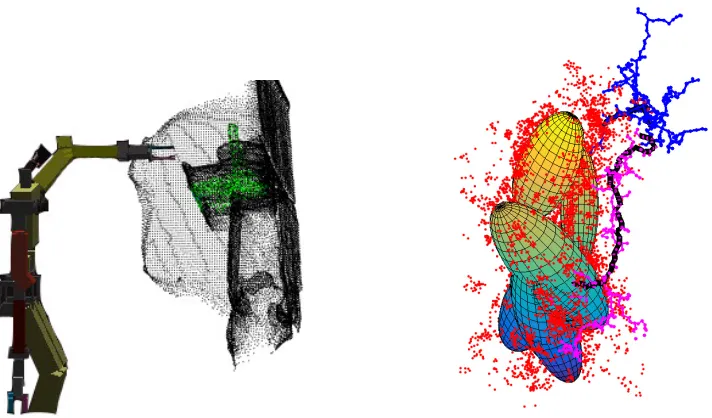
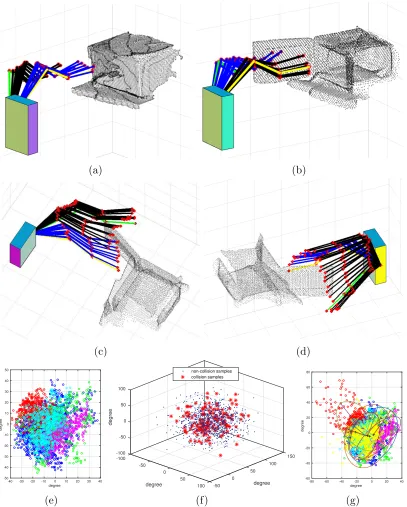
3.1 A manipulator moves to the shelf to grasp an object. Ellipsoids mean the 90% confidence level of the collision. The blue and magenta lines depict trees, and the black line is the final path. The red dots are collision exemplars for the GMM. (Best viewed in color) . . . 22
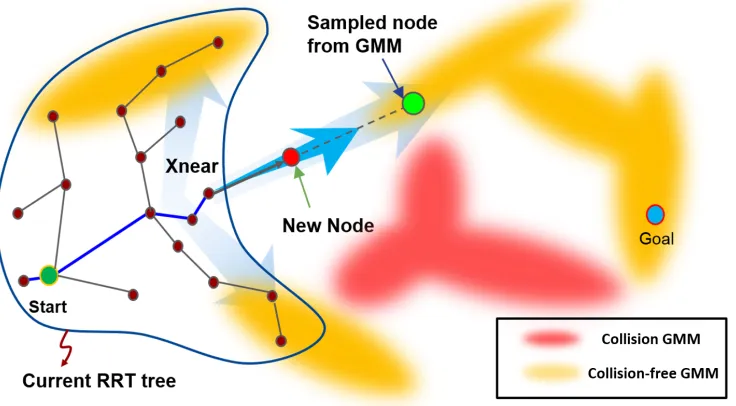
3.2 The overall workflow of the GMM-based RRT. Our main contributions are hightlighted in red. . . 23
3.3 (a) The GMM after three RRT iterations (b) The GMM after 10 RRT iterations. The learned GMM is refined online with additional exem-plars every RRT iteration. It depicts a 3-dimensional space projected from a 7-dimensional space. . . 24
3.4 The GMM clustering result: (a) the clustering with Euclidean distance (b) the clustering in 2n-dimensional circular feature space. For the visualization, 7-dimensional space is projected to 2-dimensional plane. (Best viewed in color) . . . 26
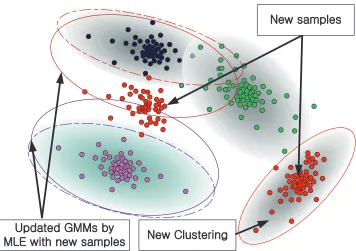
3.5 Illustrating GMM learning with Bhattacharyya distance: additional exemplars (red dots) are included into other clusters and GMMs are updated by MLE, or they make a new cluster (Best viewed in color) . 28
3.6 Illustrating the biased random sampling using the learned GMM dis-tribution . . . 30
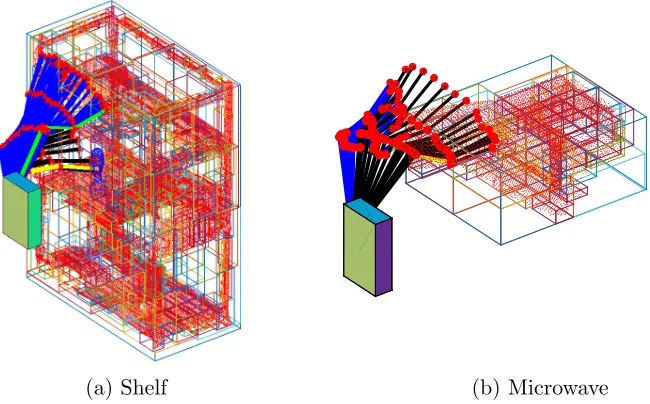
3.7 The Kinect sensor data with AABB . . . 31
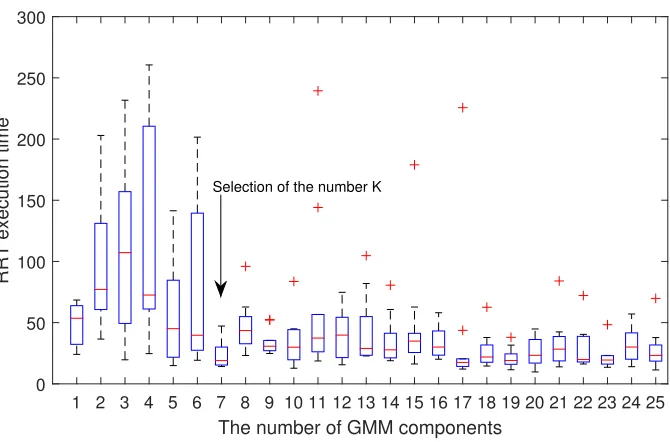
3.8 The execution time of the RRT with respect to the number of compo-nents on the example of Fig. 3.7(a) . . . 32
3.9 Probability density distributions of collision and collision-free exem-plars with respect to the relative Mahalanobis distance on the example of Fig. 3.7(a) . . . 33
3.10 Comparison with the basic and bi-directional RRT. It shows that the time and the number of collision checks are less than for the basic and bi-directional RRTs. The path length of the end-effector is similar to that of the bi-directional RRT.. . . 34
3.12 GMM is updated under the changed environment. . . 35
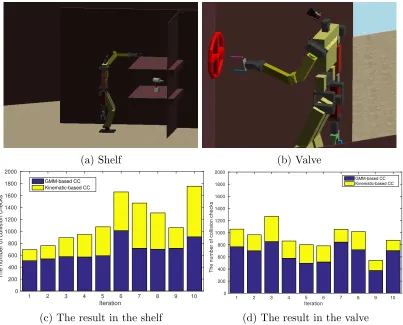
3.13 The result of simulation in Webots: (c) and (d) show the portion of the GMM-based collision checks. . . 37
4.1 QS-RRT planning with learned Q-function: (a) learned RBF features, (b) the RRT planning result in the two-dimensional C-space with the learned state value, and (c) manipulation planning with a real robot in the shelf environment. . . 40
4.2 The overall workflow of the suggested learning approach with RRT planning . . . 41
4.3 RBF features in the 2DoF planar manipulator of Fig. 4.11: (a) colli-sion region (blue), collicolli-sion-free region (red), and classification criteria (green) by an RBF threshold value and (b) RBF feature of collision regions.. . . 44
4.4 RBF networks for the feature of Q-function approximation. . . 45
4.5 Sampling method in C-space during RRT planning: The softmax node selection method chooses the node based on the learned state values (green dot) among the open nodes (yellow dot). When the random node (blue dot) is chosen, the standard RRT extension grows the tree. The size of dots represents the probability of selection. . . 47
4.6 Softmax node selectionchooses a node with probability in theopenset. The selected node is removed and the new explored node is added in the openset. . . 48
4.7 Comparison between RRT and QS-RRT with obstacles (yellow) and safety boundary (green) . . . 52
4.8 Nonholonomic constraints. . . 53
4.9 RRT planning with a nonholonomic constraint (Maximum curvature) 53
4.10 The learned state-value (left column) and RRT planning results with the learned sampling policy in the navigation problem (right column). 56
4.11 Comparison results with the standard RRT in the 2DoF planar ma-nipulator: (a) manipulation results in the workspace, (b) QS-RRT planning results in the C-space with the learned state values, and (c) standard RRT planning results with collision samples (Magenta). (Best viewed in color) . . . 57
4.12 Comparison results with the traditional approaches in the 2DoF planar manipulator as shown in Fig. 4.11. . . 58
4.13 The performance comparison of QS-RRT in the changed environment: (a) the original environment, (b) the perturbed environment with ob-stacle changes (blue circles), (c) and (e) show planning results in the original C-space, (d) and (f) show planning results in the perturbed C-space. . . 59
4.14 Performance with respect to the change level (lower is better). . . 60
4.16 Comparison results among RRT (the first column), QS-RRT (the sec-ond column), and nonholonomic QS-RRT (the third column) . . . 63
4.17 Simulation and experiment in the physical system: (a) simulation ditions (b) experiment with a physical robot. The start and goal con-figurations are randomly assigned for planning in the shelf environment. 64
4.18 Comparison results with bidirectional RRT, QS-RRT, and bidirectional QS-RRT: (a) simulation results with 100 randomly assigned start and goal configurations and (b) test results in the physical robot system with eight sequential configurations. . . 65
4.19 The performance comparison: (a) RRT, (b) QS-RRT, (c) QS-RRT with the goal feature (d) QS-RRT with the RBF feature. The green dots are collision nodes. . . 66
4.20 β(q) using RBF for navigation functions. . . 69
4.21 Comparison results: odd rows show navigation function results with RBF feature representation and soft node selection approach, and even rows show QS-RRT results . . . 70
4.22 Learning curve . . . 71
5.1 (left) Probabilistically safe corridor in 3D space constructed around a sample configuration (red) by using tangent hyperplanes (gray) of confidence ellipsoids of a learned GMM of C-space obstacles. (right) Local steering via probabilistically safe corridor in 2D space: An RRT is extended along the safe direction (red dotted line) towards the pro-jection of a sample goal (red) onto the associated probabilistically safe corridor (red polygon), instead of the standard straight-line extension (blue dotted line) towards the sample goal. . . 73
5.2 Examples of learned GMMs. Ellipsoids show the confidence regions associated with the confidence level ofκ=0.9. (left) Gaussian mixtures in the 3D workspace shown in Fig. 5.9, (right) Gaussian mixtures in the C-space of a 2DoF planar manipulator. . . 76
5.3 GMM confidence regions. (a) Super level sets of individual Gaussians at confidence level κk = κ. (b) Super level sets of Gaussians at the confidence levels corresponding to a shared probability level. (c) An example C-space (collisions are in blue and free space is in red) and (d) the associated confidence ellipsoids of learned GMM distributions from collision samples (black in (c)). . . 79
5.4 Local steering via probabilistically safe corridors. (left) Example tree extension using a probabilistically safe corridor in 2D space, (right) Probabilistically safe corridor in 3D space.. . . 81
5.5 Examples of task-space steering of a robotic manipulator. Here, the new configuration (magenta), suggested by the straight line planner from the nearest configuration (black), is adjusted to a better config-uration (green) based on the associated probabilistically safe corridor.
. . . 86
5.7 Safety-guided RRT planning performance with respect to the number of collision samples used for GMM learning . . . 88
5.8 (left) PRM with the standard straight-line planner, (right) PRM with our safety guided local planner. . . 89
5.9 RRT planning performance for a 7DoF manipulator: (top) Sequential planning tasks, (middle) Average execution time, (bottom) Average number of collision checks . . . 90
5.10 RRT planning performance with an actual physical robot: (top) Ex-periment with a physical robot, (middle) Average execution time, (bot-tom) Average number of collision checks . . . 92
6.1 Constrained sampling-based planning: (a) Grasping a slanted object; (b) Transporting the object with obstacle constraints . . . 94
6.2 The overall workflow of grasping and transport tasks . . . 95
6.3 Transformations and coordinate frames involved in grasping and inter-mediate poses: (a) infinite grasping poses (b) homogeneous transfor-mations . . . 96
6.4 Planning margin with constraints . . . 98
6.5 Visualization of the non-convexplanning margin functions with respect to end-effector’s yaw angle and the parameter . . . 100
6.6 Planning procedure with a preshaping state . . . 101
6.7 Sampling in the task space with constraints imposed in the C-space for transport tasks . . . 104
6.8 (a) The scenarios are for grasping with different initial configurations (b) The scenarios are for transporting the object to the target position (pink patch) while avoiding obstacles. (Best viewed in color) . . . 106
6.9 The grasping results in scenarios of Fig. 6.8(a): MPM-RRT is relatively faster in the complicated scenarios. . . 107
6.10 (a) Fast convergence of the grasping pose selection. (b) Determining the approach distance by maximizing the cost with logarithmic barrier penalty. (Best viewed in color). . . 108
6.11 The transport result in scenarios of Fig. 6.8(b): It shows that time and path length are less than for JT-RRT and IK-RRT. . . 109
6.12 The transport planning result of the third scenario in Fig.6.8(b) : (a) MPM-RRT with soft constraints, (b) IK-RRT. . . 109
6.13 Experiment with a real robot. 3D point cloud data of the test envi-ronment with detected target objects (green and blue) . . . 110
6.14 Test results: The robot arranges two objects in the first test, and move the object inside the shelf in the second test, and rearranges objects in the cluttered environment while maintaining roll and pitch angles of the end-effector. . . 111
7.1 Online learning of probabilistic model . . . 113
7.3 Online learning with the rejection sampling . . . 120
7.4 DPMM results (a) collision clustering (b) collision-free clustering . . . 120
7.5 Illustration of the probabilistic collision map . . . 121
7.6 Online update of probabilistic collision map . . . 122
7.7 RRT planning with probabilistically safe corridor based on online learning123
7.8 Planned arm motion trajectories can vary significantly due to relatively small changes in pose between the robot base and objects in its envi-ronment: (a) original arm motion trajectory and (b) arm motion after pose change.. . . 125
7.9 Previous GMMs are predicted with IK according to the environmen-tal change and updated with new exemplars as the GMM-based RRT proceeds (Best viewed in color). . . 126
7.10 The scheme of the GMMs prediction using IK in the changed envrion-ment. The transformed collison and collision-free distribution in the new C-space can be estimated by the change of the virtual end-effector in the Euclidean space. . . 130
7.11 Visualization of predicted GMMs from previous GMMs by applying IK: the lower level joints (5th and 6th joints) are noticeably transformed compared to the upper level joints (1st and 3nd). 2-dimensional space is projected from 7-dimensional space for visualization purposes. . . . 131
7.12 The training and test scenarios: (a) in order to train the model, the collision and collision-free exemplars are obtained from the ordinary RRT of this trajectory (b) the test is conducted with the learned GMMs in this scenario. . . 135
7.13 The comparison results with the bi-directional RRT: the GMM-based RRT is relatively faster in the complicated path planning. . . 136
7.14 Execution time of the GMM-based RRT as the model update proceeds 137
7.15 Changed environment cases used in our experimental results: (a) trans-lation (b) transtrans-lation and rotation . . . 138
7.16 Comparison results with the bidirectional RRT: error bars represent one standard deviation of 10 iterations. . . 139
7.17 Performance results with the previous GMMs and the predicted GMMs: (a) scenario (b) comparison results . . . 140
7.18 The novel test scenario is composed of different configurations from the training and previous test configurations. . . 141
7.19 The test result on the example of Fig. 7.18: error bars represent one standard deviation of 10 iterations. . . 142
8.1 Planning results of PRM and RRT in the configuration space of a 2DoF planar manipulator. . . 144
8.2 PRM result : The vertices are randomly generated for constructing the roadmap. When the number of vertices is less than 300, it fails to find a path between the start (yellow) and goal (green) configurations. . . 146
Chapter 1
Introduction
Planning for robotic manipulation with a high dimensional manipulator has received
much attention in recent years due to its application in the service and industrial
ar-eas (Fig. 1.1). The sampling-based motion planners have become popular especially
because of their simplicity and efficiency in high dimensional space [70, 83, 69, 11].
However, sampling-based approaches have several critical problems. For example,
they spend most of their computational time on sampling and collision checking in
complicated high-dimensional spaces [117], and they have difficulty in narrow
pas-sages; as a result, sampling-based planners might be inefficient with an increasing
number of samples in a complicated environment. In order to increase the efficiency
of their algorithms, we consider several issues of sampling-based planning.
First, the sampling-based planning needs more than tens of thousands of
kinematic-based collision detection routines in order to generate a final path; therefore, the
collision check is a serious impediment to the efficiency of sampling-based planning.
Second, it requires an efficient and effective sampling method since the
perfor-mance of sampling-based planning depends on its sampling method. The effective
sampling reduces the number of samples and collision checks; thus improving the
performance of sampling-based planning. However, although Rapidly-exploring
Ran-dom Tree (RRT) repeats its planning in the same environment, there is no systematic
approach to improving its sampling method and tree extension. The RRT constructs
experi-Figure 1.1: Manipulation applications in various areas
ence from many samples and collision check routines for each planning, exploitation of
previous experience provides essential and valuable information for a fast and efficient
RRT. The Probabilistic Roadmap (PRM), which is another sampling-based planning
approach, also has a dependency on the sampling method for its performance.
In addition, the performance of sampling-based planning approaches could be
degraded in a complicated environment, such as narrow passages, since the RRT and
the PRM require many samples to find paths through those narrow passages. Since
the biased search toward unexplored Voronoi regions does not consider collision space,
the RRT has difficulty growing in the cluttered environment. In order to resolve this
problem, the RRT should have a good sampling or tree extension algorithm to narrow
passages efficiently.
Next, traditional sampling-based planning methods still face challenges for grasp
and transport tasks with external constraints. These challenging issues arise from
the fact that the constraint manifolds defined in the task space are not analytically
mapped into the configuration space (C-space). For example, it is not obvious how
constraints defined in the workspace (e.g., avoiding collision) can be combined with
in the C-space. In addition, sampling-based planning methods typically require
set-ting a specific goal configuration, but it can be difficult to determine a single target
configuration when there are many redundant grasping solutions.
Finally, it is difficult for traditional sampling-based motion planning algorithms
to handle environmental changes in an efficient and accurate manner. A slight change
in positioning between the robot base and its workspace can render previously found
solutions for motion trajectories worthless. Naively, such a change necessitates
re-planning a new motion trajectory from scratch, leading to heavy computational loads
and slow and inefficient robot behaviors. For online learning, the approach can adapt
the complexity to the data and learn new Gaussian clusters with streaming data in
newly explored areas.
We suggest a systematic approach for sampling-based planning to achieve
sev-eral planning missions efficiently using learning of probabilistic generative models in
complicated high-dimensional environments. In many practical applications, multiple
path trajectories are required for various tasks within the same or slightly changed
en-vironment, such as in the Amazon robotics challenge [2]. In these cases, the planner
needs to be continually improved as the planning algorithm proceeds. The
single-query planner, such as RRT, can find a path quickly by growing a tree from the
start to the goal point without pre-processing [83, 69]. However, RRT has no
sys-tematic way to take advantage of information from previous experience. It requires
computing samples and collision checks from scratch in building trees whenever a
new start or goal configurations is specified, even when a similar solution has already
been computed on a previous query in the workspace. In contrast, the multiple-query
planner, such as PRM, can reuse prior information regardless of changes in the start
and goal configurations [70]. However, if there is a small change in the environment,
PRM needs to find the invalid part of the graph and then repair the roadmap before
it generates a new path. Lazy techniques for PRM attempt to circumvent some of
these issues by storing information updates and delaying validity checking during the
graph construction process [19, 39]. Even though Lazy PRM may also be applied
Figure 1.2: Learning approach to resolve issues of RRT
generate multiple trajectories using previous experience regardless of small changes
to the environment.
In order to achieve efficiency with sampling-based planning, we present several new
learning approaches using probabilistic generative models. First, we present a new
approach for fast collision detection in high dimensional configuration spaces. The
proposed method is based upon Gaussian Mixture Models (GMMs) that are learned
using an incremental Expectation Maximization clustering algorithm trained online
using exemplars provided by a slow, conventional kinematic-based collision detection
routine. Moreover, the number of collision checks needed can be drastically reduced
using biased random sampling from the learned GMM distribution.
We also suggest a learning approach for efficient sampling of RRTs based upon a
learned state-action value function (Q-function). Our novel sampling method chooses
the optimal node to extend the tree via the learned state value computed from the
node feature representation. Our softmax node selection procedure avoids becoming
stuck at the local minima and maintains the completeness property of RRTs. We
em-ploy several features in learning the Q-function, including the Radial Basis Function
(RBF) scores of collision and collision-free regions in the C-space. Since this approach
allows the RRT to explore efficiently while avoiding obstacles via the Q-function, the
RRT planner is continually adapted to the environment in an online manner.
For effective tree extension, we propose an RRT method using the safety margin of
regions, especially in narrow passages, by adjusting the direction of the new node
toward collision-free space. In order to guide the direction of the tree extension, we
first construct a probabilistically safe corridor using the margin of the collision space
of GMMs. The probabilistically safe corridor is a polyhedron composed of tangent
half spaces on the surfaces of ellipsoids representing a given probabilistic confidence
level. With a polyhedron of constructed safety corridor, we suggest an
optimization-based tree extension algorithm to increase connectivity with less likelihood of collision.
Since the tree extends within the probabilistically safe corridor, this approach can
dramatically improve efficiency by reducing the number of collisions.
For grasp and transport tasks with a redundant robotic manipulator, we present
a novel constrained, sampling-based motion planning method. We utilize a planning
margin for grasping with constraints that allows the best grasp configuration and
approach direction to be determined automatically. For manipulators with many
de-grees of freedom, our method efficiently chooses the optimal grasp pose when there are
many redundant solutions. The method also introduces a parameterized
intermedi-ate pose that is optimized to determine the approach direction, increasing robustness
under sensor uncertainty and execution errors. Our method also considers
transport-ing the grasped object to the desired target position ustransport-ing the RRT algorithm that
incorporates soft constraints via appropriate cost penalties.
Finally, we propose approaches to handling changes in the environment and for
online learning to refine and update the model. In practical applications for robotic
manipulation, the representation of collision and collision-free regions in C-space can
change due to relative motion between the robot base and workspace. We show how
to rapidly adapt to such changes by transformation of the parameters of the Gaussian
mixture model to new configurations. The transformed model is initially used as a
prior and then continually updated and refined as the RRT planning algorithm
pro-ceeds in real-time. In addition, we propose an online probabilistic generative model
based on a nonparametric Bayesian model for efficient sampling-based motion
plan-ning. Although sampling-based planning approaches can exploit probabilistic models
model. They also need to update the model whenever new samples are obtained in
unexplored areas. We propose Dirichlet Process Mixture Modeling (DPMM) to learn
probabilistic models with an online method. Since this approach is a nonparametric
Bayesian model, it can adapt the complexity to the data and generate new Gaussian
clusters with new samples in newly explored areas. Based on this online modeling,
we generate probabilistic collision maps for fast collision checking or probabilistically
safe corridors for local steering.
We demonstrate the effectiveness and efficiency of our algorithms on a number of
simulated and experimental applications. Our experimental results show a marked
improvement in computational efficiency in comparison to previously studied
Chapter 2
Related Work
There has been growing interest in sampling-based motion planners in recent years
[83, 69, 70, 11], and we now discuss approaches in the relevant literature. First
we describe methods for reducing the computational time on collision checking and
then explain the learning approach for sampling methods in sampling-based planning.
Third and fourth, we will explain approaches to improving tree extension and
con-strained sampling-based planning algorithms. Finally, we will discuss adaptive and
online learning approaches for the changed environment.
2.1
Fast collision checking
As we described, sampling-based approaches have a critical problem in that they
spend most of their computational time on checking for collisions. It requires an
efficient collision detection algorithm to maintain efficiency. Several algorithms have
been investigated to reduce the number of collision checks by changing the sampling
method [20, 57] or by delaying collision checks [117, 19]. Sanchez and Latombe
[117] present a plausible approach that delays collision tests until they are required to
check a candidate’s path, and the authors successfully demonstrate that this approach
spends less time than previous approaches. However, since the delayed collision check
retries the tree expansion whenever a collision is detected in the candidate’s path, the
Other machine learning approaches have been conducted to make RRT more
ef-ficient [103, 4]. Pan and Manocha [103] suggest a probabilistic collision detection
algorithm that considers the uncertainty of the environment with a Support Vector
Machine (SVM). Kernel perceptron [35] represents collision and collision-free
sub-spaces of a configuration space for fast collision checking. The recently proposed
RR-GP algorithm [4] based on a learned motion pattern model that combines the
flexibility of Gaussian Processes (GP) with the RRT is able to find a safe path in a
dynamic and constrained environment. While research has successfully shown that
machine learning can efficiently enhance the performance of the RRT, no approach
has been able to reduce the computational time effectively.
In terms of collision detection, precise and fast collision detection algorithms have
been developed in the robotics and computer graphics areas in order to accelerate
computation [51, 86, 111, 75]. In the Robot Operating System (ROS), the motion
planner uses the OctoMap, which is a kind of Octree-based representation of the
environment for collision detection [54].
Unlike previous approaches, we demonstrate that the learned GMMs can detect a
collision rapidly in the high dimensional configuration space, and the model is refined
and updated online by new exemplars. Moreover, the number of collision checks is
remarkably reduced by the biased random sampling from the learned GMM. Another
key feature of our approach is that we introduce the GMMs for fast collision
detec-tion in the high dimensional configuradetec-tion spaces using the incremental EM clustering,
whereas other approaches deal with the GMMs for the imitation of demonstration
trajectories [30] or exploit the GMMs to model the distribution of feasible positions
and orientations for grasping [72]. In addition, it exploits collision-free GMMs for an
efficient biased sampling compared to other approaches that handle only the
2.2
Efficient sampling
There has been much prior research on robotic manipulation by sampling-based
mo-tion planning because of its simplicity and efficiency in high dimensional spaces.
[83, 69, 70,11]. However, sampling-based motion planners typically require a
consid-erable number of node expansions and collision checks. Therefore, there are several
biased sampling methods [57,131] for improving the efficiency of the algorithm.
Urm-son and Simmons [131] present heuristic quality functions based on the cost of guiding
the biased RRT growth. Although their approach can improve the quality of paths
efficiently in some environments, it can also result in high computational cost in more
complicated environments. Lazy collision checking approaches have also been applied
for reducing the number of collision checks [19, 61], but they may not perform well
in cluttered environments, resulting in considerable backtracking and recomputation
of invalid regions in a cluttered environment.
There are several sampling-based planning approaches for improving the quality
of paths by incorporating cost values [66, 1, 46]. However, they assume predefined
explicit cost functions, or they simplify cost functions with empirical weights of
fea-tures, and they focus on minimizing the cost such as terrain cost or motions. Jaillet
et al. [66] suggest a cost-map based RRT that minimizes the cost of the trajectory,
but this approach increases planning time in favor of finding a more cost effective
path. In addition, cost-based search methods have the problem of converging to a
local minimum of the cost function. Barraquand and Latombe suggest a Monte-Carlo
algorithm to escape from the local minima of the potential field [9]. However, this
method requires adjusting many parameters and takes a long time with many
lo-cal minima. In addition, it requires expensive computation to determine the cost of
actions at every step in continuous action spaces.
Some works use previous tree structures to reduce computation time [61, 108]
when the environment is unchanged. Phillips et al. [108] also try to reuse the
con-structed high-level tree structure for fast planning, but the concon-structed tree structure
Berenson et al. [15] and Coleman et al. [31] suggest approaches to storing and
ex-ploiting stored trajectories for new planning problems. The Lightning framework by
Berenson et al. [15] saves previous planned trajectories in a path library and repairs
the retrieved trajectories which have similar endpoints of the path to the start and
goal for a new task. For repairing the infeasible path, it finds infeasible parts and
applies the multiple RRTs to revise those trajectories. Since the Lightning
frame-work saves trajectories, it requires a large size database for the path library. To
reduce the size of the database, Coleman et al. [31] suggest the Thunder framework,
which stores the experience in a sparse roadmap spanner. These approaches are very
useful for invariant constraints such as joint limits and self-collisions. However, the
stored trajectories sometimes need to update significantly under slight changes in the
workspace. In addition, it is a time consuming process to find impaired parts in the
previous trajectories and the roadmap. In addition, it is difficult to decide the size of
the path library or the roadmap and remove unnecessary or impaired trajectories in
the path library or from paths in the roadmap according to the change environment.
In addition, it is a challenge to remove an inefficient trajectory once it is registered
in the library, although it may find a better trajectory later. In contrast, since our
approach learns the state value of the configuration space, it is robust to a slightly
changed environment, and it is unnecessary to save a large size database for the
previous experience.
Many Reinforcement Learning (RL) approaches have been eagerly applied in
robotics [7, 106, 76] to use previous experience in planning and control. These RL
approaches focus on learning parameterized controllers for high performance in
con-trol tasks, while our learning approach is better indicated for efficient sampling in
RRT. There has been research which combines PRM with reinforcement learning
[147, 104], but it is not applicable to continuous space in high dimensional space
since those methods use a Q-table with discrete states for the Q-value. Ekenna et
al. [41] use the local learning approach to increase spatial and temporal adaptability
in a hybrid environment. However, their method uses the scaled Euclidean distance
features to predict proximity to the collision boundary directly in the C-space.
Regarding the Temporal Difference (TD) learning approach with linear function
approximations, there has been much research, such as Least Squares Temporal
Dif-ference (LSTD) and Least Squares Policy Iteration (LSPI) [21,123], ever since Sutton
et al. [127] proved that the policy search methods with function approximations
guar-antee convergence. These days, deep neural networks have been actively applied to
Deep Reinforcement Learning (DRL) after Mnih et al. showed that the deep learning
model can apply to the control policy in Atari games [94]. In addition, many policy
search methods are able to handle the high dimensional space problems of robotic
planning [90, 118, 95]. These approaches show that the deep learning model learns
control policies directly from high-dimensional input data, and many DRL approaches
have been applied to the real robot systems beyond simulations [85]. However, the
deep networks suffer from high sample complexity with high dimensional features,
such as images, to avoid local optimal solutions. Moreover, it takes a long time for
training, and they require retraining procedures even when environments or
condi-tions are only slightly changed.
There are several learning sampling policies based on deep neural networks [63,
110]. Conditional variational autoencoder (CVAE) [63] is suggested for learning
com-plex manifold and valid regions for sampling based planning. This approach learns
the CVAE from demonstrations of successful motion planning results and experience.
It can generate random samples with the learned CVAE. The conditioning variable
includes the initial state, the goal state, and an occupancy grid of the workspace.
Motion Planning Network [110] learns an encoder network and a planning network;
the encoder network encodes a point cloud into a latent feature, and the planning
network predicts the next robot configuration given the current configuration, the
goal configuration, and the latent feature of the point cloud. It trains the encoder
network by minimizing the reconstruction error of the point cloud and trains the
planning network to minimize errors between the estimated configuration and the
configuration from the demonstration. In addition, to guarantee the feasibility of the
combin-ing the network with a traditional planncombin-ing algorithm. However, these approaches
[63, 110] require many successful trajectories for training. In order to obtain many
trajectories, it needs a lot of collision checks and training time. In addition, these
ap-proaches require a large amount of occupancy grid maps or point clouds for training.
In contrast, since QS-RRT is a feature-based learning approach without workspace
information, it has a smaller number of parameters and requires less training time and
information compared to approaches with deep neural networks. Moreover, since we
can add more features in the Q-function, QS-RRT is extendable to various problems,
such as planning with nonholonomic constraints.
There are some approaches to leveraging features in the workspace for efficient
sampling. Zucker et al. suggest an adaptive sampling strategy based on a policy
gradient method for improving sampling-based planning [149]. Since this approach
requires workspace features and discretization of the workspace, it is difficult to
gen-eralize to all problem domains. Learning from demonstrations for robot motion
plan-ning [141] improves the performance of planning with task constraints by teaching
from human demonstrations. However, it requires time-consuming demonstrations
whenever new task and constraints are assigned.
The key features of our approach are efficient sampling and tree extension based on
the Q-learning approach, and RRT is continually improved as the planning algorithm
proceeds. While previous learning approaches for sampling strategy are specialized
for each problem case, our approach can be generalized to various problems since it is
a more flexible structure based on the Q-function with linear function approximations.
While other approaches leverage information from the workspace, our approach learns
the configuration space directly; thus it is appropriate for manipulation problems
which have no direct mapping between the C-space and the workspace.
2.3
Effective tree extension
Sampling-based planning approaches suffer from heavy computational time in
configurations and their collision checks. Therefore, several biased sampling methods
[20, 57] and rejection sampling methods [120, 121, 143] are proposed to reduce the
number of sample nodes and so to improve computational efficiency. However, these
approaches have many heuristic parameters and require explicit configuration space
information, such as visibility or collision boundaries, which usually limit their
appli-cation to low dimensional settings. Another alternative approach to increasing the
computation efficiency is to reduce the number of collision checks, using either by lazy
collision checking [61, 117, 19] or fast probabilistic collision checks [58, 60, 103, 4].
Prior planning experience and collision history is also leveraged in biased sampling
in order to perform informed configuration space exploration [58, 23, 22]. Exact
safety certificates are also utilized for minimizing the computational cost of collision
checks [17]. However, these methods remain unable to fully address the challenges of
sampling-based planning in complex configuration spaces.
To increase the connectivity around complicated regions, Zhang and Manocha
present a steering approach that retracts sample configurations to become more likely
to be connected to nearby nodes [146]. However, it requires a significant number of
it-erations to find a new collision-free configuration that is around the collision boundary
along with an appropriate distance-to-collision measure. In practice, since measuring
the exact distance-to-collision in high dimensional configuration spaces is very
chal-lenging, its applicability is also limited to low dimensional motion planning problems.
Instead of explicit modeling of collision-free space, Principle Component Analysis
(PCA) is used to adjust the tree extension heading to collision-free space based on
local random collision-free samples [128] or neighborhood nodes [34] around the
near-est node. Moreover, workspace topology is utilized in biasing configuration space
exploration for planning around difficult regions [109, 40], but the topology of
high-dimensional configuration space (e.g., robot manipulators) is significantly different
and more complex than the corresponding workspace topology.
To leverage previous experience, utility functions for connectivity between vertices
[22] are suggested for the sampling algorithm of PRM, and a task-guided planner
of collision-free space [81] is applied for an efficient search.
There are several sampling strategies which leverage the surface of collision
con-figurations to find nearby free concon-figurations [96]. Obstacle-Based PRM (OBPRM)
[96] increases the connectivity of PRM in cluttered environments by sampling near
the C-obstacle surface. Obstacle-Based RRT (OBRRT) [114] extends a tree using
an obstacle vector based on information from the workspace obstacle surface or
ap-proximate C-obstacle surface. These approaches are novel in that they place samples
close to obstacle boundaries or exploit information about C-obstacle regions to adapt
the sampling strategy. However, since OBRRT [114] computes an obstacle vector
based on collision configurations that lie in one plane of the C-space for
comput-ing the obstacle vector, unlike our approach, it is unable to determine the optimal
direction considering all C-space regions existing in various directions. In addition,
since OBRRT chooses a random parallel direction to the obstacle vector that lies
on the plane, it is effective on the C-obstacle which is composed of planes; however,
the C-obstacle of the manipulator has various surface shapes. In contrast, since our
approach considers all adjacent C-obstacle regions, and it addresses various shapes of
C-obstacles based on GMMs, it finds more optimal directions compared to previous
approaches.
Local safe corridors [138,47,26,92] have recently found significant applications in
collision-free motion planning by using sequential composition of simple local planners
[32]. Such safe corridors are usually constructed based on a convex decomposition of
the environment, which requires an explicit representation. In [6], a sensory steering
algorithm is proposed for sampling-based motion planning that increases the
con-nectivity of randomized motion planning graphs, especially around narrow passages,
by exploiting local geometry of configuration spaces via convex local safe corridors.
This construction is further extended to integrate local system dynamics and local
workspace geometry in kinodynamic motion planning [102]. However, the original
construction of sensory steering requires an explicit representation of configuration
space obstacles or an explicit distance-to-collision metric, and so its direct application
al-gorithm to adapt it to high dimensional settings, such as robotic manipulation, by
defining probabilistically safe corridors that are constructed using a learned
approxi-mate probabilistic model of a configuration space.
2.4
Constrained sampling-based planning
For the grasping pose selection, several papers investigate manipulability and
dex-terity [134, 145, 52] to evaluate the grasp configuration. However, they focus only
on the evaluation of arm configuration without considering collisions during arm
mo-tion planning. Several algorithms have attempted to enhance grasping selecmo-tion by
using an integrative method for grasping and planning [77,50,122], but they require
pre-learned information for the tasks.
In general, redundant manipulators with more than six degrees of freedom (DoF)
have no analytic solution to the Inverse Kinematics (IK) problem. There are several
sampling-based planning approaches for grasping and motion planning without
ex-plicit IK solutions or specific goal configurations [137, 132, 28, 16, 133]. Ciocarlie et
al. [28] suggest collision-aware inverse kinematics for grasp selection by searching a
feasible grasp configuration corresponding to the desired end-effector pose over the
pa-rameterized redundant joints. While their method finds a feasible solution efficiently,
it is unable to choose an optimal solution for grasp planning. In order to perform
sampling-based planning approaches without a specific grasp configuration, Weghe et
al. use the Jacobian Transpose (JT) between the target pose and the current pose
[137], and Bertram et al. [16] suggest the IK-RRT, which generates random target
configurations from plausible grasp configurations in order to exploit the advantages
of the bi-directional RRT [132, 133]. However, these approaches have the limitation
that they are unable to impose orientation constraints.
Regarding sampling-based planning for transport with constraints, Berenson et
al. [13] suggest the projection of random configurations to the region defined by
the manifold of constraints (CBiRRT). Many approaches suggest different iterative
approaches have the disadvantage that infeasible samples are projected on the
bound-ary as opposed to the center of the nearest constraint manifold. In another approach,
Stilman [124] suggests tangent-space (TS) and first-order retraction (FR) sampling
schemes that are able to explore the entire C-space of constrained motion. However,
their method still considers only hard constraints, and it could be inefficient in the
cluttered environment since it finds the optimal solution iteratively and then checks
for collisions at the end.
There are several methods for sampling-based motion planning with constraints
[73] for real applications. Atlas-based RRT [65] projects a random point to a tangent
space of the chart of the manifold. To improve the tree extension within the constraint
manifold, it keeps the extension in the chart until it reaches the random point or the
new node is unable to satisfy the constraint. However, Atlas-based RRT is time
consuming for finding the neighboring charts when adding a chart to the atlas, and
the mapping onto the atlas requires heavy computation. Tangent bundle RRT [71]
projects the new node onto the constraint manifold and generates a new tangent space
only when the RRT tree reaches a boundary of the constraint manifold or when the
distance from the new node is larger than a certain threshold. This approach can
significantly reduce the number of projections to the manifold. Kang and Park [68]
suggest a Gaussian Process approach for a point-to-manifold distance function based
on GMMs of a given data set in the constrained manifold. Since the representation is
differentiated and it can obtain the gradient of the point-to-manifold distance function
analytically, it applies CBiRRT without an iterative projection process for several
constrained planning problems. While these approaches handle hard constraint, such
as a closed chain constraint problem, our approach focuses on soft-constraints. We
define cost functions including constraints and find a sample to minimize this cost
function. This framework is appropriate for problems with soft constraints, such as
maintaining the end-effector pose.
Whereas most constrained sampling-based planning approaches consider only hard
constraints, Kunz and Stilman [79] handle soft constraints, such as the pose of the
the distance metric of joint space error. It also uses an iterative Jacobian
pseudo-inverse to find the configuration that satisfies the constraints. Although they consider
soft constraints, there is still the limitation of slowdown in the cluttered environment
since the iterative Jacobian pseudo-inverse is applied for convergence to constraint
manifolds.
Regarding sampling in the task space, Shkolnik et al. [119] suggest using a
sam-pling approach directly in the task space considering collisions. The Jacobian
pseudo-inverse method is used for the growth of the tree. It is able to reduce the
computa-tional time dramatically since sampling and searches for nearest neighbors in the task
space are able to reduce the dimensionality and guide the RRT growth efficiently to
the goal. However, in order to perform the RRT in the task space, there should be
an efficient method for finding a configuration corresponding to a node in the task
space. The suggested Jacobian pseudo-inverse method is effective if the task space is
an open space with few obstacles, but it is difficult to use when the environment is
cluttered with obstacles as explained in [135]. Furthermore, this approach considers
only the position state in the task space, and it is limited, being unable to consider
soft constraints.
The key feature of our approach in this thesis is that we exploit theplanning
mar-gin and the parameterized intermediate configuration for grasping with constraints.
Our approach also proposes sampling-based planning of transport manipulation tasks
that incorporates soft constraints via appropriate cost penalties.
2.5
Adaptive to changed environment
Several learning approaches are suggested in order to use previous experience or to
adapt to environmental changes. First, there have been proposals to accelerate the
planning process using an Experience Graph [61, 108] when the environment is not
changed over a long period of time. It generates an E-Graph from prior experience
that consists of feasible end effector locations. However, since the 7DoF manipulator
other parts of the manipulator will collide when the environment is changed, although
the end-effector does not collide in the same location as the prior experience.
Fur-thermore, in order to consider dynamic conditions, the Experience Graph may be
modified according to the environmental change.
Osa [101] suggests a learning approach with a demonstration under various
envi-ronment states and statistical models of envienvi-ronmental conditions. Although it has
the advantage of reducing computation time in various environment conditions, it
re-quires knowledge of the conditions of the environment in advance. Moreover, it also
works in only pre-defined environment conditions and could have trouble adapting to
unexpected environmental changes.
Lien et al. [87] proposed a motion planner that generates roadmaps based on the
geometric models of obstacles and exploits them when similar obstacles exist in the
new environments. However, this approach is not flexible for unstructured obstacles.
In order to solve dynamic planning problems, Multipartite-RRT is also presented
for mobile robots and manipulators [148]. This approach suggests that the tree is
expanded towards previous planning waypoints and exploits subtrees of previous tree
structures. In addition, Rodriguez et al. [115] suggest a framework of a two-stage
roadmap that is dynamically changed by moving obstacles.
In order to adapt to the changing environment, Lehner et al. [84] suggested
incremental elastic roadmaps in order to handle dynamic environments. Whereas
their work is conducted in a low dimensional workspace, our approach suggests a
generative model in the high dimensional configuration space. Kallmann and Mataric
[67] suggest an dynamic roadmap with cells and their connectivities in the workspace.
It can easily adapt to environmental changes, but it is unable to represent all possible
configurations due to the maximum number of the configurations corresponding to
each cell. Burns et al. [24] also proposed a utility-guided algorithm, which uses the
nearest neighbor model. The nearest neighbor model needs much more exemplars in
a high dimensional space compared to our GMM-based model.
The key feature of our approach is that we exploit previously learned GMMs
RRT [58], it can predict and update the GMMs without the whole EM procedure.
Moreover, the computational time of the online learning is remarkably reduced by the
prediction and update of previous GMMs. In conclusion, with the initial GMMs by
the EM procedure, the model can be adapted to a change of the environment if it is
not significant. In contrast, other approaches exploit the old tree structures generated
for past path plans [148] or construct graph structures for the feasible end-effector
positions [61]. For large changes in robot pose, however, it is difficult to directly warp
previously planned trajectories to the new configuration space, and these methods
will only be successful under restricted environmental conditions.
2.6
Online learning
Several approaches use probabilistic models for representation of the configuration
space, since the exact computation of distance-to-collision in complex high-dimensional
configuration spaces is difficult [38]. Gaussian mixture learning in [58], support
vec-tor machine (SVM) [103] or kernel perceptron [35] are applied to represent collision
and collision-free subspaces of a configuration space for fast collision checking and
bi-ased sampling over free space. In addition, an efficient sampling method bbi-ased upon
learning a state-action value function (Q-function) [59] and a probabilistically safe
local steering primitive are presented to enhance the performance of sampling-based
motion planning in complex high-dimensional configuration spaces. Although these
approaches show that the performance is significantly improved with the probabilistic
model, they require training for the learning model. In addition, they need to update
the model whenever new samples are obtained in unexplored areas.
The Expectation-Maximization (EM) algorithm is a popular parametric modeling
approach [36]. Although probabilistic models are used for modeling of observed data,
traditional parametric models have difficulty in choosing the proper model and model
complexity [129]. Figueiredo et al. [43] suggest an unsupervised learning approach
for a finite mixture model. This approach automatically selects the number of
parameters which depends on the number of mixtures using an iterative method, it
requires heavy computation. This approach also uses variants of the EM algorithm for
the initialization problem. While a parametric model fixes the number of parameters
according to data size, a nonparametric Bayesian model assumes infinite dimensional
parameters and adapts its complexity to the data [49]. The Dirichlet process (DP) is
a nonparametric model which is suggested by Ferguson [42], and Neal proposes Gibbs
sampling for the Dirichlet Process Mixture Model (DPMM) [97]. Blei and Jordan
address a variational inference approach for DPMM [18]. In our work, we show that
DPMM can be used to continually improve an RRT for trajectory planning by online
Chapter 3
Learning High-Dimensional Mixture
Models for Fast Collision Detection
In recent years, there has been growing interest in sampling-based motion planners
[70,83,69], but sampling-based approaches have a critical problem in that they spend
most of their computational time on checking for collisions. According to [117], this
collision checking uses more than 90% of the total computational time; as a result,
sampling-based planners might be inefficient with an increasing number of samples.
If obstacles are composed of geometric primitive shapes, the collision can be easily
checked by the distance between the manipulator and the surfaces of the obstacles.
However, it is difficult to construct meshes of the surface from point clouds in real
sensor data. Furthermore, the RRT needs more than tens of thousands of
kinematic-based collision detection routines in order to generate a final path; therefore, the
collision check is a serious impediment to the efficiency of an RRT.
In this chapter, GMMs are learned for fast collision detection in the high
dimen-sional configuration space as shown in Fig. 3.1. With a learned mixture of
Gaus-sians, the tree can expand by avoiding this space, and the collision is easily checked
by the probabilistic distance from the mixture. It has the advantage of reducing the
search space of the RRT; as a result, the computational time is remarkably reduced.
First, the GMMs are learned using an incremental Expectation and Maximization
Figure 3.1: A manipulator moves to the shelf to grasp an object. Ellipsoids mean the 90% confidence level of the collision. The blue and magenta lines depict trees, and the black line is the final path. The red dots are collision exemplars for the GMM. (Best viewed in color)
detection routine. Thereafter, the collision of the new node is determined by
Maha-lanobis distances from GMMs. If the decision based on the GMMs is ambiguous, the
kinematic-based collision detection routine is conducted instead of the probabilistic
distance. These exemplars obtained during the RRT planning are used to update
the model again. Finally, the collision check of the generated candidate path is
con-ducted with the kinematic-based collision detection in order to confirm its safety. If
a collision is detected in the final path, random samples are distributed once again
around the collision point, and the model is updated by the new exemplars.
Our approach differs from the traditional approaches using GMMs. We introduce
GMMs for fast collision detection in high dimensional configuration spaces using the
incremental EM clustering, whereas other approaches deal with the GMMs for the
imitation of demonstration trajectories [30] or exploit them to model the distribution
of feasible positions and orientations for grasping [72].
In summary, the core contributions of the chapter include 1) an efficient collision
check algorithm based on a discriminative classifier with an ensemble of collision and
Figure 3.2: The overall workflow of the GMM-based RRT. Our main contributions are hightlighted in red.
an adaptive sampling method using the learned GMM that considerably reduces the
number of collision checks. This allows us to apply our method for motion planning
of manipulators with high degrees of freedom in a complex geometric environment.
3.1
GMM-based RRT
In order to classify collision and collision-free samples using the GMM, the parameters
of the GMM are learned by the incremental EM clustering algorithm. First,
exem-plars inn-dimensional configuration space are mapped into a 2n-dimensional circular
feature space. The incremental EM clustering algorithm is then applied to learn an
ensemble of GMMs in 2n-dimensional space: one is the collision GMM from collision
exemplars, and the other is the collision-free GMM from collision-free exemplars.
Us-ing these learned GMMs, the collision of a new configuration sample is determined
by the Mahalanobis distance from the GMMs. Next, the learned model is also refined
online with every RRT procedure as shown in Fig. 3.3. Finally, for efficient sampling
of tree expansion, we use the biased random sampling from the learned GMM
dis-tribution. Fig. 3.2 shows the overall workflow from learning to RRT planning, and