Review Article
ABHYANGA – A CONCEPTUALIZED STUDY
Purnima Sangwan
Assisstant Professor M.D (Ayu), Dept Of Swasthavritta, Babamastnath University, Asthal Bohar, Rohtak, Haryana, India
Email:[email protected]
ABSTRACT
The prime aspiration of Ayurveda is Swasthtasyasvastsya rakshnam then aturasvikarprsaman ch.
ments they proffer several principal in that one is with oil is the one main procedure to maintaining, caring to have a cosmetology effect of the largest sense organ i.e
i.e. to sun, to moon, to air ( to their pure form to polluted forms).According to season and climate condition on skin vasodilatation and vasoconstriction take place and by these two ways skin also effect inner tissues
dhaturs. Hence our achrayas described
and duration of abhyanga, its effects on the body, its indications and contra indications to body. But in present era people are very busy in material possession that
impossible for them and to apply on skin many chemical things come in the fashion, advertisement and selling marketing on so much big level that it made impact on every one mind so drastically.
bases is not only beneficial to skin but have benefited to full body. Hence this work is indented to discuss the d tails of abhyanga by ayurveda and modern point of view.
Keywords: Abhyanga, Skin, Dincharya
INTRODUCTION
Massage is not a new concept. Almost every culture has employed massage; including Egyptians, Greeks, Romans, Japanese, Chinese and the
urvedic manage by Indians. But the oldest and most scientific scripture is ayurveda only. Massage is a systematic rubbing and manipulation of the body to prevent stiffness, promoting circulation and positive health. Massage is one of the most valuable of rem dial measures. Basis of massage is touch, and there is a increasing medical evidence to show the great
MEDICAL JOURNAL
ISSN: 2320 5091
A CONCEPTUALIZED STUDY
(Ayu), Dept Of Swasthavritta, Babamastnath University, Asthal Bohar,
Ayurveda is Swasthtasyasvastsya rakshnam then aturasvikarprsaman ch.
ments they proffer several principal in that one is Dincharya. In dincharya Abhyanga is massage of whole body with oil is the one main procedure to maintaining, caring, to rejuvenate, to improve blood circulation, strength and to have a cosmetology effect of the largest sense organ i.e. skin, which have full exposure to the enviro i.e. to sun, to moon, to air ( to their pure form to polluted forms).According to season and climate condition on skin vasodilatation and vasoconstriction take place and by these two ways skin also effect inner tissues
ribed abhyanga in very scientific elaborated manner with definition to timing , its effects on the body, its indications and contra indications to body. But in present era people are very busy in material possession that abhyanga and other health care dincharya
impossible for them and to apply on skin many chemical things come in the fashion, advertisement and selling marketing on so much big level that it made impact on every one mind so drastically. Abhyanga
bases is not only beneficial to skin but have benefited to full body. Hence this work is indented to discuss the d and modern point of view.
Abhyanga, Skin, Dincharya
Massage is not a new concept. Almost every culture has employed massage; including Egyptians, Greeks, Romans, Japanese, Chinese and the
Ay-manage by Indians. But the oldest and most only. Massage is a bing and manipulation of the body to prevent stiffness, promoting circulation and positive health. Massage is one of the most valuable of reme-dial measures. Basis of massage is touch, and there is a increasing medical evidence to show the great
value of touch. The Abhyanga
nal Oleation (Bahya sneha) dinacharya, ritu charya and also in
i.e. roots of administration of unctuousness and in modern science also many study conducted and r searches were done.
Paribhasha1:
The word Abhyanga is derived from
Abhyanjana
Abhi- towards, into, upon etc
Impact Factor: 4.018
(Ayu), Dept Of Swasthavritta, Babamastnath University, Asthal Bohar,
Ayurveda is Swasthtasyasvastsya rakshnam then aturasvikarprsaman ch. So to avert ail-is massage of whole body to improve blood circulation, strength and skin, which have full exposure to the environment i.e. to sun, to moon, to air ( to their pure form to polluted forms).According to season and climate condition on skin vasodilatation and vasoconstriction take place and by these two ways skin also effect inner tissues i.e
in very scientific elaborated manner with definition to timing , its effects on the body, its indications and contra indications to body. But in present era
dincharya procedures are looks impossible for them and to apply on skin many chemical things come in the fashion, advertisement and selling
Abhyanga with oil on daily bases is not only beneficial to skin but have benefited to full body. Hence this work is indented to discuss the
de-Abhyanga is said to be an therapy described in and also in Sneha Vicharana
i.e. roots of administration of unctuousness and in modern science also many study conducted and
IAMJ: Volume 6, Issue 11, November - 2018 2541
Anjana - to smear, to anoint
Rubbing with unctuous substance, smearing the body with oil
Definition2: Abhyanga means massage of whole
body including head with oil. IMPORTANCE:
Tree grows by absorbing water; tender leaves of tree grow on absorption of water just like body tissues known as dhatu also develops. In other words the different tissue of body grows and de-velops due to taila abhyanga.3.
Abhyanga should be done daily before physical exercise. It should be done specially to the head, ears and feet 4
As a pitcher, a dry skin and an axis (of a cart) become strong and resistant by application of oil. So by massage of oil human body become
strong and smoothed skinned, it is not suscepti-ble to the diseases due to vata, it is resistant to exhaustions and exertions5.
The body is compared to tree. If the roots of trees are given water regularly, then it lives for long time. In the same way by abhyanga the per-son dhatu becomes healthy 6.
The intelligent person should make use of either medicated oil or ghee for oil bath and anointing, considering the nature of the body, constitution, habituation, season, habitat and aggravated
dosha etc 7.
MODE OF ACTION OF ABHAYANGA:
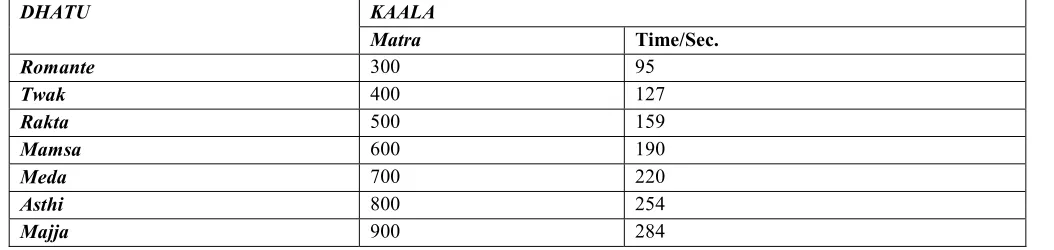
Dalhana, commentator of sushruta samita has de-scribed the effect of abhyanga according to duration. The oil used in abhyanga reaches the dhatus as shown in below table.8:
Table 1: Reaching of taila to different dhatus or effect on dhatus:
DHATU KAALA
Matra Time/Sec.
Romante 300 95
Twak 400 127
Rakta 500 159
Mamsa 600 190
Meda 700 220
Asthi 800 254
Majja 900 284
Charka: Vayu dominates in the tactile sensory organ and this sensory organ is lodged in the skin. The massage is exceedingly beneficial to the skin. So one should practise regularly9
Vagbhata: Vata mainly responsible for tactile sensation and tactile sensation is through skin. Oil bath is best for the skin and so it should be done daily10.
According to Ayurveda, oil etc. used for mas-sage does not have their actions confined to skin alone. The drugs with which these are boiled permeate through the skin and reach different tissue elements of the body. The medicated oil used for massage remain in the skin for 300
sec-onds (matras) and gradually and consecutively permeates through different tissues elements like
rakta, masna, meda, asthi, majja, the medicated oil takes about 100 matras each, to persuade and permeate through these different categories of tissue elements11.
BENEFITS:
1. It wards off old age, exertion and aggravation of
vata, improve vision, nourishment to the body, long life, good sleep, good and strong (healthy) skin12.
IAMJ: Volume 6, Issue 11, November - 2018 2542 work is not much injuries. His physique is
smooth, flabby strong and charming13.
3. Oil bath makes the body soft, controls kapha and vata aggravation, and bestows nourishment to the tissues, good complexion/colour and strength to the body14.
4. The practice of abhyanga pacifies vata, kapha,
aliments, removes tiredness, improves strength, relaxes the body, brings in sleep and improves colour, complexion and softness of the body15. CLASSIFICATION OF ABHYANGA16:
1. According to materials used 2. According to region
3. According to pressure exerted 4. According to Guna of dravya
According to the pressure applied the division is as follows.
1. lepa - application of oil over the body
2. Abhyanga - application of unctuous substances along with necessitate pressure
3. Udvartana or shareera parimarjana - reverse application of pressure
4. Udghrshana - rubbing with ununctuous sub-stances (Rookshana vidhi)
5. Utsadana - rubbing of unctuous pasts
6. Mardana - application of more pressure towards midline of body
7. Unmardana - holding and pulling of the muscles QUALITIES OF SNEHA (ABHYANGA) DRAVYA
There are nine qualities explained by Charaka. 1. Drava - liquid
2. Sookshama – minuteness 3. Sara - flowing
4. Snigdha - unctuous 5. Pichila - gelatinous 6. Guru - heavy 7. Seeta – cold 8. Manda – slow
9. Mrudu - soft Out of the above said qualities some are not seen in many of the Sneha Dravyas.
CONTRA INDICATIONS FOR ABHYANGA: 1. It should be avoided by suffering from
aggrava-tion of kapha, in purifying therapies like emesis, purgations, vamana, virechana etc. and who are suffering from indigestion17.
2. In ama state, patient of nascent fever and indi-gestion should never be anointed18.
MASSAGE DEFINITION19:
Massage is the scientific mode of curing certain forms of disease by systematic manipulations. – Murrel
Massage signifies a group of procedures, which are usually done with hand on the external tissue of the body in a variety of ways either with a curative, palliative or hygienic point in view. – Graham
Massage is the scientific manipulation of the soft tissues of the body with the palmer aspect of hand(s) and or fingers.
Massage is a term applied to certain manipula-tions of the soft tissues. These manipulamanipula-tions are most efficient performed with the palmer aspect of hand and administered for the purpose of pro-ducing effects on the nervous system, muscular system as well as on the local and general circu-lation of the blood and lymph.
– Beard
Massage is the mechanical stimulation of soft tissues of the body by rhythmically applied pres-sure and stretching.
FEATURES OF MASSAGE TECHNIQUE: Essential features of massage technique can be listed as follows:
1) Technique should apply mechanical force to the soft tissue of the body.
2) These forces must not produce any change in the position of the joint.
IAMJ: Volume 6, Issue 11, November - 2018 2543 achieve the therapeutic, restorative or, the
pre-ventive goal.
BASIS OF CLASSIFICATION OF MASSAGE: Application of touch and pressure in various man-ners constitute the manoeuvres of massage. The ef-fects produced by a technique entirely depend upon
the type of tissue approached during a particular technique and the character of the technique governs this. Magnitude of the applied force
Direction of force
Duration of force
Means of application of force.
Table 2: CLASSIFICATION OF MASSAGE ON THE BASIS OF CHARACTER OF TECHNIQUE: Character of techniques
Character of techniques Depth of tissue approached Part of body massage Means of application of pressure
1.Stroking 1.Light massage 1.General massage 1.Manual massage
2.Pressure 2.Deep massage 2.Local massage 2.Mechanical massage
3.Percussion 4.Vibration
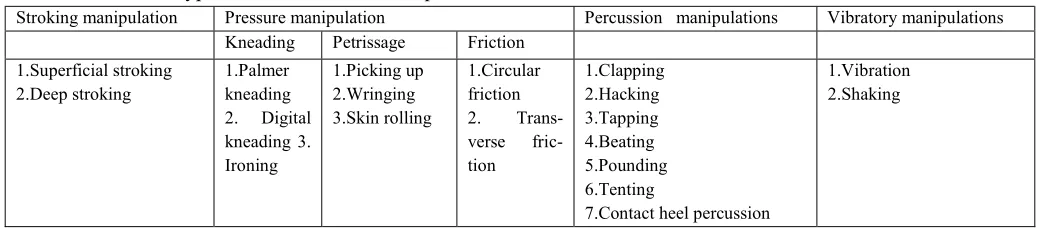
Table 3: Features types of character of techniques20:
Stroking manipulation Pressure manipulation Percussion manipulations Vibratory manipulations
Kneading Petrissage Friction
1.Superficial stroking 2.Deep stroking
1.Palmer kneading 2. Digital kneading 3. Ironing
1.Picking up 2.Wringing 3.Skin rolling
1.Circular friction
2.
Trans-verse
fric-tion
1.Clapping 2.Hacking 3.Tapping 4.Beating 5.Pounding 6.Tenting
7.Contact heel percussion
1.Vibration 2.Shaking
PHYSIOLOGICAL EFFECTS21:
The therapeutic value of massage lies in its numer-ous and combined physiological effects and tech-nique dependent. Massage, be it manual or mechani-cal, imparts pressure and stimulates mechanically the various tissue approached at the time of application of a particular technique. It is the magnitude, dura-tion, and the direction of force applied during a par-ticular technique that determines the effects, pro-duced by that technique on that body.
Effects on the circulatory system
A .On the venous and the lymphatic flow B. On the arterial flow
Effects on the mobility of the soft tissue.
Effects on the skin.
1. Effects of massage on the circulatory system22: A. On the venous and the lymphatic flow:
Massage facilitates the forward movement of the venous blood and the lymph
So reduces the chance of stagnation of the blood and the lymph in the tissue space. The mechani-cal action of massage resembles with that of normal muscular contraction. The different tech-niques of massage alternately compress and re-lease the soft tissue. This facilitates the venous and lymphatic flow.
Massage facilitates the drainage, and reduces the stagnation of fluids and speeds up the removal of waste products.
B. On the arterial flow23:
IAMJ: Volume 6, Issue 11, November - 2018 2544 flow may be attributed to the following events
happening during massage. 1. Release of vasodilators 2. Activation of axon reflex 3. Decrease of venous congestion. 1. EFFECTS ON THE SOFT TISSUE24
Elasticity, Plasticity and Mobility of soft tissue enhanced. The tissues which can be affected by massage include muscles, sheath, ligaments, tendons, aponeursios, and joint capsule sand su-perficial as well as deep fascia.
1. EFFCTS ON THE SKIN25:
It improves the nutritive status of skin and rises the temperature of skin. Massage facilitates the movement of skin over the subcutaneous struc-ture. As a result skin becomes soften, more sup-ple and finer.
After prolonged massage the skin also becomes tough, more flexible, elastic and its sensitivity is reduced. It has a soothing effect on the highly sensitive and vascular papillae, over which deeper layers of the cuticle fits.
The dead cells are removed by the constant con-tact of the hand over the skin. The sweat glands, hair follicles and the sebaceous glands, thus, be-come free from obstruction and can function more effectively.
Massage, by activating the sweat glands, in-creases perspiration, so that the heat dissipation is increased. It also facilitates the sebaceous
se-cretions from exocrine glands of skin and thus, improves the lubrication and appearance of skin. COMBINE PHYSIOLOGICAL EFFECTS OF MASSAGE26:
Increases Venous and lymphatic flow.
Increases Arterial blood flow to the muscle and skin.
Increases Stagnation of fluid in tissue space.
Increases Removal of waste products of metabo-lism.
Increases WBC, RBC and platelets count in cir-culating blood.
Increases Nutritive exchange between blood and cells.
Increases Tropic status of the part massaged.
Induce sedation.
Decreases Pain.
Facilitate contraction in hypotonic muscle.
Increases Excitability of motoneuronal pool in neurologically health person.
Modulate autonomic response.
Increases Electroderma response or GSR.
Increases Removal of secretion from lung.
Increases Gaseous exchange across pulmonary capillaries.
Increases Removal of dead cells from skin.
Increases Activity of sweat and sebaceous gland.
Modulate psychosomatic arousal.
Mobilise soft tissue.
Break the soft tissue adhesions.
Accelerate various metabolic processes.
Promote lypolysis. Table 4: CONTRAINDICATIONS OF MASSAGE27:
General contraindication Local contraindication
1. High fever
2. Severe renal or cardiac diseases 3. Deep X- Ray therapy
4. Osteoporosis 5. Severe spasticity 6. Very hairy skin 7. Patient’s preference
IAMJ: Volume 6, Issue 11, November - 2018 2545
Some basic principles are according to Ayurveda, before Abhyanga doctor must examine:
Screenings of Patient:
1. a) To selection of a patient according to prak-rurti
b) Taking the full history of patient. 2. a) Behaviour modification of patient
b) Physical activity
c) Desha, kala (Ritu)
3. Selection of oil according to this condition.
CONCLUSION
Hence abhyanga is a fully scientific procedure peo-ple of India need to believe in abhyanga not only for multiple benefit for skin but for whole body dhatu Vardhna. The further processional analysis has to be elucidated by scientific methodology under the shade of scientific knowledge.
REFERENCES
1. Sir.M. Monierwilliams, a Sanskrit English Diction-ary, 1st Edition 1899 Delhi, Motilal Banarasidas Pub-lishers pvt. Ltd.; Page-75.
2. DevarajRadhakant, ShabdaKalpaDruma, Reprint Edi-tion 2002, Nag publishers, Delhi, Page-78.
3. Prof Dinkar Govind Thatte, Susruta Samhita,,First Edition- 1994, Chaukhamba Orientalia, Varanasi and Delhi, Su. Ci 24/65.
4. Prof. K.R. Srikantha Murty, Vagbhata’s Aatangahr-dayam, Reprint Edition- 2004, Chowkhamba Kris-hanadas Academy, Varanasi, A.H.Su 2/8-9.
5. R.K. Sharma and Bhagwan Dash, Caraka Samhita, Reprint Edition- 2011,Cowkhamba Sanskrit Series Office, Varanasi, Ca. Su. 5/85-86
6. Prof Dinkar Govind Thatte, Susruta Samhita,,First Edition- 1994, Chaukhamba Orientalia, Varanasi and Delhi, Su. Ci. 24/32
7. Prof Dinkar Govind Thatte, Susruta Samhita,,First Edition- 1994, Chaukhamba Orientalia, Varanasi and Delhi. Su.Ci.24/34
8. Dr.G. Shrinivasa Acharya, Foreword By. Prof.R.H. Singh, Illustrated Panchkarama, First Edition-2006,Reprint Edition-2009,2013,Chaukambha San-skrit Pratishthan Delhi, Ch-2,Page
9. R.K. Sharma and Bhagwan Dash, Caraka Samhita, Reprint Edition- 2011,Cowkhamba Sanskrit Series Office, Varanasi, Ch.Su. 5/87
10. R.K. Sharma and Bhagwan Dash,Caraka Sam-hita,Reprint Edition- 2011,Cowkhamba Sanskrit Se-ries Office, Varanasi, Ch.Su 3/57
11. Vaidya Bhagwan Dash, Message Therapy in Ay-urveda, First published 1992, reprint 1994,1998,2002, Concept publishing company, New Delhi,
12. Prof. K.R. Srikantha Murty, Vagbhata’s Aatangahr-dayam, Reprint Edition- 2004, ChowkhambaKris-hanadas Academy, Varanasi A.H. Su 2/8.
13. R.K. Sharma and Bhagwan Dash, Caraka Samhita, Reprint Edition- 2011,Cowkhamba Sanskrit Series Office, Varanasi Ch. Su 5/88-89.
14. Prof. K.R. Srikantha Murthy, Susruta Samhi, 2ndEdition 2005,ChaukhambhaOrientalia, Varans, Su.Ci 24/30
15. Dr. Madham Shetty Suresh Babu, Yoga Ratnakara, 2ndEdition - 2011, Chowkhamba Sanskrit series
of-fice, Varanasi, Vol-1, Nitya Pravrttiadhaya /56. 16. Abhyanga – An external Oilation therapy, scientific
approach of abhyanga (massage) in ayurveda, Dr.k. Siva rama Prasad.
17. Prof. K.R.SrikanthaMurty, Vagbhata’s Aatangahr-dayam, Reprint Edition- 2004, Chowkhamba Kris-hanadas Academy, Varanasi, A.H.Su2/9.
18. Prof. K.R. Srikantha Murthy, Susruta Samhi, 2ndEdition 2005, Chaukhambha Orientalia, Varansi, Su.Ci 24/35-37.
19. Principles and practices of therapeutic massage, By Akhoury Gourang Sinha, Ch-1,Page -1,2,3
20. Principles and practices of therapeutic massage, by Akhoury Gourang Sinha, Ch-1,Page 4
21. Principles and practices of therapeutic massage, by Akhoury Gourang Sinha, Ch- 2,Page-8
22. Principles and practices of therapeutic massage, by Akhoury Gourang Sinha, Ch-2,Page -9
23. Principles and practices of therapeutic massage, by Akhoury Gourang Sinha,Ch-2, Page-10
24. Principles and practices of therapeutic massage, by Akhoury Gourang Sinha, Ch-2, Page -19
25. Principles and practices of therapeutic massage, by Akhoury Gourang Sinha, Ch-2, Page-21
26. Principles and practices of therapeutic massage, by Akhoury Gourang Sinha, Ch-2, Page-23
27. Principles and practices of therapeutic massage, by Akhoury Gourang Sinha, Ch-2, Page-34
Source of Support: Nil
Conflict Of Interest: None Declared
How to cite this URL: Purnima Sangwan: Abhyanga – A Conceptualized Study –A Review Article. International Ayurvedic Medical Journal {online} 2018 {cited November, 2018} Available from: