433 | P a g e
DEVELOPMENT AND STUDY OF BEHAVIOR OF
SELF-COMPACTING CONCRETE USING
RECYCLED AGGREGATES
Arjun B
1, M.Rame Gowda
21
M.Tech Student, Department of Civil Engineering, Adichunchanagiri Institute of Technology,
Chikmagalur, Karnataka, India
2
Professor & Head, Department of Civil Engineering, Adichunchanagiri Institute of Technology,
Chikmagalur, Karnataka, India
ABSTRACT
The present investigation covers a review of literature on recycling and reuse of waste concrete aggregate.
Dumping of raw material has become a problem for many countries. Construction industry in india generate
around 10-20 million tones of waste annually. In this paper the literature related to the recycling and reuse of
waste concrete aggregate to the self compacting concrete is presented. The experimental procedure consists of
fixing the optimum mix for SCC taking into account the criteria for SCC and design mix calculated as per Nan
Su method. The mix ratio obtained from Nan Su method is made to satisfy the EFNARC Guidelines by trial mix
method. Then the coarse aggregate is replaced by 25-60% with an interval of 5% by RCA for the optimum mix
and studied the fresh and hardened properties. Results obtained reports that as much of 40% of aggregates can
be replaced without any significant consequences on the concrete produced.
Keywords - Compressive Strength, Natural Aggregate, Recycled Coarse Aggregate, Split Tensile
Strength
I. INTRODUCTION
The self compacting concrete consist of cement, sand, coarse aggregate and superplastisers. Their proportion in
the concrete is based on grade of concrete. Cement has two main functions, to fill voids between aggregate particles and water tightness and to give Strength to hardened concrete. The aggregate which comprises of 70 to
80 % of volume of concrete has three main functions are to provide a cheap filler, to provide a mass of particles
for resisting the action of applied loads and to reduce the volume changes resulting from the settling and
hardening process. Recycling is the act of processing the used material for use in creating new product. In order
to reduce the usage of natural aggregate, recycled aggregate can be used as the replacement material. Recycled
aggregate comprised of crushed, graded inorganic particle processed from the materials that have been used in
the construction and demolition wastes. These materials are from building, roads, bridges etc.
Many researchers have come across many benefits and barriers. Barriers like in some countries it is considered
that low economic cost of natural aggregate than that of recycled aggregate, non-regular supply of waste. Benefits are like reduction in transportation cost, wastes generally present near the construction site, and it
434 | P a g e
and reuse the large amount of waste generated from the construction and demolition due to increase inpopulation and urbanization or natural disaster.
These wastes constitute a major portion of total solid waste production in the world, and most of it is used in the
landfills. Due to the shortage of dumping sites and increase in cost of transport, majority of
developed/developing countries are facing problems in handling and disposal of such wastes. By considering all
the aspect, it is beneficial to reuse the generated waste for effective utilization and to save environment.
II. LITERATURE REVIEW
A.N.Dabhade et al (1): There investigation was carried out using workability test, compressive test, split tensile test and bulk density, water absorption, impact value test, crushing value test, Fineness modulus. There were
total of sixth batches of concrete mixes, consists of every 20% increment of recycled aggregate replacement from 0% to 100%. The results showed that a gradually increasing in the compressive strength up to 20% of
recycled aggregate and as well as for the tensile strength as the percentage of recycled aggregate.
C. Sumanth Reddy et al [2]: They studied the mechanical and durability properties of the concrete. Three concrete grades M20, M40 and M60 are prepared with recycled aggregate substitutions of 0%, 25%, 50% and
100% to test for compressive strength, acid resistance and water adsorption. Results suggest that as much of
25% of aggregates can be replaced without any significant consequences on the concrete produced. They
concluded that RCA concrete performance deteriorated with increase in grade of concrete suggesting that
caution is to be exercised when using RCA for higher grade concretes.
Md. Safiuddin et al [4]: have investigated on the effects of RCA on the key fresh properties such as filling ability, passing ability, and segregation resistance of SCC. In the present study, RCA was used as partial and full
re-placements of NCA to produce self-consolidating concrete (SCC). Different SCC mixes were produced with
RCA substituting 0%, 30%, 50%, 70%, and 100% NCA by weight. The overall test results suggest that RCA
can be used to produce SCC substituting up to 50% NCA without affecting the key fresh properties of concrete.
Mirjana Malesev et al [5]: have investigated on the properties of fresh and hardened concrete with three types of concrete mixtures were tested: concrete made entirely with natural aggregate (NAC) as a control concrete and
two types of concrete made with natural fine and recycled coarse aggregate (50% and 100% replacement of coarse recycled aggregate). They concluded the concrete with more than 50% of recycled coarse aggregate has
significantly more shrinkage compared to concrete with natural aggregate.
Prashant O. Modani et al (6): In this study coarse recycled aggregate (RCA) were used in the production of self compacting concrete (SCC) in varying percentage replacements of natural coarse aggregate (NCA) from 0%
to 100% with increment of 20%. They have concluded that all the mixes having recycled aggregates have higher
permeability values, which is a consequence of high initial water absorption of RCA. Concrete mixes up to 40%
RCA have shown good resistance to acid attack and chloride penetration.
435 | P a g e
have concluded that the use of RCA in SCC provides dual advantage by deriving the benefits of both thematerials as these materials reduce the impact of CO2 emissions apart from improving properties.
Sudhir P.Patil et al [8]: they aimed to evaluate physical properties of concrete using recycled coarse aggregate. In this research concrete waste is from demolished structure (Near Kamla Nehru Park, Bhandarkar
Rd, Pune) has been collected and coarse aggregate of different %
is used for preparing fresh concrete. The compressive strength of recycled coarse aggregate (RCA) is found to
be higher than the compressive strength of normal concrete when used upto a certain %. At the end it can be
said that the RCA up to 50 % can be used for obtaining good quality concrete.
III. MATERIALS AND METHODS
Materials
Cement: Portland cement is one of the most widely used additives for all types of construction activity. The cement used for the investigation was Ordinary Portland cement (PPC-43grade). It confirmed to the requirement of Indian Standard Specification IS: 8112-1989.
Sand: Good river bank sand in absence of any earthy matter and organic matter. Particles are angular in shape passing 4.75mm and retaining on 150 micron standard sieve.
Coarse aggregates: The maximum size of aggregate is generally limited to 20mm. Coarse aggregate which passed through 12mm sieve but retained on 6mm sieve are used for the SCC mix.
Mixing water: Ordinary potable water of normal pH 7 is used for mixing and curing the concrete specimen.
Superplasticizer: Conplast SP430 is used because it is essential component of SCC to provide necessary workability.
Recycled coarse aggregates: Demolition of old and deteriorated buildings and traffic infrastructure, and their substitution with new ones, is a frequent phenomenon today in a large part of the world. The main reasons for
this situation are changes of purpose, structural deterioration, rearrangement of a city, expansion of traffic
directions and increasing traffic load, natural disasters. A possible solution to these problems is to recycle
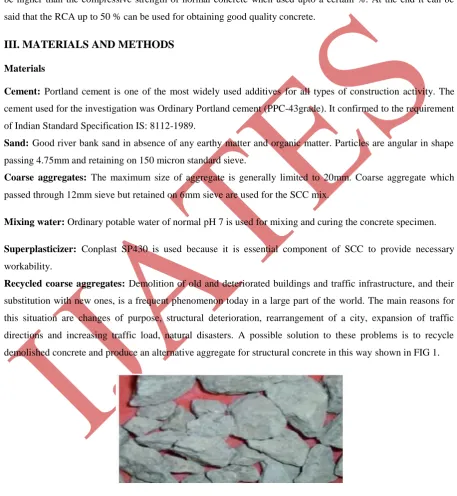
demolished concrete and produce an alternative aggregate for structural concrete in this way shown in FIG 1.
FIG 1:Coarse aggregate segregated from concrete waste Basic Properties of Concrete with Recycled Concrete Aggregate
436 | P a g e
Treatment process for RCA:
To improve the quality of RCA some treatment process is required which is given in detail.
Washing:
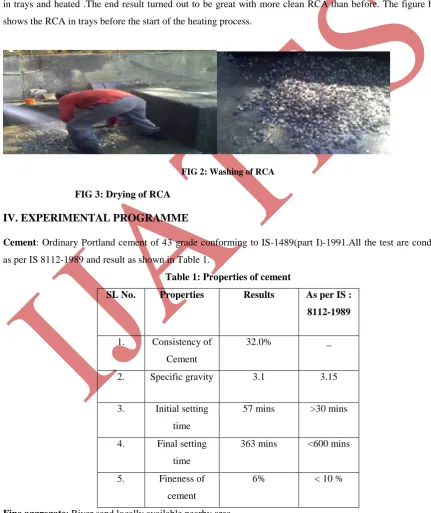
The aggregates collected by sieve analysis are washed by pressure washing. This is done so as to remove the
mortar adhered to the aggregates. The pressure at which water is applied is 500 psi for about 15 to 20 mins.
Washing process cleanes the aggregates to a considerable extent as shown in FIG 1. The RCA were then kept for sun drying for about 30 mins as shown in FIG 2.
Heating:
The RCA were then heated in an oven at temperature of around 150 º C for about an hour. The RCA were kept
in trays and heated .The end result turned out to be great with more clean RCA than before. The figure below
shows the RCA in trays before the start of the heating process.
FIG 2: Washing of RCA
FIG 3: Drying of RCA
IV. EXPERIMENTAL PROGRAMME
Cement: Ordinary Portland cement of 43 grade conforming to IS-1489(part I)-1991.All the test are conducted as per IS 8112-1989 and result as shown in Table 1.
Table 1: Properties of cement
SL No. Properties Results As per IS : 8112-1989
1. Consistency of
Cement
32.0% _
2. Specific gravity 3.1 3.15
3. Initial setting
time
57 mins >30 mins
4. Final setting
time
363 mins <600 mins
5. Fineness of
cement
6% < 10 %
437 | P a g e
Coarse aggregate: Machine crushed granite obtained from quarry was used as a coarse aggregate.
Recycled aggregate: It is obtained from demolition of concrete
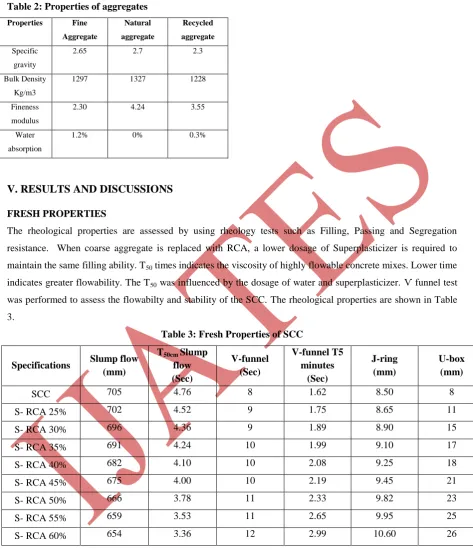
Table 2: Properties of aggregates
Properties Fine
Aggregate Natural aggregate Recycled aggregate Specific gravity
2.65 2.7 2.3
Bulk Density
Kg/m3
1297 1327 1228
Fineness
modulus
2.30 4.24 3.55
Water
absorption
1.2% 0% 0.3%
V. RESULTS AND DISCUSSIONS
FRESH PROPERTIES
The rheological properties are assessed by using rheology tests such as Filling, Passing and Segregation
resistance. When coarse aggregate is replaced with RCA, a lower dosage of Superplasticizer is required to
maintain the same filling ability. T50 times indicates the viscosity of highly flowable concrete mixes. Lower time
indicates greater flowability. The T50 was influenced by the dosage of water and superplasticizer. Ѵ funnel test
was performed to assess the flowabilty and stability of the SCC. The rheological properties are shown in Table
3.
Table 3: Fresh Properties of SCC
Specifications Slump flow (mm)
T50cm Slump
flow (Sec) V-funnel (Sec) V-funnel T5 minutes (Sec) J-ring (mm) U-box (mm)
SCC 705 4.76 8 1.62 8.50 8
S- RCA 25% 702 4.52 9 1.75 8.65 11
S- RCA 30% 696 4.36 9 1.89 8.90 15
S- RCA 35% 691 4.24 10 1.99 9.10 17
S- RCA 40% 682 4.10 10 2.08 9.25 18
S- RCA 45% 675 4.00 10 2.19 9.45 21
S- RCA 50% 666 3.78 11 2.33 9.82 23
S- RCA 55% 659 3.53 11 2.65 9.95 25
S- RCA 60% 654 3.36 12 2.99 10.60 26
Hardened properties of SCC
438 | P a g e
percentage of recycled aggregate increased. The comparison of 7 and 28 days compressive as well as splittensile strength for various water cement ratio is shown in Table 4 & 5.
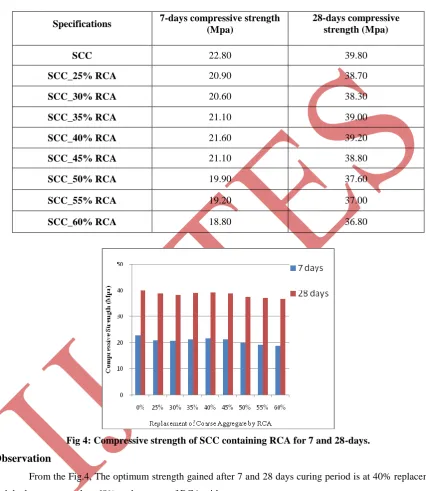
Table 4: Compressive strength at 7 and 28-days for various replacement levels of RCA (%).
Specifications 7-days compressive strength (Mpa)
28-days compressive strength (Mpa)
SCC 22.80 39.80
SCC_25% RCA 20.90 38.70
SCC_30% RCA 20.60 38.30
SCC_35% RCA 21.10 39.00
SCC_40% RCA 21.60 39.20
SCC_45% RCA 21.10 38.80
SCC_50% RCA 19.90 37.60
SCC_55% RCA 19.20 37.00
SCC_60% RCA 18.80 36.80
Fig 4: Compressive strength of SCC containing RCA for 7 and 28-days.
Observation
From the Fig.4, The optimum strength gained after 7 and 28 days curing period is at 40% replacement
and the lowest strength at 60% replacement of RCA with coarse aggregate.
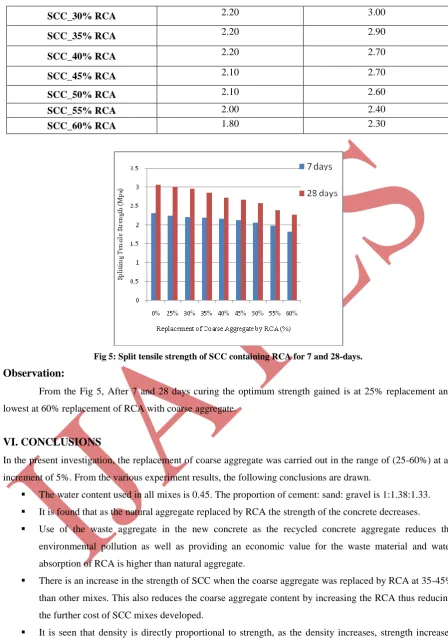
Table 5: Splitting tensile strength at 7 and 28-days for various replacement levels of RCA (%).
Specifications 7-days Split tensile strength (Mpa)
28-days Split tensile strength (Mpa)
SCC 2.30 3.10
439 | P a g e
SCC_30% RCA 2.20 3.00
SCC_35% RCA 2.20 2.90
SCC_40% RCA 2.20 2.70
SCC_45% RCA 2.10 2.70
SCC_50% RCA 2.10 2.60
SCC_55% RCA 2.00 2.40
SCC_60% RCA 1.80 2.30
Fig 5: Split tensile strength of SCC containing RCA for 7 and 28-days.
Observation:
From the Fig 5, After 7 and 28 days curing the optimum strength gained is at 25% replacement and
lowest at 60% replacement of RCA with coarse aggregate.
VI. CONCLUSIONS
In the present investigation, the replacement of coarse aggregate was carried out in the range of (25-60%) at an
increment of 5%. From the various experiment results, the following conclusions are drawn.
The water content used in all mixes is 0.45. The proportion of cement: sand: gravel is 1:1.38:1.33.
It is found that as the natural aggregate replaced by RCA the strength of the concrete decreases.
Use of the waste aggregate in the new concrete as the recycled concrete aggregate reduces the
environmental pollution as well as providing an economic value for the waste material and water
absorption of RCA is higher than natural aggregate.
There is an increase in the strength of SCC when the coarse aggregate was replaced by RCA at 35-45%
than other mixes. This also reduces the coarse aggregate content by increasing the RCA thus reducing
the further cost of SCC mixes developed.
It is seen that density is directly proportional to strength, as the density increases, strength increases
440 | P a g e
REFERENCES
[1] A.N.Dabhade, Dr.S.R.Choudhari, Dr.A.R.Gajbhiye, International Journal of Engineering Research and
Applications (IJERA) ISSN: 2248-9622 www.ijera.com Vol. 2, Issue 4, July-August 2012, pp.1387-1391
[2]C.Sumanth Reddy, K.V.Ratna Sai, Dr.P.Rathish Kumar, “Mechanical and Durability properties of Self Compacting Concrete with recycled concrete aggregates” International Journal of Scientific & Engineering
Research, Volume 4, Issue 5, May-2013.
[3] EFNARC, (2002), “Specifications and Guidelines for Self-Compacting Concrete”, EFNARC, UK
(www.efnarc.org), pp.1-32.
[4] Md. Safiuddin, M.A. Salam, M.Z. Jumaat, “Effects of recycled concrete aggregate on the fresh properties of
self-consolidating concrete”, Archives Of Civil And Mechanical Engineering, Vol. XI, 2011, No. 4.
[5] Mirjana Malešev, Vlastimir Radonjanin And Snežana Marinković, “Recycled Concrete As Aggregate For Structural Concrete Production”, 30 April 2010.
[6] Prashant O. Modani, Vinod M Mohitkar, “Self-Compacting Concrete With Recycled Aggregate: A Solution For Sustainable Development”, International Journal Of Civil And Structural Engineering, Volume 4, No 3,
2014.
[7] Srinivas Vasam, K. Jagannadharao, “Use Of Scc And Rca For Sustainable Construction - An Overview”,
Ijret, Volume: 02 Issue: 11 | Nov-2013.