R E S E A R C H A R T I C L E
Open Access
Prepackaged central line kits reduce procedural
mistakes during central line insertion:
a randomized controlled prospective trial
Yelena Fenik
1†, Nora Celebi
2*†, Robert Wagner
2, Christoph Nikendei
3, Frederike Lund
3, Stephan Zipfel
4,
Reimer Riessen
5and Peter Weyrich
2Abstract
Background:Central line catheter insertion is a complex procedure with a high cognitive load for novices. Providing a prepackaged all-inclusive kit is a simple measure that may reduce the cognitive load. We assessed whether the use of prepackaged all-inclusive central line insertion kits reduces procedural mistakes during central line catheter insertion by novices.
Methods:Thirty final year medical students and recently qualified physicians were randomized into two equal groups. One group used a prepackaged all-inclusive kit and the other used a standard kit containing only the central vein catheter and all other separately packaged components provided in a materials cart. The procedure was videotaped and analyzed by two blinded raters using a checklist. Both groups performed central line catheter insertion on a manikin, assisted by nursing students.
Results:The prepackaged kit group outperformed the standard kit group in four of the five quality indicators: procedure duration (26:26 ± 3:50 min vs. 31:27 ± 5:57 min, p = .01); major technical mistakes (3.1 ± 1.4 vs. 4.8 ± 2.6, p = .03); minor technical mistakes (5.2 ± 1.7 vs. 8.0 ± 3.2, p = .01); and correct steps (83 ± 5% vs. 75 ± 11%, p = .02). The difference for breaches of aseptic technique (1.2 ± 0.8 vs. 3.0 ± 3.6, p = .06) was not statistically significant. Conclusions:Prepackaged all-inclusive kits for novices improved the procedure quality and saved staff time resources in a controlled simulation environment. Future studies are needed to address whether central line kits also improve patient safety in hospital settings.
Keywords:Central catheter placement, Cognitive load, Split-attention principle
Background
A central line catheter is a central venous catheter typi-cally used in critical care and oncological patients [1]. Although often vital in a clinical setting, central line catheters are associated with a number of serious com-plications, estimated at approximately 5.3 complications per 1000 catheter days [1,2]. Complications include catheter-related infections and mechanical complications du-ring insertion, such as arterial puncture, catheter misplace-ment, pneumothorax, hemothorax, pericardial tamponade,
air emboli, and even death. Late complications, including venous thrombosis, embolism and venous stenosis can also occur [3-8]. Self-limiting cardiac arrhythmias are common and are caused by irritation of the ventricle by the guide wire. Some authors have claimed that a very low complica-tion rate is achievable for central line catheter insercomplica-tions [9,10]. There is strong evidence that infectious complica-tions can be prevented with thorough training in central line catheter placement; maximum barrier precautions; dis-infection of the insertion site; hand hygiene; antiseptic coating of the catheter; timely removal of unnecessary catheters; and the use of all-inclusive catheter carts [11,12]. Failed puncture can often be avoided using ultrasound guidance [13,14].
Studies have shown that inexperienced physicians are more likely to fail or induce mechanical complications * Correspondence:[email protected]
†Equal contributors
2Department of Endocrinology, Diabetology, Nephrology, Angiology and Clinical Chemistry, University Hospital of Tuebingen, Otfried-Mueller-Str. 10, Tuebingen 72076, Germany
Full list of author information is available at the end of the article
while placing a central line than their experienced col-leagues [15,16]. Mechanical complications usually arise from the complex multistep insertion procedure, and iden-tifying practices that contribute to a technically correct cen-tral line catheter insertion minimizes these complications.
One of the simplest measures to prevent central line catheter complications is using a prepackaged all-inclusive central line catheter insertion kit. Central line catheter in-sertion is a complex task with a high cognitive load for novices. Cognitive load theory assumes that the human cog-nitive system has a limited working memory of no more than five to nine information elements and actively processes no more than two to four elements simultaneously [17]. Tasks with high element interactivity are difficult to understand and produce a high cognitive load because learners must deal with several elements simultaneously [17]. There are several ways to reduce the cognitive load in novices. The split-attention principle focuses on replacing multiple sources of informa-tion, distributed either in space (spatial split-attention) or time (temporal split-attention), with one integrated source of infor-mation [17]. Placing all of the materials required for a certain procedure into one prepackaged kit represents this principle, and may facilitate the complex insertion procedure for nov-ices. To our knowledge, there are only two studies assessing the introduction of an all-inclusive central line kit at two dif-ferent intensive care units [10,18]. In both studies, several changes were introduced simultaneously (checklists, staff edu-cation, and daily central line assessments). Neither study assessed the effect of prepackaged all-inclusive central line catheter kits in reducing mechanical complications or time re-sources. In addition, there was no differentiation between novices and experts.
We investigated whether the use of a prepackaged all-inclusive central line catheter insertion kit by novices effect-ively reduces the number of procedural mistakes, procedure duration, breaches of aseptic technique, and improves ad-herence to the procedural algorithm.
Methods
Study design
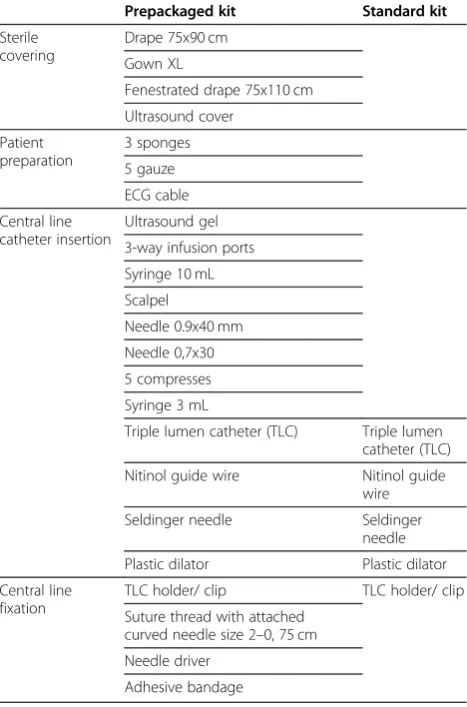
This was a randomized, controlled, prospective, single-blind study to assess whether the use of a prepackaged all-inclusive central line catheter insertion kit (prepackaged kit) containing all of the necessary materials for insertion from preparation to cleanup vs. a central line catheter kit containing only the catheter components and all other se-parately packaged components provided in a materials cart (standard kit, Table 1) would result in fewer procedural mistakes and possibly improve asepsis breaches during the insertion procedure when performed by novices.
Study cohort
Novice residents and final year medical students were ran-domized into two equal groups using a random number
list. To identify possible confounders, the following data were recorded for all participants: educational status (year of medical education, former studies in health care); prior central line catheter insertion experience for both manikins and patients (number of procedures); age; and sex. We ex-cluded participants who had previously performed central line catheter insertion more than 15 times.
Both groups were assisted by first year nursing students with limited experience assisting with central line catheter insertion. Each nursing student assisted only once or twice during the study.
Central line catheter kits
One group performed central line catheter insertion using the prepackaged kit and the other group used the standard kit with additional necessary items provided in the clinic’s stocked standard materials cart (see Table 1). The prepackaged kit contained almost all of the items necessary for the central line catheter insertion from preparation to cleanup, while the
Table 1 Contents of the prepackaged and standard kits
Prepackaged kit Standard kit
Sterile covering
Drape 75x90 cm Gown XL
Fenestrated drape 75x110 cm Ultrasound cover
Patient preparation
3 sponges 5 gauze ECG cable Central line
catheter insertion
Ultrasound gel 3-way infusion ports Syringe 10 mL Scalpel
Needle 0.9x40 mm Needle 0,7x30 5 compresses Syringe 3 mL
Triple lumen catheter (TLC) Triple lumen catheter (TLC) Nitinol guide wire Nitinol guide
wire
Seldinger needle Seldinger
needle Plastic dilator Plastic dilator Central line
fixation
TLC holder/ clip TLC holder/ clip Suture thread with attached
curved needle size 2–0, 75 cm Needle driver
Adhesive bandage
standard kit contained only the components of the central line catheter itself. This meant that the standard kit group had to decide which additional items were needed for the procedure and actively select them from the materials cart or ask the nurse for them at a later stage. We designed the prepackaged kit based on our internal departmental standards and safety policies. B. Braun Melsungen AG (Melsungen, Germany) manufactured and supplied both kits. The prepackaged kit was labeled to indicate that it did not include saline, lidocaine, sterile gloves, mask, cap, or blood gas syringe, because these materials were either not sterilizable (plastic containers or sy-ringes, mask, cap) or dependent on the physician’s individual size (gloves). The standard kit is routinely used in our tertiary care hospital and contained a triple lumen catheter (TLC), a nitinol guide wire, a Seldinger needle, a plastic dilator and a TLC holder/clip. All other materials (including drapes, syrin-ges, and gauze) had to be selected separately from the mate-rials cart that is used for a variety of puncture procedures in our clinic (see Table 1), including ascites drainage and bone marrow aspiration. The materials cart contained the items used for these other procedures as well as the additional items needed for central line insertion when using the standard kit.
Simulation manikin
The insertion procedure was performed on a central line manikin (SimuLab Corporation, Seattle, Washington, USA). The model was chosen because it is well established in teaching central line catheter insertion. It has a realistic ana-tomical jugular vein access and permits ultrasound guidance to identify both arterial and venous vessel tubes [19]. Over 150 punctures per silicon block are possible according to the manufacturer’s information (personal communication).
Procedure evaluation by video assessment
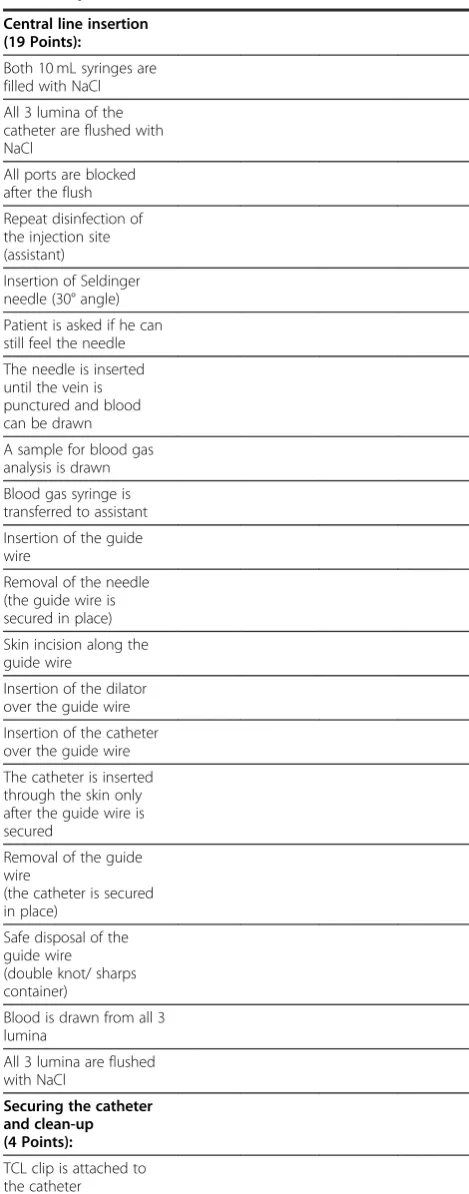
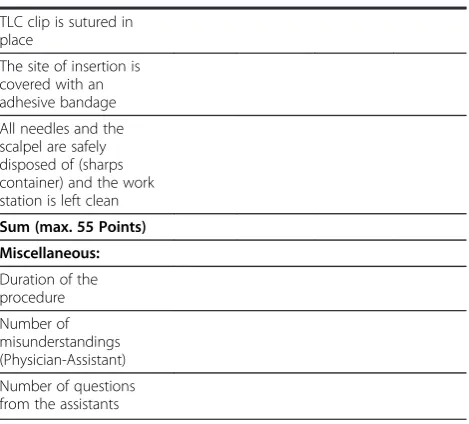
The procedure was videotaped and the videos were analyzed by two reviewers using a checklist (Table 2). The raters were experienced physicians (internal medicine consultants) and clinical skills teachers at another university hospital. The camera was angled to focus on the central line catheter inser-tion team and the manikin, but also included the materials cart and preparation table to allow assessment of the complete insertion procedure, including breaches of aseptic technique. The reviewers had no information on the study design or the study question. The checklist (Table 2) in-cluded 55 steps [20]. We also assessed five quality indicators:
– procedure duration (from the start of the
preparations until the end of the cleanup process)
– major technical mistakes (each deviation from the correct central line catheter insertion procedure that might have resulted in patient harm according to the rater’s judgment)
– minor technical mistakes (each deviation from the correct central line catheter insertion procedure that
might not have resulted in patient harm according to the rater’s judgment)
– number of correctly performed steps according to the checklist (each step of the central line catheter insertion procedure that was performed in the correct order with the correct technique)
– breaches of aseptic technique (each contact between sterile and unsterile material).
Statistics
All data provided by the video raters were entered into a Microsoft ACCESS 2008 (Microsoft Corporation, Redmond, WA) database and subsequently analyzed using the JMP 8.0 software package (SAS Institute, Cary, NC, USA). We used Student’s t-test on normally distributed numerical data, the Wilcoxon test for non-normally distributed numerical data and the Chi2test on parametric data. We used G*Power software (Erdfelder, Faul, & Buchner, 1996, Düsseldorf, Germany) for the power analysis, aiming for a power≥0.80 based on the results of previous studies conducted by our research team [21]. Ap-value of≤0.05 was considered sta-tistically significant. Interrater reliability was calculated using IBM SPSS Statistics Version 20 as an intraclass cor-relation coefficient with a two-way mixed-effects model (absolute agreement) (ICC (3,k)) according to Shrout and Fleiss’definition [22].
Ethical issues
The study protocol was reviewed and accepted by the local ethics committee, decision number 059/2011BO1. Study participation was voluntary. The results remained anonym-ous and were not used in any academic evaluations or as-sessments of the participants. All participants gave written informed consent and the study was performed in accordance with the declaration of Helsinki, revised form, Seoul 2008 [13].
Results
Power analysis
Power analysis revealed that at least 10 subjects for each group (prepackaged vs. standard kit) were required to de-tect an effect size“d”of 1.2 with a power of 80%, assuming a standard deviation of 5 (out of 55 checklist points) and normally distributed assessment scores in both groups. Be-cause the test scores in the standard kit group were non-normally distributed in our study and the effect size was lower than estimated (0.94 vs. 1.2), the final power was 69%, despite each team including 15 participants with complete data sets in each group.
Study cohort and randomization
Table 2 Procedural checklist used by the video raters to evaluate performance
Action Correct Minor
technical error
Major technical error
Breaches in aseptic technique
Preparation of materials (26 Points):
Sterile gloves Sterile gown Cap Mask
Disinfecting agent Sterile gauze Sterile compresses Local anesthetic 3ml Syringe (for the anesthetic) Needle
(for the anesthetic) Sterile drape
Sterile fenestrated drape 10 ml Syringe
Distilled water (to simulate NaCl 0.9%) TLC
Seldinger needle Guide wire Dilator Scalpel 3-way ports Blood gas syringe TLC holder/ clip Suture thread Needle driver Adhesive bandage Sharps container Patient preparation (6 Points):
Sterile use of ultrasound equipment, if applied to find the vein
Hand washing/ sanitizing All of the following are worn: sterile gloves and gown, mask, cap Disinfection of the injection site Fenestrated drape is applied to injection site Injection of the local anesthetic (must aspirate before injection!)
Table 2 Procedural checklist used by the video raters to evaluate performance(Continued)
Central line insertion (19 Points):
Both 10 mL syringes are filled with NaCl All 3 lumina of the catheter are flushed with NaCl
All ports are blocked after the flush Repeat disinfection of the injection site (assistant)
Insertion of Seldinger needle (30° angle) Patient is asked if he can still feel the needle The needle is inserted until the vein is punctured and blood can be drawn A sample for blood gas analysis is drawn Blood gas syringe is transferred to assistant Insertion of the guide wire
Removal of the needle (the guide wire is secured in place) Skin incision along the guide wire
Insertion of the dilator over the guide wire Insertion of the catheter over the guide wire The catheter is inserted through the skin only after the guide wire is secured
Removal of the guide wire
(the catheter is secured in place)
Safe disposal of the guide wire (double knot/ sharps container)
Blood is drawn from all 3 lumina
All 3 lumina are flushed with NaCl
Securing the catheter and clean-up (4 Points):
Twenty-three (77%) had performed three or fewer proce-dures, resulting in an adequate target cohort for this study.
The study participants’characteristics after randomization are summarized in Table 3. There were no differences between the prepackaged kit group and standard kit group with regard to sex, age, previous experience in central line catheter insertions and educational status (p > .12).
Procedure evaluation
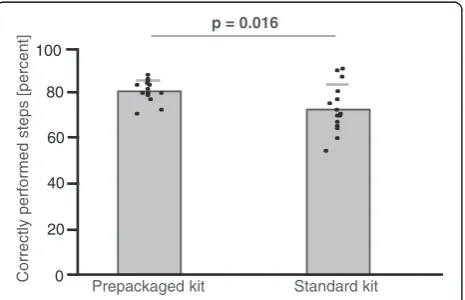
The prepackaged kit group made 35% fewer major mis-takes (3.1 ± 1.4 vs. 4.8 ± 2.6, mean ± SD, p = .033; Figure 1) and 35% fewer minor mistakes (5.2 ± 1.7 vs. 8.0 ± 3.2, p = .007; Figure 2). With regard to the checklist, the prepackaged kit group adhered better to the procedural algorithm (83 ± 5% vs. 75 ± 11% of correctly performed steps, p = .016; Figure 3). The prepackaged kit group re-quired less time to perform the procedure than the stan-dard kit group (26:26 ± 3:50 min vs. 31:27 ± 5:57 min,
p = .01; Figure 4). Although not statistically significant, there was a trend toward fewer breaches of aseptic technique in the prepackaged kit group (1.2 ± 0.8 vs. 3 ± 3.6, p = .06; Figure 5).
Interrater reliability
The interrater reliability for the two blinded video raters calculated by interclass coefficient was .841.
Discussion
Central line catheter insertion is a frequently used, com-plex, multistep procedure that produces a high cognitive load for novices. We used a worst-case scenario for our study: a novice trying to insert a central line catheter with assistance from an inexperienced nurse. We com-pared the effect of a prepackaged kit containing all of the possible necessary additional equipment with a standard kit containing only the central vein catheter and all other separately packaged components provided in a materials cart (see Table 1) for five quality indica-tors: procedure duration; adherence to the procedural al-gorithm (percentage of correctly performed steps); the Table 2 Procedural checklist used by the video raters to
evaluate performance(Continued) TLC clip is sutured in
place
The site of insertion is covered with an adhesive bandage All needles and the scalpel are safely disposed of (sharps container) and the work station is left clean Sum (max. 55 Points)
Miscellaneous:
Duration of the procedure Number of misunderstandings (Physician-Assistant) Number of questions from the assistants
Table 3 Study participants’characteristics
Prepackaged kit Standard kit Pχ2, TT, Wilcoxon
Gender 7 male, 8 female 11 male, 4 female .13
Age 27.3 ± 2.5 27.3 ± 2.2 .93
Prior experience in central line catheter insertion on manikins (n = participants)
0: n = 13 0: n = 10 .36
1-3: n = 2 1-3: n = 4
4-15: n = 0 4-15: n = 1
Prior experience in central line catheter insertion on patients (n = participants)
0: n = 7 0: n = 7 .93
1-3: n = 5 1-3: n = 6
4-15 : n = 3 4-15: n = 2
Level of Education 6 final year medical students 8 final year medical students .46 9 novice residents 7 novice residents
Results are displayed as mean ± SD.
p = 0.033 10
0 8
6
4
2
Standard kit Prepackaged kit
Number
of major technical
mistakes
number of major and minor technical mistakes; and the number of breaches of aseptic technique. A simulated setting was chosen to guarantee patient safety and to avoid any relevant variables that could interfere with the study question. We hypothesized that the use of a prepackaged kit would simplify the procedure in such a way that complications would be reduced [17]. Because the novices randomized to the prepackaged kit did not have to concentrate on the active selection of additional items required for the insertion procedure, the use of the prepackaged kit represented the split-attention principle, resulting in the reduction of cognitive load.
In four of the five categories, the novice residents and final year medical students who used the prepackaged kit outperformed those in the standard kit group. Putting most of the items required for the procedure into one prepackaged set was just one of the multistep interventions that have been shown to reduce the rate of central line catheter complications [10,18]. However, because the use of a prepackaged kit was not the only measure that was
introduced in an attempt to lower the complication rate in previous studies, it was difficult to ascertain to what extent the prepackaged kit actually contributed to procedure safety.
We wanted to identify the potential beneficial effect of a prepackaged kit for three reasons:
1. Novices have been shown to have a higher
complication rate than experts and need all the help they can get to minimize potential complications. 2. The use of prepackaged kits can be applied to other
invasive procedures with a high cognitive load for novices, e.g., insertion of a chest tube or bone marrow aspiration.
3. The use of a prepackaged kit facilitates materials manipulation and allows for homogenous sterilization.
These advantages may outweigh the additional costs of prepackaging and other possible drawbacks such as ma-terial surplus (invariably, not all components are used)
Standard kit Prepackaged kit
p = 0.007
10
0 8
6
4
2 12 14
Number
of minor technical
mistakes
Figure 2Minor technical mistakes.Number of minor technical mistakes in the prepackaged and standard kit group. Results are displayed as mean ± SD.
0 20 40 60 80 100
p = 0.016
Standard kit Prepackaged kit
Correctly
performed
steps
[percent]
Figure 3Correctly performed steps.Number of correctly performed steps in the prepackaged and standard kit group. Results are displayed as mean ± SD.
p = 0.01
40
30
20
10
0
Standard kit Prepackaged kit
T
ime
needed
to perform the procedure [minutes]
Figure 4Procedure duration.Procedure duration in the
prepackaged and standard kit group. Results are displayed as mean ± SD.
p = 0.06
10
0 5 15
Number
of breaches
of aseptic technique
Standard kit Prepackaged kit
and a certain inflexibility because the same manufacturer must be used for the individual components.
Our study has several limitations. First, we standar-dized the procedure by using a manikin. Because we did not assess central line catheter insertion in actual pa-tients, our results cannot be extrapolated. Second, des-pite having performed a pre-study power analysis, our study was ultimately underpowered and failed to detect a significant difference for one of the five quality inditors (number of breaches of aseptic technique). The ca-tegory “breaches of aseptic technique” is only a surrogate parameter for a central line catheter bloodstream infection, as is non-adherence to the procedural algorithm for mech-anical complications. A breach of aseptic technique and non-adherence to the procedural algorithm may or may not result in actual patient harm.
More research is needed to determine the effect of prepackaged kits on patient outcomes for other complex procedures and on factors that contribute to patient safety.
Conclusions
The use of prepackaged kits may help reduce procedural mistakes in the central line catheter insertion procedure for novices.
Competing interests
The authors declare that they have no competing interests.
Authors’contributions
YF made substantial contributions to the study design, performed the data acquisition and drafted the manuscript. NC made substantial contributions to the study design, helped analyze the data and drafted the manuscript. RW performed the statistical analysis and revised the manuscript critically. CN rated the videos and revised the manuscript critically. FL rated the videos and revised the manuscript critically. SZ made substantial contributions to the conception of the study and revised the manuscript critically. RR made substantial
contributions to the conception of the study and revised the manuscript critically. PW designed the study, performed the data analysis and helped draft the manuscript. All authors read and approved the final manuscript.
Author details
1University of Tuebingen Medical School, Tuebingen, Germany.2Department of Endocrinology, Diabetology, Nephrology, Angiology and Clinical Chemistry, University Hospital of Tuebingen, Otfried-Mueller-Str. 10, Tuebingen 72076, Germany.3Department of General Internal and Psychosomatic Medicine, University Hospital of Heidelberg, Im Neuenheimer Feld 410, Heidelberg 69120, Germany.4Department of Psychosomatic Medicine, University Hospital of Tuebingen, Otfried-Mueller-Str. 10, Tuebingen, 72076, Germany.5Medical Intensive Care Unit, University Hospital of Tuebingen, Otfried-Mueller-Str. 10, Tuebingen 72076, Germany.
Received: 22 July 2012 Accepted: 23 April 2013 Published: 30 April 2013
References
1. McGee DC, Gould MK:Preventing complications of central venous catheterization.N Engl J Med2003,348(12):1123–1133.
2. NNIS System:National Nosocomial Infections Surveillance (NNIS) System report, data summary from October 1986-April 1998, issued June 1998. Am J Infect Control1998,26(5):522–533.
3. Burns KE, McLaren A:A critical review of thromboembolic complications associated with central venous catheters.Can J Anaesth2008,55(8):532–541. 4. Pikwer A, Akeson J, Lindgren S:Complications associated with peripheral or
central routes for central venous cannulation.Anaesthesia2012,67(1):65–71.
5. Agarwal AK:Central vein stenosis: current concepts.Adv Chronic Kidney Dis2009,16(5):360–370.
6. Hamilton HC, Foxcroft DR:Central venous access sites for the prevention of venous thrombosis, stenosis and infection in patients requiring long-term intravenous therapy.Cochrane Database Syst Rev2007,3, CD004084. 7. D’Elia C, Correia MS, de Oliveira SD, Barbosa NM:[Bronchovascular fistula–
complication of percutaneous central venous catheter in a neonate]. J Pediatr (Rio J)2002,78(4):347–350.
8. Pesce C, Mercurella A, Musi L, Campobasso P, Negri M:Fatal cardiac tamponade as a late complication of central venous catheterization: a case report.Eur J Pediatr Surg1999,9(2):113–115.
9. Lin DM, Weeks K, Bauer L, Combes JR, George CT, Goeschel CA, Lubomski LH, Mathews SC, Sawyer MD, Thompson DA,et al:Eradicating central line-associated bloodstream infections statewide: the Hawaii experience.Am J Med Qual2012,27(2):124–129.
10. Berenholtz SM, Pronovost PJ, Lipsett PA, Hobson D, Earsing K, Farley JE, Milanovich S, Garrett-Mayer E, Winters BD, Rubin HR,et al:Eliminating catheter-related bloodstream infections in the intensive care unit.Crit Care Med2004,32(10):2014–2020.
11. Rosenthal VD, Guzman S, Safdar N:Reduction in nosocomial infection with improved hand hygiene in intensive care units of a tertiary care hospital in Argentina.Am J Infect Control2005,33(7):392–397.
12. Yilmaz G, Koksal I, Aydin K, Caylan R, Sucu N, Aksoy F:Risk factors of catheter-related bloodstream infections in parenteral nutrition catheterization.JPEN J Parenter Enteral Nutr2007,31(4):284–287. 13. Cavanna L, Civardi G, Vallisa D, Di Nunzio C, Cappucciati L, Berte R, Cordani MR,
Lazzaro A, Cremona G, Biasini C,et al:Ultrasound-guided central venous catheterization in cancer patients improves the success rate of cannulation and reduces mechanical complications: a prospective observational study of 1,978 consecutive catheterizations.World J Surg Oncol2010,8:91.
14. Wigmore TJ, Smythe JF, Hacking MB, Raobaikady R, MacCallum NS:Effect of the implementation of NICE guidelines for ultrasound guidance on the complication rates associated with central venous catheter placement in patients presenting for routine surgery in a tertiary referral centre.Br J Anaesth2007,99(5):662–665.
15. Theodoro D, Krauss M, Kollef M, Evanoff B:Risk factors for acute adverse events during ultrasound-guided central venous cannulation in the emergency department.Acad Emerg Med2010,17(10):1055–1061. 16. Sznajder JI, Zveibil FR, Bitterman H, Weiner P, Bursztein S:Central vein
catheterization. Failure and complication rates by three percutaneous approaches.Arch Intern Med1986,146(2):259–261.
17. van Merrienboer JJ, Sweller J:Cognitive load theory in health professional education: design principles and strategies.Med Educ2010,44(1):85–93. 18. Bevan M, Karwa M, Adams A, Currie B:A patient safety initiative to reduce
central-line associated bacteremias.Am J Infect Control2006,34(5):E76–E77. 19. Britt RC, Reed SF, Britt LD:Central line simulation: a new training
algorithm.Am Surg2007,73(7):680–682. discussion 682–683. 20. Regehr G, MacRae H, Reznick RK, Szalay D:Comparing the psychometric
properties of checklists and global rating scales for assessing performance on an OSCE-format examination.Acad Med1998,73(9):993–997. 21. Weyrich P, Celebi N, Schrauth M, Möltner A, Lammerding-Köppel M,
Nikendei C:Peer-assisted versus faculty staff-led skills laboratory training: a randomised controlled trial.Med Educ2009,43(2):113–120.
22. Shrout PE, Fleiss JL:Intraclass correlations: uses in assessing rater reliability.Psychol Bull1979,86(2):420–428.
doi:10.1186/1472-6920-13-60
Cite this article as:Feniket al.:Prepackaged central line kits reduce procedural mistakes during central line insertion: