drones
Article
A Comparative Analysis of the Legislation Evolution
for Drone Use in OECD Countries
Nikolaos Tsiamis * , Loukia Efthymiou and Konstantinos P. Tsagarakis
Business and Environmental Technology Economics Lab, Department of Environmental Engineering,
Democritus University of Thrace, 67100 Xanthi, Greece; [email protected] (L.E.); [email protected] (K.P.T.) * Correspondence: [email protected]; Tel.:+302541079397
Received: 4 August 2019; Accepted: 25 September 2019; Published: 1 October 2019
Abstract:Drones have been employed for multiple uses, such as for military, surveillance, recreational, scientific, and research purposes. Their presence inside civil areas has necessitated the need to regulate their use. Towards this direction, many countries worldwide have issued national legislations, which vary on vehicle categorization according to the size, weight, flight altitude, purpose of use, and restrictions. In this study, we pursued the first comparative analysis of the Organization for Economic Co-operation and Development (OECD) countries’ national legislations, in order to explore the similarities and differences in drone use and recommend improvements and homogenization. Some of the examined countries issued legislation during recent years of drone application, while others amended their existing legislative framework in order to catch up with drone technology evolution. Although from the 35 OECD countries 22 belong to the European Union, we observed much diversity among national legal frameworks. The intensive use of drones has led to severe ethical dilemmas that policy makers will need to address in the near future. We conclude with a proposal regarding the basic legislation for different uses according to the criteria that have been developed so far, followed by limitations and restrictions.
Keywords: drones; legislation; OECD; unmanned aerial vehicles
1. Introduction
An unmanned aerial vehicle (UAV), commonly known as a drone, is an aircraft without a human operator on board that can be operated and be guided from a distance [1,2] using either fixed (airplane) or rotating (helicopter) wings. A UAV consists of a vehicle, ground control, and a data recording system [3]. UAVs may have several sensors (e.g., chemical, acoustic, GPS, thermographic, thermometer, altimeter, hydrometer, and camera) along with sensors of communication and recording instruments (e.g., hard disc, PC, tablet). All these together compose an unmanned aerial system (UAS) [4–7]. Drones vary in shape and size [8], and they are classified according to weight, flight range, flight altitude, autonomy, and purpose of use [7,9].
Recently, drones have become an important enforcement tool. Except for weapon machines [8–14], they are also employed for commercial purposes [2,8,10,11], research [15], and other purposes [16]. Drones have been used by the police in order to deal with illegal immigration [17], for border surveillance in USA [17–19], and in Europe by Frontex [16,20]. Furthermore, in some US states, the police use drones for crowd control, in accidents, crime tracing, for the monitoring of crime suspects [3], and in search and rescue operations [21]. Drones can also be used for commercial purposes [22], for example, delivery [23]. Drone deliveries are more environmentally friendly compared to vehicle ones [24]; thus, several companies (e.g., Amazon and Google) are preparing to offer drone delivery services [25].
Other recent drone applications include environmental protection, environmental law enforcement, and environmental crime prevention [26]. For example, in Africa, drones have been used to deal with
Drones2019,3, 75 2 of 15
illegal poaching, which threatens the extinction of mammalian species [27], while in Italy, the police launched the “DroMEP” project, which involves the use of drones in environmental monitoring [28]. Drones have found applications in forest monitoring [29], illegal logging, deforestation, and smoke detection to prevent forest fires [15,30,31]. Small drones can be used for low-cost data collection for biodiversity [15], natural disasters [17,18], and wildlife monitoring and assessment [32]. Drones with executive programs can also be used for the detection of soil pollution and unknown perpetrators [33].
We find several other applications in sports [34]; search and rescue; identification of victims [35]; monitoring, analysis, and management of road traffic [36]; or for monitoring pedestrian behavior and accident prevention [37]. Low-cost drones with a camera on board have been used for public health purposes by detecting water spots to reveal mosquito breading areas responsible for malaria [38,39]. Drones can also be used to identify people with dementia much faster and more efficient than traditional methods [40]. They have also been used in construction to gather information for manufacturers [41]. Furthermore, drones can be used in agriculture for different applications such as: midseason crop health monitoring, irrigation equipment monitoring, and midfield weed identification [42,43]. Drones can be used by farmers for data acquisition and analysis and for continuously monitoring fields for learning and developing modern farm management skills [44].
In order to address the needs for managing the widespread use of drones, many countries worldwide have issued legislations on their use, by setting rules and restrictions for ensuring the safety and privacy of the population [45]. Towards this direction, this study consists of a comparative analysis of the respective legislations in the countries of the Organization for Economic Co-operation and Development (OECD). OECD countries are able to exchange opinions and practices on economic, social, and environmental issues, aiming to improving the quality of life and the world’s economic and social situation [46]. The aim of this paper is to explore differences and similarities for the drone legal framework of the examined countries. We also conclude with legal recommendations, which can be a point of reference for future research on the subject.
The rest of the paper is structured as follows: Section2consists of the research methodology. Section3is an overview of the legislation for each examined country followed by an analysis of the published research regarding drone technology and applications. In Section4the legal frameworks are discussed, and recommendations for their harmonization are provided, while Section5consists of the overall conclusions and future research suggestions.
2. Materials and Methods
We selected all OECD countries, which are listed in alphabetical order as follows: Australia, Austria, Belgium, Canada, Chile, Czech Republic, Denmark, Estonia, Finland, France, Germany, Greece, Hungary, Iceland, Ireland, Israel, Italy, Japan, Korea, Latvia, Luxembourg, Mexico, the Netherlands, New Zealand, Norway, Poland, Portugal, Slovak Republic, Slovenia, Spain, Sweden, Switzerland, Turkey, the United Kingdom, and the United States of America [46]. The data were collected from official government websites of countries, ministries, civil aviation, and transport authorities.
A discussion is made based on size, weight, flight altitude, purpose of use, and restrictions with reference to legal documents and to the authority in charge. Typical characteristics reported in legislation are briefly presented as follows:
• Weight: the maximum mass of the aircraft at take-off;
• Flight altitude: the flight at an altitude above ground or sea;
• Purpose: conditions for approval of drone use including business, recreational, research, or other;
• Restrictions: prohibitions and limitations on drone use.
Drones2019,3, 75 3 of 15
3. Results
This section presents the analysis of the legal frameworks and the diachronic research volume trends, as recorded by the published papers in scholarly journals.
3.1. Analysis of the Legal Frameworks
In this section, a concise reference to the legislation of each OECD country is listed. The presented legal framework refers to the time the data for this project has been collected, (i.e., July 2018). However, as this is a dynamic topic, it is continuously being studied, and new legal updates may exist. In Table1 there is a list of all studied countries, followed by the authorities in charge for drone regulation and the main legal documents that govern their operation.
Table 1.Legal authorities per country in charge of drone regulation.
Country Authority Legal Framework
Australia Civil Aviation Safety Authority [47] [48]
Austria Austro Control [49] [50]
Belgium Civil Aviation Authority [51] [52]
Canada Transport Canada [53] [54,55]
Chile General Directorate of Civil Aviation [56] [57]
Czech Republic Civil Aviation Authority of Czech Republic [58] [59] Denmark Danish Transport, Construction and Housing Authority [60] [61]
Estonia The Civil Aviation Authority of Estonia [62] [63]
Finland Finnish Transport Safety Agency [64] [65]
France Ministry of Ecological and Solidarity Transition [66] [67,68] Germany Federal Minister of Justice and Consumer Protection of Germany [69] [70]
Greece Hellenic Civil Aviation Authority [71] [72]
Hungary The National Transport Authority of Hungary [73] [74]
Iceland The Icelandic Transport Authority [75] [76]
Ireland The Irish Aviation Authority [77] [78]
Israel The Civil Aviation Authority of Israel [79] [80]
Italy The Italian Civil Aviation Authority [81] [82]
Japan The Ministry of Land, Infrastructure, Transport and Tourism of Japan [83] [84] South Korea Ministry of Land, Infrastructure and Transport of South Korea [85] [86] Latvia The Ministry for Transport and Agriculture of the Republic of Latvia [87] [88] Luxembourg The Directorate of Civil Aviation, under the Ministry of Transport in
Luxembourg [89] [90]
Mexico The Ministry of Communications and Transportation of Mexico [91] [92] The Netherlands The State Secretary for Transport, Public Works and Water Management of
Netherlands [93] [94]
New Zealand The Civil Aviation Authority of New Zealand [95] [96]
Norway The Civil Aviation Authority of Norway [97] [98]
Poland The Civil Aviation Office of Poland [99] [100–102]
Portugal The Portuguese Civil Aviation Authority [103] [104]
Slovakia The Ministry of Transport and Construction of Slovak Republic [105] [106] Slovenia The Civil Aviation Agency of the Republic of Slovenia [107] [108]
Spain The Safety Aviation Agency of Spain [109] [110]
Sweden The Transport Agency of Sweden [111] [112]
Switzerland The Federal Department of the Environment, Transport, Energy and
Communications of Switzerland [113] [114]
Turkey The Directorate General of Civil Aviation of Turkey [115] [116]
UK Civil Aviation Authority of UK [117] [118]
USA Federal Aviation Administration of USA [119] [120]
Drones2019,3, 75 4 of 15
Table 2.Reference to the criteria in national legal frameworks.
Countries.
Flying
Distance
Restrictions
W
eight
Classification
Over
Cr
owed
Ar
eas
Restrictions
Flight
Permissions
Ar
eas’
Distance
Restrictions
Dr
one
Registration
Buildings’
Distance
Restrictions
Safety
Insurance
Piloting
Certificate
Purpose
of
Flights
Operators’
Age
Limitations
Operation
Plan
Air
Flight
Zones
W
eather
Conditions Sum
Australia + + + + + + + 7
Austria + + + + + + + 7
Belgium + + + + + + + + + + + 11
Canada + + + + + + + + + + + + 12
Chile + + + + + 5
Czech Republic + + + + + + + + 8
Denmark + + + + + + + + 8
Estonia + + + + 4
Finland + + + + + + + + + + 10
France + + + + + + + + + + + + 12
Germany + + + + + + + + 8
Greece + + + + + + + + + 9
Hungary + + + + + + 6
Iceland + + + + + + + 7
Ireland + + + + + + + 7
Israel + + + + + + + + 8
Italy + + + + + + + + 8
Japan + + + + + + 6
South Korea + + + + + + + 7
Latvia + + + + + + + + + + 10
Luxembourg + + + + + + 6
Mexico + + + + + + 6
The Netherlands + + + + + + + + 8
New Zealand + + + + + + + 7
Norway + + + + + + + + + 9
Poland + + + + + + + + + + + 11
Portugal + + + + + + + + 8
Slovak Republic + + + + + + + + + + + 11
Slovenia + + + + + + + + + 9
Spain + + + + + + + + 8
Sweden + + + + + + + + 8
Switzerland + + + + + + 6
Turkey + + + + + + + 7
United Kingdom + + + + + + + + + + 10
United States + + + + + + 6
Sum 35 32 31 29 26 24 23 23 22 15 8 6 4 2
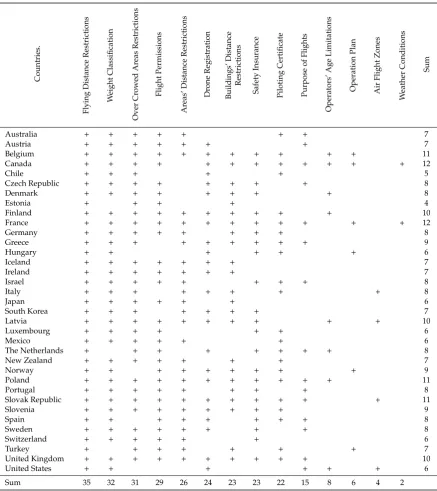
Following the classification of the key issues regarding national drone regulations, what has been observed is a different approach in legislation amongst the OECD countries, while in some countries the legislative framework is still under consideration. In some cases, the national regulations classified drones based on the vehicle’s weight, whereas other classifications included flight altitude. All OECD countries, however, classified drones according to weight, with the exemption of Estonia, the Netherlands, and Turkey.
Drones2019,3, 75 5 of 15
Drones 2019, 3, x FOR PEER REVIEW 5 of 15
122
Figure 1. Criteria in the national legal frameworks for each OECD country.
123
In Japan and Turkey, the legislation was not advanced compared to the other countries. Some
124
countries issued legislation during the very last years, and others amended their legislative
125
framework in order to cover the needs of technology improvement. Many countries considered
126
privacy seriously and posed restrictions for flights above people and public areas.
127
In the European Union (EU), where specific guidelines have been released, it is observed that
128
every member state has set its own policy on the use of drones. For example, only Italy, Latvia, and
129
Slovak Republic have legislated air traffic zones for drone use. The EU issued rules on safe use of
130
drones in 2014 (2014/2243(INI)). However, most EU countries have yet to comply with the overall
131
content of this regulation.
132
In Canada the legislative framework was stricter than in all the other OECD countries. On the
133
other hand, in USA the law follows a more liberal path. OECD countries followed a different
134
approach in legislation about the purpose of flights. For example, Australia, Austria, Canada, Czech
135
Republic, France, Greece, Israel, The Netherlands, Poland, Portugal, Slovak republic, Spain, Sweden,
136
UK, and USA had guidelines with reference to the purpose of flights. All the other OECD countries
137
do not give emphasis to such guidelines.
138
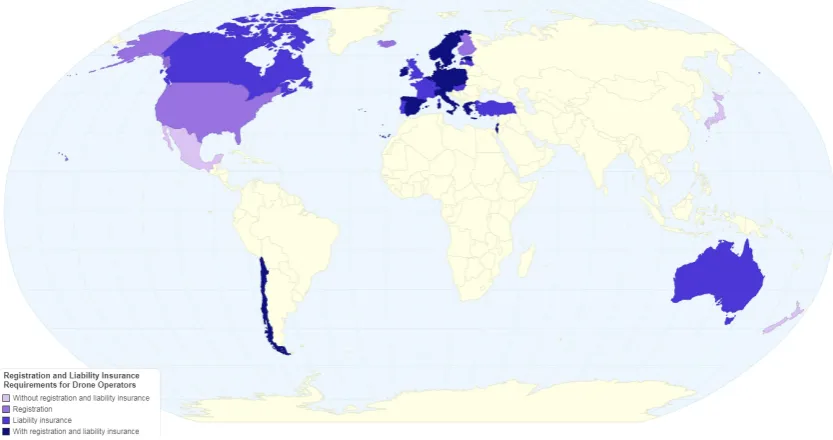
Figure 2, shows on a world map the requirements for registration and liability insurance for
139
drone operators in all examined countries. Liability insurance for flights with drones was obligatory
140
in all countries, except for Finland, Iceland, Japan, Mexico, New Zealand, Turkey, and USA. In
141
Ireland and Netherlands, liability insurance was required only for flights for commercial purposes.
142
In all countries, flights were permitted during daylight. Different regulations were observed
143
regarding flight or vehicle registration requirements. In Australia, Canada, France, Hungary, Latvia,
144
Luxembourg, Mexico, Portugal, Switzerland, Turkey, and the UK, drone registration was not
145
required.
146
Figure 1.Criteria in the national legal frameworks for each OECD country.
In Japan and Turkey, the legislation was not advanced compared to the other countries. Some countries issued legislation during the very last years, and others amended their legislative framework in order to cover the needs of technology improvement. Many countries considered privacy seriously and posed restrictions for flights above people and public areas.
In the European Union (EU), where specific guidelines have been released, it is observed that every member state has set its own policy on the use of drones. For example, only Italy, Latvia, and Slovak Republic have legislated air traffic zones for drone use. The EU issued rules on safe use of drones in 2014 (2014/2243(INI)). However, most EU countries have yet to comply with the overall content of this regulation.
In Canada the legislative framework was stricter than in all the other OECD countries. On the other hand, in USA the law follows a more liberal path. OECD countries followed a different approach in legislation about the purpose of flights. For example, Australia, Austria, Canada, Czech Republic, France, Greece, Israel, The Netherlands, Poland, Portugal, Slovak republic, Spain, Sweden, UK, and USA had guidelines with reference to the purpose of flights. All the other OECD countries do not give emphasis to such guidelines.
Drones2019,3, 75 6 of 15
Drones 2019, 3, x FOR PEER REVIEW 6 of 15
147
Figure 2. Registration and liability insurance requirements for drone operators in OECD countries.
148
The increasing use of drones has led several countries to enact new regulations regarding the
149
use of drones and their operators. However, only a small number of countries have legislated
150
regulations with specific restrictions. For example, in Luxembourg, Israel, and Germany, the
151
maximum flight altitude is regulated to 50 m above ground, whereas in Belgium, the maximum
152
flight altitude is 45 m. Said countries have legislated stricter laws than other OECD countries, where
153
the maximum flight altitude is 90–150 m above ground.
154
Another flight restriction is the maximum distance from the operator, which varied from 30 to
155
500 m. Australia, Belgium, Estonia, Israel, Japan, Korea, the Netherlands, Poland, Portugal, Slovakia,
156
Slovenia, Sweden, and Turkey had strict regulations on the horizontal distance between the operator
157
and the vehicle (flying drone), contrary to the rest of the countries, where the horizontal distance
158
between the operator and the vehicle was about 100–500 m. The combinations of altitude and
159
horizontal distance limitations per country are presented in Figure 3.
160
161
Figure 3. Maximum altitude and horizontal distance for drone flights according to national
162
legislations.
163
All OECD countries had restrictions for flights near airports, populated areas, and buildings or
164
authorities. While most of the countries have legislated a minimum distance away from airports,
165
Figure 2.Registration and liability insurance requirements for drone operators in OECD countries.
The increasing use of drones has led several countries to enact new regulations regarding the use of drones and their operators. However, only a small number of countries have legislated regulations with specific restrictions. For example, in Luxembourg, Israel, and Germany, the maximum flight altitude is regulated to 50 m above ground, whereas in Belgium, the maximum flight altitude is 45 m. Said countries have legislated stricter laws than other OECD countries, where the maximum flight altitude is 90–150 m above ground.
Another flight restriction is the maximum distance from the operator, which varied from 30 to 500 m. Australia, Belgium, Estonia, Israel, Japan, Korea, the Netherlands, Poland, Portugal, Slovakia, Slovenia, Sweden, and Turkey had strict regulations on the horizontal distance between the operator and the vehicle (flying drone), contrary to the rest of the countries, where the horizontal distance between the operator and the vehicle was about 100–500 m. The combinations of altitude and horizontal distance limitations per country are presented in Figure3.
Drones 2019, 3, x FOR PEER REVIEW 6 of 15
147
Figure 2. Registration and liability insurance requirements for drone operators in OECD countries.
148
The increasing use of drones has led several countries to enact new regulations regarding the
149
use of drones and their operators. However, only a small number of countries have legislated
150
regulations with specific restrictions. For example, in Luxembourg, Israel, and Germany, the
151
maximum flight altitude is regulated to 50 m above ground, whereas in Belgium, the maximum
152
flight altitude is 45 m. Said countries have legislated stricter laws than other OECD countries, where
153
the maximum flight altitude is 90–150 m above ground.
154
Another flight restriction is the maximum distance from the operator, which varied from 30 to
155
500 m. Australia, Belgium, Estonia, Israel, Japan, Korea, the Netherlands, Poland, Portugal, Slovakia,
156
Slovenia, Sweden, and Turkey had strict regulations on the horizontal distance between the operator
157
and the vehicle (flying drone), contrary to the rest of the countries, where the horizontal distance
158
between the operator and the vehicle was about 100–500 m. The combinations of altitude and
159
horizontal distance limitations per country are presented in Figure 3.
160
161
Figure 3. Maximum altitude and horizontal distance for drone flights according to national
162
legislations.
163
All OECD countries had restrictions for flights near airports, populated areas, and buildings or
164
authorities. While most of the countries have legislated a minimum distance away from airports,
165
Figure 3.Maximum altitude and horizontal distance for drone flights according to national legislations.
Drones2019,3, 75 7 of 15
Austria, Italy, Korea, Turkey, the UK, Hungary, Estonia, Belgium, and Luxemburg have not determined a specific distance, rather than requiring a “safety distance” (Figure4).
Drones 2019, 3, x FOR PEER REVIEW 7 of 15
Austria, Italy, Korea, Turkey, the UK, Hungary, Estonia, Belgium, and Luxemburg have not
166
determined a specific distance, rather than requiring a “safety distance” (Figure 4).
167
1.5 1.5 1.5 2 2 3 3 4 5 5 5 5 5 5 5.5 5.5 5.5 8 8 8 8 9 9 9.2 10 150 2 4 6 8 10 12 14 16
Germany Iceland Israel Chile Poland Netherlands Switzerland New Zealand Finland Ireland Slovenia Portugal Latvia Sweden Australia Czech Republic Slovak Republic Denmark Greece Spain United States Canada Japan Mexico France Italy Luxembourg Austria Belgium Estonia Hungary Korea Norway Turkey United Kingdom
Distance from airports (Km)
Not specific distance: "Away from airports"
168
Figure 4. Minimum distance of drone flights from airports.
169
3.2. Research Trends
170
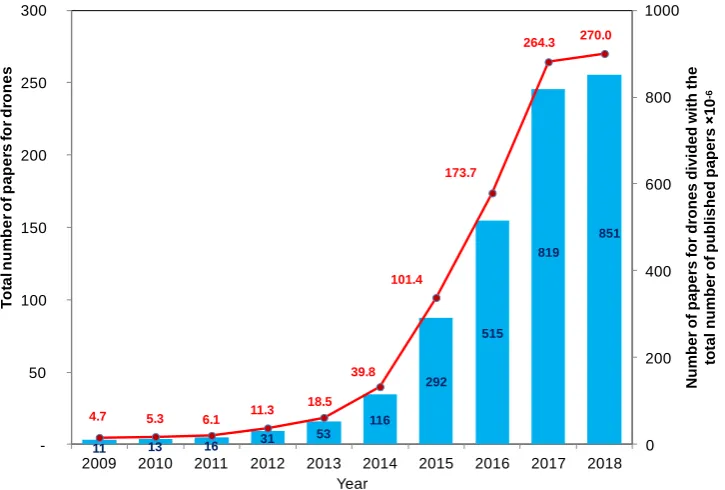
To justify the increased interest for drone applications, we ran a search in the Scopus database
171
(as for June 2019) using the keywords “drones” and “unmanned aerial vehicles” between 2009 and
172
2018. Our research resulted in 2717 published journal papers, as shown in Figure 5. There was an
173
increasing trend, from 11 papers published in 2009 to 851 published in 2018. We also show the ratio
174
of drone-related papers to the total number of papers published per year in the Scopus database,
175
which also followed an ascending trend, from 4.7 × 10⁻⁶ in 2009 to 270.0 × 10⁻⁶ in 2018.
176
This boost in published research indicates the current and forthcoming technology and
177
industrial revolution of drone use for several purposes, which needs further regulation.
178
Figure 4.Minimum distance of drone flights from airports.
3.2. Research Trends
To justify the increased interest for drone applications, we ran a search in the Scopus database (as for June 2019) using the keywords “drones” and “unmanned aerial vehicles” between 2009 and 2018. Our research resulted in 2717 published journal papers, as shown in Figure5. There was an increasing trend, from 11 papers published in 2009 to 851 published in 2018. We also show the ratio of drone-related papers to the total number of papers published per year in the Scopus database, which also followed an ascending trend, from 4.7×10⁻⁶in 2009 to 270.0×10⁻⁶in 2018.
DronesDrones 2019, 3, x FOR PEER REVIEW 2019,3, 75 8 of 158 of 15
11 13 16 31 53
116 292
515 819
851
4.7 5.3 6.1 11.3 18.5 39.8 101.4 173.7 264.3 270.0 0 200 400 600 800 1000 -50 100 150 200 250 300
2009 2010 2011 2012 2013 2014 2015 2016 2017 2018
Number of papers for drones divided with the total number of published papers × 10 -6 T o ta l n u m b e r o f p a p e rs f o r d ro n e s Year
Figure 5. Evolution of papers published on drones per year.
4. Discussion
Despite OECD countries being able to exchange opinions and experiences on many aspects, including emerging technologies, the national regulations on drones demonstrate high diversity. Although among OECD countries there are groups of countries, such as those belonging to the European Union, that have released specific guidelines, it is observed that every member state has set its own policy on the use of drones. It is, therefore, recommended that a single policy on drone use should be implemented among the OECD countries.
This analysis focused on 14 criteria located in the national legislations based on size, weight, flight altitude, purpose of use, restrictions, insurance, and registration requirements. Based on the aforementioned comparative analysis, we identified the differences and similarities between national legislations on the use of drones.
Former studies limited their results to specific countries or groups of countries, or presented the use of drones for commercial purposes, without specific analysis of the relevant legislation. For example, Cracknell [22] presented an analysis on the legislation of drone use in Australia, USA, other countries (UK and China), and the EU. Cunliffe et al. [15] analyzed the safe growth of lightweight drones in UK, whereas Chamoso et al. [12] discussed the use of drones in Spain with reference to Spanish and European legislation. To the best of our knowledge, this is the first time that the legislative framework for the use of drones in so many countries is examined, highlighting major similarities and differences.
We have collected all practices, criteria, and restrictions reported in legislation in OECD countries and have proposed a common legislation framework. This proposal consists of the basic requirements that each country should legislate. This way, all countries will present some basic similarities in legislation for equal opportunities for drone uses and operators. Specific conditions may allow for further detailing a country’s legal framework. This proposed framework suggests reference to the purpose of drone use, necessity for piloting training skills and qualifications, flight registration, classification per weight, permitting authority, insurance, accidents' record, and penalties, as detailed in Table 3.
Figure 5.Evolution of papers published on drones per year.
4. Discussion
Despite OECD countries being able to exchange opinions and experiences on many aspects, including emerging technologies, the national regulations on drones demonstrate high diversity. Although among OECD countries there are groups of countries, such as those belonging to the European Union, that have released specific guidelines, it is observed that every member state has set its own policy on the use of drones. It is, therefore, recommended that a single policy on drone use should be implemented among the OECD countries.
This analysis focused on 14 criteria located in the national legislations based on size, weight, flight altitude, purpose of use, restrictions, insurance, and registration requirements. Based on the aforementioned comparative analysis, we identified the differences and similarities between national legislations on the use of drones.
Drones2019,3, 75 9 of 15
Table 3.Recommendations for a homogenous legal framework.
Purpose of Use Certification for Pilots
Flight Online Registration
Size Classifications
Flight Altitude (Without Special
License)
100 gr <4 kg 4–25 kg 25–150 kg
>150
kg 120 m 150 m
Commercial and industrial X X X X X X X
Recreational and
infotainment X X X X
Scientific/research X X X X X X X
Surveillance and security X X X X X X X X
Agriculture X X X X X X X
Enforcement Monitoring X X X X X X X X
Search and rescue and first
aid X X X X X X X
Infrastructure X X X X X X X
Environmental
management X X X X X X X X
Concerning the purpose of use, drones should be classified with reference to at least commercial, recreational, scientific/research, surveillance and security, agriculture, monitoring, search and rescue, first aid, infrastructure, or environmental management categories. Each vehicle could be suitable for one or more categories.
In the case where special permissions for flights are not obligatory, we suggest that drones should fly at a maximum altitude of 120 m and at a distance of 500 m from the operator. The Civil Aviation Authority of each country should regulate and supervise every flight, whereas the operator should immediately report to a special database every accident. Finally, in case of legal violations, criminal penalties and fees should be enforced to the operators of drones.
We suggest that every drone should have a unique number that will be its identity. For this purpose, every owner should register the vehicle’s characteristics online in a database. Furthermore, this unique number should be set on the vehicle in order to be recognized in case of accident or loss. The owner of the vehicle should visit the online database before they start a flight and register data such as: the operator’s license, the flight plan, the type of vehicle, the purpose and the flight duration, the operator’s credentials, and the insurance contract. Flight permission should be issued by the authorities after request by the owner of the vehicle, considering the meteorological conditions (expected pressure, wind, visibility, temperature, precipitation, etc.). The authorities should notify the operator about flight permissions and limitations. This flight permission should be provided with a unique number that will enable the authorities to inspect the flight.
5. Conclusions
Drones2019,3, 75 10 of 15
able to revisit and revise the requirements for permissions and restrictions, which is necessary along with technology development and maturation.
We consider this work as a starting point to further look into regulation and legislation for drone use, with an emphasis on the dynamic nature of this technology and a legal framework that will be flexible enough to follow technology improvements.
Author Contributions:Conceptualization, N.T.; Data curation, N.T.; Formal analysis, N.T. and K.P.T.; Methodology, N.T.; Writing—original draft, N.T. and L.E.; Writing—review & editing, N.T., L.E., and K.P.T.
Funding:This research received no external funding
Conflicts of Interest:The authors declare no conflicts of interest.
References
1. Clarke, R. Understanding the drone epidemic.Comput. Law Secur. Rev.2014,30, 230–246. [CrossRef] 2. Rao, B.; Gopi, A.G.; Maione, R. The societal impact of commercial drones. Technol. Soc. 2016,45, 83–90.
[CrossRef]
3. Stelmack, K. Weaponized Police Drones and Their Effect on Police Use and Force.J. Technol. Law Policy2014, 15, 276. [CrossRef]
4. Thompson, R.M.Drones in Domestic Surveillance Operations: Fourth Amendment Implications and Legislative Responses; Library of Congress Congressional Research Service: Washington, DC, USA, 2012.
5. Ivoševi´c, B.; Han, Y.-G.; Cho, Y.; Kwon, O. The use of conservation drones in ecology and wildlife research. Ecol. Environ.2015,38, 113–188. [CrossRef]
6. Koh, L.P.; Wich, S.A. Dawn of drone ecology: Low-cost autonomous aerial vehicles for conservation.Trop. Conserv. Sci.2012,5, 121–132. [CrossRef]
7. Saranya, C.; Pavithira, L.; Premsai, N.; Lavanya, H.; Govindarajan, R. Recent trends of drones in the field of defense.Int. J. Electr. Appl.2015,1, 47–55.
8. Balasingam, M. Drones in medicine—The rise of the machines.Int. J. Clin. Pract.2017. [CrossRef]
9. Klemas, V.V. Coastal and environmental remote sensing from unmanned aerial vehicles: An overview. J. Coast. Res.2015,31, 1260–1267. [CrossRef]
10. Luppicini, R.; So, A. A technoethical review of commercial drone use in the context of governance, ethics, and privacy.Technol. Soc.2016,46, 109–119. [CrossRef]
11. Finn, R.L.; Wright, D. Unmanned aircraft systems: Surveillance, ethics and privacy in civil applications. Comput. Law Secur. Rev.2012,28, 184–194. [CrossRef]
12. Chamoso, P.; González-Briones, A.; Rivas, A.; Bueno De Mata, F.; Corchado, J.M. The use of drones in Spain: Towards a platform for controlling UAVs in urban environments.Sensors2018,18, 1416. [CrossRef] [PubMed]
13. Rothe, D.L.; Collins, V.E. The normality of political administration and state violence: Casuistry, law, and drones.Crit. Criminol.2014,22, 373–388. [CrossRef]
14. Haidari, L.A.; Brown, S.T.; Ferguson, M.; Bancroft, E.; Spiker, M.; Wilcox, A.; Ambikapathi, R.; Sampath, V.; Connor, D.L.; Lee, B.Y. The economic and operational value of using drones to transport vaccines.Vaccine 2016,34, 4062–4067. [CrossRef] [PubMed]
15. Cunliffe, A.M.; Anderson, K.; DeBell, L.; Duffy, J.P. A UK Civil Aviation Authority (CAA)-approved operations manual for safe deployment of lightweight drones in research. Int. J. Remote Sens. 2017,38, 2737–2744. [CrossRef]
16. Marin, L.; Krajˇcíková, K. Deploying Drones in policing southern European borders: Constraints and challenges for data protection and human rights. In Drones and Unmanned Aerial Systems; Springer: Berlin/Heidelberg, Germany, 2016; pp. 101–127.
17. Roma, A. Drones and popularisation of space.Space Policy2017,41, 65–67. [CrossRef]
18. Shishkov, B.; Hristozov, S.; Janssen, M.; van den Hoven, J. Drones in Land Border Missions: Benefits and Accountability Concerns. In Proceedings of the 6th International Conference on Telecommunications and Remote Sensing, Delft, The Netherlands, 6–7 November 2017; pp. 77–86.
Drones2019,3, 75 11 of 15
20. Tikanmäki, I. Possibilities to Operational Use of Remotely Piloted Aircrafts in Finland. Master’s Thesis, Laurea-ammattikorkeakoulu, Vantaa, Finland, 2011.
21. Villasenor, J. “Drones” and the future of domestic aviation [Point of View].Proc. IEEE2014,102, 235–238. [CrossRef]
22. Cracknell, A.P. UAVs: Regulations and law enforcement.Int. J. Remote Sens.2017,38, 3054–3067. [CrossRef] 23. Sky Taxi to Fly in Dubai from July. Available online:https://www.bbc.com/news/av/technology-39003397/sk
y-taxi-to-fly-in-dubai-from-july(accessed on 24 March 2018).
24. Goodchild, A.; Toy, J. Delivery by drone: An evaluation of unmanned aerial vehicle technology in reducing CO2 emissions in the delivery service industry. Transp. Res. Part D Transp. Environ. 2018,61, 58–67. [CrossRef]
25. The Economics of Drone Delivery. Available online:https://spectrum.ieee.org/automaton/robotics/drones/th e-economics-of-drone-delivery(accessed on 10 February 2018).
26. Florescu, E.; Glenn, J.C. Environmental Security Rising on the International Agenda.Dev. Environ. Foresight 2015,1, 6–23.
27. Cheteni, P.An Analysis of Anti Poaching Techniques in Africa: A Case of Rhino Poaching; University of Fort Hare: Alice, South Africa, 2014.
28. Massarelli, C.; Muolo, M.R.; Uricchio, V.F.; Dongiovanni, N.; Palumbo, R. Improving environmental monitoring against the risk from uncontrolled abandonment of waste containing asbestos. In The DroMEP project. In Proceedings of the FOSS4G Europe Como 2015, Como, Italy, 15–17 July 2015.
29. Manfreda, S.; McCabe, M.F.; Miller, P.E.; Lucas, R.; Pajuelo Madrigal, V.; Mallinis, G.; Ben Dor, E.; Helman, D.; Estes, L.; Ciraolo, G. On the Use of Unmanned Aerial Systems for Environmental Monitoring.Remote Sens. 2018,10, 641. [CrossRef]
30. Lawlor, K.; Olander, L.; Boyd, W.; Niles, J.; Madeira, E.Addressing the Causes of Tropical Deforestation: Lessons Learned and the Implications for International Forest Carbon Policy. International Forest Carbon and the Climate Change Challenge Series–Brief Number 5. June; Nicholas Institute for Environmental Policy Solutions, Duke University: Durham, NC, USA, 2009.
31. Paneque-Gálvez, J.; McCall, M.K.; Napoletano, B.M.; Wich, S.A.; Koh, L.P. Small drones for community-based forest monitoring: An assessment of their feasibility and potential in tropical areas.Forests2014,5, 1481–1507. [CrossRef]
32. Wallace, P.; Martin, R.; White, I. Keeping pace with technology: Drones, disturbance and policy deficiency. J. Environ. Plan. Manag.2018,61, 1271–1288. [CrossRef]
33. Capolupo, A.; Pindozzi, S.; Okello, C.; Fiorentino, N.; Boccia, L. Photogrammetry for environmental monitoring: The use of drones and hydrological models for detection of soil contaminated by copper.Sci. Total Environ.2015,514, 298–306. [CrossRef] [PubMed]
34. Tanaka, K.; Tochihara, N.; Sato, T.; Koike, H. A real-time image processing framework with an aerial overhead camera for sports. In Proceedings of the 2018 International Conference on Advanced Visual Interfaces, Grosseto, Italy, 29 May–1 June 2018. Article No. 34.
35. Karaca, Y.; Cicek, M.; Tatli, O.; Sahin, A.; Pasli, S.; Beser, M.F.; Turedi, S. The potential use of unmanned aircraft systems (drones) in mountain search and rescue operations.Am. J. Emerg. Med.2018,36, 583–588. [CrossRef]
36. Khan, M.A.; Ectors, W.; Bellemans, T.; Janssens, D.; Wets, G. UAV-Based Traffic Analysis: A Universal Guiding Framework Based on Literature Survey.Transp. Res. Procedia2017,22, 541–550. [CrossRef] 37. Sutheerakul, C.; Kronprasert, N.; Kaewmoracharoen, M.; Pichayapan, P. Application of Unmanned Aerial
Vehicles to Pedestrian Traffic Monitoring and Management for Shopping Streets.Transp. Res. Procedia2017, 25, 1720–1739. [CrossRef]
38. Hardy, A.; Makame, M.; Cross, D.; Majambere, S.; Msellem, M. Using low-cost drones to map malaria vector habitats.Parasites Vectors.2017,10, 29. [CrossRef]
Drones2019,3, 75 12 of 15
40. Hanna, D.; Ferworn, A.; Lukaczyn, M.; Abhari, A.; Lum, J. Using Unmanned Aerial Vehicles (UAVs) in locating wandering patients with dementia Monterey. In Proceedings of the 2018 IEEE/ION Position, Location and Navigation Symposium (PLANS), Monterey, CA, USA, 23–26 April 2018; pp. 809–815. [CrossRef] 41. Li, Y.; Liu, C. Applications of multirotor drone technologies in construction management. Int. J. Constr.
Manag.2018, 1–12. [CrossRef]
42. Veroustraete, F. The Rise of the Drones in Agriculture.EC Agric.2015,2, 325–327.
43. Marinello, F.; Pezzuolo, A.; Chiumenti, A.; Sartori, L. Technical analysis of unmanned aerial vehicles (drones) for agricultural applications. In Proceedings of the Engineering for Rural Development, Jelgava, Latvia, 25–27 May 2016; Volume 15.
44. Mahajan, U.; Raj, B. Drones for Normalized Difference Vegetation Index (NDVI), to Estimate Crop Health for Precision Agriculture: A Cheaper Alternative for Spatial Satellite Sensors. In Proceedings of the International Conference on Innovative Research in Agriculture, Food Science, Forestry, Horticulture, Aquaculture, Animal Sciences, Biodiversity, Ecological Sciences and Climate Change (AFHABEC-2016), New Delhi, India, 22 October 2016.
45. Clarke, R. The regulation of civilian drones’ impacts on behavioural privacy.Comput. Law Secur. Rev.2014, 30, 286–305. [CrossRef]
46. The Organization for Economic Co-operation and Development (OECD). About the OECD. Available online: http://www.oecd.org/about/(accessed on 19 January 2018).
47. Australian Government Civil Aviation Safety Authority. Flying Drones/Remotely Piloted Aircraft in Australia. Available online:https://www.casa.gov.au/aircraft/landing-page/remotely-piloted-aircraft-system(accessed on 22 February 2018).
48. Australian Government. Federal Register of Legislation. Available online:https://www.legislation.gov.au/D etails/F2017C00742(accessed on 22 February 2017).
49. Control, A. Welcome to Austro Control! Available online:https://www.austrocontrol.at/jart/prj3/austro_cont rol/main.jart?rel=en(accessed on 22 March 2018).
50. Austro Control. Operation of Unmanned Aerial Vehicles-Drones. Available online:https://www.austrocont rol.at/jart/prj3/austro_control/main.jart?rel=de&content-id=1374135213843(accessed on 20 February 2017). 51. Drones. Available online:https://mobilit.belgium.be/nl/luchtvaart/drones(accessed on 20 May 2017). 52. Federal Public Service Mobility and Transport Belgian Civil Aviation Authority. Aviation Safety Information
Leaflet: Drone Flying. Available online:https://mobilit.belgium.be/sites/default/files/resources/files/asil_2017 _01_drone_flying.pdf(accessed on 1 March 2018).
53. Government of Canada. Flying Your Drone Safely and Legally. Available online:http://www.tc.gc.ca/en/serv ices/aviation/drone-safety/flying-drone-safely-legally.html(accessed on 1 February 2018).
54. Government of Canada. Canadian Aviation Regulations, SOR/96-433, by Aeronautics Act. Available online: https://laws-lois.justice.gc.ca/eng/regulations/SOR-96-433/FullText.html#s-602.41(accessed on 1 February 2018). 55. Department of Transport. Interim Order No.9 Respecting the Use of Model Aircraft. Available online: http://www.gazette.gc.ca/rp-pr/p1/2018/2018-06-16/html/notice-avis-eng.html#ne6(accessed on 31 May 2018). 56. General Directorate of Civil Aviation of Chile (DGAC). Available online:https://www.dgac.gob.cl/(accessed
on 12 February 2018).
57. DGAC Chile. How to Operate a Drone in Chile? Available online:https://www.dgac.gob.cl/como-operar-un -dron-en-chile/(accessed on 12 February 2017).
58. The Civil Aviation Authority of Czech Republic. Available online: http://www.caa.cz/ (accessed on 23 January 2018).
59. Civil Aviation Authority of Czech Republic. Available online:http://lis.rlp.cz/predpisy/predpisy/dokumenty /L/L-2/data/effective/doplX.pdf(accessed on 20 March 2018).
60. Danish Transport, Construction and Housing Authority. Available online:http://www.trafikstyrelsen.dk/EN. aspx(accessed on 5 April 2018).
61. Danish Transport Construction and Housing Authority. Available online:http://www.trafikstyrelsen.dk/da/ droneregler(accessed on 5 April 2018).
62. Republic of Estonia Civil Aviation Administration. Civil Aviation Authority (CAA). Available online: https://www.ecaa.ee/en(accessed on 21 April 2018).
Drones2019,3, 75 13 of 15
64. Finnish Transport Safety Agency. Available online:https://www.trafi.fi/en(accessed on 5 April 2018). 65. Finnish Transport Safety Agency. Use of remotely Piloted Aircraft and Model Aircraft. Available
online:https://www.trafi.fi/filebank/a/1483970125/4a6ac53bf4b1cb434d7f85a15f36dde0/23661-OPS_M1-32_ RPAS_2016_eng.pdf(accessed on 5 April 2018).
66. Ministry of Ecological and Solidarity Transition. Available online:https://www.gouvernement.fr/en/composi tion-of-the-government(accessed on 15 April 2018).
67. Decree of 17 December 2015 on the use of Airspace by Aircraft Operating on Board NO. Available online: https://www.legifrance.gouv.fr/eli/arrete/2015/12/17/DEVA1528469A/jo(accessed on 15 April 2018). 68. Article L6211-3. Available online:https://www.legifrance.gouv.fr/affichCodeArticle.do?cidTexte=LEGITEX
T000023086525&idArticle=LEGIARTI000023075496&dateTexte=&categorieLien=cid(accessed on 15 April 2018).
69. Federal Ministry of Justice and Consumer Protection. Air Traffic Regulation. Available online: https: //www.bmjv.de/DE/Startseite/Startseite_node.html(accessed on 3 February 2018).
70. Federal Minister of Justice and Consumer Protection. Air Traffic Licensing Regulations (LuftVZO). Available online:http://www.gesetze-im-internet.de/luftvzo/BJNR003700964.html#BJNR003700964BJNG000102308 (accessed on 3 February 2018).
71. Civil Aviation Authority of Greece. Regulation. Available online:http://epae.elao.gr/index.php/epaegeneral info/epaelaw(accessed on 10 March 2018).
72. Hellenic Civil Aviation Authority Regulation–General Framework for Flights of Unmanned Aircraft. Systems-UAS. Available online:https://dagr.hcaa.gr/docs/HCAA%20UAS%20Regulation.pdf(accessed on 10 March 2018).
73. National Transport Authority. Available online: http://www.nkh.gov.hu/en/web/english/ (accessed on 2 January 2018).
74. Ministry of Innovation and Technology Traffic Authority. Rationality, National Interest, Lawfulness. Available online:http://www.nkh.gov.hu/kereses?p_p_id=regenssearch_WAR_mediacenterportlet&p_p_lifecycle=0& p_p_mode=view&_regenssearch_WAR_mediacenterportlet_keywords=unmanned(accessed on 23 February 2016).
75. Icelandic Transport Authority. Safe, Productive Efficient Transport. Available online:https://www.icetra.is/ (accessed on 28 April 2018).
76. Icelandic Transport Authority. Remotely-controlled Aircraft (Drones). Available online:https://www.icetra.i s/aviation/drones/(accessed on 28 April 2018).
77. Irish Aviation Authority. Drones. Available online:https://www.iaa.ie/general-aviation/drones(accessed on 11 March 2018).
78. Irish Aviation Authority. Irish Aviation Authority Small Unmanned Aircraft (DRONES) and Rockets Order, 2015. Available online:https://www.iaa.ie/docs/default-source/publications/legislation/statutory-instrument s-(orders)/small-unmanned-aircraft-(drones)-and-rockets-order-s-i-563-of-2015.pdf?sfvrsn=26f50bf3_6 (accessed on 10 March 2018).
79. Ministry of Transport Civil Aviation Authority Director of Regulations and Standards. The Civil Aviation Authority of Israel. Available online:http://en.caa.gov.il/index.php(accessed on 28 April 2018).
80. The Civil Aviation Authority. EN-ROUTE. Available online:http://en.caa.gov.il/index.php?option=com_con tent&view=article&iotype=w&id=408&Itemid=272&lang_ovrrde=ENG(accessed on 28 April 2018). 81. Enac, Italian Civil Aviation Authority. Available online:https://www.enac.gov.it/en(accessed on 1 July 2018). 82. ENAC Italian Civil Aviation Authority. Remotely Piloted Aerial Vehicles. Available online:https://www.en ac.gov.it/sites/default/files/allegati/2018-Sep/Regulation_RPAS_Issue_2_Rev_4_eng.pdf(accessed on 2 July 2018).
83. The Ministry of Land, Infrastructure, Transport and Tourism. Available online:http://www.mlit.go.jp/en/in dex.html(accessed on 1 April 2018).
84. Civil Aeronautics Act. Available online:http://www.japaneselawtranslation.go.jp/law/detail/?id=37&vm=02 &re=02(accessed on 14 April 2018).
85. Ministry of Land Infrastructure and Transport (Korea). Available online:http://www.molit.go.kr/english/intr o.do(accessed on 19 April 2018).
Drones2019,3, 75 14 of 15
87. The Ministry for Transport and agriculture of the Republic of Latvia. Available online:https://www.zm.gov.l v/en/zemkopibas-ministrija/statiskas-lapas/minister?nid=1118#jump(accessed on 6 March 2018).
88. Cabinet of Ministers Regulations Procedures for the Conduct of Unmanned Aerial Vehicles and other Types of Aircraft which do not Qualify as Aircraft. Available online:https://www.vestnesis.lv/op/2016/231.1(accessed on 6 March 2018).
89. The Directorate of Civil Aviation (DAC). Available online:https://dac.public.lu/direction/index.html(accessed on 24 March 2018).
90. Direction de l’Aviation Civile. General Conditions for Unmanned Aircraft System (UAS) Operations Within the Luxembourg Airspace. Available online:https://dac.public.lu/actualites/2016/11/UAS-2016/index.html (accessed on 24 March 2018).
91. Ministry of Communications and Transportation. Available online:https://www.gob.mx/sct(accessed on 23 February 2018).
92. Ministry of Communications and Transportation. It Will Regulate the Use of Unmanned Aircraft (Drones), SCT. Available online:http://www.sct.gob.mx/fileadmin/DireccionesGrales/DGAC-archivo/modulo3/ co-av-23-10-r4.pdf(accessed on 23 February 2018).
93. Government of Netherlands. Rules for Recreational Use of Drones. Available online:https://www.governme nt.nl/topics/drone/rules-pertaining-to-recreational-use-of-drones(accessed on 28 April 2018).
94. Law Bank of Netherlands. Model Flying Arrangement. Available online:http://wetten.overheid.nl/BWBR00191 47/2015-11-07#Artikel5,%20http://wetten.overheid.nl/BWBR0019147/2015-11-07(accessed on 28 April 2018). 95. Civil Aviation Authority of New Zealand. Available online: https://www.caa.govt.nz/ (accessed on
1 March 2018).
96. Civil Aviation Authority of New Zealand. Unmanned Aircraft. Available online:https://www.caa.govt.nz/ unmanned-aircraft/(accessed on 1 March 2018).
97. T The Civil Aviation Authority of Norway’s Main Objective Is to Contribute to Safe Civil Aviation in Norway. Available online:https://luftfartstilsynet.no/en/(accessed on 16 April 2018).
98. Civil Aviation Authority -Norway. About drones/RPAS. Available online:https://luftfartstilsynet.no/en/dron es/commercial-use-of-drones/about-dronesrpas/regulations-of-drones/(accessed on 16 February 2018). 99. The Civil Aviation Office of Poland. Available online:http://www.ulc.gov.pl/pl(accessed on 15 February 2018). 100. Polish Aviation Centenary. Safe Sky-Regulations on Flying Drones in Poland. Available online:
http://dziennikustaw.gov.pl/DU/2013/440/(accessed on 15 February 2018).
101. Government Legislation Center. Regulation of the Minister of Transport, Construction and Maritime Economy of June 3, 2013 Regarding Qualification Certificates. Available online:http://www.dziennikustaw. gov.pl/DU/2013/664/1(accessed on 8 April 2018).
102. Government Legislation Center. The Act of July 3, 2002-Aviation Law. Available online:http://dziennikusta w.gov.pl/DU/2002/1112/1(accessed on 9 April 2018).
103. The Portuguese Civil Aviation Authority. Available online:https://www.anac.pt/vPT/Generico/Paginas/Hom epage00.aspx(accessed on 18 April 2018).
104. Portugese Civil Aviation Authority Tem Mão no teu Drone. Available online:https://www.voanaboa.pt/regu lamento(accessed on 18 April 2018).
105. The Ministry of Transport and Construction of The Slovak Republic. Available online:https://www.mindop .sk/en(accessed on 3 April 2018).
106. Transport Authority. Register Aircraft. Available online:http://letectvo.nsat.sk/letova-sposobilost/register-l ietadiel-slovenskej-republiky/(accessed on 3 April 2018).
107. Official Gazette of the Republic of Slovenia. Available online: https://www.uradni-list.si/(accessed on 2 April 2018).
108. Official Gazette of the Republic of Slovenia. Rulebook on Ultralight Aircraft Installations. Available online: https://www.uradni-list.si/glasilo-uradni-list-rs/vsebina/89174#kljucna_pravila(accessed on 2 April 2018). 109. The Safety Aviation Agency of Spain. Available online:https://www.seguridadaerea.gob.es/lang_en/la_age
ncia/organizacion_y_funciones/default.aspx(accessed on 10 March 2018).
110. Government of Spain Resolución Directora. Available online:https://www.seguridadaerea.gob.es/lang_en/ci as_empresas/trabajos/rpas/marco/resolucion_directora/default.aspx(accessed on 10 March 2018).
Drones2019,3, 75 15 of 15
112. Transport Stylersen. New Rules for Drones on February 1, 2018. Available online:https://www.transportsty relsen.se/sv/luftfart/Luftfartyg-och-luftvardighet/Obemannade-luftfartyg-UAS/nya-regler-for-dronare/ (accessed on 2 May 2018).
113. The Federal Department of the Environment, Transport, Energy and Communications (DETEC). Available online:https://www.admin.ch/gov/en/start/departments/department-of-environment-transport-energy-c ommunications-detec.html(accessed on 11 February 2018).
114. The Federal Department of Environment, Transport, Energy and Communication, DETEC Regulation on Aircraft of Special Categories. Available online:https://www.admin.ch/opc/de/classified-compilation/199403 51/index.html#a5(accessed on 11 February 2018).
115. Directorate General of Civil Aviation Procedures for Permit to Fly (PtoF). Available online:http://web.shgm .gov.tr/en/s/2222-procedures-for-certificate-of-special-flight-permit(accessed on 21 February 2018). 116. The Directorate General of Civil Aviation of Turkey. Insansiz hava araci Sistemlerinin Ayrilmi¸s hava
Sahalarindaki Operasyonlarinin usul ve Esaslarina Ili¸skin Talimat (Sht-Iha). Available online:http://web.sh gm.gov.tr/doc5/sht-iha.pdf(accessed on 10 May 2018).
117. The Civil Aviation Authority of UK. Available online: https://www.caa.co.uk/home/ (accessed on 1 March 2018).
118. Civil Aviation Authority of UK. Unmanned Aircraft and Drones. Available online:https://publicapps.caa.co. uk/modalapplication.aspx?appid=11&mode=detail&id=415(accessed on 1 March 2018).
119. Federal Aviation Administration (FAA). Regulations and Guidelines. Available online:https://www.faa.gov/ (accessed on 15 February 2018).
120. United States Department of Transportation. Unmanned Aircraft Systems. Available online: https: //www.faa.gov/uas/getting_started/(accessed on 15 February 2018).