Practice
Vol. 5, 2018
© 2018 by the author(s). This is an Open Access article distributed under the terms of the Creative Commons Attribution 4.0 International (CC BY 4.0) License (https:// creativecommons.org/licenses/ by/4.0/), allowing third parties to copy and redistribute the material in any medium or format and to remix, transform, and build upon the material for any purpose, even commercially, provided the original work is properly cited and states its license.
Citation: Brooks, I., Kossmann, M., and Kossman, V. 2018. Educating for Change – Enabling Local Implementation of the United Nations’ Sustainable Development Goals in Cameroon. Project Management Research and Practice, Article ID 5869. https://doi.org/10.5130/ pmrp.v5i0.5869
ISSN 2207-1415 | Published by UTS ePRESS | http://epress. lib.uts.edu.au/journals/index. php/PMRP/index
Implementation of the United Nations’
Sustainable Development Goals in Cameroon
Ian Brooks1*, Mario Kossmann2, Virginie Kossmann3
1 University of the West of England, Frenchay Campus, Coldharbour Lane, Bristol, BS16 1QY,
United Kingdom. [email protected]
2 AIRBUS (Bristol, UK). Portishead, BS20 6JZ, United Kingdom. [email protected] 3 South Gloucestershire Council, St. Helen’s Primary School, Alveston. Portishead BS20 6JZ,
United Kingdom. [email protected]
*Corresponding author: Ian Brooks. [email protected]
DOI: https://doi.org/10.5130/pmrp.v5i0.5869
Article History: Received 03/01/2018; Revised 30/11/2018; Accepted 30/11/2018; Published 30/01/2019
Abstract
The United Nations’ Sustainable Development Goals (SDGs) framework was adopted by every member state of the United Nations in 2015, and, albeit not legally binding, it is arguably one of the most significant steps of humanity to address the identified problems of our time. It addresses a wide range of topics such as environmental protection, equal opportunities, education, eradication of diseases, famine, poverty, slavery and child labour. Both concerning its comprehensive scope and its worldwide support, this framework arguably represents one of the most significant international frameworks in human history.
Using education-related examples from a charity project related to a local health care system in the African rain forest in Cameroon, this paper illustrates how projects can and should implement critical aspects of the SDGs framework pre-emptively within their scope. This could be at the local level, before and in support of the full, legally binding implementation of the framework at the national level. This not only helps to make our world a better place but also very concretely to reduce project risks, create funding opportunities and make the project’s deliverables more sustainable.
Countries (2). The 8 MDGs set targets for key areas such as reducing extreme poverty & hunger and improving access to sanitation. The MDGs ran from 2000 to 2015 and have been described as “the most successful anti-poverty movement in history” (2).
Despite the significant improvement delivered towards the MDGs, we still live in a world where people experience hunger, suffer from air pollution and are disadvantaged by inequality. The SDGs go beyond the MDGs with a broader range of goals and apply to all countries, hence are often referred to as the ‘Global Goals.’ The SDGs consist of 17 high-level goals (shown in Figure 1) and 169 targets that provide more detail within each goal.
Figure 1 The United Nations Sustainable Development Goals (1) (Image used following the Global Goals Asset License at GlobalGoals.org)
Cameroon was one of the countries which made significant progress towards the 8 MDGs but still faces significant challenges in, for example, eradicating extreme poverty and reducing the burden of disease (3). The country restated its commitment to “Développement Durable” (Sustainable Development) and the adoption of the SDGs at the 70th session of the United
Nations General Assembly (4).
the framework at the national level by Cameroon. The Mahola project is concerned with the development and delivery to the local population of a health care system in a deprived area in the African rainforest.
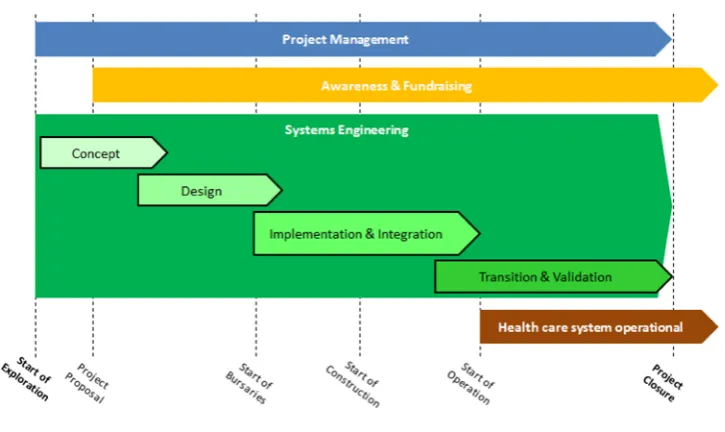
The Project Management, Awareness & Fundraising, and the Systems Engineering activities of the Mahola project can be considered parallel streams as shown in Figure 2. The Systems Engineering activities as applied for the Mahola project are displayed in phases that are roughly aligned, albeit simplified, with the INCOSE Systems Engineering Handbook (7) and the ISO 15288 (8): Concept phase; Design phase; Implementation & Integration phase; and Transition & Validation phase.
Figure 2 Project Management, Awareness & Fundraising and Systems Engineering activities of the Mahola Project (5)
At the time of writing this paper, the Mahola project had completed the design phase, with three sub-projects still on-going that are concerned with the development of the solar energy sub-system, the ICT solution of the Mahola system and the development of a computer game for the recruitment and training of the staff members of the Mahola system, respectively.
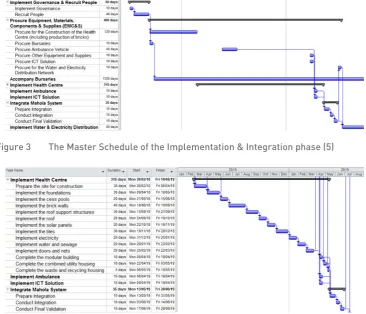
However, the necessary funding for the implementation and integration phase of the project had not been fully secured. As such, the master schedule of this phase (Figures 3 and 4) is merely indicative of the activities, dependencies, and durations; but they do not represent the particular completion times of the related activities. Figure 3 provides the high-level master schedule of the implementation and integration phase of the Mahola project; whereas Figure 4 provides a more detailed view of the activities related to the implementation of the health centre as part of this phase.
Figure 3 The Master Schedule of the Implementation & Integration phase (5)
Figure 4 The detailed Master Schedule of the implementation of the Health Centre (5)
Implementation of the SDGs at the national level
The SDGs are an ambitious set of goals adopted by 193 nations, but they do not have the status of international law. There are a wide variety of implementation routes and stakeholders, though national governments are the “duty-bearers” in the end (9). Achievement of the SDGs is beyond the means or capacity of individual governments, and the SDG framework explicitly recognizes this in Goal 17 Partnerships for the Goals. Governments must work with other local and international stakeholders, including businesses and third sector organizations, for practical implementation. Some goals may be achieved through legislation or taxes, for example, Goal 13 Climate Action. Other goals will require the mobilization of business investment, e.g., Goal 7 Affordable and Clean Energy. As part of their support for the SDG partnership approach, the United Nations maintains a voluntary register of multi-stakeholder programs for delivery of the SDGs. At the time of writing, there were 14 partnership programs registered with impacts in Cameroon (10).
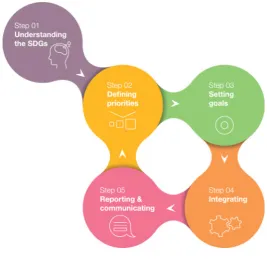
Many businesses are now starting to express the development benefits they provide, as well as the negative impacts they have, using the SDG framework. For example, Airbus has published its analysis of the 8 SDGs which are most relevant to its business (12). Some businesses are concerned that the 17 SDGs and 169 targets are too broad a scope for them to engage with meaningfully. A group of leading organizations in the fields of sustainable development and corporate social responsibility have published the “SDG Compass” as an approach for business leaders to “align their strategies as well as measure and manage their contribution to the realization of the SDGs.” (13). The SDG Compass approach is shown in Figure 5.
Non-Governmental Organizations (NGOs) or ‘Third Sector Organizations’ usually have more experience in aligning their activities and reporting with national and international development priorities. This is often necessary for attracting donor support, and those, which have already been operating in the context of the MDGs will find it a natural transition to the SDGs. Faith-based organizations have played a significant role in the negotiation of the SDGs. Indeed, Pope Francis addressed the United Nations General Assembly which was gathered to adopt the SDGs. The SDGs are strongly consistent with the papal encyclical ‘Laudato Si’ (14).
As well as implementing partnerships to achieve the SDGs, there is a parallel requirement to report on progress towards the SDG targets. The data collection will be carried out by national governments and consolidated by the United Nations Statistics Division. They publish an annual report on progress to the SDGs (15).
This combination of evolving national and partnership initiatives alongside national reporting processes is essential in the context of the Mahola project. Since the specification of these areas is yet incomplete, we must use the SDGs framework as the outline requirements for the system and be prepared to report in a way consistent with the 17 SDGs and 169 targets.
The fact that the SDGs are implemented into national legislation by many countries in different ways makes future compliance with this updated legislation in each country a real challenge for MNCs, NGOs and international projects (both for-profit and not-for-profit) that operate across national boundaries. Next, we will look at how the Mahola project anticipates being compliant (pre-emptively) with the future implementation of the SDGs through national legislation.
The local implementation of key SDGs by the Mahola Project
Figure 5 SDG Compass Approach (13)
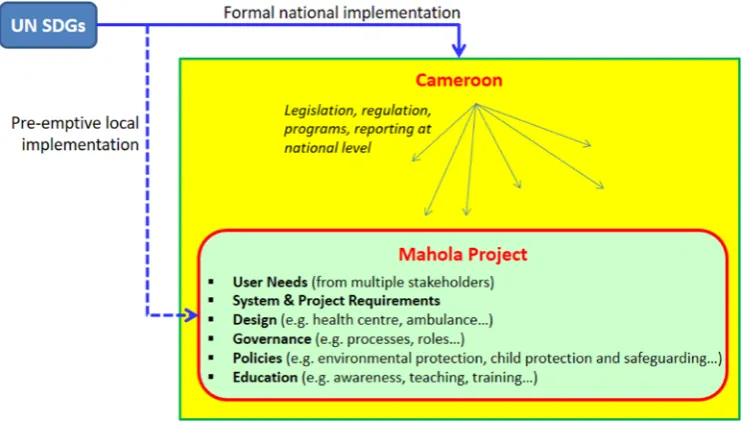
By explicitly addressing the SDGs as user needs for the project, and related, specific parts of these targets as project requirements and system requirements, the Mahola project can ensure that relevant aspects of the SDGs be implemented. These include how the project is run and the Mahola system as the project’s core deliverable. For both the User Needs and the related System Requirements, acceptance criteria were defined that allow later verification of whether the Mahola system satisfies the system requirements (verification), and once put in operation (i.e., in the intended context), whether it satisfies the underlying User Needs (validation). Design solutions were developed to meet the applicable System Requirements that had been allocated to the sub-systems of the Mahola system. Some of these solutions to the requirements are the health centre, the ambulance, the Governance organization, policies and training of the local population.
Figure 6 Pre-emptive local implementation of the SDGs by the Mahola Project (5)
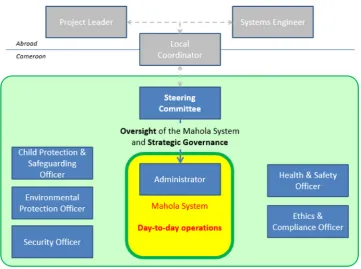
Figure 7 depicts the Governance organization of the Mahola system, which has already been partly put in place during the Mahola project. The elected Steering Committee has already started overseeing the local activities related to the Mahola Project - supported from abroad by the project leader, the systems engineer and the local coordinator of the project - and will oversee the day-to-day operation of the Mahola System that, once deployed, will be managed on their behalf by the ‘Administrator’.
The Steering Committee also nominates and supports five ‘Officers’ from among the local population for the five different topics of the Mahola Policies, i.e., Environmental Protection, Child Protection & Safeguarding, Health & Safety, Security and Ethics & Compliance. These officers will drive their respective topics and ensure that necessary steps be taken to continuously improve the Mahola system and generate awareness among the local population regarding their topic. They own the similar policies, which are one of the most important means by which the Steering Committee can govern and strategically direct the Mahola system; while they are also necessary to secure funding and other support from industrial, governmental and non-governmental organizations. Many of these potential partner organizations must, or will want to, make sure that adequate policies be in place and well implemented to qualify for their respective funding or other support schemes.
Figure 7 The Governance organization of the Mahola system (5)
To plan, conduct and assess the effectiveness of education-related activities to promote and implement the SDGs within the scope of the Mahola project – in close cooperation with these policy officers – one of the roles of the Mahola system is that of a ‘Trainer.’ This employee will drive all education-related matters, including the teaching of both pupils and staff members at surrounding schools, training of staff members and volunteers of the Mahola system, and raising awareness among the local population in the area.
Thus, it is anticipated that multiple objectives of the SDGs framework will already be sufficiently addressed, independently of the timescale of the national implementation of the full framework by Cameroon. However, this national implementation may contain detailed aspects that the project could not anticipate, e.g., reporting mechanisms and frequencies. The need for minor adjustments, therefore, should be expected. Still, most of the relevant, underlying topics are likely to have been addressed in a significant way already.
Education-related examples of the local implementation of
key SDGs
Around the globe, education plays a crucial and undeniable part. It becomes even more powerful in deprived countries like Cameroon where access to schools and universities might not be a priority for families as they cannot perceive how it will help their children to become capable and respected members of the community they live in and how they will contribute to making the world a better place.
Reuse and Recycle’ through a series of diverse and engaging lessons in the local primary schools of Mawel and Nguimakong, which are several kilometres away from Siliyegue. The selected aspects of the relevant targets under SDG 12 (1) are highlighted in green in Figure 8.
The second topic aims to achieve gender equality by emphasising and demonstrating to the members of the village of Siliyegue and other surrounding villages that both men and women can do tasks in and around the household. The selected aspects of the relevant targets under SDG 5 are highlighted in blue in Figure 8.
Figure 8 Selected example aspects of targets under SDGs 5 and 12
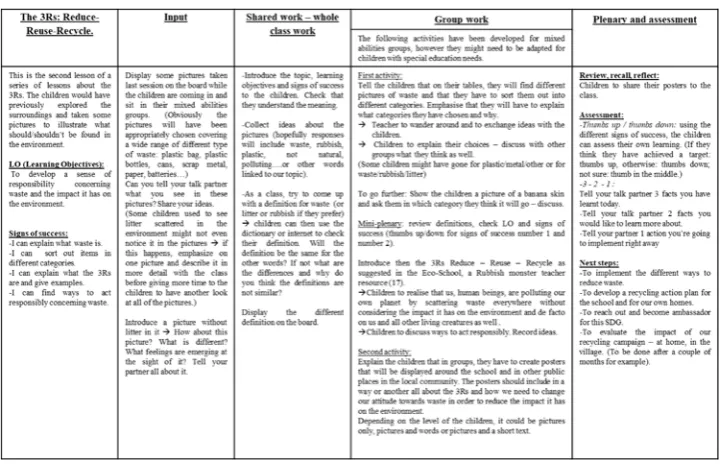
Figure 9 shows a typical curriculum map for the topic ‘The 3Rs – Reduce, Reuse, Recycle’, which represents a termly overview of teaching contents on the topic, and how these can be linked to different subjects that are taught in these schools. Linking the topic into several subjects brings the advantage of deepening the learning experience and making use of other knowledge and experience that pupils and staff members at these schools will gain. This also enhances the realization of how relevant this topic is, which could not be achieved if the topic was taught in isolation only.
Figure 10 displays a detailed teaching plan for a specific teaching unit on the selected topic. The benefit of such detailed teaching plans is that the teaching quality is likely to be higher and the knowledge created during the preparation, conduct and subsequent assessment of the respective teaching unit can be re-used and continuously updated and improved.
Figure 9 Example curriculum map – a termly overview of teaching contents and how these can be linked to different subjects
Figure 10 An example teaching plan for a classroom teaching unit
a deeper understanding of ‘gender equality’ in general, and especially the empowerment of all women and girls, and what this means to local people in their daily lives. While it is true that both men and women are discriminated against in certain ways of life or professional areas, it is arguably more difficult for women to overcome such difficulties, hence the particular focus on the empowerment of women and girls.
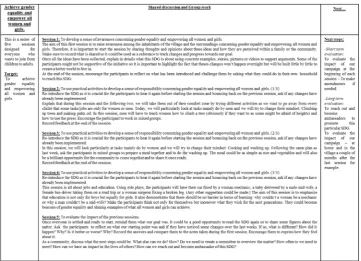
The first session aims to raise awareness among the inhabitants of the village and the surroundings concerning gender equality and empowering all women and girls, starting with the sharing of thoughts and opinions about these ideas and how they are perceived within a family or the community. It is essential to record what is shared so that it could be used as a reference to track changes and progress towards our goal. The basic thoughts about the topic will be repeated briefly at the beginning and end of each subsequent session to enforce the main messages.
The following sessions will look in turn at activities that are typically reserved for men and other activities reserved for women respectively. Practical activities could be climbing up palm trees to harvest seeds needed to make oil (subject to volunteers of course) and then pressing the seeds to produce oil, which are activities traditionally carried out only by men. Activities could follow that are typically carried out by women only, such as cooking and washing up. These activities and a meal following the sessions are further opportunities to bring everyone together and discuss and strengthen the bonds among the local population.
Figure 11 An example teaching plan for village awareness events
the anticipated implementation of the SDGs by Cameroon through national legislation, was pursued for multiple reasons. They include: including the wish of the project team and stakeholders to bring about significant improvements along some of the axes suggested by the SDGs, and also, the necessity to secure funding and other support from various organizations that increasingly expect at least partial project alignment with crucial elements of the SDGs to qualify for their support. In addition to that, not anticipating pending changes in the local legislation that are based on Cameroon’s commitments concerning the national implementation of the framework would have represented a significant risk both for the project itself and the sustainability of its deliverables, most notably the Mahola system as the core deliverable.
The paper looked especially into some education-related aspects and presented two concrete examples of driving education to make progress towards achieving relevant SDGs (via certain aspects of their associated targets). The first concerns the topic of the ‘3Rs – Reduce, Reuse and Recycle’ through a series of diverse and engaging lessons in the local primary schools of Mawel and Nguimakong, which are several kilometres away from Siliyegue. The other concerns ‘gender equality and the empowerment of all women and girls’ through a series of awareness sessions for village communities in the area that focus on specific tasks in and around the household that could be carried out by both men and women.
The above, of course, does not only apply to the Mahola project, which was used here as an example. Instead, from a project management perspective in the international context, relevant aspects of the SDGs and their associated targets must be considered to make any such project more successful, reduce project risks, and make the world a better place. Education is key to achieving this. Thus, planning, conducting and assessing (and reporting on) SDGs related training, teaching and awareness activities should be pro-actively integrated into similar projects’ master schedules – even if there may not be a legal requirement to do so yet.
About the Authors
Ian Brooks is a Senior Lecturer in Sustainable IT at the University of the
West of England (UWE) and a Senior Teaching Fellow at the University of Bristol. The large part of his career has been in management consultancy and Green IT with PricewaterhouseCoopers and IBM. His last role with IBM was as their Sustainability leader on the IBM outsourcing contract with Defra (the UK Department for Environment, Food and Rural Affairs). He has an MSc in Environmental Consultancy from UWE and has embarked on Ph.D. research on the use of the UN Sustainable Development Goals as Requirements in Software Engineering, also at UWE.
Dr. Mario Kossmann (ESEP) is an experienced Systems Engineer and
Capability Integrator for Airbus, having previously worked for Blohm & Voss as Program Manager, Systems Engineer, Technical Manager and Consultant in Services Marketing. He has served as a naval officer with the German and French navies, and was awarded an MEng in Aerospace Technology from the University of the Federal Armed Forces in Munich (Germany), an MBA from the University of Warwick (UK) and a Ph.D. in Systems & Software Engineering from the University of the West of England. He is the author of the books ‘Delivering Excellent Service Quality in Aviation’ (Ashgate 2006) and ‘Requirements Management – How to ensure that you achieve what you need from your projects’ (Gower 2013), as well as numerous research publications in the fields of Systems Engineering, Software Engineering and Project Management. Mario is also a certified Project Manager and ‘Expert Systems Engineering Professional’ (INCOSE). Mario has been involved in the ‘Mahola’ project (www.maholaproject.org) as both Project Leader and Systems Engineer from the start of the project in December 2012.
Virginie Kossmann is an experienced primary school teacher in the UK (all
age groups and subjects), having previously worked as a head teacher of a primary school, and teacher in various primary schools in France. She was awarded a BSc in Sciences (Physics and Chemistry) from the University Paul Sabatier in Toulouse, France, and has ‘Qualified Teacher Status’ in both the UK and France. Virginie has been involved in the ‘Mahola’ project (www. maholaproject.org) and guided the project in matters related to education including bursaries, teaching, and training, from the start of the project in December 2012.
References
1. United Nations General Assembly. Transforming our world: the 2030 Agenda for Sustainable Development [Internet]. A/RES/70/1 2015 p. 1–35. Available from: http://www.un.org/ga/search/ view_doc.asp?symbol=A/RES/70/1&Lang=E
content/uploads/2014/04/pmwj21-apr2014-Kossman-requirements-health-care-system-cameroon-AdvancesSeriesArticle.pdf
7. INCOSE. Systems engineering handbook: a guide for system life cycle processes and activities. Walden D, Roedler G, Forsberg K, Hamelin R, Shortell T, editors. Vol. Fourth. Hoboken, New Jersey: Wiley; 2015. 510 p. https://doi.org/10.1002/j.2334-5837.2015.00089.x
8. International Organization for Standardization. ISO/IEC/IEEE 15288:2015 - Systems and software engineering -- System life cycle processes [Internet]. 2015 [cited 2017 Nov 8]. Available from: https:// www.iso.org/standard/63711.html
9. Sustainable Development Solutions Network. Getting Started with the Sustainable Development Goals [Internet]. Paris; 2015. Available from: https://sdg.guide/
10. United Nations. Partnerships for SDGs platform [Internet]. 2017 [cited 2017 Mar 10]. Available from: https://sustainabledevelopment.un.org/partnership/search/?str=
11. Sustainable Development Solutions Network. Global Mayors, Governors Commit to Urban Sustainable Development Agenda and Aggressive Emissions Reductions [Internet]. 2015 [cited 2017 Mar 10]. p. 1. Available from: http://unsdsn.org/news/2015/09/23/global-mayors-governors-commit-to-urban-sustainable-development-agenda-and-aggressive-emissions-reductions/
12. Airbus. Airbus Group - Responsible business [Internet]. 2016 [cited 2016 May 18]. Available from: http://www.airbusgroup.com/int/en/corporate-social-responsibility/Responsible-Business.html# 13. Global Reporting Initiative, UN Global Compact, World Business Council for Sustainable
Development. SDG Compass – A Guide for Business Action to Advance the Sustainable Development Goals [Internet]. 2015 [cited 2016 Feb 15]. Available from: http://sdgcompass.org/
14. Francis. Laudato Si’ [Internet]. Vatican: Vatican Press; 2015. 184 p. Available from: http://w2.vatican. va/content/francesco/en/encyclicals/documents/papa-francesco_20150524_enciclica-laudato-si.html 15. United Nations. The Sustainable Development Goals Report 2016 [Internet]. New York; 2016. Available from: https://unstats.un.org/sdgs/report/2016/
16. Global Goals Educator Task Force. TEACH SDGs [Internet]. TEACH SDGs. 2017 [cited 2017 Nov 27]. Available from: http://www.teachsdgs.org/