THE METHODOLOGICAL ASPECTS OF METRICS CREATION FOR INFORMATION-ANALYTICAL SYSTEM OF UNIVERSITY
Leda A. Sysoeva
Center of information systems and technologies in educational activity, Russian State University for the Humanities (RSUH),
125993, Moscow, Russian Federation
Abstract
The IS projects currently in use are characterized by the necessity to provide the ways and methods of measurement of necessary indicators and metrics at the initial stages of the project, which will be re-quired during the integration of the existing system with BI-system. The article reviews methodologies which are needed to be considered when forming metrics of business processes and the business ser-vices used with the support of information technologies and systems. As a result of the performed analysis the multilevel metrics structure of the university information and analytical system was creat-ed and developcreat-ed bascreat-ed on the methodologies RUP, ITIL, ITSM, BPM, of project management.
Key words: the process approach for project management, service oriented information system,
man-agement of information system, PDCA cycle, metrics of information system
1. INTRODUCTION
In modern conditions one of the factors, which has an impact on efficiency of functioning of the or-ganizations, is a level of use of analytical information processing systems for the decision-making support on the basis of arrays of the primary data accumulated in corporate applications. Practically all companies-vendors of the software in the sphere of corporate IS and storages of data (IBM, Oracle, Microsoft, SAP, etc.) include BI systems in their software portfolios. The demand and development of the intellectual analysis technology of business information led to the appearance of the new BI 2.0 direction, which is connected with the pro-active analysis, currently available in organizing of the in-formation.
Another aspect influencing activization of use of analytical information processing systems, is con-nected with the broad introduction of process management (BPM) where a big role is played by ana-lytical information on indicators of productivity of business processes.
The demand of analytical systems in information architecture of the organization causes the need to provide methods and models of integration with them of the existing and newly developed program applications at a stage of implementation of the IS project.
Therefore the purpose of this article is to attempt to define methodologies and approaches to formation of metric systems, which must be considered both at the stage of creation of information system, and at the stage of its operation and integration with systems of analytical data processing.
2. METHODOLOGICAL ASPECTS OF CREATION AND MANAGEMENT OF INFORMATION SYSTEM
Process approach to management of the IS project
At the base of the management of the IS project lies the process approach, which is one of eight prin-ciples of quality management, and which declares that "the desirable result is reached more effectively when activity and appropriate resources are operated as a process" [1]. In a quality management stand-ards "any activity in which resources for transformation of entrances to exits are used, can be viewed as a process" [1].
When organizing the management of the IS project, the process will be considered the structured set of the interconnected and interacting types of the jobs performed in a certain interval of time, transform-ing entrances to exits and directed toward achievtransform-ing a concrete result. Let's consider that: 1) process has one or several entrances and transform them to the defined, planned exits; 2) process includes de-vices of a control and management necessary for reliable granting an exit, meeting set requirements.
The accepted definition will be coordinated with a concept of process approach: "systematic definition and management of the processes applied by the organization, and especially interaction of these pro-cesses can be considered as "process approach" [1].
Considering that process is always purposeful, it has to include the analysis of requirements and goals formation, monitoring, control and an assessment of current state of process, development of correc-tive actions in case of a deviation of indicators from allowable values. Therefore any process includes two components: result creation itself (production of an exit) and management of result creation (pro-duction of an exit) [1, 2, 3]. According to ITIL, the management of process is an activity on planning and structuring of a process for the purpose of its effective, productive and coordinated implementa-tion [2].
The importance of application of process approach in management is in structurization of different types of activity. The structured processes allow to manage quality according to the cycle PDCA, which provides achievement of the stable results related to the established standards and requirements, at a rational utilization of resources.
According to PDCA methodology at a control stage, the collection of information about a course of realization of process is carried out; process indicators, including KPI are defined, deviations of indi-cators from threshold values become evident and the analysis with identification of the reasons of de-viations is performed.
The methodology of process approach is applied also in a project activity. When working according to the IS project, the following processes are distinguish: creation of a project product (in this case – IS) and management of process of its creation, i.e. management of the project (management of integration, works, terms, cost, quality, resources, a configuration, risks, contracts and control).
Interrelations between processes of the enterprise/the organization and processes of the IS project are regulated by the state standard specification GOST R ISO/IEC 15288-2005 [7].
Methodology of creation of a design product – information system
The most widespread methodology in which all stages of life cycle of creation of IS are supported in-strumentally, is the methodology of Rational Unified Process (RUP) at the heart of which is iterative, "step-by-step approach".
RUP is the unified, accurately defined process, describing the structure of a project life cycle, the roles and responsibilities of certain performers, tasks performed by them, and models used in the course of development, reports, documentation as well as other devices that control implementation and quality of development and mechanisms of system testing [6].
The RUP methodology consists of the main processes (modeling of business processes; management of requirements; analysis and design; realization; testing; expansion) and auxiliary processes (man-agement of changes; man(man-agement of the project; man(man-agement of the environment).
One of components of the modeling process is a creation of the system of metrics and business pro-cesses indicators. According to RUP, the models of business-propro-cesses are developed with definition of KPI which have to be considered when monitoring of IS indicators. During expansion and function-ing of IS, the IS indicators are monitored and the analysis of level of their deviation from threshold values is performed. The results of monitoring and analysis are transferred to the modeling module for improvement or optimization of models of business processes.
The service-oriented approach to architecture of IS
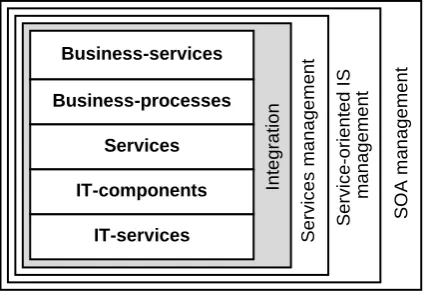
During the design of architecture of IS, various approaches are applied, one of which is service ap-proach. The architecture of the service-oriented IS is considered as multilevel structure (fig. 1):
– infrastructure (hardware-software platform as set of IT services);
– components (functional components of application);
– services (the atomic applied functions realizing logic of business process);
– business-processes (models of business processes and assembly of services according to logic of business process);
– business-services (the services provided to consumers);
– integration (ensuring inter-level interaction).
Business-services
Business-processes
Services
IT-components
IT-services
In
te
g
ra
ti
o
n
Se
rvi
ce
s
ma
n
a
g
e
m
e
n
t
Se
rvi
ce
-o
ri
e
n
te
d
I
S
ma
n
a
g
e
me
n
t
SO
A
m
a
n
a
g
e
me
n
t
Fig. 1. SOA as multilevel structure
At the each SOA level the measurements are taken using the appropriate sets of metrics including met-rics of business services, business processes, services, component of applications, IT services.
The IT-services are: «set of functionality information technologies, and, probably, not information technologies, provided to final users as a service. The examples of services can be: transmission of messages, business applications, services of files and the press, network services, etc.» [10].
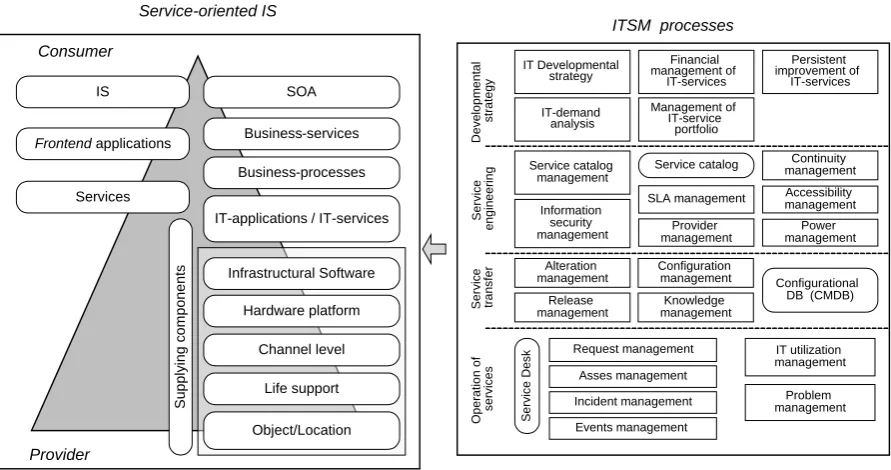
Control service-focused IS accomplish considering methodologies of ITIL V3, Cobit, standard speci-fication GOST P ISO/IEC 20000 [3, 4]. Management processes in ITIL are subdivided into processes of support and providing IT services (fig. 2). According to ITIL all processes have to be measured and have sets of metrics.
Consumer IT Developmental strategy Financial management of IT-services IT-demand analysis Management of IT-service portfolio Persistent improvement of IT-services Provider IS
Frontend applications
Services S u p p ly in g c o m p o n e n ts Business-services Business-processes
IT-applications / IT-services
Infrastructural Software Hardware platform Channel level Life support Object/Location SOA
ITSM processes
D e ve lo p m e n ta l st ra te g y Service catalog management Service catalog Information security management SLA management Continuity management Accessibility management Provider management Power management S e rvi c e e n g in e e ri n g Alteration management Configuration management Release management Knowledge management Configurational DB (CMDB)
S e rvi c e tr a n sf e r O p e ra ti o n o f se rvi ce s S e rvi ce D e
sk Request management
Incident management Asses management Events management IT utilization management Problem management Service-oriented IS
Fig. 2. Structure of management processes service-oriented IS
In the service-oriented IS not only processes are subject to measurement, but also services. During creation of services metrics it is necessary to consider the following aspects:
– in case of IT-services direct participation in realization of business-services, their indicators are directly connected with the indicators of business-services, and values of metrics of IT services are formed automatically by information system using the results of a business activity;
– as IT-services can be provided in the form of IT-services to consumers, it is necessary to perform an assessment of level of providing IT-services according to the agreement between the supplier and the consumer about the level of a providing services (SLA); in this case the metrics of devia-tions from KPI are applied, allowing to analyze the ability of IT-divisions to provide the required level of the IT-services recorded in SLA;
– in order to provide the required level of indicators both separated IT-services, and IS as a whole, it is necessary to consider the processes utilized in IT-divisions.
According to ITIL V3 [2, 8], the approach based on the hierarchy of metrics is used in the develop-ment of IT-services metrics.
– the first level – services metrics and metrics of their components;
– the second level – total services metrics and metrics of management processes;
– the third level– metrics of IT-goals;
– the fourth level – metrics of business-goals.
This approach is based on the multilevel architecture of IS, and on the principle of interrelation of business-services and IT-services.
If IT-services are considered as a type of service provided to users, then from the ITSM perspective all the metrics used for the description and an assessment of IT-services, subdivided into three groups:
– service-related (demonstrate the level of provided service);
– technological (demonstrate the characteristics of the infrastructure);
– process-related (demonstrate efficiency of internal IT-processes in an organization).
Thus, for service-focused IS during metrics development, it is necessary to consider approach based on the hierarchy of metrics and approach of service management to development of metrics for an as-sessment of IT services.
3. FORMATION OF METRICS SYSTEM FOR INFORMATION AND ANALYTICAL SYSTEM OF UNIVERSITY
The analysis of the projection management of RUP, ITIL, BPM methodologies, showed the necessity of carrying out the measurements at all the stages of the project and life cycle of information system. The measurements are an important component of the project control systems, and life cycle of IS, and they are directed, first of all, at measuring of processes and services.
Implementation of measurements requires a systematic approach which will allow to combine various measures and metrics for the purpose of formation of a uniform view on processes and services in con-text of their measurement [2].
According to ITIL methodology the measurement as process also consists of a sequence of stages and steps.
Stage 1. Preparation of performing the measurements: definition of measurements purposes; definition of what it is necessary to measure to receive information necessary for decision-making; definition of what it is possible to measure; the definition of which means will allow to gather and receive the re-quired information and data; formation of target indicators; choice of measuring instruments; choice of methods of implementation of monitoring and measuring; definition of individuals responsible for data control; definition of who will analyze and process the data and what methods and criteria will they use to process and analyze the data; definition of types of reports.
Stage 2. Data collection.
Stage 3. Processing of measured data.
Stage 4. Analysis of data.
Stage 5. Submitting of information.
Stage 6. Development of corrective actions.
At a stage of preparation of performing measurements, one of the components is the development of the system of indicators.
The indicator is a measurable parameter for achieving a definite purpose. The indicator is character-ized by target value and a desirable tendency.
Most often metrics are applied to definition of indicators – available to supervision and measurement of the characteristic of processes, services and their interrelations on which value it is possible to judge condition, changes and behavior of created or operated system. I.e. as a metric we will understand measurable parameter.
The principles of metrics development.
1. SMART (Specific, Measurable, Achievable, Realistic, Timely) – set of characteristics of any met-rics which have to be defined before it will be applied. The metmet-rics have to belong to a concrete pro-cess (or parts of a propro-cess), and service. The metrics has to be measurable and achievable under given conditions. The metrics have to be realistic, make sense and measure real processes and services. The metrics have to be timely, have the reasonable frequency of measurements and application term.
2. KISS (Keep It Simple Stupid) – the metrics have to be well explained, and ways of its achievement have to be clear enough.
3. GQM (Goal, Question, Metric) – approach to formation of metrics "from top to bottom" – from def-inition of the high-level purposes (project, process, service) to drawing up the list of the questions,
allowing to define the extent of achievement of the purpose, and then development of a set of metrics for a quantitative assessment of results.
4. MAPE (MEAN ABSOLUTE PERCENTAGE ERROR) – APPROACH TO ENSURING COMPARABILITY OF METRICS
For simplification of understanding of absolute numerical measures and for comparison of metrics, the percentage representation of numerical sizes is used. Percentage sizes are applied also to an assess-ment of reliability of a predicted metrics.
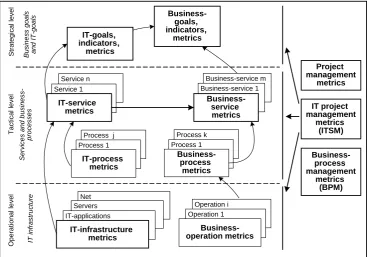
It is expedient to form the metrics-informational and analytical system of university considering a pro-cess approach, levels of management and types of goals (fig. 3).
IT-goals, indicators,
metrics
Strate
g
ical leve
l
Tactic
al level
Op
era
tional le
vel Net
Servers IT-applications
IT-infrastructure metrics
Service n Service 1
IT-service metrics
Business-service m Business-service 1
Business-service metrics
Process k Process 1
Business-process
metrics
Business-goals, indicators,
metrics
Project management
metrics
IT project management
metrics (ITSM)
Busine
ss go
als
and IT
-go
als
Se
rvice
s a
nd b
usine
ss
-p
roce
sse
s
IT
infrastru
ctu
re
Process j Process 1
IT-process metrics
Operation i Operation 1
Business-operation metrics
Business-process management
metrics (BPM)
Fig. 3. Structure of system of metrics for information-analytical system of university on the basis of service-process approach
When using process approach in management activity of the organization is represented in the form of the interconnected set of such components as: services, processes, infrastructure. Measurements which include service metrics, process metrics and technological metrics are used for management of each of the segments.
Service metrics show how service is provided to consumers (customers). The level of services provid-ed to consumers is supervisprovid-ed by these metrics alteration. Service metrics have to correspond with the parameters of services coordinated in agreements on the level of services providing (SLA).
Here are examples of the service metrics: time of formation of analytical reports; groups (quantity) of indicators on which the analytics are performed; forms of a conclusion of reports and their interfaces, etc.
Values of service metrics depend on realization of processes and infrastructure.
Technological metrics reflect condition of infrastructure.
Here are examples of technological metrics: number of program and hardware failures; how loaded the communication channels are, etc.
Metrics of processes are the metrics that allow to define a condition of the whole process on the basis of data, which collected in the form of critical factors of success, key indicators of efficiency, metrics of works, operations and other metrics of processes in a framework of service-management.
Metrics of IT processes show efficiency of internal processes of IT divisions.
According to process approach the process metrics are subdivided into:
– entrance metrics: they measure how loaded the processes are also serve as the information indica-tors for the manager of process, which it is impossible to affect, but it is required to consider and react;
– exit metrics (productivity metrics): they show the level of achievement of process goal;
– metrics of resources: they measure load and sufficiency of the resources used by process;
– management metrics: measure level of controllability of process and efficiency of operating in-fluences.
In CobitT the metrics are subdivided into indicators of productivity, rationality, controllability, and the maturity model is offered for each process.
Despite various approaches to classification of metrics they are rather comparable: productivity indica-tors – exit metrics; rationality indicaindica-tors – metrics of resources; process maturity – management met-rics.
For formation of indicators of processes it is necessary to balance various metrics among themselves.
Metrics of management processes are grouped taking into account types of goals: to the short-term there correspond operational processes, medium-term – tactical, long-term – strategic.
For operational management processes metrics are used: services Service Desk, managements of inci-dents; managements of a configuration; managements of alterations; managements of releases; for support of appendices; for applications programming; for managements of ICT infrastructure.
Metrics are applied to tactical management processes: managements of level of providing services (SLA); management of problems; managements of capacities; management of a continuity of provid-ing IT services; managements of availability; managements of information security.
Metrics are applied to strategic management processes: continuous improvement of IT services and services; managements of finance for IT services; risk management; managements of documentation; managements of competence and training of employees.
Metrics for management of projects: number of the works which haven't been executed in planned terms; number of the revealed risks of the project; general time of a delay of the project; delay of a critical way; satisfaction of clients, etc.
5. CONCLUSION
The performed analysis showed that an important component of monitoring and control is formation of system of indicators and the metrics developed taking into account certain methodologies, methods and standards, and only on the basis of such metrics the analysis and an assessment of IT services and processes can be carried out.
According to methodology of process approach of one of the main characteristics of process is its measurability, i.e. each process has to have system of indicators and metrics. In methodology of ITIL it is recommended to form metrics at the same time with processes. Need of development of the sys-tem of indicators and metrics of processes at a stage of modeling of business processes is noted in RUP methodology.
In ITIL and CobiT are given approaches to classification of metrics of processes which despite their distinction are nevertheless rather comparable.
For formation of indicators of processes it is necessary to perform balancing of various metrics among themselves.
Besides the continuous growth of interest to business analytics, in particular to process focused, need of integration of existing and developed information systems with BI systems, demands thought-over, scientifically reasonable approach to formation of indicators and metrics of services and processes.
REFERENCES
1. GOST R ISO 9000-2008. (2008) Quality management systems. Fundamentals and vocabulary. – Inroduction 2008-03-18. – М.: Standartinform, 2008. – 36 p.
2. Glossary Terms and Definitions. (2009) ITIL V3 Glossary v0.92, 30 April 2009. – Electronic re-sources. – Access mode: http://www.itexpert.ru/rus/biblio/itil_v3/ITILV3_Glossary_Russian_ v092_2009.pdf.
3. GOST R ISO/IEC 20000-1-2010. (2011) Informational Technology. Service Management. Part 1. Specification . – Introduction 2011-07-01. – М.: Standartinform, 2011. – IV, 15 p.
4. GOST R ISO/IEC 20000-2-2010. (2011) Informational Technology. Service Managemen. Part 2. Practice Codex. – Introduction 2011-07-01. – М.: Standartinform, 2011. – VI, 28 p.
5. Fedorov I.G. (2013) About the Process-related Management Terminology /Open Education. – 2013. – №4 (99). – С.32-39.
6. Kroll P., Kratchen F. (2004) Rational Unified Process – it is Easy. RUP manual. 2004. – 432 p.
7. GOST R ISO/IEC 15288-2005. (2005) Informational Technology. System Engineering. System Life Cycle Processes. – Introduction 2005-12-15. – М.: Standartinform, 2005. – 57 p.
8. ITIL (2011) Official site ITIL. – Access mode: http://www.itil-officialsite.com.
9. CobiT (2011) Official site. – Access mode: http://www.isaca.org/cobit
10. GOST R 53114-2008. (2008) Information security. Ensuring information security in the organiza-tion. Main terms and definitions. – Introduction 2009-10-01. – М.: Standartinform, 2009. – IV, 15 p. 11. Gartner (2014) Magic Quadrant for Business Intelligence and Analytics Platforms, Rita L. Sallam, Joao Tapadinhas, Josh Parenteau, Daniel Yuen, Bill Hostmann, February 20, 2014.
12. SOMA: A Method for Developing Service-Oriented Solutions. (2008) A. Arsanjani, S. Ghosh, A. Allam, T. Abdollah, S. Ganapathy, K. Holley // IBM Systems Journal. – 2008. – Vol. 47, № 3. – P. 377-396. – URL: http://www.cs.jyu.fi/el/tjtse54_09/Artikkelit/ ArsanjaniEtAlIBMSsJ.pdf
13. SOA Governance: Governing Shared Services On-Premise & in the Cloud. (2011) Stephen Ben-nett, Thomas Erl and other. NJ: Prentice Hall. – Pearson PTR, Hardcover, 2011, P. 704.
14. The SOA Source Book. (2010). – Access mode: http://www.opengroup.org/soa/source-book/intro/
15. Microsoft: SOA & Business Process. (2011) – Access mode: http://www.microsoft.com/soa/
16. SMART: Analyzing the Reuse Potential of Legacy Components in a Service-Oriented Architec-ture Environment. (2008) Technical note CMU/SEI-2008-TN-008 / Grace A. Lewis, Edwin J. Morris, Dennis B. Smith, S. Simanta. – Carnegie Mellon Univ., cop. 2008. – 37 p. – URL: http://www.sei.cmu.edu/library/abstracts/reports/ 08tn008.cfm
17. Stracke, Christian M. (2006) "Process-oriented Quality Management", in: Ehlers, UlfDaniel/ Paw-lowski, Jan Martin (Eds.): Handbook on Quality and Standardisation in E-Learning. Berlin: Springer. 79-96. [also online available on: http://www.qed-info.de/downloads]