Page 294
RESEARCH OF THE STUDENTS’ SATISFACTION FROM THE QUALITY OF TRAINING IN AN AFFILIATE "PROF. DR. I. MITEV" TO VRATSA AT MEDICAL UNIVERSITY IN
SOFIA
Galya Т. Yankova, Pavlinka P. Dobrilova, Kalina Stefanova
Medical University Sofia, Branch “Prof. Dr. Ivan Mitev” Vratsa, Department of Health Care, Bulgaria
Abstract
The quality and his appraisal are in the center of the modern management of the educational process. Quality is present in the mission, objectives and tasks of every university. The student opinion is one of the main indicators about the quality of training. Students with their awareness and mobility can be an indicator and a corrective for the extent to which the knowledge they receive gives them competitive advantages.
The article explores the research results about the students’ satisfaction from the quality of training in an affiliate "Prof. Dr. Ivan Mitev "– Vratsa. The results obtained make it possible to draw conclusions and to identify adequate measures in accordance with the needs and requirements of the students, which would improve their motivation for active participation in the learning process.
Keywords: quality of training, students’ satisfaction, motivation, learning process
1. INTRODUCTION
The education became not only basic and fast growing sector in the contemporary global competitive environment, but and a means of achieving labor market benefits, to upgrade the employment and the professional realization, to increase the economic growth and not last a prestigious and a profitable investment in the future [10]. Providing a quality education is a very important task for every high schools and this guarantees their competitiveness.
If the high school education have to meet the needs of the business, the high medical education first must meet the needs of the society.
The scientific basis of medicine is universal and a task of the medical education is to provide health care. The healthcare professionals are a key factor in the quality medical attention and that`s why their preparation in the high schools becomes increasingly important subject of study.
The increasing the quality of the medical and health professionalists` training in the higher education system is one of the important tasks in the conception of modernization of the professionalization of the medical and health personnel. It is of paramount importance to form policies to improve the quality of the medical education, for training and development of specialists with high professional competence, meeting the needs of healthcare [3, 8].
The quality is a complex set of properties and characteristics of higher education (university, specialty, training program) which they give the ability to satisfy determined or supposedly dynamically changing requirements to it [9]. There is not accepted one measure. It includes the teaching characteristics, scientific research activities, the relationship between teachers and students, the material base and other.
Page 295
Researches on students' opinion regarding the content and organization of school work, the material conditions, the teachers and the information provision are an important resource for assessing the quality of university education in the health care and for its improvement [1, 6, 11].
The quality and its evaluation are in the middle of the modern management of the educational process. That is why it is in the mission, objectives and tasks of "Prof. Dr. Ivan Mitev "- Vratsa, which follows the standards and the guidelines for a quality assurance in the European Higher Education Area. The affiliate has a Quality Management System where the basic users of educational services are the students.
A traditional practice in the affiliate is to seek feedback with students by systematically studying, analyzing and using their views on the quality of the educational product.
The aim of this research is to investigate the level of the student satisfaction with the quality of education.
2. MATERIALS AND METHODS
The present research is conducted in the execution on a scientifically research project which is financed by Medical University-Sofia from a competition GRANT-2018 on topic: ``Exploring the possibilities for using a computing and communication technology in a healthcare training in the affiliate "Prof. Dr. Ivan Mitev "- Vratsa".
In May - June 2018, it is conducted a survey among 300 students studying in the field ``Health care`` in an affiliate "Prof. Dr. Ivan Mitev "- Vratsa to Medical University – Sofia. The research is for the bachelor student from each courses in the specialty - "Nurse ", "Midwife" and "Medical assistant" for the school year 2017/2018.
To achieve the research goal, a questionnaire was developed, in which the formulation and selection of the questions were carried out by the authors.
The idea is to obtain a multifaceted feature of the degree of student satisfaction by covering the full set of students. The main indicators for quality of training in the affiliate "Prof. Dr. Ivan Mitev "- Vratsa, namely:
relevance of educational content; the knowledge in clinical practice;
The interest in the discipline, which can be assessed by attending lectures and exercises, etc. Opinions and recommendations of the students for improving the quality of the learning process.
The questions are divided into four thematic modules: data about the interviewee;
satisfaction with the level of accessibility and condition of the facilities; attendance of the classes and conducting the training;
Opinions and recommendations of the students for improving the quality of the learning process.
The data were processed using the statistical software SPSS 19.0. The tables and the charts are made using Word and Exсel.
3. RESULTS AND DISCUSSION
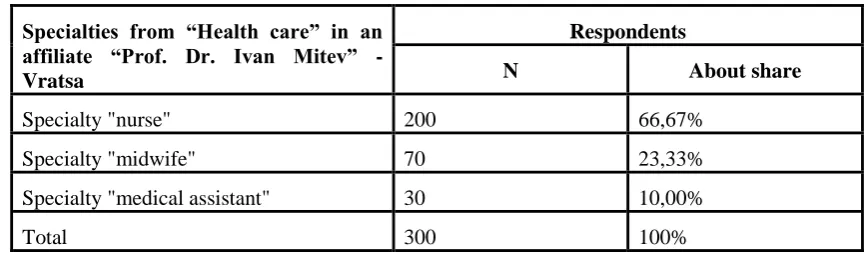
300 volunteers participated in the research from I-IV course, which are training in a specialty “Health care” in an affiliate "Prof. Dr. Ivan Mitev "- Vratsa.
Page 296
Table 1. Distribution of students by specialties
The age range of the surveyed contingent is 19 - 50 years. The average age of the respondents is 24 years. From all respondents, 94% are women and 6% are men. The gender structure is related to the university profile and feminization of a large part of the specialties and professions.
The data show that 44% of all respondents have excellent and very good success, 40% - good and 16% - with moderate success.
The material base forms the student’s satisfaction. It creates a home comfort and a possibility for more intensive, visual and modern learning. When there are good living conditions in the school halls, the training process is better, not boring and tiring. Approximately ½ of the student’s surveyed expressed satisfaction with the facilities of affiliate, nearly 40% - are undecided, while 14 percent did not approve.
In the curricula of the specialties of the "Health care" provided a self-preparation - a work with educational literature, solving of tests, development of course work and papers, presentation of clinical cases. The fund of the affiliated library contributes to the complete self-preparation. Besides books, textbooks and magazines in traditional paper, it has magnetic media editions, electronic catalogs and more. The degree of satisfaction of the students from the library fund is presented in Fig 1.
Fig. 1. Satisfaction with accessibility to literature in the library Specialties from “Health care” in an
affiliate “Prof. Dr. Ivan Mitev” - Vratsa
Respondents
N About share
Specialty "nurse" 200 66,67%
Specialty "midwife" 70 23,33%
Specialty "medical assistant" 30 10,00%
Page 297
The respondents appreciate the quest towards constantly upgrading and renovation of library funds and that is why about 70% of students believe that the library has the necessary literature and finds that services are accessible (66% - to a high degree, 30% - to a certain extent and only 4% - that they are not available).
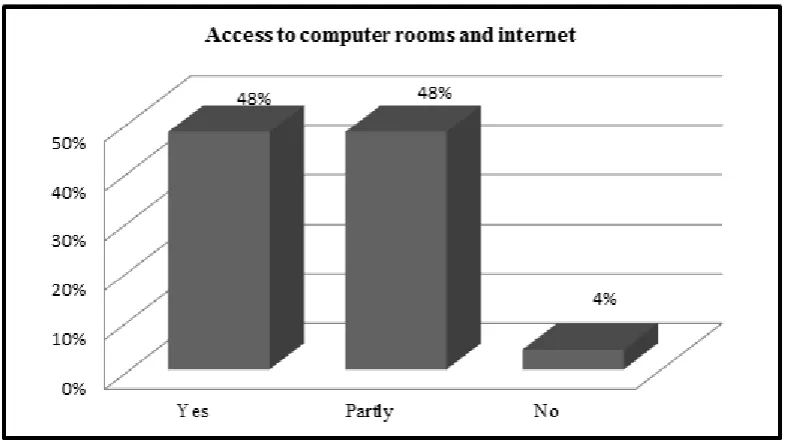
The necessary information resources stimulates the self-education of the students. The degree of satisfaction of the students with the information resources of the affiliate is important for the quality of the training. The leading criterion is the access to computer rooms. Students' opinion on this issue is more positive (Figure 2).
Fig. 2. Access to computer rooms and internet
Class attendance is one of the indicators of students' interest in them. The good theoretical training is a factor contributing to the optimal formation of professional competence, which motivates 72% of the students to attend the lecture courses regularly (39% attend all lectures and 33% most of them). The necessity to acquire practical skills and competencies related to their future professional activity is well aware that 81% of them are present, 14% of the majority of the exercises and only 5% regularly absent.
Page 298
Table 2. Visiting students in lectures and exercises
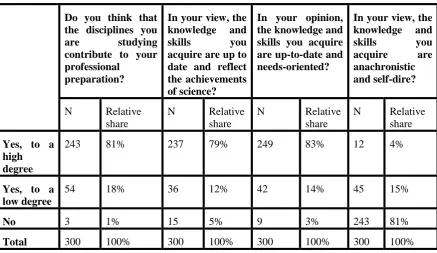
Generally, the students believe that the disciplines help them to prepare professionally (81% indicating a high degree), 79 % of the responders think that the knowledge reflect the contemporary achievements of science and also they are with a practical orientation (83%).
In spite of that, there are and negative evaluation – 4% of the students think that the acquired knowledge and skills are highly anachronistic and self-directed (Table 3).
Table 3. Comments students the knowledge and skills
The satisfaction of the students with the quality of the training in the form of lectures, exercises and practical training is a significant factor in their professional preparation.
The students express a high degree of satisfaction with the quality of the exercises (90%), followed by the quality of the lectures (59%) and the practical training - clinical practice and pre-graduate practice
Vising in lectures Visiting in exercises Visiting clinical practice and pre-graduate practice N Relative
share
N Relative
share
N Relative
share
Everyone 117 39% 243 81% 258 86%
Most 99 33% 42 14% 39 13%
A smaller part
84 28% 15 5% 3 1%
No one 0 0% 0 0% 0 0%
Total 300 100% 300 100% 300 100%
Do you think that the disciplines you
are studying
contribute to your professional
preparation?
In your view, the knowledge and
skills you
acquire are up to date and reflect the achievements of science?
In your opinion, the knowledge and skills you acquire are up-to-date and needs-oriented?
In your view, the knowledge and
skills you
acquire are anachronistic and self-dire?
N Relative share
N Relative share
N Relative
share
N Relative share
Yes, to a high degree
243 81% 237 79% 249 83% 12 4%
Yes, to a low degree
54 18% 36 12% 42 14% 45 15%
No 3 1% 15 5% 9 3% 243 81%
Page 299
(83%). The results show that the satisfaction with the quality of the exercises is almost 2 times higher than the lectures, indicating that the internal motivation of the students is related to the practical professional training (Table 4).
Table 4. Satisfaction from the quality of training
The choice of appropriate methods, forms and tools for training is a guarantee for the quality of the learning process and motivates the students for higher results in the educational activity.
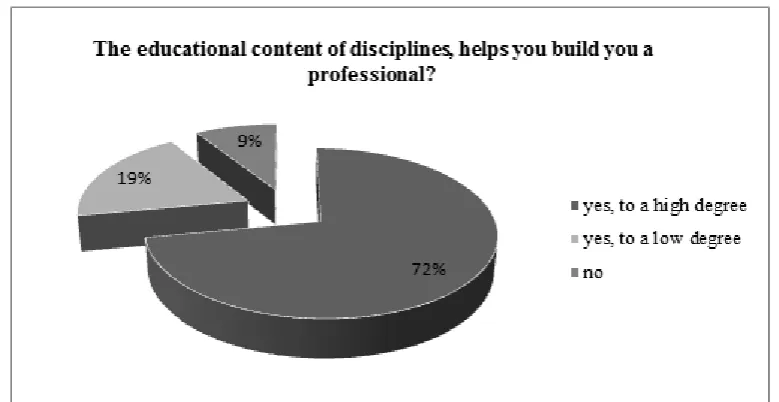
The students' opinion is interesting about the curricular content of the subjects studied. The results show that 72% of the students are of the opinion that the curricular content of the disciplines studied contributes to their construction as professionals. (Fig. 3).
Fig. 3. Students' opinion about the relationship between the curriculum and the professionalism.
The way of presentation of the study material is one of the most important prerequisites for its successful understanding and for the maintaining interest and attendance at classes. The general assessment of respondents about teaching is high. 79% of the students think that the study material is taught clear and understandable. (Fig.4)
Degree of satisfaction from the quality of training
Lectures Exercises Clinical practice and pre-graduate
practice N Relative
share
N Relative share
N Relative
share
Yes, to a high degree
177 59% 270 90% 249 83%
Yes, to a low degree
108 36% 15 5% 42 14%
No 15 5% 15 5% 9 3%
Page 300
Fig. 4. Structure of the students about the teaching of the study material in %.
50% of the students think that the overall quality of training is very good. The percent of students who set low evaluation is comparatively low (4%).
Fig. 5. Evaluation of training quality
Page 301 4. CONCLUSION
After the research we can make a conclusion that the quality of the education in the specialties from the sector "Health Care" in the affiliate "Prof. Dr. Ivan Mitev "- Vratsa at a good level.
But there are the separate components which can optimize and improve the efficiency and the competitiveness of educational activity like:
improvement of the didactic and educational approaches in conducting the lecture courses; using more electronic resources;
adding the contemporary technology in the process of training; Using an interactive training methods and other.
ACKNOWLEDGMENTS
The present research is conducted in the execution on a scientifically research project which is financed by Consul of Medical Science in Medical University-Sofia, contract №: D-102/03.04.2018, from a competition GRANT-2018 with topic: „Exploring the possibilities for using a computing and communication technology in a healthcare training in the affiliate "Prof. Dr. Ivan Mitev "- Vratsa".
REFERENCES
1. Andonova Al. (2013). A structural-functional model of the factors influencing positively the academic motivation of students majoring in the nursing and midwifery. Journal "Nursing", 45, 2013, № 3,р.13-16
2. Georgieva, G. (2016). Advantages and disadvantages of the teachning and learing process in the eyes of the students and opportunities for its improvement, <https://ejournal.vfu.bg/bg/pdfs/G.Georgieva.pdf>
3. Miteva, Kr. (2011). The educational process in forming professional competences of medical specialists. journal "Nursing",43, 2011, № 1-2, р.47-52
4. Mladenova, M., Brezin B. (2013). Challenges to implementation of ict in education of generation "Social networking". Management and sustainable development 4/2013 (41),p.108-112
5. Nikolova, M., Linkova M. (2013). Possibilities for increasing the quality of students’ professional training and motivation. Journal "Dialogue",2013, р.88-100
6. Peeva K. (2010). Theoretical aspects of the assessment of quality in higher education, Trakia Journal of Sciences, Trakia Journal of Sciences, Volume 8, Suppl. 2, 2010, 429-435
7. Peeva K. (2012). Evaluation of the quality of education at the higher medical schools. Doctoral dissertation, 2012,
8. Serbezova, I. (2015). Need for change in educational technology for health professionals, Scientific work of the Rousse University, 2015, vol. 54, series 8.3,p.64-69
9. Stoenchev, N., Sarhachev, J. (2014). Statistical study of the level of satisfaction of the students from business administration speciality in university of forestry from the quality of education. Management and sustainable development 4/2014 (47), p.54-60
Page 302