Page 181
TRAINING IN THE CULTURAL AND ENVIRONMENTAL SECTOR: A SUCCESSFUL WORK PLACEMENT WITHIN THE CONTEXT OF THE MASTER “PLANNING AND PROMOTION OF ARTISTIC AND CULTURAL EVENTS” HELD AT THE UNIVERSITY
OF BOLOGNA IN ITALY Salvatore Lorusso1, Angela Mari Braida2
1Department of Cultural Heritage, Alma Mater Studiorum University of Bologna, Viale degli Ariani 1,
48121 Ravenna, Italy
2University of Palermo, Palermo, Italy
Abstract
The paper aims to show how a University Master made up of a combination of lessons and work experience can provide openings and generate new job opportunities for young people in today’s employment market. It presents the successful experience of a post-graduate student who participated in a University Master dealing with the sector of cultural heritage. The Master covered a variety of interdisciplinary areas on the subject of planning and promotion of artistic and cultural events. Themes included heritage research and preservation, internationalization, fund-raising, economics, legal aspects, and others. On completion of the course lessons a work placement (internship)was programmed for each participant in a Cultural or Business Unit in order to put into practice the acquired knowledge and gain first-hand experience in a real work situation (on-the-job training). During this period, as reported by the participant, they were able to acquire or improve different skills, and to feel they had accomplished something concrete for their future.
Key words: work placement, university master, professional training
1. INTRODUCTION
At the end of the Master (2014-2015), held for six consecutive years at the University of Bologna, Italy, I felt it was particularly important to bring together in one collection all the reports written on the "project work" carried out by the students in the various work placements relating to the various course subjects in the third volume of the book series, "Training and research in the field of cultural heritage". Each report is followed by a review written by those who achieved the best exam results on completion of the Master. The book provides an account of the acquired training skills, commendably commented by these students.
The following is a brief description of one experience chosen from among the various Cultural and Productive Units where the post-graduates did their internships after completing the programmed course lectures and seminars, and is linked to the theme of the International Conference, “Education, research and development” organized by International Scientific Events. The description clearly shows that different issues are inherent in the process of valorizing cultural and environmental heritage which, in turn, naturally implicate the design and realization of artistic and cultural events within a context of internationalizing culture.
2. ON THE JOB TRAINING: A TRAINEE STUDENT’S SUCCESSFUL WORK PLACEMENT
Page 182
The Agency's partners were among the first to promote the city of Ferrara and its territory in the Emilia Romagna region, both in Italy and abroad, with a varied clientele which includes travel agencies, tour operators, CRALs (recreational clubs for employees organized on a national scale), associations.
The Agency’s long experience in the hospitality tourism sector has meant they are able to propose all kinds of cultural packages, ranging from art, nature, cycling, birdwatching, nautical excursions in the Delta and the Valleys of Comacchio, and food and wine tours. The Agency, in fact, is able to provide all types of tourist services: accommodation, catering, guides, boat excursions, promotion of exhibitions and events, guided tours to businesses and production companies, in addition to offering various experiences, such as food and wine tasting, lunches and dinners, bike rentals, horse riding, boating, fishing trips in the Adriatic and any other activity a tourist may wish for during their visit.
In reference to the activities carried out by the student at the said agency, after a preliminary screening phase, other work phases included:
1. Developing communication skills through the use of social networks; evaluating with the senior staff how to increase the Agency’s visibility and offers; improving its presence on Facebook by publishing articles and posts that would make the city of Ferrara’s wide-ranging offers more visible to visitors: art treasures, special events organized in the city, from exhibitions to nature walks or wine tasting tours and so on.
The aspect relating to the Agency’s communication and promotion was a point which was particularly focused on throughout the entire period of the work experience, and brought a considerable increase in visitors to the Agency’s Facebook page.
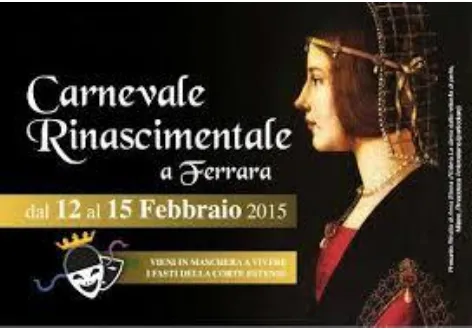
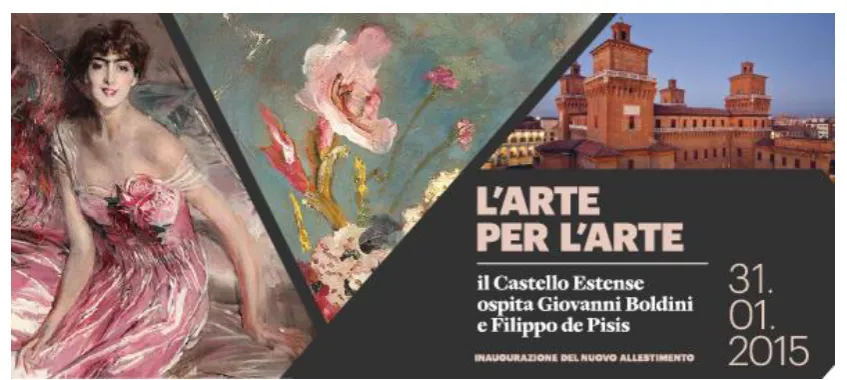
2. Organizing services for tourists in connection with the main events that have always animated the city of Ferrara: New Year's Eve at the Castle, the Carnival of Cento and that of Renaissance Ferrara, the city’s programmed exhibitions.
This organization involved aspects concerning comfortable hotel accommodation, lunches and dinners in typical restaurants in the area and, for the length of the stay, tours with or without a guide with a cultural flavor, promoting the most attractive events, the most convenient solutions and the most satisfactory services in order to win over customers.
Figure 1. Promotional poster for the Renaissance Carnival of Ferrara.
Page 183
Figure 2. Brochure of the exhibition "Art for art (L’arte per l’arte). Giovanni Boldini and Filippo de Pisis”, Ferrara, Castello Estense.
3. Organizing tours for foreign tourists in Italy. For a pleasant and interesting stay, the peculiarities of several places to visit were proposed, including alternative sites, such as the Cucchi Museum of Asiago, the Museum of Ala Piano, vineyards, dairies, breweries, farms, and other places that were already structured for group visits and tastings, with already available prepared packages or custom-made, based on suggestions put forward by the Agency.
The interesting thing in this type of activity was to combine the cultural aspect with the food and wine, creating in this way an indispensable network within the territory for the valorization of its riches.
Part of the program was established in collaboration with "Find your Italy", a tour operator and travel agency created to promote and diffuse the Italy people know little about, but which abroad, is considered to be the most characteristic.
Source: http://www.findyouritaly.com/it
It was thus possible to access the platform and use their portal to publicize itineraries to promote Ferrara and its province with its artistic and natural wonders, and food and wine, in order to attract, above all, foreign tourists, as well as creating a blog to write posts, to promote the territory it represents.
For example, on one occasion, "Find your Italy" was requested to design an itinerary especially for a group of tourists who were attending a trade fair in Bologna, but were staying in Ferrara to learn about the city of the Este family and appreciate its food, wine, art, culture and nature.
Page 184
Preparing the index-cards is an activity that requires painstaking work, because publication of the cards is subject to strict rules that enforce the information available to potential customers to be complete and accurate.
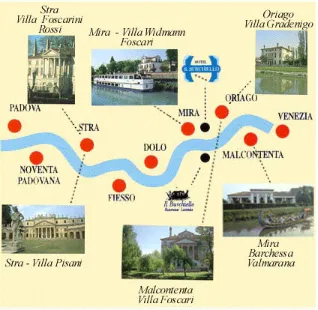
As a result, itineraries were prepared to highlight places, attractions, food and wine tasting, tours of Ferrara and all its territory; one of these was published on the portal. In addition, a cultural itinerary of the Brenta Riviera visiting different Venetian cities and Palladian villas was compiled by the Master participant (Figure 4).
Figure 4. Cultural itinerary designed by Master participant
5. Organizing spaces inside cultural structures to promote activities for young people, with meetings and diffusion of knowledge on subjects mediated by a speaker, film reviews to comment on, graphics and video production workshops, readings recited by theater companies, photographic marathons and competitions open to photography experts and amateurs.
3. COMMENT
The richness and variety of services offered by the Agency, "ESTENSE INCOMING", have not only enabled the creation of innovative and diverse cultural projects in their achievements, but above all the constant development of strategies for their economic sustainability.
Page 185
This synergy can be a winning factor, especially if implemented between neighboring territories; valorizing these territories all together, in terms of history, art, nature, wine and food, hospitality, or more properly culture, makes it possible to offer stimulating and engrossing ideas that can attract, on the one hand, foreign tourism, that has been active in Italy for decades, and on the other, favor the rediscovery (if not the actual "discovery") of the highly varied cultural heritage scattered throughout the country.
In these terms, identifying sponsors or other partners who are able to collaborate in valorizing the uniquely typical territorial products and / or the specific nature of certain services, results in both a social exchange and an exchange of values that is extremely advantageous for all parties. It makes it possible to create a cultural offer which can fill deficiencies in any sector and also generate medium to long-term benefits of a social, economic and image-based matrix, as well as multiplicative, indirect and induced, with a view to enriching the triangle formed by users, participating actors and the territory.
Given the importance fundraising activities have in organizations, especially in times of severe economic hardship and financial crisis on several fronts, it seemed appropriate to link this training experience to the teaching of "Internationalization and fundraising in culture and research”. This is important, as it is only through continuous cooperation between the actors united by a common goal that initiatives with a solid content can be planned and put into practice and so satisfy people’s expectations as well as strengthen the image Italy has worldwide. However, when speaking of internationalization and cultural events it not only refers to those planned and promoted in Italy, but also abroad.
In this regard, Italian Cultural Institutes are extremely important for the implementation of cultural activities that diffuse knowledge of cultural heritage and the different research sectors, in the countries where they are established1. Very often their structures promote and host, as well as their own initiatives, concerts, art exhibitions, film festivals, conferences, theater and dance performances. In addition to the initiative (or involvement) of the individual cultural institution, it is also important to remember the coordination carried out by EUNIC (European Union National Institutes for Culture), the association of cultural institutes of the EU member states.
4. CONCLUSION AND PROPOSAL
To conclude, I would like to propose to the members of International Scientific Events who organized this International Conference on "Education, Research and Development" and the Italian Institute of Culture in Sofia, a project, whose objective is the training of an interdisciplinary professional figure within the context of the "Planning and promotion of artistic and cultural events".
In this regard, determination of this joint initiative must be found in a common cultural denominator, so that the proposed events show a close and comprehensive relationship between the actors involved, which unites the two European countries.
The advantage of this collaboration is to give the project a better opportunity of being funded and implemented. This highlights the need for a dynamic figure, an expert in public relations, as well as a good connoisseur of the territory, who as a fundraiser, will take care of raising funds, starting with the Institute of Culture, and stating the project to be implemented and the patronage to be obtained, which more often than not is "spiritual" rather than economic.
Therefore, the possibility of creating a joint cultural project between Italy and Bulgaria is of great interest. This obviously means striving to find a common denominator, but it is also one of the best opportunities to diffuse culture.
1The Italian Cultural Institutes were established in the 1920s by the fascist government to demonstrate the
Page 186 REFERENCES
Lorusso, S., Natali, A., Lamborghini, M., Rossi, E. 2016, Relazioni e commenti sugli stages del Master attivato dal Dipartimento di Beni Culturali Alma Mater Studiorum Università di Bologna (sede di Ravenna) A.A. 2013 – 2014, Progettazione e promozione degli eventi artistici e culturali, Mimesis Edizioni, Milano-Udine.
Lorusso, S., Cogo, GM, Natali, A., 2016, ‘The protection and valorization of cultural and environmental heritage in the development process of the territory’, paper presented at 16th CIRIAF
National Congress, Sustainable Development, Human Health and Environmental Protection, April 7-9, 2016, Assisi, Italy.
Lorusso, S., Natali, A., Braida, AM, 2016,’ Drawing value from culture and the territory’, paper presented at Annual International Symposium on Culture, 9-12 May, 2016, Athens, Greece.