http://www.gjaets.com © Global Journal of Advance Engineering Technology and Sciences
33
Global Journal of Advanced Engineering Technologies and Sciences
A THEORETICAL STUDY OF CHLORINE MOLECULE ADSORPTION
ON Au CLUSTERS
Nkechi E. Ibisi
*12, Zhenyu Li
1, Anthony I. Onuchukwu
2, Jinlong Yang
1*1Hefei National Laboratory For Physical Sciences in Microscale, University of Science and Technology of China, Hefei, Anhui 230026, People’s Republic of China.
2College of Natural and Applied Sciences, Michael Okpara University of Agriculture Umudike. P. M. B
7267 Umuahia. Abia – State, Nigeria.
Abstract
Adsorption of chlorine molecule on cationic, neutral, and anionic Aun (n=1−6) clusters have been studied using
density functional theory to find the adsorption structure and energy, charge population, and vibrational frequency. Comparative results are obtained using the PW91 exchange-correlation functional and the B3LYP hybrid functional. Calculations show a pronounced sensitivity to cluster size and charge state. Adsorption energy of Cl2 is above 0.2
eV on all clusters, indicating that the adsorption is energetically favorable. The adsorption energies of cationic clusters decrease as the cluster size increases. An even-odd oscillation of the adsorption energy is observed for neutral clusters, in which the odd clusters were observed to favor dissociative adsorption. Adsorption energy for the anionic clusters was found to be consistently high in the range of 2.4 - 4.5 eV with the exception of Au3- cluster.
Effects of the strength of interaction between Cl2 and Aun on charge transfer and Cl-Cl stretching frequency are also
discussed. In addition Au3Cl2 cluster showed an extraordinary stability amongst the studied clusters which was
further explained based on structural planarity, binding energy of Cl2 molecule on the clusters and energetics of its
nearest neighbours. Our results demonstrate the possibility of electronic structure engineering by cluster size control.
Keywords:Au Clusters, Chlorine Molecule, Density functional theory(DFT), Adsorption
Introduction
Experimental and theoretical studies have been devoted to unveiling the catalytic mechanism of nanosized gold clusters. [1-7] Reports from these studies have shown compelling evidence that their chemical activity is hinged on their unique cluster size effect, contact structure, and support selection. These observations have made it a growing choice of catalytic materials.
Bulk gold is chemically inert and is generally regarded as a poor catalyst. Interestingly, it is found that gold clusters smaller than 3-4 nanometers catalyze various reactions with high efficiency even below room temperature. [8,1] Some of the properties of gold-based catalyst such as low operation temperature and high efficiency have potential for positive environmental and economic impact, especially in CO oxidation which served as a model reaction and application. [6] Furthermore, studies of supported clusters have found that the stoichiometry of metal oxide substrate has a significant effect on the CO oxidation, [9, 7, 10] suggesting that catalytic reactivity of gold cluster is influenced by the clusters’ charge state.
Häkkinen and Landman [11] and Grönbeck and Andreoni [12] both conducted studies on neutral and anionic clusters using density functional theory to predict the ground-state structures of the clusters. Häkkinen and Landman[11] also reported the structural sensitivity of neutral and anionic clusters and the dominant planarity in which he noted that three dimensional structures (3D) are preferred for N ≥ 8. As a further example, Gilb et al.
performed ion mobility measurements and density functional calculations of small gold cluster cations (Aun+, n<14)
http://www.gjaets.com © Global Journal of Advance Engineering Technology and Sciences
34
nuclear-nuclear repulsion (ENN), electron-nuclear attraction (EEN), electron-electron repulsion (EEE), and kinetic energy (EKE).
Reactivity of free gold clusters (Aun) and its dependence on both size and charge states of the clusters were studied
both experimentally and theoretically. For example, Cox et al. [15] investigated the reactivity of small neutral, cationic and anionic gold clusters towards hydrogen, methane and oxygen. They found that hydrogen reacts readily with small gold cations whereas anionic clusters are reactive to oxygen. Wallace and Whetten [16] studied the pressure dependent adsorption activity of CO on Aun- (n=4-19) which showed a strong size dependence of both adsorption activity and saturation. Ding et al. performed a theoretical study on adsorption behavior of nitric oxide molecule on Aun clusters (n=1-6) [17] as well as molecular nitrogen adsorption on Aun clusters of the same number of atoms [18] using density functional theory calculations to predict the adsorption trends varying due to charge transfer.
In spite of the above mentioned studies there are still other challenges in gold catalysis and of a particular interest is the interaction of chlorine and gold. Chlorine adsorption on gold has been considered as an important gas-solid interaction system with an evolving focus on Au catalysis where both gold and chlorine are often involved. [19, 20] For example gold is found to be especially active towards catalytic oxidation of mercury by chlorine [19] and has shown potential commercial applications in environmental mercury removal. [21]
Gold chloride is used as homogeneous catalyst for a number of important organic reactions including intramolecular cyclizations and cross cycloisomerization reactions. [22, 23] Chlorine is also used as a lixiviate for gold and its adsorption on Au (111) electrode has been studied electrochemically. [24] Recently, Pinnaduwaje et al. [20] reported that there is increase in the selectivity for olefin epoxidation due to the presence of Cl on Au, which indicates that chlorine may be an effective promoter for enhancing the selectivity of Au-based catalyst used in heterogeneous epoxidation of olefins.
Despite these indications, the detail on how chlorine interacts with gold is still unclear. A number of experimental and theoretical studies have reported chlorine interaction with Au surface. Based on surface studies, potential binding sites of chlorine on gold surface includes flat terrace sites and different types of defect sites. [25]
Defects and under coordinated gold atoms are especially important to understand catalysis since these sites are thought to be more reactive and are often the active sites on a surface. [25] Having considered interaction of chlorine on a surface there is a lack of direct experimental and theoretical evidence on chlorine interaction on Au clusters. Clusters have low coordination and are less symmetric due to their limited sizes. This cluster characteristic affects the electronic properties of the atom and can lead to unusual chemical properties.
In this work, we report a comprehensive study based on DFT for the adsorption of chlorine molecule on Aun clusters, focusing on size of (n=1-6). We investigate the interaction by comparing the adsorption energy of chlorine molecule on neutral, cationic and anionic clusters. We observe that anionic clusters have a stronger interaction with chlorine molecule and the Cl-Cl bond length is greater than ˃2.4eV for all studied clusters. However, the neutral clusters prefer dissociation adsorption for odd numbered clusters while the adsorption energy decrease as the cluster size increases for cationic clusters. Besides the cluster size, we also considered the charge transfer interaction between Au cluster and chlorine and the weakening and elongation of Cl-Cl bond which are essential factors for adsorption.
Computational Details
The density functional theory (DFT) results were obtained with the Gaussian 03 package using the generalized gradient approximation (GGA) and the hybrid functional. [26] The Perdew-Wang parameterization (PW91) of the gradient corrected exchange-correlation energy was used in GGA,[27] while the Becke’s three parameters hybrid functional (B3LYP) was used in the hybrid DFT.[28]
http://www.gjaets.com © Global Journal of Advance Engineering Technology and Sciences
35
Geometry optimizations of several isomeric structures were carried out until the gradient forces vanished with respect to the threshold value of 0.00045a.u, and all calculations performed with (75,302) pruned grid. Analysis of vibrational frequency was performed to ensure optimized geometries as minima not as transition structures. A scale factor of 0.9614 for B3LYP vibrational frequency was used as common. [30]
All adsorption energies were corrected taking into account the effects of basis set superposition error (BSSE) estimated by using the counterpoise corrections method [31] and the spin contamination was found negligible.
We used the natural population analysis (NPA) [32] to calculate the populations and information of whether the charge transfer exists in the adsorption process. [32, 33] Since the 6–311+G(3df) basis set used in the calculation involves polarization and diffuse functions, the NPA charge analysis is more appropriate than Mulliken population analysis. [34]
RESULTS
The optimized ground state structures of free Aun cluster (n=1-6) were first considered which showed dominantly
planar structures, this is attributed to strong relativistic bonding effects [35] that reduce the s – d energy gap thereby inducing the hybridization of the atomic 5d - 6s levels and causing overlap of the 5d shells of neighbouring atoms in the cluster. The planar structures is in good agreement with previous studies reported by Häkkinen and Landman [11], Grönbeck and Andreoni [12] and the lowest energy isomer cationic structures of Gilb et al. [13]. These results were further supported by Furke et al. who used ion mobility measurements and density functional calculations to find energetically favorable structures for anionic clusters. [36]
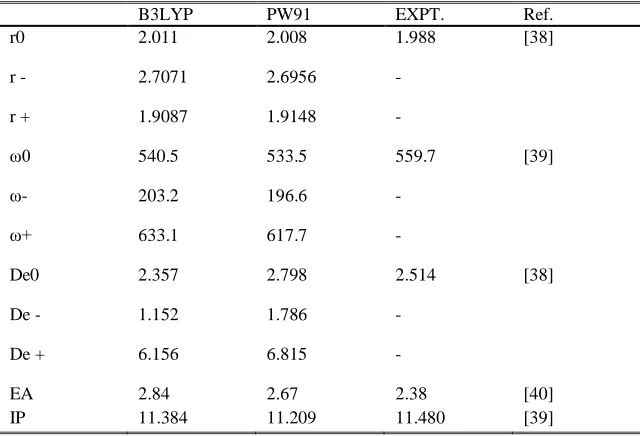
Some parameters of chlorine molecule such as electron affinity (EA), ionization potential (IP), bond length, dissociation energy (De) and vibrational frequency were investigated, we observed that theoretical results by both B3LYP and PW91 with 6 – 311+(3df) basis set are in good agreement with experimental results Ref. [38–40]. To check the accuracy of the computational methods used for this investigation, we have also performed the calculations for Au2 and AuCl, which is of importance to the Au and chlorine interaction. The calculated Au2 bond
length with B3LYP and PW91 is 2.57Ǻ and 2.55Ǻ. These values are in excellent agreement with previous DFT studies with the same functional and basis set (B3LYP/LANL2DZ) by Sankaran et al. for Au2 (2.57Ǻ) [41] and it
also compared favorably with a higher level coupled cluster calculation by Wesendrup, Hunt and Schwerdtfeger Au2 (CCSD 2.517Å, CCSD(T) 2.512Å).[42] Our DFT Au2 bond length is ~0.1Å above the experimental result
2.47Ǻ [49],[52],[38].
For AuCl, the calculated bond length is 2.26 Ǻ (B3LYP) and 2.24 Ǻ (PW91) while the experimental value is 2.23 Ǻ.[43]. We also compared our results with those based on coupled cluster calculation and MP2 method and it shows good agreement. For example Schulz and Hargittai reported AuCl bond length calculated with three different correlated theories: density functional with the B3LYP formalism, MP2 and CCSD(T) as follows: 2.293Ǻ(B3LYP), 2.277Ǻ(MP2), 2.293Ǻ(CCSD(T)) [46] and it is in a good agreement with our results. The AuCl stretching frequency is calculated to be 333.7cm-1 for B3LYP and 344.7cm-1 for PW91, reasonably agreeing with the experimental value
of 382.8cm-1. Hargittai et al. (47) also carried out a B3LYP and MP2 level of calculation for this frequency, and
they obtained 328 cm-1 for B3LYP and 353 cm-1 for MP2.
The dissociation energy for both Au2 and AuCl compares favorably with experiment [45, 44] and previous high
http://www.gjaets.com © Global Journal of Advance Engineering Technology and Sciences
36
Table 1. Bond lengths r, vibrational frequencies ω, dissociation energies De for neutral, anionic, and cationic Cl2 molecule
(designated as 0, –, + respectively). Electron affinities (EA) and ionization potentials (IP) of Cl2 molecule are given in
adiabatic values to compare with the available experimental data. (Units: r in Ǻ, ω in cm-1 and energies in eV)
B3LYP PW91 EXPT. Ref.
r0 2.011 2.008 1.988 [38]
r - 2.7071 2.6956 -
r + 1.9087 1.9148 -
ω0 540.5 533.5 559.7 [39]
ω- 203.2 196.6 -
ω+ 633.1 617.7 -
De0 2.357 2.798 2.514 [38]
De - 1.152 1.786 -
De + 6.156 6.815 -
EA 2.84 2.67 2.38 [40]
IP 11.384 11.209 11.480 [39]
Table 2. Calculated Bond length R, Electron Affinity EA, Dissociation energy De and Frequency ω for Au2 and AuCl.
R(Ǻ) EA(eV) De(eV) ω(cm-1)
B3lyp Pw91 Expt. B3lyp Pw91 Expt. B3lyp Pw91 Expt. B3lyp Pw91 Expt. Au2 2.57 2.54 2.47a 1.94 2.12 2.02e 1.87 2.20 2.29d 162.2 168.9 190.9a AuCl 2.26 2.24 2.23b 2.58 2.94 2.90±13c 333.7 344.7 382.8a Ref: a [49][38],[52 ], b [43 ], c [44], d [45 ],[52], e[50]
GEOMETRIES
We optimized the geometries of (AunCl2)+,-,0 (n=1-6) from as many started geometries including two and three
dimensional structures in order to avoid trapping into local minima. We also performed the calculations with higher spin multiplicities to test the suitability of the spin multiplicity used in the calculation, and we confirmed that the lower spin multiplicities of 1 and 2 gave lower energies.
In all cases, 2D geometries are more stable than the 3D ones. Au atoms remain mostly in the Au plane except for few exceptions where the chlorine molecule departs from the Au plane. The preferred planarity of small gold clusters is attributed to relativistic effects which have been reported by Häkkinen et al. [48] and other previously published work. [35]
CATIONIC CLUSTERS
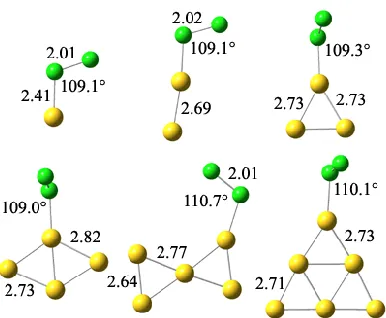
The optimized geometries of cationic Aun clusters using B3LYP and PW91 functionals gave similar geometries as
observed in Fig. 1 and Fig. 2 respectively. Structures of the free Au clusters were not distorted upon chlorine molecule adsorption except some variations of the bond lengths, dihedrals (internal co-ordinates changed). It is interesting that in the optimized geometries there is a bent angle of Au – Cl – Cl which is around 100o – 117o in all
the clusters. The cationic geometric structure of Cl2 on Aun clusters (n = 1 – 6) is very similar to that observed for
NO adsorbed on Aun clusters. [17] This geometry is favorable for overlap between the p* orbital of Cl2 and d + sp
http://www.gjaets.com © Global Journal of Advance Engineering Technology and Sciences
37
Fig.1 Optimized geometries of cationic Aun clusters (n = 1 – 6) using B3LYP functional.
Fig. 2 Represents geometries of cationic Aun clusters (n = 1 – 6) using PW91 functional
NEUTRAL CLUSTERS
Fig. 3 and 4 represents the optimized geometries of neutral Aun clusters (n = 1 – 6) using B3LYP and PW91
functionals. For Au3 and Au5 clusters Cl2 molecule dissociated into atoms instead of adsorbing as a molecule. When
a molecule dissociates, the breaking species form a chemical bond per atom, which leads to stronger binding energy. The rest of the optimized geometries have a bent angle of Au – Cl – Cl which is between 103o – 157o with the
exception of B3LYP Au1 which has similar Au-Cl bond lengths of 2.27Å as Au3 and Au5.
We found two structures of Au4Cl2, with a Y shaped and rhombic gold structure. The latter had a slightly lower
energy. One of the chlorine atoms caps at the side of the rhombus, showing a similar structure as that of the ground state geometry of free Au5 cluster. The Au bond lengths varies between 2.68 and 2.77Å while the expanded
http://www.gjaets.com © Global Journal of Advance Engineering Technology and Sciences
38
Fig. 3 Optimized geometries of neutral Aun clusters (n = 1 – 6) using B3LYP functional.
Fig. 4 Represents geometries of neutral Aun clusters (n = 1 – 6) using PW91 functional
ANIONIC CLUSTERS
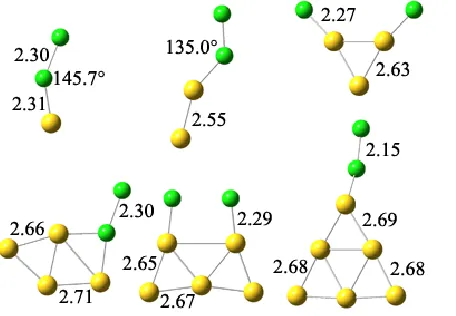
As shown in Fig. 5 and 6, the optimized geometries of anionic Aun clusters (n = 1 – 6) have a bent angle for Au – Cl
– Cl with n = 2 – 5 and a straight Au – Cl – Cl line with n =1. The distance between Au and the nearest Cl (DCl-Au)
atom is between 2.53Å to 2.38Å and the distance between the Cl-Cl (DCl-Cl) is 2.65Å-2.94Å for all clusters with the
exception of Au3 which has a DCl-Cl of 2.42Å.
The anionic clusters have a stronger interaction with Cl2 molecule and Cl-Cl bond length is greater than >2.40 even
though it is a molecular adsorption. The additional electron in the anionic state of the clusters is strongly localized on Cl2 molecule further activating the Cl-Cl bonding and decreasing the stretching frequencies, this alters the bond
http://www.gjaets.com © Global Journal of Advance Engineering Technology and Sciences
39
Fig. 5. Optimized geometries of anionic Aun clusters (n = 1 – 6) using B3LYP functional.
Fig. 6. Optimized geometries of anionic Aun clusters (n = 1 – 6) using PW91 functional.
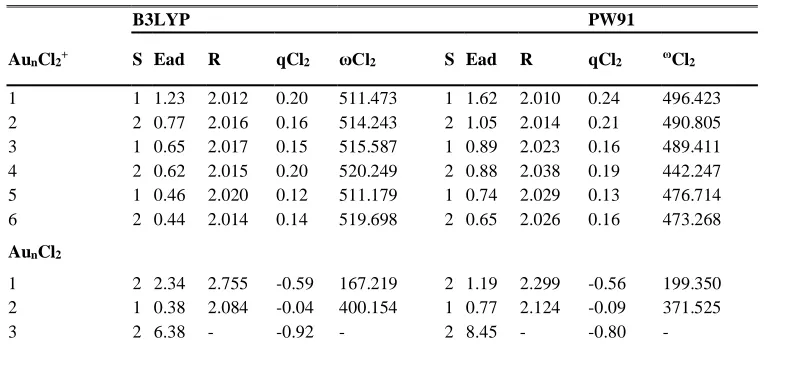
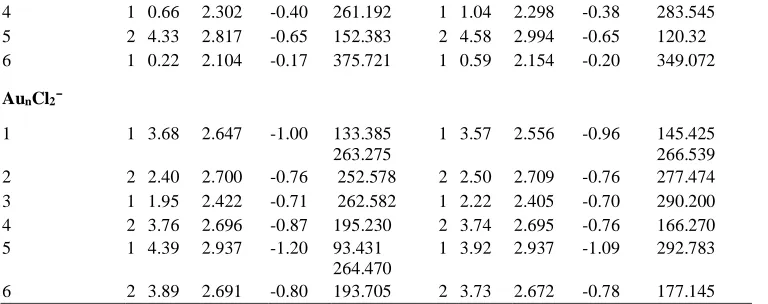
Table 3. The calculated results for Cl2 adsorption on Aun clusters (n = 1 - 6). Spin multiplicity S, Adsorption energy Ead, Cl2
bond length r, NPA charge population on Cl2 molecule qCl2, Vibrational frequency of Cl2, ωCl2 are given. (Units: Ead in eV, r
in Ǻ and ω in cm-1)
B3LYP PW91
AunCl2+ S Ead R qCl2 ωCl2 S Ead R qCl2 ωCl2
1 1 1.23 2.012 0.20 511.473 1 1.62 2.010 0.24 496.423 2 2 0.77 2.016 0.16 514.243 2 1.05 2.014 0.21 490.805 3 1 0.65 2.017 0.15 515.587 1 0.89 2.023 0.16 489.411 4 2 0.62 2.015 0.20 520.249 2 0.88 2.038 0.19 442.247 5 1 0.46 2.020 0.12 511.179 1 0.74 2.029 0.13 476.714 6 2 0.44 2.014 0.14 519.698 2 0.65 2.026 0.16 473.268
AunCl2
1 2 2.34 2.755 -0.59 167.219 2 1.19 2.299 -0.56 199.350 2 1 0.38 2.084 -0.04 400.154 1 0.77 2.124 -0.09 371.525
http://www.gjaets.com © Global Journal of Advance Engineering Technology and Sciences
40
4 1 0.66 2.302 -0.40 261.192 1 1.04 2.298 -0.38 283.545 5 2 4.33 2.817 -0.65 152.383 2 4.58 2.994 -0.65 120.32 6 1 0.22 2.104 -0.17 375.721 1 0.59 2.154 -0.20 349.072
AunCl2
-1 1 3.68 2.647 -1.00 133.385 263.275
1 3.57 2.556 -0.96 145.425 266.539 2 2 2.40 2.700 -0.76 252.578 2 2.50 2.709 -0.76 277.474 3 1 1.95 2.422 -0.71 262.582 1 2.22 2.405 -0.70 290.200 4 2 3.76 2.696 -0.87 195.230 2 3.74 2.695 -0.76 166.270 5 1 4.39 2.937 -1.20 93.431
264.470
1 3.92 2.937 -1.09 292.783
6 2 3.89 2.691 -0.80 193.705 2 3.73 2.672 -0.78 177.145
ADSORPTION ENERGY
The adsorption energies (Ead) of Cl2 molecule adsorption on cationic, anionic and neutral Aun clusters were
calculated based on the optimized geometries and it is defined as the energy difference between the adsorption system with individual cluster and chlorine molecule which is represented as the following equation.
Ead = [EAu Cluster + ECl2] – EAdsorption System
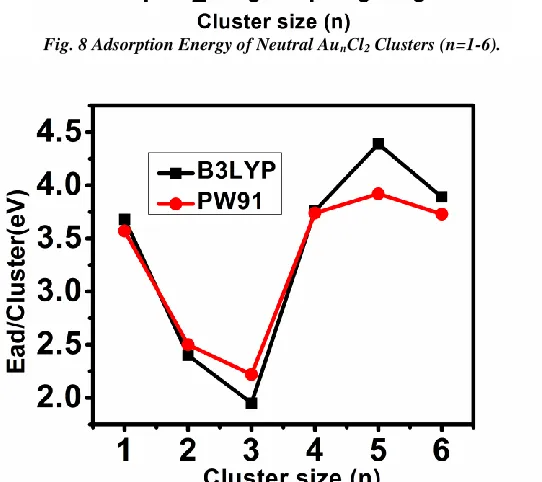
The results are listed on Table 3. Adsorption energy as a function of cluster size for AunCl2+,-,0 was plotted in
Figs.7-9. For each charge state, the result of the calculation using B3LYP and PW91 exchange – correlation functionals are compared. PW91 typically gave a higher adsorption energy value. However the adsorption energies calculated with the two functionals show very similar behaviors as a function of cluster size. This suggests that adsorption trends should have been correctly predicted by both functionals. The adsorption energies of the cationic clusters decreased as the clusters size increased. As the cluster size increased the change in adsorption energy became increasingly smaller for cationic clusters.
For the neutral clusters there is an even and odd oscillation in which the odd numbered cluster favored a dissociative adsorption. The bond length of Au-Cl becomes very small and the interaction between Cl-Cl is greatly reduced as Au-Cl becomes stronger. The adsorption energy of anionic clusters is between 2.4 - 4.4eV with the exception of Au3Cl2- which is 1.95eV for B3LYP and 2.2eV for PW91. We observed that the anionic Au3 cluster has the biggest
electron affinity relative to the other anionic gold clusters as a result the adsorption energy is small.
There is relatively remarkable adsorption for the clusters of different charge states since none of the clusters had adsorption energy less than 0.2eV.
http://www.gjaets.com © Global Journal of Advance Engineering Technology and Sciences
41
Fig. 8 Adsorption Energy of Neutral AunCl2 Clusters (n=1-6).
Fig. 9 Adsorption Energy of Anionic AunCl2 Clusters (n=1-6)
CHARGE TRANSFER AND VIBRATIONAL FREQUENCY
Charge transfer is crucial for enhanced catalytic ability, it is also an essential factor to determine the Cl2 molecule
adsorption behavior on the ionic clusters such as Aun cluster (n=1-6). When the charge transfer occurs, Ρπ*
antibonding orbital of Cl2 will be filled by more electrons so the Cl-Cl bonding will be weakened as a result Cl2
bond length will be elongated and vibrational frequency of Cl2 bond will be decreased, this trend is observed on all
charge states.
Vibrational modes can be divided into three classes, those involving Au and Cl (AuCl2 mode), Cl – Cl stretch (Cl2
mode) and Au modes which gave relatively small frequencies all less than 200cm-1. The highest vibrational
frequency (>500cm-1) corresponds to the Cl
2 mode. When the interaction between Au atoms and Cl molecule is
weak the vibration frequency is higher, and when it is strong the vibration frequency is lower. For the cationic clusters the Cl2 bond lengths are between 2.01-2.02Ǻ and all there vibrational frequencies of Cl2 bond are between
442.2 and 496.4cm–1 for PW91 calculations.
http://www.gjaets.com © Global Journal of Advance Engineering Technology and Sciences
42
appreciably smaller vibrational frequency. The Au3Cl2 Cl-Cl bond length is peculiar because of the dissociative
adsorption that took place and these accounts for the very strange value of the adsorption energy.
For anionic clusters with exception of Au3Cl2-, all the Cl-Cl bond lengths are between 2.6-2.9 Ǻ so their vibrational
frequency is low. The Au3Cl2- also showed a peculiarity, the Cl-Cl bond length is 2.4Ǻ, which gives a subsequently
higher vibrational frequency. It is noteworthy to mention that two asymmetric Cl-Cl vibrational modes were observed for anionic AuCl2 and Au5Cl2.
STRUCTURE AND RELATIVE STABILITY OF NEUTRALAu3Cl2CLUSTER Binding energies of molecular chlorine on Au2, Au3 and Au4 Clusters
The binding energy of nanostructures is very important for its structural and electronic properties. Thus the binding energies of the chlorine molecules to the neutral gold clusters Au2, Au3 and Au4 has been calculated to evaluate the
stability of Au3 cluster. Stable clusters can be identified by a higher stability as compared to its nearest neighbors.
Therefore the binding energies of molecular chlorine on Au2, Au3 and Au4 clusterswere determined by the following
equation below and the results are summarized in Table 4.
BE = E[Aun] + E[Cl2] − 2E[AunCl2]
Here n is equal to 2, 3, 4 whereas E[Au], E[Cl2] and E[AunCl2] represents the total energies of the most stable Aun,
Cl2 and AunCl2 respectively. If Cl2 does not bind to a gold cluster as molecular chlorine, it can still bind as two
separate chlorine atoms, as long as the reactants have sufficient energy to break the Cl–Cl bond. The values of our calculated results have shown that Au3 has a higher binding energy value to chlorine molecule compared to Au2 and
Au4 and the greater the binding energy, the more stable the nucleus. It has also been demonstrated by Li et al that
the binding energy of bare gold clusters increases with an increase in the size of gold clusters [62]. Increasing binding energy means increasing stability due to enhanced core electron configurations. Whereas when molecular chlorine combines with Aun (n=2-4), the binding energy of molecular chlorine on Au2, Au3 and Au4 increases thus:
Au2<Au4<Au3 as can be noted from Table 4.
The Au3Cl2 cluster showed an unusual high stability in spite of having an odd number of electrons. The results
suggest that the Cl2 molecule incorporated into the bare Aun changed the structural stability and it is worth noting
that the binding energy of AuCl is greater than Au2.The bond lengths are 2.57 and 2.23eV for Au-Au and Au-Cl, the
shortening of bonds due to relativistic effects is especially pronounced in the monohalides of gold as observed in Au-Cl. This is due to the pronounced contraction of 6s orbital in the d10 electronic configuration of gold.
The minimum energy structure of Au3Cl2 has two Au-Cl bonds and this would likely have contributed to the
enhanced stability of the structure while Au2Cl2 and Au4Cl2 have one Au-Cl bond each in the geometric structure.
This is because stable isomers as observed in Au3Cl2 tend to equally delocalize valence electrons of the constituent
atoms over the entire structure and maximize the number of Au-Cl bonds in the structure.
Energetics of gas phase gold clusters of Au2, Au3 and Au4
On this basis we first determined the atomization energies of Au2[1.87(B3lyp),2.20(Pw91)] and
Au3[2.75(B3lyp),3.41(Pw91)], by combining values of these results one can easily obtain the enthalpy of reaction
for Au3.
Au3 = Au2 + Au
http://www.gjaets.com © Global Journal of Advance Engineering Technology and Sciences
43
From our results we obtained 1.21eV (PW91) for the enthalpy of reaction (∆Hr º)as compared to the experimental
value of 1.51 ± 0.13eV[61] and the ionization energies of Au3 and Au are 7.26eV and 9.42eV respectively while the
experimental results are 7.27 ± 0.15eV and 9.26 ± 0.1eV[59].
Table 4. Binding energies (BE) of Cl2 on Au2, Au3, Au4 in the neutral clusters Au2Cl2, Au3Cl2, and Au4Cl2, Electron affinities
(EA), Ionization energies (IE) and Atomization energies (AE) of Au2, Au3 and Au4 in (eV).
B3lyp Pw91 B3lyp Pw91 Expt. B3lyp Pw91 Expt. B3lyp Pw91 Expt.
BE AE IE EA
Au2 0.38 0.77 1.87 2.20 2.29±0.02c 9.43 9.59 9.5 ± 0.3e 1.94 2.12 2.02i
Au3 2.49 3.03 2.75 3.41 3.80±0.13d 7.26 7.37 7.27±0.15f 3.68 3.78 3.9a 3.4 - 3.95b
Au4 0.66 1.05 4.66 5.81 - 7.94 8.11 8.6g 2.62 2.86 2.58h
c[54], d[55], e[60] f[59] g[56] h[60] a[57] b[60] i[50]
CONCLUSION
In conclusion using DFT with both GGA and hybrid functional, we have given a systematic theoretical study of chlorine molecule adsorption on gold clusters(AunCl2)+,−,0 (n=1-6). Based on the carefully optimized geometries,
we have calculated the adsorption energies and analyzed the corresponding adsorption possibilities. Charge transfer between Au clusters and chlorine molecule and also the corresponding weakening and elongation of Cl-Cl bond have been observed. The results show that by controlling the size of the clusters one can also control the property of materials to some degree.
In particular Au3Cl2 cluster showed an extraordinary stability amongst the studied clusters which was further
explained based on the structural planarity, binding energy of Cl2 molecule on the clusters and energetics of its
nearest neighbors. Stable isomers as observed in Au3Cl2 tend to equally delocalize valence electrons of the
constituent atoms over the entire structure and it also maximized the number of Au-Cl bonds in the structure.
In particular Au3Cl2 cluster showed an extraordinary stability amongst the studied clusters which was further
explained based on the structural planarity, binding energy of Cl2 molecule on the clusters and energetics of its
nearest neighbours.
Acknowledgment
This work is partially supported by MOST (2011CB921404), NSFC (21121003 and 91021004), and by USTCSCC, SCCAS, and Shanghai Supercomputer Centers.
References
1. M. Valden, X. Lai, D.W. Goodman, Science281, 1647 (1998) 2. W. T. Wallace, R. W. Whetten, J. Am. Chem. Soc. 124, 7499 (2002) 3. H. Häkkinen, U. Landman, J. Am. Chem. Soc. 123, 9704 (2001) 4. M. Haruta, Catal. Today36, 153 (1997)
5. F. Boccuzzi, A. Chiorino, J. Phy. Chem. B, 104, 5414 (2000)
6. A. Sanchez, S. Abbet, U. Heiz, W. D. Schneider, H. Häkkinen, R. N. Barnett, and U. Landman, J. Phys. Chem. A 103, 9573 (1999)
7. H. Over and A.P. Seitsonen, Science 297, 55892003 (2002)
8. M. Haruta, S. Tsubota, T. Kobayashi, H. Kageyama, M. J. Genet, B. Delmon, J. Catal. 144,175 (1993) 9. J. D. Grunwaldt, A. Baiker, J. Phys. Chem. B 103, 1002 (1999)
10. T. T. Magkoev, D. Rosenthal, S. L. M. Schroder, K. Christmann, Tech. Phys. Lett.26, 894 (2000) 11. H. Häkkinen and U. Landman,Phys. Rev. B 62, R2287 (2000)
12. H. Grönbeck and W. Andreoni, Chem. Phys. 262, 1 (2000)
13. S. Gilb, P. Weis, F. Furche, R. Ahlrichs, and M. M. Kappes, J. Chem. Phys. 116, 4094 (2002)
14. A.Nijamudheen and Ayan Datta in Proceedings of the International Conference on NanoScience, Technology and Societal Implications (NSTSI11) Bhubaneswar, India. 2011, pp 1-5
15. D. M. Cox, R. Brickman, K. Greegan, A. Z. Kaldor, Z. Phys. D 19, 353 (1991) 16. W. T. Wallace, R. L. Whetten, J. Phys. Chem. B 104, 10964 (2000)
http://www.gjaets.com © Global Journal of Advance Engineering Technology and Sciences
44
18. X. Ding, J. Yang, J. G. Hou, Q. Zhu, J. Mol. Struct. Theochem 755, 9 (2005)
19. Y. X. Zhao, M. D. Mann, J. H. Pavlish, B. A. F. Mibeck, G. E. Dunham, E. S. Olson, Environ. Sci. Technol. 40, 1603 (2006)
20. D. S. Pinnaduwage, L. Zhou, W. Gao, C. M. Friend, J. Am. Chem. Soc. 129, 1872 (2007) 21. R. Burks, Chem Eng. News 85, 87 (2007)
22. A. S. K. Hashmi, T. M. Frost, J. W. Bats, J. Am. Chem. Soc. 122, 11553 (2000)
23. A. S. K. Hashmi, L. Schwarz, J. H. Choi , T. M. Frost, Angew. Chem. Int. Ed. 39, 2285 (2000) 24. Z. C. Shi, S. J. Wu, J. Lipkowski, J. Electroanal. Chem. 384, 171 (1995)
25. T. A. Baker, C. M. Friend, E. Kaxiras, J. Chem. Phys. 129, 104702. (2008)
26. M. J. Frisch, G. W. Trucks, H. B. Schlegel, et al Gaussian 03, Revision B.04, (Gaussian, Inc., Pittsburgh PA. 2003).
27. J.P. Perdew, J.A. Chevary, S.H. Vosko, K.A. Jackson, M.R. Pederson, D.J. Singh, C. Fiolhais, Phys. Rev. B 46, 6671 (1992)
28. A. D. Becke, J. Chem. Phys. 98, 5648 (1993)
29. P. J. Hay, W.R. Wadt, J. Chem. Phys. 82, 270 (1985) 30. A. P. Scott, L. Radom, J. Phys. Chem. 100, 16502 (1996) 31. S. F. Boys, F. Bernadi, Mol. Phys. 10, 553 (1970)
32. E. D. Glendening, A. E. Reed, J. E. Carpenter, F. Weinhold, in NBO Version 3.1 (Theoretical Chemistry Institute, University of Wisconsin – Madison. 1995)
33. A. E. Reed, L. A. Curtiss, F. Weinhold, Chem. Rev. 88, 899 (1988) 34. A. E. Reed, R. B. Weinstock, F. Weinhold, J. Chem. Phys. 83, 735 (1985) 35. P. Pyykkö, Chem. Rev. 88, 563 (1988)
36. F. Furche, R. Ahlrich, P. Weis, C. Jacob, S. Gilb, T. Bienweiler, and M. Kappes, J. Chem. Phys. 117, 6982 (2002)
37. H. Häkkinen, B. Yoon, U. Landman, X. Li, H.J. Zhai, L.S. Wang, J. Phys. Chem. A 107, 6168 (2003). 38. K. P. Huber, G. Herzberg, in Molecular Spectra and Molecular Structure, Constants of Diatomic
Molecules, (Van Nostrand Reinhold, New York, 1979)
39. D. R. Lide, in CRC Handbook of chemistry and Physics, 86th edn. (CRC Press, Cleveland, OH. 2005)
40. P. S. Drzaic, J. Marks, J. I. Brauman, in In Gas Phase Ion Chemistry, edited by M. T. Bowers, (Academic Press, Orlando, 1984) pp 167.
41. M. Sankaran, B. Viswanathan, Bulletin of the Catalysis Society of India, 5, 26 (2006) 42. R. Wesendrup, T. Hunt, and P. Schwerdtfeger, J. Chem. Phys. 112, 9356 (2000) 43. E. S. Clark, D. H. Templeton, and C. H. MacGillavry, Acta Cryst. 11, 284 (1958)
44. Y.R. Luo, in Comprehensive Handbook of Chemical Bond Energies, (CRC Press, Boca Raton, Florida, 2007) pp 64-69
45. T. L. Cottrell, in The Strengths of Chemical bonds, 2d edn. ( Butterworth, London 1958) 46. A. Schulz, M. Hargittai, Chem. Eur. J. 7, 3657 (2001)
47. M. Hargittai, A. Schulz, B. Réffy, M. Kolonits, J. Am. Chem. Soc. 123,1449 (2001) 48. H. Häkkinen, M. Moseler, U. Landman, Phys. Rev. lett. 89, 033401 (2002)
49. B. Simard, P. A. Hackett, J. Mol. Spectros., 142, 310 (1990)
50. K.J. Taylor, C.L. Pettiette-Hall, O. Cheshnovsky, R.E. Smalley, J. Chem. Phys. 96, 3319 (1992) 51. B. Yoon, H. Häkkinen, and U. Landman, J. Phys. Chem. A 107, 4066 (2003)
52. M. D. Morse, Chem. Rev. Washington, D.C. 86, 1049 (1986) 53. G. A. Bishea and M. D. Morse, J. Chem. Phys., 95, 5646 (1991) 54. K. A. Gingerich, Far. Symp. Chem. SOC. 14, 109 (1980)
55. K. Hilpert and K. A. Gingerich, Ber. Bunsenges. Phys. Chem. 84,739 (1980)
56. a) O. Chesnovsky, C. L. Pettiette, R. E. Smalley, Ion and Cluster Ion Spectroscopy and Structure (Ed.: J. P. Maier), Elsevier, Amsterdam, 1988; b) C. Jackschath, I. Rabin, W. Schulze, Ber. Bunsen-Ges. 96, 1200 (1992)
57. C. W. Bauschlicher, Jr., S. R. Langhoff, and H. Partridge, J. Chem. Phys. 91, 2412 (1989); C. W. Bauschlicher, Ir., Chem. Phys. Lett. 156, 91 (1989).
58. M. A. Cheesman and J. R. Eyler, J. Phys. Chem. 96, 1082 (1992)