* Dr. Amir H. Khoury, Lecturer, Tel Aviv University, Faculty of Law.
11 Amir H. Khoury*
Table of Contents
Introduction . . . 12
Chapter One The Catalyst for This Research . . . 12
1.1 The Debate Surrounding Intellectual Property Régimes . . . 12
1.2 The Gap in Conventional Literature . . . 18
1.3 Arab Countries and the Policy Debate . . . 22
Chapter Two A Model for Measuring Trademark Law in Action: Present and Future Trademark Use . . . 24
2.1 The “Absolute Level” . . . 26
2.2 The “Relative Level” . . . 29
2.3 The “Particular Level” . . . 32
2.4 The Concept of “Trademark Potential” . . . 37
2.4.1 Raw Materials . . . 38
2.4.2 Manufactured Products . . . 39
2.4.3 Services . . . 39
2.5 Assessing the “Trademark Potential” of Arab Countries . . . 41
2.5.1 Franchising . . . 55
2.5.2 Services . . . 58
2.5.3 Super Brands . . . 61
Chapter Three The “M.A.R.T.I.N.A.” Scale . . . 63
3.1 Defining the M.A.R.T.I.N.A. Scale . . . 64
3.1.1 Japan . . . 65
3.1.2 Israel . . . 65
3.1.3 Jordan . . . 66
INTRODUCTION
When the law sets out rules and standards it also sets in motion a complex set of mechanisms that determine how the law is implemented and how it functions. Thus, the “law in books” and the “law in action” are, in more ways than one, distinct creatures, separated at birth, leading separate lives. Trademark law is no exception.
This research introduces, through data analysis, a method for measuring and assessing the effects of trademark law on countries. In constructing this model I have focused on four Arab countries. However, the model itself is applicable to all countries. Indeed, the comparative data that is presented in this research relates to various countries around the world.
CHAPTER ONE
THE CATALYST FOR THIS RESEARCH
The purpose of this research is to introduce a mechanism for measuring the effects of trademark laws by focusing on “the law in action” i.e., how the trademark régime is actually utilized.
I suppose that when first confronted with this topic, one might ponder the question as to why it is of any relevance; and more bluntly, why should the legal community be bothered with this seemingly trivial issue of examining the effects of trademark régimes? These skeptics might pose a question along these lines: would it not be wiser to focus our energy on the actual protection of rights in trademarks and not to attempt to examine the “effects” of trademark laws on a given economy?
This compelling question casts some doubt on the very merits of such an endeavor and might have even rendered it completely redundant, if it were not for the ongoing debate pertaining to intellectual property protection.
Indeed, this research has been prompted by three overlapping factors each of which, I believe, provides sufficient cause for conducting it.
1.1 The Debate Surrounding Intellectual Property Régimes
1. The issue of protecting trademarks has collided repeatedly with concepts of national and international social justice. One unlikely source for such a debate took place during the legislation process of the United States trademark law—the Lanham Act. Initially the U.S. Department of Justice considered the Act as “too strongly favoring big business and allowing for illegal monopolies.” See Carla Oakely, The United States Trademark Century in Review: Prosperity in the U.S. Leaps and Lulls, 1930 to 1959,
available at http://www.inta.org/index.php?option=com_content&task=view&id=1291&Itemid=126& getcontent=1 (last visited May 15, 2006) (noting that eventually the Lanham Act was accepted and was perceived “as a means to protect consumers from deception and essential for business to secure protection in the United States and abroad.”).
questioned their benefits for developing countries. Indeed, doubts about the justification for trademark protection are not new. Even in the United States, today’s leading proponent of trademark protection, the advent of trademarks has not been without controversy.1
On the one hand, proponents of trademark protection contend that trademark protection is beneficial to the economies of developing countries in that it assists domestic producers to reap income that would otherwise be lost to counterfeiters. These proponents also argue that protecting foreign brands will encourage their owners to invest in developing countries and to establish an industrial or commercial presence therein thus opening their respective markets and creating new jobs therein.
Opponents to this approach contend that the above mentioned benefits of trademark protection do not apply in the case of developing countries because these countries are generally consumers rather than owners of trademarks. In addition, opponents contend that foreign investments do not contribute to the economies of developing countries because those investments are primarily “turnkey” projects that do not include a substantial transfer of technology or expertise.
In essence, the above mentioned debate merely constitutes a mini-cosmos of sorts for a much more expansive debate regarding the development of Third World countries. That debate is reflected in two opposing theories; namely, the “Development Theory” and the “Dependency Theory” which cover all spheres of development including economic structure and social values.
2. See KEITH E. MASKUS, INTELLEC TUAL PROPERTY RIGHTS IN THE GLOBAL ECONOMY x (2000); Robert M. Sherwood, Human Creativity for Economic Development: Patents Propel Technology, 33 AKRON L. REV. 351 (2000); Robert J. Gutowski, Comment, The Marriage of Intellectual Property and International Trade in the TRIPS Agreement: Strange Bedfellows or a Match Made in Heaven?, 47 BUFF. L. REV. 713, 715 (1999).
3. See PETER GALLAGHER, GUIDE TO THE WTO AND DEVELOPING COUNTRIES 16 (2000). See also
MASKUS, supra note 2 (contending that the “balance of evidence strongly suggests” that IPRs provide an important foundation for promoting technology transfer, local innovation and economic growth in the long run and further asserting that in Lebanon and China trademark and trade secret infringement was at least as costly to domestic as to foreign firms, who had greater resources to deal with it and more options to withdraw from the market).
4. See Ruth L. Gana, The Myth of Development, the Progress of Rights: Human Rights to Intellectual Property and Development, 18 LAW & POL’Y 315, 326 (1996).
5. See Martin Khor, How the South is Getting a Raw Deal at the WTO, in VIEWS FROM THE SOUTH: THE EFFECTS OF GLOBALIZATION AND THE WTO ON THIRD WORLD COUNTRIES 19, 22-23, 26-27 (Sarah Anderson ed., 2000). See also Walden Bello, Building an Iron Cage: The Bretton Woods Institutions, The WTO and the South, in VIEWS FROM THE SOUTH: THE EFFECTS OF GLOBALIZATION AND THE WTO ON THIRD WORLD COUNTRIES 74-77 (Sarah Anderson ed., 2000).
6. PETER DRAHOS, A PHILOSOPHY OF INTELLEC TUAL PROPERTY 204-05 (1996). See also
CHRISTOPHER MAY, A GLOBAL POLITICAL ECONOMY OF INTELLEC TUAL PROPERTY RIGHTS, THE NEW ENCLOSURE? 155 (2000); Glynn S. Lunney, Trademark Monopolies, 48 EMORY L.J. 367 (1999); MASKUS,
supra note 2 (contending that stronger protection of IPRs, by itself, is not enough to promote growth). 7. Amir H. Khoury, The Effects of Trademark Policy on Development: The Case of Arab international trade and for securing development.2
Similarly, leading international organizations such as WTO, WIPO and INTA contend that standards of trademark protection (as formulated in TRIPS) are equally beneficial to developed countries and to developing countries.3
Further down the scale, other sources regard trademarks, and other forms of intellectual property rights (hereinafter “IPRs”), as non-universal norms not “applicable to non-industrialized societies.”4 Others, at the far end of the
scale, go even further by contending that IPRs are merely an economic tool of Western monopoly.5 Those further contend that modern standards of
intellectual property (hereinafter “IP”) protection are prone to nourish the monopoly that was created by developed countries and to widen the existing economic rift between developed and developing countries, this, due to the unequal distribution of IP across countries. Hence, they advocate for a new IP régime that is more receptive to the needs of developing countries.6
Countries, in INTELLECT UAL PROPERTY, TRADE AND DEVELOPMENT (Daniel Gervais ed., forthcoming Oct. 2007).
8. MASKUS, supra note 2, at 156 (submitting that, on the one hand, “effective trademark enforcement both raises the average quality of products over time and provides a wider range of qualities from which consumers may choose.” However, Maskus cautions that “[w]hile this statement is widely accepted by economists and business scholars and finds extensive anecdotal support, I have found no systematic econometric study of whether it applies in developing countries.”).
9. Zvi. Y. Hershlag, Industrialization in Arab Countries: Patterns, Options and Strategies, in
ARAB INDUSTRIALIZATION AND ECONOMIC INTEGRATION 13 (Robert Alibani ed., Croom Helm Ltd. 1979). Hershlag explains that: “Arab countries present a wide and diversified spectrum, both geographically and economically, apart from political, institutional and special aspects.” It is worth noting that Arab countries are divided into three groups depending on their geographic location, namely; the Arab Peninsula, Levant Countries and North Africa. Except for Yemen, countries located in the Arab Peninsula are also widely referred to as the “Gulf States.” These countries include Saudi Arabia, The United Arab Emirates (U.A.E), Kuwait, Oman, Qatar, Bahrain and they comprise the Gulf Cooperation Council (G.C.C.). The largest, wealthiest and most powerful member of this group is the Kingdom of Saudi Arabia. Hence, it has been selected to represent this group. The second group referred to as the “Levant Countries” includes Lebanon, Jordan, Iraq, Syria and the Palestinian Areas. Of this group, I focused on Jordan and Syria. The last group is comprised of countries located in North Africa. This group of Arab countries includes Egypt, Sudan, Tunisia, Algeria, Libya, and Morocco. Egypt is the most prominent member of this group and has the largest population. I have selected it to represent this group. Some regions of the Arab world are endowed with rich deposits of minerals namely Petroleum. Other Arab countries do not have such resources. Indeed, this distinction is held by some to be the most important one because it separates the “haves” from the “have-nots.” Saudi Arabia for example represents the “haves” and Syria, to a large extent, represents the “have-nots.” Egypt is not only the Arab country with the biggest population but is also among the most influential of Arab countries and the most dominant on the political scene. What is more, during the past three decades, Egypt has been striving to attain better ties with the West through economic openness. Furthermore, Egypt was the first Arab state to sign a formal peace treaty with Israel. Syria, on the other hand, has a relatively closed and underdeveloped economy. Jordan has a relatively small population and a weak but aspiring economy. It has strong ties with the United States and other Western countries and has signed a peace treaty with Israel. Saudi Arabia is the richest Arab country in the oil-rich Arabian Gulf. Much like Egypt, Saudi Arabia traditionally maintained firm connections with the West which have
Clearly, this ongoing debate does not, and cannot, provide a conclusive answer as per the effects of trademark laws on countries. That is because the bulk of existing literature is limited to theoretical arguments and does not provide data in order to substantiate anyone of these conflicting assertions.8
This research intends to fill this gap by introducing a model for measuring the effect of trademarks on developing countries, what is referred to as the “law in action” as opposed to the “law in books.”
experienced considerable strain in the wake of September 11th.
10. HOWARD HANDELMAN, THE CHALLENGE OF THIRD WORLD DEVELOPMENT 12 (1996). 11. Assafa Endeshaw, Intellectual Property Policy for Non-Industrial Countries, in LAW, SOCIAL CHANGE AND DEVELOPMENT SERIES 1996, at 11 (Dartmouth 1996); ZVI YEDHDA HERSCHLAG, THE PHILOSOPHY OF DEVELOPMENT REVISITED (Leiden 1984); FRANK CASS, DEVELOPMENT THEORY: FOUR CRITICAL STUDIES (David Lechmann ed., 1979); Francis G. Snyder, Law and Development in Light of the Dependency Theory, 14 LAW & SOC’Y REV. 723 (1980); Leonard J. Theberge, Law and Economic Development, 9 DENV. J. INT’L L. & POL’Y 231 (1980); BJÖRN HETTNE, DEVELOPMENT THEORY AND THE THREE WORLDS: TOWARDS AN INTER NATION AL POLITICAL ECONOMY OF DEVELO PMENT (1990); DEPENDENCY THEORY: A CRITICAL REASSESSMENT (Dudley Seers ed., 1981); Paulo Almeida, The Political Economy of Intellectual Property Protection: Technological Protectionism and Transfer of Revenue Among Nations, 10 INT’L J. TECH. MGMT. 214 (1995); HANDELMAN, supra note 10, at 14; Warner Baer,
The Economics of Prebisch and ECLA, in LATIN AMERICA: PROBLEMS IN ECONOMIC DEVELOPMENT (C.T. Nisbet ed., 1969).
12. Endeshaw, supra note 11, at 5.
and in order to gain a better understanding, the research also considers other Arab countries.
According to the “Development Theory,” developing countries are advised to “acquire modern cultural values and create modern economic and political institutions” that would act more like the West.10 This theory is
based on the premise that the only way for non-industrialized countries to develop is by imitating developed countries and by adopting the latter’s standards, values and conduct.11
In essence, this theory advocates a mechanical adoption and imitation of norms (including legal norms) undertaken by other countries in their strive towards attaining development and prosperity.
In this context, Development theorists suggest that “ICs have developed because of the existence of specific forms of laws and institutions, while non-ICs failed to do so because they had no such laws and institutions or were ‘traditional.’”12 In the context of trademark protection, the Development
theory would typically suggest that developing countries that adopt modern standards of trademark protection would prompt their economies and industries to become developed.
13. FRIEDRICH LIST, THE NATIONAL SYSTEM OF POLITICAL ECONOMY (Samson S. Lloyd trans., Longmans, Green & Co. 1885) (1841) (demonstrating that “free trade is inimical to domestic industrial development if undertaken with more foreign partners”); 1 KARL MARX, CAPITAL 1019-23 (Samuel Moore & Edward Aveling trans., Foreign Languages Publishing House 1961) (1867). According to Endeshaw, this relationship has reflected negatively on the countries of the “Periphery” in various ways including the exchange process, the freedom of independent economic decision-making and the proliferation of technology. See Endeshaw, supra note 11, at 3.
14. See HANDELMAN, supra note 10, at 21.
15. Id. at 29-30; see also Endeshaw, supra note 11, at 2-15 (expanding on the comparison between modernization and dependency). See also MAURICE H. DOBB, SOME ASPECTS OF ECON OM IC DEVELOPMENT (1951) (noting that the problem of industrialization is, in essence, not of finance, but of economic organization; research submits that economic independence is not attainable unless governments undertake radical economic and social changes which encompass a wide array of issues including national economy, poverty, illiteracy, as well as, imperialistic monopolization).
16. Dependency theorists submit that developing countries cannot develop by merely copying “Western” values and standards because, in this way, they will become dependent on “Western” capital and technology. Therefore, these theorists advocate a proactive approach by developing countries mainly through self-sufficiency and ultimately by competing for international export markets. See also
HANDELMAN, supra note 10, at 226 (discussing the various “Industrial Strategies” undertaken by some third world countries, including ISI-ISI-Import Substituting Industrialization (e.g. in Latin America) and EOI-Export-Oriented Industrialization (e.g. the “Asian Tiger Economies”)).
“condemned to agriculture.” Thus, according to this line of reasoning, the “Periphery” was prevented from attaining industrialization and remained in the capacity of supplier of primary products.13
Dependency theorists further contend that this unbalanced exchange (between “Center” and “Periphery”) is evident in the permanent transfer of value-added products from the “Center” to the “Periphery.” That, in turn, is said to have caused a lack of foreign currency reserves and lack of capital accumulation in countries of the “Periphery.” Thus, a “vicious circle” was created whereby countries of the “Periphery” were largely relegated to the production and export of food and raw materials and forced to trade for industrial imports on unfavorable terms.14 In the context of this research,
dependency theorists would suggest that excessive protection of trademarks as well as other intellectual property rights only serves the industries of developed countries and will hamper the efforts of developing nations to compete in the global marketplace.
Dependency theorists call for severing these ties of dependency. In their view, the “Development” theory cannot justify stringent trademark protection in developing countries because the mere adoption of standards of trademark protection does not automatically entail economic benefits.15 Consequently,
17. See Douglas F. Greer, The Economic Benefits and Costs of Trademarks: Lessons for Developing Countries, 7 WORLD DEV. 683 (1979); Peter O’Brien, Trademarks in Developing Countries, 14 J. MODERN AFR. STUD. 297 (1976); Surendra J. Patel, Editor’s Introduction, 7 WORLD DEV. 649 (1979); Surendra J. Patel, Trademarks and the Third World, 7 WORLD DEV. 653 (1979); Richard T. Rapp & Richard P. Rozek, Benefits and Costs of Intellectual Property Protection in Developing Countries, 5 J. WORLD TRADE 75 (1990).
18. SÁNDOR VIDA, TRADE MARKS IN DEVELOPING COUNTRIES 22 (1981).
19. MASKUS, supra note 2, at 10-11, 87-197 (specifically considering Patent Applications; Trademark Applications; Applications for Registrations of Plant Varieties; Scope of demand for copyrighted Products; Trade in IPR-Sensitive Goods for Selected Countries; Trade in IPR-Sensitive Services and Royalties and License Fees; Inward and Outward Stocks of Foreign Direct Investment; Membership Trends in Key Intellectual Property Conventions; Indications of the Strength of IPRs Laws; Estimated Rates of Software Piracy and Lost Revenues; Simulated Increases in Total Imports by Sector into Developing Countries Resulting from Strengthened Patent Laws; Percentage of Firms Claiming that Strength or Weakness of IPRs has a Strong Effect on the Level of Direct Investment; Estimators of How TRIPS Patent Changes Affect International Flows of Economic Activity for Selected Countries); see also
United Nations Conference on Trade and Development (UNCTAD), The Impact of Trademarks on the Development Process of Developing Countries, U.N. Doc. TD/B/C. 6/AC.3/3, Geneva, Switz. (June 1977). 20. United Nations Conference on Trade and Development (UNCTAD), Systems Including Industrial Property Systems for Improving the National Scientific and Technological Infrastructure of Developing Countries, U.N. Doc. TD/B/C.G/AC.2/4 Geneva, Switz. (1975).
1.2 The Gap in Conventional Literature
Literature pertaining to the effects of trademark laws on developing countries approaches the topic from a legalistic and formalistic angle; namely by highlighting basic moral concepts calling for fair competition and fair dealing in trade and by identifying the amendments and measures that are necessary in order to comply with internationally accepted standards of trademark protection. Thus, the bulk of literature is saturated with formalistic materials pertaining to the perceived benefits of trademark protection without presenting data to that effect.
Contrary to this type of literature, other literature attempts to examine the “law in action” i.e. the actual use of trademarks.17 In this regard, one
commentary contends that before turning to study trademark laws, it is first necessary to clarify “the role played by trademarks in developing countries in trade and in connection with the process of industrialization.”18 That type of
research also considers the relationship between protection for IPRs and economic development.19 Notably, in its research, the United Nations
21. NIKOLAUS THUMM, INTELLEC TUAL PROPERTY RIGHTS: NATIO NAL SYSTEMS AND HARMONIZATION IN EUROPE (2000). This research also includes a survey in the form of a questionnaire that was sent to various biotechnological firms throughout Europe. Id. at 80-94, 137-39.
22. ROBERT L. OSTERGARD, JR., THE DEVELOPMENT DILEMMA: THE POLITICAL ECONOMY OF INTELLEC TUAL PROPERTY RIGHTS IN THE INTER NATION AL SYSTEM 83-95, 102-06, 128 (2003).
23. MASKUS, supra note 2, at 68, 70-77, 80-92, 100.
24. Lee Branstetter, Measuring the Impact of Academic Science on Industrial Innovation: The Case of California’s Research Universities (May 15, 2007), http://www.nber.org/CRIW/papers/branstetter.pdf.
Additional research dealing with the economic effects and implications of intellectual property protection has factored a host of empirical date into a single model, the aggregate of which, provides an indication as to the effects of legal norms. For example, a recent research has investigated the economic effects of patent protection by analyzing data pertaining to a host of factors including: rating innovative technical fields; the ratio of non-resident/resident patent applications in all industries (referred to, by that research, as the “dependency ratio”); number of patent applications; number of patent applications for a country and the ratio of resident and non-resident patent applications for patents.21
Another research that is even more recent examined the link between intellectual property rights and economic growth by analyzing data pertaining to: export market share in technology intensive products (for the years 1970, 1980 and 1990); research and development expenditure as a percentage GNP; non-defense research expenditures as a percent of GNP; corporate profits (1959-1995); merchandise imports and exports; number of drugs introduced in the U.S. (1940-1979); foreign sales of U.S. software (1986-1991); estimates of market share for pirated video cassettes; estimated U.S. trade losses (1993); gross revenues of selected films and net foreign direct investment in China (1980-1994).22
A third research that assesses the economic effects of IP régimes analyses various relevant data pertaining to: patent applications in selected countries; trademark application in selected countries; applications for registrations of plant varieties in selected countries; indications of demand for copyright products in selected countries; trade in IPR-sensitive goods for selected countries; trade in IPR-sensitive services and royalties in license fees; membership trends in key IP conventions; qualitative trends in IP protection in selected countries and estimated rates of software piracy and lost revenue.23
25. For one example of IP related research in Arab countries that focuses primarily on patents rather than trademarks, see KENA’AN AL-AHMAR, THE ROLE OF IP AND INDU STRIAL PROPERTY AND E-COMMERCE IN GROWTH (2000). Al-Ahmar contends that the protection of inventions and creations is a precondition for maintaining inventiveness. Also, the protection of IP and industrial property is a condition for the organization of competition and for a healthy performance of the economy. Furthermore, such protection serves the interests of consumers. In this regard Al-Ahmar focuses on patent protection, incentives to produce, transfer of technology, allowing for the development of similar inventions. Patents and trademarks have different rationales. While patents center on R&D and inventiveness, trademarks operate primarily as a marketing tool. Thus, empirical research that reflects on patent protection cannot be unreservedly applied to trademarks.
26. Research generally associates IP protection with patents. See ROBERT M. SHERWOOD, INTELLEC TUAL PROPERTY AND ECONOMIC DEVELOPMENT 67-82 (1990); see also MICHAEL R. GADBAW & TIMOTHY J. RICHARDS, INTELLEC TUAL PROPERTY RIGHTS, GLOBAL CONSENSUS, GLOBAL CONFLICT? (Boulder, Westview Press 1988); Carlos Alberto Primo Braga, Intellectual Property Rights and the GATT: A View from the South, 22 VAND. J. TRANSNAT’L L. 243 (1989); Friedrich-Karl Beier, The Significance of the Patent System for Technical, Economic and Social Progress, 5 IIC INT’L REV. INDUS. PROP. & COPYRIGHT L. 563 (1980); Siegfried Greif, The Role of Patent Protected Imports in the Transfer of Technology to Developing Countries, 10 IIC INT’L REV. INDUS. PROP. & COPYRIGHT L. 124 (1979); Siegfried Greif, Patents and Economic Growth, 18 IIC INT’L REV. INDUS. PROP. & COPYRIGHT L. 191 (1987); Hans Peter Kunz-Hallstein, The Revision of the International System of Patent Protection in the Interest of Developing Countries, 10 IIC INT’L REV. INDUS. PROP. & COPYRIGHT L. 650 (1979); Barbara Hansen, Economic Aspects of Technology Transfer to Developing Countries, 11 IIC INT’L REV. INDUS. PROP. & COPYRIGHT L. 430-40 (1980); Hanns Ullrich, The Importance of Industrial Property Law and Other Legal Measures in the Promotion of Technological Innovation, 1989 INDUS. PROP. 102.
27. For a detailed survey of this type of literature, see Khoury, supra note 7, at 15; EDWAR EID, BUSINESS AND TRADERS AND COMM ERCIAL INSTITUTIONS 463-65 (1971); SAMIHA AL-KILOOBI, COMME RCIAL LAW 254 (1999); SAMIHA AL-KILOOBI, INDUSTRIAL AND COMM ERCIAL PROPERTY 240 (1968).
Evidently, the bulk of research dealing with the effects of IP protection focuses on patents.25 Far less research has been devoted to other types of IP
including copyrights, trade secrets and trademarks.26 Furthermore, the bulk
of research attempting to tackle the quandary pertaining to the effects of intellectual property régimes does so by presenting theoretical assertions and, in some cases, by providing anecdotal support. Indeed, most literature that supports trademark protection refers to the basic attributes (and functions) of trademarking but refrains from crossing beyond that threshold into the domain in which the rationales of trademarking are not taken for granted but, rather, are scrutinized vis-à-vis empirical data.27
28. MASKUS, supra note 2, at 7. See also Sherwood, infra note 30, at 1 (noting that “the literature is replete with studies of the relation of innovation to economic growth, but the relation between intellectual property protection and innovation in developing countries rests largely on conjecture.”); MASKUS, supra
note 2, at 2 (noting that “[a]lthough patents have been studied in various ways for their role in developed country economies, literature relevant to developing countries is scant.”).
29. MASKUS, supra note 2, at 156.
30. VIDA, supra note 18, at 21. The literature dealing with the effects of trademark protection in developing countries typically focuses on regions other than the Middle East (i.e. the Far East, Latin America, the Indian Sub-Continent and Africa). Also see Endeshaw, supra note 11, at 12; Robert M. Sherwood, Intellectual Property Systems and Investment Stimulation: The Rating of Systems in Eighteen Developing Countries, 37 IDEA 261 (1997).
31. W.R. CORNISH & JENNIFER PHILLIPS, THE ECONOMIC FUNCTIONS OF TRADE MARKS: AN ANAL YSIS WITH SPECIAL REFERENCE TO DEVELOPING COUNTRIES 41 (IIC 01/1982). See also ECO NO MIC COU NC IL OF CANADA, REPORT ON INTELLECTUAL AND INDU STRIAL PROPERTY 181-219 (1971); O’Brien,
supra note 17, at 297-309; Guido Di Tella, The Manipulation of Demand: The Problem of Trade Marks, 1 WORLD DEV. 35-42 (1971); Mayer Gabay, The Role of Trademarks and Development in Developing Countries, 20 INDUS. PROP. 102 (1981); United Nations Conference on Trade and Development (UNCTAD), Geneva, Switz., The Impact of Trademarks on the Development Process of Developing Countries U.N. Doc. TD/B/C. 6/AC.3/3 (June 1977).
32. Fattoh Abed El-Galil Hamed, Working Paper on IP and the Expected Changes in Light of GATT
3-5, The Egyptian Academy of Scientific and Technological Research. As such, that commentary does not accept the TRIPS face value but rather recommends following a balanced approach; by identifying the virtues as well as the pitfalls of that agreement. Thus, this approach attempts to boost national research and technology while not taking too radical an approach that may hamper foreign investments.
analyze their subtleties and test them with empirical evidence.”28
In this regard, one research has observed that there is no systematic econometric study of whether that anecdotal support applies in developing countries.29
Another commentary observed that literature “did not have in mind the detailed interests of developing countries,” and did not analyze the particular problems of these countries, nor reflect on their specific problems with respect to trademark legislation.30 In this regard, that commentary observes that
trademarks “play a variety of roles, which differ from industry to industry and which may produce different balances of advantages and disadvantages.”31
Consequently, some commentators recommend conducting a thorough review of the TRIPS’ provisions in order to achieve a balance between IPRs and the national interests of developing countries.32
33. TRIPS came into effect on January 1, 1995. See generally Marshall A. Leaffer, The New World of Intellectual Property Law, 2 MARQ. INTELL. PROP. L. REV. 1 (1998). For a concise summary of TRIPS, see Main Provisions of the TRIPS Agreement, available at http://www.southcentre.org/publications/trips/ toc.htm (last visited May 15, 2007); see also DANIEL GERV AIS, THE TRIPS AGREEMENT: DRAFTING HISTORY AND ANAL YSIS (Sweet & Maxwell 1998).
34. MASKUS, supra note 2, at 15-26.
35. GALLAGHER, supra note 3, at 53, 181. The deadline for implementation of TRIPS into national law depends on how that country is classified; namely: “Developed Countries” (until 1995); “Developing Countries” (until January 2000); “Least-Developed Countries” (until 2006).
36. TRIPS allows for settling IP related disputes between member states by applying the WTO
1.3 Arab Countries and the Policy Debate
In order to extenuate the research question, it is imperative to shed some light on the trademark laws in the four Arab countries that constitute the subjects of the case study in this research and to examine the compatibility of these laws with international standards of trademark protection.
In view of their ever-increasing economic value, trademarks, much like other types of intellectual property rights (IPRs), received protection within a wide array of international as well as regional agreements and national laws. The Paris Convention for the Protection of Industrial Property in 1883 was the first multilateral international agreement intended to protect industrial property including trademarks. Since then, other agreements and treaties have been introduced culminating in the Agreement on Trade Related-Aspects of Intellectual Property Rights (TRIPS).33
TRIPS regulates various issues relating to IPRs including availability; scope; use; enforcement and multilateral dispute settlement procedures. TRIPS requires member states to establish a minimum level of intellectual property protection in their respective national law. With respect to trademarks, TRIPS sets various standards, including: recognition of service marks; setting a minimum (renewable) term of protection; defining use requirements; enhancing the role of customs in enforcement and recognizing well-known marks even if not registered in the specific jurisdiction.34 In
addition, TRIPS allows for canceling the registration of a mark due to non-use (subject to exceptions); confirming the right to use a mark without conditions; and regulating issues of licensing and assignment.
The TRIPS obligations, undertaken by members of the WTO, are rigorously implemented.35 TRIPS sanctioned the lack of IP protection by
“Dispute Settlement Mechanism.” This mechanism also covers disputes pertaining to “National Treatment” and “Most Favored Nation” status. Other issues such as Gray Market (parallel imports) have been excluded from TRIPS and the dispute settlement mechanism. See GALLAGHER, supra note 3, at 182.
37. MAY, supra note 6, at 76; DAVID W. PLANT, RESO LVIN G INTERN ATIONAL INTELLECTUAL PROPERTY DISPUTES (International Chamber of Commerce Publishing 1999). Notwithstanding these uniform standards, TRIPS allows its members to exercise some independence, including: the right to limit the scope of rights within certain bounds, the right to grant compulsory licenses under certain conditions, and to take measures to prevent abusive anti-competitive practices. GALLAGHER, supra note 3, at 181.
38. WORLD INTELLECTUAL PROPERTY ORGANIZATION, INTRODUCTION TO INTELLECTUAL PROPERTY: THEORY AND PRACTICE 475 (Kluwer Law International 1997); see also INTER NATION AL TRADEMARK ASSOCIATION (INTA), TRIPS 2000 SUBCOMMITTEE TREATY ANALYSIS COMMITTEE, DEVELOPING COUNTRIES COMPLIANCE WITH THE TRIPS AGREEMENT, available at http://www.inta.org/downloads/tap_ trips2000.pdf (last visited May 15, 2007).
39. JOHN H. JACKSON ET AL., LEGAL PROBLEMS OF INTER NATION AL ECONOMIC RELATIONS 291, 885-92 (3d ed. 1995).
40. The Ministerial Declaration on the Uruguay Round, stated that
in order to reduce the distortions and impediments to international trade, and taking into account the need to promote effective and adequate protection of intellectual property rights and to ensure that measures and procedures to enforce intellectual property rights do not themselves become barriers to legitimate trade, the negotiations shall aim to clarify GATT provisions and elaborate on appropriate new rules and disciplines.
http://www.sice.oas.org/trade/Punta_e.asp (last visited Aug. 3, 2007); SHERWOOD, supra note 26, at 67-92;
see also Endeshaw, supra note 11, at 121; MAY, supra note 6, at 78.
41. For more details and expansive research on this matter, see Amir H. Khoury, The Development of Modern Trademark Legislation and Protection in Arab Countries of the Middle East, 3 J.L. & TECH. 233 (2003), and Amir H. Khoury, Trademark Policy: The Case of Arab Countries, in INTELLECTUAL PROPERTY, TRADE AND DEVELOPMENT (Daniel Gervais ed., forthcoming Oct. 2007).
of IP protection because of its substantive rules, its ability to harmonize the legal régimes and its ability to ensure the adoption and continued enforcement of these norms.37 Consequently, it is not surprising that TRIPS is widely
regarded as the most central agreement in the context of IP protection.38
Significantly, the legal norms pertaining to intellectual property rights have ceased to be shaped in accordance with national norms and interests, and have become intertwined in the wider context of international trade.39 In fact, by
including the IP régime of TRIPS within the WTO, the lack of protection for IPRs is now viewed as an impediment to trade, much like dumping and subsidies.40
Today, the overwhelming majority of Arab countries are members to all of the main treaties, agreements and conventions pertaining to intellectual property protection, and primarily the Paris Convention (16 Arab countries) and the TRIPS agreement (1994) (11 Arab countries). Furthermore, as my previous expansive research indicates, all of these countries have enacted new intellectual property laws.41 Indeed, Arab countries have actively and
42. Jordan, Egypt and Lebanon have already undertaken such commitments of comprehensively amending their IP laws. Moreover, substantial legal literature within Arab countries advocates the adoption of modern standards of IP protection, including trademarks, as a pre-condition for transforming these countries into modern economies. See A’AMER AL-KSIWAN I, INTELLEC TUAL PROPERTY 12, 58 (1998); SAYED HASSAN AMIN, INTELLEC TUAL PROPERTY AND INDUSTRIAL PROPERTY IN THE MIDDLE EAST (1992). 43. The data pertaining to trademark registration originates in a variety of sources including: World
intellectual property protection as prescribed by various international agreements and mainly TRIPS and have been expending efforts with respect to trademark protection and enforcement.42 In so doing, Arab countries appear
to have adopted the approach advocated by Development theorists; specifically, that trademark protection will yield positive effects. Thus, the underlying assumption of my research is that Arab countries are operating within a clear, effective and modern trademark régime.
Considering the three above mentioned factors, the question persists: How, if at all, would it be possible to measure the effects of trademark régimes in countries and to assess the “law in action” therein.
CHAPTER TW O
AMODEL FOR MEASURING TRADEMARK LAW IN ACTION:
PRESENT AND FUTURE TRADEMARK USE
Thus far, we have alluded to the fact that, in literature, there are conflicting views regarding the ramifications of trademark régimes. On the one hand stands the assertion that trademarks are essential for creating a viable market and for stimulating and attaining economic growth. On the other hand is the contention that in developing countries, the trademark system merely benefits foreign brand owners. “In attempting to provide some objective mechanism for measuring the effects of trademark régimes, I propose a model containing two levels namely; the ‘trademark balance’ and the ‘trademark potential.’” The “Trademark Balance” comprises three elements, namely the:
a. “Absolute” number of registrations and/or applications in a given country;
b.. “Relative” trademark registration by residents and non-residents; c. “Particular” countries that dominate trademark registration in a given
country.
Intellectual Property Organization (WIPO); the United Nations Conference on Trade and Development (UNCTAD); the International Trademark Association (INTA); the World Trade Organization (WTO); the U.S. Trade Representative (USTR); and Arab Government agencies. See, e.g., The Office of the United States Trade Representative (USTR), 2001 Trade Policy Agenda and 2000 Annual Report, available at
http://www.ustr.gov/Document_Library/Reports_Publications/2001/2001 _Trade_Policy_ Agenda/Section_ Index.html (last visited May 15, 2007) (indicating that the Far East and the Middle East remain hotspots for counterfeit toiletries, foods as well as luxury goods).
44. The only exception being well-known marks that are protected (in a limited manner) despite not being registered in the jurisdiction.
The data pertaining to trademark registration has important economic significance because trademark law accords protection to trademarks based on their registration. Marks that are not registered generally do not benefit from the trademark régime.44 Consequently, data pertaining to trademark
registration in a specific jurisdiction and the identity of their owners is indicative of the brands that are being used and protected by law in the relevant jurisdiction. In addition, the absolute number of trademark registrations is indicative of the number of products and services that are on sale in the market. This in turn reflects the economic vitality of that market. The “Trademark Potential” of a country is based on its trade structure. This is determined by considering empirical data pertaining to imports and exports as well as the type of production that dominates Arab economies. This data helps to predict the degree of future trademark use in Arab countries, i.e. their “Trademark Potential.”
In essence, the “Trademark Potential” is the aggregate between the types of products and services that are produced in a certain country, and the ability to sell these products and services under trademarks and service marks. For example, if a country produces raw materials that are shipped in bulk before processing, then it is possible to conclude that the country has a very low trademark potential.
In this regard, special attention is accorded to the franchising and service sectors because they both involve substantial use of marks. In addition, some emphasis is placed on the relationship between Arab corporations and leading brands. Furthermore, special attention is devoted to the petroleum industry because of its dominant share in the GDP and exports of Arab countries.
45. For the first period, see World Intellectual Property Organization, Intellectual Property Statistics, WIPO, Geneva, 1984. For the period 1984-2000, see WIPO, http://www.wipo.int (last visited May 28, 2006). The data provided by WIPO is presented on a country by country basis. The tables that I have constructed in this chapter are a compilation of data. Some countries have not always provided WIPO with data. In those cases the slot has been marked with “n/a” (not available).
2.1 The “Absolute Level”
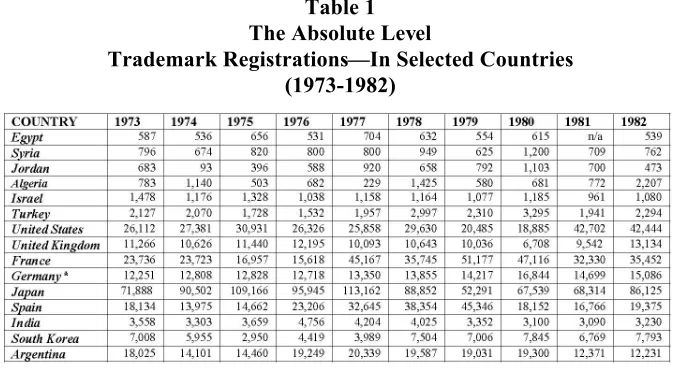
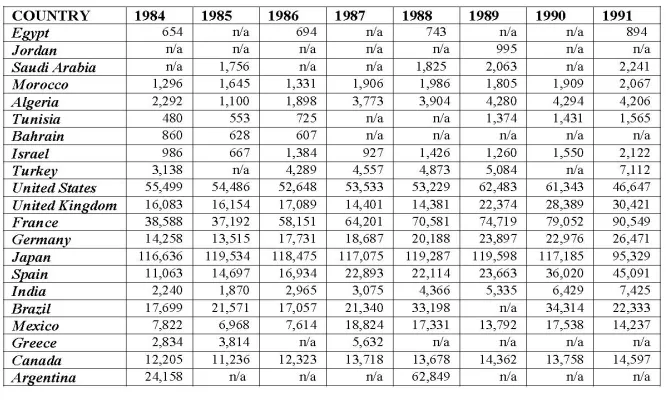
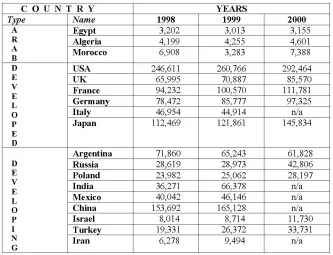
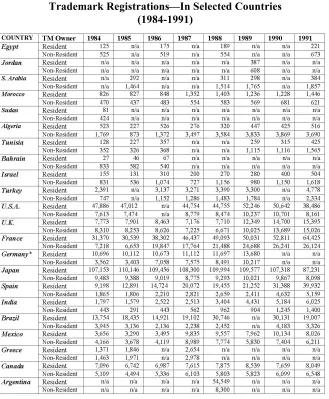
The “Absolute” level considers the overall volume of trademark “traffic” in a given country in terms of the number of trademark registrations therein. In order to provide some comparative insight with respect to the number of trademark registrations, the data pertaining to Arab countries is contrasted with those of other countries around the world. The next three tables depict the scope of trademark registration in various countries for the period (1973-2000). Each of these tables focuses on a different segment of that period, namely; 1973-1982, 1984-1991 and 1992-2000.45
Table 1 The Absolute Level
Trademark Registrations—In Selected Countries (1973-1982)
Table 2 The Absolute Level
Trademark Registrations—In Selected Countries (1984-1991)*
*No data is provided by WIPO for the year 1983.
Table 3 The Absolute Level
46. In tables 1, 2 and 3, “Developed Countries” include the U.S.; U.K.; France; Germany; Japan; Spain; and Canada. “Developing countries” include Arab countries; Israel; Turkey; India; South Korea; Brazil; Mexico; Greece and Argentina.
47. Based on statistics by WIPO. See www.wipo.int (last visited June 14, 2006).
As is evidenced by the three tables above, the numbers of trademark registrations in developed countries exceeds, by far, trademark registrations in Arab countries and other developing countries.46 While in developed
countries tens of thousands of trademarks are registered each year, in Arab countries and other developing countries, only a few thousand trademarks are registered annually. This gap between developed and developing countries has been expanding. Suffice it to consider the number of trademark applications for the year 1998-2000 as detailed in the next table.
Table 4 The Absolute Level
Trademark Applications—In Selected Countries (1998-2000)47
48. See WIPO, Intellectual Property Statistics, WIPO, Geneva, see www.wipo.int (data on file with author) (last visited June 4, 2006). The term “Non-Residents” includes any legal entity that owns a trademark registration in the country but is not domiciled/based in that country. Thus, for example a Saudi company that owns a trademark registration in Jordan, would be considered a “Non-Resident” registrant in Jordan.
Marks that are not registered are not factored into these tables, because these marks (except for well-known marks) are not protected by trademark law and therefore, by definition, do not benefit from the existing trademark régime.
2.2 The “Relative Level”
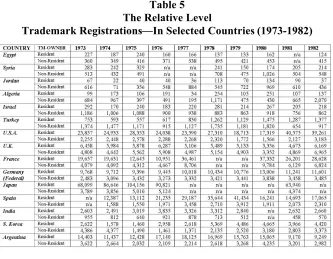
The “Relative” level reveals the allocation of trademark registrations between local and foreign entities thus indicating the share of foreign trademark activity in a given country. Where foreign trademark owners own most of the trademarks that are registered in a given country, it is possible to argue that the trademark régime is used by foreigners. The next three tables detail “Relative” trademark registration in selected countries for the period 1973-2000. This is done by examining the ownership of trademark registrations by “Residents” and “Non-Residents.”48
Table 5 The Relative Level
Table 6 The Relative Level
Trademark Registrations—In Selected Countries (1984-1991)
Table 7 The Relative Level
Trademark Registrations—In Selected Countries (1992-2000)
*Federal Republic of Germany
49. UNCTAD, The Role of the Patent System in the Transfer of Technology to Developing Countries, United Nations Publication, No. E. 75 II. D. 6, at 15 (June 1977). According to that report, the term “Developing Countries” refers to regions: Africa, Asia and Latin America. Arab countries may be included in either Africa or Asia. Also see WIPO, Industrial Property Statistics for 1974 (IP/STAT/ 1974/3), Geneva, Dec. 1976. UNCTAD, id. at 15-16. The UNCTAD report points to western countries in which there was a high share of foreigners that have registered trademarks therein: e.g. Norway (84%); Finland (81%); Australia (59%); Greece (53%); and Benelux countries (44%). But these foreign-owned marks originate in developed countries. Interestingly, the report indicated that in 1972, foreigners owned 84% of all patents granted in developing countries.
were registered in the Kingdom of Saudi Arabia, but only 298 of those marks were registered by residents of that country. Similarly, in the year 2000, 2,536 marks were registered in Jordan but only on third of those (876) were registered by residents of Jordan. In contrast, during 1998 Japan’s trademark office registered 126,656 marks and only 17,620 of those were owned by non-residents of Japan. The rest of those registered marks (a staggering 106,036) were owned by residents of Japan.
It should be noted that similar trends have been observed during the late 1970s. According to a 1977 report by UNCTAD, the share of foreign-owned trademarks registered in different world regions for the years 1964 and 1974 was much higher in developing regions than in developed regions. Specifically, Africa was the continent with the highest share of foreign owned trademarks registered therein (88% of all trademarks registered in Africa). Asia, followed suit with 65% and Latin America had 34%. Significantly, the UNCTAD report indicates that in developing countries, as a whole, the share of non-residents in trademark registrations had risen significantly from 27% in 1964 to about 50% in 1974. In contrast, developed market economies had the lowest share of foreign owned trademark registrations.49
From all of this, it is possible to conclude that the pattern of trademark registration in both developed and developing countries has remained constant despite the introduction of modern trademark laws that are TRIPS compliant.
2.3 The “Particular Level”
50. Id. at 15. 51. Id. at 15-16.
This issue is of great significance because, if residents of Arab countries own “foreign” trademarks, registered in an Arab country, then it cannot be argued that Arab countries are not making use of the trademark system. On the other hand, if it is determined that foreign marks registered in Arab countries are owned by residents of developed countries, then, it would be possible to conclude that the trademark régime in Arab countries is primarily intended to protect brands originating in developed countries.
As early as 1979, a report by UNCTAD indicated that trademarks in developing countries are largely owned by nationals of developed (industrialized) countries. According to that report, trademarks were “increasingly being registered by foreigners, most of them located in developed countries.”50
The report concluded that 97% of all trademarks registered by foreigners had originated in developed market-economy countries, whereas nationals of developing countries owned only 2.2% of all foreign trademarks worldwide. Furthermore, the report concluded that 96.9% of all marks registered by foreign entities in developed countries as well as developing countries originated in developed countries.
Specifically, in 1974, 34% of all foreign registered trademarks in developing countries were owned by U.S. corporations. Furthermore, according to that report, the other four leading industrial countries (Japan, U.K., France and Federal Republic of Germany) collectively accounted for 43% of trademark registrations in developing countries. Indeed, only about 2,000 trademarks, originating in developing countries, were registered outside of their home countries in 1974. In addition, in that year, the flow of marks from developing countries to developed countries constituted only 1.1 of all foreign marks registered in developed countries.51 The same report also
provides some indication as to the nature of foreign trademarking activity of different countries. The report states that in 1974, 43.8% of all marks originating in developed countries were registered in developing countries. In contrast, 72% of marks originating in developing countries were registered in developing countries. Thus, only 28% of marks originating in developing countries are registered in developed countries. In other words, marks originating in developing countries are primarily used in other developing countries.
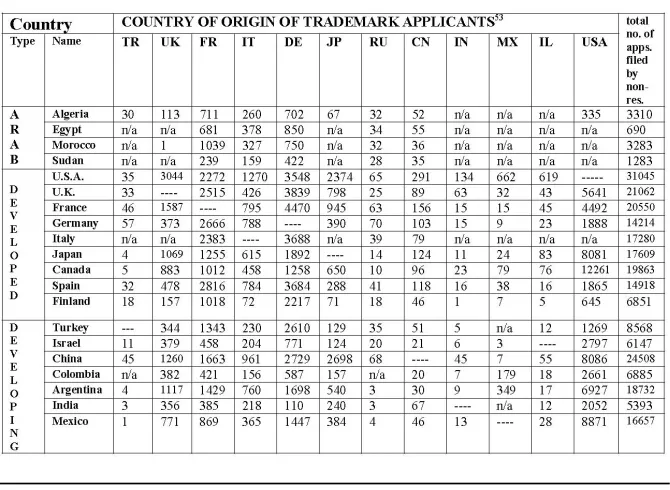
52. The information depicted in this table is based on: The World Intellectual Property Organization (WIPO), Applications for Registration Filed by Non-Residents in 1999, WIPO, IP/STAT/1999/B marks, www.wipo.int (last visited Aug. 29, 2006).
53. Initials of “Countries of Origin”: TR=Turkey, UK=United Kingdom, FR=France, IT=Italy, DE=Germany, JP=Japan, RU=Russia, CN=China, IN=India, MX=Mexico, IL=Israel, USA=United States of America.
spread out among all regions of the world. On the other hand, developing countries typically have a larger portion of trademark registrations by non-residents and their non-residents are inclined to limit their external trademarking activity to other developing countries and not to venture into developed countries. Thus, while brand owners in developed countries are heavily involved in trademarking activity within developing countries, the opposite is not true. This indicates that brand owners from developing countries do not (proportionally) venture into developing markets in order to sell their branded goods/services. Significantly, the findings in that research which was conducted in the late 1970s have remained constant through the end of 1999. The next table depicts the national origin of “non-resident” trademarks in selected countries around the world for the year 1999.52
Table 8
54. The table is a compilation of data provided by the Jordanian Ministry of Industry and Trade. See http://www.mit.gov.jo/mit/owa/k_sts2e (last visited Apr. 16, 2006). The information regarding
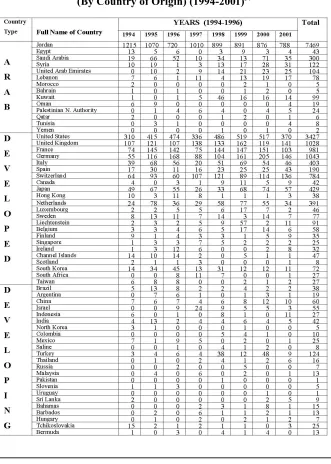
Table 9
trademark registrations in Jordan is provided in the form of annual figures. The countries depicted in the table are categorized into three country groups namely: “Arab,” “Developed” and “Developing.”
55. Developing countries account for only a small portion of trademark registrations in Jordan. Similarly, most Arab countries account for a negligible amount of trademark registrations. Trademarks originating in Saudi Arabia, Syria, Kuwait and the U.A.E, have a notable share in trademark registration in Jordan but remain well below the number of trademark registrations originating in developed countries. 56. LEE E. PRESTON, TRADE PATTERNS IN THE MIDDLE EAST 7 (American Enterprise Institute for Public Policy Research 1970) (suggesting such a tri-sector distinction).
The table above reveals that most of the foreign trademarks that are registered in Jordan originate in developed countries, namely the United States, The United Kingdom, France, Switzerland, Germany, Italy, The Netherlands and Japan.55 Significantly, throughout the surveyed period, the number of
trademark registrations originating in developed countries has been gradually increasing while the number of registrations by Jordanians, in Jordan, has been decreasing, this despite Jordan’s amendment of its trademark law in accordance with TRIPS. Furthermore, on the relative level, the number of Jordanian marks registered locally does not exceed the total number of foreign marks registered in Jordan.
2.4 The Concept of “Trademark Potential”
In the first three sections of this chapter, I have examined the scope of trademark registration in Arab countries with respect to three elements, specifically: “Absolute,” “Relative” and “Particular.” In this section, I examine the extent to which Arab economies can use trademarks in the future. I refer to this as the “Trademark Potential” of Arab countries.
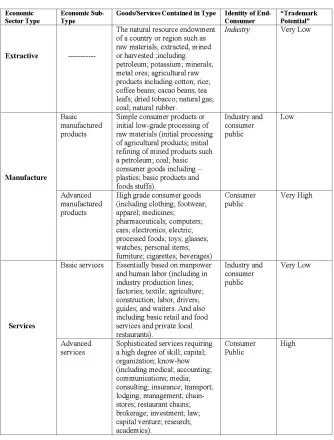
This concept of “Trademark Potential” submits that the ability to use trademarks in any country is inherently connected with the economic and commercial structure of that country. In this regard, a given country or region might participate in world trade within any of three sectors or a combination thereof, namely raw materials, manufactured products and services. Each of these has a different “Trademark Potential.”56 Therefore, when assessing the
57. VIDA, supra note 18, at 24, referring to the Pearson Report that classifies primary and raw materials into four subgroups. These primary products include industrial raw materials including rubber; cotton and hard fibers. Also, included are mining products such as minerals; metals; phosphates; gas; oil and ores (copper, zinc, and lead).
58. These products, much like other primary goods, are shipped under their generic “identity” as simply “coffee,” “tea,” “cocoa,” and “tobacco.” It is only after undergoing processing and packaging that they assume their new “branded” identity. It is worth noting that some developing countries have managed to acquire distinct brands of their own, but in most of these rare cases the brand is only identified by bulk purchasers and does not appear on the final product. It is only at the end of the manufacturing process that these crude/raw materials are transformed into a product that is identifiable by the end-consumer. Furthermore, agricultural produce such as sugar, rice, cereals and meat are also exported in bulk and not under trademarks. More, surprisingly, fats, oils and dairy products (e.g. cheeses) are generally exported from developing countries without trademarks. This, despite their suitability for direct retail trade and their relatively high trademark potential. Indeed, in developed countries cheeses, oils, and dairy products are marketed and sold fewer than hundreds of different trademarks. See VIDA, supra note 18, at 32, also points out that some exceptional cases have involved goods trademarked by the country of export including SAMBA for edible oil from Brazil, MILAK (with woman head device) for peanuts and cashew nuts from India, MA-LING for peanuts from the Peoples Republic of China.
2.4.1 Raw Materials
This trade sector involves raw materials that are extracted, mined or harvested from nature. Typically, this includes petroleum, natural gas, phosphates, minerals, wheat, corn, cotton, cacao beans, coffee beans, tea leafs, sugar canes and tobacco leaves. These “extractive” and “agricultural” commodities undergo processing that transforms them into products that are in demand by end-consumers including fuel, gas for cooking/heating, minerals, cereals, chocolate, coffee, tea, sugar, and tobacco.57
59. Significantly, even in cases involving products with a high trademark potential such as textiles there are very few brands that originate in developing countries. This is because clothes are manufactured in developing countries, then shipped to markets worldwide while bearing trademarks owned by Western corporations. European companies like Marks&Spencer and C&A as well as leading footwear manufactures such as Nike, Puma, and Adidas are but a few that operate in such a manner. See VIDA,
supra note 18, at 33. Notwithstanding, some developing countries have been selling various products including textile products under domestically owned trademarks. These countries include The People’s Republic of China, India, Iran, Hong Kong, Taiwan and Israel. See VIDA, supra note 18, at 34, notes some examples of these brands including: DIAMOND (with a brilliant diamond figure); RED HORSE (with the design of two red horses); SOAR (with eagle design); MIMI (with cat design). All of these marks are used to sell clothing items. However, these cases remain the exception to the rule.
2.4.2 Manufactured Products
This category covers a wide array of manufactured products directed towards the end consumer ranging from the very basic or mundane industry (“Basic Manufactured Products”) to the very complex and high-tech products (“Advanced Manufactured Products”). While “Basic Manufactured Products” such as thread and plastics have a low “trademark potential,” “Advanced Manufactured Products” have a very high “trademark potential” because virtually all of these products bear some kind of distinctive marking, rendering them the most “fertile” in terms of trademark use and registration.59
2.4.3 Services
Table 10
Summary of the “Trademark Potential” of Economic Sector Types
60. Collaborates in Development: Report of the Commission on International Development (C.B. Pearson ed., Praeger, 1969) concluding that 60% of developing countries earned 60% of the respective export receipts from three primary products. See also VIDA, supra note 18, at 24.
61. BEVER LY M. CARL, TRADE AND THE DEVELOPING WORLD IN THE 21ST CENTURY 19 (Transnational Publisher, Inc., Ardsley, New York 1998). Carl also notes that “technological developments have further reduced the demand for primary products of developing countries; for example, synthetic materials replacing cotton and wool. Industrial primary materials are exported (upon extraction) in large quantities, to industrialized countries (primarily the U.S., Western Europe and Japan) where they are subsequently processed (and refined) then sold under various trademarks to consumers worldwide including the same exporting countries. For example, crude oil extracted from the Middle East and other developing regions is subsequently refined then sold back to those developing countries under foreign (non-Arab) trademarks such as EXXON, SHELL, CHEVRON, and MOBIL. Even when the refining process takes place in the same country of extraction, foreign companies manage the process, and the end product is sold under foreign marks. See also VIDA, supra note 18, at 32.
62. This in order to establish a link between specific trading partners and specific goods, PRESTON,
supra note 56, at 15.
63. Id. at 42. Preston notes that in 1964 the respective National product of Egypt, Jordan and Syria was (in millions of U.S. dollars) 4,120, 375 and 941 respectively. What is more, the Per-capita income for the same period was 151, 194 and 172 U.S. dollars respectively. Agricultural exports constituted 26%, 24.9% and 36.9% of total exports from those countries.
products.60
Furthermore, at that time, 50% of all developing countries based their entire export activity on a single primary commodity. This situation has remained largely unchanged because according to another research that was conducted three decades later, 80% of developing countries received 70% of their export earnings from raw materials such as minerals and unprocessed agricultural products.61
2.5 Assessing the “Trademark Potential” of Arab Countries
As alluded to above, there is a clear link between the “trademark potential” of a country and the commodities, products and services that comprise its economy. This section examines the “Trademark Potential” of Arab countries for a period covering three decades (1970-2000). This is done by taking into account commodities and services that are exported and/or imported by Arab countries, as well as by considering Arab countries’ major trading partners.62
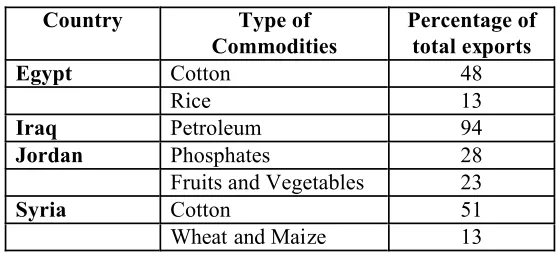
In 1964, Arab countries’ exports were highly concentrated in a handful of commodities. During the 1960s, all non-oil-producing Arab countries have achieved a similar per-capita income, wherein agriculture commanded a substantial share in economic activity.63 Evidently, as early as 1964, and as
64. Id. at 43 (referring to Yacoub Mokhlis Zaki, The Impact of Arab Economic Integration on the Egyptian Economy (March 1969) (Unpublished Doctoral Dissertation), University of California, Berkeley).
economies reflects a low “trademark potential” because its exports are dominated by primary materials and agricultural produce.
Table 11
Export Specialization Among Arab Countries (1964)64
Country Type of
Commodities
Percentage of total exports
Egypt Cotton 48
Rice 13
Iraq Petroleum 94
Jordan Phosphates 28
Fruits and Vegetables 23
Syria Cotton 51
Wheat and Maize 13
65. UNCTAD, Handbook of International Trade and Development Statistics, Supplement 1987, 163-78, U.N. Doc. (1988). The percentage figures appearing in this table constitute a simple average of data provided by the United Nations for the years: 1970, 1975, 1980, 1983, 1984, 1985 and 1986. The figures for the following countries, appearing in this table, are based on slightly different years: Saudi Arabia (1970, 1975, 1980, 1981, 1982); Syria (1970, 1975, 1980, 1982, 1983, 1984); U.A.E. (1970, 1975, 1979, 1980, 1981, 1982); Turkey (1970, 1975, 1980, 1983, 1984, 1985).
Table 12
Import Structure of Commodities by Main Categories (1970-1986)65
66. Id. § 4.1, at 142-56.
Table 13
Export Structure of Commodities by Main Categories (1970-1986)66
(Average percentage of total commodity exports by country)
The table above clearly indicates that the exports of Arab countries are dominated by fuels, crude petroleum and agricultural raw materials. Conversely, developed countries primarily export manufactured goods, two thirds of which are machinery and equipment. For example, fuels account for 99.3%, 97.2%, 62% and 45.4% of the exports of Saudi Arabia, U.A.E., Syria and Egypt respectively. On the other hand, manufactured goods account for 84.4%, 79.7%, 68.3%, 67.6% and 66.4% of exports from Japan, Italy, the U.K., France and the U.S. respectively.
What is more, the exports of Saudi Arabia, Syria, Egypt, Jordan, U.A.E., Tunisia, Kuwait and Iraq are dominated by primary raw materials such as crude petroleum, natural and manufactured gas, coal, etc. In contrast, the exports of France, Finland, Italy, Japan, the U.S., the U.K., South Korea and Switzerland are dominated by manufactured products.
67. Economic and Social Commission for Western Asia: Analytical Review of Developments and Issues in the External Trade and Payments Situation of Countries of ESCWA Region, UNITED NATIONS app. 2 (1996) [hereinafter ESCWA].
tea, coffee, fresh vegetables, fertilizers, etc.). In contrast, developed countries boast exports with a high trademark potential (e.g. road motor vehicles; telecommunications equipment; clothing; footwear; watches and clocks; alcoholic beverages; non-electrical machines; office machines; electrical machinery).
As reflected by tables 14, 15 and 16, (below) the structure of exports and imports of Arab countries has remained largely unchanged through 1985-1993.67
Table 14
Overall Average Commodity Structure of Exports by Arab Countries (1985-1993)
68. Research indicates that the share of manufactured exports from the Middle East and North Africa regions (MENA region) is on the rise. According to on source, manufactured exports from the MENA region have risen from 10.7% in 1990, to 16.4% in 1995, with an annual growth rate of 12.6 percent. However, despite this rise, that research observes that “dynamic manufactured products remain under-represented in the region’s exports, their proportion out of the total manufactured output is still negligible, and their diversification beyond traditional markets is modest.” MENA, Macroeconomic Performance and Global Integration: Trends and Forecasts, Chapter 1: Overview of MENA, Macroeconomic Performance, http://www.erf.org/html/body-Chap1.html (last visited Mar. 15, 2007).
Table 15
Overall Average Commodity Structure of Imports by Arab Countries (1985-1993)
(Percentage Share of Various Commodity Sectors)
69. In this regard, it is also worth noting that food and live animal imports have decreased in importance during this period 1985-1993. According to the ESCWA, supra note 67, at 17, this decline is attributed to the “agricultural promotion policies undertaken in most countries of the region.” See Antoine B. Zahlan, MIDDLE EAST EXECUTIVE REPORTS 274 (indicating that Arab Countries are importing advanced civilian technologies). See also JAMES J. EMERY ET AL., TECHNOLOGY TRADE WITH THE MIDDLE EAST 89-116 (Westview Press 1986).
70. See ESCWA, supra note 67, at 22-23 (referencing OPEC (Organization of Petroleum Exporting Countries Statistical Bulletin and quoting information provided by the U.S. Energy Information Administration (EIA)). See alsoBusiness Indicators, 22 MIDDLE EAST EXECUTIVE REPORTS, No. 4, 23 (Apr. 1999) (stating that the annual oil exports of these countries for the period 1985-1993 show that Saudi Arabia and the U.A.E. are the largest two oil-exporting countries in the region while Syria is the smallest oil exporter. Iraq’s and Kuwait’s oil exports in 1991 were slashed due to the Iraqi invasion of Kuwait. Oil exports in Kuwait recovered while Iraqi exports did not due to UN-imposed sanctions.).
71. See Saudi Arabia: Planning Beyond Current Conditions, SABIC Moves Ahead on Petrochemicals, 22 MIDDLE EAST EXECUTIVE REPORTS, No. 2, 8 (Feb. 1999) the Saudi Arabia Basic Industries Corporation (SABIC) initiated four expansion projects (worth about 3 million US$) including construction of new ethylene glycol; chemical grade method; ammonia; urea; and ethylene facilities. Oil production in Saudi Arabia has always been on the rise. In 1999 (despite the fact that 1998 was a year of depressed oil prices), SABIC has moved ahead in increasing annual production of petrochemicals (at its 15 plants). Oil production rose even during 1998 (when oil prices slumped) by 5%. Furthermore, the volume of marketed products rose 7%. These down stream petrochemical products include aromatics and PVC-Based products. Except for Africa, no such region even nears these figures. Furthermore, in developed regions, the situation is almost the complete opposite; mining products account for only a modest (7.2%) share of total merchandise exports of North America, Western Europe and Asia. In 2000, mining products accounted for only 8.8% of all goods imported into the Middle East. The price of oil has a direct effect on the credit quality of banks in the Arabian Gulf. In the wake of the 1998 decline in oil prices, those commentators contended that “prolonged low oil prices present a direct threat to the profitability, liquidity
From all of the above it is possible to conclude that while Arab countries’ exports are primarily comprised of mineral fuels and inedible crude materials, their imports are dominated by manufactured goods. Consequently, while their export sector has a very low trademark potential, their import sector is dominated by products with a high trademark potential.69
The clearest indication of the low trademark potential of Arab economies is demonstrated by its massive oil sector which, in 1993, produced a staggering 4.2 billion barrels of oil. In 1998, over 27% of the world’s oil was produced by Saudi Arabia, Kuwait, Iran, Bahrain, Iraq, Qatar, and the U.A.E. with a combined production totaling 17.1 million barrels a day. In that same year Saudi Arabia exported 7.9 million barrels (of oil) a day that accounted for 46% to total Gulf oil exports for that year. Furthermore, these countries are thought to possess 64% of the world’s oil reserves.70