1
Partial breast radiotherapy after breast conservation surgery for early breast cancer:5-year outcomes from the IMPORT LOW (CRUK/06/003)phase III randomised controlled trial
Corresponding author: Dr Charlotte E Coles, PhD, Reader in Breast Radiation Oncology,
2
AbstractBackground:
Local cancer relapse rates after breast conservation surgery followed by radiotherapy have
fallen sharply in many countries with risk influenced by patient age and clinico-pathological
factors. In women at lower than average risk of local relapse, partial breast radiotherapy
restricted to the vicinity of the original tumour is hypothesised to improve the balance of
beneficial versus adverse effects compared with whole breast radiotherapy.
Methods:
The IMPORT LOW trial (ISRCTN12852634) recruited women aged ≥50 years after breast
conserving surgery for invasive ductal adenocarcinoma pT≤3cm, pN0-1, G1-3 and ≥2mm
resection margins. Using 15 daily treatments, patients were randomly allocated (1:1:1) to 40 Gy
whole breast radiotherapy (control), 36 Gy whole breast plus 40 Gy to partial breast (reduced
dose) or 40 Gy partial breast only (partial breast). Primary endpoint was ipsilateral local tumour
control (80% power to exclude a +2.5% non-inferiority margin at 5 years for each test group).
Field-in-field intensity modulated radiotherapy was delivered using standard tangential beams
that were simply reduced in length for the partial breast group.
Findings:
Between May 2007 and October 2010, 2018 women were recruited (control n=675, reduced
dose: n=674, partial breast: n=669). With a 72.2 month median follow-up (IQR 61.7-83.2), 5-year
local relapse rates were 1.1% (95%CI 0.5-2.3), 0.2% (0.02-1.2) and 0.5% (0.2-1.4) in control,
reduced dose and partial breast groups. Estimated absolute differences in local relapse rate
compared with the control group were -0.73% 0.99, 0.22) for the reduced dose and -0.38%
(-0.84, 0.90) for the partial breast groups, demonstrating non-inferiority for both test schedules.
Photographic, patient and clinical assessments recorded comparable, and in some domains,
lower, levels of adverse effects after reduced dose or partial breast radiotherapy, including two
patient domains achieving statistically significantly lower adverse effects compared with whole
breast radiotherapy. Breast cancer prognosis was excellent with no statistically significant
difference in rates of distant relapse, disease-free survival and overall survival between
treatment groups.
Interpretation:
At 5 years, partial breast and reduced dose radiotherapy achieved local relapse rates
3
breast cancer and equivalent or milder late normal tissue adverse effects. This simpleradiotherapy technique is implementable in radiotherapy centres worldwide.
Funding:
Cancer Research UK (CRUK/06/003).
Manuscript
Introduction
Breast radiotherapy after breast conserving surgery has been shown to reduce the risk of any
recurrence by one-half and breast cancer mortality by one-sixth in patients with early breast
cancer [1]. Whole breast radiotherapy is standard of care in the UK and internationally [2-5].
Current treatment guidelines discuss partial breast radiotherapy in selected patients based
mainly on retrospective and prospective cohort studies after treatment using Mammosite® and
by mature results of a single relatively small well-conducted randomised trial of interstitial
brachytherapy [6-10].
One challenge in treating women with early breast cancer has always been to reduce the
morbidity of radiotherapy without compromising cure. The rationale for investigating partial
breast radiotherapy is based on falling local relapse rates reported internationally, and
recognition that a majority of ipsilateral local relapses occur close to the region of the index
tumour, the so-called tumour bed [11, 12]. Rapid technical advances in radiotherapy combined
with accurate localisation of the tumour bed using titanium surgical clips enable more precise
matching of radiotherapy dose intensity to the spatial variation in local relapse risk. This can now
be achieved using a linear accelerator [13-15]. The advantages of this approach are predicted to
be fewer chronic adverse effects given the lower exposure of organs at risk, including breast
tissue, ribcage, lung and heart, without loss of local tumour control. Many thousands of patients
are currently under follow-up in randomised studies, but mature (5 years or more) data are
available for a minority [7, 16-18]. Against this background, we report 5-year results of the first
phase III trial testing partial breast radiotherapy using a standard external beam technique and
delivered after complete local tumour excision of low risk early breast cancer.
Methods
Study design
IMPORT LOW is a multicentre randomised phase III non-inferiority trial comparing the safety
and efficacy of standard whole breast radiotherapy using accelerated schedules of 40 Gray (Gy)
in 15 fractions (f) (control) with two experimental schedules of 36 Gy/15f to the whole breast and
40 Gy/15f to the partial breast (reduced dose), and 40 Gy/15f to the partial breast only (partial
4
techniques (IMRT) to optimise dose homogeneity. There were two substudies addressing lateadverse effects, including photographic assessments of the breast and comprehensive patient
reported outcomes; centres declared upfront whether they wished to participate in the
substudies. Within participating centres, all patients approached about IMPORT LOW were
informed about the substudies, and separate consent was given to main trial and substudies.
Patients were recruited from the participating sites until planned substudy sample size had been
obtained.
Participants
Women who were aged 50 years or older who had breast conserving surgery for unifocal
invasive adenocarcinoma (excluding invasive carcinoma of classical lobular type), pathological
tumour size ≤3cm (pT1-2), axillary node negative or 1-3 positive nodes (pN0-1), any grade and with minimum microscopic margins of ≥2mm were eligible. Patients were ineligible if they had a
previous malignancy of any kind (unless non-melanomatous skin cancer), had undergone
mastectomy, received neoadjuvant chemotherapy or concurrent adjuvant chemo-radiotherapy.
Primary endocrine therapy was allowed as long as the tumour was less than 3.0cm, all other
inclusion criteria were met and surgery was carried out. Eligibility criteria were amended twice
during the trial. Women with grade 3 tumours and/or tumours >2cm were excluded prior to a
protocol amendment (approved 04/03/2008). A subsequent amendment (approved 07/05/2009)
allowed inclusion of lymphovascular invasion and patients with 1-3 positive nodes. Falling local
relapse rates demonstrated within the START trial and other studies, indicated that it was safe to
broaden the eligibility criteria11. The study was approved by the Oxfordshire Research Ethics Committee B (06/Q1605/128). It was sponsored by The Institute of Cancer Research and was
conducted in accordance with the principles of Good Clinical Practice. All patients provided
written informed consent. The Institute of Cancer Research Clinical Trials and Statistics Unit
(ICR-CTSU; London, UK) were responsible for study management and carried out central
statistical data monitoring and all analyses. The Trial Management Group was responsible for
day to day running of the trial and was overseen by an Independent Trial Steering Committee
(TSC) and interim data reviewed confidentially by an Independent Data Monitoring Committee
(IDMC). Patient advocates were involved at every stage of the trial, from initial study design
through to preparation of the final manuscript.
Randomisation and masking
Women were randomly assigned (in a 1:1:1 ratio) to receive conventional whole breast
radiotherapy or one of the two experimental schedules (reduced dose or partial breast). To
randomise a patient, centres telephoned ICR-CTSU. Computer-generated random permuted
blocks (mixed size 6 and 9) were used to stratify patients by radiotherapy treatment centre.
5
ProceduresIt was strongly recommended to insert surgical clips, but if this was not possible, localisation of
the tumour bed was achieved using ultrasound, MR or CT imaging [13, 20]. If it was not possible
to adopt one of the recommended procedures, it was permissible to enter a patient provided the
clinician was confident that clinical localisation was accurate, for example, if there was an
obvious palpable tissue deficit (appendix 1). [13, 20] The protocol specified forward-planned
field-in-field IMRT delivered by standard medial and lateral tangential beams reduced in length
but not in width. Non-target breast tissue medial and/or lateral to the planning target volume was
thereby included in the high dose zone (figure 1 for radiotherapy technique for partial breast
group). Details of contouring and planning are described in the IMPORT LOW Radiotherapy
Planning Pack (appendix 1), which was used in addition to the clinical protocol (appendix 2) and
developed in partnership with the UK Radiotherapy Trials Quality Assurance (RTTQA) team.
Each centre completed an initial questionnaire to establish details of their intended technique. In
addition, the RTTQA team visited each radiotherapy centre before opening to validate
independently the technique in use against the information given in the questionnaire.
Measurements were made across the treatment volume within a purpose-made breast phantom,
with particular reference to dose homogeneity. All plans together with corresponding computed
tomography data sets were collected electronically and stored at the RTTQA repository. In
addition, a subset of approximately 1 in 10 patients identified at randomisation had
thermo-luminescence dosimetry (TLD) measurements, which were also sent to the RTTQA team.
After radiotherapy, patients were scheduled for annual follow up to 10 years. Mammographic
schedule was according to local practice, which was typically annually for the first 5 years and
then 3-yearly as part of the national screening programme. Normal tissue effects were assessed
by clinicians, patients and using photographs. Clinicians assessed breast shrinkage, distortion,
induration, breast oedema and telangiectasia at 1, 2, 5 and 10 years using a 4-point scale (“not at all”, “a little”, “quite a bit” or “very much”), comparing the ipsilateral versus contralateral breast
where relevant [21]. The year 1 assessment was only required after protocol amendment
(approved 04/03/2008). Photographs were taken at baseline (post-surgery and
pre-radiotherapy), 2 and 5 years for patients in the photographic substudy [22]. Patients in the
patient reported outcomes substudy completed the EORTC QLQ-C30 core questionnaire,
EORTC QLQ-BR23 breast cancer module, Body Image Scale, protocol-specific questions (skin
appearance changed, overall breast appearance changed, breast smaller, breast harder/firmer
to touch), Hospital Anxiety and Depression Scale and the EuroQol EQ-5D-3L. These were
scheduled at baseline (before randomisation), 6 months, 1, 2 and 5 years. Cases of
symptomatic rib fracture, symptomatic lung fibrosis and ischaemic heart disease were recorded
6
OutcomesThe primary outcome measure was local tumour control, defined as the absence of any
invasive/non-invasive carcinoma in any location inthe ipsilateral breast parenchyma or overlying
skin. This was recorded as “local relapse”. Secondary efficacy outcomes were location of local
tumour relapse, time to regional relapse (axilla, supraclavicular fossa and internal mammary
chain), time to distant relapse, disease-free survival (with an event defined as any local, regional
or distant relapse, contralateral breast cancer or death due to breast cancer), overall survival,
contralateral breast cancers and other second primary cancers. Secondary outcomes relating to
late onset normal tissue effects were assessed by patients, photographs and clinicians.
Patient-reported outcomes focused on key items (arm/shoulder and breast) from the BR23
module and protocol-specific questions that were dichotomised as moderate/marked (“quite a bit/very much”) and presented as proportion occurring at five years and time to development of
first moderate/marked event. Cross-sectional and time-to-event analyses characterise the
pattern of normal tissue effects over time. This manuscript reports on selected items from the
BR23 breast cancer module and protocol-specific questions that correspond to clinician-reported
assessments. Further analysis of patient reported outcomes will be reported in a separate
manuscript.
Digital photographs were scored as showing none, mild or marked change in breast appearance
at 2 and 5 years compared with baseline by 3 observers using a previously described and
validated consensus method [22]. Observers were blind to treatment allocation but not year of
follow-up. Clinician-reported late normal tissue effects were also summarised as the proportion
of patients with moderate/marked (“quite a bit/very much”) events at five years and time to
development of first moderate/marked event, for each item scored.
Statistical analysis
The trial was powered to evaluate non-inferiority of the local relapse rate for each of the
experimental groups compared with the control group. A 2.5% local relapse rate at 5 years was
assumed with whole breast radiotherapy and the trial aimed to exclude an increase of greater
than 2.5% in local relapse rate in either experimental group. This required 645 patients in each
group to give 80% power with alpha of 2.5% (one-sided) and allowing for 5% loss to follow-up by
5 years. A target number of events was not stated in the protocol but data maturity was reviewed
and discussed by the IDMC and TSC. The IDMC considered data to be sufficiently mature once
7
The photographic substudy required 400 patients per group to have >90% power to detect atleast a 10% difference in change in overall breast appearance for each experimental group
compared with control (two-sided alpha of 0.025). With 400 patients per group, the patient
reported outcome substudy had >80% power to detect differences of at least 15% in the
prevalence of normal tissue effects (two-sided alpha of 0.005 to allow for multiple testing) and
allowing for 10% attrition (due to death or illness). The same 0.005 threshold for significance
was used for the clinician reported normal tissue effects.
Survival analysis methods were used to compare efficacy outcomes between the control group
and experimental schedules with time measured from randomisation. For time to local relapse,
patients were censored at death or at last follow-up for those who remained event-free. For
distant relapse, disease-free and overall survival, patients not experiencing an event were
censored at last follow-up. Nelson-Aalen cumulative hazard functions were plotted by treatment
group.
Kaplan-Meier methods were used to estimate event rates at 5 years with 95% confidence
intervals (CI). Estimates of treatment effect were made using unadjusted Cox regression
models, with hazard ratios (HR) <1 indicating a decreased risk of the event in the experimental
group compared with the control group. Absolute treatment differences in local relapse rate were
calculated based on the Kaplan Meier estimate of the local relapse-free rate in the control group
and the HR. Each experimental group could be considered non-inferior to the control group if the
upper limit of the two-sided 95% CI for local relapse HR was <2.03 (critical hazard ratio,
excluding an increase in local relapse from 2.5% to 5%). Superiority of each experimental group
compared to the control could be tested if non-inferiority could be claimed (using a 0.025
significance level). Analyses were by intention to treat since compliance to allocated treatment
was high. The primary outcome was also analysed in the per-protocol population, including all
patients who completed their protocol-defined radiotherapy regimen, given this was a
non-inferiority trial.
The proportion of late moderate/marked events at five years is reported for each clinician and
patient-reported late normal tissue event. Fisher’s Exact tests were used to compare each
experimental schedule with the control group. Time to first moderate/marked event was
analysed using the Kaplan-Meier method. Patients not experiencing an event were censored at
last assessment of normal tissues (by clinician or patient as appropriate) or death. For the
patient reported outcomes, the Cox model was adjusted for baseline scores. Photographic data
is presented as the proportion of patients with none or mild/marked change in breast
8
compare each experimental schedule with the control group at both time points. There was noimputation of missing normal tissue data.
For all time-to-event analyses the proportional hazards assumption of the Cox model was tested
using Schoenfeld residuals and found to hold. Analyses were based on a database snapshot
taken on 15th June 2016, and performed using STATA version 13. This study is registered, number ISRCTN12852634.
Role of funding source
Cancer Research UK provided peer-reviewed approval for the trial but had no other role in study
design, collection, analysis, interpretation of data, or report writing. The corresponding author
had full access to all the study data and had final responsibility for the decision to submit for
publication. CG and JMB also had full access to study data.
Results
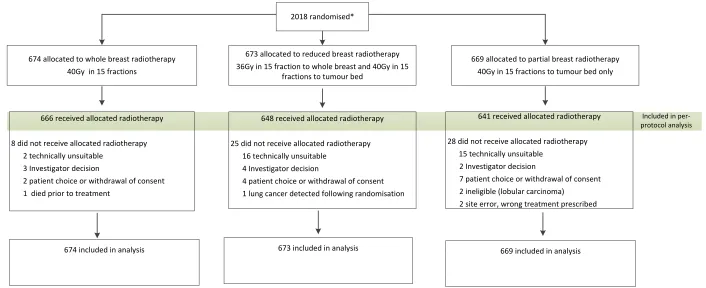
Between May 2007 and October 2010 2018 patients entered the study from 30 UK radiotherapy
centres (control n=675, reduced dose n=674 and partial breast n=669). Four patients were found
to be ineligible after randomisation (three patients had lobular carcinoma and one had previous
renal cell carcinoma) and two patients withdrew consent from any data being used in analysis
(Figure 2). Seven patients did not receive any radiotherapy and 54 did not receive their allocated
treatment (Figure 2). Seventy-four percent of patients had surgical clips, 24% used imaging
(either CT or ultrasound) and 2% used clinical methods alone to localise the tumour bed.
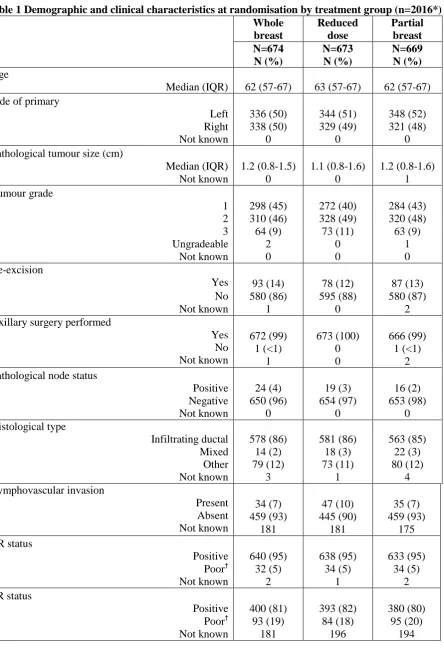
Demographic and clinical characteristics were well balanced across the three treatment groups
(Table 1). Chemotherapy was given to 104 (5%) women, 90% (n=1826/2008) had endocrine
therapy and 2% (n=36/2008) had trastuzumab.
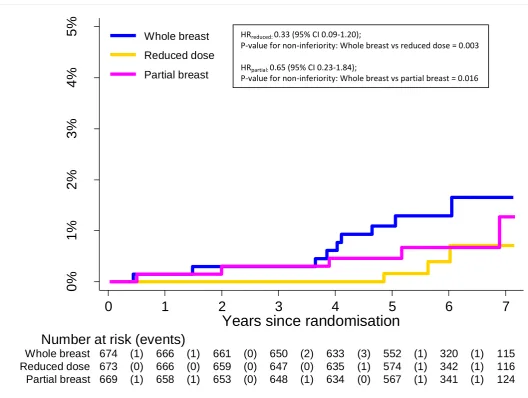
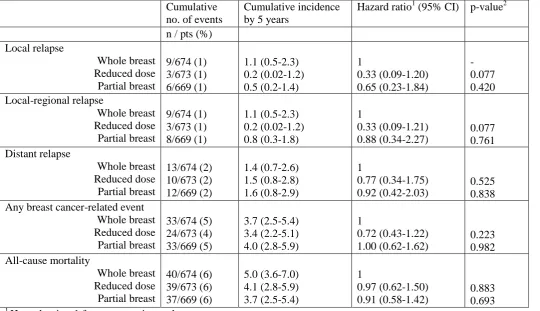
After a median follow-up of 72.2 (IQR 61.7-83.2) months, local relapse had been reported for 18
patients whole breast (n=9), reduced dose (n=3) and partial breast (n=6) groups respectively. At
five years, the local relapse rates were 1.1% (95%CI 0.5-2.3) in those allocated to whole breast,
0.2% (0.02-1.2) in the reduced dose and 0.5% (0.2-1.4) in the partial breast groups respectively.
The estimated absolute treatment differences in the local relapse rate compared with whole
breast radiotherapy at five years was -0.73 (-0.99, 0.22)% for the reduced dose group and -0.38
(-0.84, 0.90)% for the partial breast group. Since the upper limit of the two-sided 95% confidence
interval ruled out a >2.5% increase in local relapse risk for each of the test schedules,
non-inferiority can be claimed for both reduced and partial breast radiotherapy. Confirmation of this
assertion is illustrated by a test against the critical hazard ratio HR>2.03, with p=0.003 and
p=0.016 for the reduced and partial groups respectively compared with the whole breast
9
consistent (p=0.003 and p=0.017 for the reduced dose and partial breast comparisonsrespectively). Local relapses occurred most frequently in patients with at least one high risk
feature (Appendix 3).
Four regional relapses were reported: (whole breast (n=1), reduced dose (n=1) and partial
breast (n=2) groups respectively, of which 2 coincided with local relapse and 2 were isolated
axillary relapses. Rates of distant relapse, disease-free survival and overall survival were similar
across treatment groups, with low overall event rates and no statistically significant differences
observed between experimental and control groups. Thirty-two patients developed invasive
contralateral breast primary cancers (whole breast (n=10), reduced dose (n=11) and partial
breast (n=11) groups). Non-breast second primary cancers were reported for 96 patients (whole
breast (n=35), reduced dose (n=37) and partial breast (n=24) groups (Table 3)). Gastrointestinal,
gynaecological and lung cancers were the most common. All but one (18/19) of the lung cancers
developed within five years of randomisation and there were similar numbers ipsilateral and
contralateral to the treated breast (Appendix 4).
A total of 116 patients had died, 26 from breast cancer, 90 from other causes (including 42 from
second cancers and 9 cardiac-related) and 2 with unknown cause of death with no evidence of
disease relapse prior to death (Table 3). There were similar numbers of cardiac deaths for
patients with left and right sided breast cancers (Appendix 5).
In relation to normal tissue effects, at the 5-year assessment, patients generally reported fewer
moderate/marked events for the protocol-specific questions (skin change, overall breast
appearance change, breast smaller and harder/firmer to touch) in the partial breast group
compared with the whole breast group (Table 4), although this reduction was statistically
significant for change in breast appearance only (p<0.001). Five-year cumulative incidence
estimates indicated that change in breast appearance was the most common item reported as
moderate/marked by patients. There was evidence of a significant reduction in
moderate/marked events up to 5 years for both the reduced dose and partial breast (HR<1)
compared with the whole breast group for breast harder/firmer only (reduced dose p=0.002;
partial breast p<0.0001). Cumulative incidence rates of breast harder/firmer were much higher
than the point prevalence at 5 years as they included events reported earlier on in follow-up,
many of which were likely to be temporary post-surgical effects. The proportion of patients
reporting arm and shoulder symptoms as moderate/marked at 5 years was low across all groups
with no evidence of a difference for either experimental schedule compared with the control
group. Similarly, cumulative incidence estimates indicated similar rates of arm and shoulder
10
A total of 1319 women consented to the photographic substudy and baseline photographs werereceived and assessable for 1222 patients. Two year photographs were assessable in 1000
women. The most common reasons for photographs not being available were centre
administrative oversight meaning photographic appointments were not made, patients not
attending hospital visits and patients withdrawing consent from the substudy. At two years, mild
or marked changes in breast appearance were observed in 37/332 (11%), 32/335 (10%) and
31/333 (10%) allocated to whole breast, reduced dose and partial breast radiotherapy
respectively. At 5 years, photographs were available for 805 women and, compared with the
2-year results, the proportion of patients with mild or marked changes had increased across all
groups (whole breast n=60/262 (23%), reduced dose n=59/264 (22%) and partial breast
n=50/279 (18%)). There was no evidence of a statistically significant difference in the proportion
of patients experiencing change in breast appearance for either experimental schedule
compared with whole breast radiotherapy at 2 (reduced dose p=0.527; partial breast p=0.446) or
5 years (reduced dose p=0.917; partial breast p=0.165).
Clinical assessment of late normal tissue effects at 5 years showed very low levels of
moderate/marked events across all treatment groups (Table 5). Breast shrinkage had the
highest prevalence of moderate/marked events (whole breast n=41/452 (9%), reduced dose
n=37/478 (8%) and partial breast n=33/472 (7%)). Moderate/marked breast oedema was rare at
5 years (whole breast n=4/446; reduced dose n=2/468; partial breast n=0/468). The cumulative
incidences also indicated breast shrinkage to be the most common late normal tissue effect..
The hazard ratios for all late effects were consistently <1 but there was no evidence of
statistically significant differences for individual events. Severe late adverse effects were rare.
There were 4, 8 and 5 confirmed reports of rib fracture, lung fibrosis and ischaemic heart
disease respectively (Appendix 6).
Discussion
Our 5 year results confirm that local relapse rates were very low across all trial groups and that
non-inferiority was demonstrated for both partial breast and reduced dose radiotherapy. Late
normal tissue effects were also uncommon across all groups and statistically significantly fewer
in patient reported breast hardness in the partial breast radiotherapy group compared with
control. This supports our hypothesis that partial breast radiotherapy using a standard radiation
technique can reduce late toxicity without jeopardising local tumour control.
IMPORT LOW has several novel aspects. Firstly, it is the only phase III trial of partial breast
radiotherapy to use the same dose-fractionation regimen and radiation technique in both whole
breast and partial breast radiotherapy group(s). Therefore, differences in treatment outcome can
11
Group phase II partial breast radiotherapy trial is similarly designed to have breast volume as theonly variable, but has a primary endpoint of grade ≥2 breast induration at 3 years (personal
communication, B Offersen)
Other phase III partial breast radiotherapy trials report a variety of different dose-fractionation
regimens ranging from a single intraoperative dose to 1-2 weeks of treatment [18, 23, 24]. These
differences make it challenging to distinguish variations in outcome being due to differences in
treated volume or to radiation dose-time effects. This is illustrated by the interim results at 3
years from the RAPID trial that compared 3D conformal partial breast radiotherapy using 38.5
Gy in 10 fractions over 5 days, with whole breast radiotherapy using 42.5 Gy or 50 Gy in 16 or
15 fractions respectively with an optional boost. Cosmetic outcome and late normal tissue
toxicity were worse in the partial breast radiotherapy group, which suggests that dose-time
effects were the dominant factor over reduced irradiated volume within this study. Other
randomised trials using similar dose-fractionation regimens to RAPID have yet to publish mature
outcome data although early reports suggest limited toxicity.
A second novel aspect is the engagement of patients to produce the most comprehensive
patient reported outcomes in any published partial breast radiotherapy trial to date. It is obvious
that the patient’s viewpoint is extremely important, but previous breast radiotherapy trials have
also demonstrated that patient reported outcomes are very sensitive in distinguishing between
different dose-fractionation regimens
[25]
. IMPORT LOW suggests that patient reported outcomes are also able to detect a radiotherapy volume effect. This observation is highlyrelevant for the design of future breast radiotherapy trials as patient reported outcomes could
prove to be the most cost-effective yet sensitive and patient-centred method of outcome
assessment. We have analysed and presented the late normal tissue toxicity for both patient
reported outcomes and clinician reported outcomes in two ways: using discrete 5 year time
points and also the cumulative incidence. The purpose of dual analysis is to convey different
information, in that the longitudinal results capture the maximum grades of toxicity, whereas the
cross sectional 5 year results take into account resolution of some side effects, such as oedema
that may reduce over time. We acknowledge that multiple statistical tests were conducted for the
normal tissue toxicity analysis, but we accounted for this by using a stringent significance level of
0.005 for clinical and patient reported outcomes.
A third important strength of IMPORT LOW is its simplicity. The partial breast radiotherapy
technique uses standard tangential fields that are simply shortened to encompass the tumour
bed and margin of healthy tissue. This means that a larger volume of breast is treated in
comparison with other 3D conformal/IMRT and brachytherapy techniques, but tangential beams
12
beams within the breast. This may be important in minimising second radiation-induced cancers.It may also minimise the mean heart dose without the need for breath-hold in most left-sided
breast cancer patients, given that the majority of patients have tumours in the upper half of the
breast and above the level of the heart [26] [[27]. The tangential field arrangement is more likely
to deliver at least some dose to the lower axilla in comparison with more conformal partial breast
radiotherapy techniques. This may prove to be important in minimising axillary recurrences [28].
A simple form of forward planned IMRT was used to optimise dose homogeneity, but this is now
standard in the vast majority of centres [29, 30]. This means that implementation of this
technique does not require additional resources or training in the majority of countries.
By today’s standards, the original estimates of local relapse rate on which sample size was
based were high given recent improvements in outcome [11]. Retrospective power calculations,
based on year 5 data being available for 1832 (91%) patients and an observed control group
local relapse rate of 1.1%, confirm that a clinically relevant absolute 2.0% increase in 5-year
local relapse rate could be excluded for each test group, assuming 80% power and 2.5% alpha
(one-sided). The demonstration of non-inferiority is expected to be stable with increasing
follow-up, although the local relapse rate in IMPORT LOW is likely to be in the range 1-3% by 10 years.
This expectation is based on the ELIOT trial in which the cumulative incidence of local relapse in
the intra-operative group rose in an apparently linear fashion between 5 and 9 years [23].
Compliance with photographic assessments was not as high as anticipated. However, given the
relatively low rate of any change in breast appearance at 5 years in the control group (23%),
retrospective power calculations indicate that there would be 75% power to detect a difference of
10% (with a 2.5% significance level).
Another possible limitation is bias in late normal tissue toxicity reporting as it is impossible to
blind patients and clinicians to treatment randomisation. The panel of assessors undertaking
photographic assessments are however blinded to treatment arm, albeit that photographic
assessments appear less sensitive to subtle changes in normal-tissue toxicity.
A major question raised by this trial is: which patients should be selected for partial breast
radiotherapy? IMPORT LOW had relatively permissive eligibility criteria, but it is apparent from
the baseline characteristics that the majority of women actually recruited had small, low grade,
ER+, node negative tumours. This may be partly explained by the widening of eligibility criteria
during recruitment. Appendix 3 shows that despite the proportional lower number of patients with
higher risk disease, this group contributed 8 out of 18 of the local relapses. However, this
observation needs to be taken with caution as the overall number of events was very low. The
UK has taken a pragmatic approach to patient selection for partial breast radiotherapy by
13
partial breast radiotherapy can be considered for patients ≥50 years, grade 1–2, ≤30 mm, ER+,HER2-, N0 with minimum 1 mm radial excision margins for invasive disease. Given the very
small percentage of node positive patients in IMPORT Low, we support the UK Breast
Radiotherapy Consensus in not recommending partial breast radiotherapy for this group.
Consistent with the findings of ACOSOG Z0011, IBSCG 23-01, NCIC MA20, and EORTC
22922, we recommend that node positive patients receive whole breast radiotherapy as
standard of care.
A further controversy raised by this and other reported studies, is the definition of ipsilateral
“local relapse”. For example the IMPORT LOW definition is recurrence of any
pre-invasive/invasive carcinoma in the ipsilateral breast regardless of histology or location of the
index breast cancer. The GEC-ESTRO trial definition does not take into account location within
the breast, but does exclude tumours with differing histology and the Cochrane review only
includes relapses within the index quadrant with the same histology. Clearly, inclusion or
exclusion of local relapses could make a substantial difference in reported results given the very
low event rate in this patient group.
Finally, the results of IMPORT LOW are not consistent with the 2016 overview by the Cochrane
Collaboration based on the published data of phase III trials, 6 of which contributed to analyses
of local relapses and 4 to analyses of toxicity endpoints [31]. This overview reported inferior
results for both local relapse and late normal tissue toxicity with partial breast radiotherapy. The
relatively small number of contemporary partial breast radiotherapy trials included within this
report may explain these findings [30]. Four other phase II trials testing partial breast
radiotherapy are yet to report 5-year results: NSAPBP/RTOG, RAPID, SHARE and IRMA. The
mature results from over 10,000 patients recruited within these important trials will add to the
literature in due course.
It is clear that we need the results from as yet unpublished partial breast radiotherapy trials, but
due to the huge heterogeneity in dose-fractionation regimen, radiotherapy technique, irradiated
volume and inconsistencies in definition of ipsilateral breast tumour recurrence, it may prove
challenging to interpret these data. A large individual patient data meta-analysis may go some
way to resolving this potential dilemma and we strongly support this initiative.
We also recognise the importance of investigating possible effects of partial breast radiotherapy
on development of radiation induced second cancer and major cardiac events. However, this
research will require thousands of patients followed up for many years before robust conclusions
14
Another approach will be to investigate the biology of local relapse and its relationship to partialbreast radiotherapy. For example, it is still unclear what constitutes a “true” ipsilateral recurrence
from an ipsilateral new primary at the molecular level and this requires further investigation.
Conclusion
At 5 years, partial breast radiotherapy delivered using a simple intensity modulated technique
achieved non-inferiority in local relapse rates compared with whole breast radiotherapy and
comparable or reduced late adverse effects. This method of partial breast radiotherapy appears
safe and effective and could be implemented easily within the majority of radiotherapy centres
worldwide.
Declaration of interests
We declare we have no conflicts of interest.
Acknowledgements
We thank the patients who participated in this study and all investigators and research support
staff, past and present, at participating centres (appendix 7). Recognition goes to all trials unit
staff at The Institute of Cancer Research Clinical Trials and Statistics Unit who contributed to the
central coordination of the study.
We thank the members of the Trial Management Group past and present (appendix 8), the
independent members of the Trial Steering Committee (Malcolm Mason (chair), Vivian
Cosgrove, Philip Poortmans) and the Independent Data Monitoring Committee (Helen Lucraft
(chair), Matthew Sydes, John Staffurth), for overseeing the study.
We acknowledge support from Cancer Research UK (grant number C1491/A6035), the National
Institute for Health Research (NIHR) Cancer Research Network (CRN), National Health Service
Research Scotland, Health and Care Research Wales and the National Institute of Health
Research Royal Marsden/Institute of Cancer Research Biomedical Research Centre. In addition
Dr Charlotte Coles is supported by the Cambridge National Institute of Health Research
Biomedical Research Centre.
We are grateful to the NCRI Radiotherapy Trials Quality Assurance (RTTQA) group at Mount
Vernon Hospital for overseeing the radiotherapy planning and delivery throughout the study.
The IMPORT Trialists’ Group consists of the Trial Management Group, Trial Steering
Committee, Independent Data Monitoring Committee and the principal and main co-investigators
at the participating centres.
IMPORT LOW is sponsored by The Institute of Cancer Research, London.
15
CEC and JRY are the current and previous chief investigators. AK is the chief clinicalcoordinator. JMB is the scientific lead for the study within the Institute of Cancer Research
Clinical Trials and Statistics Unit and provided oversight and guidance for trial management and
statistical analysis throughout. JYR, JMB, CEC and JSH were responsible for the study design.
JMB, CEC,JRY, AK and CG were responsible for data interpretation and writing the report. CG
and JH undertook the statistical analysis. ME, JT, RK and IB managed the study and data
collection. MW and MJ are patient advocate members of the trial management group and
provided guidance for study documentation and reports. YT and LC were the quality assurance
radiographer and physicist and contributed to radiotherapy planning and quality assurance. ED
was involved in radiotherapy planning and set up. RA, AA, MB, CC, AH, ES, IS and DW are
principal investigators (past or present) at participating centres and members of the trial
management group and were responsible for patient recruitment and contributed to the report
through review and discussion. PH is the Patient Reported Outcomes lead. All authors reviewed
the manuscript.
Research in context
Evidence before this study
A comprehensive literature search using PubMed and Medline was carried out before the trial
opened and addressed the following (i) identification of all previous pathological and clinical
breast radiotherapy studies investigating patterns of recurrence within the ipsilateral breast and
(ii) results of previous partial breast radiotherapy studies. We concluded that existing research
suggested that the majority of local relapses occur in the vicinity of the original tumour bed and
that older trials testing partial breast radiotherapy were uninformative due to suboptimal patient
selection, poor localisation of the tumour and, hence, inaccurate radiotherapy. We hypothesised
that partial breast radiotherapy using modern methods of radiotherapy planning and treatment
would be non-inferior in terms of local relapse rates and may have reduced normal tissue toxicity
in a low risk of relapse population. This formed part of our peer-reviewed funding application for
the trial.
Added value of this study
IMPORT LOW is the first phase III trial reporting 5-year outcome data for local relapse and
adverse effects after partial breast radiotherapy delivered using standard external beam
16
unconfounded by radiotherapy dose-time factors. In addition, it is unique by including verycomprehensive patient reported outcome measures.
At 5 years, partial breast radiotherapy delivered using a simple and standard technique, showed
no increase in local relapse rates compared with whole breast radiotherapy, and produced
equivalent or reduced late adverse effects. Follow-up is continuing and 10 year local relapse
rates and toxicity will be reported.
Implications of all the available evidence
IMPORT LOW has similar local relapse rates compared with the recently reported GEC-ESTRO
brachytherapy partial breast radiotherapy trial that also confirmed non-inferiority. Our method of
partial breast radiotherapy appears safe and effective and a key advantage of the IMPORT LOW
partial breast technique is its relative simplicity compared with conformal/inverse planned
intensity modulated radiotherapy or brachytherapy. The use of standard medial and lateral
tangential beams also minimise the mean heart dose without the need for breath hold in most
left-sided breast cancer patients, given that the majority of patients have tumours in the upper
half of the breast and above the level of the heart. Implementation of this technique will not
require additional resources or training in the majority of countries worldwide.
Figure legends
Figure 1 – Radiotherapy technique for partial breast group Figure 2 - CONSORT Flow Chart
18
Figure 2 - CONSORT Flow Chart
2018 randomised*
674 allocated to whole breast radiotherapy 40Gy in 15 fractions
673 allocated to reduced breast radiotherapy 36Gy in 15 fraction to whole breast and 40Gy in 15
fractions to tumour bed
669 allocated to partial breast radiotherapy 40Gy in 15 fractions to tumour bed only
674 included in analysis
673 included in analysis 669 included in analysis
666 received allocated radiotherapy
8 did not receive allocated radiotherapy 2 technically unsuitable
3 Investigator decision
2 patient choice or withdrawal of consent 1 died prior to treatment
648 received allocated radiotherapy
25 did not receive allocated radiotherapy 16 technically unsuitable
4 Investigator decision
4 patient choice or withdrawal of consent 1 lung cancer detected following randomisation
641 received allocated radiotherapy
28 did not receive allocated radiotherapy 15 technically unsuitable
2 Investigator decision
7 patient choice or withdrawal of consent 2 ineligible (lobular carcinoma)
2 site error, wrong treatment prescribed
Included in per-protocol analysis
19
Figure 3 Cumulative hazard of local relapse by treatment group0%
1%
2%
3%
4%
5%
R
isk
o
f
lo
ca
l r
e
la
p
se
669 (1) 658 (1) 653 (0) 648 (1) 634 (0) 567 (1) 341 (1) 124 Partial breast
673 (0) 666 (0) 659 (0) 647 (0) 635 (1) 574 (1) 342 (1) 116 Reduced dose
674 (1) 666 (1) 661 (0) 650 (2) 633 (3) 552 (1) 320 (1) 115 Whole breast
Number at risk (events)
0
1
2
3
4
5
6
7
Years since randomisation
Whole breast
Reduced dose
Partial breast
HRreduced: 0.33 (95% CI 0.09-1.20);
P-value for non-inferiority: Whole breast vs reduced dose = 0.003
HRpartial: 0.65 (95% CI 0.23-1.84);
20
TablesTable 1 Demographic and clinical characteristics at randomisation by treatment group (n=2016*) Whole breast Reduced dose Partial breast N=674 N (%) N=673 N (%) N=669 N (%) Age
Median (IQR) 62 (57-67) 63 (57-67) 62 (57-67)
Side of primary
Left 336 (50) 344 (51) 348 (52)
Right Not known 338 (50) 0 329 (49) 0 321 (48) 0 Pathological tumour size (cm)
Median (IQR) 1.2 (0.8-1.5) 1.1 (0.8-1.6) 1.2 (0.8-1.6)
Not known 0 0 1
Tumour grade
1 298 (45) 272 (40) 284 (43)
2 310 (46) 328 (49) 320 (48)
3 Ungradeable 64 (9) 2 73 (11) 0 63 (9) 1
Not known 0 0 0
Re-excision
Yes 93 (14) 78 (12) 87 (13)
No 580 (86) 595 (88) 580 (87)
Not known 1 0 2
Axillary surgery performed
Yes No Not known 672 (99) 1 (<1) 1 673 (100) 0 0 666 (99) 1 (<1) 2 Pathological node status
Positive Negative Not known 24 (4) 650 (96) 0 19 (3) 654 (97) 0 16 (2) 653 (98) 0 Histological type Infiltrating ductal Mixed Other Not known 578 (86) 14 (2) 79 (12) 3 581 (86) 18 (3) 73 (11) 1 563 (85) 22 (3) 80 (12) 4 Lymphovascular invasion Present Absent Not known 34 (7) 459 (93) 181 47 (10) 445 (90) 181 35 (7) 459 (93) 175 ER status
Positive 640 (95) 638 (95) 633 (95)
Poor† 32 (5) 34 (5) 34 (5)
Not known 2 1 2
PR status
Positive 400 (81) 393 (82) 380 (80)
Poor† 93 (19) 84 (18) 95 (20)
21
HER2 status
Negative 599 (96) 603 (96) 580 (94)
Positive 23 (4) 25 (4) 34 (6)
Not known 52 45 55
Adjuvant therapy received (not mutually exclusive) Chemotherapy Endocrine therapy Trastuzumab Not known 29 (4) 610 (91) 7 (1) 1 42 (6) 614 (91) 15 (2) 3 33 (5) 602 (90) 14 (2) 4 * Two patients withdrew consent for any of their data to be used in analysis
†
ER/PR poor refers to less than 10% receptor staining
Table 2 Relapse and mortality by treatment group
Cumulative no. of events
Cumulative incidence by 5 years
Hazard ratio1 (95% CI) p-value2
n / pts (%) Local relapse Whole breast Reduced dose Partial breast 9/674 (1) 3/673 (1) 6/669 (1) 1.1 (0.5-2.3) 0.2 (0.02-1.2) 0.5 (0.2-1.4) 1 0.33 (0.09-1.20) 0.65 (0.23-1.84) -0.077 0.420 Local-regional relapse Whole breast Reduced dose Partial breast 9/674 (1) 3/673 (1) 8/669 (1) 1.1 (0.5-2.3) 0.2 (0.02-1.2) 0.8 (0.3-1.8) 1 0.33 (0.09-1.21) 0.88 (0.34-2.27) 0.077 0.761 Distant relapse Whole breast Reduced dose Partial breast 13/674 (2) 10/673 (2) 12/669 (2) 1.4 (0.7-2.6) 1.5 (0.8-2.8) 1.6 (0.8-2.9) 1 0.77 (0.34-1.75) 0.92 (0.42-2.03) 0.525 0.838 Any breast cancer-related event
Whole breast Reduced dose Partial breast 33/674 (5) 24/673 (4) 33/669 (5) 3.7 (2.5-5.4) 3.4 (2.2-5.1) 4.0 (2.8-5.9) 1 0.72 (0.43-1.22) 1.00 (0.62-1.62) 0.223 0.982 All-cause mortality Whole breast Reduced dose Partial breast 40/674 (6) 39/673 (6) 37/669 (6) 5.0 (3.6-7.0) 4.1 (2.8-5.9) 3.7 (2.5-5.4) 1 0.97 (0.62-1.50) 0.91 (0.58-1.42) 0.883 0.693 1
Hazard ratio <1 favours experimental group
2
22
Table 3- Local relapse, second cancers and deaths by treatment group1
Two patients with DCIS
2
One patient with DCIS
3
One patient reported a colorectal second cancer followed by a lung second cancer and is included as both categories
4
Other includes adrenal, squamous cell carcinoma of the skin, melanoma, leukaemia and mesothelioma
5
Angiosarcoma developed in the treated breast
6
One patient with distant relapse prior to death died from mesothelioma
7
One patient with distant relapse prior to death died from renal failure
8
Two patients with distant relapse prior to death also died from other causes, one sepsis and one was cardiac related
Whole breast N=674 N (%) Reduced dose N=673 N (%) Partial breast N=669 N (%) Total N=2016 N (%) Local relapse
Local relapse within radiotherapy field Yes
No Borderline Not documented
91 (1)
9 0 0 0
32 (1)
1 0 0 2 6 (1) 4 0 1 1 18 (1) 14 0 1 3
Contralateral breast second primary
Invasive DCIS
Non-breast second primary
Colorectal Lung Gynaecological Other4 Oesophagus Pancreas Lymphoma Genitourinary Head & neck Liver Cancer of unknown primary Peritoneal Sarcoma 12 (2) 10 2 35 (5) 103 113 5 4 0 1 0 3 1 0 0 0 1 13 (2) 11 2 37 (5) 7 4 8 3 3 2 2 1 2 2 0 2 15 13 (2) 11 2 24 (3) 3 4 4 1 3 3 3 0 0 1 2 0 0 38 (2) 32 6 96 (5) 20 19 17 8 6 6 5 4 3 3 2 2 2 Deaths
23
Table 4 Patient assessments of moderate/marked late adverse eventsModerate/marked events Cumulative
no. of events
Cumulative
incidence by 51
years
Hazard ratio (95% CI)
p-value2
Proportion with event at 5
years
p-value3
n / pts randomised (%)
Comparison with whole n / pts (%) Comparison with whole
Breast appearance changed whole reduced partial 158/411 (38) 123/433 (28) 113/421 (27) 47.7 (41.1-54.8) 36.7 (30.6-43.6) 35.1 (28.7-42.5) 1
0.74 (0.54-1.00), p=0.051 0.64 (0.46-0.89), p=0.007
80/295 (27) 66/325 (20) 49/331 (15) 0.047 <0.0001 Breast smaller whole reduced partial 119/411 (29) 110/433 (25) 104/421 (25) 37.3 (30.9-44.4) 31.9 (26.3-38.4) 34.7 (27.5-43.0) 1
0.83 (0.59-1.16), p=0.280 0.78 (0.54-1.11), p=0.162
66/294 (23) 63/326 (19) 56/331 (17) 0.373 0.086 Breast harder/firmer whole Reduced partial 115/411 (28) 74/433 (17) 58/421 (14) 35.3 (28.4-43.3) 21.0 (16.2-26.9) 15.3 (12.0-19.5) 1
0.53 (0.36-0.79), p=0.002 0.47 (0.32-0.71), p<0.0001
27/292 (9) 23/325 (7) 15/330 (5) 0.376 0.024 Arm/shoulder pain whole reduced partial 98/411 (24) 104/433 (24) 97/421 (23) 32.6 (26.3-39.9) 30.1 (24.7-36.4) 27.2 (21.9-33.6) 1
0.94 (0.71-1.25), p=0.678 0.97 (0.73-1.28), p=0.809
33/297 (11) 43/329 (13) 24/331 (7) 0.465 0.097 Swollen arm/hand whole reduced partial 21/411 (5) 26/433 (6) 16/421 (4) 6.2 (4.1-9.5) 9.8 (6.2-15.3) 4.4 (2.7-7.3) 1
1.19 (0.67-2.11), p=0.558 0.59 (0.30-1.15), p=0.123
5/295 (2) 15/330 (5) 2/330 (1)
0.066 0.264 Difficulty raising arm
whole reduced partial 42/411 (10) 45/433 (10) 47/421 (11) 13.6 (9.2-19.8) 14.0 (9.8-19.8) 13.5 (10.1-18.0) 1
0.98 (0.64-1.50), p=0.913 1.08 (0.71-1.64), p=0.726
10/297 (3) 17/328 (5) 15/331 (5) 0.326 0.542 Shoulder stiffness whole Reduced partial 56/411 (14) 56/433 (13) 58/421 (14) 19.3 (14.0-26.5) 19.3 (13.9-26.4) 15.3 (12.0-19.5) 1
0.93 (0.64-1.35), p=0.701 1.06 (0.73-1.54), p=0.756
24
whole reduced partial 67/411 (16) 65/433 (15) 64/421 (15) 19.1 (14.9-24.3) 16.9 (12.9-22.1) 18.2 (14.1-23.4) 10.96 (0.68-1.35), p=0.812 0.96 (0.68-1.36), p=0.830
13/295 (4) 18/330 (5) 13/328 (4) 0.584 0.842 Breast swollen whole reduced partial 31/411 (8) 26/433 (6) 17/421 (4) 8.1 (5.7-11.3) 6.8 (4.7-9.9) 4.7 (2.9-7.6) 1
0.84 (0.49-1.41), p=0.503 0.49 (0.27-0.89), p=0.019
1/295 (<1) 4/329 (1) 1/328 (<1) 0.377 0.999 Breast oversensitive whole reduced partial 64/411 (16) 59/433 (14) 54/421 (13) 17.2 (13.7-21.5) 16.5 (12.0-22.4) 18.3 (13.0-25.5) 1
0.89 (0.62-1.27), p=0.526 0.80 (0.55-1.14), p=0.220
9/296 (3) 16/330 (5) 13/330 (4)
0.308 0.665 Skin problems in breast
whole reduced partial 50/411 (12) 42/433 (10) 35/421 (9) 15.7 (11.1-21.9) 13.4 (9.2-19.2) 9.2 (6.7-12.7) 1
0.78 (0.52-1.18), p=0.237 0.64 (0.42-0.99), p=0.045
7/296 (2) 10/328 (3) 9/330 (3)
0.632 0.806 Skin appearance changed
whole reduced partial 63/411 (15) 59/433 (14) 49/421 (12) 21.0 (15.5-27.9) 17.9 (13.2-24.0) 14.6 (10.4-20.5) 1
1.07 (0.68-1.68), p=0.775 0.87 (0.54-1.40), p=0.569
22/294 (8) 23/325 (7) 12/330 (4) 0.878 0.051 1
25
Table 5 Clinician assessment of moderate/marked late adverse eventsModerate/marked events Cumulative
no. of events
Cumulative
incidence by 51
years
Hazard ratio (95% CI)
p-value2
Proportion with event at 5
years
p-value3
n / pts randomised (%)
Comparison with whole n / pts (%) Comparison with whole
Worst NTE whole reduced partial 134/674 (20) 108/673 (16) 94/669 (14) 27.6 (22.5-33.6) 21.1 (17.2-25.7) 20.0 (15.6-25.4)
1
0.77 (0.60-0.99), p=0.043 0.69 (0.53-0.90), p=0.006
60/457 (13) 48/480 (10) 49/474 (10) 0.152 0.221 Breast shrinkage whole reduced partial 79/674 (12) 70/673 (10) 61/669 (9) 18.4 (13.7-24.5) 13.6 (10.6-17.5) 13.9 (10.1-19.0)
1
0.86 (0.62-1.18), p=0.345 0.78 (0.56-1.08), p=0.134
41/452 (9) 37/478 (8) 33/472 (7)
0.480 0.276 Breast induration (index)
whole reduced partial 63/674 (9) 43/673 (6) 48/669 (7) 12.7 (9.5-16.8) 8.4 (6.0-11.6) 10.8 (7.7-15.1)
1
0.66 (0.45-0.98), p=0.040 0.77 (0.53-1.12), p=0.165
21/453 (5) 13/474 (3) 24/471 (5)
0.161 0.762 Breast induration (outside index)
whole reduced partial 15/674 (2) 10/673 (2) -2.3 (1.4-3.8) 2.1 (1.0-4.1)
-1
0.66 (0.30-1.48), p=0.310 -2/450 (<1) 2/464 (<1) ->0.999 -Telangiectasia whole reduced partial 8/674 (1) 8/673 (1) 5/669 (1) 1.6 (0.8-3.3) 3.0 (1.3-6.8) 0.6 (0.2-1.7)
1
0.96 (0.36-2.57), p=0.976 0.62 (0.21-1.92), p=0.401
3/445 (1) 6/468 (1) 4/465 (1) 0.507 >0.999 Breast oedema whole reduced partial 24/674 (4) 18/673 (3) 11/669 (2) 4.0 (2.6-6.2) 3.2 (2.0-5.3) 1.7 (0.9-3.0)
1
0.74 (0.40-1.37), p=0.338 0.46 (0.23-0.94), p=0.029
4/446 (1) 2/468 (<1) 0/468 (0)
0.441 0.056 Other radiotherapy related
whole reduced partial 11/674 (2) 9/673 (1) 6/669 (1) 1.7 (1.0-3.1) 1.4 (0.7-2.6) 0.9 (0.4-2.0)
1
0.81 (0.34-1.97), p=0.646 0.55 (0.20-1.49), p=0.234
3/457 (<1) 0/480 (0) 0/474 (0) 0.263 0.221 1