IJEDR1801154
International Journal of Engineering Development and Research (
www.ijedr.org
)
886
Proposal along with implementation of detection of
misbehavior node in CGSR network
1
Monika Gupta,
2Monika Jatiwal
Student
1Computer Science, Y.M.C.A. University of Science and Technology, Faridabad, India
________________________________________________________________________________________________________ Abstract - A mobile ad hoc network (MANET) is generally defined as a network that has many self-organized, free or autonomous nodes that can arrange themselves in various ways and operate without any supervision of strict network administration.The Dynamic nature of the MANET is a major challenge to maintain the frequently changing topology of the network. So there is more possibility of attacker and misbehaving node. When misbehaving nodes participate in the route discovery phase but refuse to forward the data packets, the performance is degraded severely. Various types of misbehavior can be possible in MANET. This paper studied the various techniques to detect the misbehaving nodes.
Keywords-- MANET, CGSR, Routing, Network.
________________________________________________________________________________________________________
I. INTRODUCTION
1.1 Cluster head gateway switching routing protocol
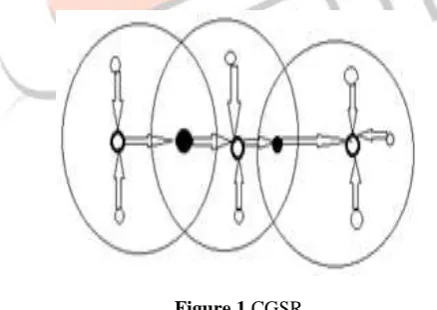
CGSR protocol is a multichannel operation capable protocol. It performs code separation between clusters. The clusters are elected by cluster head election process, which is very intensive process. It uses DSDV as the underlying routing scheme that is based on hierarchical cluster head-to-gateway routing. In CGSR the mobile nodes are grouped into clusters and a cluster-head is elected by election procedure. All nodes that are in the direct communication range of the cluster-head are in its cluster. A gateway node is a node that is in the communication range of two or more cluster-heads. In a dynamic network due to cluster head election procedure some problems may also occur like performance degradation, so CGSR uses a Least Cluster Change (LCC) algorithm. In LCC, cluster-head change occurs only if there is change in network causes two cluster-heads to come into one cluster or one of the nodes moves out of the range of all the cluster-heads. The general algorithm works in the following manner. The source transmits the packet to its cluster-head then from this cluster-head to the gateway node that connects this cluster-head and the next cluster-head along the route to the destination. In Fig.1 the gateway node sends it to the cluster-head and so on until the destination cluster-head is reached in this way. Finally destination cluster-head then transmits the packet to the destination. Each node maintains a table that has mapping from each node to its respective cluster-head.
Figure 1 CGSR
Each node broadcasts its cluster member table periodically and updates its table after receiving the table from other nodes whenever required. In addition, each node also has a routing table that gives the next hop to reach the destination cluster. On receiving a packet, a node finds the minimum distance located cluster-head along with the route to the destination according to the cluster member table and the routing table. Finally it examines its routing table to find the next hop in order to reach the cluster-head that are one step away and transmits the packet to the respective node.
IJEDR1801154
International Journal of Engineering Development and Research (
www.ijedr.org
)
887
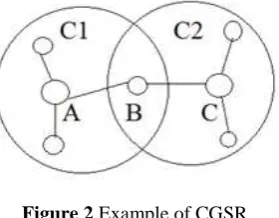
Figure 2 Example of CGSR
Figure 2 shows how the CGSR protocol manages the transfer of packet from node A to node C.
1) Node A (cluster head of C1) must get the permission to transmit in cluster C1. 2) Node B (gateway) must select the same code as node A to receive the packet from node A. 3) Node B must select the same code as node C (cluster head of C2) and get the permission to transmit in cluster C2 (receives a token from node C).
II. RELATED WORK
Literature review is a way of identification, and evaluation of all available research related to a particular research topic. Systematic literature reviews highlights on fair evaluation of a research topic by using a rigorous and balancing methodology. Systematic analysis must be carried out with a predefined search strategy.
Indhumathi.J, Prem Jacob.T[1,9]proposed an algorithm named as fast key generation in which TTL is assigned to the network. The source will send the data packet to the destination, and monitors all the node detail. And the network continuously updates the key of each node for data transmission. S. Marti, T. J. Giuli, K. Lai, and M. Baker[10]proposed two techniques WATCHDOG and PATHRATER. The authors explained that Watchdog is the basis of different intrusion detection system. Rasika Mali, Sudhir Bagade[2] ExWatchdog is an extension of watchdog. Using this mechanism, weakness of Watchdog mechanism has been overcome to some extent. S.Tamilarasan and Dr.Aramudan[5]:Here author analyze IDS determine whether the data is under attack or not. Buchegger[3,11,18]introduced the concept of CONFIDANT. In this each node can observe the behavior of all its neighboring nodes that are within its radio range. Bansal and M. Baker[14,15,16] gives a protocol, called OCEAN in which every node maintains rating for each neighboring node and monitors their misbehavior through promiscuous mode. Wenjia Li, Anupam Joshi.[6,8]According to the authors TWOACK is neither an enhancement nor a Watch-dog based scheme. It aims at resolving the receiver collision and limited transmission power problems of Watchdog, TWOACK detects misbehavior by sending acknowledgement through every data packets transmitted over each three consecutive nodes through the path from the source to the destination. T. Sheltani, A. Al-Roubaiey, E. Shakshuki and A. Mahmoud[4,7,13]described that Adaptive ACK is somewhat similar to TWOACK.AACK is an acknowledgement-based network layer scheme which is a combination of a scheme call and an end-to-end acknowledgement scheme called ACK. Michiardi and Molva[12,17] proposed a technique named as CORE similar to CONFIDANT which is similar to monitoring and reputation system.
III. OBJECTIVES
The proposed algorithm for “Detection of misbehaving node and selection of gateway node in MANET” is based on mechanism to identify the malicious node. The proposed work will leads to the identification of misbehaving node more accurately. To identify the misbehaving node an algorithm is developed. (1) To achieve detail knowledge of misbehaving node. (2) To find several techniques and methods for identifying different types of misbehaving node. (3) To understand the various issues related to misbehaving nodes.
IV. NODE MISBEHAVIOR
Malicious nodes do not give priority to saving battery life, and aim at damaging other nodes. It is introduced that two different types of selfish nodes. As the nodes in MANETs are battery powered, energy becomes a precious resource, and thus, role of selfish nodes draws more attention. Thus, it is describes three routing behaviors of nodes in a MANET.
Type-0: well-behaved node: A well behaved node cooperates in the communication well, performs as required by the routing
protocol, and equally participates in the communication activities like route discovery, maintenance, packet forwarding and receiving etc.
Type-1: active selfish node: Such a node does not participate in packet forwarding, and drops every received packet. It disables the packet forwarding mechanism for the packets which have a destination address, other than this selfish node. In fact, it helps the selfish node to save its own energy, thereby still contributing to network maintenance.
IJEDR1801154
International Journal of Engineering Development and Research (
www.ijedr.org
)
888
misbehaving nodes, we evaluate the performance of DSDV, DSR and AODV routing protocols through extensive simulations, where a certain percentage of nodes behave as active and/or passive selfish nodes with the remaining nodes being well-behaved.4.1 Selfish node Problem
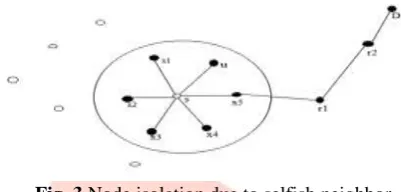
Another effect of node misbehaviors and failures in ad hoc networks is the node isolation problem due to the fact that coordination between nodes is completely dependent on routing and forwarding packets. In turn, the presence of selfish node is a direct cause for node isolation, which further affects network survivability. Traditionally, node isolation refers to the phenomenon in which nodes have no active neighbors. Due to the presence of selfish node, a node can be isolated even if active neighbors are present. In Figure 3, suppose node x5 is a selfish node. When node u initiates a route discovery to another node D, the selfish neighbor x5 may be reluctant to broadcast the route request from u. In this case, x5 behaves like a failed node. It is also possible for x5 to forward control packets. However, the situation could be worse since s may select x5 as the next hop and send data to it. Consequently, x5 may discard all data to be forwarded via it, and then communications between s and D cannot proceed. When all neighbors of s are selfish, s is unable to establish any communications with other nodes at a distance of more than one-hop away.
Fig. 3 Node isolation due to selfish neighbor
In this case, node is isolated by its selfish neighbors. Selfish nodes can still communicate with other nodes via their cooperative neighbors, which is different from failed nodes.
V. PROPOSED WORK
Identification of misbehaving node is important to detect the security attacks in adhoc network. Misbehaving nodes in the adhoc network may be of various types like selfish nodes. Selfish nodes do not aim at damaging other node. They intend to save their battery power for their communication. Further the nodes can be categorized as follows:
Well behaved nodes: A well behaving nodes corporate in the communication very well. It performs as per required by the protocol. And it equally participates in the communication.
Active selfish node: This type of node discards the entire packet passing through it if the destination is not the address of this node. It saves its battery power for itself communication only.
Malicious nodes: Malicious nodes are active nodes. They intentionally damage other nodes and create interruptions in the network. These nodes discard the packets and modify the routing tables. They do not intend to battery saving.
In the intrusion detection system, when source sends a data packet to the destination node. Then data packet will be send through intermediate nodes and the acknowledgment to the source will be send when data has transferred through consecutive nodes. Suppose source sends a data packet to the destination and network is assigned a TTL. If the network monitors that the acknowledgement is not received then the network will identify the misbehavior. And it raises the node as misbehaving node. Here acknowledgement is must. Based on the acknowledgement only network identifies the misbehaving node. Here the time delay is minimized.
But the problem with this technique is that if it founds the node as misbehaving then it declares it as misbehaving node and delete that node but there is a possibility that acknowledgement is not received because of link failure, collision or some other reasons. The solution of the above problem can be the new algorithm as proposed.
5.1 Explanation of proposed algorithm
IJEDR1801154
International Journal of Engineering Development and Research (
www.ijedr.org
)
889
Fig. 4 Flow chart for detection of misbehaving node
If the destination node is not present in this cluster then this cluster head sends the data packet to the next cluster head via gateway node. If the destination is present in this cluster then cluster head will send the data packet to the destination and it will wait for the acknowledgement from the destination. If the acknowledgement is not received in a set time period then according to the proposed work a loop is applied. The loop will check for the acknowledgement from the destination. The loop will run three times. The loop will send hello message three times. If any reply is received by the previous node in any one of the three ti mes. Then the node is not misbehaving. And if the reply is not received in all of the three times then node is said to be misbehaving.
VI. SELECTION OF GATEWAY NODE IN CGSR
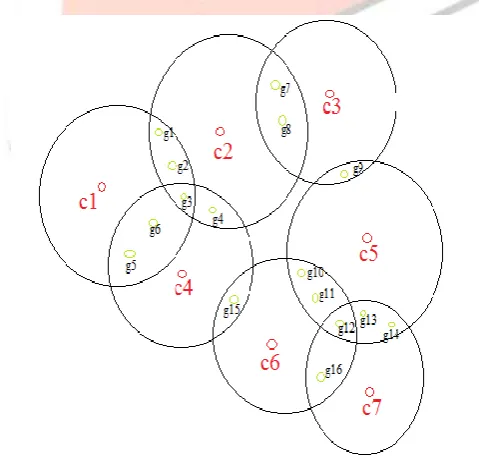
There are multiple clusters in the cluster head gateway switching routing protocol. Now for the communication between the source and destination one requires to select one single gateway node from the multiple gateway nodes. So to select the gateway node following concept can be applied. There are multiple clusters in CGSR. In fig.5 some clusters are such that they transfer packets through the single gateway node. Remove these types of clusters and separate them out. Then select those cluster head which share more than one gateway node between them. Then check the gateway nodes which are common. Now will check with which gateway node we are left with. Out of those nodes, will select the gateway node on some particular base which can be either battery or any another factor.
Figure 5 Clusters with gateway nodes
The following scenario shows the entire possible gateway node through which the nodes can communicate.
6.1 Gateway nodes for the different clusters
IJEDR1801154
International Journal of Engineering Development and Research (
www.ijedr.org
)
890
Cluster head
(Source, Destination)
Gateway nodes
C1 ,C2 g1 g2
C1 ,C4 G5 g6 g7
C2 ,C4 G3 g4
C2 ,C3 G7 g8
C4 ,C6 G15
C3 ,C5 G9
C5 ,C6 G10 g11 g12
C6 ,C7 G16 g12
C5 ,C7 G12 g13 g14
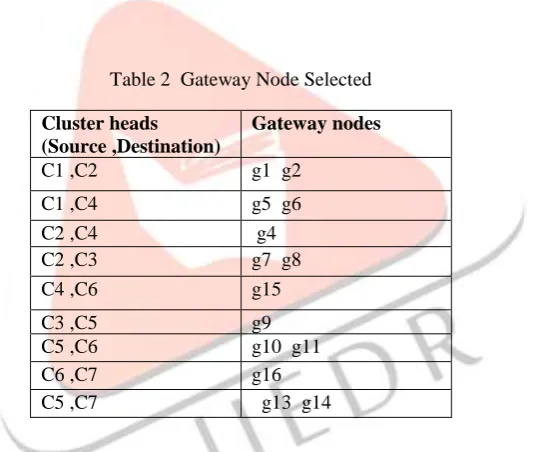
The following scenario shows the only gateway nodes through which the nodes can communicate after removing the gateway nodes which are busier in the communication process.
6.2 Selected gateway nodes
Table 2 Gateway Node Selected
Cluster heads (Source ,Destination)
Gateway nodes
C1 ,C2 g1 g2
C1 ,C4 g5 g6
C2 ,C4 g4
C2 ,C3 g7 g8
C4 ,C6 g15
C3 ,C5 g9
C5 ,C6 g10 g11
C6 ,C7 g16
C5 ,C7 g13 g14
As shown in Table 1 here for the transfer of packet between the cluster 1 to cluster 2 three gateway nodes g1, g2 and g3 are available. But from the table 2 out of the three gateway nodes g3 is also act as a gateway node between the clusters 1 and 4.So in this case the communication between the cluster 1 and 2 will take place through g1 or g2. For the communication between the clusters 5 and 6 there are three gateway nodes g10,g11 and g12.Out of these three gateway nodes g12 also acts as a gateway node for cluster 6 and 7.So in this case g12 will be skipped and for the communication between the cluster 5 and 6 g10 and g11 will be used. For the communication between the clusters 5 and 7 there are three gateway nodes g12, g13 and g14. Out of these three gateway nodes g12 also acts as a gateway node for cluster 5 and 6. So in this case g12 will be skipped and for the communication between the cluster 5 and 7, g13 and g14 will be used.
VII. IMPLEMENTATION OF IDENTIFICATION OF MISBEHAVING NODE
IJEDR1801154
International Journal of Engineering Development and Research (
www.ijedr.org
)
891
Figure 6 MATLAB program for identification of misbehaving node
The figure 6 shows the MATLAB code for the identification of misbehaving node. In this first data packet is sent to the cluster head. Then cluster head randomly selects the next cluster head and then sends the data packet to the destination. If acknowledgement is not received from the destination then the node sends the hello message three times to the next node. If the reply of the hello message is not received in any of the three time then node is raised as misbehaving node.
Figure 7 Interface for the implementation
The figure 7 shows the interface for the identification of misbehaving node and selection of gateway node in MANET in CGSR. The above figure shows the five clusters with their cluster heads, nodes and gateway nodes.
Figure 8 Transfer of packets from node 1 to node 2
IJEDR1801154
International Journal of Engineering Development and Research (
www.ijedr.org
)
892
Figure 9 Transfer of packet from node 1 to node 10 Figure 9 shows the transfer of packet from node 1 to node 10.Here node 10 is not misbehaving.
III. RESULT
Misbehaving node and selection of gateway node in MANET is discussed in this paper. This paper also contains the proposed system for identification of misbehaving node and selection of gateway node in MANET. It is believed that the proposed method will have a high accuracy in the identification of misbehaving node. This work aims at correctly identifying the misbehaving node. The proposed system checks for the acknowledgment from the destination node. If the acknowledgement is received within a particular time period then its right otherwise it applies the proposed method.
IX. CONCLUSION
Many researchers have done work on finding the different techniques for finding the misbehavior nodes. The main goal of routing algorithms is to find the most suitable path from source to desired destination. While sending packet it may also happen that the any one of the node in between the network did not send the acknowledgement to the source node. Then such nodes present in network are said to as malicious node. So, one of the technique is mentioned in this paper to identify that malicious node. Hence there is need to study about how to detect malicious node present in network. Various attacks possible in MANET are also described. Watchdog has good network throughput, but it suffers from various disadvantages which are resolved to very little extent by other techniques. Ex Watchdog solves the problem of false misbehavior reporting. 2ACK and AACK have reduced routing overhead and reduced network overhead respectively. And the new algorithm has been proposed in order to detect the misbehaving node. Identification of misbehaving node is important to detect the security attacks in adhoc network. Misbehaving nodes in the adhoc network may be of various types like selfish nodes. The work in this paper is tried to analyze the misbehaving node in CGSR routing protocol in mobile adhoc networks.
X. FUTURE WORK TO BE CARRIED
Mobile adhoc network are widely used network due to their flexibility in nature that is easy to deploy and less time to set up. These are exposed to internal and external attack due to their dynamic nature. There is decentralized security mechanism in Mobile ad hoc networks. The proposed algorithm detects the misbehaving node very well. Further this work can be extended to which takes less time to detect the misbehaving node.
XI. ACKNOWLEDGEMENT
A special thank to Dr. Parul gupta for her technical support to implement this protocol and also for useful comments, discussions, and suggestions regarding this approach.
REFERENCES
[1] Isha V. Hatware, Atul B. Kathole, Mahesh D. Bompilwar” Detection of Misbehaving Nodes in Ad Hoc Routing” IJETE, Volume 2, Issue 2, February 2012.
[2] Rasika Mali, Sudhir Bagade,” Techniques for Detection of Misbehaving Nodes in MANET: A Study”, International Journal of Scientific & Engineering Research, Volume 6, Issue 8, August-2015.
[3] Sumiti, S. Mittal “Identification Technique for All Passive Selfish Node Attacks in a Mobile Network,” International Journal of Advance Re-search in Computer Science and Management Studies, vol. 3, Issue 4, Apr. 2015.
[4] M. S. Alnaghes and F. Gebali “A Survey on Some Currently Existing Intrusion Detection Systems for Mobile Ad Hoc Networks,” In Proceedings of Second International Conference on Electrical and Electronics Engineering, Clean Energy and Green Computing, Konya, Turkey, 2015.
[5] S.Tamilarasan and Dr.Aramudan”, A Performance and Analysis of Misbehaving node in MANET using Intrusion Detection System”, IJCSNS, VOL.11 No.5, May 2011.
IJEDR1801154
International Journal of Engineering Development and Research (
www.ijedr.org
)
893
[7] Zaiba Ishrat “Security Issues, Challenges and Solution in MANET,” International Journal of Current Science and Technology, vol. 2, Issue 4, Oct. - Dec. 2011.[8]Usha Sakthivel and S. Radha,” Misbehaving Node Detection in Mobile Ad Hoc Networks using Multi Hop Acknowledgement Scheme”, Journal of Computer Science, 2011.
[9]Indhumathi.J, Prem Jacob.T,” Identification of Misbehaviour Activities in Mobile Adhoc Networks”, IJCSIT, Vol. 5 (2), 2014. [10] S. Marti, T. J. Giuli, K. Lai, and M. Baker, “Mitigating Routing Misbehavior in Mobile Ad Hoc Networks," Proceedings of the 6th Annual International Conference on Mobile Computing and Networking (MobiCom'00), pp. 255-265, August 2000. [11] S. Buchegger and J. Y. Le-Boudec, “Nodes bearing grudges: Towards routing security, fair-ness, and robustness in mobile ad hoc networks”, In Proceedings of EUROMICRO- PDP‟02, 2002.
[12] P. Michiardi and R. Molva, “CORE: A collaborativereputation mechanism to enforce node cooperation inmobile ad hoc networks”, In Proc. 6th IFIP Commun. AndMultimedia Security Conf., Sept. ’02.
[13] T. Sheltani, A. Al-Roubaiey, E. Shakshuki and A. Mahmoud “Video Transmission Enhancement in Presence of Misbehaving Nodes in MA-NETs,” Journal of Multimedia Systems, Springer, Oct. 2009.
[14]S. Bansal and M. Baker. "Observation-Based Cooperation Enforcement in Ad-hoc Networks", Techical Report, Stanford University, ’03.
[15] R. Manoharan, S. Rajarajan, S. Sashtinathan, and K. Sriram, “A novel multi-hop b3g architecture for adaptive gateway management in heterogeneous wireless networks,” in Proc. 5th IEEE WiMob, 2009, pp. 48-54.
[16] Y. Yan, L. Ci, Z. Wang, and W. He, “QoS-based gateway selection inMANET with Internet connectivity,” 15th Int. Conf. AdvancedCommunication Technology (ICACT), 2013, pp.195-199.
[17]H. Ammari, and H. El-Rewini, “Integration of mobile ad hoc networksand the internet using mobile gateways,” in Proc. IEEE InternationalParallel and Distributed Processing Symposium (IPDPS'04), USA,2004, p. 218b.