EVALUATION OF IN VITRO ANTIOXIDANT CAPACITY AND
REDUCING POTENTIAL OF POLYHERBAL FORMULATION
OXIWELL: A NUTRITIONAL SUPPLEMENT
Poonam Bhadauriya*1 and Arvind S. Jadon2
1
Gurukul Institute of Pharmaceutical Science and Research, Gwalior-474001 (M.P).
2
School of Studies in Pharmaceutical Sciences, Jiwaji University, Gwalior-474001 (M.P).
ABSTRACT
In biological system, reactive oxygen species (ROS) and reactive
nitrogen species (RNS), such as superoxide, hydroxyl, and nitric oxide
radicals, can damage the DNA and lead to the oxidation of lipid and
proteins in cells. Normally, antioxidant system occurring in human body
can scavenge these radicals, which would keep the balance between
oxidation and anti-oxidation. Nonetheless, the exposure of cigarette
smoking, alcohol, radiation, or environmental toxins induces the
production of excessive ROS and RNS, which disrupt the balance
between oxidation and anti-oxidation and result in some chronic and
degenerative diseases. Many herbs contain antioxidant compounds
which protects the cells against the damaging effects of reactive oxygen species. Polyherbal
formulations containing different herbs are used for the treatment of various diseases. The
study revealed a very good in vitro free-radical scavenging properties of oxiwell a polyherbal
formulation from ayurwell labs which contains the extracts of Mangifera indica, Withania
somnifera, Glycyrrhiza glabra, Vitis vinifera, powders of Emblica officinalis; and oils of
Triticum sativum. The antioxidant activity of this formulation was evaluated by measuring
reducing ability, free radical scavenging activity by DPPH and hydrogen peroxide methods.
KEYWORDS: Free radicals, antioxidants, polyherbals.
INTRODUCTION
Medicinal plants play a pivotal role in the health care of ancient and modern cultures.
Ayurveda, the Indian system of medicine mainly uses plant based drugs or formulations to
Volume 8, Issue 7, 1347-1359. Research Article ISSN 2277– 7105
Article Received on 28 March 2019,
Revised on 18 April 2019, Accepted on 09 May 2019
DOI: 10.20959/wjpr20197-15019
*Corresponding Author
Prof. Poonam Bhadauriya
Gurukul Institute of
Pharmaceutical Science and
Research, Gwalior-474001
treat various human ailments because they contain the components of therapeutic value. In
addition, plant based drugs remain an important source of therapeutic agents because of the
availability, relatively cheaper cost and non-toxic nature when compared to modern
medicine.[1] Many herbs contain antioxidant compounds which protects the cells against the
damaging effects of reactive oxygen species. Oxygen is essential for the survival of all on this
earth. During the process of oxygen utilization in normal physiological and metabolic
processes approximately 5% of oxygen gets univalently reduced to oxygen derived free
radicals like superoxide, hydrogen peroxide, hydroxyl and nitric oxide radicals. Reactive
Oxygen Species (ROS) such as superoxide anion, hydroxyl radical and hydrogen peroxide
play a crucial role in the development of various ailments such as arthritis, asthma, dementia,
mongolism, carcinoma and parkinson’s disease. The free radicals in the human body are
generated through aerobic respiration or from exogenous sources.[2,3]
Free radicals produced in the body react with various biological molecules namely lipids,
proteins and deoxyribonucleic acids resulting in the imbalance between oxidants and
antioxidants. Even though our body is safeguarded by natural antioxidant defense, there is
always a demand for antioxidants from natural sources.[4]
Role of antioxidant based drugs in biological system.
Today, herbal medicines are manufactured similarly as the different dosage forms of the
modern system. Though the plants have been proven for their efficacy since centuries, the
documentation of the evidences are not available for every practice. Hence, herbal medicines
need to be revalidated at present for the evidence based medicine practice.[5,6]
In the advent of the internationally accepted protocol for the evaluation of a drug and with due
consideration to the established understanding of the plants, as is available in the literature of
Ayurveda, a better utilization may be achieved.[7]
What are Free radicals
Free radicals are highly reactive substances formed in the body's cells as a result of metabolic
processes.[7] In 2001 Gerschman et al., first proposed the theory of free radical formation. A
free radical is a molecule with one or more unpaired electrons in its outer orbital. Many of
these molecular species are oxygen (and sometimes nitrogen) centered. Oxygen free radicals
What are Antioxidants?
Antioxidants are substances that scavenge free radicals and help to decrease the incidence of
oxidative stress induced damage.[9] Recent developments in the field of medicine reports a
number of diseases associated with free radicals. The risk of diseases due to oxidative stress is
compounded by unhealthy lifestyle, exposure to chemicals, pollution, smoking, drugs, illness,
stress, etc.
MATERIAL AND METHODS
MATERIALS
Chemical compounds
1, 1-Diphenyl–2-picrylhydrazyl (DPPH), Nitro blue tetrazolium (NBT), Ethylene diamine tetra
acetic acid (EDTA), dimethyl sulphoxide (DMSO), Riboflavin. Trichloroacetic acid, nitric
oxide, sulphanilamide, chromophore, ammonium molybdate, citric acid monohydrate,
potassium ferricyanide, trichloroacetic acid.
Apparatus and equipment’s.
General laboratory glassware including volumetric flask, measuring cylinder, beakers, pestle
and mortar, filter papers, test tubes, micro pipette, weighing balances and water bath. Specific
equipment used in the study included centrifuge apparatus (REMI-2000), incubator, and a
spectrophotometer (Jasco V-630) was also used in the present research work.
Herbal Formulation
Oxiwell, a phytopharmaceutical formulation of the Ayurwell labs was purchased from
ShivShakti medical store, Dawa bazaar, Lashkar, Gwalior (M.P.) for the present research
work. Oxiwell is recommended in the management of oxidative stress associated with
Coronary artery disease, Diabetes mellitus, Oral submucous fibrosis and other conditions by
inhibiting oxidation reactions, thereby preventing the damage caused by free radicals. Oxiwell
is containing the extracts of Mangifera indica, Withania somnifera, Glycyrrhiza glabra, Vitis
vinifera, powders of Emblicaofficinalis; and oils of Triticum sativum.
Composition
Each Oxiwell capsule contains
Extracts
Amra (Mangifera indica) --- 84 mg
Yashtimadhu (Glycyrrhiza glabra) --- 39 mg
Draksha (Vitis vinifera) --- 27 mg
Powders
Amalaki (Emblica officinalis) --- 138 mg
Oil
Godhuma (Triticum sativum) --- 5.5 mg
METHODS
The antioxidant activity of Polyherbal Formulation (PHF), Oxiwell were proved by different
In-vitro methods which are given as follows -
A. DPPH free radical scavenging activity.
B. Nitric oxide radical scavenging (NO) assay.
C. Determination of Total Phenolics.
D. Determination of reducing power.
E. Hydrogen peroxide scavenging activity.
Preparation of test sample solution
The test sample solutions having concentration 100, 300, 500, 750, 1000 μg/ml of the
Polyherbal Formulation (PHF), Oxiwell were prepared in dimethyl sulphoxide (DMSO).
DPPH free radical scavenging activity[9]
The synthetic anti-oxidant, such as 2, 2-diphenyl-1-picrylhyrazyl (DPPH), was used as
preservatives in foods and food packaging. This anti-oxidant was used to delay the
deterioration of food flavours and odours and increase the shelf life of many foods.[9]
However, interest is growing internationally for herbal products, such as essential oils, to
replace the synthetic anti-oxidants based on their emerging deleterious side effects. The DPPH
scavenging activity of the Polyherbal Formulation (PHF), Oxiwellwas measured according to
the procedure described by Ashvin VD, et al(2007), with some modifications. Radical
scavenging activity of Oxiwell against the stable DPPH radical was determined
spectrophotometrically. Accurately weighed 4.3 mg of DPPH was dissolved in 3.3 ml of
methanol in a test tube. Solution was protected from light by covering with aluminum foil. 150
solution was taken immediately at 517 nm on UV spectrophotometer using methanol as blank.
This reading was served as control reading.
The antioxidant activities of PHF were measured in terms of hydrogen donating or radical
scavenging ability, using the stable radical DPPH. 20 microliters of various concentrations
(100, 300, 500, 750 and 1000μg/ml) of the Oxiwell in dimethyl sulphoxide (DMSO) were put
into appropriate tubes and 4 ml of 0.004% methanolic solution of DPPH was added to each
tube. After vortexing, the mixtures were incubated for 20 minutes at 37°C., the absorbance of
this solution was taken at 517 nm on UV spectrophotometer using methanol as blank. The
absorbance was taken in triplicate manner. Radical scavenging activity was expressed as
percentage inhibition of DPPH radical and was calculated by following equation,[10]
% inhibition= (Absorbance of control-Absorbance of test /Absorbance of control) × 100.
The decrease in the absorbance of the test mixture (due to quenching of the DPPH free
radicals) was measured and the percentage inhibition was calculated. The IC 50 (Inhibition
Concentration) values were determined as the concentrations of the test mixtures that gave a
50% reduction in the absorbance from a control blank.
B. Nitric oxide radical scavenging (no) assay[11]
Nitric oxide was generated from sodium nitroprusside and measured by the Griess reaction.
Sodium nitroprusside in aqueous solution at physiological pH spontaneously generates nitric
oxide, which interacts with oxygen to produce nitric ions that can be estimated by use of
Griess reagent. Scavenger of nitric oxide competes with oxygen leading to reduced production
of nitric oxide. Sodium nitroprusside (5 M) in phosphate–buffered saline (PH 7.4) was mixed
with 3ml of various concentrations of polyherbal formulation and incubated at 250C for 150
min. The samples from the above were allowed to react with the Greiss reagent. The
absorbance of the chromophore which was formed during the diazotization of nitrite with
sulphanilamide and its subsequent coupling with naphthylethylenediamine was read at
546nm.[12] The experiments were repeated in triplicates. The percentage scavenging of the
nitric oxide radical activity was calculated by the formula which has been given below and the
results were computed.
NO Scavenging (%) = [(Absorbance of Control - Absorbance of test Sample) / (Absorbance of
Determination of Total Phenolics[13]
The total phenol content (TPC) was determined spectrophotometrically using the
Folin-Ciocalteu assay.[13] 0.5ml of 1-5 mg/ml of PHF made up with 0.5ml of distilled water was
introduced into test tubes followed by 0.5 ml Folin-Ciocalteu’s reagent and gently mixed. The
solution was then kept at dark for 5 min and then 1 ml sodium carbonate (7.5% w/v) was
added. The tubes were covered with parafilm and kept again in the dark for 1 h. Absorption at
765 nm was measured with a spectrophotometer UV-vis (Jasco V-630) and compared to a
gallic acid calibration curve. Each assay was carried out in triplicate. The concentration of total
phenolics is expressed as milligram of gallic acid /g of mixture.
Determination of reducing power[14]
Assay of Reducing Power was carried out by potassium ferricyanide method. 2.5 ml of various
concentrations of polyherbal formulation were mixed with 2.5 ml phosphate buffer (0.2 M, pH
6.6) and 2.5 ml potassium ferricyanide [K3Fe (CN6)] (10g/L). The mixture was then incubated
at 50°C for 20 minutes. To this mixture 2.5 ml of trichloroacetic acid (100g/L) was added,
which was then centrifuged at 3000 rpm for 10 minutes. Finally, 2.5 ml of the supernatant
solution was collected and mixed with 2.5 ml of distilled water and 0.5 ml Fecl3 (1g/L) and
absorbance was measured at 700 nm. Ascorbic acid was used as standard and phosphate buffer
as blank solution. Increased absorbance of the reaction mixture indicates stronger reducing
power.
% Reductive ability = Absorbance of Control- Absorbance of Sample/ Absorbance of control x 100
Hydrogen peroxide scavenging activity[14]
Hydrogen peroxide 2mm/L solution prepared with standard (PO4 buffer pH- 7.4). Different
concentrations of PHF (100, 300, 500, 750, 1000 μg/ml) prepared in distilled water.1ml of
solution of different concentrations of extract (100, 300, 500, 750, 1000 μg/ml) mixed with 0.6
ml hydrogen peroxide solution. After 10 min Absorbance was measured at 230 nm against
blank solution containing PO4 Buffer without hydrogen peroxide.
STATISTICAL ANALYSIS
The results were expressed as % Inhibition as Mean ±SD of 3 determinations, on applying test
for significance p<0.05 was considered as statistically significant. IC 50 values were also
RESULTS AND DISCUSSION
DPPH free radical scavenging activity
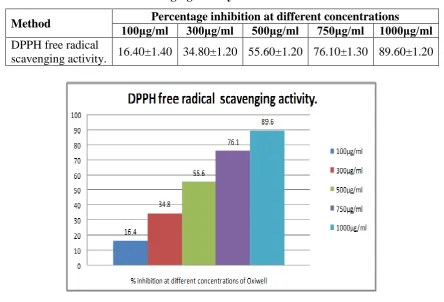
The potential to scavenge the DPPH free radical of the PHF, Oxiwell was not significant with
the various assayed concentrations of 100-1000 μg/ml. The inhibitory concentration (IC50) of
the PHF is found to be 415.92 μg/ml, which was not significant as compared to that of the
[image:7.595.78.523.222.524.2]positive control, which was 84.4 μg/ml.
Table 1: DPPH free radical scavenging activity.
Method Percentage inhibition at different concentrations
100μg/ml 300μg/ml 500μg/ml 750μg/ml 1000μg/ml
DPPH free radical
scavenging activity. 16.40±1.40 34.80±1.20 55.60±1.20 76.10±1.30 89.60±1.20
Graph-1: DPPH free radical scavenging activity.
Scavenging of the nitric oxide radical activity
Nitric oxide (NO) is an important chemical mediator generated by endothelial cells,
macrophages, neurons, etc and is involved in the regulation of various physiological processes.
Excess concentration of nitric oxide is associated with several diseases. Oxygen reacts with the
excess nitric oxide to generate nitrite and peroxy nitrite anions, which act as free radicals. The
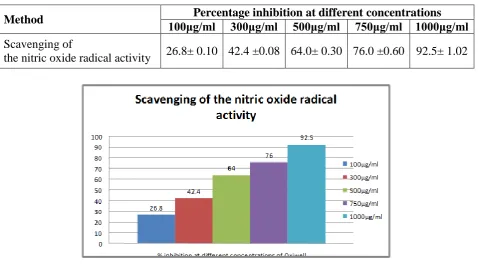
PHF, Oxiwell revealed that a potential significant inhibition of the nitric oxide free radical
scavenging activity, which was mainly concentration dependent with the inhibitory
concentration (IC50), at which there was a 50% free radical inhibition, was found to be 400
Table 2: Scavenging of the nitric oxide radical activity.
Method Percentage inhibition at different concentrations
100μg/ml 300μg/ml 500μg/ml 750μg/ml 1000μg/ml Scavenging of
the nitric oxide radical activity 26.8± 0.10 42.4 ±0.08 64.0± 0.30 76.0 ±0.60 92.5± 1.02
Graph 2: Scavenging of the nitric oxide radical activity.
Determination of reducing power
The reducing properties are generally associated with the presence of reductones, which have
been shown to exert antioxidant action by breaking the free radical chain by donating a
hydrogen atom. Reductones are also reported to react with certain precursors of peroxide, thus
preventing peroxide formation. The reducing power increased with increasing amount of the
extract of polyherbal formulation. The extract of the polyherbal formulation showed the
highest reducing ability of 74.41±1.67% at 1000 μg/ml.
Table 3: Determination of reducing power.
Method Percentage reducing ability at different concentrations
100μg/ml 300μg/ml 500μg/ml 750μg/ml 1000μg/ml
Determination of
Graph 3: Determination of reducing power.
Determination of Total Phenolic content
In estimation of total phenolic content, when the concentration was increased, absorbance
increased in both gallic acid and Polyherbal formulation.
Table 4: Determination of Total Phenolic content.
Methods Absorbance at 765 nm
100μg/ml 300μg/ml 500μg/ml 750μg/ml 1000μg/ml Gallic acid 00.56 00.94 01.20 01.60 01.92 PHF Oxiwell 00.20 00.38 00.55 00.68 00.82
Graph-4: Determination of Total Phenolic content.
Hydrogen peroxide scavenging activity
In determination of Hydrogen peroxide scavenging activity, when the concentration of PHF
Table-5. Hydrogen peroxide scavenging activity.
Method
Standard Polyherbal formulation(Oxiwell)
PO4buffer
(pH- 7.4) 100μg/ml 300μg/ml 500μg/ml 750μg/ml 1000μg/ml Absorbance
at 230 nm 01.85 00.65 00.96 01.33 01.64 01.80
Graph 5: Hydrogen peroxide scavenging activity.
DISCUSSION
Oxiwell is recommended in the management of oxidative stress associated with Coronary
artery disease, Diabetes mellitus, Oral submucous fibrosis and other conditions by inhibiting
oxidation reactions, thereby preventing the damage caused by free radicals.
The present investigation was performed to test the hypothesis “Does the PHF, Oxiwell have
any antioxidant activity by which it controls oxidative stress associated with Diabetes mellitus,
Oral submucous fibrosis and other pathological conditions. The alterations in the oxidant and
the antioxidant profile are known to be involved in the pathophysiology, thus affecting the cell
and its components, causing damage to them and releasing their products as markers.[16] Many
earlier studies have shown the influence of lipid peroxidation, oxidative stress and the
antiox-idant status on human body.[17-22]
The above data has shown that this PHF, Oxiwell have the antioxidant potential by which it
may controls oxidative stress associated with Diabetes mellitus, Oral submucous fibrosis and
CONCLUSION
The results of the current study suggests that the PHF, Oxiwell which contains medicinal herbs
such as the extracts of Mangifera indica, Withania somnifera, Daucus carota, Glycyrrhiza
glabra, Vitis vinifera, powders of Emblica officinalis and Yashada bhasma; and oils of
Triticum sativum, have good antioxidant potential. Thus, it may be concluded on the basis of
the current study that the medicinal herbs such as Mangifera indica, Withania somnifera,
Daucus carota, Glycyrrhiza glabra, Vitis vinifera, Emblica officinalis,Yashada bhasma; and
Triticum sativum may play an important role in the management of oxidative stress associated
with Coronary artery disease, Diabetes mellitus, Oral submucous fibrosis and other conditions
by inhibiting oxidation reactions. The current study appears to be the first to investigate
antioxidant potential of the poly herbal formulation Oxiwell from The Himalaya Drug
Company with respect to its total phenolic content, DPPH free radical scavenging activity,
Nitric oxide radical scavenging activity, Hydrogen peroxide scavenging activity, reducing
power, and oxidative stability. Thus, further studies are needed to confirm the result of the
current study and to evaluate the effects of Mangifera indica, Withania somnifera, Daucus
carota, Glycyrrhiza glabra, Vitis vinifera, Emblicaofficinalis, Yashada bhasma; and Triticum
sativum extracts in oxidative stress.
REFERENCES
1. Agbor AG, Ngogang YJ. Toxicity of herbal preparations. Cam. J. Ethnobot, 2005; 1:
23-28.
2. Aruoma, OI, Smith RC, Cecchini PJ, Halliwell B. Free radical scavenging and inhibition
of lipid peroxidation by beta-blockers and by agents that interfere with calcium
metabolism: A physiologicallysignificant process Biochem Pharmacol, 1991; 42: 735-743.
3. Rimbach G, Fuchs J, Packer L. Application of nutrigenomics tools to analyze the role of
oxidants and antioxidants in gene expression. In: Rimbach G, Fuchs J, Packer L (eds.),
Nutrigenomics, Taylor and Francis Boca Raton Publishers, FL, USA, 2nd edition, 2005;
11-24.
4. Gerschman R, Gilbert D, Nye SW, Dwyer P, Fenn WO. Oxygen poisoning and
X-irradiation: a mechanism in common. Nutrition, 2001; 17: 162-174.
5. Ashvin VD and Mishra SH. In-vitro antioxidant activity of an Adaptogenic Homeopathic
6. Manjamalai A, Berlin Grace VM. Antioxidant Activity of Essential Oils from Wedelia
chinensis (Osbeck) in vitro and in vivo Lung Cancer Bearing C57BL/6 Mice. Asian Pacific
J Cancer Prev., 2012; 13: 3065-3071.
7. Duda-Chodak A, Tarko T, Rus M .Antioxidant activity and total polyphenol content of
selected herbal medicinal products used in Poland. Herbs polonica, 2011; 57(1): 20-28.
8. Abdollahi M, Ranjbar A, Shadnia S, Nikfar S, Rezaiee A. Pesticides and oxidative stress:
A review. Med Sci. Monit, 2004; 10: 141-47.
9. Anja Klanc Nik, Bernarda Guzej, Majda Hadolin Kolar, Helena Abramovic And Sonja
Smole Moz Ina. In Vitro Antimicrobial and Antioxidant Activity of Commercial Rosemary
Extract Formulations. Journal of Food Protection, 200; 72(8): 1744–1752.
10.Ilalenti A, Moncada S, Di Rosa M. Modulation of adjuvant arthritis by endogenous nitric
oxide. Brit J Pharmacol, 1993; 110: 701-706.
11.Megha Jha, Ganesh N, Varsha Sharma. In vitro Evaluation of Free Radical Scavenging
Activity of Pistia stratiotes, International Journal of ChemTech Research, 2010; 2(1):
180-184.
12.Al-Nimer MSM, Ali EA. The dual effects of the interaction between meloxicam,
diclofenac sodium or tramadol and the nitrogen species radicals: An in vitro comparative
study. Int. J. Pharmacol, 2009; 5: 86-89.
13.Kahkonen MP, Hopia AI, Heikki JV, Rauha JP, Pihlaja K, Kujala TS, Heinonen M.
Antioxidant activity of plant extracts containing phenolic compounds. J Agric Food
Chem., 1999; 47: 3954–3962.
14.Yu-Ling HO, Shyh-Shyun HUANG, Jeng-Shyan DENG, et al; In vitro antioxidant
properties and total phenolic contents of wetland medicinal plants in Taiwan. Botanical
Studies, 2012; 53: 55-66.
15.Charalampos Proestos, Konstantina Lytoudi, Olga Konstantina Mavromelanidou,
Panagiotis Zoumpoulakis and Vassileia J. Sinanoglou. Antioxidant Capacity of Selected
Plant Extracts and Their Essential Oils. Antioxidants, 2013; 2: 11-22.
16.Valko M, Rhodes CJ, Moncol J, Izakovic M, Mazur M. Free radicals, metals, and
antioxidants in oxidative stress induced cancer. Chem Biol Interact., 2006; 18: 131-35.
17.Decker EA, Warner K, Richards MP, Shahidi F. Measuring antioxidant effectiveness in
food. J Agric Food Chem., 2005; 53: 4303-4310.
18.Elhoussine derwich, Rachida Chabir, Rachid Taouil, Omar Senhaji. In-vitro Antioxidant
Activity and GC/MS Studies on the Leaves of Mentha piperita (Lamiaceae) from Morocco.
19.Hoyle CHV and Santos J H. Cyclic voltammetric analysis of antioxidant activity in citrus
fruits from Southeast Asia. , International Food Research Journal, 2010; 17: 937-946.
20.Jiri Sochor, Jiri Dobes, Olga Krystofova, et al. Electrochemistry as a Tool for Studying
Antioxidant Properties. Int J Electrochem Sci., 2013; 8: 8464–8489.
21.Pradnya Onkar, Jitendra Bangar and Revan Karodi. Evaluation of Antioxidant activity of
traditional formulation Giloy satva and hydroalcoholic extract of the Curculigo orchioides
gaertn. Journal of Applied Pharmaceutical Science, 2012; 02(06): 209-213.
22.Sajeeth CI, Manna PK, Manavalan R. Antioxidant Activity of Polyherbal Formulation on
Streptozotocin Induced Diabetes in Experimental Animals. Der Pharmacia Sinica, 2011;