On the Performance of the Cache Coding Protocol
Behnaz Maboudi1, Hadi Sehat1, Peyman Pahlevani1* and Daniel E. Lucani2
1 Institute of Advanced Studies in Basic Sciences (IASBS); {behnazmaboudi, h.sehat, pahlevani}@iasbs.ac.ir 2 Aarhus University; [email protected]
* Correspondence: [email protected] Tel.: +98-24-3315-3436
Abstract:Network coding approaches typically consider an unrestricted recoding of coded packets in the relay nodes for increased performance. However, this can expose the system to pollution attacks that cannot be detected during transmission, until the receivers attempt to recover the data. To prevent these attacks while allowing for the benefits of coding in mesh networks, the Cache Coding was proposed. This protocol only allows recoding at the relays when the relay has received enough packets to decode an entire generation of packets. At that point, the relay node recodes and signs the recoded packets with its own private key allowing for the system to detect and minimize the effect of pollution attacks and make relays accountable for changes on the data. This paper analyzes the delay performance of Cache Coding to understand the security-performance trade-off of this scheme. We introduce an analytical model for the case of two relays in an erasure channel relying on an Absorbing Markov Chain and a approximate model to estimate the performance in terms of the number of transmissions before successfully decoding at the receiver. We confirm our analysis using simulation results. We show that Cache Coding can overcome security issues of unrestricted recoding with only a moderate decrease in system performance.
Keywords:Cache Coding, Source Coding, Absorbing Markov Chain
1. Introduction
Mobile Ad-hoc Networks (MANET) constitute an infrastructure-less network architecture for mobile devices. In MANETs, network coding has been shown to increase reliability and throughput [19]. In network coding, data is encoded in a sender and transmitted through a network to be decoded at one or multiple receivers. Intermediate nodes in the network can also recombine coded packets (recode) without decoding the original data. Network coding can be considered as a generalized routing, in which relay nodes not only store and forward packets but also combine packets received from multiple input paths before sending to any output path [1][2]. Random Linear Network Coding (RLNC) is a simple, yet asymptotically optimal method, where packets are linearly combined using random coefficients drawn uniformly at random from the elements of a finite field [1] and then transmitted [3].
However, RLNC with unrestricted and unsupervised recoding is vulnerable to pollution attacks. A pollution attack occurs when a malicious or faulty node injects invalid linear combinations of generation into the network [16]. These invalid coded packets can quickly propagate into other packets via recoding in relay nodes and can prevent destination node from decoding properly [11]. To prevent them, homomorphic signatures, which are preserved through linear combination and recoding, can be used [4] [5] [7]. These method allow the system to check integrity of network coded data and to track and find malicious nodes in the network However, due to high processing cost, this method is not practical [11]. While there exists alternatives for preventing pollution attacks with reduced processing costs, these solutions place limitations on topologies, require loose clock synchronization on the order of 100 ms, limit the hop count, require large field sizes or demand new public keys generated per generation. These requirements are not feasible in dynamic MANET networks. Thus, new integrity mechanism to mitigate pollution attacks [10].
As an alternative, the authors of [16] proposed a protocol solution called Cache Coding. Cache Coding allows certified relay nodes to recode data only when they have decoded an entire generation.
At that time, the relay nodes can generate new recoded packets and sign them with their own identifier. This generates trusted packets from both the data source and the trusted relay nodes, thus allowing the network to detect pollution attacks before they propagate.
Although [16] presents the protocol to cope with this vulnerability and identifies some bounds on the number of transmissions, a precise analytical model to characterize the performance of Cache Coding in multi-relay networks is missing. This performance analysis is critical to understand the security-delay trade-off imposed by the protocol. This paper provides two models for analysis of the Cache protocol The first model is a simple, yet accurate approximation to predict the number of required transmissions. The second model is based on an Absorbing Markov Chain inspired by previous work, e.g., [12], and is used to accurately characterize the total number of transmissions in the system as well as the number of linearly independent packets in all nodes after some constant transmissions from the source node. Although we focus on a simple relay policy from the Cache Coding protocol, future work can exploit the Markov Chain structure of the problem to derive optimal policies using Markov Decision Processes (MDP) as in recent RLNC work, e.g., [15], [17], [18].
We validate our analytical models using simulation results showing the difference between the Absorbing Markov Chain model and the simulation results is negligible for all analyzed generation sizes and packet loss rates. For moderate loss rates, at most 10 % deviation is expected between our heuristic model and the simulation results. However, the heuristic model losses accuracy for high loss rates. Finally, we show that the Cache Coding protocol is at most 25 % worse than RLNC with unrestricted recoding in terms of the number of transmissions. However, in average there is only 7 % deviation between Cache Coding and Unrestricted Coding.
This paper is organized as follows. In Section 2, we discuss system model and different coding methods in relay nodes. In Sections 3 and 4 we discuss our two analytical models, while Section 5 focuses on validating those models using simulation results. We present our conclusions in Section 6.
2. System Model
We consider a topology with one source nodeS, two relay nodesR1andR2, and a destination nodeD. A total number ofnpackets must be sent fromStoD. This transmission occurs by using the links shown in Figure1. Each link has a fixed packet loss rate,e, which are considered constant throughout the transmission and independent from each other.
We define aDegree of Freedom(DoF) of a node as the number of linearly independent packets received by that node. In any topology, the transmission will be carried on untilDoFof the destination node is equal to generation size, i.e., when the destination has enough information to decode the original data. We also define thegeneration size(npackets) as the number of original data packets that will be linearly combined to generate network coded packets.
Sgenerates packets using RLNC. It uses data packetsp1,p2,...,pnin the generation to create a linear combination with coding coefficientsa1,a2,...,an, i.e.,∑ni=1aipi. These coefficients are randomly selected fromqelements of a Galois Field, i.e.,GF(q)[15].
𝑅1
𝑅2
𝑆 𝐷
𝝐 𝝐
𝝐 𝝐
Figure 1.The topology of a two-relay network
broadcast toD, respectively. We assume a shared channel between all nodes for sending data in this topology and the use of a TDMA protocol is used to manage each node’s access to this shared channel.
Source Tx
𝑅1
Rx 𝑅2
Rx 𝑅1
Tx 𝑅2
Tx
Time
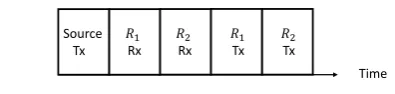
Figure 2.A transmission round
We assume that whenever a relay node receives a packet, it is permitted to transmit a packet. This packet is determined by one of the following three coding methods.
Source Coding (C−C)
Upon reception of a transmission fromS,R1and/orR2send a packet toDwhich is identical to the packet received fromS. Thus, theDreceives only one independent packet if it receives packets from more than one relay in the same time slot. Repeated coded packets are discarded.
Unrestricted Coding(U−C)
In this method,R1andR2receive encoded packets fromS.R1andR2recode packets with previously received coded packets in each relay’s buffer and send the newly generated recoded packet toD. Each relay transmits a recoded packet when they receive a coded packet fromS.
Cache Coding (C−C)
In this method,R1andR2will act like the Source Coding method until itsDoFis equal to the generation size (n). Then, the relay will decode all received packets. After decoding all packets, the mentioned relay will recode the original packet and send recoded data toD. This mechanism continues until the end of transmission, whereDoFofDis equal to generation size (n).
3. Heuristic
This section derives an approximation to evaluate the performance of the three coding methods described in Section2in a system with the topology of Figure1. We address each method in different subsections. We focus on the number of transmissions from the source untilDdecodes a generation of npackets as well as the total number of transmissions in all links in the network.
3.1. Source Coding
The probability that a packet is received byDfrom eitherR1orR2or bothR1andR2is
Pr =2(1−e)2. (1)
As a new packet is innovative inDif and only if it is received from only one of the relays, then we need to subtract probability of receiving a packet from bothR2andR2from Equation (1) The probability that a packet is received byDfrom bothR1andR2is equal to(1−e)4. Thus, the probability of receiving a linearly dependent packet byDis
Pindep =2(1−e)2−(1−e)4. (2) Using Equation (2), the number of required transmissions from S to decode the generation completely inDis
transmission round includes a transmission fromS, therefore this metric equals the total number of transmission rounds in the system.
The total number of transmissions in all links requires us to also determine the number of transmissions from each relay. As each relay transmits a packet if and only if it receives a packet fromS, the number of transmissions from each relay is equal tok(1−e). Hence, the total number of transmissions in all links is
Tsc=2ksc(1−e) +ksc. (4)
Note that the number of linearly dependent packets received inD, i.e., coded packets received by Dfrom bothR1andR2in the case of this scheme, is given by
LDsc=ksc.(1−e)4. (5)
3.2. Unrestricted Coding
The approximations derived for number of transmission rounds and total number of transmissions in this Section are achievable lower bounds to the real value. Our assumption is that the system operates in optimally, i.e., each transmitted coded packet is linearly independent forDas well as for the joint information of both relays. The latter means that if a transmission from the source is successfully received by at least one receiver and it increases the joint DoFs of the relays, then it is considered a useful transmission. Although this optimal scheme is achievable, from a practical perspective it may impose increased signaling requirements in the network. Practical schemes will require the same or more coded packet transmissions.
The total number of transmissions fromStoR1andR2is kuc= n
1−e2, (6)
while the total number of transmissions fromR1andR2toDuntilDcan decode the whole generation is
k0uc = n
1−e. (7)
Using Equation (6) and (7), results in the total number of transmissions in all links being
Tuc= n(2−e)
(1−e)2. (8)
3.3. Cache Coding
For the Cache Coding protocol, the total number of transmissions from all links can be separated in three separate contributions, as follows
1. The number of transmissions fromStoR1andR2until the relays decode the generation is equal to 1n−e.
2. The number of transmissions fromR1andR2toDuntil they have decoded the whole generation is equal to 2n.
3. The number of transmissions fromR1andR2toDafter they have decoded the whole generation is equal to
n−∑n
i=0(1−e).n.ei 1−e
Summing these three equations, we can calculate total number of transmissions in the whole system as
Tcc= n
e +2n+ n−∑n
i=0(1−e)nei
While the total number of transmission rounds in the system is
kcc= n
e + n−∑n
i=0(1−e)n.ei
2.(1−e) , (10)
where we have used the three different contributions as well. The key difference is that the number of transmission rounds beforeR1andR2have decoded the data is equal to number of transmissions fromStoR1andR2, i.e.,1−ne, and the fact that the number of transmission rounds after the relays have decoded the data is equal to number of transmissions from theR1andR2toDdivided by number of relays.
In order to determine the number of linearly dependent packets inR1andR2, we use the fact that number of packets received byR1orR2is equal ton(1−e)and that the number of packets received by only one of them is equal tone(1−e). Thus, the number of dependent packets is equal to subtraction of these two equations.
LDcc=n(1−e)2. (11)
4. Absorbing Markov Chain Model
This section provides a full characterization of the Cache Coding protocol using an analytical model based on an Absorbing Markov Chain. We define the states as a triple(r1,r2,r), wherer1and r2are theDoFs inR1andR2, respectively, andrrepresents theDoFs inD. Note thatr1+r2 ≥ r based on these states. The absorbing states are the states wherer=n. This absorbing Markov Chain will also include a cost matrixCalongside the matrix of transition probabilitiesA. Cijis the total number of transmissions in all links required for the transition between statesiandj. We have derived closed-form expressions for each element of these two matrices.
4.1. Transition Probabilities
The transition probabilities between states S = (r1,r2,r)and S0 = (r1+1,r2+j,r+k)are dependent on the the Cache Coding protocol’s stage in the communication process. Thus, we organize the transition probabilities into five cases as follows.
1. r1≤n−1 andr2≤n−1
No single relay node has decoded the data or decodes the data after receiving the new coded packet. Thus, both relays receives the coded packet and forward the received packet toD. Thus,
PS →S0 =
e.(1−e)2 ifi=1 andj=0 andk=1 e.(1−e)2 ifi=0 andj=1 andk=1
(1+e).(1−e)3 ifi=1 andj=1 andk=1 e2.(1−e) ifi=1 andj=0 andk=0 e2.(1−e) ifi=0 andj=1 andk=0 e2.(1−e)2 ifi=1 andj=1 andk=0 e2 ifi=0 andj=0 andk=0
0 Otherwise
2. r1=n−1 andr2≤n−1 orr1≤n−1 andr2=n−1
PS →S0 =
e.(1−e)2 ifi=1 andj=0 andk=1 e.(1−e)2 ifi=0 andj=1 andk=1 2e.(1−e)3 ifi=1 andj=1 andk=1 e2.(1−e) ifi=1 andj=0 andk=0 e2.(1−e) ifi=0 andj=1 andk=0 e2.(1−e)2 ifi=1 andj=1 andk=0 e2 ifi=0 andj=0 andk=0
(1−e)4 ifi=1 andj=1 andk=2
0 Otherwise
3. r1=nandr2<n
In this case,R1recodes and sends data toD, whileR2forwards the received coded packets. Even ifR2receives a new packet and decodes data completely(The caser2=n−1), it recodes data and sends a recoded packet to destination, which is different from the packet sent byR1. The difference between this case and case 2 is the fact thatR1sends a recoded packet toDwhether or not it receives a packet fromS. How ever this event does not occur in case 2. Thus,
PS →S0 =
(1−e)3 ifi=0 andj=1 andk=2 2e.(1−e)2 ifi=0 andj=1 andk=1
(1−e).e2 ifi=0 andj=1 andk=0 e2 ifi=0 andj=0 andk=0 e.(1−e) ifi=0 andj=0 andk=1
(1−e2).(1−e) ifi=0 andj=1 andk=1 andr=n−1
0 Otherwise
4. Case 4 :r1<nandr2=n
In this case,R2recodes and sends data toD, whileR1forwards the received coded packets. Even ifR1receives a new packet and decodes data completely(The caser1=n−1), it recodes data and sends a recoded packet to destination, which is different from the packet sent byR2. The difference between this case and case 2 is the fact thatR2sends a recoded packet toDwhether or not it receives a packet fromS. How ever this event does not occur in case 2. Thus,
PS →S0 =
(1−e)3 ifi=1 andj=0 andk=2 2e.(1−e)2 ifi=1 andj=0 andk=1
(1−e).e2 ifi=1 andj=0 andk=0 e2 ifi=0 andj=0 andk=0 e.(1−e) ifi=0 andj=0 andk=1
(1−e2).(1−e) ifi=1 andj=0 andk=1 andr=n−1
0 Otherwise
5. Case 5 :r1=nandr2=n
PS →S0 =
e2 ifi=0 andj=0 andk=0 2e.(1−e) ifi=0 andj=0 andk=1
(1−e2) ifi=0 andj=0 andk=2
0 Otherwise
4.2. Cost of transitions
The cost of any transition are 0, 1 or 2 depending on number of broadcast transmissions that occur. Using the cases introduced in Subsection4.1, we can derive the cost of transitions
1. r1≤n−1 andr2≤n−1
CS →S0=
2 ifi=1 andj=0 andk=1 2 ifi=0 andj=1 andk=1 3 ifi=1 andj=1 andk=1 2 ifi=1 andj=0 andk=0 2 ifi=0 andj=1 andk=0 3 ifi=1 andj=1 andk=0 1 ifi=0 andj=0 andk=0 0 Otherwise
2. r1=n−1 andr2≤n−1 orr1≤n−1 andr2=n−1
CS →S0=
2 ifi=1 andj=0 andk=1 2 ifi=0 andj=1 andk=1 3 ifi=1; andj=0 andk=0 2 ifi=0 andj=1 andk=0 3 ifi=1 andj=1 andk=0 1 ifi=0 andj=0 andk=0 3 ifi=1 andj=1 andk=2 0 Otherwise
3. r1=nandr2<n
CS →S0 =
3 ifi=0 andj=1 andk=2 3 ifi=0 andj=1 andk=1 3 ifi=0 andj=1 andk=0 2 ifi=0 andj=0 andk=0 2 ifi=0 andj=0 andk=1
4. r1<nandr2=n
CS →S0 =
3 ifi=1 andj=0 andk=2 3 ifi=1 andj=0 andk=1 3 ifi=1 andj=0 andk=0 2 ifi=0 andj=0 andk=0 2 ifi=0 andj=0 andk=1
3 ifi=1 andj=0 andk=1 andr=n−1 0 Otherwise
5. r1=nandr2=n
CS →S0=
2 ifi=0 andj=0 andk=0 2 ifi=0 andj=0 andk=1 2 ifi=0 andj=0 andk=2 0 Otherwise
4.3. Performance Analysis using the Markov Chain
4.3.1. Calculation of number of transitions
After establishing all transition probabilities in a transition matrix, we can build the fundamental matrixFas follows [20]:
F= "
Ir×r Zr×t Rt×r Qt×t,
#
where,tis number of transient (non-absorbing) states andris number of absorbing states.Qis the matrix of transition probabilities between transient states.Ris the matrix of transition probabilities from transient states to absorbing states. Iis the identity matrix andZis an all-zero matrix. After building this matrix, the mean number of transitions can be calculated using Definition 1.
Definition2. The mean number of transitions before being absorbed when starting in a transient state i, is the ithelement of the column vector
M= (I−Q)−1Γ,
where I is the identity matrix with same dimensions as Q andΓis all-one vector.[23] 4.3.2. Calculation of number of transmissions from all nodes
The number of transmissions from all node is calculated using both transition matrixAand cost matrixC.
Definition2. For an absorbing Markov Chain in state i, the mean number of transmissions in its next transition is equal to[22]
E[Tri] =
n
∑
j=0 AijCij
Theorem 1. For an absorbing Markov chain with state probabilityπ, the mean number of transmissions in
next transition is equal to
E[Tr] =π(A.C)Γ,
Proof-sketch of Theorem 1. Using Definition 2, for a system in state I, average number of transmission is equal to∑n
i=0Aij.Cij. Asπishows the probability for the system to be in state i; So average number of transmissions in system equal to∑ni=0pii∑nj=0Aij.Cij.
5. Results
In this section, we assess the validity of proposed models and compare the three recoding schemes using various performance measures. We simulate the topology of Figure1using the KODO library [21] in C++ to perform encoding/decoding operations. We have carried 1000 independent experiments for each generation size and packet loss rate and report the average of this measurements. This experiments were carried out by using GF(28) for encoding/decoding operations.
We have calculated the total number of transmissions in Source Coding. Using equation (4) in our heuristics, we can approximate the total number of transmission in all links for Source Coding. Figure3compares simulation results with our heuristics, showing that the approximated model can estimate this metric within 10 % of the real value for a wide range of generation sizes and packet loss rates. This difference comes from the fact that additional transmissions fromSto bothR1andR2occur, while these packets are not innovative forD.
Figure 3.Average number of transmissions in all links in Source Coding
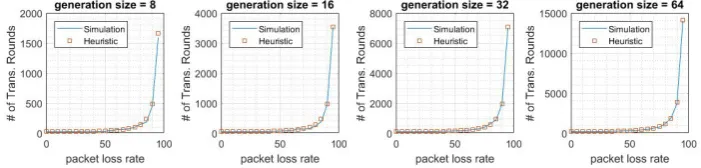
Figure4shows the total number of transmissions in all links for Unrestricted Coding. This figure shows that our heuristic model has at most 20 percent deviation with simulation results for all generation sizes and packet loss rates. However in moderate loss rate, there is only 10 percent derivation between simulation and heuristic results. This gap is created because the heuristic is a lower bound for Unrestricted Coding.
Figure 4.Average number of transmissions in all links in Unrestricted Coding
Figure 5.Average number of transmission rounds in Cache Coding
Figure 6.Average number of transmissions in all links in Cache Coding
Table 1.Total Number of transmission rounds in Cache Coding
Generation Size error = 0.5 error = 0.75
simulation Heuristic Markov simulation Heuristic Markov
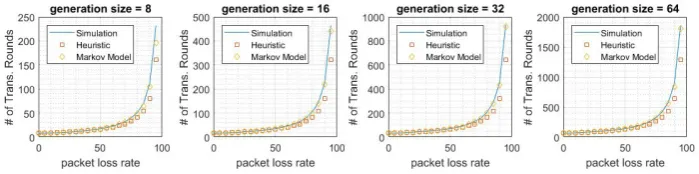
8 10.4695 10.854200 10.387300 40.071900 32.562500 37.576200 16 21.913100 21.708300 21.261800 79.952000 65.125000 76.481200 32 44.574400 43.416700 43.685100 158.715000 130.250000 152.631800 64 89.816200 86.833300 84.539200 322.970000 260.500000 308.481900
Table 2.Total Number of transmissions in all links in Cache Coding
Generation Size error = 0.5 error = 0.75
simulation Heuristic Markov simulation Heuristic Markov
8 26.373600 27.333300 26.527300 69.231800 66.000000 68.246300 16 54.644400 54.666700 54.638100 135.878000 132.000000 134.491700 32 112.070000 109.333000 111.984200 268.762000 264.000000 265.871200 64 226.947000 218.667000 223.247100 534.164000 528.000000 528.796300
Figures7and8show the number of linearly dependent packets received inDfor Cache Coding and Source Coding, respectively. As shown, this number decreases by increasing packet loss rate. This comes from the fact that there is a lower probability of receiving the same packets byR1andR2in higher packet loss rates, which decreases the probability of receiving non-innovative packets inD.
Figure 8.Number of linearly dependent packets inDin Source Coding
We also compare the performance of Cache Coding and Unrestricted Coding. In Figures9and10 we show the average number of transmissions in all links for these coding schemes. The results for simulation confirm that Cache Coding is only 7 % worse than Unrestricted Coding in terms of total number of transmissions in worst case. This gap is larger for results of heuristic. There is at most 12 % derivation in heuristic models of Unrestricted Coding and Cache Coding.
Figure 9.Average number of transmissions in Cache Coding and Unrestricted Coding by simulation results
Figure 10.Average number of transmissions in Cache Coding and Unrestricted Coding by Heuristic results
6. Conclusions and Future Work
This paper presents a model and full characterization for the Cache Coding protocol presented in [16] as well as an approximated, yet accurate model for this and other protocols of interest. This analysis also considers an achievable lower bound for the number of transmissions in the network, which serves as the gold standard to measure various protocols, including the Cache coding protocol. Using our models and simulation results, we have confirmed that the Cache Coding protocol, which is originally designed to overcome the security issues of Unrestricted Coding, can overcome the security issues with negligible decrease in performance in the two-relay system analysed in this paper. Although this fact had been shown by simulations [16], our paper provides the first confirmation using analytical models to describe the system.
Our future work will consider closed-form expressions for other performance metrics, such as number of linearly dependent packets received by the Destination Node. Future work will consider extensions of the analytical model to systems with more than two relays.
Sehat and Behnaz Maboudi. Hadi Sehat was responsible for writing and editing the paper using Behnaz’s help. The analysis and simulation were taken under supervision of Dr. Pahlevani and Dr. Lucani.
Conflicts of Interest:The authors declare no conflict of interest.
References
1. Ahlswede, R.; Cai, N.; and YENG, R.W., Network information flow.IEEE T Inform Theory,200046.41204-1216, doi:10.1109/18.850663.
2. Koetter, R.; Medard, M., An algebraic approach to network coding. IEEE ACM T Network, 200346.4 782-795,doi:10.1109/TNET.2003.818197.
3. Ho, T.; Medrad, M.; Koetter, D.; Karager, D.R., A Random Linear Network Coding Approach to Malticast. IEEE T Inform Theory,200611.54413-4430,doi:10.1109/TIT.2006.881746.
4. Lee, S.H; Gerla, M.; Krawczyk, H.; Lee, K.W.; Quaglia, E., Performance evaluation of secure network coding using homomorphic signature. InProceedings of International Symposium on Network Coding, Beijing, China, 25-27 July 2011, pp.1-6.
5. Gennaro, R,; Katz, J.; Krawczyk, H.; Rabin, T.,Secure network coding over the integers. InProceedings of 13th International Conference on Practice and Theory in Public Key Cryptography, Paris, France, 26-28 May 2010, pp. 142–160.
6. Boneh, D.; Freeman, D.; Katz, J.; Waters, B.,Signing a linear subspace: Signature schemes for network coding. InProceedings of 12th International Conference on Practice and Theory in Public Key Cryptography, Irvine, CAL, USA, 18-20 March 2009, pp. 68–87.
7. Agrawal S.; Boneh D.,Homomorphic MACs: MAC-Based Integrity for Network Coding. InProceedings of 7th Applied Cryptography and Network Security. ACNS 2009, Paris-Rocquencourt, France, 2-5 June 2009, pp. 292-305.
8. Zhao, F.; Kalker, T.; Medard, M.; Han, K. J.,Signatures for content distribution with network coding. In Proceedings of IEEE International Symposium on Information Theory, ISIT 2007, Nice, France, 24-29 June 2007, pp. 556-560.
9. Han, K.; Ho, T.; Koetter, R.; Medard, M.; Zhao, F., On network coding for security. InProceedings of Military Communications Conference, MILCOM 2007, Orlando, FL, USA, 29-31 October 2007, pp. 1-6.
10. Dong, J.; Curtmola, R.;Nita-Rotaru, C., Practical defenses against pollution attacks in intra-flow network coding for wireless mesh networks. InProceedings of the second ACM conference on Wireless network security, Zurich, Switzerland, 16-19 March 2009, pp. 111-122.
11. Esfahani, A.; Mantas, G.;, Rodriguez, J.; Neves, J. C. ,An efficient homomorphic MAC-based scheme against data and tag pollution attacks in network coding-enabled wireless networks.INT J INF SECUR,201716.6 4413-4430, doi:10.1007/s10207-016-0351-z.
12. Lucani, D. E.; Médard, M.; Stojanovic, M., Broadcasting in time-division duplexing: A random linear network coding approach. InProceedings of Network Coding, Theory, and Applications, 2009. NetCod’09, Lausanne, Switzerland, 15-16 June 2009, pp. 62-67.
13. Tsimbalo, E.; Tassi, A.; Piechocki, R. J., Novel Performance Analysis of Network Coded Communications in Single-Relay Networks. InProceedings of Global Communications Conference (GLOBECOM), 2016 IEEE, Washington, DC, USA, 4-8 December 2016, pp. 1-6.
14. Tsimbalo, E.; Tassi, A.; Piechocki, R. J., Reliability of Multicast under Random Linear Network Coding. In arXiv preprint, arXiv preprint arXiv:1709.05477.
15. Khamfroush, H.; Pahlevani, P.; Lucani, D. E., Hundeboll, M., On the coded packet relay network in the presence of neighbors: Benefits of speaking in a crowded room. InProceedings of IEEE International Conference on Communications (ICC), 2014, Sydney, Australia, 10-14 June 2014, pp. 1928-1933.
16. Joy, J.; Yu-Ting, Y.; Perez, V.; Lu, D.; Gerla, M., A new approach to coding in content-based MANETs. In Proceedings of 2014 International Conference on Computing, Networking and Communications (ICNC), Honolulu, HI, USA , 3-6 February 2014, pp. 173-177.
17. Khamfroush, H.; Lucani, D.E.; Pahlevani, P.; Barros, J., On optimal policies for network-coded cooperation: Theory and implementation.IEEE J SEL AREA COMM,201533.2199-212, doi:10.1109/JSAC.2014.2384291. 18. Khamfroush, H.; Lucani, D. E.; Barros, J.; Pahlevani, P., Network-Coded Cooperation Over Time-Varying
19. Zhang, C.; Fang, Y.; Zhu, X., Throughput-Delay Tradeoffs in Large-Scale MANETs with Network Coding IEEE INFOCOM 2009 2009 Rio de Janeiro, Brazil, 19-25 April 2009, pp.199-207, doi: 10.1109/INFCOM.2009.5061922.
20. Kemeny, J. G.; Snell J. L.; et al., Finite markov chains.van Nostrand Princeton,356, NJ, US, 1960.
21. Pedersen, M. V.; Heide, J.; Fitzek, F. H., Kodo: An open and research oriented network coding library. In International Conference on Research in Networking, Springer, Berlin, Heidelberg, 9 May 2011, pp. 145-152. 22. Lucani, D. E.; Medard, M.; Stojanovic, M. On coding for delay—Network coding for time-division duplexing.
IEEE Transactions on Information Theory,2012,58.4, pp. 2330-2348.