EXPLORING THE PROBLEMATICAL NATURE OF
BUILDING PERFORMANCE FOR BIM
REPRESENTATION
Mohammad Mayouf1 and David Boyd2
1School of Built Environment (Birmingham City University), Birmingham-West Midlands, B4 7XG 2 School of Built Environment (Birmingham City University), Birmingham-West Midlands, B4 7XG
Building performance has been of interest for many years to facilitate better the operation of buildings and to prevent buildings not working as intended. Approaches include Building Performance Evaluation, Post Occupancy Evaluation and Total Building Performance. The advent of Building Information Modelling (BIM) has driven a desire to accommodate building performance into models for use during design. This paper will review the suitability of the various approaches to Building Performance for this task. It will argued that to be successful for this then a multiple perspective analysis is required to accommodate users, facilities managers and designers viewpoints of performance. It will be concluded with a discussion on the possibilities of this and the research required to demonstrate it.
Keywords: BIM, Building Performance, Post-occupancy evaluation, Building performance evaluation, Total building performance
INTRODUCTION
Building performance has been an area of major research interest to understand its nature (Gross, 1996). This interest in building performance has been driven by the fact that buildings do not always (or often) work as intended. Thus, there was a need to establish approaches that can help to measure and evaluate the performance of buildings. The first approaches to this determined building occupants’ satisfaction of the building they worked in and was commonly known as Post-occupancy evaluation. Other research, such as BPE (building performance evaluation) and TBP (Total building performance) sought much more pro-active approaches to accommodate the whole building life cycle. These approaches have not been fully adopted because they are time consuming, costly and are difficult to understand because of the complexity and amount data. These techniques also suffer because, to analyse the building, it has already to be designed and constructed with any inadequacies built in. What is required is an approach which can manage the complexity of building performance analysis during design.
simulate several aspects (e.g. amount of sun light) which affect the building externally and internally. These are very limited aspects of building performance.
This paper will review the different approaches to building performance and analyse how they can be implemented in a BIM design environment. It will identify that the physical aspects of buildings that BIM excels in does not adequately represent building performance. In reviewing the success of buildings it is identified that as well as these physical aspects that designers can address, buildings need to be manageable in the long term and this is addressed by facilities managers and to be comfortable for users. Thus the successful performance of a building as it is realised is a result the multi-perspective of the designer, facility manager and occupants of the building. The paper explores these multiple perspectives from the literature and presents research that will contribute to their inclusion in BIM representations.
BACKGROUND TO BUILDING PERFORMANCE
Over the years, the concept of evaluating building performance has been
undertaken by many researchers (Wong and Jan, 2003). Davies (1990) claimed that it is critical to generalize a definition of building performance which can match various interdisciplinary views met by contractors, managers, owners, engineers, architects, programmers and policy makers. All approaches to building performance recognise that it requires calculative aspects associated with the building form and fabric in its location and indeterminate aspects associated with the way the people in the building perceive it and experience it in their activities. According to Duffy (1990), buildings are typically evaluated based on the perception of measuring output (e.g. design awards for the architect) where another perception of evaluating performance is observing the behaviour of the product in use (Douglas, 1996). It is argued by Cooper (2001) that performance of the building can only be evaluated after it has been
occupied to understand if the building is truly effective. In support of this, approaches like Post-occupancy evaluation (POE) have been developed where it’s aim is to deliver an ideal building that can satisfy occupants (Khan and Kotharkar, 2012) . However, although this approach has successfully been implemented, a need for pro-active approaches was necessary like Building Performance Evaluation (BPE) and Total Building Performance (TBP). This section will explain these techniques as the most commonly used for evaluating building performance.
Post-Occupancy Evaluation (POE)
Preiser, (1989) claimed that POE was introduced in response to significant
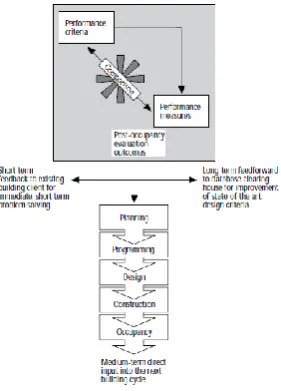
problems faced within building performance in 1960s, and emphasised the occupants’ perspective as shown in figure 1 (Preiser, 1995). The concept of POE is based on the assumption that buildings are built to enhance and support occupants’ goals and
activities. Preiser et al. (1988) definition of POE is:
Moreover, Vischer (2001) stated that POE identified architectural and social problems that arose in a building through a systematic assessment of the physical environment in terms of how people were using them. It was not until later that POE was seen as a mechanism for collecting useful information for the building industry which could impact on design and construction for the long term (Preiser and Vischer, 2005). Thus the RIBA (1991) could claim that building performance evaluation using POE results in delivering invaluable information about the design performance of the building.
Figure 1: Performance concept in the building Delivery Process (Preiser, 1995)
Building Performance Evaluation (BPE)
BPE has been evolved from POE (Preiser et al., 1988). The basic approaches of
BPE were presented by Preiser (1989) in his book Building Evaluation. Preiser (1989)
believed that there was a need to broaden the range of decision makers and improve quality of decisions in buildings by providing an evaluation which has interfaces with all phases of building delivery (Preiser and Schramm, 1997). BPE is defined as the systematic approach to comparing the actual performance of buildings, places and systems to their expected performance (Preiser and Vischer, 2005). It adopts a
process-oriented approach that accommodates relational concepts. This implies that it can be applied to any type of building or environment (Preiser and Vischer, 2005). The goal then of BPE is to improve the decision quality at every phase of the building life cycle (see figure 2) from planning to programing, design and construction, to facility management and adaptive reuse. Using an Activation Process Model (Preiser, 1997), BPE presents a holistic, process-oriented approach towards building
Figure 2: Building Performance Evaluation (BPE) process model (Preiser and Vischer, 2005)
Total Building Performance (TBP)
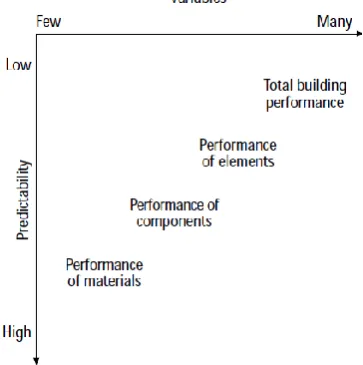
Total Building Performance is the most comprehensive tool for evaluating buildings in use and considers performances on many different levels (see figure 3) (Douglas, 1996). The two other approaches to measuring performance in buildings limited their analysis to calculative aspects of: noise control, fire safety, thermal efficiency and internal air quality. This approach drove an expanded understanding of the importance of the critical balance that is required to fulfil successful building performance (Douglas, 1996). In addition, total building performance addressed a growing need for an effective future prediction of the performance of a building.
Figure 3: Total building performance compared with other performances (Douglas, 1996)
The TBP framework identifies and evaluates all performance areas (Wong and Jan, 2003). It consists of six performance measurements: spatial performance, acoustic performance, thermal performance, indoor air quality, visual performance and
sociological, physiological and economic needs for users’ satisfaction (Low et al., 2008). TBP provides the needs of the users by considering several building mandates simultaneously in order to achieve a healthy environment which will facilitate the
functioning of the space for the occupants (Low et al., 2012).
BIM CONTRIBUTIONS TOWARDS BUILDING PERFORMANCE
Information technology has helped to solve several complex issues through structuring problems and providing simple interfaces with people and working in a real time environment (Gleick 2011). The use of information technology in the construction industry has been accelerated with the availability of BIM (building
information modelling) in an economic and manageable form (Yan et al., 2011).
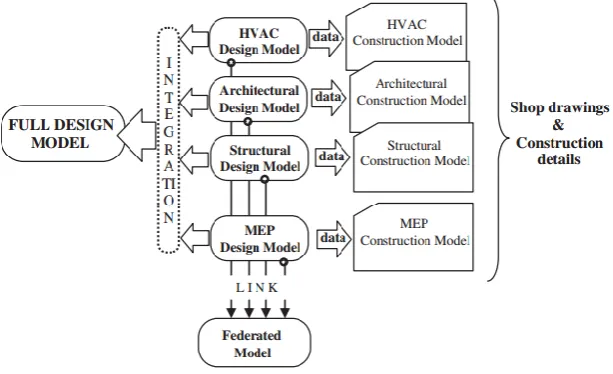
According to Porwal and Hewage (2012), BIM provides a full design model by integrating all systems (structural, architectural, MEP and HVAC) within one whole model (see figure 4).
Figure 4: Diagrammatic representation of model definitions (Porwal and Hewage, 2012)
It is claimed by Motawa and Carter (2013) that BIM can transform the way that the built environment operates by storing, linking and exchanging the project based technical information for use over the whole project life-cycle and in so doing, benefit all stakeholders. It is obvious that this can be extended to building performance and there has been some BIM-based packages developed to analyse different building performances. For example, EnergyPlus and Ecotect consider energy performance allowing the dynamic calculation of the effects of thermal insulation, natural
ventilation and many other aspects (Cho et al., 2010). Yuan and Yuan (2011) have
created several interfaces to BIM to provide an effective data management platform which allows building energy saving design to be undertaken by modelling design performance using the information on building type, construction materials, system types (Heating/Cooling), room type (zone management), project location (weather files), etc. . In a similar way, BIM has the future potential to support the delivery of
sustainability (Barlish and Sullivan, 2012). Referred to as Green BIM, Azhar et al.
estimating the percentage of carbon emissions which affects occupants and the environment towards overall sustainability.
BIM excels in situations that require quantitative geometrical based data. Thus BIMs current contribution towards building performance mostly focuses on energy performance. Currently, Autodesk BIM can simulate full energy analysis and provide full zone HVAC-based information with an enormous amount of data that mostly are not used, but can be presented in BIM. However, the design of successful buildings-in-use, through concepts like building performance, requires the use of not only this calculable data but also indeterminate judgements. The latter data is qualitative in nature and involves subjective psychological evaluations. Currently no BIM model can represent these and so cannot compute a building performance evaluation.
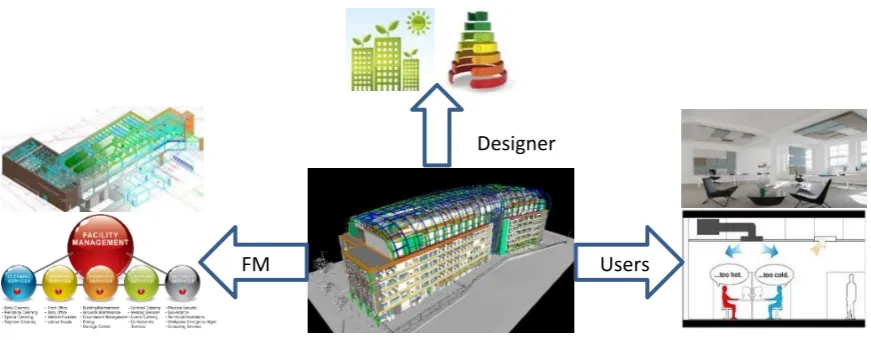
In addition, the interface and information provided by the BIM model is a single perspective contributed by the designer. Building Performance requires a multiple perspective in terms of project stakeholders’ evaluation of building performance. An outline of this is shown in figure 6. What is required then is data to provide different perspectives contributing towards an overall building performance not only for designers, but also for facility managers and users as well.
MULTIPLE PERSPECTIVES IN BUILDING PERFORMANCE
In acknowledging the need for multiple perspectives in order to assist the design of successful buildings in use, this research is providing an original contribution to the development of BIM. The selection of just three perspectives at this stage is necessary to accommodate the major differences in perception of these stakeholders but
sufficient because of the complexity of the problem. The nature of the differences is provided here.
Designer
A designer would evaluate a building based on the full integrity of its form. Their perspective on Building Performance considers energy and lighting aspects (e.g. HVAC and lighting system) which can be calculated in BIM. Looking at one of the building performances, energy performance is associated with the orientation and shape of the building, with consideration given to the amount of sun light and the energy consumption of the building where all these factors affect the EPC (Energy performance certificate) rating. In BIM environment, energy analysis has been conducted using many packages such as Autodesk Ecotect Analysis and
DesignBuilder (Somboonwit and Sahachaisaeree, 2012). Nevertheless, it is important to acknowledge the significant impact that facilities have on energy performance where this yet represents another conceptual level of understanding of energy performance evaluation in the building. However, the interoperability issues within BIM has set limitation for having a full integrated systems within single model (Porwal and Hewage, 2012) although other platforms such as Cloud BIM (Redmond et al., 2012) have been developed for information exchange in BIM.
Facility Manager
Building Performance
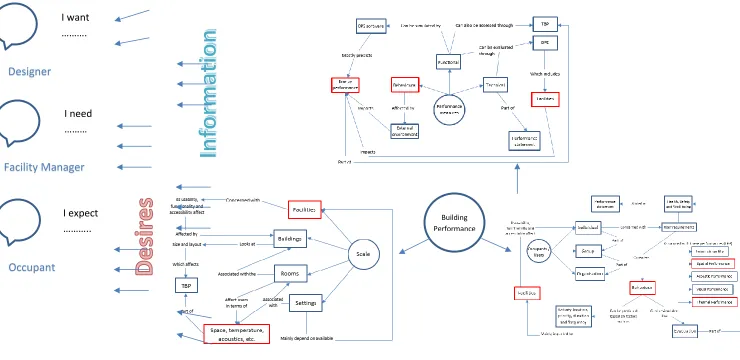
Figure 5: The interdisciplinary information and several perspectives related to building performance based on the performance variables model (Preiser and Vischer, 2005) to reflect the complexity of building performance nature.
I want ……….
I need ………
I expect ………..
Designer
Facility Manager
merely seen as data offered by packages such as CoBie (Construction operation building information exchange). However a spreadsheet with great amount of data does not adequately represent the performance of a building from a facilities managers’ perspective as it does not show the problems of building management and maintenance.
Users
The user is concerned with different performances (especially at the work place) in terms of facilities, energy and space. Currently, the occupant requirements in a building are done based on the occupant guideline and standards. In addition, these requirements are in terms of their safety (e.g. fire exits, evacuations and emergency situations) within the building where most of them have been simulated through BIM interfaces such as evacuation simulation
(Ruppel and Schatz, 2011; Song et al., 2013). For instance, facilities would be rated on the
basis of its functionality, accessibility and usability within the building which have a direct impact on the users’ behaviour and satisfaction. Similarly, a good energy performance for the user is mainly associated with the thermal comfort (e.g. room temperature and humidity) which can be simulated in BIM based on the analysis of energy software(s) such as Ecotect. In terms of space, spatial performance is both concerned with the ergonomic arrangement of the space (Robertson and Courtney, 2001) and with aesthetic impact together which
contribute to user’s satisfaction. This is important since it has a direct impact on the quality
and quantity of the occupant outcome (Low et al., 2008). Some aspects of space such as
acoustics can be simulated through virtual reality using BIM model although the full
acknowledgement of performance can only be determined through sensors which could only be done after the building start operating. On the other hand, looking at a higher level than an occupant, group and organisation are too complex to be considered in building performance evaluation, and this requires compiling additional factors like culture, politics and
management role which are qualitative data that currently cannot be computed by BIM.
THE FUTURE OF BIM IN PROVIDING MULTI-PERSPECTIVE VIEW
IN BUILDING PERFORMANCE
The views drawn in the previous section have expressed that the nature of the problem lies in the multi-perspective view of evaluating building performance. This has been highlighted with drawing some emphasis on elements like facilities management, space utilisations and energy performance in order to compose the overall picture of building performance. The occupants and facility managers perspectives in the evaluation of building performance is yet to be provided through BIM representations due to the type of information required compared to the input data which mostly serve designer perspective. Therefore, there is a need to model and manage the different perspectives for several elements within building performance (see figure 5 ‘highlighted red boxes’) in BIM to maximize overall satisfaction and improve manageability of the whole building life cycle. It is believed that BIM can provide the desired multi-perspective view of building performance (see figure 6), but there are still obstacle in terms of representation of qualitative data and the subsequent interoperability as such data systems as IFCs (International foundation classes) do not accommodate such data. This can raise a question whether multi-perspective views in building performance can be delivered using a single model or a multiple model. The decision has yet to be made as this depends on required data and the representation of the output.
particular zone) to the design evaluation. What level of accuracy can be expected or required high as more parameters and fuzzier parameters are considered has yet to be determined. Such assessments of buildings are complex and this level of complexity increases when the interaction between building facilities and users is high (e.g. hospitals or hotels). Such situations will require more psychological and sociological factors to be considered. Therefore, the desire is for BIM to have the capability to provide qualitative data analysis from soft as well as hard information and to generate multiple perspectives in order to fully evaluate building performance.
Figure 6: featured view of BIM to provide multi-perspective view for building performance
CONCLUSION
Building performance is a complex area that requires not just calculative analyses but the assessment of qualitative data and the acknowledgment of multiple perspectives. This paper has provided an overview of building performance through the most commonly used
techniques of Post Occupancy Evaluation, Building Performance Evaluation and Total Building Performance. Through this review, it was realised that each of the techniques focuses on certain views where this has created a barrier to understanding of the concept of building performance. The capabilities of BIM in addressing building performance were evaluated. BIM has supported many aspects in building performance such as energy
performance, sustainability and facility management (through CoBie). However, it was noted that the aspects of building performance such as facilities, energy performance and space require a multi-perspective view not the single view as offered currently by BIM. Therefore, the multi-perspective view was developed for users, designers and facility managers. It is believed that BIM can provide a great shift in the conceptual understanding of building performance, but the question to be raised is to what extent BIM can provide the multi-perspective view in order to satisfy all building stakeholders?
REFERENCES
FM Users
Azhar, S., Carlton, W. A., Olsen, D. and Ahmed, I. (2011) ‘Building information modelling
for sustainable design and LEED rating analysis’, Automation in Construction, 20(2), pp.
217 – 224.
Cooper, I. (2001) ‘Post-occupancy evaluation – where are you?’, Building Research and
Information, 29(2), pp. 85 – 102.
Cho, Y. K., Alaskar, S. and Bode, T. A. (2010) Building information modelling and
interoperability with Environmental Simulation Systems (Book Chapter). In Sobh, T. (Ed.) Innovations and advances in computer sciences and engineering. Dordrecht: Springer Netherlands.
Davis, G. (1990) Building Performance: Function, Preservation and Rehabilitation. (2nd ed.).
USA: ASTM.
Douglas, J. (1996) ‘Building Performance and its relevance to facilities management’, Facilities, 14(3), pp. 23 – 32.
Duffy, F. (1990) ‘Measuring Building Performance’, Facilities, 8(5), pp. 17 – 20.
Gleick, J. (2011) The information: a history, a theory, a flood. London: Fourth Estate.
Gross, J, G (1996) ‘Developments in the application of performance concept in building’, National institute of standards and technology. Gaithersburg (USA).
Khan, S. and Kotharkar, R. (2012) ‘Performance Evaluation of School Environs: Evolving an
Appropriate Methodology Building’, ASEAN Conference on Environment-Behaviour
Studies. Bangkok.
Low, S. P., Deng, X. and Quek, L. T. (2012) ‘Assimilating total building performance
mandates with Chinese geomancy principles and scenarios’, Facilities, 30(13), pp. 558 –
589.
Low, S. P., Liu, J. Y. and Oh, K. H. (2008) ‘Influence of Total building performance, spatial
and acoustic concepts on buildability scores of facilities’, Facilities, 26(1/2), pp. 85 – 104.
Motawa, I. and Carter, K. (2013) ‘Sustainable BIM-based Evaluation of Buildings’, Social
and Behaviour Sciences, 74, pp. 419 – 428.
Porwal, A. and Hewage, K. N. (2012) ‘Building Information Modelling (BIM) partnering
framework for public construction projects’, Automation in Construction, 31, pp. 204 –
214.
Preiser, W. F. E. (1989) Building Evaluation. New York: Plenum.
Preiser, W. F. E. (1995) ‘Post-occupancy evaluation’, Facilities, 13(11), pp. 19 – 28.
Preiser, W. F. E. (1997) ‘Hospital Activation: Towards a Process Model’, Facilities, 12/13,
pp. 306 – 351.
Preiser, W. F. E. and Schramm, U. (1997) Building Performance Evaluation. In Time-Saver
Standards for Architectural Data (D. Watson, M. J. Crosbie, and J. H. Callender, eds), pp. 233 – 238. McGraw-Hill.
Preiser, W. F. E. and Vischer, J. C. (2005) Assessing Building Performance. Oxford:
Elsevier.
Redmond, A., Hore, A., Alshawi, M. and West, R. (2012) ‘Exploring how information
exchange can be enhanced through Cloud BIM’, Automation in Construction, 24, pp. 175
Robertson, M. M. and Courtney, T. K. (2001) ‘Office ergonomics: analyzing the problem and
creating solutions’, Professional Safety, 46(4), pp. 25 – 31.
Ruppel, U. and Schatz, K. (2011) ‘Designing a BIM-based serious game for the fire safety
evacuation simulations’, Advanced Engineering Informatics, 25(4), pp. 600 – 611.
Somboonwit, N. and Sahachaisaeree, N. (2012) Healthcare Building: Modelling the Impacts
of Local Factors for Building Energy Performance Improvement in Thailand. ASEAN
Conference on Environment-Behaviour Studies. Bangkok.
Song, Y., Jianhua, G., Li, Y., Cui, T., Fang, L. and Cao, W. (2013) ‘Crowd evacuation simulation for bioterrorism in micro-spatial environments based on virtual geographic
environments’, Safety Science, 53, pp. 105 – 113.
Vischer, J. C. (2001) Post Occupancy Evaluation: A Multi-facetted Tool For Building
Improvement. In Learning from our Buildings: A State-of-the-Practice Summary of
Post-occupancy Evaluation (Federal Facilities Council). National Academy Press.
Wong, N. H. and Jan, W. L. S. (2003) ‘Total building performance evaluation of academic
institution in Singapore’, Building and Environment, 38, pp. 161 – 176.
Yan, W., Culp, C. and Graf, R. (2011) ‘Integrating BIM and gaming for real-time interactive
architectural visualisation’, Automation in Construction, 20, pp. 446 – 458.
Yuan, Y. and Yuan, J. (2011) ‘The theory and framework of integration design of building
consumption efficiency based on BIM’, Advanced in Control Engineering and
Information Science, 15, pp. 5323 – 5327.