REAL-TIME FRAMEWORK FOR ENERGY
MANAGEMENT SYSTEM OF A SMART
MICROGRID USING MULTIAGENT SYSTEMS
Roberto Netto1,*, Guilherme Rosse2, Benedito Bonatto1, Otavio Carpinteiro3, A. C. Zambroni de Souza1, Denisson Oliveira4and Rodrigo Braga1
1 Institute of Power Systems and Energy, Federal University of Itajuba, Itajuba, MG 37500-903, BR;
[email protected](RN), [email protected](BB), [email protected](AS), [email protected](RB)
2 Instituto Federal Sul de Minas Gerais, MG; [email protected](GR)
3 Instituto de Engenharia de Sistemas e Tecnologia da Informação, Federal University of Itajuba, Itajuba, MG
37500-903, BR; [email protected](OC)
4 Universidade Federal do Maranhão, MA; [email protected](DO)
* Correspondence: [email protected]; Tel.: +55 35 99118 4992
Abstract:This paper deals with the problem of real-time management of Smart Grids. For this sake, 1
the energy management is integrated with the power system through a telecommunication system. 2
The use of Multiagent Systems leads the proposed algorithm to find the best-integrated solution, 3
taking into consideration the operating scenario and the system characteristics. The proposed 4
technique is tested with the help of an academic microgrid, so the results may be replicated. 5
Keywords:microgrid; real-time simulation; multiagent system; energy management system. 6
1. Introduction 7
Electrical power systems in the world are going through a modernization period with drastic 8
improvements. This brings environmental consequences and raises concerns about sustainability and 9
resilience of these systems. Particularly, the penetration of renewable sources and communication 10
features increases the complexity of these systems, known as active systems. Microgrids fit in active 11
systems and depending on the level of communication and control structures, may become smart 12
grids. A microgrid is a network in small scale to supply small community loads [1]. At [2], it is possible 13
to define microgrid as a small power system, able to balance its generation and demand, in order to 14
maintain stable power supply inside a defined area, as shown in Figure1. 15
Microgrids offer the possibility of integration of different resources, so the operation may help 16
one to supply critical loads under emergency conditions. The main objectives of this integration are 17
the increase in efficiency, reliability, and reduction of losses and greenhouse gases emission, among 18
others[3]. One of the strategies and technologies proposed to achieve these objectives is the concept of 19
Sustainable Microgrids. 20
A microgrid must be capable of properly handle two basic operation states: normal (grid 21
connected) and emergency (islanded). To achieve an islanded operation capacity for a long period, a 22
microgrid must fulfill requirements of energy storage and continuous microgeneration for supplying 23
all loads, or in critical operation cases, supplying the highest priority loads [4]. 24
To efficiently operate and thus make the power grid becoming more reliable, increasing availability 25
and safety, and reducing environmental impact, a smart telecommunication system[5] is required. It 26
has the function of integrating all microgrid components and enables the insertion of dispatchable 27
distributed generation (DG), energy trading, integrated system protection, power quality management 28
and real-time microgrid monitoring [1]. 29
Figure 1.Microgrid Model[2].
However, the monitoring, management, and operation, even for a small network, can be a complex 30
task [1]. Then, with the use of a Multiagent System (MAS) it is possible to split this complex problem 31
into several small and simple ones [6]. Some recent works such as [7–9] present solutions to partially 32
handle this problem, but none of them evaluate the complete integration of the available resources. 33
The concern of the response time of a simulation could be seen in [10] by using PSCAD\NS2 34
(Network Simulator 2), in [11] by using PSFL\NS2 [12–15] it is possible to see an effort and concern 35
for this integration or co-simulation and thus validate the results in the new context of the intelligent 36
network. You can still find other researchers of multiagent system applied to microgrid [16–23] where 37
the telecommunications system was not included. As it is responsible for obtaining the data in the IED 38
and delivering it to the Information Technology (IT) system, include it in the simulation have a great 39
impact on the evaluation of the solution. 40
Another important aspect that should be noted is how SMAs were developed to solve problems 41
in a microgrid. Some researchers such as [24–31] have proposed frameworks and guidelines for the 42
design, modeling and development of SMA with a correct view on how they should act, interact, 43
socialize and pursue the goal, which is the power management solution of their power system. It is 44
not intended to classify solutions in the microgrids as in [32–34] and for MAS as presented at [35–37]. 45
These works propose an analysis in real time of the impact of modeling a MAS using two different 46
triggers and see the time impact of this modeling. Further, analyzing all systems, we verify the impact 47
of a good data protocol development, so the information necessary to define the expected behavior of 48
the agents could be sent to their recipients. 49
This paper is then organized as follows: Section II describes the proposed microgrid model; 50
Section III presents the Multiagent System that will be used in Section IV, shows the results of real time 51
simulation; finally Section V presents the conclusions. 52
2. Microgrid 53
A microgrid is a local grid, scalable and sustainable, consisting of electric and thermal loads 54
and their corresponding sources of power generation. Its components include; sources of distributed 55
communications infrastructure and secure information management. This nomenclature is valid for a 57
wide range of systems, including a University campus [38]. 58
The characteristics described above may enable a microgrid to operate autonomously in islanded 59
mode (disconnected from the main grid) in emergency conditions and improve the power quality (PQ) 60
levels provided to their customers [39] when connected to the main grid. In this sense, the system 61
stability may be improved as well. Microgrids are also seen as one of the most promising tools for 62
the modernization of distribution networks, due to their versatility. This concept has been spread 63
worldwide [40], especially in universities [32] where it is used as a laboratory for testing technologies 64
that will be used in smart grids, as well as a mean of reducing its dependency on energy consumption 65
from pollutants sources [38]. 66
In a study made by [41] in 20 microgrids papers, the most cited in the last 10 years, it was verified 67
the main motivations related to microgrids implementation: 68
• Peak reduction, integration of renewable heat and power combined are the primary goals (17/20); 69
• Energy storage is required for temporary situations and "load steps", i.e. fully dispatchable 70
inverters are needed (16/20); 71
• Islanding without loss is desirable to improve the power quality (13/20); 72
• Primary sources based on inverters will be used in microgrids (13/20). 73
In this way, the distribution network that used to be passive has become active, with power flow 74
no longer having the conventional property of being exclusively in the direction from generation 75
through transmission to customer [6]. Now, bidirectional flows are expected in different operating 76
conditions, which need to be modeled and monitored. Besides that, the consideration of new operating 77
scenarios enables one to work on plug-in electric vehicles loading [42] and resilience of microgrids in 78
emergency conditions [43,44]. 79
The microgrid has the capacity to operate in islanded mode or connected mode, and then there 80
are three stages or steps that it must pass. The process when it goes from the connect mode to the 81
islanded mode, the islanded mode operation and the reconnection process, that is, from islanded mode 82
to connected mode. There are studies for each of these steps, either methodologies for island-based 83
detection (islanded mode detection articles) or for reconnection of the microgrid to the main electrical 84
system (microgrid reconnection articles) and for microgrid operation during the islanded mode, Which 85
is the focus of this work. 86
3. Multiagent System 87
Agents and Multiagent Systems (MAS) enable a new way to analyze, design and implement 88
complex control systems. A MAS can be defined as a loosely coupled network of problem solvers 89
working together to solve problems that are beyond their individual capacities or knowledge to solve 90
a problem [6]. Thus, a multiagent system should be able to operate without direct human intervention 91
or of other agents and should have control of their own behavior and internal state. So, it must have a 92
flexible autonomous action, showing the following characteristics: 93
• Responsive: agents must perceive their environment and respond in a timely manner to the 94
dynamic changes that occur in it; 95
• Proactive: agents must not only act in response to the environment, they are able to exhibit 96
goal-directed behavior by taking the initiative in order to satisfy their design objectives. 97
• Social: agents should be able to interact, when appropriate, with other agents or humans looking 98
to complete their tasks, and assist others with their activities [6,45]. 99
The reasons for choosing MAS are: the ability to provide robustness and efficiency; ability to allow 100
interoperation with existing legacy systems and ability to solve problems where data, knowledge or 101
Therefore, the use of a MAS is an option for Smart Grids as in Smart Homes applications [46], in 103
microgrids [17,28], either for control of Distributed Generation (DG) [47], energy management [48–50] 104
or microgrid control [16,25,51–53]. 105
The development of MAS can benefit the intelligent operation of electrical power systems in 106
many ways, but there are still some challenges that need to be addressed as problem formulation, 107
standardization, communication, coherency, robustness, implementation [35]. 108
At [27] it is described that the current trend of the use of SMA in Power Systems can be divided into 109
two modes: one as a methodology for developing flexible and extensible computer/hardware systems; 110
and the other as a problem modeling methodology. The flexibility denotes the capacity to correctly 111
respond to dynamic situations and support for replications in different situations (environments). The 112
extensibility denotes the capacity to easily add a new functionality to a system, enhancing or updating 113
any type of functionality. As a modeling methodology, Multi-agent systems are more than a system 114
integration method, by offering a different way to see the world. An agent system can intuitively be 115
used to represent a real situation of interacting entities and give a way to test how complex behaviors 116
can arise. 117
4. RealTime Framework 118
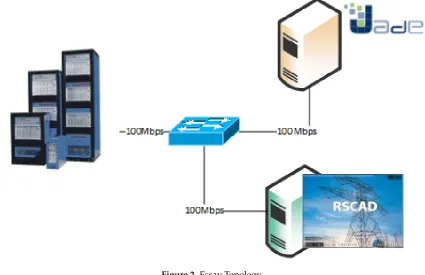
To perform the tests, and to execute them in real time, the RTDS was used for the simulation of the 119
microgrid. This is because it has the capacity to send/receive information to/from the system modeled 120
in real time. This is an important factor and a contribution of this work since despite simulations of 121
electrical systems integrated to computational systems with bi-directional information flows have 122
already been studied in[21,54,55], the response time was not obtained in the execution time, Which 123
caused a certain delay. Some solutions were implemented for the time synchronization between the 124
simulated electrical systems, the communication system, and the data processing system, as seen in 125
[56–59], but the type of data sent from the power system simulator is not analyzed.
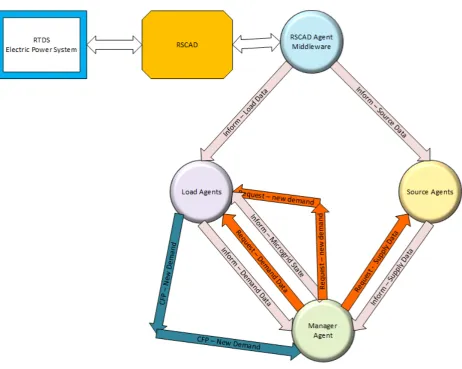
Figure 2.Essay Topology.
4.1. Microgrid Simulation 127
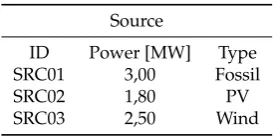
The proposed power system model for this test case simulation is composed by one wind power 128
generator, one Photovoltaic (PV) generator, and one dispatchable diesel generator, as presented in 129
Table1. There are also 7 loads described in Table2. The priority of the loads can be defined according 130
to specific criteria for each particular microgrid. 131
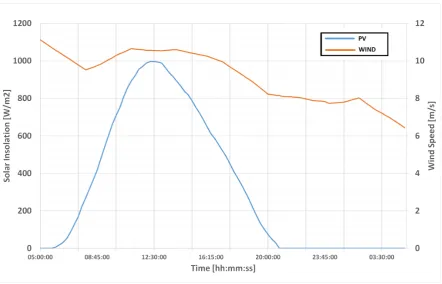
The renewable generators have a wind speed and solar irradiance profiles as shown in Figure 132
3. The data regarding these typical profiles are based on the Belgium electricity transmission system 133
operator (ELIA) website. Any other test case could be used in this study, as well as a more complex 134
case. This simple case was selected in this paper in order to prove the concepts and enable one to 135
reproduce the results. 136
Table 1.Microgrid Power Sources
Source
ID Power [MW] Type
SRC01 3,00 Fossil
SRC02 1,80 PV
SRC03 2,50 Wind
Table 2.Description of Load at Microgrid
LOAD
ID Demand [MW] Group (Priority)
LD01 1,60 3
LD02 1,60 2
LD03 0,60 3
LD04 1,00 1
LD05 0,70 1
LD06 0,60 2
LD07 1,10 1
4.2. Multiagent System Design 137
The test case model presented here is useful to demonstrate the multiagent system interacting 138
with the electrical power system in the islanded mode, pursuing the goal to supply all the loads as long 139
as possible following the goal described at equation3where the Source is defined by1and the Load is 140
defined by2. The load of group 1 belongs to the Emergency state, loads of group 2 to the Critical state 141
and the loads of group 3 to the survival. This modeling platform also shows the potentials of this type 142
of evaluation in real time in integrating the three systems. Weaknesses and unforeseen constraints can 143
then be directly verified as in the real time frame. 144
PSource =PWind+PPV+PGenerator (1)
PLoads=
∑
PPriority1+∑
PPriority2+∑
PPriority3 (2)PSource >PLoads (3)
For the implementation of the multiagent system, there are several platforms or development 145
frameworks such as Zeus, Cybele, Cougar, Net. In this work, it was chosen the platform JADE (Java 146
Agent Development) [60]. JADE is widely used because it is a middleware that abstracts the distributed 147
Figure 3.Power Generation Profile for Wind and Photovoltaic Sources
on the logical aspects of the system because it controls communication between different hosts and 149
messages exchanged between agents [61]. 150
All the communications between the agents are made using FIPA (Foundation for Intelligent 151
Physical Agents) protocol, implemented in JADE, and the communication between the agents and the 152
power system in the RTDS is done using TCP/IP protocol. For this simulation, the following agents 153
are proposed: 154
The development of the SMA was based on the GAIA [62] methodology, that helped and guided 155
with the definitions of the roles that will be exercised, of the agents that will participate and execute the 156
roles, and of the services that each agent will have to perform to reach the desired goal. The following 157
roles were defined: Equipment, Manager, and Translator, where the Equipment represents the agents 158
responsible for the management of the IEDs, whether they are coupled to the loads or to the sources of 159
power generation. The Manager is responsible for verifying the current situation of the microgrid and 160
define a state (emergency, critical or survival) and the Translator makes the connection between the 161
electrical or microgrid system and the SMA. 162
The agent models are based on the roles to be performed at the environment in which they 163
are immersed. Thus, four agents are defined: LOAD (load) responsible for monitoring the loads of 164
the microgrid and has "Equipment" as the role to be prosecuted; Source (generation) responsible for 165
the equipment of generation of energy and that has the same role as the Load; Middle (translator) 166
responsible for the exchange of information and translation of commands between the microgrid 167
and the SMA by performing the role "Translator"; and the Manager, responsible for collecting the 168
information of those who perform the role "Equipment" for the definition of a priority status when 169
performing the role "Manager". 170
By performing the tests on a real-time electrical system simulation platform and accessing the data 171
through a SCADA monitoring interface, it is possible to determine which data will actually become 172
information used in other simulations using an electrical system and MAS make use of information 174
that is not necessarily available by the Intelligent Electronic Device (IED). 175
5. Simulation and Results 176
The interaction between the MAS and the power system has to be executed in real time. The 177
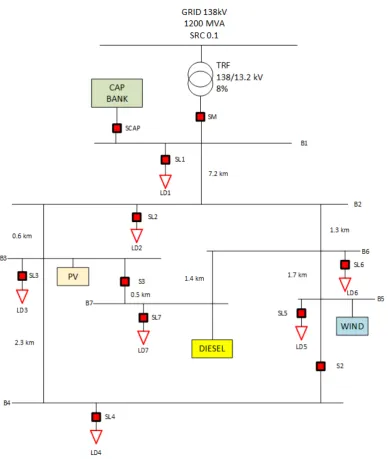
microgrid described in Figure4is used to test the interaction between the proposed methodology and 178
the Real Time Digital SimulatorR (RTDS).
179
Figure 4.Simulated Microgrid.
The JADE framework has a Directory Facilitator (DF) that enables one to know all the agents that 180
are active on the multiagent platform. There is also a sniffer agent that can be used to review how the 181
communication between agents work. In this work, no index of communication performance was 182
considered, which can be addressed in future works. 183
The middle agent is capable of interacting with the microgrid by using scripts commands to 184
the loads. This emulates a power management solution for a microgrid in a real telecommunication 186
context. Such a communication system receives and processes information in real time, and then send 187
responses. Therefore, the decision also occurs in real time. 188
The simulation starts with the microgrid in the grid-connected mode, i.e., there is no concern of 189
the agents to meet the demand of the smart microgrid (SMG). As soon as the SMG is disconnected, the 190
information is sent to the MAS to enter in the islanded mode, triggering the generation/load balance 191
policy within the microgrid. In this research, the MAS follows the algorithm described in Figure5to 192
operate the microgrid in the islanded mode based on the methodology presented in [43]. 193
Figure 5.Flowchart of MAS Actions
The communication of the agents in this system determines all the loads and power sources 194
available. This enables the manager agent to define the state of the SMG in order to guarantee the 195
power supply to the priority loads. All the agents are registered in the DF so that the identification of 196
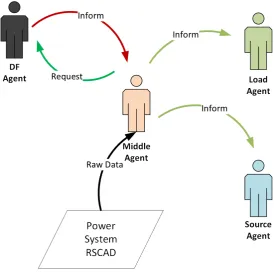
them all could be possible in any state of the SMG. Figure6illustrates the process. 197
Once the middle agent is connected to the power system, such information is sent to the other 198
agents (load and source agents). Both of them receive a stream of information in a multicast message 199
sent by the middle agent that use the DF to know all the load agents and build a list. The same action 200
is executed for the source agents. These ACL INFORM carry the information of all devices in the 201
microgrid, which is monitored by the load or source agents. 202
Each agent verifies the message, find its respective information and update its status. This step 203
occurs in 5s time intervals and this information is not sent directly to the manager agent. The manager 204
agent makes a request for both groups of agents, load, and source, using an ACL REQUEST message 205
Figure 6.Data Exchange in MAS
agents identify the request, they send an ACL INFORM message with the information of their status 207
to the manager, which processes the data to determine what is the state that the microgrid is in that 208
exact moment, based on the available variables. 209
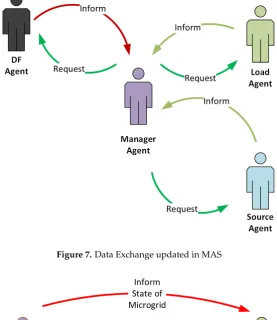
Then, the manager informs all the load agents about of the actual microgrid status, (EMERGENCY, 210
CRITICAL or SURVIVAL) using an ACL INFORM message with the ID "microgrid-state", and so, each 211
load agent verifies its priority, and if necessary, send an ACL REQUEST message to the middle agent 212
to reject a respective load. 213
The middle agent receives the request and then, it sends to RSCAD a script command to open the 214
branch using the TCP/IP connection and sends back to load agent an ACL INFORM message with 215
the "OK" status. Then, the load agent changes its state to OFF. Therefore, the next update of all loads 216
available will be different, and so will the microgrid state. Figure7illustrates the process. The Status 217
EMERGENCY, CRITICAL or SURVIVAL can be defined according to distributed generation priority 218
levels of the load for a particular microgrid. 219
Hence, there is a new microgrid perspective from the demand and power supply that should be 220
monitored by the manager agent. When the state of this microgrid is changed, the manager agent 221
sends another message to all registered loads in the DF for each one to execute their own actions based 222
on their state and priority. This will be repeated until all the power source is not able to supply the 223
loads connected to the microgrid in the survival state. 224
On the other hand, if the manager agent detects that the supply is greater than the actual demand, 225
it will send an ACL REQUEST to all loads, since they do not know the priority of each load. Each load 226
agent receives the message and checks if the group or priority is the same of them. Then, they send the 227
information back to the manager using an ACL CFP message with the maximum demand data or zero, 228
if the group request is not the same of them, as shown in Figure8. 229
5.1. Results 230
The simulation uses a client-server model to read the information from the IED. A polling time 231
Figure 7.Data Exchange updated in MAS
Figure 8.New Demand Request and Reply
is in intervals of 15 minutes in order to generate a complete simulation, which is updated in the RTDS 233
every 15 seconds, and the polling time of the middle agent and manager agent is 12s. Thus, every 12s 234
in the graph of the manager (GUI) represents 15 minutes of data profile. A 24 hour-time span of the 235
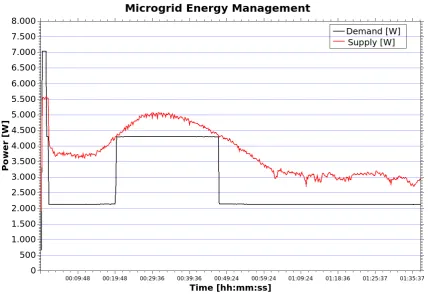
data profile of power generation and loads is employed. The results are shown in Figure9. 236
In Figure9the SMG starts in the grid-connected mode, so there is no problem with the demand 237
to be greater than the generation. When the SMG changes the mode to islanded, for any reason, such 238
as a faulted line, the SMG is in the emergency status. When the MAS detects that the actual generation 239
in not able to supply all the loads in the microgrid, the manager changes the MSG state to critical in a 240
first attempt to supply the loads. The manager has a new scenario of the SMG with only four loads 241
and, in this moment the power generation inside the microgrid is still less than the necessary to supply 242
the demand. Again, the manager changes the state of SMG, but now to survival. In this new scenario, 243
only the two high priority loads can be supplied with the inside power generation. 244
Until this point, where loads were rejected using priority, it seems that there is no reason to 245
use MAS to manage the microgrid energy when it is in islanded mode. But, when the generation is 246
Figure 9.Energy Management for Power Profile
prioritize the loads at the current power generation. The MAS has to discover the new demand of the 248
new state before reconnecting the loads, so the Manager Agent has a picture of the actual generation 249
and the next demand, to make the decision of raising the state or keeping the state. 250
The manager still keeps checking the balance of power generation inside the SMG, since the mode 251
is still islanded. When the manager notes that there is more power than demand, it asks for the loads 252
of next priority what are their maximum demand. If the power at this moment is greater than the 253
actual demand plus the new demand of the next priority load, then the manager changes the state to 254
critical, and the load is connected again to the SMG as seen in Figure10. 255
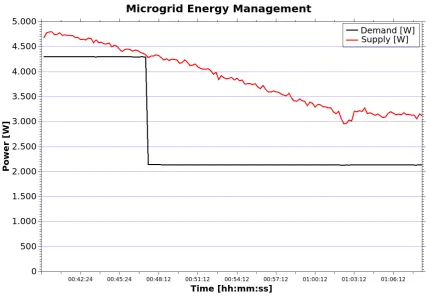
When the power generation is decreasing, as shown in Figure11, the manager agent still keeps 256
checking the power balance inside the SMG, and when it becomes insufficient to supply the loads, it 257
changes the state of SMG again to survival, so only the high priority loads are able to remain connected. 258
It is assumed here that the total power generation inside the microgrid is sufficient to supply the high 259
priority loads. 260
By using the first method to model the MAS, it is possible to see when the demand is higher than 261
the supply, as depicted in in Figure12. This happens for few seconds, but it is undesirable since it 262
results in voltage and frequency drop issues. Since the methodology applied to MAS is based only 263
on a pooling time, even when the manager identifies an unbalanced situation, this is reflected in the 264
next pooling only. Therefore, to optimize the operation and obtain a better power management, an 265
event-driven solution with the pooling mechanism was developed. Then, when the manager detects 266
that the power is unbalanced, it sends a message for state changing and requests an update. The 267
obtained result is now is a better fit of the balance as shown in Figure11. 268
Another issue that was discovered during the tests is that just reading the power of the meters will 269
not lead MAS to the goal that was designed. The information that the load agent firstly was designed 270
to receive is the information of the power meter. So, when the LOAD is connected to the microgrid, 271
Figure 10.Energy Management for Power Profile Increasing
Figure 12.Multiagent System without Event Driven behavior
generation is decreasing. But this information is useless when the power generation is raising. When 273
the manager asks for the status of the loads to verify if is possible to supply the new demand, the 274
meter is showing 0W (zero). Thus, the manager will not raise the microgrid status, and the LOADs 275
will not be reconnected to the grid. 276
During the test, it was noted the need for a more elaborated language for the MAS. As we can see 277
at Figure13the Diesel generator was following the load in the microgrid, so when there was less load 278
to supply, the model of the generator in the RTDS reduced the power delivered. The maximum power 279
capacity of this power resource should be sent to allow the Manager agent receive information that 280
real reflect the place that it is inserted. 281
Without this information, the Manager could not decide to raise the microgrid state, because even 282
when the PV generator achieve a power that plus the maximum power of the diesel generator and the 283
Wind generator is capable to supply the next state, it will not change because the information is the 284
actual power generation of the diesel power source. It is necessary a new behavior of the Source agent 285
to lead the diesel generator to the desired power that could supply the new state. 286
6. Conclusions 287
This paper presented a framework in real time to test a solution for energy management in a 288
smart microgrid in an islanded mode using the multiagent system. The integration of all agents 289
was possible by using TCP/IP communication, but it was necessary a middleware to exchange and 290
translate information from the MAS to the power system. Since was not possible to use an OpenSource 291
JAVA API for the IEC 61850 in the JADE Framework, it was necessary to create a bridge between the 292
data from the power system and the data for the MAS. This is a critical point because if the middle 293
agent eventually goes down, the communication with the power system is lost. In a mission-critical 294
system, like the power system, it is not desirable. 295
The use of MAS and its performance analysis in real time has shown to be a good solution for 296
Figure 13.Multiagent System without Event Right Information
to provide the sociability behavior expected from this type of methodology. When the MAS uses only 298
the polling mechanism it was observed some problem related to the timing and synchronization for 299
control of the loads in an unbalanced state. By adding an event-driven mechanism to the pooling, the 300
problem was solved. Therefore, the simulation of multiagent systems in smart microgrids in real-time 301
and with real communication links can reveal some issues that only happens in this type of simulation, 302
like the kind of information an agent should be able to report and what type of methodology is better 303
to fit a real situation. This enhances the relevance of the models and research framework presented in 304
this paper. 305
Acknowledgments:The authors would like to thank to CNPq, INERGE, CAPES, FAPEMIG, RTDSR and UNIFEI 306
for their support in this research. They also acknowledge the relevant contributions of Prof. Paulo Fernando
307
Ribeiro for this research.
308
Author Contributions: “R.N., B.B. and D.O. conceived and designed the experiments; R.N. performed the
309
experiments; R.N., B.B. and Z.S. analyzed the data; G.R., O.C. and R.B. contributed with materials/analysis tools;
310
R.N. and Z.S wrote the paper.”
311
312
1. Chowdhury, S.; Crossley, P.Microgrids and active distribution networks; The Institution of Engineering and
313
Technology, 2009.
314
2. Microgrid Institute. http://www.microgridinstitute.org/, 2016. Accessed: 2016-09-30.
315
3. Grid, S.IEEE Smart Grid Vision for Computing: 2030 and Beyond; 2013; pp. 1–133.
316
4. Hatziargyriou, N.Microgrids: architectures and control; John Wiley & Sons, 2013.
317
5. Hatziargyriou, N.; Asano, H.; Iravani, R.; Marnay, C. Microgrids.IEEE Power Energy Mag.2007,5, 78–94.
318
6. Jennings, N.R.; Sycara, K.; Wooldridge, M. A Roadmap of Agent Research and Development. Autonomous
319
agents and multi-agent systems1998,38, 7–38.
7. Shi, W.; Li, N.; Chu, C.C.; Gadh, R. Real-time energy management in microgrids. IEEE Transactions on
321
Smart Grid2017,8, 228–238.
322
8. Dehghanpour, K.; Nehrir, H. Real-time multiobjective microgrid power management using distributed
323
optimization in an agent-based bargaining framework. IEEE Transactions on Smart Grid2017.
324
9. Kanellos, F. Real-Time Control based on Multi-Agent Systems for the Operation of Large Ports as Prosumer
325
Microgrids. IEEE Access2017.
326
10. Hopkinson, K.; Birman, K. EPOCHS: Integrated commercial off-the-shelf software for agent-based electric
327
power and communication simulation. Proceedings of the 2003 Winter Simulation Conference2003.
328
11. Lin, H.; Veda, S.S.; Shukla, S.S.; Mili, L.; Thorp, J. GECO: Global event-driven co-simulation framework
329
for interconnected power system and communication network. IEEE Transactions on Smart Grid2012,
330
3, 1444–1456.
331
12. Bhor, D.; Angappan, K.; Sivalingam, K.M. A co-simulation framework for Smart Grid wide-area monitoring
332
networks. 2014 Sixth International Conference on Communication Systems and Networks (COMSNETS).
333
IEEE, 2014, pp. 1–8.
334
13. Manbachi, M.; Sadu, A.; Farhangi, H.; Monti, A.; Palizban, A.; Ponci, F.; Arzanpour, S. Real Time
335
Co-Simulation Platform for Smart Grid Volt-VAR Optimization using IEC61850. IEEE Transactions on
336
Industrial Informatics2016, pp. 1–1.
337
14. Hua Lin, H.; Sambamoorthy, S.; Shukla, S.; Thorp, J.; Mili, L. Power system and communication network
338
co-simulation for smart grid applications. ISGT 2011. IEEE, 2011, pp. 1–6.
339
15. Saleem, A.; Honeth, N.; Wu, Y.; Nordström, L. Integrated multi-agent testbed for decentralized control of
340
active distribution networks. IEEE Power & Energy Society General Meeting2013, pp. 1–5.
341
16. Logenthiran, T.; Srinivasan, D.; Khambadkone, A.M.; Aung, H.N. Multiagent system for real-time operation
342
of a microgrid in real-time digital simulator. IEEE Transactions on Smart Grid2012,3, 925–933.
343
17. Dimeas, A.L.; Hatziargyriou, N.D. Operation of a multiagent system for microgrid control. IEEE
344
Transactions on Power Systems2005,20, 1447–1455.
345
18. Logenthiran, T.; Srinivasan, D.; Khambadkone, A.M.; Aung, H.N. Scalable Multi-Agent System (MAS) for
346
operation of a microgrid in islanded mode. 2010 Joint International Conference on Power Electronics, Drives
347
and Energy Systems, PEDES 2010 and 2010 Power India2010.
348
19. Kumar Nunna, H.S.V.S.; Doolla, S. Multiagent-based distributed-energy-resource management for
349
intelligent microgrids. IEEE Transactions on Industrial Electronics2013,60, 1678–1687.
350
20. Xu, Y.; Liu, W. Novel multiagent based load restoration algorithm for microgrids. IEEE Transactions on
351
Smart Grid2011,2, 140–149.
352
21. Dimeas, A.L.; Hatziargyriou, N.D. Operation of a multiagent system for microgrid control. IEEE Trans.
353
Power Syst.2005,20, 1447–1455.
354
22. Oyarzabal, J.; Jimeno, J.; Ruela, J.; Engler, A.; Hardt, C. Agent based micro grid management system. 2005
355
International Conference on Future Power Systems2005, pp. 1–6.
356
23. Colson, C.M.; Nehrir, M.H. Comprehensive real-time microgrid power management and control with
357
distributed agents. IEEE Transactions on Smart Grid2013,4, 617–627.
358
24. Pipattanasomporn, M.; Feroze, H.; Rahman, S. Multi-Agent Systems in a Distributed Smart Grid : Design
359
and Implementation2009. pp. 1–8.
360
25. Avramescu, M. High-level design of Multi-agent System based Microgrid. Systems and Computer Science
361
(ICSCS), 2012 1st International Conference on. IEEE, 2012, pp. 1–5.
362
26. Feroze, H. Multi-Agent Systems in Microgrids : Design and Implementation. Simulation2009, p. 131.
363
27. McArthur, S.D.J.; Davidson, E.M.; Catterson, V.M.; Dimeas, A.L.; Hatziargyriou, N.D.; Ponci, F.; Funabashi,
364
T. Multi-Agent Systems for Power Engineering Applications-Part I: Concepts, Approaches, and Technical
365
Challenges2007. 22, 1743–1752.
366
28. Catterson, V.; Davidson, E.; McArthur, S. Issues in Integrating Existing Multi-Agent Systems for Power
367
Engineering Applications.Proc. 13th Int. Conf. on, Intell. Syst. Appl. to Power Syst.2005, pp. 396–401.
368
29. Wood, M.; DeLoach, S. An Overview of the Multiagent Systems Engineering Methodology.Agent-Oriented
369
Software Engineering2001,1957, 1–53.
370
30. McArthur, S.D.J.; Davidson, E.M.; Catterson, V.M.; Dimeas, A.L.; Hatziargyriou, N.D.; Ponci, F.; Funabashi,
371
T. Multi-agent systems for power engineering applications - Part II: Technologies, standards, and tools for
372
building multi-agent systems.IEEE Transactions on Power Systems2007,22, 1753–1759.
31. Pavón, J.; Gómez-sanz, J. Agent Oriented Software Engineering with INGENIAS.Multi-Agent Systems and
374
Applications III2003, pp. 394–403.
375
32. Bayindir, R.; Hossain, E.; Kabalci, E.; Perez, R. A comprehensive study on microgrid technology.
376
International Journal of Renewable Energy Research2014,4, 1094–1107.
377
33. Satish, B.; Bhuvaneswari, S. Control of microgrid - A review. 2014 International Conference on Advances in
378
Green Energy, ICAGE 20142014, pp. 18–25.
379
34. Olivares, D.E.; Mehrizi-Sani, A.; Etemadi, A.H.; Ca??izares, C.A.; Iravani, R.; Kazerani, M.; Hajimiragha,
380
A.H.; Gomis-Bellmunt, O.; Saeedifard, M.; Palma-Behnke, R.; Jim??nez-Est??vez, G.A.; Hatziargyriou, N.D.
381
Trends in microgrid control. IEEE Transactions on Smart Grid2014,5, 1905–1919.
382
35. Moradi, M.H.; Razini, S.; Mahdi Hosseinian, S. State of art of multiagent systems in power engineering: A
383
review. Renewable and Sustainable Energy Reviews2016,58, 814–824.
384
36. Gomez-Sanz, J.J.; Garcia-Rodriguez, S.; Cuartero-Soler, N.; Hernandez-Callejo, L. Reviewing microgrids
385
from a multi-agent systems perspective.Energies2014,7, 3355–3382.
386
37. Kulasekera, A.L.; Gopura, R.A.R.C.; Hemapala, K.T.M.U.; Perera, N. A review on multi-agent systems in
387
microgrid applications.2011 IEEE PES International Conference on Innovative Smart Grid Technologies-India,
388
ISGT India 20112011, pp. 173–177.
389
38. Mohn, T. Campus microgrids: Opportunities and challenges. IEEE Power and Energy Society General
390
Meeting2012, pp. 1–4.
391
39. Real-world MicroGrids - An overview. 2007 IEEE International Conference on System of Systems
392
Engineering, SOSE, 2007.
393
40. Klemun, M.; Analyst, G. NORTH AMERICAN MICROGRIDS 2014 : The Evolution of Localized Energy
394
Optimization. Technical report, GreenTech Media, 2014.
395
41. Paquette, A.D.; Divan, D.M. Providing improved power quality in microgrids: Difficulties in competing
396
with existing power-quality solutions. IEEE Industry Applications Magazine2014,20, 34–43.
397
42. Oliveira, D.; de Souza, A.Z.; Delboni, L. Optimal plug-in hybrid electric vehicles recharge in distribution
398
power systems. Electric Power Systems Research2013,98, 77–85.
399
43. Oliveira, D.; de Souza, A.Z.; Almeida, A.; Santos, M.; Lopes, B.; Marujo, D. Microgrid management in
400
emergency scenarios for smart electrical energy usage. PowerTech, 2015 IEEE Eindhoven. IEEE, 2015, pp.
401
1–6.
402
44. Portelinha Júnior, F.M.; Carlos Zambroni de Souza, A.; Castilla, M.; Queiroz Oliveira, D.; Ribeiro, P.F.
403
Control Strategies for Improving Energy Efficiency and Reliability in Autonomous Microgrids with
404
Communication Constraints. Energies2017,10, 1443.
405
45. Wooldridge, M. An introduction to multiagent Systems2009. [0803.3905].
406
46. Asare-Bediako, B.; Kling, W.L.; Ribeiro, P.F. Multi-agent system architecture for smart home energy
407
management and optimization. IEEE PES ISGT Europe 2013. IEEE, 2013, pp. 1–5.
408
47. Logenthiran, T.; Srinivasan, D.; Wong, D. Multi-agent coordination for {DER} in MicroGrids. Sustainable
409
Energy Technologies, 2008. ICSET 2008. IEEE International Conference on2008, pp. 77–82.
410
48. Meiqin, M.; Wei, D.; Chang, L. Multi-agent based simulation for Microgrid energy management. 8th
411
International Conference on Power Electronics - ECCE Asia2011, pp. 1219–1223.
412
49. Asare-Bediako, B.; Kling, W.; Ribeiro, P. Integrated agent-based home energy management system for
413
smart grids applications. IEEE PES ISGT Europe 20132013, pp. 1–5.
414
50. Mao, M.; Jin, P.; Hatziargyriou, N.D.; Chang, L. Multiagent-based hybrid energy management system for
415
microgrids. IEEE Transactions on Sustainable Energy2014,5, 938–946.
416
51. Dou, C.X.; Jin, S.J.; Jiang, G.T.; Bo, Z.Q. Multi-Agent Based Control Framework for Microgrids. 2009
417
Asia-Pacific Power and Energy Engineering Conference (Appeec), Vols 1-72009, pp. 1095–1098.
418
52. Dimeas, A.L.; Hatziargyriou, N.D. A MAS architecture for microgrids control. Proceedings of the 13th
419
International Conference on Intelligent Systems Application to Power Systems, ISAP’052005,2005, 402–406.
420
53. Digra, R.K.; Pandey, R.K. Multi-agent control coordination of Microgrid. 2013 Students Conference on
421
Engineering and Systems, SCES 2013, 2013.
422
54. Logenthiran, T.; Srinivasan, D.; Khambadkone, A.M. Multi-agent system for energy resource scheduling of
423
integrated microgrids in a distributed system. Electr. Power Syst. Res.2011,81, 138–148.
55. Mehta, R.; Menon, B.; Srinivasan, D.; Panda, S.K.; Rathore, A.K.; Jhqw, D.; Ri, R.; Mehta, R.; Menon, B.
425
Market based multi-agent control of microgrid. 2014 IEEE Ninth Int. Conf. Intell. Sensors, Sens. Networks Inf.
426
Process.2014, pp. 1–6.
427
56. Bottura, R.; Borghetti, A.; Napolitano, F.; Nucci, C.A. ICT-power co-simulation platform for the analysis of
428
communication-based volt/var optimization in distribution feeders. Innovative Smart Grid Technologies
429
Conference (ISGT), 2014 IEEE PES. IEEE, 2014, pp. 1–5.
430
57. Georg, H.; Wietfeld, C.; Müller, S.C.; Rehtanz, C. A HLA based simulator architecture for co-simulating
431
ICT based power system control and protection systems. Smart Grid Communications (SmartGridComm),
432
2012 IEEE Third International Conference on. IEEE, 2012, pp. 264–269.
433
58. Lin, H.; Veda, S.S.; Shukla, S.S.; Mili, L.; Thorp, J. GECO: Global event-driven co-simulation framework
434
for interconnected power system and communication network. IEEE Transactions on Smart Grid2012,
435
3, 1444–1456.
436
59. Hopkinson, K.; Wang, X.; Giovanini, R.; Thorp, J.; Birman, K.; Coury, D. EPOCHS: a platform for
437
agent-based electric power and communication simulation built from commercial off-the-shelf components.
438
IEEE Transactions on Power Systems2006,21, 548–558.
439
60. Bellifemine, F.L.; Caire, G.; Greenwood, D.Developing multi-agent systems with JADE; Vol. 7, John Wiley &
440
Sons, 2007.
441
61. Kouluri, M.K.; Pandey, R.K. Intelligent Agent Based Micro grid Control.2011 2nd International Conference
442
on Intelligent Agent and Multi-Agent Systems (IAMA)2011, pp. 62–66.
443
62. Wooldridge, M.; Jennings, N.R.; Kinny, D. The Gaia methodology for agent-oriented analysis and design.
444
Autonomous Agents and multi-agent systems2000,3, 285–312.
![Figure 1. Microgrid Model[2].](https://thumb-us.123doks.com/thumbv2/123dok_us/1020224.1602032/2.595.93.505.84.326/figure-microgrid-model.webp)