The plantaris muscle: anatomy, injury, imaging,
and treatment
Andreo A. Spina, DC*
The plantaris muscle is often dismissed as a small, vestigial muscle, however an injury to this structure should actually be included in differential considerations of the painful calf. Injury to the plantaris on its own, or in association with concurrent injuries of the knee can present a diagnostic challenge to the manual practitioner. This review discusses the diagnosis, imaging, and evidence based management of this tiny, but important muscle of the lower limb.
(JCCA; 51(3):158–165)
k e y wo r d s: plantaris, muscle, diagnosis.
Le muscle plantaire est souvent atrophié et se présente sous une forme vestigiale, or une blessure sur cette structure doit en fait être incluse dans les considérations différentielles sur les douleurs au mollet. La blessure du muscle plantaire isolée ou associée à des blessures simultanées du genou peut présenter un défi diagnostique pour le thérapeute. Cette étude présente la gestion, fondée sur le diagnostic, l’imagerie et les preuves de ce muscle, petit mais important, du membre inférieur. (JACC 2007; 51(3):158–165)
m o t s c l é s : plantaire, muscle, diagnostic
Introduction
The plantaris is a small muscle that courses along the posterior aspect of the leg as part of the posterosuperficial compartment of the calf. Often thought of as a vestigial, accessory muscle, the plantaris muscle is absent in only 7–20% of limbs.1 Although injuries of this structure have
been a source of controversy3,4,5,6,7 pathology of the
plantaris muscle and tendon is an important differential diagnosis for pain arising from the proximal posterior as-pect of the leg.
The purpose of this paper is to outline the anatomy, in-jury, diagnostic imaging, and treatment of the plantaris muscle. As well, it is intended to highlight the impor-tance of including injury of this structure as a reasonable differential diagnosis for proximal posterior leg pain.
Anatomy
The plantaris muscle consists of a small, thin muscle bel-ly, and a long thin tendon that forms part of the postero-superficial compartment of the calf. (Figure 1) Together with the gastrocnemius, and soleus, they are collectively referred to as the triceps surae muscle. The muscle origi-nates from the lateral supracondylar line of the femur just superior and medial to the lateral head of the gastrocne-mius muscle as well as from the oblique popliteal liga-ment in the posterior aspect of the knee.8,9 The muscle
ranges from 7 to 13 cm long varying highly in both size and form when present.2 From its origin, the muscle
courses distally in an inferior and medial direction across the popliteal fossa. At the level of the proximal third of the leg, the muscle belly is situated between the popliteus
* Private Practice, Director – Sports Performance Centres Ltd. Email: [email protected]
AA Spina
muscle anteriorly, and the lateral head of the gastrocne-mius muscle posteriorly. The myotendinous junction oc-curs approximately at the level of the origin of the soleus muscle from the tibia in the proximal portion of the lower leg.9 The long thin tendon forms part of the medial
bor-der of the muscle belly as it courses between the medial head of the gastrocnemius muscle and the soleus muscle in the midportion of the leg.10 On cadaveric dissection,
this long, slender tendon is easily mistaken for a nerve and hence has been dubbed by some the “freshman’s nerve.”2 It continues inferiorly along the medial aspect of
the Achilles tendon, which it accompanies to its insertion on the calcaneus. Anatomic studies have shown that the calcaneal insertion may also occur independently of the Achilles tendon. This is of interest as the plantaris tendon often remains intact when the Achilles tendon ruptures.8
Neural innervation is common to all three muscles of the triceps surae group and is provided by the tibial nerve (S1, S2).
In terms of function, the plantaris muscle acts with the gastrocnemius but is insignificant as either a flexor of the
knee or a plantarflexor of the ankle. It has been consid-ered to be an organ of proprioceptive function for the larger, more powerful plantarflexors as it contains a high density of muscle spindles.2
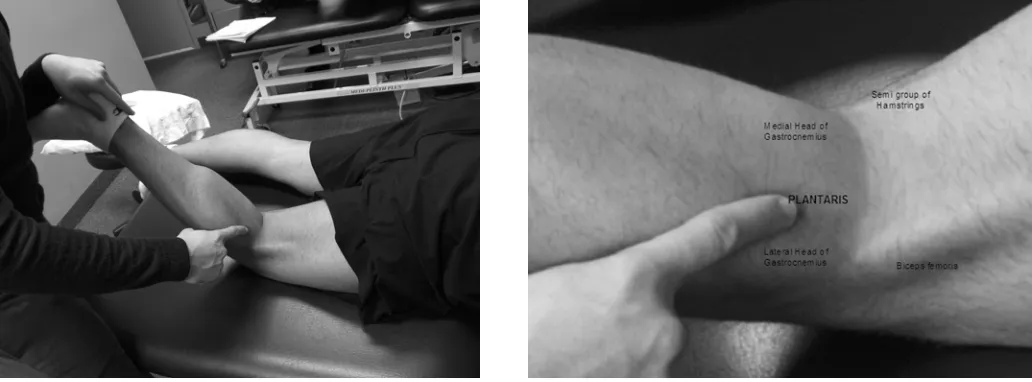
Palpation of the muscle belly is possible in the pop-liteal fossa as well as along the medial aspect of the com-mon tendon of the triceps surae group. With the patient prone and the leg flexed to approximately 90 degrees, the distal hand of the practitioner covers the heel while the forearm is applied against the plantar aspect of the foot, allowing a simultaneous resistance to plantarflexion of the foot and flexion of the knee. The muscle is palpated in the popliteal fossa, medial and superior to the lateral head of the gastrocnemius muscle. Its tendinous portion can be palpated along the medial aspect of the Achilles tendon into its calcaneal insertion.11 (Figure 2)
Injury
Despite its small size, injuries of the plantaris muscle and tendon, which have been termed “tennis leg,” have been a source of controversy in the literature.3,4,5,6,7 Tennis leg is
a relatively common clinical condition.8 In the past it has
been described as being caused by various etiologies in-cluding plantaris tears, medial head of gastrocnemius tears, soleus tears, or a combination thereof. The injury occurs most frequently during running or jumping and usually results from an eccentric load placed across the ankle with the knee in an extended position. Even though the injury is the result of an indirect mechanism, subjec-tively the patient may describe direct trauma to the calf region – often the athlete feels as though they were struck on the calf by an object such as a ball or piece of equip-ment.12 Depending on the severity, calf soreness may be
experienced that may cause the athlete to stop play, or may simply be experienced throughout the remainder of the activity. This pain usually becomes more severe after resting or the next day.13 Accompanying the pain may be
swelling that may extend down to the ankle and foot. Any attempt at active or passive dorsiflexion, and resisted plantarflexion with elicit severe pain.12,13
The etiology of “tennis leg,” and the existence of an isolated rupture of the plantaris muscle as the cause, has been debated since Powell first described this clinical condition in 1883.14 Arner and Lindholm15 rekindled the
debate in 1958, followed by Miller5 in 1977, as well as
Severance and Bassett6 in 1982, all of whom concluded
that isolated rupture of the plantaris was not the cause of this clinical condition. In fact, Miller5 described this
eti-ology as an “intellectual hoax.”
It has now been established through the use of MR im-aging, sonography, and surgical exploration, that injuries to this muscle may in fact occur in isolation,8,9,16,17 as
well as in association with tears of the gastrocnemius, so-leus, and ACL (Anterior Cruciate Ligament).9 Allard et
al. were the first to demonstrate ruptures of the plantaris muscles of two patients.16 One was demonstrated on MR
imaging, and the other on diagnostic ultrasonography. Later, Helms et al. examined the MR images of fifteen patients with sports-related injuries to the lower leg.9 The
plantaris muscle and tendon, as well as the surrounding structures, were retrospectively examined for abnormali-ties. In all fifteen patients, evidence of rupture or strain of the plantaris muscle was present. An associated torn ante-rior cruciate ligament (ACL) was found in 10 of 15 pa-tients. Five injuries were isolated or associated with partial tears of the gastrocnemius or popliteus muscle.
The first surgically confirmed isolated rupture of plantaris was documented by Hamilton et. al in 1997.17
AA Spina
seen in the emergency room with a 7-day history of pain and swelling in her calf region after stepping off a curb and feeling a “pop.” After discovering a fusiform mass measuring 5 × 2 cm in the greatest transverse dimensions lying between the medial head of gastrocnemius and the soleus on MR imaging, an excisional biopsy was per-formed on an elective basis in fear of the existence of an underlying neoplasm. A gray white, well-circumscribed mass, later shown to be a benign resolving hematoma, was discovered along with a complete tear of the plantaris muscle at its musculotendinous junction. No as-sociated damage of the gastrocnemius or soleus was found again demonstrating the possibility of an isolated plantaris rupture causing this clinical condition.
Delgado et al. in 2002 retrospectively reviewed sono-graphic findings in 141 patients referred with a clinical diagnosis of tennis leg.8 Findings included rupture of the
medial head of the gastrocnemius muscle in 66.7% of the sample, fluid collection between the aponeuroses of the medial gastrocnemius and soleus muscles without muscle rupture in 21.3%, sole rupture of the plantaris tendon in 1.4%, and partial rupture of the soleus muscle in 0.7%. These findings suggest that the etiology of tennis leg can be caused by injury sustained by various tissues in isola-tion, or in combination.
Thus the literature demonstrates that injury to the plantaris muscle either on its own, or in combination with gastrocnemius, or soleus damage, can represent the cause of the clinical condition known as tennis leg. This etiolo-gy however is not as common as gastrocnemius injury, which is highly susceptible due to its superficial location, predominance of type II fibers, eccentric muscle action, and extension across two joints.18
Findings related to deep venous thrombosis in the calf can be mistaken for those of tennis leg and thus must be kept in mind in the differential diagnosis of clinical findings suggestive of this condition.8,10,19 Other
differ-entials may include a ruptured Baker’s cyst, and calf neo-plasms.10
Imaging
Magnetic resonance (MR) imaging and ultrasonography (US) have been used as the primary imaging techniques for evaluation of patients with the clinical diagnosis of non-specific posterior lower leg pain (Figure 3). The im-portance of imaging patients with this condition is to rule
out more serious conditions such as deep venous throm-bosis.8,12 In addition, imaging can be used to evaluate the
location and extent of the muscle injury; however, treat-ment of this injury does not depend on these findings.12
The appearance of plantaris muscle injury on MR im-ages depends on the severity of the muscle strain. An ab-normally high signal intensity may be seen both within, and adjacent to the muscular fibers of the plantaris mus-cle at the level of the knee joint, or at the myotendinous junction on T2-weighted images. In proximal injuries to the middle of the muscle belly, high signal may involve the plantaris muscle on its own, or it may also involve structures adjacent to the muscle in the posterolateral as-pect of the knee. This type of plantaris strain can be seen in association with anterior cruciate and arcuate ligament injury, as well as with lateral compartment bone contu-sions.9 Complete plantaris rupture, which most often
oc-curs at the myotendinous junction, results in proximal retraction of the muscle, which may appear as a mass lo-cated between the popliteus tendon anteriorly and the lat-eral head of the gastrocnemius posteriorly. The mass may demonstrate high signal intensity on T2-weighted and fat-suppressed images in the acute setting unless it is rup-tured completely through the mid-substance of the ten-don.9 In the acute setting, an intermuscular hematoma
between the soleus muscle and the medial head of the gastrocnemius may also be seen.
Using sonography, the muscle belly of the plantaris muscle is initially located in the proximal calf region us-ing a transverse scan. It is readily appreciated as a trian-gular structure having the soleus muscle as its base and the medial and lateral bellies of the gastrocnemius as it sides.10 While utilizing the transducer in a transverse
fashion it is possible to follow the muscle from its most proximal attachment on the lateral femoral condyle, down to the myotendinous junction at the level of the fibular head. Because the tendon forms the medial border of the belly, it is seen on the transverse scan as a subtle thickening at the medial corner of the triangular belly. Distal to the myotendinous junction, the tendon is gener-ally not visualized well in the transverse plane.10
bellies of the gastrocnemius and soleus. This fibrillar pat-tern of both the muscle and tendon is, in most individu-al’s, well depicted.10
Rupture of the plantaris will demonstrate discontinuity of the muscle or tendon on longitudinal scanning. Fluid usually accumulates (creating a hypoechoic area) in a tubular configuration between the medial head of the gastrocnemius and the soleus muscle bellies, along the course of the plantaris.20 Fluid collections associated
with the plantaris are sometimes seen even when no mus-cle or tendon tear is seen. Helms et al demonstrated using MR imaging that fluid may be associated with plantaris strains9 and further to this, Leekham et al concluded that
when such fluid collections are seen in patients with a strong clinical suspicion for plantaris injury, a diagnosis of plantaris strain is appropriate if no tear is seen.9,10
Treatment
Although an there are no studies specifically looking at the treatment of plantaris injury, early literature on “non-specific” tennis leg has stated that simple conservative
treatment is effective, and that permanent disability rarely results.21 This idea is mirrored in more recent papers that
agree that conservative therapy is effective.8,12 However
the lone study done on treatment of non-specific posterior calf musculature strains that can support these claims was a retrospective study done by Millar in 1979.22 This study
was performed on a series of 720 patient cases, over a 12-year period. The treatment routine included pain relief throught the use of cryotherapy and passive stretching, followed by a 5-min period of ultrasound therapy. Treat-ment then progressed to strengthening exercises for the antagonists and later the agonists, and quadriceps exercis-es. This treatment protocol was considered effective as evidenced by a recurrence of the condition in only 0.7% of the patients. As it was a retrospective study, no control group was utilized and no other treatment regimen was considered. The extent of the muscular injury, or grade of the tear, was also not considered. Thus there is a paucity of evidence guiding clinicians as to the most effective form of treatment.
AA Spina
topic, the practitioner may turn to the literature concern-ing the treatment of muscle injuries in general in order to establish an evidence based treatment protocol. However, when examining the literature regarding the management of muscular injury, it is surprising to find that the current treatment principles of injured skeletal muscle lacks firm scientific basis. Only a few clinical studies exist on the treatment of muscle injury, and thus, the current treat-ment principles are primarily based on experitreat-mental studies or empirical evidence.23 Even the basic
manage-ment of acute injury using the rest, ice, compression, and elevation principle (RICE) protocol lacks scientific ex-amination. In fact there are no randomized clinical trials to prove the effectiveness of the RICE principle in the treatment of soft tissue injury.24 Thus Recent advances in
treatment approaches have in large part come from stud-ies that have correlated basic science principles with clinical observation.25 When broken down into its
histo-logical components, treatment of muscle injury in the acute phase should include preventing further damage, controlling the inflammatory cascade, limiting pain in or-der to promote early mobilization. Later, proper repair and regeneration of both muscle tissue, and its connective tissue components become the focus of treatment, as excessive fibrosis scar-tissue formation is one of the ma-jor factors that can slow muscle healing.26 After that,
strengthening, proprioceptive rehabilitation, and in ath-letes, sport specific rehabilitation becomes paramount.
The immediate treatment of muscle injury involves the RICE (rest, ice, compression, elevation) protocol. Al-though, as stated prior, no direct evidence exists for this protocol, there is scientific evidence for the appropriate-ness of the distinct components of the concept.23 In terms
of the resting component, a brief period of immobiliza-tion is needed in order to allow the body to provide new granulation tissue with the needed tensile strength to withstand the forces generated by muscle contrac-tions.27,28,29 The position of immobilization is also an
im-portant factor that can influence healing. Two studies by Jarvinen looking at the effect of position of immobiliza-tion on the tensile properties of muscle found that when immobilizing in a shortened versus a lengthened position, the shortened position resulted in a decreased resting length, a decreased force to failure, a decreased energy absorbing capacity, and a greater loss of weight of the muscle-tendon units.30,31 Additional literature
demon-strates that early mobilization is important for healing in terms of creating a more rapid and intensive capillary in-growth, better regeneration of the muscle fibers, more parallel orientation of the regenerating myofibers, and a faster recovery of biomechanical strength.27,32,33,34
There-fore, the recommendation is that a short period of immo-bilization be allowed (for first 1–3 days, depending on the extent of the injury) with the healing tissue placed in a slightly lengthened (or at least a neutral) position. In terms of the scientific management of a plantaris injury, this would mean placing the ankle in a neutral, or slightly dorsiflexed position while maintaining the knee in a straightened position. This may be achieved simply by applying a firm adhesive tape (leukoplast tape) in a man-ner that prevents plantarflexion of the ankle mortise artic-ulation. As well, the use of crutches may be considered in the case of severe injury. After this period, a progression of activity can be started in which the rate will depend highly on pain levels and the extent of injury.
During the immobilization period, the other compo-nents of the RICE protocol can be utilized including ice (cryotherapy), compression, and elevation. As previously stated, scientific proof for the appropriateness of each component exists with regards to the ability of minimiz-ing bleedminimiz-ing into the injured site, as well as decreasminimiz-ing pain.35,36,37
Despite the lack of direct human evidence, the utiliza-tion of NSAIDs for muscle injuries has been documented quite well experimentally.38,39,40,41,42 It seems that
al-though long-term use may be detrimental to the regener-ating skeletal muscle40, short-term use can be effective in
decreasing inflammation38, with no adverse effects on the
healing process, or resultant strength of the regenerated muscle.38,39,41 Thus short term use of NSAIDS post
mus-cle injury can be justified. The same cannot be said for the utilization of glucocorticoids however, as their use has been shown to retard muscle regeneration, as well as delay elimination of the hematoma and necrotic tissue, thus hindering healing.38,43
mobiliza-tion, or myofacial release may be beneficial in order to distend the maturing scar during a phase in which it is still plastic, but already has the required strength to pre-vent a functionally disabling retraction of the muscle stumps. These therapies may also be effective due to the fact that collagen fiber growth and realignment can be stimulated by early tensile loading of muscle, tendon, and ligament.44 As well it is known that external stretching or
mechanical loading is able to induce the expression of growth factors beneficial to muscle regeneration and re-pair.45 Progressive strengthening from isometric, to
isot-onic, to isokinetic exercise based on pain tolerance, as well as proprioceptive and sport specific rehabilitation are also key components in proper rehabilitation of mus-cle injury.
The literature overwhelmingly supports conservative treatment as sufficient to properly manage non-specific causes of tennis leg.5,8,9,12,13,21,22 This consensus mirrors
the current treatment concepts regarding general muscu-lar injury, which suggest that one should exercise extreme caution in considering surgical intervention for the treat-ment of muscle injuries.23 Anecdotally, it appears that a
properly executed non-operative treatment results in a good outcome in virtually all cases of muscle injury.23
Specifically with regards to plantaris injury as the cause of tennis leg, it is clinically considered less severe than that of a gastrocnemius injury. In fact, the plantaris ten-don is commonly harvested as an autograft for ligament and tendon reconstructions by orthopedic surgeons thus, demonstrating the ability to maintain function despite its absence.9 Still, regardless of the relative benign nature of
plantaris injury, the situation may arise where surgical in-tervention is necessary due to a rupture of the plantaris or gastrocnemius. Surgical treatment (fasciotomy) is indi-cated in situations when an associated posterior compart-ment syndrome has complicated the evolution of the signs and symptoms because of the swelling and hemato-ma forhemato-mation associated with a rupture or tear.8, 9
Conclusion
Often dismissed as a small, vestigial muscle, injury of the plantaris muscle should actually be included in differ-ential considerations of the painful calf. Injury to the plantaris muscle may occur at the myotendinous junction with or without an associated hematoma, or partial tear of the medial head of the gastrocnemius or soleus. A strain
of the more proximal plantaris muscle belly may also oc-cur as an isolated injury, or in conjunction with injury to the adjacent ACL. As proper management for muscular injury in general is scarce, it is not surprising that the lit-erature is lacking with regards to the proper management of plantaris injury. Also lacking in the literature is a solid understanding as to the role that the plantaris plays in functional mechanics. Further research is needed in order to assess its importance to mechanics as well as its role in other conditions affecting the knee.
References
1 Simpson SL, Hertzog MS, Barja RH. The plantaris tendon graft: an ultrasound study. J Hand Surg [Am] 1991; 16:708–711.
2 Moore KL, Dalley AF, eds. Clinically Oriented Anatomy. 5th ed. Philadelphia: Lippincott Williams & Wilkins, 2006; 648–649.
3 Platt H. Observations on some tendon ruptures. Br Med J 1931; 1:611–615.
4 Arner O, Lindholm A: What is tennis leg? Acta Chir Scand 1958; 116:73–77.
5 Miller WA. Rupture of the musculotendinous juncture of the medial head of the gastrocnemius muscle. Am J Sport Med 1977; 5(5):191–193.
6 Severance HJ, Basset FH. Rupture of the plantaris: does it exist? J Bone Joint Surg [Am] 1983; 65:1387–1388. 7 Mennen U. Rupture of the plantaris: does it exist? (letter).
J Bone Joint Surg [Am] 1983; 65:1030.
8 Delgado GJ, Chung CB, Lektrakul N, Azocar P, Botte MJ, Coria D, Bosch E, Resnick D. Tennis Leg: Clinical US Study of 141 Patients and Anatomic Investigation of Four Cadavers with MR Imaging and US. Radiology 2002; 224:112–119.
9 Helms CA, Fritz RC, Garvin GJ. Plantaris Muscle injury: Evaluation with MR Imaging. Radiology 1995;
195:201–203.
10 Leekam RN, Agur AM, McKee NH. Using Sonography to Diagnose Injury of Plantaris Muscles and Tendons. AJR 1999; 172:185–189.
11 Tixa S. Atlas of Palpatory Anatomy of Limbs and Trunk. Teterboro, NJ: Icon Learning System Inc., 2003;333. 12 Toulipolous S, Hershmann EB. Lower Leg Pain: Diagnosis
and Treatment of Compartment Syndrome and other Pain Syndromes of the Leg. Sports Med 1999; 27(3):193–204. 13 Gecha SR, Torg E. Knee Injuries in Tennis. Clin in Sports
Med 1988; 7(2):435–437.
14 Powell RW. Lawn tennis leg. Lancet 1883; 2:44.
15 Arner O, Lindholm A. What is tennis leg? Acta Chir Scand 1958; 116:73–75.
AA Spina
17 Hamilton W, Klostermeier T, Lim EV, Moulton JS. Surgically Documented Rupture of the Plantaris Muscle: A Case Report and Literature Review. Foot & Ankle International 1997; 18(8):522–523.
18 Bencardino JT, Rosenberg ZS, Brown RR, Hassankhani A, Lustrin ES, Beltran J. Traumatic Musculotendinous Injuries of the Knee: Diagnosis with MR Imaging. RadioGraphics 2000; 20:S103-S120.
19 Gilbert TJ, Bullis BR, Griffiths HJ. Tennis Calf or Tennis Leg. Orthopedics 1996; 19(2):182–184
20 Jamadar DA, Jacobson JA, Theisen SE, Marcantonio DR, Fessell DP, Patel SV, Hayes CW. Sonography of the Painful Calf: Differential Considerations. AJR 2002; 179:709–716. 21 Froimson A. Tennis leg. JAMA 1969; 209:415–416. 22 Millar A. Strains of the posterior calf musculature (“tennis
leg”). Am J Sports Med 1979; 7(3):172–174.
23 Jarvinen TAH, Jarvinen TLN, Kaariainen M, Kalimo H, Jarvinen M. Muscle Injuries: Biology and Treatment. Am J of Sports Med 2005; 33(5):745–763.
24 Bleakley C, McDonough S, MacAuley D. The use of ice in the treatment of acute soft tissue injury: a systematic review of randomized controlled trials. Am J Sports Med 2004; 34:251–261.
25 Best TM, Hunter KD. Muscle Injury and Repair. Phys Med and Rehab Clin of N Am 2000; 11(2):251–265.
26 Li Y, Fu FH, Huard J. Cutting-Edge Muscle Recovery: Using Antifibrosis Agents to Improve Healing. Phys and Sports Med 2005; 33(5):44–50.
27 Jarvinen M. Healing of a crush injury in rat striated muscle, 4: effect of early mobilization and immobilization on the tensile properties of gastrocnemius muscle. Acta Chir Scand 1976; 142:47–56.
28 Lehto M, Duance VC, Restall D. Collagen and fibronectin in a healing skeletal muscle injury: an
immunohistochemical study of the effects of physical activity on the repair of injured gastrocnemius muscle in the rat. J Bone Joint Surg Br 1985; 67:820–828.
29 Jarvinen M, Lehto MUK. The effect of early mobilization and immobilization on the healing process following muscle injuries. Sports Med 1993; 15:78–89. 30 Jarvinen M. Immobilization Effect on the Tensile
Properties of Striated Muscle: An Experimental Study in the Rat. Arch Phys Med Rehabil 1977; 58: 123–127. 31 Jarvinen MJ, Einola SA, Virtanen EO. Effect of the
Position of Immobilization Upon the Tensile Properties of the Rat Gastrocnemius Muscle. Arch Phys Med Rehabil 1992; 73:253–257.
32 Jarvinen M, Sorvari T. Healing of a crush injury in rat stiated muscle, 1: description and testing of a new method of inducing a standard injury to the calf muscles. Acta Pathol Microbiol Scand 1975; 83A:259–265.
33 Jarvinen M. Healing of a crush injury in rat stiated muscle, 2: a histological stuey of the effect of early mobilization and immobilization on the repair processes. Acta Pathol Microbiol Scand 1975; 83A:269–282.
34 Jarvinen M. Healing of a crush injury in rat striated muscle, 3: a microangiographical study of the effect of early mobilization and immobilization on capillary ingrowth. Acta Pathol Microbiol Scand 1976; 84A:85–94. 35 Meeusen R, Lievens P. The use of cryotherapy in sports
injuries. Sports Med 1986; 3:398–414.
36 Thorsson O, Hemdal B, Lilja B, Westlin N. The effect of external pressure on intramuscular blood flow at rest and after running. Med Sci Sports Exerc 1987; 19:469–473. 37 Deal DN, Tipton J, Rosencrance E, Curl WW, Smith TL.
Ice reduces edema: a study of microvascular permeability in rats. J Bone Joint Surg Am 2002; 84:1573–1578. 38 Jarvinen M, Lehto M, Sorvari T, et al. Effect of some
anti-inflammatory agents on the healing of ruptured muscle: an experimental study in rats. J Sports Traumatol Rel Res 1992; 14:19–28.
39 Obremski WT, Seaber AV, Ribbeck BM, Garrett WE. Biochemical and histological assessment of a controlled muscle strain injury treated with piroxicam. Am J Sports Med 1994; 22:558–561.
40 Mishra DK, Friden J, Schmitz MC, Lieber RL. Anti-inflammatory medication after muscle injury: a treatment resulting in short-term improvement but subsequent loss of muscle function. J Bone Joint Surg Am 1995; 77:1510–1519.
41 Thorsson O, Rantanen J, Hurme T, Kalimo H. Effects of nonsteroidal anti-inflammatory medication on satellite cell proliferation during muscle regeneration. Am J Sports Med 1998; 26:172–176.
42 Almekinders LC. Anti-inflammatory treatment of muscular injuries in sport: an update of recent studies. Sports Med 1999; 28:383–388.
43 Beiner JM, Jokl P, Cholewicki J, Panjabi MM. The effect of anabolic steroids and corticosteroids on healing of muscle contusion injury. Am J Sports Med 1999; 27:2–9.
44 Herring SA. Rehabilitation of muscle injuries. Med Sci Sports Exer 1990; 22(4):453–456.