STUDIES ON ION-SOLVENT
INTERACTIONS OF ELECTROLYTE
SOLUTIONS – PART 4:OSMOTIC
COEFFIENTS OF 2-2 ELECTROLYTES
(SULPHATES OF TRANSITION
METALS )
N.S.S.V.Rajarao1* ,
1
Department of Physics,Godavari Institute of Engineering and Technology, Rajahmundry-533105,A.P., INDIA; [email protected]
V.Brahmajirao2, 2
Department of Nanoscience and Technology,School of Biotechnology,MGNIRSA
(A Unit of D. Swaminathan Research Foundation),Hyderabad -500072, A.P., INDIA; [email protected]
A.V.Sarma3
3
Department of Physics , Andhra University, Visakhapatnam-530003,A.P.,INDIA; [email protected] *E-mail for correspondance : [email protected]
Abstract: This paper presents the application of the our evaluated dielectric data to the calculations of Osmotic coefficient ,and related parameters of the Bromley ,Pitzer’s equations for aqueous 2-2 electrolytes namely Copper sulphate,Nickel sulphate,Manganese sulphate and Cobalt sulphate .Several details about the ion pairs, their characteristics , the experimental techniques so far in use for their study, and so far reported important findings are given. Our Results are represented as plots between square root of molality, √c as abscissa and Osmotic coefficients as ordinates in set 1; and between molality, c as abscissa and Osmotic coefficient as ordinates in set 2. The study of the slopes of the graphs reveals several details about the latent Eigen and Tamm’s Ion-pair formation mechanism .Systematic analysis along with supporting findings from the literature are cited.
Keywords: Osmotic coefficient, Pitzer’s model, ionic atmosphere, Bromley model, Dielectric constant, ion-pairs, Eigen and Tamm mechanism, Dielectric relaxation in relation to ion pairs.
1.0 INTRODUCTION: Aqueous electrolytic solutions are found to play a prominent role in our daily life, in environmental, biological and Industrial applications. So the study of their behavior in detail is a topic of universal interest, even today. Further the study of several thermodynamic and other physical properties1 project very complex challenges, that require intricate and rigorous studies into the fundamental phenomena using sophisticated set ups, which require the combined effort of specialists working in Physics, Mathematics and Chemistry.
In recent years, several theoretical methods have been proposed in which the ion pairing is based on the addition of the ad hoc chemical-association model of Bjerrum.N and EG Model, for the Restricted-primitive model (RPM) of size-symmetric electrolytes.
Fisher and Levin 11, 12 extended DH theory by considering the solvation of dipolar ion pairs in an ionic fluid (dipole-ion interactions). When the hard core of the ions is neglected, the resulting Debye-Huckel-Bjerrum- Dipole-Ion (DHBjDI) theory gives a fairly good agreement with the results of the Monte-Carlo Simulations
13
.DHBjDI model is probably quantitatively the most successful theory for the RPM electrolyte presently available. However careful studies revealed that the hard-core contribution is important in determining the phase coexistence of electrolytes. Still a lot of debate prevails in literature about this. Recently J.Jiang et.al. 14, incorporated ionic association into the RPM of electrolyte to account for the strong attraction between the unlike ions. They investigated two methods within the McMillan-Mayer framework: first is the binding mean-spherical approximation (BIMSA) based on the Wertheim Ornstein-Zernike integral equation formalism; and the second is the combination of the BIMSA with a simple interpolation Scheme (SIS) based on the Wertheim thermodynamic perturbation theory. They established that the latter gives a better description. When unlike ions are fully paired, corresponding to a charged hard dumbbell (CHDB) system, they obtained the best agreement with the most recent computer simulations of the RPM electrolyte.
1.2 Physical and Chemical Electrolytic models:
A detailed description of the electrolytic models is attempted by Nicolas Papaiconomo15 in his doctoral thesis .G.Maurer 16, Renon, H 17 in their respective reviews, classified the electrolytic models into the Physical and chemical models. Debye-Huckel limiting law is the starting point to all the physical models, and they assume that all necessary corrections are due to physical interactions between the ionic species. Xiaohua Luet.al. 18, using the model proposed by Xiaohua Lu & G.Maurer 19 attempted to predict Activity coefficients and Enthalpies simultaneously.This model of Lu & Maurer is developed by combining ionic solvation equilibria and physical interaction forces. It is shown that by using the parameters correlated from single electrolyte aqueous systems; the activity coefficients in mixed electrolyte aqueous solutions can be accurately predicted up to the solubility limit, for example, at very high ionic strength.Christensen et al. 20, Haghtalab and Vera 21, and Liu et al. 22 are among those models, which can be treated as Local composition models.Some of these are able to provide a continuous transition from electrolyte to nonelectrolyte systems.
Chemical models describe deviations from the ideal mixture as a result of chemical reaction leading to solvated ions, and try to explain some of the mechanisms like the association. The solvation models of Stokes and Robinson 23 and some later modifications in those of Glueckauf24, Nesbitt 25, Kawaguchi et al., 26 Ghosh and Patwardhan 27 are typical examples for such models.
Chen and Mathias 28 observe that in addition to experiments, a theory is required to describe the phenomena measured, to interpolate between the experimental data points and, if possible, to extrapolate to conditions outside the experimental range . Usually, the theory is formulated as a mathematical model that contains one or more parameters that are adjusted for a better representation of reality. The ideal model is the model that does not require experimental data and still is flexible enough to use.G.H. Van Bochove 29, in his doctoral work could successfully be correlate, the experimental liquid-liquid equilibrium data using an activity coefficient model based on the extended electrolyte NRTL model. He points out that in general, of the two fundamentally different methods for phase equilibrium calculations namely calculations based on activity coefficient models, and calculations based on equations of state (EOS); those based on equations of state are not suitable for polar components and less good in describing the liquid phase than the vapour phase. At atmospheric pressure, excess Gibbs energy models give a better description of the liquid phase. The EOS approach has not been applied widely for electrolyte solutions. Recently some progress has been achieved in the development of an electrolyte equation of state 30.
2.0 . Pitzer’s equations for Osmotic coefficient :
All the peculiarities under discussion related to ion-ion, ion-solvent, are introduced into the second virial coefficient through the following equation
1 1
2 2
1 2
(0) (1) I (2) I
B
e
e
(1)(0)
and
(1)cater to the terms that represent the same effects of the short range forces of the2-2 electrolytes as for the other types of electrolytes.
(2)And α2 reproduce the anomalous behavior of the 2-2 electrolytes in the range below 0.1M .The value of
(2)is large and negative.The value of α2 is large and positive .Pitzer et.al, suggested that it can be shown, by a suitable expansion
theoretically, that for the limit of very dilute solutions the ion pair association constant K is -2
(2) and α2=32Aφwhere Aφ is the Debye–Huckel coefficient for the osmotic coefficient .The details of data chosen by
Pitzer et.al was given 38 in a separate publication by them.
The complete set of equations for the Osmotic coefficient, including the Debye-Huckel term and a simple third virial coefficient, for the 2-2 electrolyte as was developed by Pitzer and Mayorga39 is given below :
2
1
4
f
mB
MXm C
MX
(2)
1 1
2 2
[
/(1
)]
f
A I
bI
(3)
1 1
2 2
1 2
(0) (1) I (2) I
MX MX MX MX
B
e
e
(4)and the terminology used by the original authors of the equations is retained .The values b=1.2, α1 =1.4, α2 =12.0 are retained as was done in the case of Activity coefficient data evaluation , (reported earlier by us) . The
details of the values of the β’s, Cф
(used in Pitzer model)and the value of B(used in Bromley model) are given in the Table:1 for the electrolytes chosen for our study.
Table: 1. Parameters of Thermodynamic functions for 2-2 electrolytes in water at 250 C
Electrolyte β(0) β(1) β(2) Cф B (kgmol‐1)
coppersulphate 0.2358 2.4850 ‐47.3500 ‐0.0012 ‐0.0364
nickel sulphate 0.1702 2.9070 ‐40.0600 0.0366 ‐0.0296
manganesesulphate 0.2010 2.9800 ‐40.0000 0.0182 ‐0.0470
cobalt sulphate 0.2000 2.7000 ‐30.7000 ‐ ‐0.0350
3.0 Bromley’s equations for the Activity & Osmotic coefficients: A generalized analytic correlation was presented for activity coefficient, osmotic coefficient, enthalpy, and heat capacity of single and multicomponent strong aqueous solutions. A good correlation for each salt to an ionic strength of six is claimed to have been obtained by assigning a single parameter “B” value to each salt. These B values are well approximated by assigning two parameters for each ion. The estimation of activity and osmotic coefficients of many unmeasured salt solutions was presented by Bromley.
1 2 1 2
ln
[
]
1
A I
m
I
(5)For 1-1 salts are a function of
1 2
I
,even for small I values. He showed that,β (taken as a constant) may be approximated as the sum of individual ion, β values although the constant is only applicable to about 0.1 molal.Some of the effects of this drastic assumption will be considered under “Discussion of Results”, below. Meissner 41 also showed that the functional dependence is essentially temperature independent, although the parameter (equivalent to B) maybe temperature dependent.3.1. Bromley‘s Presumptions applied to the Guggenheim’s equation:
Some of the presumptions made by Bromley, to obtain the final equation from the Guggenheim’s equation are listedbelow:
(1)After several trials, for the strongly ionized salts an equation that provides a good fit to the experimental data from several sources was arrived at to start with .This equation used an integer ‘n’ ,whose best assigned value was ‘2’.
(2) The value for the parameter ‘ρ’ used in their model was determined using the data of Robinson and Stokes 5
, Wu and Hamer 42. These values varied from (ρ=1.0) to (ρ=1.6), Also they found the value of ρ to be temperature dependent, which fact is not properly taken cognizance of, in the equations.
(3) The value of the parameter ‘a’ is nearer to unity ,and appears to decreases systematically with the increase in the valence number [
z z a
] is very nearly equal to 1.5.The values of ρ and a were also determined independently using data on heats of mixing and heat capacity for a number of salts(4) Even the value of ‘C’, was found to bear no consistent relation to either the B value and the individual values of C ,which formed a normal probability distribution about C = 0.Consequently the value of C is assigned , wherein the coefficient of the I2 in the starting equation sometimes leads to erratic results. A sum total effect of these drastic approximations leaves the end result crude, and delicate mechanisms like the ion pair formation, get masked in the plots which fail to reflect the true picture.
Following the terminology of the original author ‘Bromley’, his equations for the Activity Coefficient and Osmotic Coefficient, used by us in our evaluations are given below
Activity coefficient equation:
1 2 1 2 1 1 2 2
0.511
(0.06
0.6 )
[log
]
[
] [
] [
]
1.5
(1
)
1
z z
I
B I
BI
z z
I
I
z z
(6)In this the relevant values of ‘B’, are taken from Bromley’s paper 43 and re tabulated in Table: 1.
This equation with the relevant dielectric data was used to evaluate the activity coefficient data communicated in our earlier communication 44
The Osmotic Coefficient equation:
1
1 2
2
1
2.303
(
)
2.303(0.06
0.6 )
(
)
2.303
3
2
2
I
I
I
A z z
I
B z z
aI
B
(7) 1 1 2 21
2.303
(
)
2.303(0.06
0.6 )
(
)
2.303
3
2
2
I
I
I
A z z
I
B z z
aI
B
(8)
1 1 1
2 2 2
1 1
3
2 2
3
1
(
)
[1
(
)
2ln(1
)
(
)
1
I
I
I
I
I
(9)And
(
)
2
[
1 2
2ln(1
)
]
(1
)
aI
aI
aI
aI
aI
aI
(10)4.0 Discussion of results:
We present below our observations and evaluations, with supporting equations and propositions used in the models used in our evaluations. The findings of other workers were given then for comparison.
4.1 Our observations
This paper reports the extension of our work using Pitzer’s model 45 and Bromley’s model 46 in the evaluation of the osmotic coefficient Φ
‘into which our earlier communicated experimental dielectric data
47
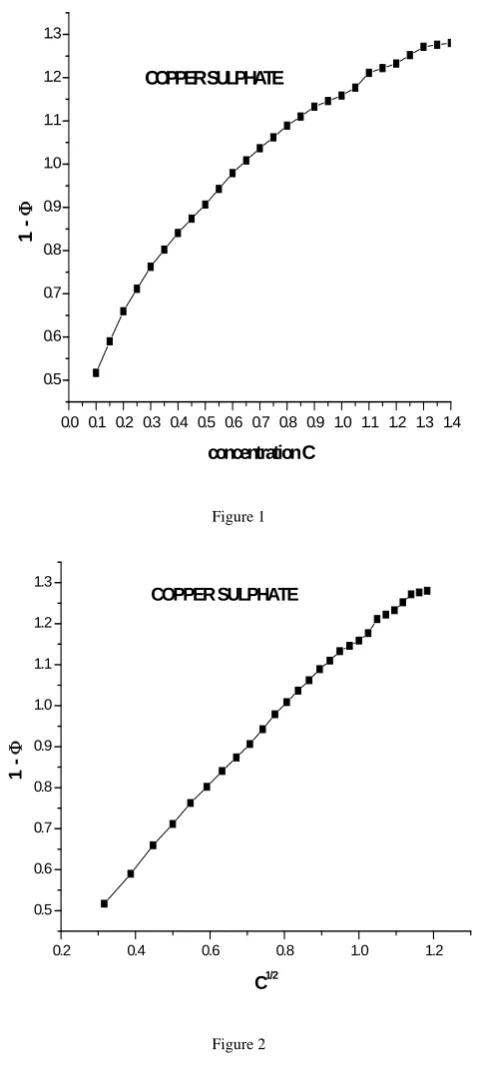
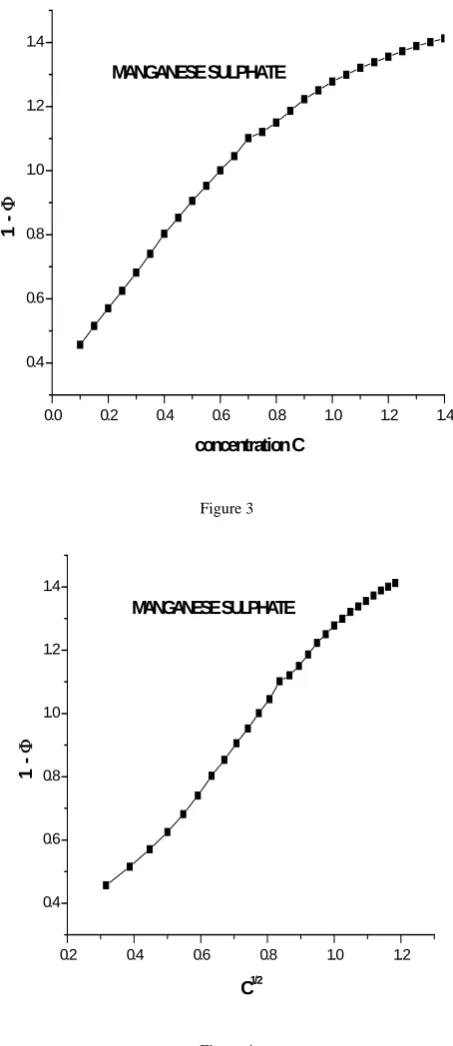
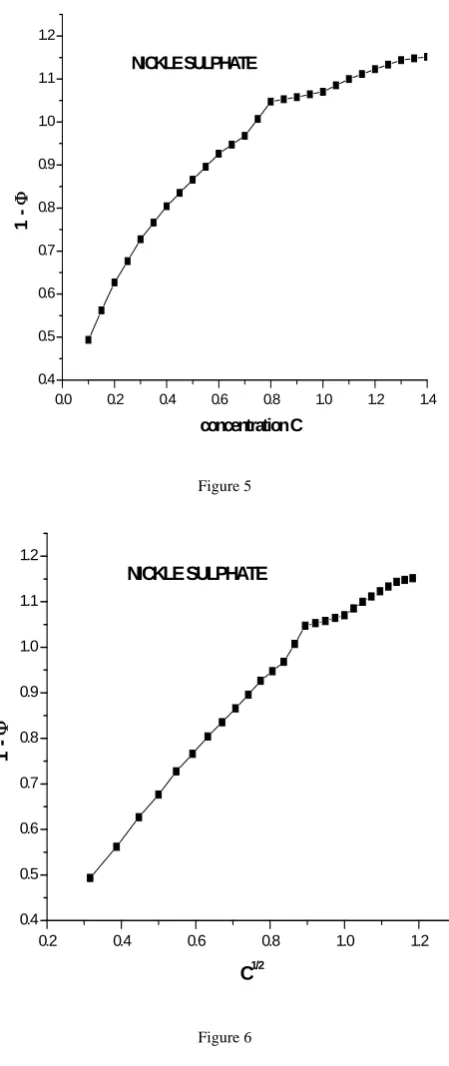
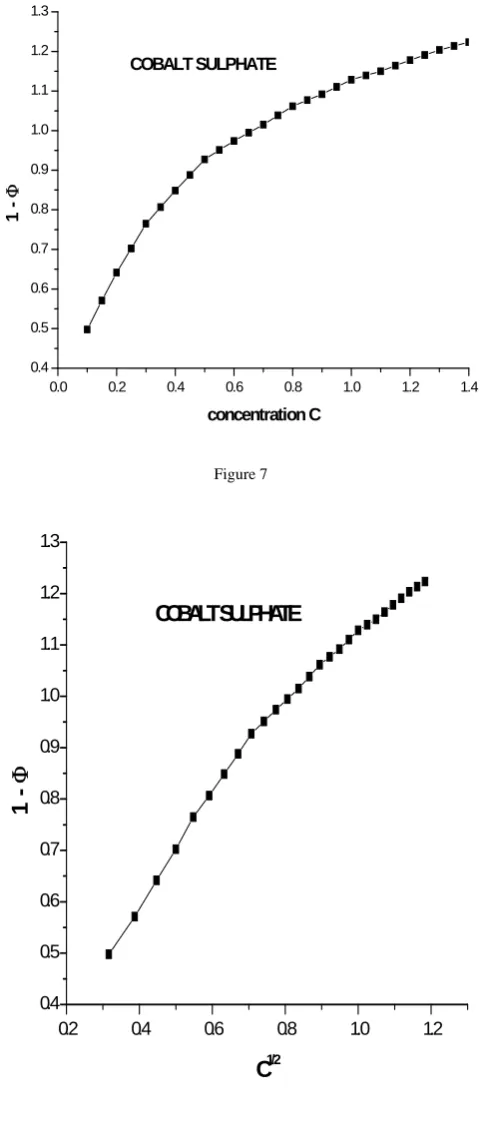
is used. The presented plots are between; √ and c as abscissae separately, & (1-Φ) as ordinate for the aqueous electrolyte solutions of copper sulphate, nickel sulphate, manganese sulphate, cobalt sulphate.
These plots are expected to be straight lines with a constant slope as per the predictions of the basic Debye-Huckel model, which is being used with modifications by different authors .When we introduce the variation of the relative permittivity with concentration, we observe that the linearity is disturbed 48 .The same result is found in our observations .The changes in slope recorded in the plots for the calculations with Pitzer’s model are given in Table: 2. We report a comparison of the Osmotic coefficient data (1) obtained from Pitzer’s model (фP),(2) Bromley model (фB) and (3) the data collected from Robinson and Stokes (фR.S) , for comparison all of them at 250 C in Table :3.
Table: 2.Slopes of c vs (1-Ф) and c1/2 vs (1-Ф) for sulphates with Pitzer model using experimental dielectric data.
S.No electrolyte
slopes of C Vs (1 -Ф ) slopes of C 1/2 Vs (1 -Ф )
solvent separated pairs
solvent shared pairs
solvent contact pairs
solvent separat-ed pairs
solvent shared Pairs
solvent contact pairs
1 copper sulphate 0.7130 0.2150 0.1880 0.9740 0.4613 0.1962
0.6880 0.6180 0.6536
2 nickel sulphate 0.7905 0.1146 0.0760 0.9261 0.2202 0.4749
0.7970 0.2456 1.3788 0.5739 0.1763
3 manganese sulphate 1.0215 0.5880 0.4376 1.2394 1.0680 0.7347
1.2409
4 cobalt sulphate 1.3350 0.8125 0.3292 1.1003 0.7025 0.4405
Table: 3.Comparison of calculated Osmotic Coefficient of Sulphates from Pitzer model (фP) and Bromley model (фB) with the data collected
from Robinson and Stokes (фR.S) at 250 C.
For concentration of 0.6 gr.mol.lit-1 and more, The Osmotic coefficient was observed to become negative. The possible reason for this might be, the inconsistency in the set of assumptions of the model, and details about this are possible to be explained only after some more analysis about several other variables, from the experimental studies, which are in progress at our end. The apparent relative molar enthalpy, relative enthalpy and other related thermodynamic parameters evaluation using our precise “ANTON PAAR” (Ultrasonic, density and Refractive index measurements) Austrian make experimental setup is in progress and would be communicated soon.
R.M. Pytkowicz et.al49 proposed a partial long-range order model for aqueous electrolyte solutions to avoid contradictions present in the Debye-Huckel theory. The partial long-range order increases with increasing salt concentration because, as the ions are closer together, the columbic energy of interaction which generates, a quasi-lattice increases. Furthermore, the order decreases with increasing temperature because the thermal energy increases relative to the columbic attraction of the ions.
The net charge density according to the D-H Modelcan be written as ( ) 2 ( )
4 1
j D r a j j D jz
e
e
a
r
(11)in which Z j is the valence of the ion at ‘j’, ‘
’ is the electronic charge,
is the reciprocal of ionic atmosphere, a function of the dielectric constant,a
Dis the Debye radius andr
j is the distance of the point under consideration. Hence
( )j decreases monotonically from a maximum value atr
j=a
Di.e., the surface of the ion ‘j’, to zero atr
j= ∞.The potential due to the effect of all the ions located in a volume element dV in the solution situated at a distance
r
jfrom the central ‘j’ ion, is not a unique function of position, since the relative permittivity of the medium εr, is responsible to control the columbic interaction, between the charged entities. Consequently the depression in the permittivity, with the concentration of the ionic system requires to be counted upon, through the Glueckauff’s model. In our earlier communication we reported this experimentally evaluated data, by a very accurate operational amplifier circuit, with details.We can write for following Debye -Huckel 50 as: ( ) ( ) ( )
1
J D r a j Je D J
Z
e
e
D
a
r
(12) concentration C gr.mol.lit-1copper sulphate nickel sulphate manganese sulphate
фP фB фR.S фP фB фR.S фP фB фR.S
in which De is the dielectric constant of the solvent system. This equation involves De, and ‘κ’, in a complex distribution of terms. In the above equations for De&
( )J we observe that the happenings around the central ion in the ion atmosphere are simultaneously influenced through multiple terms in the relevant expressions. So it becomes necessary, to analyze the dependence of the parameters studied on different powers of concentrations. In this paper we studied the dependence as a function of c, √ and presented our findings as different sets of graphs, Figure 1- Figure 8 shown below, from which conclusions are drawn.4.2 Findings of other workers by using other techniques:
R.Buchner et.al, 51 a detailed investigation of aqueous solutions of MgSO4 has been made by dielectric
relaxation spectroscopy over a wide range of frequencies (0.2 ≤ ν/GHz ≤ 89) and concentrations (0.017 ≤ c/M ≤ 2.24). Detailed analysis of the spectra shows conclusively, as has long been inferred from ultrasonic absorption studies, the simultaneous presence of double solvent separated (2SIP), solvent-shared (SIP), and contact (CIP) ion pairs. The constants derived for the stepwise formation of each ion pair type and for the overall association are in excellent agreement with literature estimates based on other kinds of measurements. In addition, evidence has been obtained for the existence of a triple ion, Mg2SO42+ (aq), or possibly a more aggregated species, at high
electrolyte concentrations (> 1 M). Support for the presence of CIPs, SIPs, and the triple ion is provided by Raman spectroscopy. The implications of the present findings for quantitative models of the thermodynamic behavior of higher-valent electrolytes are briefly discussed.
Hefter.G.et.al, 52 used broadband dielectric relaxation spectroscopy (DRS) which is a powerful tool for studying the nature and dynamics of room-temperature ionic liquids. It was providing one of the means to directly measure their dielectric constants. A recent method using operational amplifier circuitry, for the determination of the relative permittivity at radio frequencies developed by the authors group 53 is more simpler ( and precise technique) . The DR spectra of neat ionic liquids reported by Hefter et.al, exhibit many modes, especially at high frequencies, where they reflect 'intermolecular' vibrations and librations. Detailed investigations have also been made into mixtures of ionic liquids with molecular solvents of varying character. The spectra indicate that typical ionic liquids retain their chemical nature even after significant dilution by a molecular solvent such as dichloromethane. Contrary to popular belief, there is little evidence for the existence of discrete ion pairs in the neat ionic liquids; such species appear to exist only at high dilution (typically at xIL< 0.1) in molecular solvents. Matthews RP et.al, 54 calculated the association constants from computer simulations which have historically been complicated because of difficulties in validating metal ion force fields for solution simulations. They developed a method that produces a force field for divalent metal ions in metal sulphate solutions (i.e., Mg(2+)SO(4)(2-), Ca(2+)SO(4)(2-), Mn (2+)SO(4)(2-), Fe(2+)SO(4)(2-), Co(2+)SO(4)(2-), Ni(2+)SO(4)(2-), Cu(2+)SO(4)(2-), and Zn(2+)SO(4)(2-)). Using free energy of perturbation calculations, they were able to calibrate the potential of mean force W(r) for these metal sulphate solutions. Using the calibrated free energy profiles the association constants for contact, solvent-shared, and solvent-separated ion pairs were evaluated. These were in excellent agreement with available ultrasonic and dielectric spectroscopic data. This metal solution force field was accurate for the calculation of relative free energies from physical and biophysical computer simulations.
Ting Chen, Glenn Hefter&Richard Buchner 55 published their results of a dielectric relaxation study of the aqueous solutions of KCl and CsCl at 25 °C using measurements with a vector network analyzer (0.2 ≤ ν/GHz ≤ 20) and with waveguide interferometers (27 ≤ ν/GHz ≤ 89). Similar to the earlier reported data for NaCl, the spectra of both salts are well fitted by a Cole−Cole equation, although a double-Debye model is competitive at intermediate CsCl concentrations. The impact of the solute on the water structure, reflected in a decrease in the bulk-water relaxation time with rising electrolyte concentration, decreases in the sequence NaCl>KCl> CsCl and appears to be proportional to the surface-charge density of the cation. The interactions of K+ and Cs+ with their hydration shells are too weak to cause irrotational bonding of H2O molecules. It was argued that CsCl
exhibited weak ion pairing, although the data are not sufficiently accurate to determine the extent of association and the nature of the ion pair formed.
Chandrika Akhilan56, 57, 58 presented an explanation viable to the ion pair formation of Manfred Eigen &Tamm, in her work of dielectric relaxation, Cu (II) ion selective electrode potentiometry, titration calorimetry and UV-Visible Spectrophotometry on copper sulphate solutions. She concluded after a detailed investigation that the presence of solvent-separated ion pairs was detected partially by UV-Visible spectrophotometry. A similar mechanism, due to hydrogen bonding or otherwise invokes modification to the simple mathematical relation between the dielectric constant and temperature.
If the Ion pair formation is to be considered it becomes necessary, for a term or two to be added to the basic equations for the parameters determined to interpret the happenings, responsible to record the deviations observed between the theory and experiment .This becomes conspicuous in the case of several fundamental thermodynamic parameters, information about whom would follow in the succeeding parts of our communications.
Matlab programming used to calculate Osmotic coefficient of aqueous electrolytes from Pitzer model:
%%%%%%
clc
clear all
close all
m=[0.1:0.05:1.4];
Api=[0.4453, 0.4675,0.4917,0.5080, 0.5251,0.5370,
0.5493,0.5595,0.5700,0.5825,0.5954,0.6054,0.6149,0.6234,0.6329,0.6400,0.648
1,0.6522,0.6563,...
0.6630,0.6766,0.6805,0.6844,0.6921,0.6999,0.7018,0.7037]; I=[0.4:0.2:5.6];
beta0=0.2358; beta1=2.485; beta2=-47.35; sigma=0.003; b=1.2;
alpha1=1.4; alpha2=12.0; Cpi=-0.0012;
%%%%%%%%%
for i=1:27
fpi(1,i)=-Api(1,i)*[sqrt(I(1,i))/[1+(b*sqrt(I(1,i)))]];%eq.6
Bpi(1,i)=beta0+(beta1*exp(-alpha1*sqrt(I(1,i))))+(beta2*exp(-alpha2*sqrt(I(1,i))));%eq.7
end
%%%%%%%
for i=1:27
pi(1,i)=1+4*fpi(1,i)+m(1,i)*Bpi(1,i)+(m(1,i).^2)*Cpi;%%%%eq.5
end
%%%%%
Cgamma=(3/2)*Cpi;%%%%%%%eq.11
%%%%%%%%%%
for i=1:27
a(1,i)=1+b*sqrt(I(1,i));
end
for i=1:27
fgamma(1,i)=-Api(1,i)*((sqrt(I(1,i))/a(1,i))+((2/b)*log(a(1,i))));%eq 9
Bgamma(1,i)=2*beta0+((2*beta1)/((alpha1.^2)*I(1,i)))*(1-(1+(alpha1*sqrt(I(1,i)))...(0.5*(alpha1.^2)*I(1,i)))*exp(alpha1*sqrt(I(1,i)
))+((2*beta2)/((alpha2.^2)*I(1,i)))*(1-(1+(alpha2*sqrt(I(1,i)))...
-(0.5*(alpha2.^2)*I(1,i)))*exp(-alpha2*sqrt(I(1,i))));%eq.10
end
for i=1:27
loggamma(1,i)=4*fgamma(1,i)+m(1,i)*Bgamma(1,i)+m(1,i).^2*Cgamma;%eq.8
0.0 0.1 0.2 0.3 0.4 0.5 0.6 0.7 0.8 0.9 1.0 1.1 1.2 1.3 1.4 0.5
0.6 0.7 0.8 0.9 1.0 1.1 1.2 1.3
COPPER SULPHATE
1
-
concentration C
Figure 1
0.2 0.4 0.6 0.8 1.0 1.2
0.5 0.6 0.7 0.8 0.9 1.0 1.1 1.2 1.3
COPPER SULPHATE
1 -
C1/2
0.0 0.2 0.4 0.6 0.8 1.0 1.2 1.4 0.4
0.6 0.8 1.0 1.2 1.4
MANGANESE SULPHATE
1
-
concentration C
Figure 3
0.2 0.4 0.6 0.8 1.0 1.2
0.4 0.6 0.8 1.0 1.2 1.4
MANGANESE SULPHATE
1 -
C1/2
0.0 0.2 0.4 0.6 0.8 1.0 1.2 1.4 0.4
0.5 0.6 0.7 0.8 0.9 1.0 1.1 1.2
NICKLE SULPHATE
1 -
concentration C
Figure 5
0.2 0.4 0.6 0.8 1.0 1.2
0.4 0.5 0.6 0.7 0.8 0.9 1.0 1.1 1.2
NICKLE SULPHATE
1 -
C1/2
Figure 6
0.0 0.2 0.4 0.6 0.8 1.0 1.2 1.4 0.4
0.5 0.6 0.7 0.8 0.9 1.0 1.1 1.2 1.3
COBALT SULPHATE
1 -
concentration C
Figure 7
0.2 0.4 0.6 0.8 1.0 1.2
0.4 0.5 0.6 0.7 0.8 0.9 1.0 1.1 1.2 1.3
COBALT SULPHATE
1 -
C
1/2
Figure 8
References:
[1] M.D.Cohen (1987), Ph.D., Thesis entitled: ‘Studies of Concentrated Electrolyte solutions Using the Electrodynamic Balance’, submitted to California Institute of Technology, Pasadena. U.S.A.,
[2] Bjerrum.N.(1926), K.danske.vidensk.Selsk.,7(9); “Selected Papers,p.108,Einar Munksgaard,Copenhagen (1949
[3] P. W. Debye and E. Hückel, Phys. Z. 24, 185 (1923). L. Blum, J. Chem. Phys. 61, 2129 (1974); Mol. Phys., 30, 1529 (1975). [4] L. Blum, in Theoretical Chemistry: Advances and Perspective, Vol. 5, edited by H. Eyring And D.Henderson (Academic, New York,
1980), p. 1.
[6] W. Ebeling and M. Grigo, Ann. Phys. (Leipzig) 37, 21 (1980); J. Sol. Chem. 11, 151 (1982). [7] M. J. Gillan, Mol. Phys. 48, 421 (1983).
[8] A. Tani and D. Henderson, J. Chem. Phys. 79, 2390 (1983). [9] K. S. Pitzer and D. R. Schreiber, Mol. Phys. 60, 1067 (1987).
[10] J. M. H. Levelt Sengers and J. A. Given, Mol. Phys. 80, 899 (1993).;M. E. Fisher, J. Stat. Phys. 75, 1 (1994).;G. Stell, J. Stat. Phys. 78, 197 (1996).; B. Guillot and Y. Guissani, Mol. Phys. 87, 37 (1996).;H. Weingärtner and W. Schröer,(2001)Adv. Chem. Phys. 116, 1 [11] M. E. Fisher and Y. Levin, Phys. Rev. Lett. 71, 3826 (1993).
[12] Y. Levin and M. E. Fisher,(1996),Physica A 225, 164 (1996).
[13] A. Z. Panagiotopoulos,(1992),Fluid Phase Equilib. 76, 97 (1992). J. M. Romero -Enrique, G. Orkoulas, A. Z. Panagiotopoulosand M. E. Fisher, ,(2000), Phys. Rev. Lett. 85, 4558(2000).
[14] J. Jiang et.al., (2002),J. Chem. Phys.116,7977(2002)
[15] Nicolas Papaiconomou(2003), Ph.D. Thesis entitled: “Thermodynamic Modelling of Industrial Relevant Electrolyte solutions”, submitted to DER UNIVERSITÄT REGENSBURG,Germany
[16] Maurer, G.{1983), “Electrolyte Solutions,” Fluid Phase Equilibr., 13, 269,(1983). [17] Renon ,H(1986), “Electrolyte Solutions,” Fluid Phase Equilibr., 30, 181
[18] Xiaohua Lu et.al.,(1996), ‘Simultaneous prediction of Activity coefficient and Enthalpy for aqueous Electrolyte solutions at high temperatures’ ,Fluid Phase Equilibria 116,pp201-208.
[19] Xiaohua Lu& G.Maurer (1993).AIChE Journal, 39(9) , p1527
[20] Christensen, C., B. Sander, A. Fredenslund, and P. Rasmussen, “Toward the Extension of UNIQUAC to Mixtures with ectrolytes,”Fluid Phase Equilibria, 13, 297 (1983).
[21] Haghtalab, A., and H. Vera, (1988)“A Nonrandom Factor Model for the Excess Gibbs Energy of Electrolyte Solutions,” AIChE J., 34, 803 ; Ibid (1991), “Nonrandom Factor Model for ElectrolyteSolutions,” AIChE J., 37, 147 (1991).
[22] Liu, Y., A. H. Harvey, and J. M. Prausnitz, “Thermodynamics of Concentrated Electrolyte Solutions,” Chem. Eng. Commun.,77,43 (1989); Liu, Y., and U. Gren, “Simultaneous Correlation of Activity Coefficientsfor 55 Aqueous Electrolytes Using a Model with Ion SpecificParameters,” Chem. Eng. Sci., 46, 1815 (1991).
[23] R.A.Robinson and R.H.Stokes ,(2002),Chapter 14, on: ‘Ion Association’, pp392-431, in ‘ElectrolyteSolutions’ (Second revised edition),Dover Publications INC. Mineola, NewYork.Stokes, R. H., and R. A. Robinson,(1948) “Ionic Hydration and Activity in Electrolyte Solution,”J.Am. Chem. Soc., 70, 1870.; Ibid(1973), “Solvation Equilibria in Very Concentrated Electrolyte Solution,” J. Sol. Chem., 2, 173 (1973)
[24] Glueckauf, E.(1955), “The Influence of Ionic Hydration on Activity Coefficients in Concentrated Electrolyte Solutions,” Trans. Faraday Soc., 51, 1235 (1955).
[25] Nesbitt, H. W., “The Stokes and Robinson Hydration Theory: A Modification with Application to Concentrated Electrolyte Solutions,’’ ,J. Sol. Chem., 11, 415 (1982).
[26] Kawaguchi, Y., H. Kanai, H. Kajiwara, and Y. Arai, “Correlation for Activities of Water in Aqueous Electrolyte Solution Using ASOGModel,” J. Chem. Eng. Japan, 14, 243 (1981).Kawaguchi, Y ., Y. Tashima, and Y. Arai, “Supplement to Correlation for Activities of Water inAqueous Electrolyte Solution Using ASOG Model,” J. Chem. Eng. Japan, 15, 62(1982).
[27] Ghosh, S., and V. S. Patwardhan, “Aqueous Solution of Single Electrolytes: A Correlation Based on Ionic Hydration,” Chem. Eng.Sci., 45, 79 (1990).
[28] Chen, C.C., P.M. Mathias, (2002) , AIChE J., 48, 2 pp194-200
[29] G.H.Van Bochove (2003), Ph.D. Thesis, submitted to Delft University, The Netherlands
[30] Fürst, W., H. Renon, (1993), AIChE J., 39, 2 (1993) 335-343 Industrial Relevant Electrolyte solutions”, submitted to DER UNIVERSITÄT
[31] K.S.Pitzer and G.Mayorga(1974)Journal of Solution Chemistry,3(7)(1974)
[32] A.R.Davis and B.G. Oliver ,J.Phys.Chem,77,p1315;R.Larson,ActaChem.Scand.18,p1923
[33] G.Atkinson and S.K.Kor,J.Phys.Chem(1965) .69,p128 ; G.Atkinson and S. Petruccii(1966)70,p3122
[34] R. Buchner and J. Barthel,(1994), Annu. Rep. Prog. Chem., Sect. C, 1994, 91, 71. J. Barthel, H. Krienke and W. Kunz,(1998),Physical Chemistry of Electrolyte Solutions, Steinkoppf/Springer,Darmstadt/New York, 1998.J. Barthel, R. Buchner and M. M¨unsterer,(1995)Electrolyte Data Collection, Part 2: Dielectric Properties of Waterand Aqueous Electrolyte Solutions, in Chemistry Data Series, ed. G. Kreysa, vol. XII, DECHEMA, Frankfurt,1995.J. Barthel, R. Buchner and M. M¨unsterer,(1996),Electrolyte Data Collection, Part 2a: DielectricProperties ofNonaqueous Electrolyte Solutions, in Chemistry Data Series, ed. G. Kreysa, Vol. XII, DECHEMA, Frankfurt,1996.
[35] Glueckauff (1964), Trans.Faraday.Soc.60 1637, 572; “Digest of literature on dielectrics” Nat.Acad.Of. Sci., National research council Washington .D.C.; Von Hippel (1954),“Dielectric materials and applications “, The Technology Press,M.I.T., Massachusetts, U.S.A.
[36] N.S.S.V. Rajarao, et.al.,(2012) (in press of the journal IJST(UK)Submission Reference number :IJST_558196134389657) [37] K.S.Pitzer and G.Mayorga(1974)Journal of Solution Chemistry,3(7)(1974)
[38] K.S.Pitzer,(1972), J.Chem. Soc.,Faraday.Trans. II 68,p101.
[39] K.S.Pitzer and G.Mayorga(1974)Journal of Solution Chemistry,3(7)(1974)
[40] Bromley, L. A., A. E. Diamond, E. Salami, and D. G. Wilkins,(1970) “Heat Capacities and Enthalpies of Sea SaltSolutions to 2OO0C,”
J. Chem. Eng. Data, 15, 246 (1970).LA Bromley et.al, (1972), “Approximate Individual Ion Values of p (or B) in Extended Debye-Huckel Theory for Uni-Univalent Aqueous Solutions at 298.15”K,” J. Chem. Thermo.,4, 669 (1972).
[41] Meissner, H. P., and J. W. Tester, “Activity Coefficient of Strong Electrolytes in Aqueous Solutions,” Ind. Eng. Chem.,Process Design Deuelop., 11, 128 (1972).; Meissner, H. P., and C. L. Kusik, “Activity Coefficients ofStrong Electrolytes in Multicomponent Aqueous Solutions,”AIChEJ., 18,294 (1972). ; And J. W. Tester, “Activity Coefficients of Strong Electrolytes in Aqueous Solution-Effect of Temperature, AIChEJ” 18, 661.(1972).
[42] Wu, Y-C., and W. J. Hamer, “Osmotic Coefficients and Mean Activity Coefficients of a Series of Uni-Univalcnt Electrolytes in Aqueous Solutions at 25“C,” N.B.S. Report 10002 (Feb. 10, 1969).
[43] L.A.Bromley (1973),in ‘Thermodynamic Properties of Strong Electrolytes in Aqueous Solutions’ AlChE Journal,19(2),pp313-320 [44] N.S.S.V.Rajarao., et.al, (2012), communicated to IJST(U.K.)with submission reference number IJST_181369134795175 [45] K.S.Pitzer and G.Mayorga(1974)Journal of Solution Chemistry,3(7)(1974)
[46] L.A.Bromley (1973),in ‘Thermodynamic Properties of Strong Electrolytes in Aqueous Solutions’ AlChE Journal,19(2),pp313-320 [47] N.S.S.V. Rajarao, et.al.,(2012) (in press of the journal IJST(UK)Submission Reference number :IJST_558196134389657)
www.nsa2010.gpgcrishikesh.com.V.Brahmajiraoet.al., (2010) ,“Glueckauff’s model for solution. Ultrasonics- ‘Ion pairs (SULPHATES)”, Journal of Acoustical society of India ,[ ISSN-0973-3302], .37(1), (2010),pp111to121 .Website :www.nsa2010.gpgcrishikesh.com
[49] R.M. Pytkowicz et.al.,(1977),in‘Long-range order model of aqueous electrolyte Solutions’,Geochemical Journal, Vol. 11, pp. 1 to 7, [50] "Historic Papers in Electrochemistry”, Physikalishe Zeitschrift(1923) Vierundzwanzigster Jahrgang,Mit elf Tafeln, Electrochemical
Science and Technology Information Resource (ESTIR)P. Debye and E. Hückel (1923). "Zur Theorie der Elektrolyte. I. Gefrierpunktserniedrigung and Verwandte Erscheinungen, The theory of electrolytes. I. Lowering of freezing point and related phenomena]"PhysikalischeZeitschrift24: pp185–206. ; Debye–Hückelequation,&limiting law
Wikipedia,http://en.wikipedia.org/wiki/Debye%E2%80%93H%C3%BCckel_equation
[51] R.Buchner et.al,(2004), in “Complexity in “Simple” Electrolyte Solutions: Ion Pairing in MgSO4(aq)”J. Phys. Chem. B, 2004, 108
(7), pp 2365–2375.
[52] Hefter, G., Buchner, R., Hunger, J. and Stoppa, A. (2009) Chemical speciation in ionic liquids and their mixtures with polar solvents using dielectric spectroscopy. In: Plechkova, N.V., Rogers, R.D. and Seddon, K.R., (eds.) Ionic Liquids: From Knowledge to Application. American Chemical Society, Washington, DC, pp. 61-74. <http://researchrepository.murdoch.edu.au/id/eprint/1442> [53] N.S.S.V. Rajarao, et.al.,(2012) (in press of the journal IJST(UK)Submission Reference number :IJST_558196134389657)
[54] Matthews RP et.al, (2010), in “Experimentally consistent ion association predicted for metal solutions from free energy simulations”, J Phys. Chem B. 2010 Jun 3; 114(21): pp7286-93
[55] Ting Chen, Glenn Hefter&Richard Buchner(2003) in “Dielectric Spectroscopy of Aqueous Solutions of KCl and CsCl”, J. Phys. Chem. A, 2003, 107 (20), pp 4025–4031
[56] Chandrika Akhilan (2008) Ph.D., Thesis entitled ‘ Thermodynamic and related studies of aqueous copper sulphate solutions’ , submitted to Murdoch University, Perth, Western Australia
[57] Akhilan.C. et.al., (2006) ‘Temperature effects on ion association and hydration in MgSO4 By dielectricspectroscopy’Chem.Phys. Chem, 7 (11). pp. 2319-2330.
http://pubs.acs.org/doi/abs/10.1021/jp0620769&http://onlinelibrary.wiley.com/doi/10.1002/cphc.200600342/abstract;jsessionid=012E 166EA0FB311CFD1EA70EA2AE49D4.d03t03.
[58] Akhilan.C. et.al., (2006) in ‘Ion association and hydration in aqueous solutions of copper(II) Sulfate from 5 to 65 °C by dielectric spectroscopy’, Journal of Physical Chemistry B, 110 (30). pp. 14961-14970. http://pubs.acs.org/doi/abs/10.1021/jp0620769 C.Akilan, et.al, (2006), ‘Thermodynamics of Association in aqueous solutions’,12th International Symposium on Solubility Phenomena and