95
RESEARCHES ON THE INFLUENCE OF ROOTSTOCKS ON GROWTH
AND FRUCTIFICATION OF PLUM VARIETIES
CIOBANU ANDI University of Craiova, Faculty of Agronomy
keywords: variety, rootstock, root, plum
ABSTRACT
Plum is a rustic species that succeeds in minimal agrotechnic conditions and therefore has expanded extensively in the gardens of the population.
Particularly favorable ecological conditions for the plum culture allow for the expansion of new varieties, recently created in our country or imported from abroad. By properly applying crop technologies, high and consistent production can be achieved to meet the needs of domestic consumption and to ensure availability for export.
The researches were carried out between 2014 and 2016 within a plantation set up in 1995. The biological material used in this paper is represented by 19 plum varieties (Diana, Ialomiţa, Silvia, Piteştean, Centenar, Minerva, Flora, Carpatin, Valcea, Tita, Tuleu gras, Renclod Althan, Pescăruş, Dâmboviţa, Record and Anna Spath) grafted on 3 or 4 rootstocks (Oteşani 8, Pixy, Miroval and Roşior văratic).
The paper aims to establish the rootstock's influence on growth and fructification within the graft / rootstock biosystem.
The Oteşani 8 rootstock imprints to the studied varieties the smallest growth, while the Miroval rootstock imprints the highest growth force to the varieties studied. In all studied elements. Pixy and Roşior văratic varieties give to the studied varieties an average growth force compared to the other two rootstocks.
INTRODUCTION
In international fruit trade, plums account for about 2% of the total volume of trade, and in the Common Market (EU) it represents 6-7% (Chiriac, 1992).
Plums are appreciated for fresh, dehydrated consumption (dried plums) and processed in the form of jams, marmalades, compotes, jellies, liqueurs, brandy, candied or pickled fruits; it is more suitable than other kernel fruit for refrigeration storage, especially in sugar syrup (Botu M., 2000).
Sitarek et al. (2004), studying the behavior of 5 plum varieties grafted on three rootstocks under different conditions from the pedoclimatic point of view, concluded that varieties grafted on Pixy rootstock had lower yields compared to varieties grafted on rootstock P. divaricata, respectively smaller fruits.
Grzyb and Sitarek (2007), after four years of research, concluded that the Wangenheim Prune and Jaspi rootstocks impressed to Hanita and Dabrowice plum varieties, reduced vigor, high productivity and higher weight of fruit.
96
Meland and Moe (1999), studying behavior in the climatic conditions of the area (600
northern latitude) of six plum varieties grafted on three rootstocks, concluded that the tested rootstocks gave rise to vigorous trees, from semi-dwarf to semi-vigorous, and the Saint Julien A and Pixy rootstocks led to the production of semi-vigorous trees, but which induce high yield and high quality fruit.
Botu I. and Achim Gh. (2004), studying the behavior of the graft / rootstock biosystem according to the soil type, found out that it has a major influence on the fruit production, its quality and the growth vigor.
Studying the physiological aspects of two plum trees grafted on three rootstocks, Cichi M. (2002) found out that the Miroval rootstock influences the photosynthesis and breathing processes more intensely than the Oteşani 8 rootstock.
MATERIALS AND METHODS
The research was carried out between 2014 and 2016 within a plantation set up in 1995. The biological material used in this paper is represented by 19 plum varieties (Diana, Ialomița, Silvia, Piteştean, Centenar, Minerva, Flora, Carpatin, Valcea, Tita, Tuleu gras, Renclod Althan, Pescăruş, Dâmboviţa, Record and Anna Spath) grafted on 3 or 4 rootstocks (Oteşani 8, Pixy, Miroval and Roşior varatic). The research methods used in the three years of study (2014-2016) have taken into account the proposed objectives.
To determine the rootstock's influence on growth, fructification and root suckers capacity within the graft / rootstock bio-system, the following researches were conducted on:
1) biometric measurements: trunk circumference (cm); trunk section area (TSA) (cm2)
crown diameter (cm); tree height (cm); crown volume (m3) and land use degree (%). The
research consisted in making measurements on trees each year, using the calipers, roulette, meter, etc.
2) growth and fructification phenophases: the beginning of swelling of vegetative buds; the beginning of the bloom; fruit maturation; end of vegetation period; the number of days of the growing season and the days with active temperatures (>50 C).
From the end of February to the beginning of March, all these phenophases were observed in the plantation, recording the calendar date for each variety and rootstock, the observations ending with the end of the vegetation period, respectively the fall of the leaves (calendar period: end of October - end of November).
RESEARCH RESULTS 1. Influence of rootstock within the bio-system
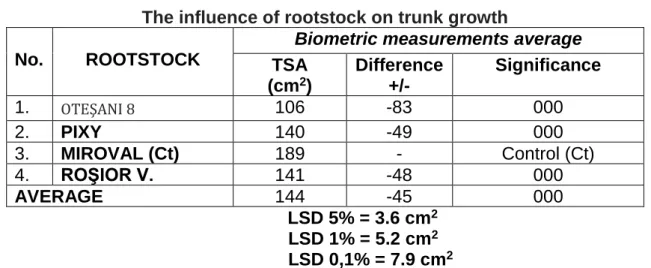
If we follow the influence of rootstock on the growth of the variety (Table 1), we find that the average value of the trunk section surface at the four rootstocks is of 144 cm2. The
highest value is recorded at the Miroval rootstock (189 cm2) and the lowest value at the
Oteşani 8 rootstock (106 cm2). Roşior văratic and Pixy portals record values close to
average, respectively 141 cm2 and 140 cm2. If we take as control the Miroval rootstock, there
are found very significant negative statistical differences: -83 cm2 at the root of Oteşani 8,
97
The influence of rootstock on trunk growth
No. ROOTSTOCK
Biometric measurements average TSA
(cm2)
Difference +/-
Significance
1. OTEŞANI 8 106 -83 000
2. PIXY 140 -49 000
3. MIROVAL (Ct) 189 - Control (Ct)
4. ROŞIOR V. 141 -48 000
AVERAGE 144 -45 000
LSD 5% = 3.6 cm2 LSD 1% = 5.2 cm2 LSD 0,1% = 7.9 cm2
The average diameter of the crown recorded in the four rootstocks is 356 cm, with the following values: 314 cm at the Oteşani 8 rootstock, 354 cm at Pixy rootstock, 364 cm at Roşior văratic rootstock and 392 cm at the Miroval rootstock (Table 2).
The average height of the trees on the four rootstocks is 399 cm, respectively 362 cm at the Oteşani 8 rootstock, 393 cm at Pixy rootstock, 399 cm at Roşior văratic rootstock and 441 cm at the Miroval rootstock (Table 2).
The average volume of tree crown grafted on the four rootstocks has a mean value of 34 m3, with 24 m3 at the Oteşani 8, 32 m3 at Pixy rootstock, 35 m3 at the Roşior văratic
and 46 m3 to the Miroval rootstock (Table 2).
The average utilization rate of the land by trees is 62.1%, the values being 48.3% for the grafting on the Oteşani 8 rootstock, 61.4% for the trees grafted on Pixy rootstock, 65.0% for the grafted trees Roşior văratic rootstock and 75.3% for trees grafted on the Miroval rootstock (Table 2).
Table 2
The influence of rootstock on variety growth
No.
ROOTSTOCK
Biometric measurements average The
diametre of the crown
Height of the
tree (cm)
The average
volum (m3)
The average utilization rate
of the land (%)
1. OTEŞANI 8 314 362 24 48,3
2. PIXY 354 393 32 61,4
3. MIROVAL (Ct) 392 441 46 75,3
4. ROŞIOR V. 364 399 35 65,0
AVERAGE 356 399 34 62,1
98
The Pixy and Roşior văratic rootstock imprints a medium growth force to the studied varieties, compared to the other two rootstocks, to all the elements that have been determined.
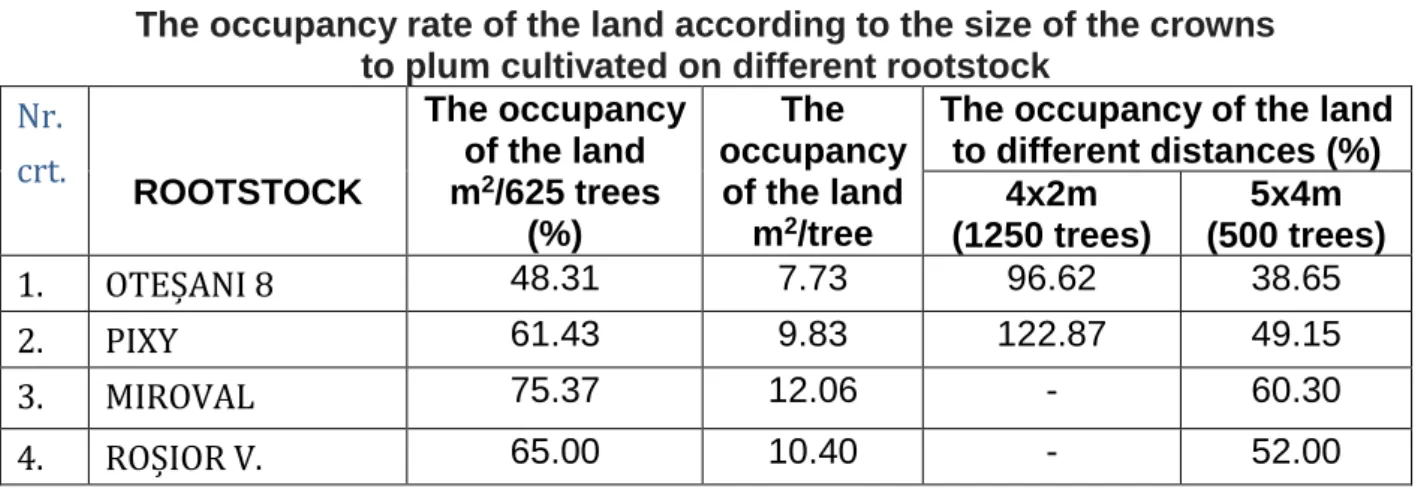
Studying the occupancy of the land, according to the size of the crowns and the planting distance, to the plum varieties grafted on the four rootstocks, the following were found (table 3):
- to the plum varieties grafted on the Oteşani 8 rootstock, at the planting distance of 4.0 / 4.0 m (625 plants/ha), the utilization rate of the land is 48.31%. The surface area occupied by a tree is 7.73 m2. If the planting distance is 4.0/2.0 m (1250 plants/ha) then
the occupancy of the land is 96.62%. If the planting distance is 5.0/4.0 m (500 plants/ha), the occupancy rate of the land is only 38.65%.
- to the plum varieties grafted on Pixy rootstock, the occupancy of the land is 61,43%, at the planting distance of 4.0/4.0 m. The area occupied by each tree is 9.83 m2. If
tree planting is at a distance of 4.0/2.0 m (1250 plants/ha), then the occupancy of the land is 122.87%, meaning that the trees cross their crowns. As a result, this planting distance is not indicated for the plum varieties grafted on Pixy rootstock. If the planting distance is 5.0/4.0 m (500 plants/ha), the occupancy of the land is only 49.15%, therefore this planting distance is not recommended to be used.
- to the plum varieties grafted on the Miroval rootstock with a planting distance of 4.0/4.0 m (625 plants/ha), the occupancy rate of the land is 75.37%. The area occupied by a tree is 12.06 m2. If the planting distance is 5.0/4.0 m (500 plants/ha), the occupancy
rate of the land is only 38.65%.
- to the plum varieties grafted on the Roşior văratic, the occupancy of the land is 65,00%, with the planting distance of 4.0/4.0 m (625 plants/ha). The area occupied by each tree is 10.40 m2. If the planting distance is 5.0/4.0 m (500 plants/ ha), the utilization
rate of the land is only 52.00%, so this planting distance is not indicated for use.
In conclusion, we can say that, if we take into account the occupancy of the land, for the plum varieties grafted on the Oteşani 8 rootstock, the optimal planting distance is 4.0/2.0 m (1250 plants/ha), and for the varieties of plum grafted on the other rootstocks this distance is not indicated because the land occupancy degree is over 100%.
Table 3
The occupancy rate of the land according to the size of the crowns to plum cultivated on different rootstock
Nr. crt.
ROOTSTOCK
The occupancy of the land m2/625 trees
(%)
The occupancy
of the land m2/tree
The occupancy of the land to different distances (%)
4x2m (1250 trees)
5x4m (500 trees)
1. OTEȘANI 8 48.31 7.73 96.62 38.65
2. PIXY 61.43 9.83 122.87 49.15
3. MIROVAL 75.37 12.06 - 60.30
4. ROȘIOR V. 65.00 10.40 - 52.00
2. Cover of the main growth and fructification phenophases
99
of the fruits, the end of the vegetation period and the number of days of the vegetation period (days with active temperatures >50 C).
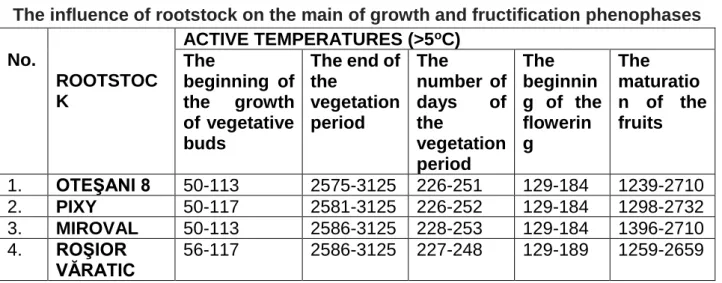
The beginning of vegetative buds (2014-2016) occurs when the sum of the active temperature degrees (>5aC) records values between 50-1130C, in the case of varieties
grafted on the rootstocks Oteşani 8 and Miroval (calendar between March 03 - March 15) between 50-1170C for varieties grafted on Pixy rootstock (calendar between March 03 -
March 16) and 56-1170 C in the case of varieties grafted on Roşor vrăratic rootstock
(calendar between March 06 - March 16) (Table 4). It is thus found that the recorded differences are very small.
The beginning of the bloom (2014-2016) takes place when the sum of the active temperature degrees is between 129-1840C, in the case of the Oteşani 8, Pixy and Miroval
rootstocks (calendar between March 28 and April 04) respectively between 129-1890C in
the case of varieties grafted on the Roşior văratic rootstock (calendar between March 28 - April 5).
The varieties were blossom occurs most rapidly are Diana, Silvia, Vâlcean, Ialomiţa, Centenar, Renclod Althan and Valor, and those with the later flowering are Stanley, Dâmboviţa, Anna Spath, Alina, Tuleu gras etc.
Fruit maturation occurs when the sum of the active temperature degrees is between 1239-27100C for varieties grafted on Oteşani 8 rootstock (calendar between 30 June to 12
September) between 1259-27100C to varieties grafted on the Miroval rootstock (calendar
between July 1 and September 12), between 1298-27320C to varieties grafted on Pixy
rootstock (calendar July 3 to September 14) and between 1430-26590C to the varieties
grafted on the Roşior văratic rootstock (calendar July 10 - September 6).
The order of maturation of the varieties is as follows: Diana, Ialomiţa, Minerva, Piteştean, Carpatin, Vâlcean, Silvia, Centenar, Renclod Althan, Tita, Flora, Alina, Pescăruş, Dâmboviţa, Tuleu gras, Stanley, Valor, Record and Anna Spath.
Table 4
The influence of rootstock on the main of growth and fructification phenophases
No.
ROOTSTOC K
ACTIVE TEMPERATURES (>5oC) The
beginning of the growth of vegetative buds
The end of the
vegetation period
The
number of days of the
vegetation period
The beginnin g of the flowerin g
The maturatio n of the fruits
1. OTEŞANI 8 50-113 2575-3125 226-251 129-184 1239-2710
2. PIXY 50-117 2581-3125 226-252 129-184 1298-2732
3. MIROVAL 50-113 2586-3125 228-253 129-184 1396-2710
4. ROŞIOR
VĂRATIC
56-117 2586-3125 227-248 129-189 1259-2659
The end of the vegetation period (2014-2016) is recorded when are accumulated active temperatures ranging between 2575-31250C to varieties grafted on Oteşani 8
rootstock (calendar between October 22 - November 16), between 2581-31250C to varieties
2586-100
31250C to the varieties grafted on the Miroval and Roşior văratic rootstocks (calendar
between 24 October to 20 November).
The number of days of active temperatures during the vegetation period varied between 226-251 days in varieties grafted on the Oteşani 8 rootstock, between 226-252 days at varieties grafted on Pixy rootstock, between 228-253 days for varieties grafted on the Miroval rootstock and between 227-248 days for varieties grafted on Roşior văratic rootstock.
In the light of the above, we can conclude that the influence of rootstock on the main phenophases of growth and fructification of plum varieties studied is not very high, the values recorded by the four rootstocks being close.
CONCLUSIONS
1. on rootstock's influence on growth within the graft / rootstock bio-system
- the Oteşani 8 rootstock imprints the smallest growth of the studied varieties, namely
the section of the trunk section, the crown diameter, the height of the tree, the crown volume and the degree of use of the land, while the Miroval rootstock imprints the greatest growth force to the varieties in all studies element. The Pixy and the Roşior văratic rootstock imprint a medium growth force to the studied varieties, compared to the other two rootstocks, to all the elements that have been determined.
- if we take into account the occupancy of the land, for the plum varieties grafted on the Oteşani 8 rootstock, the optimal planting distance is 4.0/2.0 m (1250 plants/ha), and for the varieties of plum grafted on the other rootstocks this distance is not indicated because the land occupancy degree is over 100%.
2. on growth and fructification phenophases
- starting in vegetation, marked by the beginning of budding, occurs when the sum of active temperatures degrees (>50C) records values between 50-1170 C, these values being greatly influenced by the duration of the cold season;
- The flowering of plum varieties in the central area of Oltenia took place in April during the registration of active temperatures ranging from 129-1890C, differences in flowering
being found between varieties as well as within the variety, depending on the graft/rootstock biosystem. The varieties were blossom starts at the earliest are Diana, Silvia, Vâlcean, Ialomiţa, Centenar, Renclod Althan and Valor, and those with the later blossom are Stanley, Dâmboviţa, Anna Spath, Alina, Tuleu etc.;
- for fruit maturation the sum of the recorded active temperatures (2014-2016) varies between 1239-2732aC, depending on the year and the graft / rootstock association. The
order of maturation of the varieties is as follows: Diana, Ialomita, Minerva, Piteştean, Carpatin, Vâlcean, Silvia, Centenar, Renclod Althan, Tita, Flora, Alina, Pescăruş, Dâmboviţa, Tuleu gras, Stanley, Valor, Record and Anna Spath.
- the end of the vegetation period, marked by the fall of leaves, occurs at the accumulation of 1575-3125aC active temperatures;
- the number of days with active temperatures during the growing season during the three years of study (2014-2016) varies between 226-253 days;
101
BIBLIOGRAPHY
1. Botu I., Achim Gh. – 2004 – Evaluation of the stress capacity of different soil types on tha scion – rootstock biosystem for plum.Acta Horticulturae 658, ISHS 2004: 413-417.
2. Botu M. - 2000 – Cercetări pentru stabilirea unor genotipuri şi soiuri valoroase de prun pentru zona subcarpatică a Olteniei. Teza de doctorat. Universitatea din Craiova.
3. Chiriac Şt., Isac Il., Olteanu N., Drăgoi D. – 1992 – Strategia dezvoltării producţiei de prune în România în contextul Pieţei Internaţionale. Lucr. Ses. Tehnico-Ştiinţifice
“Zilele Prunului “ Ed. a VI-a, Sâmbureşti-Olt.
4. Cichi M. – 2002 – Aspecte fiziologice ale unor soiuri noi de prun în zona colinară a Olteniei. Analele Facultăţii de Agricultură.
5. Gastrol M., Poniedzialek W. – 2007 – Garla – a new promising rootstock for plums.
Acta Horticulturae 732, ISHS: 257-260.
6. Grzyb Z.S., Sitarek M. – 2007 – Evaluation of Jaspi and Ishtara plum rootstocks in Polish climatical conditions. Acta Horticulturae 734, ISHS: 397-400.