This text was adapted by The Saylor Foundation under a Creative
Commons Attribution-NonCommercial-ShareAlike 3.0 License without
Preface
In 1977, chemists Theodore L. Brown and H. Eugene LeMay (joined in subsequent editions by Bruce Bursten and Julia Burdge) published a general chemistry textbook titled Chemistry: The Central Science. Since that time, the label the central science has become more and more associated with chemistry above all other sciences.
Why? Follow along, if you will. Science is grounded, first and foremost, in mathematics. Math is the language of science. Any study of true science must use math as an inescapable tool. The most fundamental science is physics, the study of matter and energy. (For the sake of argument, I include astronomy as part of physics.) Then we progress to the study of the description of matter and how that description can change—that’s chemistry.
As this point, however, several directions are possible. Do you want to study the chemistry of living things? That’s biology. The chemistry of the earth? That’s geology. The chemistry of how compounds work in our body? That’s pharmacology. The application of chemistry to better our lives? That’s engineering (chemical engineering, to be more specific, but we’ve just opened the door to the applied sciences). Granted, there are connections between more fundamental sciences and others—geophysics, astrobiology, and so forth—but a map of the sciences and their interconnections shows the most obvious branches after chemistry. This is why we consider chemistry the central science.
This concept is reinforced by the fact that many science majors require a course or two of chemistry as part of their curriculum (indeed, perhaps this is the reason you are using this textbook). Do you want to study biology? You’ll need some chemistry courses. Are you a geology major? You’ll need to know some chemistry. Many engineering disciplines, not just chemical engineering, require some background in chemistry as well. The reason that chemistry is required by so many other disciplines is that it is, to overuse the word, central.
and depend on chemistry every day. This is what makes chemistry an integral part, and what should make chemistry an integral part, of the modern literate adult.
The goal of this textbook is not to make you an expert. True expertise in any field is a years-long endeavor. Here I will survey some of the basic topics of chemistry. This survey should give you enough knowledge to appreciate the impact of chemistry in everyday life and, if necessary, prepare you for additional instruction in chemistry.
The text starts with an introduction to chemistry. Some users might find this a throwaway chapter, but I urge you to look it over. Many people—even scientists—do not know what science really is, and we all can benefit if we learn what science is and, importantly, what science is not. Chemistry, like all sciences, is inherently quantitative, so Chapter 2 "Measurements" discusses measurements and the conventions for expressing them. Yes, chemistry has conventions and arbitrarily adopted, agreed-on standards against which everything is expressed. Students are sometimes dismayed to learn that a hard science like chemistry has arbitrary standards. But then, all fields have their arbitrary standards that experts in that field must master if they are to be considered “experts.” Chemistry, like other sciences, is no different.
Chemistry is based on atoms, so that concept comes next. Atoms make molecules, another important topic in chemistry. But atoms and molecules can change—a fundamental concept in chemistry. Therefore, unlike some other competing texts, I introduce chemical change early. Chemistry is little without the concept of chemical change, so I deem it important to introduce the concept as early as possible.
Energy is also an important topic in chemistry, so now that atoms and molecules, chemical reactions, and stoichiometry have been introduced, I include energy as a quantitative property. With this, the basic topics of chemistry are introduced; the remaining chapters discuss either more applied topics or topics less crucial to their survey of knowledge even if they are
fundamental to our understanding: electronic structure, bonding, phases, solutions, acids and bases, chemical equilibrium, oxidation and reduction, and nuclear chemistry. I finish the text with a quick introduction to organic chemistry, if only to whet the appetites of those who thirst to know more.
Throughout each chapter, I present two features that reinforce the theme of the textbook—that chemistry is all around you. The first is a feature titled, appropriately, “Chemistry Is
Everywhere.” These features examine a topic of the chapter and demonstrate how this topic shows up in everyday life. In Chapter 1 "What Is Chemistry?", “Chemistry Is Everywhere”
focuses on the personal hygiene products that you may use every morning: toothpaste, soap, and shampoo, among others. These products are chemicals, aren’t they? Ever wonder about the chemical reactions that they undergo to give you clean and healthy teeth or shiny hair? I will explore some of these chemical reactions in future chapters. But this feature makes it clear that chemistry is, indeed, everywhere.
The other feature focuses on chemistry that you likely indulge in every day: eating and drinking. In the “Food and Drink App,” I discuss how the chemistry of the chapter applies to things that you eat and drink every day. Carbonated beverages depend on the behavior of gases, foods contain acids and bases, and we actually eat certain rocks. (Can you guess which rocks without looking ahead?) Cooking, eating, drinking, and metabolism—we are involved with all these chemical processes all the time. These two features allow us to see the things we interact with every day in a new light—as chemistry.
exercises to practice the material from that section, and each chapter ends with Additional Exercises that are more challenging or require multiple steps or skills to answer.
The mathematical problems in this text have been treated in one of two ways: either as a conversion-factor problem or as a formula problem. It is generally recognized that consistency in problem solving is a positive pedagogical tool. Students and instructors may have different ways to work problems mathematically, and if it is mathematically consistent, the same answer will result. However, I have found it better to approach mathematical exercises in a consistent fashion, without (horrors!) cutesy shortcuts. Such shortcuts may be useful for one type of problem, but if students do not do a problem correctly, they are clueless as to why they went wrong. Having two basic mathematical approaches (converting and formulas) allows the text to focus on the logic of the approach, not the tricks of a shortcut.
Inundations of unnecessary data, such as the densities of materials, are minimized for two reasons. First, they contribute nothing to understanding the concepts. Second, as an
introductory textbook, this book focuses on the concepts and does not serve as a reference of data. There are other well-known sources of endless data should students need them.
Chapter 1
What Is Chemistry?
Opening Essay
If you are reading these words, you are likely starting a chemistry course. Get ready for a fantastic journey through a world of wonder, delight, and knowledge. One of the themes of this book is “chemistry is everywhere,” and indeed it is; you would not be alive if it weren’t for chemistry because your body is a big chemical machine. If you don’t believe it, don’t worry. Every chapter in this book contains examples that will show you how chemistry is, in fact, everywhere. So enjoy the ride—and enjoy chemistry.
What is chemistry? Simply put, chemistry is the study of the interactions of matter with other matter and with energy. This seems straightforward enough. However, the definition of
chemistry includes a wide range of topics that must be understood to gain a mastery of the topic or even take additional courses in chemistry. In this book, we will lay the foundations of
chemistry in a topic-by-topic fashion to provide you with the background you need to successfully understand chemistry.
1.1 Some Basic Definitions
LEARNING OBJECTIVE
1. Learn the basic terms used to describe matter.The definition of chemistry—the study of the interactions of matter with other matter and with energy—uses some terms that should also be defined. We start the study of chemistry by defining some basic terms.
Matter is anything that has mass and takes up space. A book is matter, a computer is matter,
computer, food, and dirt), we sometimes forget that air has mass and takes up space. Things that are not matter include thoughts, ideas, emotions, and hopes.
EXAMPLE 1
Which of the following is matter and not matter?1. a hot dog 2. love 3. a tree
Solution
1. A hot dog has mass and takes up space, so it is matter. 2. Love is an emotion, and emotions are not matter. 3. A tree has mass and takes up space, so it is matter.
Test Yourself
Which of the following is matter and not matter? 1. the moon
2. an idea for a new invention
Answer
1. The moon is matter.
2. The invention itself may be matter, but the idea for it is not.
To understand matter and how it changes, we need to be able to describe matter. There are two basic ways to describe matter: physical properties and chemical properties.
is the phase (or state) of matter. The three fundamental phases of matter are solid, liquid, and gas (see Figure 1.1 "The Phases of Matter").
Chemical properties are characteristics of matter that describe how matter changes form in the presence of other matter. Does a sample of matter burn? Burning is a chemical property. Does it behave violently when put in water? This reaction is a chemical property as well (Figure 1.2 "Chemical Properties"). In the following chapters, we will see how descriptions of physical and chemical properties are important aspects of chemistry.
If matter always stayed the same, chemistry would be rather boring. Fortunately, a major part of chemistry involves change. A physical change occurs when a sample of matter changes one or more of its physical properties. For example, a solid may melt (Figure 1.3 "Physical Changes"), or alcohol in a thermometer may change volume as the temperature changes. A physical change does not affect the chemical composition of matter.
A chemical change is the process of demonstrating a chemical property, such as the burning match in Figure 1.2 "Chemical Properties". As the matter in the match burns, its chemical composition changes, and new forms of matter with new physical properties are created. Note that chemical changes are frequently accompanied by physical changes, as the new matter will likely have different physical properties from the original matter.
EXAMPLE 2
Describe each process as a physical change or a chemical change.
1. Water in the air turns into snow. 2. A person’s hair is cut.
3. Bread dough becomes fresh bread in an oven.
2. Your long hair is being shortened. This is a physical change.
3. Because of the oven’s temperature, chemical changes are occurring in the bread dough to make fresh bread. These are chemical changes. (In fact, a lot of cooking involves chemical changes.)
Test Yourself
Identify each process as a physical change or a chemical change.
1. A fire is raging in a fireplace.
2. Water is warmed to make a cup of coffee.
Answers
1. chemical change 2. physical change
A sample of matter that has the same physical and chemical properties throughout is called a substance. Sometimes the phrase pure substance is used, but the word pure isn’t needed. The definition of the term substance is an example of how chemistry has a specific definition for a word that is used in everyday language with a different, vaguer definition. Here, we will use the term substance with its strict chemical definition.
Chemistry recognizes two different types of substances: elements and compounds. An element is the simplest type of chemical substance; it cannot be broken down into simpler chemical substances by ordinary chemical means. There are about 115 elements known to science, of which 80 are stable. (The other elements are radioactive, a condition we will consider in Chapter 15 "Nuclear Chemistry".) Each element has its own unique set of physical and
A compound is a combination of more than one element. The physical and chemical properties of a compound are different from the physical and chemical properties of its constituent
elements; that is, it behaves as a completely different substance. There are over 50 million compounds known, and more are being discovered daily. Examples of compounds include water, penicillin, and sodium chloride (the chemical name for common table salt).
Elements and compounds are not the only ways in which matter can be present. We frequently encounter objects that are physical combinations of more than one element or compound. Physical combinations of more than one substance are called mixtures. There are two types of mixtures. A heterogeneous mixture is a mixture composed of two or more substances. It is easy to tell, sometimes by the naked eye, that more than one substance is present.
A homogeneous mixture is a combination of two or more substances that is so intimately mixed that the mixture behaves as a single substance. Another word for a homogeneous mixture is solution. Thus, a combination of salt and steel wool is a heterogeneous mixture because it is easy to see which particles of the matter are salt crystals and which are steel wool. On the other hand, if you take salt crystals and dissolve them in water, it is very difficult to tell that you have more than one substance present just by looking—even if you use a powerful microscope. The salt dissolved in water is a homogeneous mixture, or a solution (Figure 1.4 "Types of Mixtures").
EXAMPLE 3
Identify the following combinations as heterogeneous mixtures or homogenous mixtures.
1. soda water (Carbon dioxide is dissolved in water.)
2. a mixture of iron metal filings and sulfur powder (Both iron and sulfur are elements.)
1. Because carbon dioxide is dissolved in water, we can infer from the behavior of salt crystals dissolved in water that carbon dioxide dissolved in water is (also) a
homogeneous mixture.
2. Assuming that the iron and sulfur are simply mixed together, it should be easy to see what is iron and what is sulfur, so this is a heterogeneous mixture.
Test Yourself
Are the following combinations homogeneous mixtures or heterogeneous mixtures?
1. the human body
2. an amalgam, a combination of some other metals dissolved in a small amount of mercury
Answers
1. heterogeneous mixture
2. homogeneous mixture
"Semimetals"). Nonmetals also exist in a variety of phases and colors at room temperature. Some elements have
properties of both metals and nonmetals and are called semimetals (or metalloids). We will see later how these descriptions can be assigned rather easily to various elements.
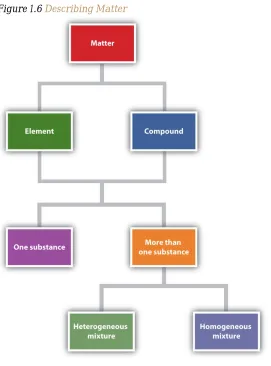
Figure 1.6 "Describing Matter" is a flowchart of the relationships among the different ways of describing matter.
Figure 1.6 Describing Matter
This flowchart shows how matter can be described.
Chemistry Is Everywhere: In the Morning
If you take a shower or bath in the morning, you probably use soap, shampoo, or both. These items contain chemicals that interact with the oil and dirt on your body and hair to remove them and wash them away. Many of these products also contain chemicals that make you smell good; they are called fragrances.
When you brush your teeth in the morning, you usually use toothpaste, a form of soap, to clean your teeth. Toothpastes typically contain tiny, hard particles
called abrasives that physically scrub your teeth. Many toothpastes also contain fluoride, a substance that chemically interacts with the surface of the teeth to help prevent cavities.
Perhaps you take vitamins, supplements, or medicines every morning. Vitamins and other supplements contain chemicals your body needs in small amounts to function properly. Medicines are chemicals that help combat diseases and promote health.
Perhaps you make some fried eggs for breakfast. Frying eggs involves heating them enough so that a chemical reaction occurs to cook the eggs.
After you eat, the food in your stomach is chemically reacted so that the body (mostly the intestines) can absorb food, water, and other nutrients.
If you drive or take the bus to school or work, you are using a vehicle that probably burns gasoline, a material that burns fairly easily and provides energy to power the vehicle. Recall that burning is a chemical change.
These are just a few examples of how chemistry impacts your everyday life. And we haven’t even made it to lunch yet!
KEY TAKEAWAYS
Chemistry is the study of matter and its interactions with other matter and energy. Matter is anything that has mass and takes up space.
Matter is composed of elements and compounds.
Combinations of different substances are called mixtures.
Elements can be described as metals, nonmetals, and semimetals.
EXERCISES
Identify each as either matter or not matter.
a. a book b. hate c. light d. a car e. a fried egg
2. Give an example of matter in each phase: solid, liquid, or gas.
3. Does each statement represent a physical property or a chemical property? a. Sulfur is yellow.
b. Steel wool burns when ignited by a flame. c. A gallon of milk weighs over eight pounds.
4. Does each statement represent a physical property or a chemical property?
a. A pile of leaves slowly rots in the backyard.
b. In the presence of oxygen, hydrogen can interact to make water. c. Gold can be stretched into very thin wires.
a. Water boils and becomes steam.
b. Food is converted into usable form by the digestive system.
c. The alcohol in many thermometers freezes at about −40 degrees Fahrenheit.
6. Does each statement represent a physical change or a chemical change?
a. Graphite, a form of elemental carbon, can be turned into diamond, another form of carbon, at very high temperatures and pressures.
b. The house across the street has been painted a new color.
c. The elements sodium and chlorine come together to make a new substance called sodium chloride.
7. Distinguish between an element and a compound. About how many of each are known?
8. What is the difference between a homogeneous mixture and a heterogeneous mixture?
9. Identify each as a heterogeneous mixture or a homogeneous mixture.
a. Salt is mixed with pepper. b. Sugar is dissolved in water. c. Pasta is cooked in boiling water.
10. Identify each as a heterogeneous mixture or a homogeneous mixture.
a. air b. dirt
c. a television set
11. In Exercise 9, which choices are also solutions?
13. Why is iron considered a metal?
14. Why is oxygen considered a nonmetal?
15. Distinguish between a metal and a nonmetal.
16. What properties do semimetals have?
17. Elemental carbon is a black, dull-looking solid that conducts heat and electricity well. It is very brittle and cannot be made into thin sheets or long wires. Of these properties, how does carbon behave as a metal? How does carbon behave as a nonmetal?
18. Pure silicon is shiny and silvery but does not conduct electricity or heat well. Of these properties, how does silicon behave as a metal? How does silicon behave as a nonmetal?
ANSWERS
1. a. matter b. not matter c. not matter d. matter e. matter
3. a. physical property b. chemical property c. physical property
b. chemical change c. physical change
7. An element is a fundamental chemical part of a substance; there are about 115 known elements. A compound is a combination of elements that acts as a different substance; there are over 50 million known substances.
9. a. heterogeneous b. homogeneous c. heterogeneous
10. Choice b is a solution.
11. Iron is a metal because it is solid, is shiny, and conducts electricity and heat well.
13. Metals are typically shiny, conduct electricity and heat well, and are malleable and ductile; nonmetals are a variety of colors and phases, are brittle in the solid phase, and do not conduct heat or electricity well.
1.2 Chemistry as a Science
LEARNING OBJECTIVE
1. Learn what science is and how it works.
Chemistry is a branch of science. Although science itself is difficult to define exactly, the following definition can serve as starting point. Science is the process of knowing about the natural universe through observation and experiment. Science is not the only process of knowing (e.g., the ancient Greeks simply sat and thought), but it has evolved over more than 350 years into the best process that humanity has devised to date to learn about the universe around us.
The process of science is usually stated as the scientific method, which is rather naïvely
described as follows: (1) state a hypothesis, (2) test the hypothesis, and (3) refine the hypothesis. Actually, however, the process is not that simple. (For example, I don’t go into my lab every day and exclaim, “I am going to state a hypothesis today and spend the day testing it!”) The process is not that simple because science and scientists have a body of knowledge that has already been identified as coming from the highest level of understanding, and most scientists build from that body of knowledge.
An educated guess about how the natural universe works is called a hypothesis. A scientist who is familiar with how part of the natural universe works—say, a chemist—is interested in furthering that knowledge. That person makes a reasonable guess—a hypothesis—that is
designed to see if the universe works in a new way as well. Here’s an example of a hypothesis: “if I mix one part of hydrogen with one part of oxygen, I can make a substance that contains both elements.”
universe to see if a guess (hypothesis) is correct. An experiment to test our previous hypothesis would be to actually mix hydrogen and oxygen and see what happens. Most experiments include observations of small, well-defined parts of the natural universe designed to see results of the experiments.
Why do we have to do experiments? Why do we have to test? Because the natural universe is not always so obvious, experiments are necessary. For example, it is fairly obvious that if you drop an object from a height, it will fall. Several hundred years ago (coincidentally, near the inception of modern science), the concept of gravity explained that test. However, is it obvious that the entire natural universe is composed of only about 115 fundamental chemical building blocks called elements? This wouldn’t seem true if you looked at the world around you and saw all the different forms matter can take. In fact, the concept of the element is only about 200 years old, and the last naturally occurring element was identified about 80 years ago. It took decades of tests and millions of experiments to establish what the elements actually are. These are just two examples; a myriad of such examples exists in chemistry and science in general.
When enough evidence has been collected to establish a general principle of how the natural universe works, the evidence is summarized in a theory. A theory is a general statement that explains a large number of observations. “All matter is composed of atoms” is a general statement, a theory, that explains many observations in chemistry. A theory is a very powerful statement in science. There are many statements referred to as “the theory of _______” or the “______ theory” in science (where the blanks represent a word or concept). When written in this way, theories indicate that science has an overwhelming amount of evidence of its
correctness. We will see several theories in the course of this text.
consequences (such as speed limits). Here again, science uses these terms differently, and it is important to apply their proper definitions when you use these words in science.
There is an additional phrase in our definition of science: “the natural universe.” Science is concerned only with the natural universe. What is the natural universe? It’s anything that occurs around us, well, naturally. Stars; planets; the appearance of life on earth; and how animals, plants, and other matter function are all part of the natural universe. Science is concerned with that—and only that.
Of course, there are other things that concern us. For example, is the English language part of science? Most of us can easily answer no; English is not science. English is certainly worth knowing (at least for people in predominantly English-speaking countries), but why isn’t it science? English, or any human language, isn’t science because ultimately it is contrived; it is made up. Think of it: the word spelled b-l-u-e represents a certain color, and we all agree what color that is. But what if we used the word h-a-r-d-n-r-f to describe that color?
That would be fine—as long as everyone agreed. Anyone who has learned a second language must initially wonder why a certain word is used to describe a certain concept; ultimately, the speakers of that language agreed that a particular word would represent a particular concept. It was contrived.
That doesn’t mean language isn’t worth knowing. It is very
important in society. But it’s not science. Science deals only
with what occurs naturally.
Figure 1.9 English Is Not Science
EXAMPLE 4
Which of the following fields would be considered science?
1. geology, the study of the earth 2. ethics, the study of morality
3. political science, the study of governance 4. biology, the study of living organisms
Solution
1. Because the earth is a natural object, the study of it is indeed considered part of science. 2. Ethics is a branch of philosophy that deals with right and wrong. Although these are useful
concepts, they are not science.
3. There are many forms of government, but all are created by humans. Despite the fact that the word science appears in its name, political science is not true science.
4. Living organisms are part of the natural universe, so the study of them is part of science.
Test Yourself
Which is part of science, and which is not?
1. dynamics, the study of systems that change over time 2. aesthetics, the concept of beauty
Answers
The field of science has gotten so big that it is common to separate it into more specific fields. First, there is mathematics, the language of science. All scientific fields use mathematics to express themselves—some more than others. Physics and astronomy are scientific fields
concerned with the fundamental interactions between matter and energy. Chemistry, as defined previously, is the study of the interactions of matter with other matter and with energy. Biology is the study of living organisms, while geology is the study of the earth. Other sciences can be named as well. Understand that these fields are not always completely separate; the boundaries between scientific fields are not always readily apparent. Therefore, a scientist may be labeled a biochemist if he or she studies the chemistry of biological organisms.
Finally, understand that science can be either qualitative or quantitative. Qualitative implies a description of the quality of an object. For example, physical properties are generally qualitative descriptions: sulfur is yellow, your math book is heavy, or that statue is pretty.
A quantitative description represents the specific amount of something; it means knowing how much of something is present, usually by counting or measuring it. As such, some
quantitative descriptions would include 25 students in a class, 650 pages in a book, or a velocity of 66 miles per hour. Quantitative expressions are very important in science; they are also very important in chemistry.
EXAMPLE 5
Identify each statement as either a qualitative description or a quantitative description.
1. Gold metal is yellow.
2. A ream of paper has 500 sheets in it. 3. The weather outside is snowy.
Solution
1. Because we are describing a physical property of gold, this statement is qualitative. 2. This statement mentions a specific amount, so it is quantitative.
3. The word snowy is a description of how the day is; therefore, it is a qualitative statement. 4. In this case, the weather is described with a specific quantity—the temperature. Therefore, it
is quantitative.
Test Yourself
Are these qualitative or quantitative statements?
1. Roses are red, and violets are blue. 2. Four score and seven years ago….
Answers
1. qualitative 2. quantitative
Food and Drink App: Carbonated Beverages
Some of the simple chemical principles discussed in this chapter can be illustrated with
carbonated beverages: sodas, beer, and sparkling wines. Each product is produced in a different way, but they all have one thing in common. They are solutions of carbon dioxide dissolved in water.
Carbon dioxide is a compound composed of carbon and oxygen. Under normal conditions, it is a gas. If you cool it down enough, it becomes a solid known as dry ice. Carbon dioxide is an
important compound in the cycle of life on earth.
water. However, very little carbon dioxide can dissolve in water. If the atmosphere were pure carbon dioxide, the solution would be only about 0.07% carbon dioxide. In reality, the air is only about 0.03% carbon dioxide, so the amount of carbon dioxide in water is reduced
proportionally.
However, when soda and beer are made, manufacturers do two important things: they use pure carbon dioxide gas, and they use it at very high pressures. With higher pressures, more carbon dioxide can dissolve in the water. When the soda or beer container is sealed, the high pressure of carbon dioxide gas remains inside the package. (Of course, there are more ingredients in soda and beer besides carbon dioxide and water.)
When you open a container of soda or beer, you hear a distinctive hiss as the excess carbon dioxide gas escapes. But something else happens as well. The carbon dioxide in the solution comes out of solution as a bunch of tiny bubbles. These bubbles impart a pleasing sensation in the mouth, so much so that the soda industry sold over 225 billion servings of soda in the United States alone in 2009.
Some sparkling wines are made in the same way—by forcing carbon dioxide into regular wine. Some sparkling wines (including champagne) are made by sealing a bottle of wine with some yeast in it. The yeast ferments, a process by which the yeast converts sugars into energy and excess carbon dioxide. The carbon dioxide produced by the yeast dissolves in the wine. Then, when the champagne bottle is opened, the increased pressure of carbon dioxide is released, and the drink bubbles just like an expensive glass of soda.
KEY TAKEAWAYS
Science is a process of knowing about the natural universe through observation and experiment. Scientists go through a rigorous process to determine new knowledge about the universe; this
process is generally referred to as the scientific method.
EXERCISES
1. Describe the scientific method.
2. What is the scientific definition of a hypothesis? Why is the phrase a hypothesis is just a guess an inadequate definition?
3. Why do scientists need to perform experiments?
4. What is the scientific definition of a theory? How is this word misused in general conversation?
5. What is the scientific definition of a law? How does it differ from the everyday definition of a law?
6. Name an example of a field that is not considered a science.
7. Which of the following fields are studies of the natural universe?
a. biophysics (a mix of biology and physics) b. art
c. business
8. Which of the following fields are studies of the natural universe?
a. accounting
b. geochemistry (a mix of geology and chemistry)
c. astronomy (the study of stars and planets [but not the earth])
a. The Titanic was the largest passenger ship build at that time. b. The population of the United States is about 306,000,000 people. c. The peak of Mount Everest is 29,035 feet above sea level.
10. Which of these statements are qualitative descriptions?
a. A regular movie ticket in Cleveland costs $6.00.
b. The weather in the Democratic Republic of the Congo is the wettest in all of Africa. c. The deepest part of the Pacific Ocean is the Mariana Trench.
11. Of the statements in Exercise 9, which are quantitative?
12. Of the statements in Exercise 10, which are quantitative?
ANSWERS
1. Simply stated, the scientific method includes three steps: (1) stating a hypothesis, (2) testing the hypothesis, and (3) refining the hypothesis.
3. Scientists perform experiments to test their hypotheses because sometimes the nature of natural universe is not obvious.
5. A scientific law is a specific statement that is thought to be never violated by the entire natural universe. Everyday laws are arbitrary limits that society puts on its members.
9. a. qualitative b. not qualitative c. not qualitative
Chapter 2
Measurements
Opening Essay
Source: Chart courtesy of Centers for Disease Control and Prevention,http://www.cdc.gov/nchs/nhanes.htm#Set%201.
units of morphine to a patient rather than the “2–3” units prescribed. (The patient ultimately survived.) These incidents occurred because people weren’t paying attention to quantities. Chemistry, like all sciences, is quantitative. It deals with quantities, things that have amounts and units. Dealing with quantities is very important in chemistry, as is relating quantities to each other. In this chapter, we will discuss how we deal with numbers and units, including how they are combined and manipulated.
2.1
Expressing Numbers
LEARNING OBJECTIVE
1. Learn to express numbers properly.
Quantities have two parts: the number and the unit. The number tells “how many.” It is important to be able to express numbers properly so that the quantities can be communicated properly.
Standard notation is the straightforward expression of a number. Numbers such as 17, 101.5, and
0.00446 are expressed in standard notation. For relatively small numbers, standard notation is fine. However, for very large numbers, such as 306,000,000, or for very small numbers, such as 0.000000419, standard notation can be cumbersome because of the number of zeros needed to place nonzero numbers in the proper position.
Scientific notation is an expression of a number using powers of 10. Powers of 10 are used to express
numbers that have many zeros:
100 = 1
101 = 10
102 = 100 = 10 × 10
104 = 10,000 = 10 × 10 × 10 × 10
and so forth. The raised number to the right of the 10 indicating the number of factors of 10 in the original number is the exponent. (Scientific notation is sometimes called exponential notation.) The
exponent’s value is equal to the number of zeros in the number expressed in standard notation.
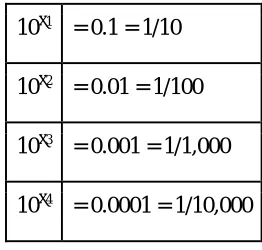
Small numbers can also be expressed in scientific notation but with negative exponents:
10−1 = 0.1 = 1/10
10−2 = 0.01 = 1/100
10−3 = 0.001 = 1/1,000
10−4 = 0.0001 = 1/10,000
and so forth. Again, the value of the exponent is equal to the number of zeros in the denominator of the associated fraction. A negative exponent implies a decimal number less than one.
A number is expressed in scientific notation by writing the first nonzero digit, then a decimal point, and then the rest of the digits. The part of a number in scientific notation that is multiplied by a power of 10 is called the coefficient. Then determine the power of 10 needed to make that number into the original number and multiply the written number by the proper power of 10. For example, to write 79,345 in scientific notation,
79,345 = 7.9345 × 10,000 = 7.9345 × 10
4Thus, the number in scientific notation is 7.9345 × 10⁴. For small numbers, the same process is used, but
the exponent for the power of 10 is negative:
0.000411 = 4.11 × 1/10,000 = 4.11 × 10
−4Typically, the extra zero digits at the end or the beginning of a number are not included. (See Figure 2.1 "Using Scientific Notation".)
Figure 2.1 Using Scientific Notation
EXAMPLE 1
Express these numbers in scientific notation.
1. 306,000 2. 0.00884 3. 2,760,000 4. 0.000000559
Solution
1. The number 306,000 is 3.06 times 100,000, or 3.06 times 105. In scientific notation, the
number is 3.06 × 10⁵.
2. The number 0.00884 is 8.84 times 1/1,000, which is 8.84 times 10−3. In scientific notation, the
number is 8.84 × 10⁻³.
3. The number 2,760,000 is 2.76 times 1,000,000, which is the same as 2.76 times 106. In
scientific notation, the number is written as 2.76 × 10⁶. Note that we omit the zeros at the
end of the original number.
4. The number 0.000000559 is 5.59 times 1/10,000,000, which is 5.59 times 10−7. In scientific
notation, the number is written as 5.59 × 10⁻⁷.
Test Yourself
Express these numbers in scientific notation.
Answers
1. 2.307 × 10⁴
2. 9.706 × 10⁻⁴
Another way to determine the power of 10 in scientific notation is to count the number of places you need to move the decimal point to get a numerical value between 1 and 10. The number of places equals the power of 10. This number is positive if you move the decimal point to the right and negative if you move the decimal point to the left:
56
↖
Many quantities in chemistry are expressed in scientific notation. When performing calculations, you may have to enter a number in scientific notation into a calculator. Be sure you know how to correctly enter a number in scientific notation into your calculator. Different models of calculators require different actions for properly entering scientific notation. If in doubt, consult your instructor immediately.
KEY TAKEAWAYS
Standard notation expresses a number normally.
Scientific notation expresses a number as a coefficient times a power of 10.
The power of 10 is positive for numbers greater than 1 and negative for numbers between 0 and 1.
EXERCISES
1. Express these numbers in scientific notation.
2. Express these numbers in scientific notation.
a. −890,000
b. 602,000,000,000 c. 0.0000004099 d. 0.000000000000011
3. Express these numbers in scientific notation.
a. 0.00656 b. 65,600 c. 4,567,000 d. 0.000005507
4. Express these numbers in scientific notation.
a. 65
b. −321.09
c. 0.000077099 d. 0.000000000218
5. Express these numbers in standard notation.
a. 1.381 × 10⁵
b. 5.22 × 10⁻⁷
c. 9.998 × 10⁴
a. 7.11 × 10⁻²
b. 9.18 × 10²
c. 3.09 × 10⁻¹⁰
7. Express these numbers in standard notation.
a. 8.09 × 100
b. 3.088 × 10⁻⁵ c. −4.239 × 10²
8. Express these numbers in standard notation.
a. 2.87 × 10⁻⁸
b. 1.78 × 10¹¹
c. 1.381 × 10⁻²³
9. These numbers are not written in proper scientific notation. Rewrite them so that they are in proper scientific notation.
a. 72.44 × 10³
b. 9,943 × 10−5
c. 588,399 × 102
10. These numbers are not written in proper scientific notation. Rewrite them so that they are in proper scientific notation.
a. 0.000077 × 10⁻⁷
b. 0.000111 × 10⁸
11. These numbers are not written in proper scientific notation. Rewrite them so that they are in proper scientific notation.
a. 345.1 × 10²
b. 0.234 × 10⁻³
c. 1,800 × 10−2
12. These numbers are not written in proper scientific notation. Rewrite them so that they are in proper scientific notation.
a. 8,099 × 10−8
b. 34.5 × 100
c. 0.000332 × 10⁴
13. Write these numbers in scientific notation by counting the number of places the decimal point is moved.
a. 123,456.78 b. 98,490 c. 0.000000445
14. Write these numbers in scientific notation by counting the number of places the decimal point is moved.
a. 0.000552 b. 1,987
15. Use your calculator to evaluate these expressions. Express the final answer in proper scientific notation.
a. 456 × (7.4 × 108) = ?
b. (3.02 × 10⁵) ÷ (9.04 × 10¹⁵) = ?
c. 0.0044 × 0.000833 = ?
16. Use your calculator to evaluate these expressions. Express the final answer in proper scientific notation.
a. 98,000 × 23,000 = ? b. 98,000 ÷ 23,000 = ?
c. (4.6 × 10−5) × (2.09 × 103) = ?
17. Use your calculator to evaluate these expressions. Express the final answer in proper scientific notation.
a. 45 × 132 ÷ 882 = ?
b. [(6.37 × 104) × (8.44 × 10−4)] ÷ (3.2209 × 10¹⁵) = ?
18. Use your calculator to evaluate these expressions. Express the final answer in proper scientific notation.
a. (9.09 × 10⁸) ÷ [(6.33 × 109) × (4.066 × 10−7)] = ?
b. 9,345 × 34.866 ÷ 0.00665 = ?
ANSWERS
b. 5.631 × 10⁵
c. 8.04 × 10⁻²
d. 6.67 × 10⁻⁶
3. a. 6.56 × 10⁻³
b. 6.56 × 10⁴
c. 4.567 × 10⁶
d. 5.507 × 10⁻⁶
5. a. 138,100 b. 0.000000522 c. 99,980
7. a. 8.09
b. 0.00003088
c. −423.9
9. a. 7.244 × 10⁴
b. 9.943 × 10⁻²
c. 5.88399 × 10⁷
11. a. 3.451 × 10⁴
b. 2.34 × 10⁻⁴
c. 1.8 × 101
13. a. 1.2345678 × 10⁵
b. 9.849 × 10⁴
15. a. 3.3744 × 10¹¹
b. 3.3407 × 10⁻¹¹
c. 3.665 × 10⁻⁶
17. a. 6.7346 × 100
b. 1.6691 × 10⁻¹⁴
2.2 Expressing Units
LEARNING OBJECTIVES
1. Learn the units that go with various quantities. 2. Express units using their abbreviations.
3. Make new units by combining numerical prefixes with units.
A number indicates “how much,” but the unit indicates “of what.” The “of what” is important when communicating a quantity. For example, if you were to ask a friend how close you are to Lake Erie and your friend says “six,” then your friend isn’t giving you complete information. Six what? Six miles? Six inches? Six city blocks? The actual distance to the lake depends on what units you use.
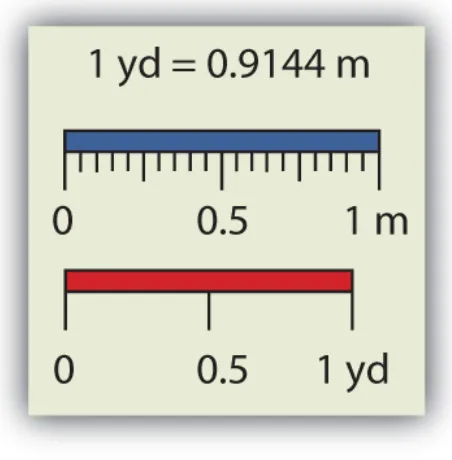
Figure 2.3 The Meter
The SI standard unit of length, the meter, is a little longer than a yard.
To express a quantity, you need to combine a number with a unit. If you have a length that is 2.4 m, then you express that length as simply 2.4 m. A time of 15,000 s can be expressed as 1.5 × 10⁴ s in scientific notation.
Sometimes, a given unit is not an appropriate size to easily express a quantity. For example, the width of a human hair is very small, and it doesn’t make much sense to express it in meters. SI also defines a series of numerical prefixes that refer to multiples or fractions of a
fundamental unit to make a unit more conveniently sized for a specific quantity. The chart lists the prefixes, their abbreviations, and their multiplicative factors. Some of the prefixes, such as kilo-, mega-, and giga-, represent more than one of the fundamental unit, while other prefixes, such as centi-, milli-, and micro-, represent fractions of the original unit. Note, too, that once again we are using powers of 10. Each prefix is a multiple of or fraction of a power of 10.
Table 2.1 Multiplicative Prefixes for SI Units
Prefix Abbreviation Multiplicative Amount
mega- M 1,000,000 ×
kilo- k 1,000 ×
deci- d 1/10 ×
centi- c 1/100 ×
milli- m 1/1,000 ×
micro- μ* 1/1,000,000 ×
nano- n 1/1,000,000,000 ×
pico- p 1/1,000,000,000,000 ×
* The letter μ is the Greek letter lowercase equivalent to an m and is called “mu” (pronounced “myoo”).
To use the fractions to generate new units, simply combine the prefix with the unit itself; the abbreviation for the new unit is the combination of the abbreviation for the prefix and the abbreviation of the unit. For example, the kilometer (km) is 1,000 × meter, or 1,000 m. Thus, 5 kilometers (5 km) is equal to 5,000 m. Similarly, a millisecond (ms) is 1/1,000 × second, or one-thousandth of a second. Thus, 25 ms is 25 one-thousandths of a second. You will need to become proficient in combining prefixes and units. (You may recognize that one of our fundamental units, the kilogram, automatically has a prefix-unit combination, the kilogram. The
word kilogram means 1,000 g.)
In addition to the fundamental units, SI also allows for derived units based on a fundamental unit or units. There are many derived units used in science. For example, the derived unit for area comes from the idea that area is defined as width times height. Because both width and height are lengths, they both have the fundamental unit of meter, so the unit of area is meter × meter, or meter2 (m2). This is sometimes spoken as “square meters.” A unit with a prefix can also
Volume is defined as length times width times height, so it has units of meter × meter × meter or meter3 (m3), sometimes spoken as “cubic meters.” The cubic meter is a rather large unit,
however, so another unit is defined that is somewhat more manageable: the liter (L). A liter is 1/1,000th of a cubic meter and is a little more than 1 quart in volume (see - ball-ch02_s02_f02).
Prefixes can also be used with the liter unit, so we can speak of milliliters (1/1,000th of a liter; mL) and kiloliters (1,000 L; kL).
Another definition of a liter is one-tenth of a meter cubed. Because one-tenth of a meter is 10 cm, then a liter is equal to 1,000 cm3 ( - ball-ch02_s02_f03). Because 1 L equals
1,000 mL, we conclude that 1 mL equals 1 cm3; thus, these
units are interchangeable.
Figure 2.5 The Size of 1 Liter
One liter equals 1,000 cm3, so 1 cm3 is the same as 1 mL.
Figure 2.4 The Liter
Units not only are multiplied together but also can be divided. For example, if you are traveling at one meter for every second of time elapsed, your velocity is 1 meter per second, or 1 m/s. The word per implies division, so velocity is determined by dividing a distance quantity by a time quantity. Other units for velocity include kilometers per hour (km/h) or even micrometers per nanosecond (μm/ns). Later, we will see other derived units that can be expressed as fractions.
EXAMPLE 2
1. A human hair has a diameter of about 6.0 × 10⁻⁵ m. Suggest an appropriate unit for this
measurement and write the diameter of a human hair in terms of that unit. 2. What is the velocity of a car if it goes 25 m in 5.0 s?
Solution
1. The scientific notation 10−5 is close to 10−6, which defines the micro- prefix. Let us use
micrometers as the unit for hair diameter. The number 6.0 × 10⁻⁵ can be written as 60 × 10−6,
and a micrometer is 10−6m, so the diameter of a human hair is about 60 μm.
2. If velocity is defined as a distance quantity divided by a time quantity, then velocity is 25 meters/5.0 seconds. Dividing the numbers gives us 25/5.0 = 5.0, and dividing the units gives us meters/second, or m/s. The velocity is 5.0 m/s.
Test Yourself
1. Express the volume of an Olympic-sized swimming pool, 2,500,000 L, in more appropriate units.
2. A common garden snail moves about 6.1 m in 30 min. What is its velocity in meters per minute (m/min)?
1. 2.5 ML 2. 0.203 m/min
KEY TAKEAWAYS
Numbers tell “how much,” and units tell “of what.”
Chemistry uses a set of fundamental units and derived units from SI units. Chemistry uses a set of prefixes that represent multiples or fractions of units. Units can be multiplied and divided to generate new units for quantities.
EXERCISES
1. Identify the unit in each quantity.
a. 2 boxes of crayons b. 3.5 grams of gold
2. Identify the unit in each quantity.
a. 32 oz of cheddar cheese b. 0.045 cm3 of water
3. Identify the unit in each quantity.
a. 9.58 s (the current world record in the 100 m dash) b. 6.14 m (the current world record in the pole vault)
a. 2 dozen eggs
b. 2.4 km/s (the escape velocity of the moon, which is the velocity you need at the surface to escape the moon’s gravity)
5. Indicate what multiplier each prefix represents.
a. k b. m c. M
6. Indicate what multiplier each prefix represents.
a. c b. G
c. μ
7. Give the prefix that represents each multiplier.
a. 1/1,000th × b. 1,000 ×
c. 1,000,000,000 ×
8. Give the prefix that represents each multiplier.
a. 1/1,000,000,000th × b. 1/100th ×
9. Complete the following table with the missing information.
10. Complete the following table with the missing information.
11. Express each quantity in a more appropriate unit. There may be more than one acceptable answer.
a. 3.44 × 10⁻⁶ s
12. Express each quantity in a more appropriate unit. There may be more than one acceptable answer.
a. 0.000066 m/s (Hint: you need consider only the unit in the numerator.) b. 4.66 × 10⁶ s
c. 7,654 L
13. Express each quantity in a more appropriate unit. There may be more than one acceptable answer.
a. 43,600 mL b. 0.0000044 m c. 1,438 ms
14. Express each quantity in a more appropriate unit. There may be more than one acceptable answer.
a. 0.000000345 m3
b. 47,000,000 mm3
c. 0.00665 L
15. Multiplicative prefixes are used for other units as well, such as computer memory. The basic unit of computer memory is the byte (b). What is the unit for one million bytes?
17. Acceleration is defined as a change in velocity per time. Propose a unit for acceleration in terms of the fundamental SI units.
18. Density is defined as the mass of an object divided by its volume. Propose a unit of density in terms of the fundamental SI units.
ANSWERS
1. a. boxes of crayons b. grams of gold
3. a. seconds b. meters
5. a. 1,000 × b. 1/1,000 × c. 1,000,000 ×
7. a. milli- b. kilo- c. giga-
11. a. 3.44 μs
b. 3.5 kL c. 4.5 cm
13. a. 43.6 L b. 4.4 µm c. 1.438 s
15. megabytes (Mb)
17. meters/second2
2.3
Significant Figures
LEARNING OBJECTIVES
1. Apply the concept of significant figures to limit a measurement to the proper number of digits. 2. Recognize the number of significant figures in a given quantity.
If you use a calculator to evaluate the expression 337/217, you will get the following:
337
and so on for many more digits. Although this answer is correct, it is somewhat presumptuous. You start with two values that each have three digits, and the answer has twelve digits? That does not make much sense from a strict numerical point of view.
Consider using a ruler to measure the width of an object, as shown in - ball-ch02_s03_f01. The object is
definitely more than 1 cm long, so we know that the first digit in our measurement is 1. We see by
counting the tick marks on the ruler that the object is at least three ticks after the 1. If each tick represents 0.1 cm, then we know the object is at least 1.3 cm wide. But our ruler does not have any more ticks
between the 0.3 and the 0.4 marks, so we can’t know exactly how much the next decimal place is. But with a practiced eye we can estimate it. Let us estimate it as about six-tenths of the way between the third and fourth tick marks, which estimates our hundredths place as 6, so we identify a measurement of 1.36 cm for the width of the object.
Figure 2.6 Expressing Width
What is the proper way to express the width of this object?
This concept of reporting the proper number of digits in a measurement or a calculation is
called significant figures. Significant figures (sometimes called significant digits) represent the limits of what values of a measurement or a calculation we are sure of. The convention for a measurement is that the quantity reported should be all known values and the first estimated value. The conventions for calculations are discussed as follows.
EXAMPLE 3
Use each diagram to report a measurement to the proper number of significant figures.
1.
2.
Solution
3. Combining the digits, we have a measurement of 4.33 psi (psi stands for “pounds per square inch” and is a unit of pressure, like air in a tire). We say that the measurement is reported to three significant figures.
2. The rectangle is at least 1.0 cm wide but certainly not 2.0 cm wide, so the first significant digit is 1. The rectangle’s width is past the second tick mark but not the third; if each tick mark represents 0.1, then the rectangle is at least 0.2 in the next significant digit. We have to estimate the next place because there are no markings to guide us. It appears to be about halfway between 0.2 and 0.3, so we will estimate the next place to be a 5. Thus, the measured width of the rectangle is 1.25 cm. Again, the measurement is reported to three significant figures.
Test Yourself
What would be the reported width of this rectangle?
Answer
0.63 cm
The following conventions dictate which numbers in a reported measurement are significant and which are not significant:
1. Any nonzero digit is significant.
2. Any zeros between nonzero digits (i.e., embedded zeros) are significant.
3. Zeros at the end of a number without a decimal point (i.e., trailing zeros) are not significant; they serve only to put the significant digits in the correct positions. However, zeros at the end of any number with a decimal point are significant.
4. Zeros at the beginning of a decimal number (i.e., leading zeros) are not significant; again, they serve only to put the significant digits in the correct positions.
So, by these rules, the population figure of the United States has only three significant figures: the 3, the 6, and the zero between them. The remaining six zeros simply put the 306 in the millions position. (See -
ball-ch02_s03_f05for another example.)
EXAMPLE 4
Give the number of significant figures in each measurement.a, 36.7 m b. 0.006606 s c. 2,002 kg
d. 306,490,000 people
Solution
a. By rule 1, all nonzero digits are significant, so this measurement has three significant figures. b. By rule 4, the first three zeros are not significant, but by rule 2 the zero between the sixes is;
therefore, this number has four significant figures.
d. The four trailing zeros in the number are not significant, but the other five numbers are, so this number has five significant figures.
Test Yourself
Give the number of significant figures in each measurement.
1. 0.000601 m 2. 65.080 kg
Answers
1. three significant figures 2. five significant figures
How are significant figures handled in calculations? It depends on what type of calculation is being performed. If the calculation is an addition or a subtraction, the rule is as follows: limit the reported answer to the rightmost column that all numbers have significant figures in common. For example, if you were to add 1.2 and 4.71, we note that the first number stops its significant figures in the tenths column, while the second number stops its significant figures in the hundredths column. We therefore limit our answer to the tenths column.
The dropping of positions in sums and differences brings up the topic of rounding. Although there are several conventions, in this text we will adopt the following rule: the final answer should be rounded up if the first dropped digit is 5 or greater and rounded down if the first dropped digit is less than 5.
EXAMPLE 5
1. Express the final answer to the proper number of significant figures.
a. 101.2 + 18.702 = ? b. 202.88 − 1.013 = ?
Solution
a. If we use a calculator to add these two numbers, we would get 119.902. However, most calculators do not understand significant figures, and we need to limit the final answer to the tenths place. Thus, we drop the 02 and report a final answer of 119.9 (rounding down). b. A calculator would answer 201.867. However, we have to limit our final answer to the
hundredths place. Because the first number being dropped is 7, which is greater than 7, we round up and report a final answer of 201.87.
Test Yourself
Express the answer for 3.445 + 90.83 − 72.4 to the proper number of significant figures.
21.9
If the operations being performed are multiplication or division, the rule is as follows: limit the answer to the number of significant figures that the data value with the leastnumber of significant figures has. So if we are dividing 23 by 448, which have two and three significant figures each, we should limit the final reported answer to two significant figures (the lesser of two and three significant figures):
23
The same rounding rules apply in multiplication and division as they do in addition and subtraction.
EXAMPLE 6
Express the final answer to the proper number of significant figures.
1. 76.4 × 180.4 = ? 2. 934.9 ÷ 0.00455 = ?
Solution
1. The first number has three significant figures, while the second number has four significant figures. Therefore, we limit our final answer to three significant figures: 76.4 × 180.4 = 13,782.56 = 13,800.
2. The first number has four significant figures, while the second number has three significant figures. Therefore we limit our final answer to three significant figures: 934.9 ÷ 0.00455 = 205,472.5275… = 205,000.
Test Yourself
1. 22.4 × 8.314 = ? 2. 1.381 ÷ 6.02 = ?
Answers
1. 186 2. 0.229
As you have probably realized by now, the biggest issue in determining the number of significant figures in a value is the zero. Is the zero significant or not? One way to unambiguously determine whether a zero is significant or not is to write a number in scientific notation. Scientific notation will include zeros in the coefficient of the number only if they are significant. Thus, the number 8.666 × 10⁶ has four significant
figures. However, the number 8.6660 × 10⁶ has five significant figures. That last zero is significant; if it
were not, it would not be written in the coefficient. So when in doubt about expressing the number of significant figures in a quantity, use scientific notation and include the number of zeros that are truly significant.
KEY TAKEAWAYS
Significant figures in a quantity indicate the number of known values plus one place that is estimated.
There are rules for which numbers in a quantity are significant and which are not significant. In calculations involving addition and subtraction, limit significant figures based on the rightmost
place that all values have in common.
In calculations involving multiplication and division, limit significant figures to the least number of significant figures in all the data values.
EXERCISES
a.
b.
a.
b
3. How many significant figures do these numbers have?
4. How many significant figures do these numbers have?
a. 5.44 × 10⁸
b. 1.008 × 10⁻⁵
c. 43.09
d. 0.0000001381
5. How many significant figures do these numbers have?
a. 765,890 b. 765,890.0 c. 1.2000 × 10⁵
d. 0.0005060
6. How many significant figures do these numbers have?
a. 0.009 b. 0.0000009 c. 65,444 d. 65,040
7. Compute and express each answer with the proper number of significant figures, rounding as necessary.
a. 56.0 + 3.44 = ? b. 0.00665 + 1.004 = ?
c. 45.99 − 32.8 = ?
d. 45.99 − 32.8 + 75.02 = ?
a. 1.005 + 17.88 = ?
b. 56,700 − 324 = ? c. 405,007 − 123.3 = ?
d. 55.5 + 66.66 − 77.777 = ?
9. Compute and express each answer with the proper number of significant figures, rounding as necessary.
a. 56.7 × 66.99 = ? b. 1.000 ÷ 77 = ? c. 1.000 ÷ 77.0 = ? d. 6.022 × 1.89 = ?
10. Compute and express each answer with the proper number of significant figures, rounding as necessary.
a. 0.000440 × 17.22 = ? b. 203,000 ÷ 0.044 = ? c. 67 × 85.0 × 0.0028 = ? d. 999,999 ÷ 3,310 = ?
11. Write the number 87,449 in scientific notation with four significant figures.
12. Write the number 0.000066600 in scientific notation with five significant figures.
13. Write the number 306,000,000 in scientific notation to the proper number of significant figures.
15. Perform each calculation and limit each answer to three significant figures.
a. 67,883 × 0.004321 = ? b. (9.67 × 103) × 0.0055087 = ?
16. Perform each calculation and limit each answer to four significant figures.
a. 18,900 × 76.33 ÷ 0.00336 = ? b. 0.77604 ÷ 76,003 × 8.888 = ?
ANSWERS
1. a. 375 psi b. 1.30 cm
3. a. two b. three c. two d. four
5. a. five b. seven c. five d. four
d. 88.2
9. a. 3.80 × 10³
b. 0.013 c. 0.0130 d. 11.4
11. a. 8.745 × 10⁴
b. 6.6600 × 10⁻⁵
13. a. 293 b. 53.3
2.4 Converting Units
LEARNING OBJECTIVE
1. Convert from one unit to another unit of the same type.
In Section 2.2 "Expressing Units", we showed some examples of how to replace initial units with other units of the same type to get a numerical value that is easier to comprehend. In this section, we will formalize the process.
Consider a simple example: how many feet are there in 4 yards? Most people will almost automatically answer that there are 12 feet in 4 yards. How did you make this determination? Well, if there are 3 feet in 1 yard and there are 4 yards, then there are 4 × 3 = 12 feet in 4 yards.
This is correct, of course, but it is informal. Let us formalize it in a way that can be applied more generally. We know that 1 yard (yd) equals 3 feet (ft):
In math, this expression is called an equality. The rules of algebra say that you can change (i.e., multiply or divide or add or subtract) the equality (as long as you don’t divide by zero) and the new expression will still be an equality. For example, if we divide both sides by 2, we get
12 yd=32 ft
We see that one-half of a yard equals 3/2, or one and a half, feet—something we also know to be true, so the above equation is still an equality. Going back to the original equality, suppose we divide both sides of the equation by 1 yard (number and unit):
1 yd
The expression is still an equality, by the rules of algebra. The left fraction equals 1. It has the same quantity in the numerator and the denominator, so it must equal 1. The quantities in the numerator and denominator cancel, both the number and the unit:
1 yd
When everything cancels in a fraction, the fraction reduces to 1:
1=3 ft
We have an expression, 3 ft, that equals 1. This is a strange way to write 1, but it makes sense: 3 ft
equal 1 yd, so the quantities in the numerator and denominator are the same quantity, just expressed with different units. The expression 3 ft is called aconversion factor, and it is used to
formally change the unit of a quantity into another unit. (The process of converting units in such a formal fashion is sometimes called dimensional analysis or the factor label method.)
To see how this happens, let us start with the original quantity:
4 yd
Now let us multiply this quantity by 1. When you multiply anything by 1, you don’t change the value of the quantity. Rather than multiplying by just 1, let us write 1 as 3 ft:
4 yd × 3 ft
The 4 yd term can be thought of as 4 yd; that is, it can be thought of as a fraction with 1 in the
numerator and denominator of a fraction, they cancel. In this case, what cancels is the unit yard:
4 yd
That is all that we can cancel. Now, multiply and divide all the numbers to get the final answer:
4 × 3 ft
Again, we get an answer of 12 ft, just as we did originally. But in this case, we used a more formal procedure that is applicable to a variety of problems.
How many millimeters are in 14.66 m? To answer this, we need to construct a conversion factor between millimeters and meters and apply it correctly to the original quantity. We start with the definition of a millimeter, which is
1 mm = 1/1,000 m
The 1/1,000 is what the prefix milli- means. Most people are more comfortable working without fractions, so we will rewrite this equation by bringing the 1,000 into the numerator of the other side of the equation:
1,000 mm = 1 m
Now we construct a conversion factor by dividing one quantity into both sides. But now a question arises: which quantity do we divide by? It turns out that we have two choices, and the two choices will give us different conversion factors, both of which equal 1:
1,000 mm
1=1 m
Which conversion factor do we use? The answer is based on what unit you want to get rid of in your initial quantity. The original unit of our quantity is meters, which we want to convert to millimeters. Because the original unit is assumed to be in the numerator, to get rid of it, we want the meter unit in the denominator; then they will cancel. Therefore, we will use the second conversion factor. Canceling units and performing the mathematics, we get