Viscous Dissipation and Variable Viscosity
Effects on MHD Boundary Layer Flow in
Porous Medium Past a Moving Vertical
Plate with Suction
P. K. Singh
Department of Mathematics, University of Allahabad, Allahabad- 211002, India.
Abstract
This paper deals with the problem of a steady two dimensional boundary layer flow of an incompressible, viscous and electrically conducting fluid, with heat and mass transfer, past a moving vertical porous plate in the presence of uniform magnetic field applied normal to the plate, taking into account the effects of variable viscosity and viscous dissipation. The equations of motion, heat and mass transfer are transformed into a system of coupled ordinary differential equations in the non-dimensional form which are solved numerically. The effects of various parameters such as Prandtl number, Eckert number and Schmidt number on the velocity, temperature and concentration fields are discussed with the help of graphs.
Key words: variable viscosity, viscous dissipation, suction velocity, magnetic field, heat flux, mass flux.
Introduction
The magnetohydrodynamic boundary layer flow of an incompressible and electrically conducting fluid is encountered in geophysics, astrophysics and in many engineering and industrial processes. The MHD heat and mass transfer flow in the boundary layer induced by a moving surface in a fluid finds important applications in chemical engineering and electronics, meteorology and metallurgy etc. The study of boundary layer flow over continuous solid surface moving with constant velocity in an ambient fluid was initiated by (Sakiadis B.C., 1961). (Erickson et al.,1966) extended Sakiadis problem to include blowing or suction at the moving surface. Subsequently, (Tsou F.K. et al.,1967) presented a combined analytical and experimental study of the flow and temperature fields in the boundary layer on a continuous moving surface. In the case of the liquids, being important in the theory of lubrication, the heat generated by the internal frication and the corresponding rise in the temperature do affect the viscosity which can no longer be regarded as constant. The physical properties of the fluids, mainly viscosity may change significantly with temperature (Schlichting H., 1979). The fluid flows with temperate dependent properties are further complicated by the fact that different fluids behave differently with temperature. Different relations between the physical properties of fluids and temperature were given by (Kays and Crawferd,1980). (Gary et al.,1982) studied the effect of viscosity variation on convective heat transport in water saturated porous media. (Elbashbeshy and Ibrahim, 1993) analyzed the flow of viscous incompressible fluids along a heated vertical plate taking into account the variation of viscosity and thermal conductivity with temperature. (Elbashbeshy, 2000) analyzed the flow of a viscous incompressible fluid along a heated vertical plate taking the variation of the viscosity and thermal diffusivity with temperature in the presence of the magnetic field. (Mostafa, 2007) studied the flow and heat transfer of an incompressible viscous electrically conducting fluid over a continuously moving vertical infinite plate with uniform suction and heat flux in the presence of radiation and variable viscosity. A numerical study on a vertical plate with variable viscosity and thermal conductivity has been treated by (Palani andKim, 2010).
From the preceding investigations, it is observed that the variation of viscosity with temperature and viscous dissipation are interesting physical phenomenon in convective fluid flows. Hence, here we have considered a steady MHD boundary layer flow past a moving vertical plate by taking into account- (i)the variability of viscosity with temperature, (ii) viscous dissipation and (iii) uniform suction.
Nomenclature
Velocity in x-direction
u
−
Velocity in y-direction
v
−
g- Acceleration due to gravity
c - Specific heat at constant presure
pD- Molecular diffusivity
Sc- Schmidt number
Pr- Prandtl number
Gr- Thermal Grashof number
Gc- Mass Grashof number
w
u
- Plate velocityT - Temperature of the fluid away from the plate
∞C - Species concentration away from the plate
∞Coefficient of volume expansion
β
−
*
Coefficient of volume expansion with concentration
β
−
ρ
∞-
Ambient fluid densityλ
- Thermal conductivityk
- Medium permeabilityw
q
- Rate of heat transferm
- Rate of mass transferμ
- Fluid viscosityυ
- Kinematic coefficient of viscosityMathematical Formulation
Consider a steady laminar boundary layer flow of an incompressible electrically conducting viscous fluid on an infinite plate, moving vertically with uniform velocity. The x- axis is taken along the plate in the upward direction and y- axis is normal to it. The fluid flow is caused by the motion of the plate with uniform velocity
u
=
u
w as well as by the combined buoyancy forces due to the thermal and massThe induced magnetic field strength is too small to affect the flow.The porous medium is homogeneous and isotropic. All the intrinsic fluid properties are assumed to be uniform except the density in the body force term and the viscosity which is supposed to vary exponentially with temperature.
In view of the above assumptions and on invoking the Darcy law and Boussinesq approximations, the conservation equations for the present two dimensional, steady and laminar hydromagnetic boundary layer flow problem under consideration can be written as:
0
u
v
x
y
∂
+
∂
=
∂
∂
(1)
(
)
*(
)
B u
02u
u
u
u
u
v
g
T
T
g
C
C
x
y
y
y
k
σ
μ
μ
β
β
ρ
ρ
∞ ∞ ∞ ∞
∂
+
∂
=
∂
∂
+
−
+
−
−
−
∂
∂
∂
∂
(2)
2 2
2 2
p p p
T
T
T
u
u
v
u
x
y
C
y
C
y
k
C
λ
μ
μ
ρ
∞ρ
∞ρ
∞
∂
+
∂
=
∂
+
∂
+
∂
∂
∂
∂
(3)
2 2
C
C
C
u
v
D
x
y
y
∂
+
∂
=
∂
∂
∂
∂
(4)
the second and third terms on the right hand side of the equation(3) are due to viscous dissipation in flows through porous media as suggested by Nield and Bejan(1992).
. Also, the partial derivative of any physical parameter, say of
χ
, with respect tox
, is very small in theboundary layer region,i.e.,
x
χ
∂
∂
≈
0
, therefore from equation (1)
v
=
v
0, a constant.Also,
v
0<
0
, as a constant suction is applied at the plate. The relevant boundary conditions with prescribed heat and mass flux then are:w
u
=
u
,v
= −
v
0,T
q
wy
λ
∂
−
=
∂
,C
D
m
y
∂
−
=
∂
at y =0 (5)0,
,
u
→
T
→
T
∞C
→
C
∞ as y→∞
(6)The heat and mass flux boundary conditions at the plate surface are written following the Fourier’s and Fick’s laws of heat and mass diffusion respectively.
Introducing following non-dimensional variables-
(
)
0 0 0,
( )
,
( )
,
w wv
u
v
y
f
T
T
u
q
ρ
λ
η
η
θ η
μ
∞ ∞υ
=
=
=
−
(
)
0( )
C
C
v D
,
m
φ η
υ
∞
=
−
(7)where,
η
is the similarity variable,f
( )
η
is dimensionless form of velocity,θ
is non- dimensional temperature andφ
is non-dimensional concentration distribution.The variation of viscosity with dimensionless temperature, following Slattery (1978), is assumed to be of the form
-
μ μ
=
0e
−aθ(8)
where
a
is the viscosity variation parameter and it’s value depends on the nature of the fluid andμ
0 isviscosity of the fluid at the ambient temperature
Thus, with these assumptions on the physical parameters, the equations (2), (3) and (4) with the help of equation (7), reduce to the following ordinary differential equations:
f
′′
−
af
′ ′
θ
+
e
aθ(
f
′
+
Gr
θ
+
Gc
φ
)
−
(
Me
aθ+
δ
)
f
=
0
(9)
θ
′′
+
Pr
θ
′
+
EcPre
−aθ(
f
′
2+
δ
f
2)
=
0
(10)
φ
′′
+
Sc
φ
′
=
0
(11)
where,
2 3 0 w wq
g
Gr
v u
υ β
λ
=
,
2 * 3 0 wm
g
Gc
Dv u
υ β
=
,
2 0 2 0B
M
v
σ υ
ρ
∞=
,
2 2 0kv
υ
δ
=
,
Pr
υ
α
=
,
2 0 w p wu
v
Ec
C
q
λ
υ
=
,
Sc
D
υ
=
.
The transformed boundary conditions are:
1 ,
1 ,
1
0
f
=
θ
′
−
φ
′
= −
at
η
=
(12)
0 ,
0 ,
0
f
=
θ
=
φ
=
as
η
→ ∞
(13)
Results and Discussion
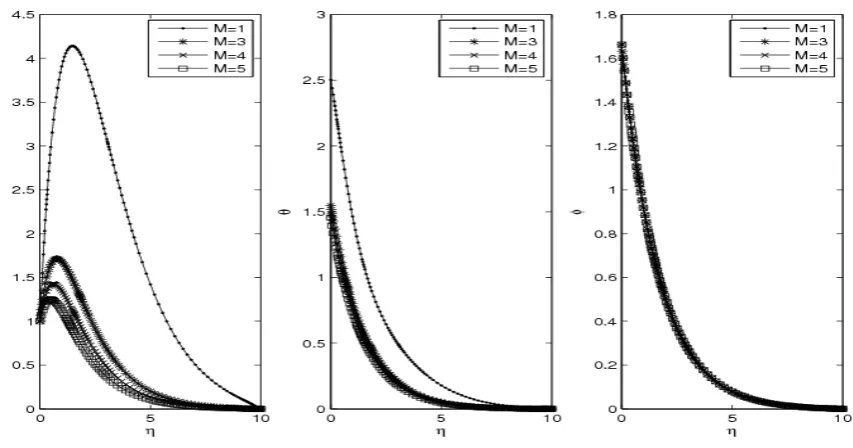
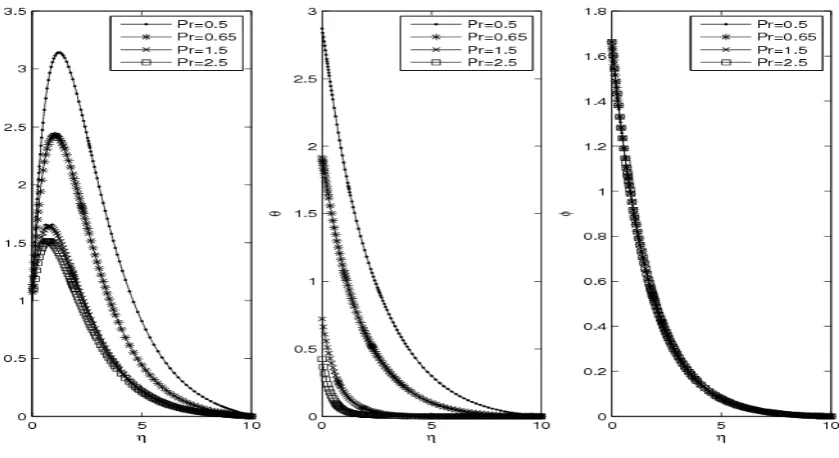
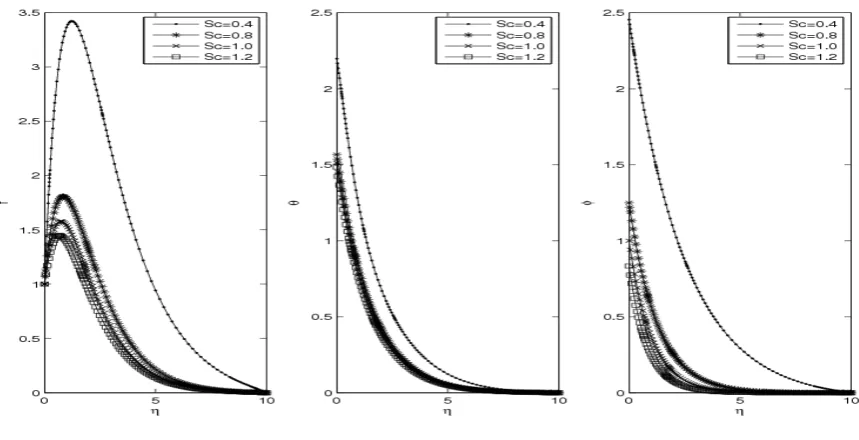
The equations (9),(10) and (11) form a system of coupled non linear ordinary differential equations which are to be solved subject to the boundary conditions (12) and (13). As the methods for analytical solutions of these equations are not available, there fore, they have been solved numerically using boundary value problem solver code. The results have been presented graphically. There are eight figures in all numbered 1-8 and each figure contains three graphs, one each for velocity (
f
), temperature (θ
) and concentration (φ
) showing the effects of various parameters on them.We observe that as the viscosity decreases (
a
>
0
), the velocity increases and with an increase in the viscosity (a
<
0
), the fluid velocity decreases. The velocity initially increases and acquires a maximum value in the boundary layer near the plate and then gradually decreases and mixes with the quiescent fluid.From the graph for
θ
for different values ofμ
(figure 1), it is clear that variation in viscosity has significant effects on the temperature profile and this result is on the expected lines as the viscosityμ
appears in the energy equation via two terms on the RHS. The effects of these two terms on the non dimensional temperature profile are controlled chiefly by the Eckert number Ec ( Fig.7). The effects ofμ
onθ
will be more clearly seen if we analyse the Fig.1 in conjunction with Fig.7. From the fig.1, it is observed that as the viscosity decreases, the temperature increases.In other words, the increasing value ofa
>
0
has the corresponding effect of increasing the temperature. And from fig.7, it is clear that an increase in Ec is followed by a corresponding increase in the non dimensional temperature profile. Here, it is worth noting that role of Ec becomes importantas both the terms in the energy equation containing Ec also explicitly contain the term
e
−aθ .From both the figures, it is also clear that neither
μ
nor Ec has any note worthy effects on the speciesconcentration profile
φ
.In figures 2 are shown the effects of thermal Grashof number Gr. It is observed that as the value of Gr increases, there is corresponding increase in both the velocity and temperature profiles. The effect of negative Gr, which corresponds to
q
w<
0
, is very clearly seen on thef
andθ
profiles. In both the profiles, the negative Gr has the effect of decreasing the boundary layer thickness.It is observed that Grasof no. has no significant effect on the concentration profile.
From figures 3, we note that an increase in the value of Gc >0 has an increasing effect on the velocity and temperature fields, the concentration profile remains unaltered.
In figures 4 are depicted the effects of magnetic field parameter M. It is observed that the velocity and temperature profiles decrease on increasing the magnetic field parameter.
In figure 5, we find the effects of permeability parameter
δ
on different profiles. Its effect is more clearly seen on the velocity profile than on theθ
andφ
profiles. In this case, the non dimensional velocity decreases if the value ofδ
is increased. For all the values ofδ
, the velocity acquires a peak value and this peak value is greater for the smaller values ofδ
. For the greater values ofδ
, though the peak value is smaller, the boundary layer thickness is more than it is for the smaller values of the parameter.The effects of Prandtl number Pr are shown in the figures 6. It is observed that an increase in the value of Pr has the effect of decreasing the velocity and temperature profiles.
Figure 1
Figure 2
Gr = 3.2; Gc = 3.7; M = 2;
δ= 1.5; Pr =0.71; Ec = 0.06; Sc = 1.2
Figure 3
Figure 4
a =
−
0.15; Gr = 3.2; M = 2;
δ
= 1.5; Pr =0.71; Ec = 0.06; Sc = 1.2
Figure 5
Figure 6
a =
−
0.15; Gr = 3.2; Gc = 3.7; M = 2; Pr =0.71; Ec = 0.06; Sc = 1.2
Figure 7
Figure 8
References
[1] Palani G.and.Kim K.Y (2010): Numerical study on a vertical plate with variable viscosity and thermal conductivity, Arch Appl. Mech. 80, pp. 711-725.
[2] Anjali Devi S.P. and Ganga B.(2009): Viscous dissipation effects on non linear MHD flow in a prous medium over a stretching porous surface, Int. J. of Math and Mech., 5(7), pp. 45-59.
[3] Anjali Devi S.P. and Ganga B.(2009): Effects of viscous dissipation and Joules dissipation on MHD flows, heat and mass transfer past a stretching porous surface embedded in a porous medium. Nonlinear Analysis:Modelling and control, 14(3) , pp. 303-314.
[4] Mostafa A.A.(2007): Variable viscosity effects on hydromagnetic boundary layer flow along a continuously moving vertical plate in the presence of radiation, Appl.Math. Sci.1(17), pp. 799-814.
a =
−
0.15; Gr = 3.2; Gc = 3.7; M = 2;
δ
= 1.5; Pr =0.71; Sc = 1.2
[5] Anjali Devi, S.P. and Kandaswami R. (2003): Effects of chemical reaction, heat and mass transfer on non-linear MHD flow an accelerating surface with heat source and thermal stratification in the presence of suction or injection. Communications in Methods in Engineering. 19, pp. 513-520.
[6] Elbashbeshy E.M.A. (2000): Free convection flow with variable viscosity and thermal diffusivity along a vertical plate in the presences of the magnetic field, Int.J.Eng.Sci. 38, pp. 207-213.
[7] Elbashbeshy E.M.A.and Ibrahim F.N. (1993): Steady free convection flow with variable Viscosity and thermal diffusivity along a vertical plate. J.Phys.26 (12), pp. 237-243.
[8] Nield and Bejan A. (1992): Convection in Porous Media, Springer-Verlog,Newyork.
[9] Lai F.C. and Kulacki F.A.(1990) :The influence of surface mass flux on mixed convection over horizontal plates in saturated porous media, Int. J. of Math and Mech. 4(1), pp. 59-65.
[10] Gary J.,.Kassory D.R,H.Tadjeran and A.Zebib (1982): Effect of significant viscosity variation on convective heat transport in water saturated porous media, J. Fluid Mech., 117, pp. 233-249.
[11] Kays W.M. and Crawferd M.E.(1980): Convective Heat and Mass Transfer, McGraw Hill, NewYork. [12] Schlichting H.(1979): Boundary layer Theory, Mc Graw Hill, NewYork.
[13] Slattery J.C. (1978): Momentum,Energy and Mass Transfer in continua, Mc Graw Hill, NewYork.
[14] Gebhart B.and Pera L. (1971): The nature of vertical natural convection flows resulting from the combined buoyancy effects of thermal and mass diffusion, Int. J. Heat and Mass Tran., 14, pp. 2025-2050.
[15] Tsou F.K., Sparrow F.M.and Golldstien R.J.(1967): Flow and heat transfer in the boundary layer in continuous moving surface, Int.J.Heat Mass Transfer 10, pp. 219-235.
[16] Erickson L.E. ,L.T.Fan and V.G.Fox (1966): Heat and Mass Transfer on a moving continuous plate with suction and injection, Ind.Eng.Chem.Fundamental 5, pp. 19-25.