Volume 2012, Article ID 705190,4pages doi:10.1155/2012/705190
Case Report
A Case of Drug Reaction with Eosinophilia and
Systemic Symptoms
Sally Kellett and Charles Cock
Division of Medicine, Repatriation General Hospital, Daws Road, Daw Park, SA 5041, Australia
Correspondence should be addressed to Sally Kellett,[email protected]
Received 24 May 2012; Accepted 16 July 2012
Academic Editor: B. Wedi
Copyright © 2012 S. Kellett and C. Cock. This is an open access article distributed under the Creative Commons Attribution License, which permits unrestricted use, distribution, and reproduction in any medium, provided the original work is properly cited.
Drug reaction with eosinophilia and systemic symptoms (DRESS) is characterized by fever, skin rash, hematological abnormalities, and systemic involvement such as hepatitis. DRESS usually presents 2–6 weeks after drug initiation. DRESS should be suspected on clinical grounds in the setting of the introduction of new drug therapy and is most commonly described after the introduction of aromatic anticonvulsants, allopurinol, or antiretroviral therapies. We describe here a case of DRESS due to phenytoin exposure with complete resolution on drug discontinuation. Our patient developed DRESS with a skin rash, lymphadenopathy, and markedly abnormal liver enzymes, 4 weeks after drug initiation following drainage of a brain abscess. He was initially diagnosed as having a recurrence of the abscess or sepsis of another origin. It is important to recognise the possibility of DRESS in this setting, as a good outcome depends on the immediate withdrawal of the offending drug. A mortality rate of up to 10% has been described in unrecognised cases.
1. Introduction
Several cutaneous reactions to medication with variable onset and manifestations occur after drug exposure [1]. These reactions are collectively known as SCAR: severe cutaneous adverse reactions to drugs. Drug reaction with eosinophilia and systemic symptoms (DRESS) is a potentially fatal drug reaction characterized by fever, a skin rash, hema-tological abnormalities including eosinophilia or abnormal lymphocytes and systemic involvement including hepatitis, interstitial nephritis or pneumonitis [2]. DRESS can mimic severe sepsis, autoimmune, tick borne, or viral diseases and should be considered in the differential diagnoses in these settings, particularly after the recent introduction of new drug therapies. The onset is typically 2–6 weeks (average 4 weeks) after first exposure [2]. DRESS is a syndromic manifestation of a type IV delayed hypersensitivity reaction due to reactive metabolites from drugs [3]. We now recognise several drugs beyond anticonvulsants as causative agents, and thus anticonvulsant hypersensitivity syndrome [4] should not be used to describe this syndrome, even when it occurs
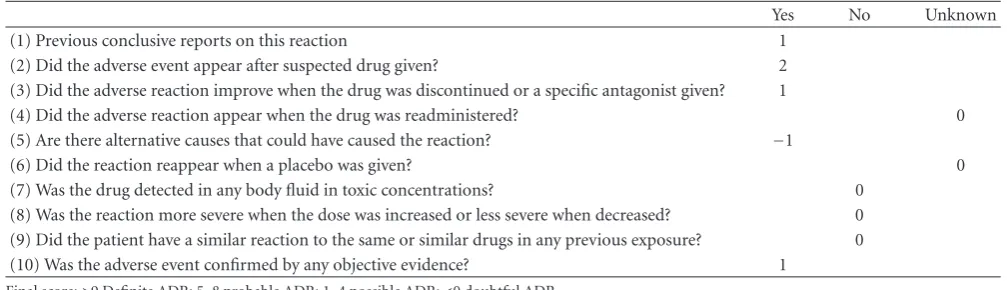
as a consequence of this group of drugs [2]. The RegiSCAR criteria (nonvalidated) [5] (Table 1) can be used to determine the likelihood of actual occurrence cases of DRESS. The Naranjo scale can also be used to assess the probability of an adverse drug reaction [6].
2. Case
2 Case Reports in Medicine
Table 1: RegiSCAR criteria for the likelihood of DRESS syndrome.
No Yes Unknown
(1) Fever>38.5◦C −1 0 −1
(2) Enlarged lymph nodes (>2 sites,>1 cm) 0 1 0
(3) Atypical lymphocytes 0 1 0
(4) Eosinophilia 0 0
0.7–1.49×10⁹/L or 10–19.9% 1
>1.5×10⁹/L or≥20% 2
(5) Skin rash 0 0
Extent>50% 0 1 0
At least 2 of: edema, infiltration, purpura, scaling −1 1 0
Biopsy suggestive of DRESS −1 0 0
(6) Internal organ involvement 0 0
One 1
2 or more 2
(7) Resolution in>15 days −1 0 −1
(8) At least 3 investigations negative for alternative cause 0 1 0
Final score:<2 No case; 2-3 possible case, 4-5 probable case;>5 definite case.
undertaken in theatre. Cultures taken from the abscess material grew Streptococcus anginosus, and the patient was commenced onto treatment with benzyl penicillin, according to the sensitivities. Phenytoin was initiated as a prophylactic anticonvulsant at an initial dose of 300 mg nocte., increased to 500 mg over 2 weeks. Anticonvulsant therapies are indi-vidualized within the neurosurgery department according to consultant preference, but the prescribed regime was in keeping with the regional clinical protocol for enteral phenytoin administration. Levels were measured and found to be below the normal range (20 umol/L (normal range 40–80 umol/L)). A week following surgery, the patient was referred to a rehabilitation unit.
Three weeks after admission to the rehabilitation unit (day 27), the patient developed fever (38.4 degrees Celsius). Blood cultures were undertaken, a chest X-ray (CXR) ordered, and a CT scan of his brain repeated which showed a reduced abscess cavity compared to his previous study. A day later the patient developed erythema over his upper torso, malaise and rigors. On the recommendation of the general medical unit on take in the hospital, the patient was commenced on antibiotic therapy (vancomycin), and his biochemistry repeated. The results of the biochemistry revealed deranged liver enzymes (Figure 1) and an elevated CRP (120 mg/L (normal range <8 mg/L)). An ultrasound of the liver was ordered and further blood cultures were taken. His fever persisted and the rash worsened over the following 24 hours. Additionally he was found to have developed lymphadenopathy. The decision was made to transfer the patient to the acute general medical unit within the hospital. After discussion with the on call medical registrar, phenytoin therapy was discontinued. He was also treated with an antihistamine. The rash and temperature persisted, but all cultures remained negative and CXR clear. The liver ultrasound was essentially unremarkable. Additional autoimmune serology was negative. Serology for hepatitis A, B, and C as well as CMV, EBV, and human herpes
2000
1500
1000
500
0
Day
1 27 28 29 30 31 32 34 35 40 43 50 62 69
AST (u/L) GTT (u/L)
ALP (u/L) ALT (u/L)
(u/L)
Figure 1: Liver enzymes show an acute rise on day 27, with gradual
normalization by day 69 (42 days after the initial rise).
viruses were also ordered at this point and were negative. The eosinophil count was 0.5×10⁹/L (N 0.02–0.05×10⁹/L). The patient had rhabdomyolysis with a total CK level of 3485 u/L (N<250 u/L) and atypical lymphocytes on blood film. The benzyl penicillin was discontinued, after which the patient rapidly improved with complete resolution of fever within 24 hours and clearing of his rash. Liver enzymes remained elevated, but decreased and eventually returned to complete normality 42 days after becoming elevated (Figure 1).
3. Discussion
Table 2: Naranjo score for the likelihood of an adverse drug reaction.
Yes No Unknown
(1) Previous conclusive reports on this reaction 1
(2) Did the adverse event appear after suspected drug given? 2
(3) Did the adverse reaction improve when the drug was discontinued or a specific antagonist given? 1
(4) Did the adverse reaction appear when the drug was readministered? 0
(5) Are there alternative causes that could have caused the reaction? −1
(6) Did the reaction reappear when a placebo was given? 0
(7) Was the drug detected in any body fluid in toxic concentrations? 0
(8) Was the reaction more severe when the dose was increased or less severe when decreased? 0 (9) Did the patient have a similar reaction to the same or similar drugs in any previous exposure? 0
(10) Was the adverse event confirmed by any objective evidence? 1
Final score:>9 Definite ADR; 5–8 probable ADR; 1–4 possible ADR;<0 doubtful ADR.
score was determined as 6 (see Table 1). The Naranjo score was 4 (see Table 2). His background history of a combination psychotropic and anticonvulsant drug use may serve as a predisposing factor through cytochrome P450 enzyme inhibition [7], allowing the accumulation of antigenic metabolites of a second drug metabolized via the same cytochrome P450 subenzymes. Drug therapy was discontinued rapidly in our patient following recognition of DRESS, with resolution of his symptom complex. His liver enzymes took an additional 42 days to normalize, however (Figure 1).
Anticonvulsant therapies, particularly those with an aromatic ring structure such as carbamazepine, phenytoin, and phenobarbital have been recognised as precipitants for DRESS syndrome, in what used to be termed anticonvulsant hypersensitivity syndrome [4]. This term has been super-seded in the literature by the use of the term DRESS [2, 5]. A multitude of other drugs have since been associated with this syndrome among which the most frequent are allopurinol, lamotrigine, nevirapine, sulfasalazine, and sul-fonamide antibiotics [2]. The alternative term drug-induced hypersensitivity syndrome (DIHS) was coined to describe DRESS in association with human herpes virus type 6 reactivation [8,9]. DRESS is rare, occurring in 1 : 1000 to 1 : 10000 patients prescribed anticonvulsant therapy [10] but if unrecognized, has a high mortality [2]. Death occurs in 5–10% [2]. Recognition could be delayed due to the delayed onset of the symptoms, which occur on average 4 weeks after drug initiation [2]. For this reason, primary care providers, including general practitioners, should be especially aware of the possibility of DRESS 3–6 weeks after drug initiation.
The proposed pathogenesis of DRESS relates to an abnormal immune response in a genetically susceptible individual [2, 3]. This is thought to be induced by the formation of reactive metabolites [3] and in some cases re-activation of herpes viruses 6, 7 and Epstein-Barr virus [2,8]. In the case of aromatic anticonvulsants, toxic metabolites in the form of arene oxides are produced, which lead to a type IV hypersensitivity reaction [3]. Some patients appear to have a lack of the enzyme epoxide hydrolase, involved in the breakdown of the toxic metabolites [3]. Due to the likelihood
of genetic predisposition, first degree relatives should avoid this class of drugs [2].
The disease occurs along a spectrum of severity, which depends to some degree on early recognition and discon-tinuation of the offending drug. A skin rash, usually an erythematous, maculopapular rash occurred in 99% of cases of DRESS described in the literature [2]. At the severe end of the spectrum, organ involvement, including liver involvement, hepatitis, is common and occurs in up to 90% of cases described in the literature [2]. Renal (9%) or pulmonary involvement (5%) is far less commonly described [2]. Organ involvement can be asymptomatic. Hematological abnormalities including hypereosinophilia
>0.7×10⁹/L (80% of cases) and atypical lymphocytes (35% of cases) also occur commonly [2]. Lymphocytoses is another common clinical finding [2].
The major differential diagnoses include septicaemia, autoimmune diseases including vasculitides and adult Still’s disease, tick borne diseases, and viral disease, including viral hepatitis and virus hemorrhagic fevers (in the appropri-ate context). These conditions should be excluded in all cases of suspected DRESS, either through relevant history or serology. Demonstration of herpes viruses, particularly herpes virus type 6 (HHV-6 infection), is suggestive of the diagnoses and may be a cofactor in the pathogenesis of DRESS [8]. An in vitro interferon gamma release test, where serum is exposed to different drugs taken by the patient with a subsequent increase in IFN-gamma demonstrated in the offending drug, can also be performed in cases where there is a clinical necessity to continue drug therapy. This is not yet readily available, but has been described as a useful adjunct in DRESS [11]. There is a high prevalence of cross reactivity to other aromatic anticonvulsants complicating treatment of epileptic disorders in patients with DRESS [12].
4 Case Reports in Medicine
Our patient fit the criteria for DRESS and showed improvement soon after discontinuation of his phenytoin. He was discharged home from the acute medical ward within a week, following drug withdrawal without the need for further rehabiltative treatment. Levetiracetam was initiated in order to replace the phenytoin. He remained on ceftriaxone at the recommendation of the infectious diseases unit and was followed up in the outpatient department with no recurrence of fever or other symptoms. The patient remained well a year following the above hospitalisation with complete normalisation of inflammatory markers and liver enzymes.
References
[1] J. C. Roujeau, L. Allanore, Y. Liss, and M. Mockenhaupt, “Severe cutaneous adverse reactions to drugs (SCAR): defini-tions, diagnostic criteria, genetic predisposition,”
Dermatolog-ica SinDermatolog-ica, vol. 27, no. 4, pp. 203–209, 2009.
[2] P. Cacoub, P. Musette, V. Descamps et al., “The DRESS syndrome: a literature review,” American Journal of Medicine, vol. 124, no. 7, pp. 588–597, 2011.
[3] N. H. Shear and S. P. Spielberg, “Anticonvulsant hypersensi-tivity syndrome. In vitro assessment of risk,” The Journal of
Clinical Investigation, vol. 82, no. 6, pp. 1826–1832, 1988.
[4] C. C. Vittorio and J. J. Muglia, “Anticonvulsant hypersensitiv-ity syndrome,” Archives of Internal Medicine, vol. 155, no. 21, pp. 2285–2290, 1995.
[5] S. H. Kardaun, A. Sidoroff, L. Valeyrie-Allanore et al., “Variability in the clinical pattern of cutaneous side-effects of drugs with systemic symptoms: does a DRESS syndrome really exist?” British Journal of Dermatology, vol. 156, no. 3, pp. 609– 611, 2007.
[6] C. A. Naranjo, U. Busto, E. M. Sellers et al., “A method for estimating the probability of adverse drug reactions,” Clinical
Pharmacology and Therapeutics, vol. 30, no. 2, pp. 239–245,
1981.
[7] S. Mahapatra, J. L. Belgrad, and M. A. Adeoye, “Psychotropic drug-related eosinophilia with systemic symptoms after acute caffeine ingestion,” Pediatrics, vol. 127, no. 1, pp. e235–e238, 2011.
[8] Y. Suzuki, R. Inagi, T. Aono, K. Yamanishi, and T. Shiohara, “Human herpesvirus 6 infection as a risk factor for the devel-opment of severe drug-induced hypersensitivity syndrome,”
Archives of Dermatology, vol. 134, no. 9, pp. 1108–1112, 1998.
[9] Y. Kano and T. Shiohara, “The variable clinical picture of drug-induced hypersensitivity syndrome/drug rash with eosinophilia and systemic symptoms in relation to the eliciting drug,” Immunology and Allergy Clinics of North America, vol. 29, no. 3, pp. 481–501, 2009.
[10] F. Fiszenson-Albala, V. Auzerie, E. Make et al., “A 6-month prospective survey of cutaneous drug reactions in a hospital setting,” British Journal of Dermatology, vol. 149, no. 5, pp. 1018–1022, 2003.
[11] K. Ben-Ari, I. Goldberg, I. Shirazi et al., “An unusual case of DRESS syndrome,” Journal of Dermatological Case Reports, vol. 3, pp. 39–42, 2008.
[12] A. T. Mansur, Y. S. Pekcan, and F. G¨oktay, “Anticonvulsant hypersensitivity syndrome: clinical and laboratory features,”
International Journal of Dermatology, vol. 47, no. 11, pp. 1184–
Submit your manuscripts at
http://www.hindawi.com
Stem Cells
International
Hindawi Publishing Corporation
http://www.hindawi.com Volume 2014
Hindawi Publishing Corporation
http://www.hindawi.com Volume 2014
INFLAMMATION
Hindawi Publishing Corporation
http://www.hindawi.com Volume 2014
Behavioural
Neurology
Endocrinology
International Journal ofHindawi Publishing Corporation
http://www.hindawi.com Volume 2014
Hindawi Publishing Corporation
http://www.hindawi.com Volume 2014
Disease Markers
Hindawi Publishing Corporation
http://www.hindawi.com Volume 2014
BioMed
Research International
Oncology
Journal of Hindawi Publishing Corporationhttp://www.hindawi.com Volume 2014
Hindawi Publishing Corporation
http://www.hindawi.com Volume 2014
Oxidative Medicine and Cellular Longevity
Hindawi Publishing Corporation
http://www.hindawi.com Volume 2014
PPAR Research
The Scientific
World Journal
Hindawi Publishing Corporationhttp://www.hindawi.com Volume 2014
Immunology Research
Hindawi Publishing Corporation
http://www.hindawi.com Volume 2014 Journal of
Obesity
Journal ofHindawi Publishing Corporation
http://www.hindawi.com Volume 2014
Hindawi Publishing Corporation
http://www.hindawi.com Volume 2014
Computational and Mathematical Methods in Medicine
Ophthalmology
Journal ofHindawi Publishing Corporation
http://www.hindawi.com Volume 2014
Diabetes Research
Journal ofHindawi Publishing Corporation
http://www.hindawi.com Volume 2014
Hindawi Publishing Corporation
http://www.hindawi.com Volume 2014
Research and Treatment
AIDS
Hindawi Publishing Corporation
http://www.hindawi.com Volume 2014
Gastroenterology Research and Practice
Hindawi Publishing Corporation
http://www.hindawi.com Volume 2014
Parkinson’s
Disease
Evidence-Based Complementary and Alternative Medicine
Volume 2014 Hindawi Publishing Corporation