1
Wavelet-Based Evolutionary Response of Multispan
2
Structures Including Wave-Passage and
3
Site-Response Effects
1
4
Van-Nguyen Dinh
1; Biswajit Basu
2; and Ronald B. J. Brinkgreve
35 Abstract:Stochastic seismic wavelet-based evolutionary response of multispan structures including wave-passage and site-response effects is 6 formulated in this paper. A procedure to estimate site-compatible parameters of surface-to-bedrock frequency response function (FRF) by using 7 finite-element analysis of the supporting soil medium is proposed. The earthquake energy content is represented by a composite power spectrum 8 density function contributed by the surface-to-bedrock FRF and bedrock power spectra. A long span multisupport structure is subjected to spa-9 tially varying differential support motions where the spatial-variability is represented by bedrock parametric coherency models and time-lags. 10 In addition to the time-lags from wave-passage effects, the site-response effects from different soil conditions at the supports are characterized 11 by frequency-dependent time-lags. In an illustrative case study, a three-span, two-dimensional hangar frame is analyzed using the proposed 12 formulations. The time-lags resulting from site-response effects and computed by different FRFs show different variation in trends and fre-13 quency content. The site-response effect is found to introduce additional frequency nonstationarity and leads to an increase in the frame 14 responses but with slower attenuation in time.DOI:10.1061/(ASCE)EM.1943-7889.0000708.©2014 American Society of Civil Engineers. 15 Author keywords:Seismic analysis; Amplitude and frequency nonstationary spatial variability; Site-response effect; Wavelets; Parametric 16 frequency response function.
17 Introduction
18 The ground motions at a site are random processes attributed to the 19 complex characteristics of the sources and paths of seismic waves. 20 Moreover, they are apparently nonstationary in both amplitude and 21 frequency from frequency-proportional velocities of seismic waves 22 and from traveling paths consisting of soil layers having different 23 properties. The structural responses underground motions are con-24 sequently random and temporally and spectrally nonstationary, and 25 they should therefore be stochastically represented by time-varying 26 statistical quantities such as the evolutionary power spectral density 27 function (PSDF). When statistical quantities representing ground 28 motions (input) are given for evaluating stochastic structural res-29 ponses (output), the input-output relations are needed. The random 30 vibration theory is applicable only if the input is time-invariant. For 31 time-varying inputs, wavelet techniques are suitable tools because 32 they can provide a joint time-frequency representation simultaneously. 33 Wavelet techniques have been used to formulate the input-output
34 relations of single degree-of-freedom systems (Basu and Gupta
35
1998, 2000) and multiple degree-of-freedom systems (Basu and
36
Gupta 1997;Tratskas and Spanos 2003) where the input spatial-37 variation was excluded and proportional damping was assumed.
38 Earthquake-induced ground motions are spatially varying because
39 of four distinct phenomena: incoherence, wave-passage, attenuation,
40 and site-response effects (der Kiureghian 1996). The spatial-variation
41 of ground motions has pronounced effects on structures. Stochastic
42 input-output relations of multisupport structures subjected to spatially
43 varying ground motions have been formulated by using random
44 vibrations (Hao 1994;Loh and Ku 1995) where incoherence and
45 wave-passage effects are considered and the ground motions are
46 only nonstationary in amplitude. Dumanogluid and Soyluk (2003)
47 and Zhang et al. (2009) considered incoherence, wave-passage, and
48 site-response effects in their ground-motion spatial-variability models
49 and carried out stochastic analyses of long-span bridges whereas the
50 frequency nonstationarity of excitations was neglected. The
site-51 response effect was shown to contribute considerably to the
max-52 imum response amplitudes. However, the influence of site-response
53 effect on the frequency content of the responses of the bridge could
54 not be investigated.
55 A more general and realistic input-output relation has been
pro-56 posed by Chakraborty and Basu (2008) using a wavelet-based
frame-57 work in which the ground motions are nonstationary in both amplitude
58 and frequency, the excitation spatial-variation from the wave-passage
59 effect is considered, and the nonstationarity in both amplitude and
60 frequency of the output are evaluated. That work is extended in this
61 paper to include the compatible earthquake energy and
site-62 response effect of supporting soil media beneath the supports.
63 In the literature, by including a term in the coherency phase, the
64 site-response effect is considered in formulating complex coherency
65 functions (der Kiureghian 1996) and in simulating spatially varying
66 nonstationary ground-motion time histories (Zerva 2009;Konakli
67
and der Kiureghian 2012). While this approach is suitable for 68 ground-motion simulation, it faces a difficulty in spectral analysis of 1Postdoctoral Research Fellow, Dept. of Civil, Structural and
Environ-mental Engineering, School of Engineering, Trinity College Dublin, Dublin 2, Ireland. E-mail: [email protected]; [email protected]
2Professor, Dept. of Civil, Structural and Environmental Engineering,
School of Engineering, Trinity College Dublin, Dublin 2, Ireland (corre-sponding author). E-mail: [email protected]
3Associate Professor, Faculty of Civil Engineering & Geosciences, Delft
Univ. of Technology, 2628 CN Delft, Netherlands; and Manager, PLAXIS bv, Computerlaan 14, 2628 XK Delft, Netherlands. E-mail: r.brinkgreve@ plaxis.nl
69 evolutionary responses. The direct use of a complex function is not 70 feasible for the second-order moment of the stochastic responses 71 because it is a real quantity. Instead, an alternative approach is for-72 mulated in this paper to separately represent the lagged coherency and 73 the phase. The site-response effect is proposed to be characterized by 74 frequency-dependent time-lags. The wavelet-based spatial-variation 75 model for ground motion to evaluate stochastic response incorporates 76 parametric lagged coherency, wave-passage, and site-response effects 77 in this paper.
78 For simulating spatially varying nonstationary ground motions 79 and analyzing structural responses, the earthquake energy content 802 has been generally characterized by stationary two-sided Kanai -81 Tajimi PSDF (Hao et al. 1989;Chakraborty and Basu 2008) and 823 Clough-Penzien PSDF (Hao 1994; Deodatis 1996;Dumanogluid 83 and Soyluk 2003; Zhang et al. 2009) among others. The Kanai-84 Tajimi and Clough-Penzien PSDFs are most commonly used in both 85 parameterization and simulation of seismic ground motions (Zerva 86 2009). However, when using these spectra, the bedrock is assumed 87 to be rigid and the parameters for the structure sites are not estimated 88 from the specific geological profiles, but are empirically assumed. 89 Because the dynamic properties of the soil medium vary horizontally 90 from site to site, such description of PSDF is unable to represent the 91 frequency and characteristic damping of the real soil conditions. The 92 effect of soil layer thickness is also not accounted for, i.e., the natural 93 period of a soil layer is proportional to its thickness (Kramer 1996). 94 A thicker layer of soft soil may exhibit lower frequencies close to the 95 dominant ones of the seismic waves and cause larger amplification 96 of the propagating waves than a thinner layer would. To account 97 for the thickness of soil deposit (i.e., the depth of the bedrock), the 98 earthquake energy content at a site is represented in this paper by 99 a composite PSDF contributed by the surface-to-bedrock frequency 100 response function (FRF) and the bedrock power spectrum. A pro-101 cedure to estimate site-compatible FRF parameters byfinite-element 102 analysis (FEA) of the soil profile under each individual support is 103 proposed in this paper and applied in the considered case study. This 104 procedure overcomes some of the existing limitations by accounting 105 for (1) soil property horizontal variation, and (2) effects of soil layer 106 thickness in the FEA.
107 Usingthe proposed representations of ground-motion spatial- 4
108 variation in “Representation of Parametric Coherency Model for
109 Ground Motions”and earthquake energy in“Site-Compatible PSD of
110 Ground Motions in Soil Medium on Elastic Bedrock,”the
wavelet-111 based stochastic models of spatially varying ground motions (input)
112 and seismic evolutionary responses of multispan structures (output)
113 are formulated in “Wavelet-Based Modeling of Spatially Varying
114 Ground Motions including Wave-Passage and Site-Response Effects”
115 and“Wavelet-Based Evolutionary Responses of Multispan Structures
116 Subjected to Differential Support Motions including Wave-Passage
117 and Site-Response Effects,” respectively (see also“Formulation
118 for Calculation of Evolutionary Responses”). “Wavelet Basis
119 Function”reviews an efficient wavelet basis function to be used in
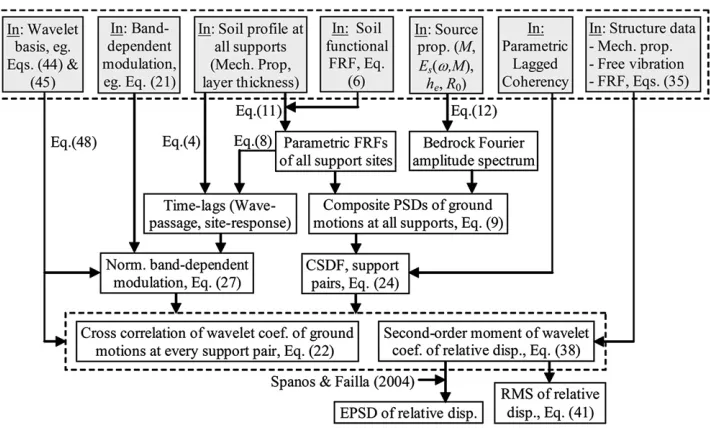
120 this paper. Aflowchart explaining the proposed methodology and
121 the relationship among the equations presented in this paper is
122 provided in Fig.1.
123 In the case study presented in“Numerical Example,”a
three-124 span, two-dimensional (2D) hangar frame supported on a
hori-125 zontally varying property soil layer and a thick elastic bedrock layer
126 is analyzed using the proposed formulations. The parameters of the
127 Clough-Penzien and Kanai-Tajimi FRFs compatible to the site
128 beneath each individual support are estimated. The stationary PSD
129 at each support is calculated by using the parametric Kanai-Tajimi
130 and Clough-Penzien FRFs. The stochastic processes corresponding
131 to these PSDs are used as orthogonal processes at different supports
132 for wavelet-based modeling of spatially varying ground motions
133 and for wavelet-based evolutionary response analyses of the frame.
134 The time-lags computed by using Kanai-Tajimi parametric FRFs
135 vary by a moderate amount around a higher frequency whereas
136 the time-lags computed by using Clough-Penzien parametric FRFs
137 vary dramatically around a lower frequency possibly stemming
138 from the additional lower frequency filter. Comparing with the
139 results in the case when only wave-passage effect is considered, the
140 site-response effect leads to an increase in wavelet-based root mean
141 squares (RMS) of the frame relative displacements with a slower
142 attenuation in time. The frequency content of such responses
143 exhibits stronger nonstationary and their instantaneous PSD peaks
[image:2.612.130.485.472.686.2]144 are higher.
145 Representation of Parametric Coherency Model for
146 Ground Motions
147 The representation of ground-motion spatial variation by a proposed 148 introduction of frequency-dependent time-lags for site-response ef-149 fects and accounting for effects of incoherence and wave-passage 150 is developed in this section.
151 The coherency function characterizes the spatial variability of 152 ground-motions in a frequency domain. Considering two supports 153 randl, the coherency function is represented by the cross-spectral 154 density function^S
rlðvÞof the stationary parts of the ground motions 155 at the two supports, normalized by the square-root of the corre-156 sponding PSDFs, i.e.,S
rrðvÞandSllðvÞ, as (der Kiureghian 1996;
157 Zerva and Zervas 2002)
grlðvÞ ¼ ^ SrlðvÞ
ffiffiffiffiffiffiffiffiffiffiffiffiffiffiffiffiffiffiffiffiffiffiffiffi SrrðvÞSllðvÞ
p (1a)
158 The PSDF of ground motion at a support is related to the FRF of the 159 soil layer beneath that support, and the bedrock PSDF in Eq.(9). 160 Eq.(1a)can be written in a complex variable form as
grlðvÞ ¼ jgrlðvÞjexp½iurlðvÞ (1b)
161 where the real term, jg
rlðvÞj, 0#jgrlðvÞj#1, is the lagged co-162 herency characterizing the variation in space. In the literature,
163 jg
rlðvÞjhas been represented by common functions such as the ones 164 given, for example, by Harichandran and Vanmarcke (1986), Luco 165 and Wong (1986), and Hao et al. (1989) . In this paper, the parametric 166 coherency models are estimated by using FE-based seismic analysis 167 of a geological soil medium model including the bedrock. The 168 coherency phase urlðvÞ represents the difference in phase of the 169 excitations at the two supports. When the wave-passage and site-170 response effects denoted by the superscriptswpandsite, respectively 171 are considered,urlðvÞis expressed as
urlðvÞ ¼uwprl þusiterl ðvÞ ¼2vt wp rl þu
site
rl ðvÞ (2)
172 The use of representation in Eq. (1b) for spectral analysis of 173 evolutionary excitations and structural responses faces the difficulty 174 that the complex coherency cannot be directly introduced into any 175 real-valued second-order moment quantity. To overcome this dif-176 ficulty, the coherency phaseu
rlðvÞis transformed into frequency-177 dependent time-lags as
urlðvÞ ¼2v.trlðvÞ ¼2v
twprl þtrlsiteðvÞ (3)
178 Consider a single soil layer under two surface sitesr and las 179 shown in Fig. 2. The properties of the soil layer are horizontally 180 varying. The propagation of seismic shear waves from the bottom to
181 the top can be characterized by one-dimensional wave propagation.
182 The time-lag from the wave-passage effect in Eqs.(2)and (3)is
183 computed from the separation distancejrland the wave-propagation
184 velocitiesVrandVlbeneath supportsrandl, respectively, and is
185 given as
trlwp¼ 2jrl VrþVl
(4)
186 The site-response effect between sitesr and lis attributed to the
187 difference in phasesurand ulat the two sites as (der Kiureghian
188
1996)
usite
rl ðvÞ ¼ulðvÞ2urðvÞ ¼tan21
ImHlðvÞHrpðvÞ
ReHlðvÞHrpðvÞ
(5)
189 When the behavior of the soil column is dominated by itsfirst mode
190 or when the high-frequency components of the ground motion do
191 not have significant contribution to the structural responses, the
192 functional form of the FRF at a siteHsðvÞ,s5r,lin Eq.(5), can be
193 represented by the Kanai-Tajimi (K-T)filter function in Eq.(6)or
194 the Clough-Penzien (C-P) filter function in Eq.(7) (Clough and
195
Penzien 2003)
HsK-TðvÞ ¼
1þ2i§sðv=vsÞ
12ðv=vsÞ2þ2i§sðv=vsÞ
(6)
HsC-PðvÞ ¼H K-T s ðvÞ
v=vf
12v=vf
2þ 2i§f
v=vf
(7)
196 In Eqs. (6) and (7), vs 5 soil characteristic frequency; and zs
197
5damping ratio. The frequencyvf and damping ratiozf used in
198 Clough-Penzien FRF, in Eq.(7), greatly attenuates the very low
199 frequency components. The frequency-dependent time-lag from the
200 site-response effect in Eq.(3)is given as
tsiterl ðvÞ ¼21
vusiterl ðvÞ (8)
201 The maximum time-lags of ground motions at every support pairr
202 andl, from site-response effects, can be evaluated by substituting
203 v ðvs,r1vs,lÞ=2 for Kanai-Tajimi FRF or v ðvf,r1vf,lÞ=2
204 for Clough-Penzien FRF into Eq. (8). The time-lags twprl and
205 tsite
rl ðvÞ contributing to the coherency phaseurlðvÞ will be used
206 separately from the lagged coherency jgrlðvÞj in the following
207 sections.
208 Site-Compatible PSD of Ground Motions in a Soil
209 Medium on Elastic Bedrock
210 In this paper, the geological profile consists of a soil layer on a very
211 thick elastic bedrock layer. The PSDF of ground motions at a
212 supportris related to that of bedrock motions by (der Kiureghian
213
1996)
SrrðvÞ ¼ jHrðvÞj2SbedrockðvÞ (9)
214 where HrðvÞ 5 FRF of the soil layer beneath support r; and
215 SbedrockðvÞ5PSD of bedrock. What follows later in the section is
216 a proposed technique based on FE modeling of the soil medium to
217 estimate the parameters of this FRF represented by a parametric
218 form. The PSD of bedrock is expressed as
SbedrockðvÞ ¼ 1 TbedrockjF
bedrockðvÞj2 (10)
219 where Tbedrock 5 stationary duration of the bedrock excitation 220 stochastic process contributed by the earthquake source and the 221 source-to-bedrock path (Trifunac and Brady 1975). The estimation 222 of soil FRF parameters and the formulation of Fourier amplitude 223 spectrum of motions at the top level of the bedrock (hereafter in short 224 called the bedrock), FbedrockðvÞ, are presented in the following 225 sections.
226 Proposed Procedure to Estimate Site-Compatible 227 FRF Parameters
228 A procedure to estimate the FRF parameters of a single-layered soil 229 column beneath a supportrby using FEA has been proposed. The 230 soil column is modeled and analyzed using FEs. The software 231 PLAXIS 2D (Brinkgreve et al. 2008) is used in this paper. The 232 excitation is a white-noise acceleration uniformly applied at the 233 bottom of soil layer. Assuming that the duration of the stationary 234 motion at the bedrock level and at the surface level is the same, the 235 unsmoothed absolute values of FRF of accelerations at the surface 236 points with respect to the source (bottom) are computed from the 237 Fourier amplitude ratio as
jH~r,iðvkÞj ¼
jFsurface
r,i j jFbed
r,i ðvkÞj
; k¼1, . . .,Nv;i¼1, . . .,Npoints
(11)
238 whereNv 5number of discrete frequency intervals necessary 239 around supportr; andNpoints5number of surface points considered 240 around supportr. The value ofNvshould be chosen as a power of 241 two to avoid zero-pad effects on fast-Fourier transform (Dinh and 242 Basu 2012). The smoothed absolute values of FRF, jHr,iðvkÞj, 243 k51, . . .,Nv, are obtained by averaging overNpointsthe number of 244 surface points considered around supportr. The parameters of the 245 FRF are estimated byfitting such smoothed absolute values to the 246 functional form of the FRF, for example the Kanai-Tajimi spectrum 247 in Eq.(6)or the Clough-Penzien spectrum in Eq.(7). The parametric 248 fitting (nonlinear least square) in the softwareMATLABis used for 249 this purpose. Model parameters (vs,z
sfor Kanai-Tajimi FRF orvs,
250 z
s,vf,zf for Clough-Penzien FRF) of the soil layer are obtained. 251 After comparing the statistical parameters (R-square, root-mean-252 square error (RMSE)], afinal set of estimated model parameters and 253 a parametric form jHrðvÞj of a soil column model at supportr is 254 obtained for each FRF functional form. This procedure is repeated 255 for each individual support having different local soil conditions.
256 Fourier Amplitude Spectrum of Earthquake 257 Bedrock Motions
258 The Fourier amplitude spectrum of earthquake motions at bedrock 259 is represented by using the stochastic seismic spectrum (Boore 260 2003)
jFbedrockðvÞj ¼C×E
sðv,MÞ×GðRÞ×Pðv,RÞ×AðvÞ×DðvÞ (12)
261 where the scaling factor and the source spectrum are, respectively, 262 expressed as
C¼ ReVeFs
4pr0Vs30 (13a)
Esðv,MÞ ¼v2M0 (
12ɛ 1þ ½v=vaðMÞ2
þ ɛ
1þ ½v=vbðMÞ2
)
(13b)
in which Re 5 radiation pattern; Ve 5 partition of total shear
263 wave energy into horizontal components;Fs 5constraint factor;
264 Vs0 5shear wave velocity;r0 5density of the source rock;va
265
5 lower-corner frequency of the source duration;vb 5
higher-266 corner frequency at which the spectrum attains one-half of the
high-267 frequency amplitude level; and ɛ 5 weighting parameter. The
268 moment magnitude M is mapped from the seismic moment M0 5
269 (dyn/cm). The geometrical spreading functionGðRÞis characterized
270 by empirical formulas well supported by data of distance range from
271 10 to 1,000 km with
R¼
ffiffiffiffiffiffiffiffiffiffiffiffiffiffiffiffi R2
0þh2e
q
272 whereR05epicentral distance; andhe5source depth.
273 For Eq.(12),Pðv,RÞ5path-dependent attenuation factor and is
274 dependent on propagation velocity;DðvÞ5diminution factor that
275 accounts for the path-independent attenuation of high-frequency
276 waveforms and can be represented by the k-filter; and AðvÞ
277
5amplification factor (which is approximated by the source/site
278 impedance ratio in a numerical scheme using the quarter-wavelength
279 approximation method).
280 Wavelet-Based Modeling of Spatially Varying
281 Ground Motions including Wave-Passage and
282 Site-Response Effects
283 A wavelet-based modeling of spatially varying ground motions
in-284 cluding wave-passage and site-response effects has been proposed
285 in this section. In wavelet analysis, a time seriesuðtÞis represented as
286 a composition of several time-localized shifted and scaled wavelets
287 (so-called the baby wavelets)ca,bðtÞof a basic waveletcðtÞ, where
ca,bðtÞ ¼ 1ffiffiffiffiffiffiffi jaj p ct2b
a
(14)
288 The parameter b localizes the basis function at t5b and its
289 neighborhood, and the parameteracontrols the frequency content of
290 the basis function by stretching or compressing it. The discrete
291 wavelet transform has been used to simulate ground motions (Iyama
292
and Kuwamura 1999). Although the discrete wavelet transform is
293 the most efficient and compact, its power-of-two relationship in scale
294 fixes its frequency resolution (Gurley and Kareem 1999). Thus, the
295 continuous wavelet transform (CWT), which allows more closely
296 spaced scaling than the 2irelationship, is used in this paper. The
297 CWT convolves the signaluðtÞwith a set of baby wavelets as (Basu
298
and Gupta 1997,1998,2000)
Wcuða,bÞ ¼ 1ffiffiffiffiffiffi jaj p
ð
uðtÞcpt2b a
dt (15)
299 where the asterisk 5complex conjugate. Eq. (15) gives the
lo-300 calized frequency information of uðtÞ around t5b. The value
301 Wcð×Þmaps afinite energy signal from the time domain to afinite
302 energy 2D distribution in the scale-translation domain.
303 A set of differential nonstationary ground motions €ugrðtÞ,
304 r51, . . .,Ns, atNssupports of a multispan structure is considered.
305 In practice,€ugrðtÞis an evolutionary random process and can be
€
ugrðt,vÞ ¼
ð ‘
2‘
Arðt,vÞeivtdGrðvÞ (16)
307 where Arðt,vÞ 5slowly varying time- and frequency-dependent 308 modulation; anddGrðvÞ5orthogonal increment process associated 309 with therth support such that
E h
dGrðvÞdGpr
v9i¼0, vv9 (17)
E h
jdGrðvÞj2
i
¼SrrðvÞdv (18)
310 In Eq.(18),SrrðvÞ5two-sided PSDF of the stationary part of the 311 random process, which has been formulated in Eq.(9). The evo-312 lutionary random process in Eq.(16)can be transformed in wavelet 313 domain by using Eq. (16), and the wavelet coefficients at a dis-314 cretized scalea
jcan be expressed as (Chakraborty and Basu 2008)
Wc€ugr
aj,b
¼ArjðbÞ
ð ‘
2‘
eivbdG~rðvÞ (19)
315 where orthogonal increment processdG~
rðvÞsatisfies (Spanos and
316 Failla 2004)
E h
dG~rðvÞdG~pr
v9i¼0, vv9 (20a)
E h
jdG~rðvÞj
2i
¼2pajjc^
vaj
j2SrrðvÞdv (20b)
The function ArjðbÞ represents the amplitude modulation for
317 €ugrðt,vÞ at a scale aj that can be the extended Shinozuka-Sato 318 amplitude modulation (Shinozuka and Sato 1967) given as
ArjðbÞ ¼arj
e2brjt2e2l r jt
(21)
319 in whichar
j,brj, andgrj 5parameters of the amplitude modulation 320 for the ground motion at thejth band of frequency and at therth 321 support.
322 Multiplying both sides of Eq. (19) by the complex conjugate 323 corresponding to another support l, as being carried out by 324 Chakraborty and Basu (2008) and considering the frequency-325 dependent time-lags from site-response effects, the cross correla-326 tion of the wavelet coefficients of seismic ground motions at the two 327 supportsrandland at a scaleajis
EWc€ugr
aj,b
Wc€ugl
aj,b
¼ArjðbÞ
ð ‘
2‘ Arj
b2twprl 2trlsiteðvÞ
E
h
dG~rðvÞdG~plðvÞ
i (22)
328 where twp
rl 5 time-lag from the wave-passage effect; andtsiterl ðvÞ 329 5 frequency-dependent time-lag from site-response effects pre-330 sented in Eqs.(4)and(8); and
E h
dG~rðvÞdG~plðv9Þ
i
¼0, vv9 (23a)
E h
dG~rðvÞdG~plðvÞ
i
¼2pajj^c
vaj
j2SrlðvÞdv (23b)
331 The modulus of the cross-spectral density function between the
332 ground motions at two supportsrandlis written from Eq.(1a)as
SrlðvÞ ¼ j^SrlðvÞj ¼ jgrlðvÞj
ffiffiffiffiffiffiffiffiffiffiffiffiffiffiffiffiffiffiffiffiffiffiffiffi SrrðvÞSllðvÞ
p
(24)
333 In this paper, the earthquake energy transmitted to each supportr
334 is completely represented by its stationary PSDFSrrðvÞin Eq.(9).
335 Thus, the energy of the modulation must be unit-normalized before
336 convoluting with the power spectral densities in Eq.(19). The energy
337 content,IA, of a frequency-dependent modulation before
normal-338 izingAðt,vÞis given by
IA¼
ðT 0 ð ‘ 0
Aðt,vÞ2dvdt¼ P Nv
k51 PNt
n51
Aðtn,vkÞ
2
Dv×Dt (25)
339 The energy content is expressed in a band-dependent form as
IA¼P ma
j51 (
Nvj P Nt
n51
AjðtnÞ
2 )
Dv×Dt (26)
340 wherema5number of frequency bands;Nvj 5number of discrete
341 frequencies injth band; andNt5number of time intervals. Hence,
342 the unit-energy normalized amplitude modulation at a band j is
343 given by
AjðtnÞ ¼ AjðtnÞ
ffiffiffiffi IA
p (27)
344 Wavelet-Based Evolutionary Responses of
345 Multispan Structures Subjected to Differential
346 Support Motions Including Wave-Passage and
347 Site-Response Effects
348 Formulation for Calculation of Evolutionary
349 Responses
350 A formulation for calculating the evolutionary response including
351 wave-passage and site-response effects is derived in this section.
352 Consider a structure havingN degrees of freedom (DOFs) andNs
353 supports subjected to spatially varying excitation-time histories
354
€
ugrðtÞ,r51,. . .,Ns. The structure is modeled in a FE framework
355 leading to a discrete dynamical system model. Using the consistent
356 mass matrix approach and an assumption that the effect of the entire
357 velocity-damping coupling is negligible in comparison with that of
358 the inertia, the motion equations of the structure is given by (Clough
359
and Penzien 2003)
M€uþCu_þKu¼2MEþMg
€
ug (28)
360 whereuðtÞ5displacement vector relative to the support motions;
361 M5systemN3Nmass matrix;C5N3Ndamping matrix; and
362 K5N3N stiffness matrix. In Eq.(28), theN3Nsinfluence
co-363 efficient matrixE, whosekth column represents the displacements at
364 the unconstrained DOF when a support DOF is displaced by a unit
365 amount while all other support DOFs remainfixed, is expressed as
366 E5 2K21K
g. TheN3Ns matrices Mg and Kg account for the
367 coupling of the inertia and stiffness between structural DOFs and
€
ug¼
D
€
ug1ðtÞ. . . €ugNsðtÞ ET
369 Using modal transformationy5Fz, wherey5hu u_ iTandF 370 5complex 2N32Neigenvector for the nonproportional damping 371 case, andy[uandF5realN3Neigenvector for the proportional 372 damping case, the uncoupled form of Eqs.(28)for the two damping 373 cases are, respectively (Chakraborty and Basu 2008)
_
zkþgkzk¼ P Ns
r51 xr
k€ugrðtÞ, k¼1, . . ., 2N (29)
€
zkþ2hkvk_zkþv2kzk¼ P Ns
r51 xr
k€ugrðtÞ, k¼1, . . .,N (30)
374 In Eqs.(29)and(30),z
k5kth modal component of the generalized 375 coordinate vector z; and the right-hand-side load 5 sum of kth 376 modal earthquake load over all supports, withxr
k representing the 377 kth modal excitation factor at supportr. In Eq.(29),g
k5complex 378 modal stiffness for the nonproportional damping case. In Eq.(30), 379 vk 5modal frequency for the proportional damping case; andh
k 380 5damping ratio for the proportional damping case.
381 Transforming Eqs. (29) and (30) by a chosen wavelet basis
382 c
a,bðtÞ and using Eq. (19) and the relations ∂=∂b½Wczkðaj,bÞ 383 5Wcz_
kðaj,bÞand∂2=∂b2½Wczkðaj,bÞ5Wc€zkðaj,bÞgives
∂ ∂bWczk
aj,b
þgkWczk
aj,b
¼ PNs
r51 xr
kArjðbÞ
ð ‘
2‘
eivbdG~rðvÞ
(31a) ∂2
∂b2Wczk
aj,b
þ2hkvk∂
∂bWczk
aj,b
þv2
kWczk
aj,b
¼PNs r51
xr kA r jðbÞ ð‘ 2‘
eivbdG~rðvÞ (31b)
Solving Eqs. (31a)and (31b)(which resemble the equations of 3846 motion in wavelet domain) by using Duhamel’sintegral gives
Wczk
aj,b
¼PNs
r51 xr
k
ð þ‘
2‘ Mrk
jðv,bÞe ivbdG~
rðvÞ (32)
385 where
Mkrjðv,bÞ ¼ ðb
0
hkðb2tÞArjðtÞeivðt2bÞdt (33)
386 Using time-localization aroundt5bof the wavelet transform and 387 the less oscillatory nature of the band-dependent envelope function 388 Ar
jðtÞ compared with the unit impulse response function hkðtÞ, 389 Eq.(33)can be approximated as
Mrkjðv,bÞ A r jðbÞ
ðb
0
hkðb2tÞe2ivðb2tÞdtArjðbÞHðvÞ (34)
390 whereHkðvÞ5conventional frequency-response function in thekth 391 mode, which is given for the nonproportional and proportional 392 damping cases in the respective equations
jHkðvÞj ¼ 1 ivþgk
(35a)
jHkðvÞj ¼ 1
v2
k2v2þ2hkvkiv
(35b)
Taking wavelet transform of the modal transformation gives
Wcup
aj,b
¼ PNd
k51
Fp,kWczk
aj,b
(36)
393 whereWcupðaj,bÞ5wavelet coefficient of relative displacement at
394 pth DOFs; andNd5number of modes considered. Multiplying both
395 sides of Eq.(36)by its complex conjugate and applying expectation
396 operator gives the second-order moment of the relative displacement
397 alongpth DOF as
E h
Wc2up
aj,b
2i¼ PNd
k51 PNd m51
Fp,kFp,mE
h Wcpzk
aj,b
Wczm
aj,b
i
(37)
398 Using the expressions ofWczkðaj,bÞand Wczmðaj,bÞin Eqs.(32)
399 and (33) and the cross correlation of the orthogonal incremental
400 processes in Eq.(23b), while considering the frequency-dependent
401 time-lags from site-response effects, Eq.(37)is simplified as
E h
Wc2up
aj,b
2i¼PNd
k51 PNd
m51
2Fp,kFp,mP Ns
r51 PNs
l51 xr kx l mA r jðbÞ ð ‘ 0 fjðvÞdv
(38)
402 where
fjðvÞ ¼2pajA l j
h
b2trlwp2trlsiteðvÞ
i
.jHkðvÞj2SrlðvÞ c^
ajv 2
(39)
403 The terms ArjðbÞand Aljb2twprl 2tsite
rl ðvÞ
5unit-energy
normal-404 ized amplitude modulations for €ugrðtÞ and €uglðtÞ at a scale j,
re-405 spectively. By using the second-order moments obtained from
406 Eq.(38), theEPSD of the relative displacement alongpth DOF can be 7
407 estimated (Spanos and Failla 2004).
408 Based on the time-lags considered, for seismic waves already
409 arrived at supportr but yet to arrive at support l, the modulation
410 intensity at the latter support should be zero, i.e.
Alj
b2twprl 2tsiterl ðvÞ
¼0 if b,trlwpþtsiterl ðvÞ (40)
411 The instantaneous mean-square value of a time-dependent process
412 (Basu and Gupta 1998) is used to compute that of the relative
413 displacement along thepth degree of freedom as
E h
u2pðtÞi t5bi
¼KP ma
j E
h Wc2up
aj,bi
2i
aj
(41)
414 where the termK is expressed as
K ¼s221
4pCcs (42)
415 In Eq.(42),s5parameter for discrete representation of the scale
Cc¼ ð þ‘
2‘ jc^ðvÞj2
v dv, ‘ (43)
417 Wavelet Basis Function
418 Although in theory the proposed stochastic seismic evolutionary 419 response is applicable for any wavelet basis function satisfying the 420 admissibility criterion in Eq.(43), the choice of the basic function is 421 important for the efficiency and accuracy in computation. Besides, 422 the analysis resulted from CWT relies heavily on the scale dis-423 cretizations and the selected frequency range (Kijewski-Correa and 424 Kareem 2006). Several wavelet basis functions were shown ad-425 vantageous in characterizing ground motions such as the Mexican 426 hat wavelets (Zhou and Adeli 2003) and harmonic wavelets (Spanos 427 et al. 2005). Tratskas and Spanos (2003) modeled the nonstationary 428 base-excitations and estimate the stochastic evolutionary responses 429 by using harmonic wavelets. Harmonic wavelets were also used by 430 Spanos and Kougioumtzoglou (2012) to compute statistically lin-431 earized evolutionary responses of nonlinear oscillators subject to 432 stochastic excitation. The modified Littlewood-Paley (MLP) basis 433 function (Basu and Gupta 1998) is used in this paper because it 434 provides high accuracy in spectral analysis (Spanos and Failla 2004) 435 and advantages in numerical computation by enabling energy com-436 putation of any signal with nonoverlapping frequency bands. The 437 MLP wavelet basis pair in time and frequency domain is given by
cðtÞ ¼ 1
p ffiffiffiffiffiffiffiffiffiffiffiffiffiffiffiffiffiffiffiffiffiffiffi2F1ðs21Þ
p .sinð2pF1stÞ2sinð2pF1tÞ
t (44)
jc^ðvÞj ¼ ffiffiffiffiffiffiffiffiffiffiffiffiffiffiffiffiffiffiffiffiffiffiffiffiffiffi1 4pF1ðs21Þ
p , F1#
2pv # sF1
¼ 0 otherwise
(45)
438 where F1 5 initial cutoff frequency of the mother wavelet. If 439 F150:5 Hz, Eqs.(44)and(45)are reduced to the original forms of 440 MLP basis function (Basu and Gupta 1998) as
cðtÞ ¼ 1 ppffiffiffiffiffiffiffiffiffiffiffiffis21.
sinðpstÞ2sinðptÞ
t (46)
j^cðvÞj ¼ ffiffiffiffiffiffiffiffiffiffiffiffiffiffiffiffiffiffiffiffiffi1 2pðs21Þ
p , p #jvj# sp
¼ 0 otherwise
(47)
441 The scaled Fourier transform is
jc^vaj
j ¼ ffiffiffiffiffiffiffiffiffiffiffiffiffiffiffiffiffiffiffiffiffiffiffiffiffiffi1 4pF1ðs21Þ
p when2pF1 aj
#jvj#2pF1s aj
¼ 0 otherwise
(48)
442 The admissibility criterion coefficient,Cc, in Eq.(43)becomes
Cc¼ 1
2ðs21Þp ð þ‘
2‘ 1
jvjdv¼2ðsln2s1Þp (49)
443 It is noted by Basu and Gupta (1998) that fors521=n,n$4 is 444 found reasonable, based on investigations on several ground motions
445 recorded. However, because a small value ofs leads to increased
446 computational effort, a value ofs521=4has been chosen (Basu and
447
Gupta 1998,2000;Spanos and Failla 2004). A higher value ofscan 448 also be chosen in the case of ground motion with relatively smooth
449 Fourier spectra.
450 Numerical Example
451 An application of the proposed theory and derived formulations in
452 this paper relating to evolutionary response of structures with
wave-453 passage and site-response effects is presented in this section. To
454 illustrate the wave-passage and the site-response effects on the
455 stochastic evolutionary responses, multispan structures that exhibit
456 considerable vertical and horizontal responses should be examined.
457 A three-span 2D frame of a hangar shown in Fig. 3 is therefore
458 considered. The cross-sectional area and moment of inertia of the
459 columns areAc51:2 m2andIc50:144 m4, respectively; and those
460 of the beams areAb52:0 m2andIb50:667 m4, respectively. The
461 frame material parameters are elastic modulusEb52:031011N=m2,
462 Poisson rationb50:29, mass densityrb57,860 kg=m3, and the
463 modal damping ratios for thefirst two modes arez15z250:02. The
464 firstfive natural frequencies of the frame are 6.72, 10.02, 12.07,
465 15.67, and 33:96 rad=s. A geological profile of the area beneath the
466 supports is shown in Fig.3and the data is presented in Table1. An
467 earthquake is assumed to occur with the moment magnitudeM55:5,
468 source depthhe520 km, and epicenter distanceR05100 km from
469 the bridge.
470 Using the procedure presented in“Site-Compatible PSD of
471 Ground Motions in a Soil Medium on Elastic Bedrock,”four soil
472 models representing the sites beneath four supports are analyzed by
473 FEs using PLAXIS 2Dwhere each soil domain is modeled with
474 dimensions 100350 m. Fine meshes are used for discretization of
475 the FE model with an automatic mesh generation scheme. Nine
476 surface observation points (Npoints59) located around the model
477 centerline have been chosen. The model domain width is chosen as
[image:7.612.63.295.326.414.2]478 large as 100 m to reduce the effect of reflected waves at the vertical
Fig. 3.Three-span frame subjected to spatially varying ground motions and geological profiles beneath the supports; 3, 6, 9, and 14 are the observation points
Table 1.Propertiesof Soil Layers, Bedrock, and Source Rock 10
Soil column EðMN=m2Þ v rðkN=m3Þ V sðm=sÞ
1 24.6 0.25 17.9 73.42
2 40.6 0.23 19.2 91.81
3 21.6 0.22 18.2 68.89
4 35.6 0.24 18.8 86.53
Bedrock 3,000 0.25 2,500 565.68
Source rock 70,533 0.23 2,800 3,200
[image:7.612.315.568.453.562.2]479 boundaries on the observation points. A linear elastic soil model has 480 been used for analysis. For generation of the FRFs,Nv51,024 has 481 been chosen. The estimated parameters of Clough-Penzien and 482 Kanai-Tajimi FRFs compatible to the sites beneath the supports are 483 shown in Tables 2 and 3, respectively. In these tables,R-square 484 stands for coefficient of determination and RMSE (standard error). 485 The estimation of parameters for Clough-Penzien spectrum is better 486 because its RMSE values are smaller andR-square values are larger 487 and .0:5.
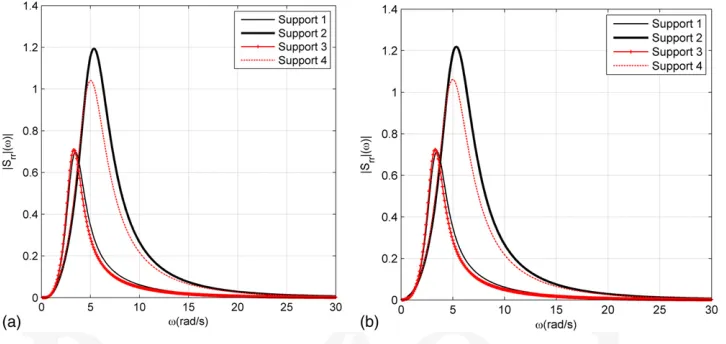
488 The stationary PSDs at the supports calculated by Eq.(9)using 489 parametric Kanai-Tajimi FRF and Clough-Penzien FRF are shown 490 in Figs. 4(a and b), respectively. The stochastic processes corre-491 sponding to these PSDs are used as orthogonal processes at different 492 supports for wavelet-based modeling of spatially varying ground 493 motions employing Eq. (22) and for wavelet-based evolutionary 494 response analyses of the frame employing Eq.(38). The variation of 495 frequency-dependent time-lags between the left support and other 496 supports from site-response effects calculated by using Eq.(8)are 497 shown in Figs.5(a and b). The time-lags computed by using Kanai-498 Tajimi parametric FRF vary by a moderate amount around the
499 frequency of 4 rad=s whereas the time-lags computed by using
500 Clough-Penzien parametric FRF vary dramatically around a lower
501 frequency of 1 rad=s. Thisfluctuation in the time-lags in the
Clough-502 Penzien FRF case around a lower frequency may have resulted from
503 the additional lower frequencyfilter [Eq.(7)], which in some cases
504 may be a more realistic representation. The Clough-Penzien FRF is
505 therefore used in the computation for structural responses in the
506 following example even though the Kanai-Tajimi FRF could have
507 been used in the computation with equal ease. For Clough-Penzien
508 FRF, the time-lag peaks of ground motions at support pairs 1 and 2, 1
509 and 3, and 1 and 4 are∼2:1, 3.5, and 2.3 s, respectively. Each peak
510 occurs approximately around the averagevf(see Table3) of the soil
511 columns below the two corresponding supports.
512 The influence of site-response effects on the amplitude and
fre-513 quency nonstationarity of the frame-relative displacement responses
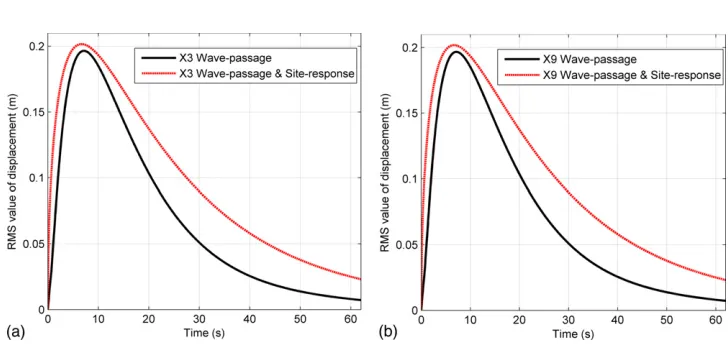
514 has been examined. Figs.6(a and b)show the RMS values of the
515 relative vertical displacement at the midpoints of the left span and the
516 midspan, respectively calculated by using Eq.(41). When the
wave-517 passage effect is considered alone, the RMS values decrease and
518 attenuate faster in time than those when both wave-passage and
site-519 response effects are considered. Similar influence of site-response
520 effects on the relative horizontal displacements at the top of thefirst
521 and the second columns can be observed in Figs.7(a and b),
re-522 spectively. The site-response effects are also shown to alter the
523 amplitude nonstationarity of frame displacements. The increase in
524 the response amplitude nonstationarity from the site-response effect
525 can be evaluated from Figs.6and7. The ratios of the increase in
526 average RMS displacement from the site-response effect, to the
527 average RMS displacement from the wave-passage effect, for the
528 nodes Y6, Y14, X3, and X9 are 41.8703, 42.3704, 39.7965, and
529 39.7949%, respectively.
530 The EPSDs of the relative vertical displacements at the midpoints
531 of the left span and the midspan using the parametric
Clough-532 Penzien FRF and Eq. (38) are shown in Figs. 8 and 9,
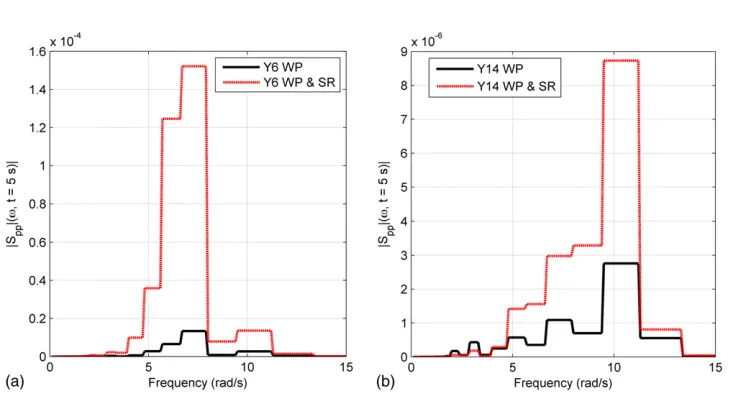
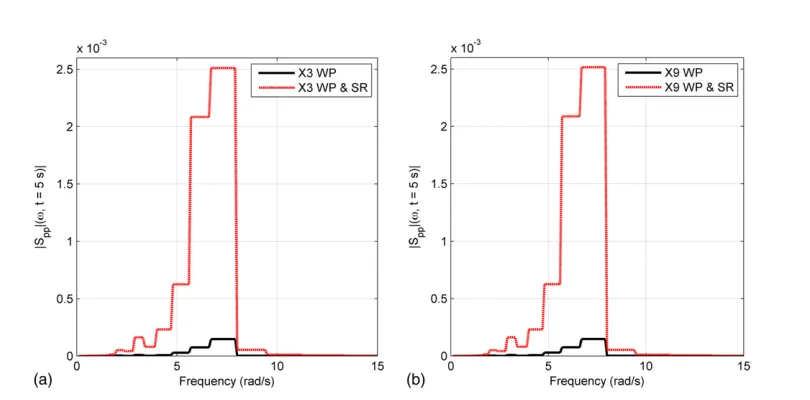
respec-533 tively. Figs.10(a and b)show the corresponding PSDs att55 s.
534 The effects of site-response on the amplitude nonstationarity and on
535 reducing the rate of decay of the RMS response envelope values in
536 time, as seen in Fig.6(b), are also observed in Figs.8(b)and9(b).
537 Figs.10(a and b)show that compared with the case with only the
538 wave-passage effect considered, the frequency content exhibits
539 stronger nonstationary and the peaks of the instantaneous PSDs are
540 higher in the case of combined wave-passage and site-response
541 effects. In addition, the attenuation of the response energy is slower
[image:8.612.42.295.291.357.2]542 in time. Similar trends are observed in the EPSD of the column
Table 2. Estimated
11 Parameters for Kanai-Tajimi Frequency Response Function
Soil column vsðrad=sÞ zs(%) R-square RMSE
1 3.218 0.334 0.525 1.966
2 5.113 0.370 0.601 1.885
3 3.202 0.320 0.601 1.661
4 4.765 0.362 0.597 1.790
[image:8.612.45.293.412.476.2]Note: R-square 5 coefficient of determination for RMSE; vs 5 soil characteristic frequency for Kanai-Tajimi;zs5damping ratio for Kanai-Tajimi.
Table 3.Estimated
12 Parameters for Clough-Penzien FRF
Soil column vsðrad=sÞ zs(%) vfðrad=sÞ zf(%) R-square RMSE
1 3.422 0.350 0.390 0.220 0.632 1.408
2 5.370 0.375 0.588 0.254 0.657 1.311
3 3.278 0.323 0.344 0.140 0.601 1.532
4 4.997 0.389 0.517 0.211 0.633 1.408
[image:8.612.126.489.540.712.2]Note:R-square5coefficient of determination for RMSE;zf 5damping frequency for Clough-Penzien;zs5damping ratio for Kanai-Tajimi;vf 5soil characteristic frequency for Clough-Penzien;vs5soil characteristic frequency for Kanai-Tajimi.
543 relative horizontal displacements in Fig.11and the PSDs att55 s 544 in Fig.12.
545 Conclusions
546 A wavelet-based evolutionary response formulation of multispan 547 structures supported on a soil medium and subjected to spatially
548 varying differential support motions including wave-passage and
549 site-response effects has been proposed in this paper. The
spatial-550 variability of support motions is formulated by bedrock parametric
551 coherency models, the time-lags from wave-passage effects, and
552 a proposed alternate way to represent site-response effect by
553 frequency-dependent time-lags. The earthquake energy content is
[image:9.612.93.515.20.192.2]554 properly characterized by a composite PSDF constituted of parametric
[image:9.612.99.542.229.414.2]Fig. 5.Variation of frequency-dependent time lags between the left support and other supports from site-response effects: (a) parametric Kanai-Tajimi FRF; (b) parametric Clough-Penzien FRF
Fig. 6.RMS value of relative vertical displacement: (a) at the midpoint of the left span (Y6); (b) at the midpoint of the midspan (Y14)
[image:9.612.123.487.443.618.2]Fig. 8.PSD of relative vertical displacement at midpoint of left span using parametric Clough-Penzien (C-P) frequency response function: (a) wave-passage effect; (b) wave-wave-passage and site-response effects
Fig. 9.PSD of relative vertical displacement at midpoint of midspan using parametric Clough-Penzien (C-P) frequency response function: (a) wave-passage effect; (b) wave-wave-passage and site-response effects
[image:10.612.124.494.499.699.2]555 surface-to-bedrock FRF and the bedrock power spectrum. The site-556 compatible parametric FRFs are proposed to be characterized in this 557 paper by carrying out a FEA of soil media beneath the supports. 558 In an illustrative case study, a three-span, 2D hangar frame is 559 analyzed using the proposed formulations. The time-lags stemming 560 from the site-response effect, and computed from different FRFs, 561 show different variations in trend. The site-response effect adds 562 frequency nonstationarity to the frame responses and results in an 563 increase of such responses with slower attenuation in time. 564 This paper proposes a more accurate seismic analysis of long-565 span multisupport structures because it accounts for the non-566 stationarities in both amplitude and frequency of excitations and 567 properties and variation of soil media beneath the supports; it offers 568 a more realistic representation of earthquake energy content. The 569 proposed formulations are generally applicable for any wavelet-570 based functions and structures.
571 Acknowledgments
572 This research is partially funded under the EU FP7 Marie Curie 573 IAPP project NOTES (grant No. PIAP-GA- 2008-230663). The
574 authors are grateful for the support. The authors also thank the
anon-575 ymous reviewers who have given valuable comments.
576 References
577 Basu, B., and Gupta, V. K. (1997).“Non-stationary seismic response of
578 MDOF systems by wavelet modelling of non-stationary processes.”
579
Earthquake Eng. Struct. Dynam., 26(12), 1243–1258.
580 Basu, B., and Gupta, V. K. (1998).“Seismic response of SDOF system by
581 wavelet modeling of non-stationary processes.”J. Eng. Mech., 10.1061/
582 (ASCE)0733-9399(1998)124:10(1142), 1142–1150.
583 Basu, B., and Gupta, V. K. (2000).“Stochastic seismic response of SDOF
584 systems through wavelets.”Eng. Struct., 22(12), 1714–1722.
585 Boore, D. M. (2003).“Simulation of ground motion using the stochastic
586 method.”Pure Appl. Geophys., 160(3–4), 635–676.
587 Brinkgreve, R. B. J., Broere, D., and Waterman, D. (2008).PLAXIS 2D
588 version 9.0 manual, PLAXIS, Delft, Netherlands.
589 Chakraborty, A., and Basu, B. (2008).“Nonstationary response analysis of
590 long span bridges under spatially varying differential support motions
591 using continuous wavelet transform.”J. Eng. Mech., 10.1061/(ASCE)
592 0733-9399(2008)134:2(155), 155–162.
593 Clough, R. W., and Penzien, J. (2003).Dynamics of structures, McGraw
[image:11.612.126.484.29.206.2]594 Hill, New York.
Fig. 11.PSD of relative horizontal displacements at the top offirst column using parametric Clough-Penzien (C-P) frequency response function: (a) wave-passage effect; (b) wave-passage and site-response effects
[image:11.612.110.515.243.443.2]595 Deodatis, G. (1996).“Non-stationary stochastic vector processes: Seismic 596 ground motion applications.”Probab. Eng. Mech., 11(3), 149–168. 597 der Kiureghian, A. (1996).“A coherency model for spatially varying ground 598 motions.”Earthquake Eng. Struct. Dynam., 25(1), 99–111.
5998 Dinh, N. V., and Basu, B. (2012).“Zero-pad effects on conditional simu-600 lation and application of spatially-varying earthquake motions.”Proc., 601 6th European Workshop on Structural Health Monitoring, Æwww 602 .ewshm2012.com/Portals/98/BB/tu3d3.pdfæ.
603 Dumanogluid, A. A., and Soyluk, K. (2003).“A stochastic analysis of long 604 span structures subjected to spatially varying ground motions including 605 the site-response effect.”Eng. Struct., 25(10), 1301–1310.
606 Gurley, K., and Kareem, A. (1999).“Application of wavelet transforms 607 in earthquake, wind, and ocean engineering.”Eng. Struct., 21(2), 608 149–167.
609 Hao, H. (1994).“Ground-motion spatial variation effects on circular arch 610 responses.”J. Eng. Mech., 10.1061/(ASCE)0733-9399(1994)120:11(2326), 611 2326–2341.
612 Hao, H., Olivera, C. S., and Penzien, J. (1989).“Multiple-station ground 613 motion processing and simulation based on SMART-I array data.”Nucl.
614 Eng. Des., 111(3), 293–310.
615 Harichandran, R. S., and Vanmarcke, E. H. (1986).“Stochastic variation of 616 earthquake ground motion in space and time.”J. Eng. Mech., 10.1061/
617 (ASCE)0733-9399(1986)112:2(154), 154–174.
618 Iyama, J., and Kuwamura, H. (1999).“Applications of wavelets to analysis 619 and simulation of earthquake records.”Earthquake Eng. Struct. Dynam.,
620 28(3), 255–272.
621 Kijewski-Correa, T., and Kareem, A. (2006). “Efficacy of Hilbert and 622 wavelet transforms for time-frequency analysis.”J. Eng. Mech., 10.1061/ 623 (ASCE)0733-9399(2006)132:10(1037), 1037–1049.
624 Konakli, K., and der Kiureghian, A. (2012).“Simulation of spatially varying 625 ground motions including incoherence, wave-passage and site-response 626 effects.”Earthquake Eng. Struct. Dynam., 41(3), 495–513.
627 Kramer, S. L. (1996).Geotechnical earthquake engineering, Prentice Hall, 628 Upper Saddle River, NJ.
629 Loh, C. H., and Ku, B. D. (1995).“An efficient analysis of structural response
630 for multiple-support seismic excitations.”Eng. Struct., 17(1), 15–26.
631 Luco, J. E., and Wong, H. L. (1986).“Response of a rigid foundation to
632 a spatially random ground motion.”Earthquake Eng. Struct. Dynam.,
633 14(6), 891–908.
634 MATLAB[Computer software]. Natick, MA, MathWorks. 9
635 Priestley, M. B. (1981).Spectral analysis and time series, Academic Press,
636 New York.
637 Shinozuka, M., and Sato, Y. (1967).“Simulation of nonstationary random
638 processes.”J. Eng. Mech. Div., 93(1), 11–40.
639 Spanos, P. D., and Failla, G. (2004).“Evolutionary spectra estimation using
640 wavelets.”J. Eng. Mech., 10.1061/(ASCE)0733-9399(2004)130:8(952),
641 952–960.
642 Spanos, P. D., and Kougioumtzoglou, I. A. (2012).“Harmonic wavelets
643 based statistical linearization for response evolutionary power spectrum
644 determination.”Probab. Eng. Mech., 27(1), 57–68.
645 Spanos, P. D., Tezcan, J., and Tratskas, P. (2005).“Stochastic processes
646 evolutionary spectrum estimation via harmonic wavelets.” Comput.
647
Methods Appl. Mech. Eng., 194(12–16), 1367–1383.
648 Tratskas, P., and Spanos, P. D. (2003).“Linear multi-degree-of-freedom
649 system stochastic response by using the harmonic wavelet transform.”
650
J. Appl. Mech. 70(5), 724–731.
651 Trifunac, M. D., and Brady, A. G. (1975).“A study on the duration of strong
652 earthquake ground motion.”Bull. Seismol. Soc. Am., 65(3), 581–626.
653 Zerva, A. (2009).Spatial variation of seismic ground motions: Modeling
654 and engineering applications, Taylor & Francis, Boca Raton, FL.
655 Zerva, A., and Zervas, V. (2002). “Spatial variation of seismic ground
656 motions: An overview.”Appl. Mech. Rev., 55(3), 271–297.
657 Zhang, Y. H., Li, Q. S., Lin, J. H., and Williams, F. W. (2009).“Random
658 vibration analysis of long-span structures subjected to spatially varying
659 ground motions.”Soil. Dyn. Earthquake Eng., 29(4), 620–629.
660 Zhou, Z., and Adeli, H. (2003). “Time-frequency signal analysis of
661 earthquake records using Mexican hat wavelets.”Comput. Aided Civ.
662
Q:1_Please check that ASCE Membership Grades (Member ASCE, Fellow ASCE, etc.) are provided for all authors who are members.
Q:2_Please give a specific reference for ‘‘Kanai-Tajimi’’.
Q:3_Please give a specific reference for ‘‘Clough-Penzien’’.
Q:4_The numbered sections and subsections were styled to journal requirements in this paragraph and the one following. Please read the changes carefully and the rewording done to make the paragraph address the sections and subsections in a consistent manner. Kindly check and confirm or amend these changes.
Q:5_AU: What does ‘‘dyn’’ stand for? Please convert to SI units.
Q:6_Please give a reference for ‘‘Duhamel’s integral’’.
Q:7_Please spell out ‘‘EPSD’’ here, at first mention.
Q:8_Please give a date of access for ‘‘Dinh and Basu 2012.’’
Q:9_Please provide version number for MATLAB.
Q:10_For Table 1, please check and confirm or amend the defined terms. Please also give a definition for ‘‘E’’ and ‘‘v’’.
Q:11_For Table 2, please check and confirm or amend the defined terms.
Q:12_For Table 3, please check and confirm or amend the defined terms.