DEVELOPMENT OF GENETIC
ALGORITHM BASED HYBRID NEURAL
NETWORK MODEL FOR PREDICTING
THE ULTIMATE FLEXURAL STRENGTH
OF FERROCEMENT ELEMENTS
Dr. SUDARSANA RAO, H.*
Professor of Civil Engineering JNTUA College of Engineering
Anantapur-515 002 E mail: [email protected]
SUBBA REDDY, P.V.
Associate Professor of Civil Engineering N.B.K.R.I.S.T.
Vidyanagar, Nellore (Dist.) – 524413 E mail: [email protected]
Dr. VAISHALI. G. GHORPADE
Associate Professor of Civil Engineering JNTUA College of Engineering
Anantapur-515 002
E mail: [email protected]
Dr. CHANDRSEKHARA REDDY, T.
Professor of Civil Engineering G.P.R. Engineering College
Kurnool-518002 E mail: [email protected]
Abstract
various stages involved in the development of genetic algorithm based neural network model are addressed at length in this paper.
Keywords: Ferrocement, Genetic Algorithm (GA), Artificial Neural Network (ANN), Back Propagation (BP), Root Mean Square Error (RMSE), Hybridization.
1. Introduction
Pierre Luigi Nervi conducted the first experimentation on ferrocement. Nervi established the properties of ferrocement as a construction material. From then on many researchers have undertaken and established the mechanical properties of ferrocement [Paul and Pama, 1978]. “Ferrocement is defined as a thin composite made with a cement based mortar matrix reinforced with closely spaced layers of continuous and relatively small diameter wire meshes to create a stiff structural form [Naaman, 2000]. The basic idea behind this material is that the mortar can undergo large strains in the vicinity of reinforcement and the magnitude of strains depends on the distribution of reinforcement throughout the mass of the mortar. The Ferrocement elements are usually of the order of 20 to 35 mm in thickness and the steel requirement varies between 300-500 kg/cum of mortar. The wire mesh used in the Ferrocement material is usually 0.50 to 1.0 mm in diameter at 5 to 25 mm spacing. A Cement-sand proportion of 1:2 or 1:3 is generally used along with a water-cement ratio of 0.40 to 0.50. The advantageous properties of Ferrocement are high tensile strength, toughness, water tightness, lightness, easy repairability, mouldability to any desired shape, durability, fire resistance, environmentally sound technology etc., cannot be matched by any other thin construction material [Naaman, 2000; Atkinson, et al., 1996]. However the applications of Ferrocement are hampered due to non-availability of mix design procedure or a macro model. Development of such a macro model using analytical approach is difficult because of the complex multi parametric relationship between the constituents of Ferrocement. By now it is established that neural networks and Genetic Algorithms have the ability to map this type of multi parametric interaction.
Artificial Neural Networks are highly non-linear and can capture complex interactions among input/output variables in a system without any prior knowledge about the nature of these interactions. In recent years, ANNs have shown exceptional performance as regression tools, especially when used for pattern recognition and function estimation. The main advantage is that one does not have to explicitly assume a model form which is a prerequisite in the parametric approach. In comparison to parametric methods, in ANNs a relationship of possibly complicated shape between input and output variables is generated by data points themselves. In comparison to parametric methods, ANNs tolerate relatively imprecise or incomplete data, approximate results, and are less vulnerable to outliers. ANNs are highly parallel i.e., their numerous independent operations can be executed simultaneously. Among all kinds of neural network algorithms, error back propagation (BP) network is the most typical delegate. But there are some intrinsic drawbacks for the BP algorithm due to its slow convergence rate and tapping in a local optimization. Furthermore, it needs plenty of training samples in model establishment. Genetic Algorithm (GA), on the other hand is a stochastic global searching and optimization algorithm that based on Darwin’s biological theory of evolution and the Mendel’s genetic principles of genes. GA is used to solve complicated problems by simulating the evolutionary course of natural selection and natural inheritance of biology circles, featured by many advantages such as simple searching method, strong robustness, global parallel searching, and is suitable to solve the complex problems of large scale. GA optimize the encoding string groups which composed by parameters, according to a certain fitness function and genetic operations (Selection, crossover and mutation) on the individual implementation of the evolution, so that high fitness value individual has been preserved and form a new group. While the individual of new group is evolving, fitness value is increasing continually until the limit meets certain conditions. At this point the highest fitness value of the individual shall be the optimum solution. However, GA also has its own shortages such as lower local convergence speed, inclining to premature convergence etc. According what is mentioned above, it is evident that there is strong complementarity between BP and GA. Based on that complementarity, a new hybrid evolution mode can be established; that is, the relationship model is established by BP network, the connection weights and thresholds of BP are optimized by GA, and then the precision of model is increased by BP. It not only avoids the deficiency of BP and GA, but also gives full play to the global searching capacity of the GA and local searching capacity of BP network. Moreover, it accelerates the convergence speed of the algorithms and overcomes the drawback of BP network that is difficult to achieve a satisfactory model with fewer training samples.
2. Literature Survey
Eldin et al. [1994] employed a NN for measuring and predicting of strength of rubberized concrete. Employing the ANN method for modeling the strength of high performance concrete was investigated by Yeh [1998]. Wang [1999] developed an automatic knowledge acquisition system based on NNs to design concrete mix. Savic et al. [1999] developed software for the optimal design of general and symmetric/balanced laminates (or sandwich panels) with specified mechanical properties. Guang et al. [2000] proposed a method to predict the compressive strength of concrete using multi layer feed forward NNs. Hayalioglu [2000] presented a genetic algorithm for the optimum design of geometrically non-linear elastic-plastic steel frames with discrete design variables. Saka et al. [2000] developed a genetic algorithm based method for the optimum design of grillage systems. Nehdi et al. [2001] have developed a neural network model for predicting performance of self compacting concrete mixtures using feed forward back propagation algorithm. Nehdi et al. [2001] have developed Neural Network models for performance of cellular concrete mixtures. Diasm et al. [2001] presented an ANN model for predicting the strength and slump of ready mixed concrete. Yang et al. [2002] presented an inverse procedure for the detection of a three dimensional crack in plates and shells using genetic searching algorithm. Cengiz Toklu [2005] formulated an aggregate-blending as a multi-objective optimization problem and solved by using genetic algorithms. Sudarsana Rao and Chandrasekhara Reddy [2008] have developed Artificial Neural Network based macro mechanical model for slurry infiltrated fibrous concrete using multi layer feed forward network with back propagation learning algorithm. However, at present there are no such models available for Ferrocement. This paper presents the methodology to develop a GA based ANN macro model for predicting the flexural strength of Ferrocement elements.
3. Development of hybrid neural network model
Development of a hybrid neural network model for predicting the ultimate flexural strength of ferrocement elements involves various stages which are addressed in the following sections.
3.1 Generation of exemplar patterns
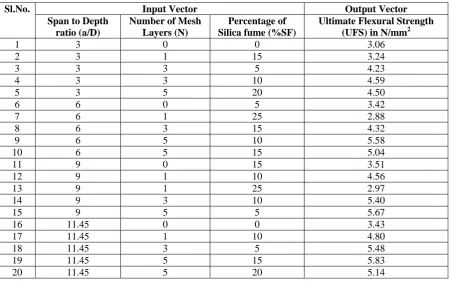
Experiments were conducted to determine the ultimate flexural strength of Ferrocement elements after 28 days of curing with span to depth ratio (3, 6, 9 & 11.45), number of mesh layers (0, 1, 3 & 5) and percentage replacement of silicafume (0, 5, 10, 15, 20 & 25) as variables. A total of 288 Ferrocement elements were cast and tested in the laboratory for flexure and the average of three samples were considered so as to get 96 data sets of results. Out of this 96 data sets, 77 data sets (80% of total data) were used for training and the remaining 19 data sets were used for validation. A part of the training set data is presented in Table No.1.
3.2 Selection of input and output vectors
In the present work, it is required to develop a hybrid network model for predicting the flexural strength of Ferrocement elements. This means, the model should be able to predict the values of ultimate flexural strength for a given input vector of span to depth ratio (a/D), number of mesh layers (N) and percentage of silica fume (%SF). Accordingly the input to the network is selected as follows.
1. Span to depth ratio (a/D) 2. Number of mesh layers (N) 3. Percentage of silica fume (%SF) The input vector selected for this model is
IP = [ a/D, N, %SF]
The output of the network is
Ultimate Flexural Strength (UFS)
Accordingly, the output vector for the Neural Network model is selected as
Table No.1: Part of the training data set
Sl.No. Input Vector Output Vector Span to Depth
ratio (a/D)
Number of Mesh Layers (N)
Percentage of Silica fume (%SF)
Ultimate Flexural Strength (UFS) in N/mm2
1 3 0 0 3.06
2 3 1 15 3.24
3 3 3 5 4.23
4 3 3 10 4.59
5 3 5 20 4.50
6 6 0 5 3.42
7 6 1 25 2.88
8 6 3 15 4.32
9 6 5 10 5.58
10 6 5 15 5.04
11 9 0 15 3.51
12 9 1 10 4.56
13 9 1 25 2.97
14 9 3 10 5.40
15 9 5 5 5.67
16 11.45 0 0 3.43
17 11.45 1 10 4.80
18 11.45 3 5 5.48
19 11.45 5 15 5.83
20 11.45 5 20 5.14
3.3 Scaling of Data
The input and output parameters have been normalized in the range (0, +1) using suitable normalization factors or scaling factors. The scaling factors for input and output parameters are presented in the Table No.2.
Table No.2: Scaling of Data
Nature of
vector Parameter
Minimum Value
Maximum Value
Scale Factor
Input vector
Span to depth ratio (a/D) 3 11.45 15
Number of mesh layers (N) 0 5 8
Percentage of silica fume (% SF) 0 25 40
Output
vector Ultimate Flexural Strength (UFS) N/mm 2
2.25 6.51 10
3.4 Selecting a suitable network configuration
Feed forward
Back propagation
Input Layer Hidden layer Output Layer (3 neurons) (10 neurons) (1 neuron)
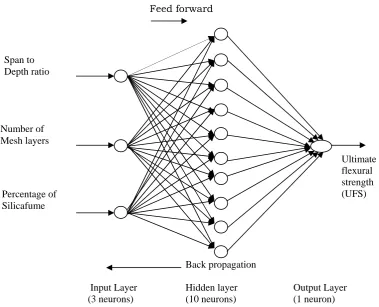
Figure No.1: Configuration of GA/ANN Model
3.5 Training of the network model
Conventionally, a BPN determines its weights based on a gradient search technique and hence runs the risk of encountering local – minima. GA on the other hand is found to be good at finding ‘acceptably good’ solutions. The idea to hybridize the two networks has been successful to enhance the speed of training [Rajasekaran and Vijayalakshmi Pai, 2003]. In the present work, the weights for the BPN have been obtained by using a GA. Genetic Algorithms (GAs) which use a direct analogy of natural behaviour, work with a population of individual strings, each representing a possible solution to the problem considered. Each individual string is assigned a fitness value which is an assessment of how good a solution is to a problem. The high-fit individuals participate in “reproduction” by cross-breeding with other individuals in the population. This yields new individual strings as offspring which share some features with each parent. The least-fit individuals are kept out from reproduction and so they “die out”. A whole new population of possible solutions to the problem is generated by selecting the high-fit individuals from the current generation. This new generation contains characteristics which are better than their ancestors. The parameters which represent a potential solution to the problem, genes, are joined together to form a string of values referred to as a Chromosome. A decimal coding system has been adopted for coding the chromosomes in the present work. The network configuration chosen for the present work is 3-10-1. Therefore, the number of weights (genes) that are to be determined are 3x10+10x1=40. With each gene being a real number, and taking the gene length as 5, the string representing the chromosomes of weights will have a length of 40x5=200. This string represents the weight matrices of the input-hidden layer-output layers. An initial population of chromosomes is randomly generated. Weights from each
chromosome have been extracted then using the procedure suggested by Rajasekaran & Vijayalakshmi Pai
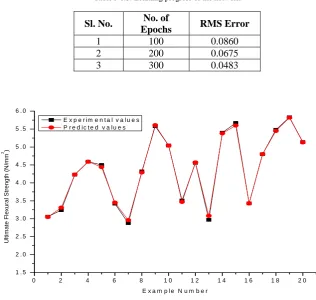
[2003]. The fitness function has been devised using FITGEN algorithm [Rajasekaran & Vijayalakshmi Pai, 2003]. A constant learning rate of 0.6 and a momentum factor of 0.9 have been adopted during the training. Satisfactory training has been obtained after just 300 training cycles. The progress of the learning of the network is presented in Table No.3. It can be seen from Table No.3, that the RMS error after 300 cycles is only 0.0483. Accordingly the performance of the network is acceptable. At this stage the training of the network is terminated to avoid over training. Such an overtraining may hamper the generalization capabilities of the network. The training of the network accepted at this stage is presented in Figure No.2. The figure is drawn only for twenty
Span to Depth ratio
Number of Mesh layers
Percentage of Silicafume
verified all the seventy seven training examples and it is found that the network has predicted all the values to the good satisfaction. Thus it can be concluded that at this stage the network has learnt the relationship between input and output parameters successfully.
Table No.3: Learning progress of the network
Sl. No. No. of
Epochs RMS Error
1 100 0.0860 2 200 0.0675 3 300 0.0483
0 2 4 6 8 1 0 1 2 1 4 1 6 1 8 2 0
1 . 5 2 . 0 2 . 5 3 . 0 3 . 5 4 . 0 4 . 5 5 . 0 5 . 5 6 . 0
U
ltimate
Flexur
al Str
ength
(N
/mm
2 )
E x a m p l e N u m b e r E x p e r im e n t a l v a lu e s
P r e d ic t e d v a lu e s
Figure No.2: Learning of GA/ANN Model for Ultimate Flexural Strength
3.6 Validation of the network model
Validation of the network is to test the network for parameters that are not used in the training of the network. The network was asked to predict flexural strength for 19 new data sets which are not included in the training set. It can be observed that from the Figure No.3, the values predicted by hybrid model for new sets matches satisfactorily with the experimental results. Hence, the results of GA based ANN model can be used for prediction of flexural strength of Ferrocement elements.
0 2 4 6 8 1 0 1 2 1 4 1 6 1 8 2 0
1 . 5 2 . 0 2 . 5 3 . 0 3 . 5 4 . 0 4 . 5 5 . 0 5 . 5 6 . 0
U
ltimate Flexur
al St
rength (
N
/mm
2 )
E x a m p l e N u m b e r E x p e r i m e n t a l v a l u e s
P r e d i c t e d v a l u e s
4. Conclusions
In this paper, the application of Genetic Algorithm based neural network macro model for predicting the ultimate flexural strength of Ferrocement elements has been demonstrated. The hybrid neural network model has been trained using 77 examples obtained from experimental results. The training examples are so chosen that they will cover all the variables involved in the problem. The weights for the network have been obtained using a genetic algorithm. The network could learn the strength prediction problem with just 300 training cycles. After successful training, the neural network model is able to predict the ultimate flexural strength of ferrocement elements satisfactorily for new problems with an accuracy of about 95%. Thus, it is concluded that the developed hybrid neural network model can serve as a macro-mechanical model for predicting the ultimate flexural strength of ferrocement elements.
References
[1] Atkinson, C., Hobbs, S., West, J. and Edward, S. 1996. Life Cycle Embodied Energy and Carbon dioxide emissions in Buildings,
UNEP Industry and Environment, 19(2): pp. 29-31.
[2] Cengiz Toklu, Y. 2005. Aggregate blending using Genetic Algorithms, Computer Aided Civil and Infrastructure Engineering, Vol.20,
No.6, pp. 450-460.
[3] Diasm, W.P.S. and Pooliyadda, S.P. 2001. Neural Networks for Predicting Properties of Concretes with admixtures, Journal of
Construction and Building Materials, Vol. 15, pp. 371-379.
[4] Dragan A. Savic, Ken E.Evans and Thorsten Silberhorn, 1999. A Genetic Algorithm based System for the Optimal Design of
Laminates, Computer Aided Civil and Infrastructure Engineering, Vol.14, No.3, pp. 187-197.
[5] Eldin, N.N. and Senouch, A.B.1994. Measurement and Prediction of the Strength of Rubberized Concrete, Journal of Cement and
Concrete Composites, Vol. 16, pp. 287-298.
[6] Gaung, N.H. and Zang, W.J. 2000. Prediction of Compressive Strength of Concrete by Neural Networks, Journal of Cement and
Concrete Research, Vol.30, pp. 1245-1250.
[7] Hayalioglu, M.S. 2000. Optimum Design of Geometrically Non-linear Elastic-plastic Steel Frames via Genetic Algorithms, Computers
and Structures, Vol.77, No.5, pp.527-538.
[8] M.Nehdi, Y.Djebbar and A.Khan, 2001. Neural Network Model for Preformed-Foam Cellular Concrete, ACI Materials Journal,
Vol.98, No.5, pp. 402-409.
[9] Moncef Nehdi, Hassan EI Chabib and M.Hesham EI Naggar, 2001. Predicting Performance of Self-Compacting Concrete Mixtures
using Artificial Neural Networks, ACI Materials Journal, Vol.98, No.5, pp. 394-401.
[10] Naaman, A.E. 2000. Ferrocement & Laminated Cementitious Composites, Techno Press 3000, Ann Arbor, Michigan.
[11] Paul, B.K. and Pama, R.P. 1978. Ferrocement, International Ferrocement Information Center, Bangkok.
[12] Rajasekaran, S. and Vijayalakshmi Pai, G.A. 2003. Neural Networks, Fuzzy Logic and Genetic Algorithms, (Prentice Hall of
India,New Delhi).
[13] Sudarsana Rao, H. and Chandrasekhara Reddy, T. 2008. Development of Artificial Neural Network based Macro Mechanical Model
for Slurry Infiltrated Fibrous Concrete, Research Journal of Engineering. and Technology, Vol.1, Issue.2, pp. 48-52.
[14] Saka, M.P., Daloglu, A. and Malhas, F. 2000. Optimum Spacing Design of Grillage Systems using a Genetic Algorithm, Advances in
Engineering Software, Vol.31, pp. 863-873.
[15] Wang J.Z., Ni, H.G. and He, J.Y. 1999. The Application of Automatic Acquisition of Knowledge to Mix Design of Concrete, Journal of
Cement and Concrete Research, Vol. 29, pp. 1875-1880.
[16] Yang, Z.L., Liu, G.R. and Lam, K.Y. 2002. An Inverse Procedure for Crack Detection using Integral Strain Measured by Optical
Fibers, Journal of Smart Materials and Structures, Vol.11, No.1, pp. 72-78.
[17] Yeh, I.C. 1998. Modeling of Strength of High Performance Concrete using Artificial Neural Networks, Journal of Cement and