Volume-7 Issue-2
International Journal of Intellectual Advancements
and Research in Engineering Computations
Towards efficient ECC based provable data possession protocol with data
dynamics for secure cloud storage
E.P.Kaushik
1, P. Boobalan
1, K. Dhamodaran
1, S. Karthik
1, S. Prabhu
2 1UG Students, Department of Computer Science and Engineering, Nandha Engineering College
(Autonomous), Erode, Tamilnadu, India
5
Assistant Professor, Department of Computer Science and Engineering, Nandha Engineering College
(Autonomous), Erode, Tamilnadu, India
ABSTRACT
Distributed computing is familiar for its financially on-request benefits dependent on web. The critical advantages of cloud administrations drive associations and people to make roughage by re -appropriating information to cloud stockpiles. Re-appropriating information brings clients' a simple and conservative method for information the executives and furthermore soothes clients' from the weight of building and keeping up neighbourhood information stockpiling. Be that as it may, information being living in some outsider's premises, clients have no full command over their information which requires guaranteein g classification and uprightness of information put away in untrusted distributed storage servers. To check the accuracy of information in distributed storage, this paper proposes an effective ECC based Provable Data Possession (EPDP) Protocol with information elements. The proposed convention jam secrecy of information put away in distributed storage and enables information proprietor to check the honesty of information without recovering the entire unique information. Additionally the convention is intend ed to perform stateless evaluating and backings information elements at square dimension holding a similar security confirmation. Security and Performance examination ends up being secure and exceptionally proficient for secure distributed storage.
Keywords-
Privacy, Cloud information stockpiling, Information honesty, Elliptic bend cryptography, Respectability check, Secure capacityINTRODUCTION
Distributed computing has been imagined as a processing model that empowers pervasive, helpful system get to, area autonomous asset pooling, quick versatility and on-request self-administration that can be provisioned and discharged with negligible administration exertion or with specialist organization association [1]. The administration rendered by cloud that can't be contrasted and different models contains adaptability, adaptability, multi-occupancy, Device and Location Independence, spryness, pay for what you use and so forth. The real cloud specialist
organizations like Amazon [2], Google [3] offer these attributes as administrations over the web. Other such suppliers incorporate Rack space, Microsoft, Sales drive, VMware, Verizon, Citrix, IBM [4, 10] and so forth. Moving information into distributed storage gives information proprietors an extraordinary accommodation which assuages proprietors from specialized complexities and from the weight of contributing, fabricating and keeping up claim foundation. Despite the fact that the advantages of cloud are critical and enormous, one of a kind viewpoint that obstructs the reception of cloud by numerous people and ventures is worry over information security [11]. Guaranteeing
privacy and honesty of the redistributed information is essential since information are put away on shared servers at remote site. As data are dealt with by certain untouchables, the data owner has nonattendance of full specialist over the redistributed data. Classification can be accomplished by scrambling the information utilizing industry standard calculations before moving into distributed storage. What's more, to avoid unapproved access, verification and access control conventions gives best arrangements. To get fine-grained access to redistributed information a safe convention is proposed in [12]. To use productively the pool of cloud administrations without dread, information proprietor must guarantee that the redistributed information isn't altered and are taken care of as they anticipate. To guarantee the rightness of put away information, information inspecting administration is basic. Numerous specialists have proposed plans for classification and uprightness check [13]-[24] for secure remote information stockpiles. Be that as it may, information uprightness confirmation can't be benefited as an administration from cloud suppliers since the cloud information stockpiles are viewed as untrusted servers. Subsequently it is one of the basic obligations of information proprietors to review how their touchy information are dealt with in cloud condition. Guaranteeing respectability of information is a troublesome assignment without a duplicate of information put away in information proprietor's server. Without having a neighborhood duplicate and recovering entire information from distributed storage for respectability confirmation ends up bulky for information proprietor. Consequently, a safe and proficient remote information honesty confirmation convention fulfilling the above prerequisites is required to get the affirmation that the redistributed information are taken care of obviously by information proprietors.
Ateniese et al. [25] was the first to present secure and proficient Provable Data Possession (PDP) plans dependent on homomorphic obvious labels. Wang et al. [26] structured a Privacy-Preserving Public Auditing for cloud information stockpiling in which open key based homomorphic authenticator was used and arbitrary concealing was utilized to accomplish protection safeguarding
SYSTEM MODEL
Cloud Data Storage overview
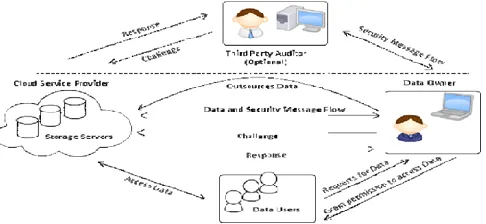
The cloud condition and the staggered security framework required to ensure the information put away in cloud servers and the duties of an information proprietor in securing information are talked about thoroughly in [33]. The cloud information stockpiling model considered in this paper comprises of the accompanying substances as portrayed in Fig.1.
1. Data Owner (DO): a substance that redistributes information to cloud information stockpiling. 2. Data User (DU): an approved individual who
sends ask for getting to the information put away in distributed storage.
3. Cloud Service Provider (C SP): an element that gives stockpiling as an administration to clients. 4. Third Party Auditor (TPA): a discretionary
element, aptitude in checking the honesty of the redistributed information for the benefit of information proprietor.
Fig. 1. Cloud Data Storage overview
Security Attacks
The information proprietors are prescribed to encrypt information before redistributing so as to ensure the sensitive information facilitated to cloud servers. Despite the fact that the information are scrambled, an assailant who is keen on knowing the information if impractical to decipher it, might decimate the put away information by doing a few controls or may erase a few information which results in perplexities to information proprietor. At such time there is a basic requirement for a productive information trustworthiness check instrument which helps in confirming whether the put away information is flawless. This information trustworthiness verification should be possible by information proprietor without anyone else or can appoint a trusted TPA to play out the confirmation. The two sorts of dangers in distributed storage condition are as per the following:
Internal Attack
The special clients in the CSP site realize how to deal with the put away information and
consequently may either deliberately or accidently control or break information which results in substantial misfortune to information proprietor.
External Attack
The malignant clients from outside the cloud condition may bargain cloud servers and hacks information which may influence the two information proprietor and CSP.
Design Goals
The proposed framework is aimed in planning an honesty confirmation convention that is effective and sufficiently secure to check the information put away in distributed storage. The proposed EPDP convention ought to include the accompanying properties:
Security
checking whether information has experienced unapproved manipulations.
Stateless check
The verifications produced by the convention ought to be founded on haphazardly picked difficulties which relieve verifier from keeping up states between reviews.
Efficiency
The proposed convention ought to be productive as far as low calculation and capacity overhead and the challenge presented ought to be boundless which genius the effectiveness of the proposed convention.
Audits without downloading
Data honesty confirmation ought to be managed without recovering the duplicate of entire unique information.
Key Generation – given a security parameter as information, this calculation creates a key pair (mystery key, open key) as yield.
Tag Generation– given information square, utilizing
a hash work and keys as data sources, this calculation gives labels as yield.
Challenge Generation – choosing arbitrary qualities, this calculation produces test (challenge) as yield.
Proof Generation – given a test 'challenge' stored information document and labels as sources of info, this calculation creates a proof for information ownership as yield.
Proof Verification– given created proofs challenge
and mystery key as sources of info, this calculation checks the evidence of information ownership and produces acknowledge or dismiss as yield.
Pre-Processing Phase
To guarantee classification of the redistributed information, before moving information into distributed storage it must be scrambled utilizing industry standard encryption calculations. In light of the affectability how information could be ensured through staggered security framework and how information clients in a chain of command could get to these ensured information securely are examined in [33, 12]. The encoded information document is considered for preparing in the
proposed framework. The periods of the proposed EPDP convention are as per the following:
Key Generation phase
The key age calculation, 'GenKey' is executed by information proprietor to create mystery and open key pair. For a given security parameter k, the GenKey calculation gives a mystery and open key pair (sk, pk) as yield. Information proprietor chooses an irregular whole number k from [1,n-1],and P=kG is registered, where k is the mystery key and P is the open key.
Algorithm 1: GenKey
1. Procedure: GenKey(1k)→(sk,pk) 2. select a random integer k ϵ [1,n-1] 3. compute P=kG
4. sk← k, pk←P 5. End Procedure
Tag Generation phase
The information proprietor registers labels over the encoded information records by executing Tag age calculation 'GenTag'. For producing labels, the information document F is partitioned into squares, state F = m1, m2,...,mn . For each square mi, in information document, information proprietor chooses an irregular number di from [1,n-1] as the mystery esteem (sv) of the square for which label Tm is created. The mystery key(sk) and the directions of open key(pk) are utilized in figuring the labels. Alongside these keys a hash work h:{0,1}*→Zp and the square mystery esteem (sv) are utilized in label calculation. The information document and the produced labels for the information squares {F, Tm}are sent to CSP. Algorithm 2: GenTag
1. Procedure: GenTag(m,sv,sk,pk)→Tm 2. compute σi,1= h(mi )k diPx
3. compute σi,2= diPy
4. Tm←{σi,1,σi,2 } 5. End Procedure
Challenge Generation phase
a test, verifier chooses I={a1, … ,a c}, an arbitrary c-component subset of the set [1,n] and for each i∈ I (1≤i≤c), an irregular esteem ri is picked. The test 'chal' shows the positions and the obstructs that are to be confirmed and is spoken to as chal={(i,ri)}i∈I . The server on getting 'chal' from the verifier, figures the reaction for the test and returns it to the verifier.
Algorithm 3: GenChal
1. Procedure: GenChal (k)→chal 2. Choose a random c-element
subset I from the set [1,n] 3. For each i∈ I, 1≤i≤c, a. select a random value ri b. chal←{(i,ri)}i∈I c. End Procedure
Proof Generation phase
The CSP on accepting a test from the verifier, registers a relating reaction as information trustworthiness verification. The calculation 'GenProof ' is executed by CSP which takes the information record, labels, challenge 'chal' and open ke y as data sources and produces ρ ={τ,µ) as confirmations.
Algorithm 4: GenProof
1. Procedure: GenProof(F,σi,1,σi,2, chal, pk)→ρ
2. compute τ = ∏i=aac 1 σi,1 Py ri A
σi,2hmiPxri 3. compute µ = ∏i=ac 1
4. ρ ←{τ,µ}
5. End Procedure
Proof Verification phase
Information proprietor on accepting the reaction for the test from the CSP, confirms the honesty of the information by executing confirmation check calculation 'Check Proof'. Verifier veri fies whether the accompanying condition holds for the got reaction utilizing his mystery key. Check Proof calculation takes the reaction ' ρ', challenge 'chal' and mystery key(sk) as sources of info and returns 'genuine' if the trustworthiness of queri ed information squares are confirmed as right or returns 'false' o therwise. That is, the verifier can check for the condition τ = k µ. In the event that the condition holds, at that point the yield is "genuine" false.
DATA DYNAMICS
The proposed EPDP convention bolsters different activities, for example, addition, change and erasure on squares in the information record.
Block Insertion (BO=1)
The information proprietor guess needs to embed a square in a predefined position say, after square 'p' in the information document F, at that point calculation 6 is executed to complete the work. In the proposed framework, the square addition activity can be performed without figuring again the labels for the squares which are gone in reverse because of inclusion of another square.
Algorithm 6: Block Insertion
1. Procedure: Block Insertion←(p,m*k
2. Select position p and new block to be inserted, 3. m*k
4. Compute σk,1,σk,2 5. Tk←σk,1,σk,2
6. Send request to server to process the update, ProcessUpdateRequest(1,p,m*k ,Tk)
7. End procedure
Block Modification (BO=2)
The information proprietor guess needs to embed a square in a predefined position say, after square 'p' in the information document F, at that point calculation 6 is executed to complete the work. In the proposed framework, the square addition activity can be performed without figuring again the labels for the squares which are gone in reverse because of inclusion of another square. Algorithm 7: Block Modification
1. Procedure: Block Modification←(p,m*k 2. modify blockmpto m*k
3. Compute σk,1,σk,2 4. Tk←σk,1,σk,2
5. Send request to server to process the update, ProcessUpdateRequest(2,p,m*k ,Tk)
6. End procedure
Block Deletion (BO=3)
obstruct, all other ensuing squares are pushed ahead one stage which is the turn around procedure of square inclusion.
Algorithm 8: Block Deletion 1. Procedure: Block Deletion ←(p 2. Select block mp to be deleted
3. Send request to server to process the update, ProcessUpdateRequest(3,p ) 4. End procedure
Process Update Request
The information activities get finished with the Process Update Request calculation. Every datum activity ask for thus calls process refresh calculation to finish the errand. This calculation at last updates obstructs in server as indicated by the square task ask for send by the information proprietor.
Algorithm 9: Process Update Request 1. Procedure: Process Update Request→F 2. If BO=1 then
3. Insert m*k after mp and move all blocks after m*kbackward
i. Store the corresponding tag Tk in server 4. Else if BO=2 then
i. Update block mp with m *
k
ii. Store the corresponding tag Tk in server 5. Else if BO=3 then
6. Delete block mp and tag Tp i. Update file F to F'
ii. Return(F')
SECURITY
AND
PERFORMANCE
ANALYSIS
A. SECURITY ANALYSIS
This area talks about the security examination of the proposed convention. The proposed EPDP convention is turned out to be right and is likewise solid.
Correctness
Theorem: In the event that the re-appropriated information is put away genuinely in distributed storage server, at that point at whatever point the server gets a test from verifier could register confirmation for the test that will dependably be acknowledged by the verifier.
Proof: We have τ =∏ac σ
i,1Pyr
i=a1 i
ac =σi,1Pyr
ii =a1 ac
= (hmikdiPx) Py ri i=a1
ac
= ( σi,2 hmi kPx ) ri i=a
1 ac
= k (σi,2 hmi Px ri) i=a1
= k µ
From the above confirmation the proposed convention is said to be right or legitimate.
Soundness
Theorem: For the exploitative server it is infeasible to bewilder the verifier to acknowledge a bogus confirmation. Proof: The server after using the as of now registered esteem or the speculated esteem can't perplex the verifier in tolerating a bogus verification on the grounds that each time the test is picked haphazardly.
Performance Evaluation of Probabilistic
verification
The proposed convention permits distributed storage server to demonstrate information ownership of chose squares of information document F. This nature of testing identifies server rowdiness with high likelihood and furthermore diminishes the remaining burden on capacity server. Following are the suppositions utilized for location likelihood.
Out of n squares of information record F, server upsets d squares (d/n)
Verifier arbitrarily chooses the records is uniform and subsequently likelihood of choosing any square in the information document F is 1/n.
Verifier approaches evidence for a test which by and large has 'c' distinctive squares and recognizes rowdiness with high likelihood. The recognition likelihood P is as per the following: d c
P = 1 - (1 - n )
P determines the location likelihood that, if server disturbs 'd' shut out of 'n' squares of the information document F, the verifier can recognize the interruption when a test is send for which the server needs to register confirmation for 'c'
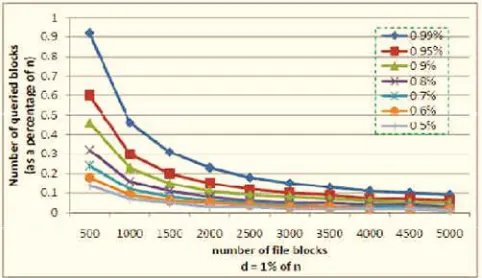
squares. Fig .2 plots P for consistent estimation of d and for various estimations of n and c. It demonstrates the outcome for various location likelihood from 0.5 to 0.99.
Fig. 2. Server misbehavior under different detection probability– number of data file blocks (n), number of queried blocks (c), disrupted block (d=100 blocks)
Fig.3 portrays the adjustments in proportion under various location probabilities where the quantity of upset squares is 1% of n. The verifier, to accomplish P of 99% ought to request least 458
squares for confirmation. To accomplish P of 95%, 90%, and80%, the verifier ought to request something like 298, 229 and 160 squares for check individually.
Performance Evaluation
The execution of proposed EPDP convention is talked about in this area. Table II demonstrates the documentations utilized for assessment of cryptographic activities. The convention is assembled utilizing cryptographic hash work and elliptic bend cryptography. On the information proprietor side, a couple of keys are produced and are utilized in label age. The calculation cost for
and the proposed EPDP convention is as per the following: To check the effectiveness of the proposed convention, the recreation is performed utilizing Intel Core i3 processor with 4GB RAM and Java cryptography library is utilized. The plans proposed in [26] and [30] depend on bilinear blending which includes calculation cost for augmentation activity, exponentiation tasks and bilinear sets. Since the proposed EPDP convention is worked without matching, the calculation cost
for example tasks and bilinear sets are decreased and the calculation cost for measured augmentation, elliptic bend point increase and hash capacities are included. The examination is performed, state the quantity of questioned squares c = 32 and the calculation expenses of the convention in [26, 30] and the proposed convention are appeared in the accompanying Fig.4.
Fig. 4. Comparison between [26, 30] and the proposed protocol
Fig.4 portrays the calculation cost for every calculation in [26], [30] and the proposed EPDP convention. From the examination, it is resolved that the calculation cost is limited and in this way the correlation result demonstrates the effectiveness of the proposed convention.
CONCLUSION
The Cloud Computing worldview gives clients various significant administrations that are required in the present worldwide electronic town. The most generally utilized cloud administrations incorporate information stockpiling and registering administrations. Information proprietors facilitating touchy information in distributed storage servers need to beat information security
REFERENCES
[1]. P.Mell and T.Granc ”Draft NIST working definition of cloud http://csrc.nist.gov/groups/sns/cloudcomputing/index.html.2012 [2]. Microsoft Azure, (online), available, http://azure.microsoft.com/en.in. [3]. Sales force, (online), http://www.salesforce.com/en.in.
[4]. VMware cloud, (online), available, http://vcloud VMware.com/en.in.
[5]. Verizon, (online), available, http://www.verizonwireless.com/support/verizoncloud. [6]. Citrixcloudservice,(online),available,http://citrix.com/solutions/cloudservice. [7]. IBM cloud, (online), available, https://www.ibm.com/cloud computing.
[8]. D.Sudhadevi and T.Thilagavathi “a novel approach to enhance cloud data defense” Asian journal of information technology, 12(9), 2013, 305-311.