10
APPLICATIONS OF INTERACTIVE
DIDACTIC EVALUATION IN
PRE-ACADEMIC LEARNING SYSTEM
Valentin Cosmin Blândul
University of Oradea, Romania E-mail: [email protected]
Abstract
The interactive didactic assessment (self-assessment / inter-assessment) is an extremely actual issue in which many teachers and specialists in education are interested. The interactive didactic assessment is defined as being that kind of control and examination activity in which the pupil/student has the possibility to appreciate both his/her knowledge and the knowledge of his colleagues, while the teacher’s intervention is more like a prompt and systematic support given to the students in order to impose a formative character to the process. The most important strategies, which can be used in the didactic assessment, are: self-grading, self-correction, the method of the objective appreciation of the personality, and so on.
The hypothesis of this research is that the use of some interactive strategies of the above mentioned types in the process of didactic assessment would lead to an obvious improvement /optimization of both school and personal performance of students. The lot of students belong to the secondary schools and high-schools from Bihor county and the work technique consisted of the three basic stages of the traditional experiment: the pre-testing (didactic tests were given to the experimental and control lots), the experimental intervention (some strategies of self-assessment / inter-assessment are used for the experimental lot) and the post-test stage (a new didactic test is given to both lots). The results obtained in this experiment show that the classes in which the interactive didactic assessment was used, the students’ grades at the disciplines included in this experiment significantly improved, fact that confirms the general hypothesis.
Key words: didactic interactive evaluation, educational system, self-evaluation, inter-evaluation, personal and scholar development.
Theoretical Argumentation
the changes that occur in the romanian contemporary society have asked for major changes in the segments that form it. a priority is made for education system, being imperative to focus on an interactive pedagogy as regarding all its segments: teaching / learning / evaluation (assessment).
the last decade experience shows that these changes have occurred only at the basic level of teaching and learning strategies, evaluation (assessment) being kept back due to a conservator way of thinking, a one-way relationship between teacher and student, an expression of power and authority of the former one.
11
in the 21st century Volume 17, 2009
This new concept is justified by the need to see, as accurate as possible, the new realities
of assessment, in a system that has already applied interactive methods which push the student to self-assessment (for example the method to objectively appreciate one’s personality). but there are also situations in which self-assessment may include comparisons with performances of others (for example, self-marking).
this new type of assessment brings forward the traditional way of assessing, being seen more recently as a “non-conventional“ kind. seen in a different way, assessment done through interactive methods might be put under the formative assessment paradigm, according to which its main task is to improve the quality of teaching. this is done by making decisions based on context and by asking all the partners involved in the act of teaching and learning.
from this point of view, one can say that the interactive assessment has a main contribution
in gathering of data regarding the progress of students and the difficulties they encounter during
the self-acquiring process. the data interpretations refer to the criteria used, the risk factors, the
difficulties that may occur in the process of learning, or the adaptation of teaching methods to
above – mentioning interpretation (ovando, 2001). this vision introduces an element of novelty. yet, another point of view admits how important and useful this interactive assessment is. cucos (2008) states that nowadays it is impossible not to use traditional ways of assessing. the strategies for self-assessment / inter-assessment have a complementary part in the system.
Interactive Strategies Used in Didactic Assessment
analyzing the traditionally used methods, (like observation, oral asking, written and practical tests, or testing by himself) the complementary ones (like projects or portfolios), and
the interactive ones, (used during self-assessment / inter assessment) one can notice that the first
ones are quite rigid and less stimulant to a divergent reality. but, they have a great advantage: an objective mind of the teacher involved in assessing. the later show a contribution to the creative personality, but from the didactic point of view, it may have a major disadvantage, that of subjectivity, due to the lack of experience of the student (blandul, 2007).
the main methods used in self-assessment / inter-assessment are as follows:
Self-correcting or mutual correcting – the students are asked to detect their own mistakes or those belonging to their colleagues. this method is suitable when becoming aware of the learning process or of your own skills.
Self-marking – during checking process, the student is asked to mark himself / herself, and then he “negotiates” it with the teacher or his / her colleagues. this method is going to be used during our experiment, in the following way: before testing through oral examination, some students will be asked to estimate their mark, considering the way they know they have prepared for the subject, as well as being asked to argue it. after testing, but before the teacher says his / her mark, students will be asked to mark themselves again, (this mark being the same or a different
one), this time counting on the effective answer. The final mark will be given by the teacher, being
also asked to motivate his / her mark. this method can be used during written tests as well. but it is highly recommended that students know the objectives and the criteria the teacher took into consideration during the assessment.
Mutual marking – students have the possibility to mark each other in written or oral tests. this method is good for students in showing responsibility and being aware of how important the mark is, under the circumstances that marking is vital in the development of the future school.
to the above mentioned method another one can be added, which is less used, but as much as valuable. it is the rating method, connected to Gh. Zapan, its promoter in romania. as the author says, all the people should know those to interact with, as well as themselves, in order to show
their best and to minimize their flaws. During school, one teacher must know his / her students, but
12 a set of phenomena and objects that are classified after a value system. In order to use this rating
method in school, it requires the knowledge of how it works. thus, at every school subject, before an assessment test, the teacher will ask his / her students to predict the ones with the best / worst results, 30% of the colleagues with the best / worst results in the test. (of course, the students may include themselves in the categories mentioned above.) the reason to ask for only 30% is due to its sharing percentage, due to Gauss equation of 5 classes, having 10%, 20%, 40%, 20%, and again 10% of “well done”, “good”, “average”, “enough” and “not enough at all”.
this kind of method is recommended to be set at least 3 or 4 months, once a week time period, to as many school subjects as possible. this method will contribute to a better knowledge and understanding of the others, as well as to you, which will lead, to paying more attention to the behavior, inside and outside the school. after the students in a class have tested their skills to objectively know and appreciate other colleagues, the teacher may ask for a questionnaire in
which the students mark the first / last colleagues who behave in a best / worst way possible. After a student’s classification, there will be done a certain ranking, as follows:
the + / – signs will be recorded for every student (paying attention if the student is on top or on the bottom of the list), and the signs will be counted;
A score will be calculated for every student, giving a very high score for the first one,
but a minimal score for the last one, the scoring being given for those who are on top,
and also for those who are on bottom of the list. The final scoring will be calculated for
both top and bottom of the list;
every student will be ranked according to his / her position in the list; if two or more students have the same score, a mathematics average will be calculated;
For the study there will be taken only the first / last 30% of the scoring results.
the importance of the rating method and its possible domain may be taken into consideration in the following:
• teaching students to self-knowledge and of the others; • a better understanding of the students;
• an individual characterization of the students;
• to correctly and properly build a test or any assessment instrument; • to correctly and properly guide the students;
• In scientific research.
after working with this method, Zapan (1984) has noticed that many people have a tendency to over-appreciate what they value and to under-appreciate those whom not. as regarding other’s rating, the same author has noticed that this is done more objectively when we talk about impersonal objects or situations, but it becomes less objective when we talk about social, moral or personal situations. self-appreciation and of the others becomes valuable when the person in talk has the skill. therefore, to improve this limitation, radu (2000) asks for introducing more interactive assessing methods (self-assessing or inter-assessing).
Psychological - Pedagogical Experiment
Hypothesis and the main objectives
after reading the bibliography, one can state that from the didactical point of view, to create self-assessment / inter-assessment skills requires a whole new structure of the lesson, by actively using new adequate teaching / learning methods, as well as a new assessment system based on an objective, permanent assessing of students (radu, 2000). on the other hand, from a formative point of view, developing self-assessment skills can improve school scoring by becoming aware of
their own value and of the others’, by trying to focus on them and diminish the flows, by honestly
rating those around you. and what is more, this could contribute to the development of rating yourself (ovando, 2001).
13
in the 21st century Volume 17, 2009
didactical experiment on improving the school and the social behavior of the students by applying some interactive didactical strategies of assessment.
therefore, at the basis of this experiment we give the following general hypothesis:
presenting and using interactive strategies in assessing will lead to a better school and social output of the students.
the most important objectives of our didactic experiment were the following: 1. to increase the students’ objective abilities of self-assessment / inter-assessment; 2. to develop students’ capacity to honestly appreciate the scholar status for themselves
and their colleagues.
The subjects
the experiment was organized according with rotariu’s requirements (1999). the sample consisted of 8 independent lots (experimental and of control), made out of two classes of each 6th grade, 8th grade, 10th grade, and 12th grade, (of humanistic and scientific profiles), classes from 4 schools in oradea and beius (bihor county). the school subjects that used interactive assessing methods (self–assessment, the rating method) were the romanian language and literature, a foreign language (english) and biology. these subjects were selected because we wished to have
a representation in the curriculum, a selection of humanistic and scientific profiles, as well as the
opening of teachers towards novelty. the psycho-pedagogical experiment took place between october 2006 and may 2007.
Methodology
the independent variable was the self-assessment method like self-marking or the rating method, and the dependent variable was the school output of the students as seen in marks. the design of the experiment had 3 main stages.
in the pre-testing stage students are asked to give a school status having in mind some strict rules and are asked to estimate the marks they consider they deserve and will get at a written test in the 3 mentioned subjects. so, we could calculate the frequency of over–assessing, objective assessing, or under-assessing of every student involved. thus, the teacher was asked to clearly state the objectives of the lesson, and the criteria the teacher has used in giving a mark.
the way the experiment proceeded was as follows: a) oral testing:
before every oral testing, the teacher has asked the students to be listened at, to anticipate the mark he / she believes he / she gets it, knowing how prepared he / she is for the lesson. the teacher asks for an argumentation of the mark;
after every answer, the teacher has asked them to self-mark his / her answer. this second mark could be identical or different from the previous. again the teacher has asked for an argumentation;
the teacher, who had to state the criteria, gave the final mark (the one in the
notebooks). b) written testing:
before written tests (test paper or a term paper), students were asked to write down
the first / last 5 students who would get the highest / lowest mark in the subject and
to argue it. if they considered it correctly, students could include themselves in the mentioned list, to either top or bottom. after correcting, the written tests were brought and analyzed in the class, students having the possibility to see the previous list. at this point, the teacher having made a list of himself / herself, the two lists were compared
and the first rank student got 5 points, the second got 4, the third got 3, the fourth got 2,
14 c) during the tutorial classes the teacher insisted on different self–knowledge / inter– knowledge, like self-portraits, colleague’s characterization, personality tests, or interviews.
in the post-testing phase there were used the same variables as in the pre–testing, being used the same methods.
Quantitative and qualitative interpretation of the results
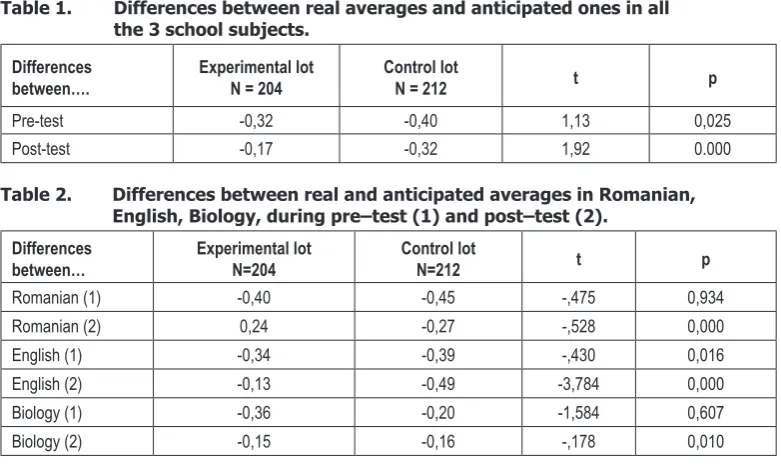
trying to sum-up the data we got during the experiment, one could conclude that there was a difference between the school averages and those anticipated at all the 3 school subjects included in the experiment (romanian, english, biology) (see table 1). taking into consideration this aspect, the averages of students in the experiment classes and of the others were smaller in the experimental classes than those in the control classes, in the pre- and after-test phases. (see
confirmation in the t test). Consequently, the growing number of anticipated averages and the real
ones is due to the fact that students have a better capacity to anticipate their own performances, having a clearer and objective opinion on value.
Going deeper in the study, one can notice that the biggest transformation was at english, where the congruent rank grows in the experimental classes, but it diminishes in the control classes (see table 2). important changes can be seen at biology, as well, where in the experimental classes the congruent rank grows in assessment and self-assessment, while in the control classes it got constant values. We could not make a clear distinction at romanian, maybe because the subject was taught by the same teacher, who did not manage the experimental and control classes very well. on the other hand, at english there were improvements in knowledge in the classes interested in the method, as well as there was a better anticipation of their own answers.
Table 1. Differences between real averages and anticipated ones in all
the 3 school subjects.
Differences
between…. Experimental lotN = 204 Control lotN = 212 t p
Pre-test -0,32 -0,40 1,13 0,025
Post-test -0,17 -0,32 1,92 0.000
Table 2. Differences between real and anticipated averages in Romanian, English, Biology, during pre–test (1) and post–test (2).
Differences
between… Experimental lotN=204 Control lotN=212 t p
Romanian (1) -0,40 -0,45 -,475 0,934
Romanian (2) 0,24 -0,27 -,528 0,000
English (1) -0,34 -0,39 -,430 0,016
English (2) -0,13 -0,49 -3,784 0,000
Biology (1) -0,36 -0,20 -1,584 0,607
Biology (2) -0,15 -0,16 -,178 0,010
Analysing the previous tables, we can observe that the final results confirm the general
15
in the 21st century Volume 17, 2009
as well as by a lot of intermediary variables which are inherent and very difficult to be controlled
in such a complex research. nevertheless, the obtained results cancel the negative effects of these
variables and confirm the specific hypothesis from the start.
therefore, we consider that the psycho-pedagogical intervention by requiring the teachers to specify very clearly the objectives and the criteria for pupils scholar results’ examination and marking, utilization some exercises like: controlled self-marking, estimation of their own’ and colleagues’ school performances (at written tests), games, debates or discussions about self-knowledgment / inter-self-knowledgment, can create the opportunity for pupils to form and develop
their self-evaluation capacity, their honest evaluation one and for the others and, not finally, their
academic performances could be improved.
Conclusions
the data say that from the variable point of view (the estimation of your own school status, the average between anticipated and real marking during two moments of research, the correlation between anticipated average for every student and the real ones, or the estimation of their own answers in romanian, english and biology), introducing and using interactive assessment methods such as self-marking or rating method, but also some methods as self-knowledge / inter-knowledge (personal or colleagues characterization, essays on the topic), all these would help students to correctly assess their own abilities, to honestly appreciate their chances at the exam,
to better value the colleagues, to find a place in the class chart, to better know themselves and the
others.
consequently, we can say that the above didactic experiment has helped the students to understand the importance of evaluation within the instructive-educational process, the objectives
and criteria of evaluation, and develop certain personality features such as self-confidence, ambition
and seriousness in preparation, objectiveness in self-evaluation / inter-evaluation, motivation, etc. on the other side, the teachers could notice how their evaluation was perceived by the students. however, the process is a very complex one and must be continued throughout their whole life.
References
blandul, V. (2007). Theoretical and Practical Approaches of Didactic Evaluation. oradea, university of oradea press.
bocos, m. (2002). Interactiv Instruction.cluj-napoca, university press of cluj.
cucos, c. (2008). Theory and Methodologz of Evaluation. iasi, polirom publushing house.
ovando, m. (2001). teachers’ perceptions of a learner-centered teacher evaluation system. Journal of Personnel Evaluation in Education, 15:3, 125–132.
radu, i. t. (2000). The Evaluation in Didactic Process. bucharest: didactic and pedagogic publushing house.
rotariu, t. (1999). Statistic Methods Applied in Social Sciences. iasi, polirom publushing house. stan, c. (2001). Self-evaluation and Didactic Evaluation. cluj-napoca, university press of cluj.
Zapan, Gh. (1984). Knowing and Appreciating’ Personality. Bucharest, Scientific and Enciclopedic publishing house.
Adviced by Vladimir Guţu, State University of Moldova, Moldova
Blândul Valentin Cosmin Senior Lecturer, PhD, Teacher Traning Department, University of Oradea, Romania.
1 University Street, 410087, Oradea, Bihor, Romania. E-mail: [email protected]