ECCLESIOLOGY TODAY
ECCLESIOLOGY TODAY
© Copyright the authors 2012. All rights reserved.
ISSN: 1460-4213
Published 2012 by the Ecclesiological Society c/o The Society of Antiquaries of London Burlington House
Piccadilly London WIV 0HS
The Ecclesiological Society is a registered charity. Charity No. 210501.
www.ecclsoc.org
Ecclesiology
Today
Issue 45 for January 2012 published July 2012
Journal of the
Ecclesiological Society
Chairman’s letter 2
‘Diminishes sweetly by elegant degrees’:
the tower of Holy Trinity, Leeds and an episode in the early-Victorian Wren Revival
by Christopher Webster 3
‘All its glory is from within’: the importance of colour in church interiors, 1840–1903
by James Bettley 15
A beginning not the end for the parish church?
by Richard Halsey 35
Fifteen photographs from fifteen years of church recording
by Cameron Newham 57
Book Reviews 88
Dear Fellow Member
This issue of Ecclesiology Today starts with Chris Webster describing the rebuilding of a church tower in Leeds in 1839, in the style of Sir Christopher Wren.This is one of those articles which make you speculate how things might have been if . . . in this case, if Wren’s architecture – rather than Gothic – had become fashionable for churches in the mid nineteenth century.
Our second article, by James Bettley, charts the rise and fall of colour in Victorian churches, an issue which was discussed vigorously at the time in various journals, with thinking developing and changing as the century progressed.This article originated as a paper at our 2011 annual conference.
For our third item we are pleased to publish the Annual Lecture given at our 2011 AGM by Richard Halsey. This important and stimulating lecture first gives the background to the State’s (limited) financial support for historic churches, and then discusses the future of Church of England parish churches in the light of the continuing pressures they face and the ways they are adapting.
In our last piece, Cameron Newham celebrates the first fifteen years of a project on which we originally reported more than twelve years ago. The aim of the project is to create a detailed photographic record of all the rural parish churches in England. The fifteen photographs shown here, one from each year of the project, give some idea of its scale and scope, and must surely also remind us of the extraordinary beauty and historical interest to be found in our parish churches.
Those of you who track these things will appreciate that we are still almost exactly one issue behind with Ecclesiology Today. We do have plans to catch up, but in the meantime I hope you will find something to enjoy in this edition’s wide-ranging miscellany.
Finally, as those of you at the AGM will know, I am sorry to say that our Hon. Editor, the Revd Dr Lynne Broughton, decided some months ago to step down from the role. The Council is grateful to her for her work on Ecclesiology Today, and is pleased that she is willing to continue to serve as a member of Council, where her experience and knowledge is much valued.
Trevor Cooper Chairman of Council
Background
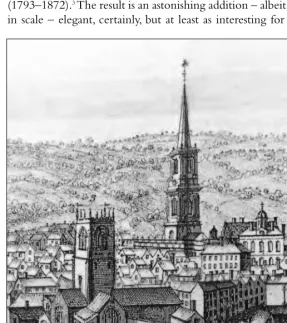
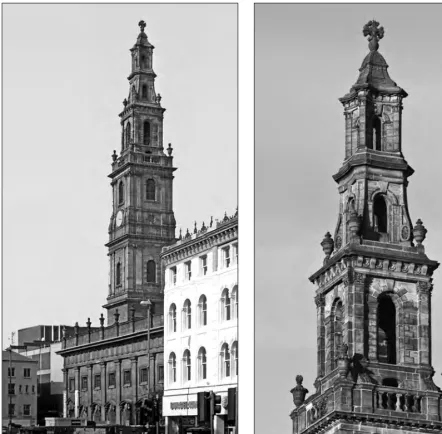
ON THE EVENING of 7 January 1839, Leeds was struck by a ‘hurricane’ and most prominent among the damaged buildings was a series of churches; several had pinnacles dislodged or parapets blown down.1At Holy Trinity, Boar Lane (Figs. 1–3), the situation was even more calamitous as the top of the spire was shattered – apparently ‘by electricity’2– and the lower parts were sufficiently damaged to create much alarm in the town. Whereas the other churches – all relatively recent and Gothic in style– were carefully restored to their original appearance, at Holy Trinity the damage generated an entirely new design, provided by Leeds’ leading architect of the day, Robert Dennis Chantrell (1793–1872).3The result is an astonishing addition – albeit modest in scale – elegant, certainly, but at least as interesting for what it
Christopher Webster is an architectural historian. He is a member of the Council of the Ecclesiological Society, and Reviews Editor of Ecclesiology
Today
‘Diminishes sweetly by elegant degrees’:
the tower of Holy Trinity, Leeds and an episode
in the early-Victorian Wren Revival
Christopher Webster
conveys to us about the stylistic possibilities of 1839, the date of the foundation of the Cambridge Camden Society and a moment now seen as one of seminal importance for the whole course of Victorian architecture – although largely by the Gothic Revival camp – a theme to which we will return.
Holy Trinity was Leeds’ third town centre church, built in the then fashionable west side in 1722–7.4The architect was William Etty (c.1675–1734) from York, the county’s most important architect of the period and a man who had already assisted Colen Campbell and John Vanburgh with their Yorkshire projects, and would later work with Nicholas Hawksmoor; despite his provincial base, he was certainly fully conversant with current metropolitan fashions and visited London on several occasions.5
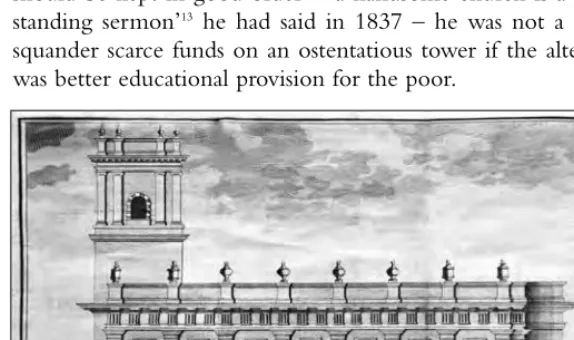
Before we can enter into discussion of Chantrell’s scheme, we need to establish the stylistic parameters of Etty’s composition to which it was added.The latter produced a wooden model in 1723, now lost but engraved in 1724 (Fig. 4),6 before construction commenced; by 1745 the tower had acquired an extra stage and a spire (Figs. 1–3).7 It is not clear at what point between 1723 and 1745 these two features were added, and who was their designer,
Fig. 2: Holy Trinity, Leeds, showing the tower and spire before the storm. (T. Allen, A New and Complete
History of the County of York
(London, I.T. Hinton, 1831), opp. p.508. From a drawing by N. Wittock.)
but in the context of this article, the question need not detain us. The church as it appeared by 1745 is classified by Terry Friedman as one of a number of ‘temple-form churches’8erected in the early eighteenth century, the most prominent and well known of which was James Gibbs’ St Martin-in-the-Fields, London (1722–6), an accomplished, highly innovative juxtaposition of Baroque and Palladian idioms. The project was illustrated in no less than seventeen plates in Gibbs’ A Book of Architecture of 1728, a volume to which Etty subscribed. Although Holy Trinity relies heavily on St Martin’s, Etty’s design is a more sober Palladian composition in which Gibbs’ Baroque flourishes are largely absent, along with the portico that gives St Martin’s much of its antique character. Holy Trinity’s stone needle spire, although arguably incongruous on a pilastered tower, was a not uncommon amalgamation in the eighteenth century, a blending of Gothic and Classical that Horace Walpole referred to as the ‘Bastard Breed’.9
Chantrell’s design for the spire
On being asked to examine the crumbling spire and finding it quite beyond repair,10 how was Chantrell to proceed? It is important to add that funds for restoration were extremely limited.With so many churches damaged within the vast Parish of Leeds, a series of fundraising ‘Bazaars’ were planned intended to raise money not only for the post-hurricane repairs, but also for the provision of a ‘church’ school for each of the parochial chapels in the town.11The latter was an initiative dear to the heart of the town’s energetic new vicar, Dr Walter Farquhar Hook, perhaps spurred on by recent national debates about the benefits of secular education.12 While he was known for his belief that churches should be kept in good order – ‘a handsome church is a kind of standing sermon’13 he had said in 1837 – he was not a man to squander scarce funds on an ostentatious tower if the alternative was better educational provision for the poor.
Fig. 4: Holy Trinity, Leeds, engraving based on William Etty’s ‘draught’ of 1723. Compare the image in Figures 1 & 2, where the tower has an extra stage and a spire. (R.Thoresby, Vicaria
Leodiensis (Leeds, Joseph Smith,
Given this climate of austerity, what were Chantrell’s options? An obvious one was simply to remove the damaged spire altogether (Fig. 3) and leave the tower in the spirit of Etty’s initial design, although a stage higher than the 1724 published design with which, surely, Chantrell would have been familiar.14 A number of early eighteenth-century churches, broadly similar to Holy Trinity, were built with towers like this, e.g. St Alkmund, Whitchurch, Shropshire, 1712–13.A second option was to rebuild the spire as it had been prior to the storm. However, while its stylistic incongruity seems to have raised few concerns at the beginning of the Georgian period, a hundred years later sensibilities among Leeds’ citizens would have been more refined and certainly for an architect educated as Chantrell had been, it must have seemed a glaring solecism. A third alternative was to build a new design of diminishing stages using the Greek Revival repertoire that was still just about fashionable; several towers of this type had been built in the 1820s, for instance St John, Waterloo Road, London by Francis Bedford (1823–4) (Fig. 5) or St Thomas, Holloway Road, Birmingham by Rickman and Hutchinson (1827–9).
Fig. 5: London, St John,Waterloo Road, London (Francis Bedford, 1823–4). (T. Shepherd, Metropolitan
(Fig. 8), the eighteenth century’s most influential pattern book, especially for church builders, a book with which Chantrell would undoubtedly have been familiar, and one he probably owned.18 Holy Trinity’s tower also has elements of St Clement Danes in London, a particularly appropriate source since that tower was left unfinished by Wren and had its upper stages subsequently added by Gibbs (Fig. 9).19However, Chantrell’s three stages defy precise sources;20ultimately his was an original composition, all the more remarkable as his first and only known essay in the Baroque.
This leads naturally to the next question: how on earth did the scheme come to be commissioned? It seems literally incredible that one of the churchwardens should have requested it; much
Fig. 6: Leeds, Holy Trinity, with Chantrell’s addition of the top three stages to the tower. (Author)
Fig. 8: James Gibbs, ‘Draughts of Steeples made for St Martin [in the Fields, London]’. (J. Gibbs, A Book of
Architecture (London,W. Innys et
al., 1728), plate 31)
more logical is that the idea came from Chantrell and at a time when he carried all before him in the town – he was then at the mid point of the reconstruction of the medieval Leeds Parish Church, a project of both national importance as well as local pride – he had sufficient support to carry the day. However, when a plain, but substantial school could be built for £1,000, and a small one for a little under £400, the decision to spend very nearly £800 on Holy Trinity’s new tower can hardly have been made without a compelling argument from the architect.21
The influence of Wren
marginalized, especially by those seeking to promote the dubious notion that the period’s only significant stylistic innovations concerned Gothic.
The crucial influence in Chantrell’s design is Wren rather than Gibbs, and is a manifestation of the renewed interest in the first half of the nineteenth century in St Paul’s and its designer. Dallaway’s Anecdotes of the Arts in England of 1800, Francesco Milizia’s The Lives of Celebrated Architects, first published in an English translation in 1826, J. S. Memes’ History of Sculpture, Painting and Architecture of 1829, along with various other works at this time, all praise Wren and his London cathedral. Inevitably, several make the comparison with St Peter’s in Rome and despite the authors’ best endeavours to the contrary, grudgingly admit St Paul’s cannot quite claim the crown, but comes a respectable second. Of especial interest for this study is Winkles’s Architectural and Picturesque Illustrations of Cathedral Churches of 1836; whereas Britton’s sumptuous Cathedral Antiquities series (started in 1814) considered only England’s 14 most interesting medieval
Fig. 9: London, St Clement Danes, largely by Christopher Wren, 1668–85; upper four stages of tower added by James Gibbs, 1719–20 (T. Shepherd, London and its
Environs in the Nineteenth Century (London, Jones and Co,
structures,23Winkles adds St Paul’s to his selection. Soane, in his Royal Academy lectures,24 delivered 1809–36 – although not annually – also praises Wren and in 1811 even sent young Chantrell, then his pupil, to draw the inside of St Paul’s as well as St Stephen,Walbrook.25
However, it is with James Elmes (1782–1862) – a middle order architect, but prolific author – that the Wren Revival really moves up a gear. He first writes about Wren in his Lectures in Architecture, 1821, and enthusiastically discusses most of Wren’s major London buildings in the richly illustrated London … in the Nineteenth Century, a collaboration with the artist Thomas Shepherd, of 1829. It was with his magisterial Memoirs of the Life and Works of Sir Christopher Wren of 1823 – the first biography of an English architect ever to be published – that Wren was really rediscovered by a new generation.26Among the converts was C. R. Cockerell (1788–1863). He was appointed Surveyor of the Fabric at St Paul’s in 1819 and became ‘an enthusiastic student … of Wren … In consequence, his own work is a unique synthesis of Neo-classical and Baroque’.27 His vast, virtuoso watercolour ‘A tribute to the Memory of Sir Christopher Wren’ illustrated every building thought at the time to be by the architect; it was one of the wonders at the Royal Academy exhibition of 1838. Subsequently, as Professor of Architecture at the Academy, Cockerell’s lectures (delivered 1841–56) had many enthusiastic references to Wren.
So far as Wren’s direct influence is concerned, a number of commentators saw Wren’s London churches – with their obvious Protestant credentials – as providing the ideal models for the church building boom that was heralded by the 1818 Church Building Act, especially from those with reservations about either the Grecian or Gothic alternatives.28A small number of architects appear to have agreed and the tower of John Walters’ St Paul, Shadwell, Middlesex (1820-1), was an especially fine confection of Wrenian motifs.As an advocate of the style for modern churches, particularly important is William Bardwell,29 a minor but interesting architect, who published Temples,Ancient and Modern or, Notes on Church Architecture, in 1837. In it the author claimed that the success of medieval Gothic was inextricably linked to the skills of stonemasons:30
Later in the book, Bardwell – who was also interested in the issue of road widening in the centre of London to ease congestion – even illustrates how a typical Wren church might be removed from its cramped, City location and rebuilt, modified to reflect current notions of Classicism as well as late-Georgian ideas of seating, to provide much-needed accommodation in a populous district. His book was perfectly timed for Chantrell’s project.
Lastly, Chantrell’s initiative could draw on support from an unlikely source:William Hogarth’s The Analysis of Beauty (1754), a text rediscovered in the nineteenth century with new editions in 1806, 1810, 1812 and 1820; crucially for this study, there were further ones in 1837 and 1838.31
St Paul’s cathedral is … [evidence] of the superior skill of Sir Christopher Wren, so justly esteem’d the prince of architects … There are many other churches of great beauty, the work of the same architect, which are hid in the heart of the city, whose steeples and spires are raised higher than ordinary, that they can be seen at a distance above the other buildings; and the great number of them dispers’d about the whole city, adorn the prospect of it, and give it an air of opulency and magnificence: on which account their shapes will be found to be particularly beautiful. Of these, and perhaps of any in Europe, St Mary-le-Bow is the most elegantly varied. St Bride’s in Fleet-street diminishes sweetly by elegant degrees.32
The churchwardens at Holy Trinity might have been indifferent to current debates about architectural style, and were perhaps unmoved by the thought of a tower diminishing sweetly by elegant degrees, but in an age when, we are told, wardens desired to have their hard work remembered by posterity,33 Hogarth’s words would have brought a contented smile to their faces: ‘adorn[ing the city] … opulency and magnificence’. It was the ultimate legacy; perhaps it was this that swung the discussion in Chantrell’s direction.
Conclusion
Acknowledgements
The author wishes to record his gratitude to Terry Friedman for numerous helpful suggestions in the preparation of this article. Ruth Baumberg provided invaluable assistance with the illustrations.
Notes
1 Leeds Intelligencer, 12 January 1839. Other injured churches included Christ Church and St George. Matters were compounded by ‘a gale’ on the night of 30 January which caused further damage. (Leeds Intelligencer, 2 February 1839.) 2 Leeds Mercury, 14 December 1839.
3 Chantrell had trained with Soane and his early work shows he was a committed Classicist. However, in the mid-1820s, he made a radical shift to become a designer of Gothic churches, a subject in which he excelled. He rose to become one of the great church architects of his generation, but remained adept at using a variety of styles. For Chantrell, see C.Webster, R. D. Chantrell (1793–1872) and
the Architecture of a Lost Generation (Reading, 2010).
4 The best account of the 1720s work comes in T. Friedman, Church Architecture in
Leeds 1700–1799 (The Thoresby Society, Leeds, 1997), 58–102. See also his The Eighteenth-Century Church in Britain (Yale U. P., 2011), 408–11. For information
about Etty’s work at Holy Trinity, this writer has drawn heavily on the 1997 publication.
5 On 23 April 1725, Etty visited London in ‘Hopes to see something that might be newly fashioned’ (University of Hull Archives DDHA14/25–26, quoted in Friedman, Leeds, 80).
6 It appeared in R.Thoresby, Vicaria Leodiensis, published in Leeds in 1724, the most famous eighteenth-century history of the town.
7 The tower in its pre-storm form is first shown in Samuel and Nathaniel Buck’s ‘The South-East Prospect of Leeds, in the County of York’, published 15 April 1745. H. W. Thompson, A Short Account of Holy Trinity Leeds (Leeds, privately printed, 1927), 14, says of the spire: ‘it was an early addition’ to Etty’s design.T. D. Whitaker, Loidis and Elmete (Leeds, Robinson, Son and Holdsworth, 1816), p. 65, while praising the general design of the church, dismisses the spire: it was ‘unquestionably one instance among many of private interference, by which the better judgement of real architects is often overruled, and for which they are unjustly considered as responsible’.
8 This is the title of the chapter in which it is discussed in Friedman,
Eighteenth-Century Church, 393–422.
9 Quoted in Friedman, Eighteenth-Century Church, 296.
10 The Intelligencer of 2 February 1839 reported that the tower was ‘seriously injured … but it has since been secured and strengthened in the inside under the superintendence of Mr Chantrell, the architect. He is of the opinion that the congregation and the inhabitants of the neighbourhood have no further cause for alarm, and the temporary repairs will secure the spire until the weather is favourable for taking it down’.
11 Fundraising received much coverage in the Intelligencer, e.g. 28 January 1839; 25 May 1839.
12 See W. R.W. Stephens (ed.), The Life and Letters of Walter Farquhar Hook (London, Richard Bentley, 1879), 443–4.
13 Leeds Intelligencer, 11 November 1837.
14 Thoresby, Vicaria Leodiensis. Even if Chantrell did not own a copy of the Thoresby book, a copy was available in the Leeds Library where he was ‘a proprietor’. I am most grateful to Geoffrey Forster, the Librarian, for searching his Leeds Library
Catalogues for this and other books.
15 171 feet to its tip in contrast to the old spire’s 155 feet. The statistics come from
Leeds Mercury, 14 December 1839.
16 Leeds Mercury, 14 December 1839.
18 Copies of the second edition of 1738 were advertised in the Leeds Mercury (6 and 13 June 1738) and might well have been in circulation in the town one hundred years later (T. Friedman, James Gibbs (Yale U. P., 1984), 336).
19 The respective contributions of the two architects are revealed in J. Gibbs, A Book
of Architecture (London, 1728), plate 28.
20 Although the three stages are decidedly Gibbsian, none of them conforms to anything Gibbs built or published. This writer’s earlier assessment – ‘a confection of various compositions published by Gibbs’ (in R. D. Chantrell, 132) – now seems to lack diligence. It suggests that close scrutiny, even of iconic buildings, can sometimes be revealing.
21 A cost of £1000 was the initial estimate for the new school at Christ Church, Meadow Lane, Leeds, in 1839, although the finished building actually cost £2,100 (Leeds Intelligencer, 1 June 1839; West Yorkshire Archive Service, Leeds, RDP 68/45).The cost of Chantrell’s school in Skipton in 1840–41 was £317 4s 4d (C. Webster, ‘The New Schoolroom for Ermysted’s Grammar School, Skipton’, in
Craven History, 2 (2008), 28–32). For the cost of Holy Trinity’s tower (£797 11s
6d ), see West Yorkshire Archive Service, Leeds, RDP 35/35.
22 The most prominent of which were H. L. Elmes, George Basevi, C. R. Cockerell and William Tite. See Frank Salmon, Building on Ruins: the Rediscovery of Rome and
English Architecture (Aldershot, 2000).
23 Although it should be noted that the J. and H. S. Storer’s much more modest production, History and Antiquities of the Cathedral Churches of Great Britain, 4 vols., (Rivingtons, 1814–19), did include St Paul’s.
24 For the lectures’ texts and their place in architectural theory, see David Watkin, Sir
John Soane: Enlightenment Thought and the Royal Academy Lectures (Cambridge U. P.,
1996).
25 The Day Books (Sir John Soane’s Museum) record that Chantrell took ‘Views of St Stephen Walbrook, 24 July–7 August 1811’ and ‘Internal views of St Paul’s dome, 12–20 December 1811’.
26 There was, of course, Stephen Wren’s Parentalia of 1750, but this might reasonably be classed as ‘Memoirs’ of the Wren family rather than a biography of Sir Christopher.
27 H. Colvin, A Biographical Dictionary of British Architects, 1600–1840 (Yale U. P., 2008), p. 261.
28 In promoting his appropriateness, the writer of an article on the subject of ‘The New Churches’ concluded, ‘Wren, the Aristo of architecture, brought [the Renaissance style] to the highest degree of excellence’ (Quarterly Review, 27, 1822, 316).
29 For Bardwell, see Colvin, Dictionary, 95–6.
30 W. Bardwell, Temples, Ancient and Modern (London, privately printed,1837), pp. viii–ix.
31 If Chantrell didn’t own his own copy, one was available in the Leeds Library by 1836 (see note 14).
32 William Hogarth’s assessment of Wren’s St Bride’s, Fleet Street (W. Hogarth, An
Analysis of Beauty, ed. Ronald Poulson (Yale U. P., 1997), p. 47). ‘Hiram’ [Batty
Langley] had earlier used a similar form of words to describe it (The Grub Street
Journal, 245, 5 September 1734, p. 1).
33 Hogarth uses the idea as part of his satire in Plate 5 of ‘Marriage à la Mode’ and many pre-Victorian churches still contain memorial boards listing repairs and ‘beautifications’ on which the names of the churchwardens who commissioned the works are prominently displayed. An example is illustrated in Friedman,
Eighteenth-Century Church, p. v.
34 The best account is in A. E. Richardson, Monumental Classic Architecture in Great
Britain and Ireland (London, 1914), chapter 5.
THE SUBJECT OF COLOUR was of the greatest importance to those engaged in designing and restoring churches in the Victorian age.*As with so much else to do with churches during that period – whether it be the style of the building itself, or how it was furnished and equipped, or what went on within it in terms of liturgy and ritual, and what people wore and did – the question was approached from a variety of angles: aesthetic, historic, symbolic. The end of this episode in the history of taste can be precisely defined by a certain event that took place in 1903; the beginning is less easy to pin down.
Colour in churches: early discussions
One finds the germ of the idea in 1840, in one of the answers that E. B. Pusey gave to ‘a lady’ who wrote to ask him what was meant by ‘Puseyism’:‘Regard for the visible part of devotion, such as the decoration of the house of God, which acts insensibly on the mind’.1The practical aspects of decoration were addressed in a book published in 1842, The Appropriate Character of Church Architecture, by the Revd George Ayliffe Poole, perpetual curate of St James’s, Leeds. Poole’s aim was to counter ‘the total neglect of all ecclesiastical character in churches, and of all appropriate design in their furniture and decorations’.2 After general introductory chapters he worked his way through the church, beginning with the porch, and by page 100 had reached ‘The Walls’, and wall paintings:
These paintings have, for the most part, been covered with the successive coats of whitewash and yellow ochre, with which churchwardens have literally daubed the interior as well as the exterior of churches; as if, to their eyes, whiteness and yellowness were the only two elements of beauty.3
He then moved on to windows:
The painted windows with which our old churches are so profusely adorned are really a part of the design; and not, as they seem now to be considered, so many separate accidental additions.4
He went on to speak of the coloured decoration of the walls, roof, floor, pillars and windows of the medieval church as if it were
James Bettley’s new volume of the Pevsner Architectural Guide to Essex was published in 2007; he is currently working on the Suffolk edition.
‘All its glory is from within’: the importance of colour
in church interiors, 1840–1903
James Bettley
taken for granted,5 and even speculated (although here he knew himself to be on dangerous ground, open to accusations of idolatry and Romanism) about the reintroduction of paintings and statuary into English churches.6
In these respects, as in many others, Poole showed himself to be very much in touch with the wind of ecclesiological change that was then blowing, but was among the very first to draw attention to the question of colour; and it was a question that was to be debated at great length in the course of the following sixty years. From the start, the re-introduction of colour seems to have been accepted as essential, not an optional extra. J. M. Neale was characteristically unequivocal on this point in Church Enlargement and Church Arrangement (1843):
A church is not as it should be, till every window is filled with stained glass, till every inch of floor is covered with encaustic tiles, till there is a Roodscreen glowing with the brightest tints and with gold, nay, if we would arrive at perfection, the roof and walls must be painted and frescoed. For it may safely be asserted that ancient churches in general were so adorned: and these decorations are the more appropriate, because they are chiefly and almost exclusively ecclesiastical.7
A complete colouring of the interior is essential, therefore, because that is what churches used to be like – although that unprovable assumption was not unchallenged, as others soon started to explore the historical background. J. G. Waller, better known for his study and production of monumental brasses, published an ‘Historical account of painting as formerly used in churches’ in the Builder in 1846,8 and the following year the architect E. L. Blackburne published his more extensive Sketches Graphic and Descriptive for a History of the Decorative Painting Applied to English Architecture during the Middle Ages. (For an example of a colour scheme in which Blackburne was involved, see the front cover.)
for scraping off whitewash; ‘there is no possibility of its injuring any stone, except clunch… and it is not strong enough to exterminate paint’. Gilbert James French, a linen draper of Bolton-le-Moors who ‘developed a considerable trade in the textile industry, providing fabric for clergymen and general ecclesiastical uses’,10 was well placed to offer Manchester cards in his Descriptive Catalogue of Articles of Church Decoration. Indeed the cards were so easy to use, he claimed, that the work ‘may be done by children’.11 The last word on that particular topic should probably go to Thomas Gambier Parry, who, in the first of a series of letters under the title ‘Whitewash and yellow dab’ published in The Ecclesiologist in 1858–60, warned against the destruction of old decorations covered by whitewash (which had hitherto protected them) by over-zealous restorers who scraped back to bare stone.12 For the ecclesiologists there was, of course, a symbolic importance in not doing what their Protestant predecessors had done, whether it was whitewashing the walls or filling the nave with box pews and galleries.Then there was the higher symbolic significance of decoration, colourful and otherwise, starting – as with so much else – with William Durandus, and the translation of his work by J. M. Neale and Benjamin Webb published in 1843 as The Symbolism of Churches and Church Ornaments. Decoration has a higher purpose:
on festivals curtains are hung up in churches, for the sake of the ornament they give; and that by visible, we may be led to invisible, beauty.These curtains are sometimes tinctured with various hues… so that by the diversity of the colours themselves we may be taught that man, who is the temple of GOD, should be ordained by the variety and diversity of virtues.13
The decorated interior is contrasted with the plain exterior:
In that the church is gloriously adorned within and not without, it is thereby signified that ALL ITS GLORY IS FROM WITHIN. For although its outward appearance be despicable, the soul which is the seat of GODis illuminated from within: according to that saying, I AM BLACK BUT COMELY.14
on romantic notions of the beauty, solemnity, and appropriateness of grey stone and dark oak. But colour in itself is not bad (after all, stained glass is accepted); perhaps, they went on to say,
the decorative painting to which we are accustomed is generally so wretched in itself, and so associated with every idea of human pomp and worldly luxury, that we feel as if by employing it we should give the House of GODthe appearance of a fashionable drawing room… We, who adorn our houses with colour, ought to have some very valid reason for denying it to the Temple of the Almighty.16
But already, in 1845, G.A. Poole was able to write, in a revised and enlarged edition of the work quoted from earlier, that he had noted
some indications of a revival of the use of colour in the decoration of churches; and not only in the windows, but also in the roof, the floor, and the walls.The use of fresco is not without its advocates, and it will doubtless be employed again to a great extent. Subjects are numerous, without the smallest suspicion of an improper representation of divine things or persons.17
Arthur Billing, an architect who worked in Benjamin Ferrey’s office, read a paper ‘On mural painting and the decorations of churches generally’ in 1851, mainly historical but ending with a plea for the increased use of painted decoration; by the time a revised edition of his paper was published in 1868, he was able to say that
among the various ways in which the anxious desire for increased beauty… in our Churches has developed itself during this period, perhaps the most remarkable is the widely extended and daily increasing use of Painting and Colour Decoration as a means of ornamentation.18
The argument won
widely used; with texts, letters must be distinctly legible, and not ‘of such intricate and obsolete forms that none but a professed antiquary can decipher them’.20 For churches unable to afford fresco decoration, the use of paper-hangings, i.e. wallpaper, is suggested:
No patterns should be employed but such as have been designed by a competent ecclesiologist, and under such restrictions I conceive that they might be made an abundant means of ornament. A deep crimson paper, for instance, divided into lozenges, by the intersection of gold bars, and with a silver fleur-de-lis in the centre of each lozenge would be a considerable improvement upon whitewash or yellow ochre.21
Cloth hangings are suitable for covering doors, or in place of a reredos. Flooring should be in harmony with the rest of the colouring. Mosaic is best, encaustic tiles the next best. He has a little to say about furniture; organ pipes should be painted in diaper. For vestments, the only deviation from white surplice and black stole should be the hoods of the various universities, except at the celebration of the Holy Eucharist.
By following out these laws of coloring and decoration our churches may be transformed from their present mean and denuded aspect, into fitting temples for the celebration of Christian worship, and the exercise of Christian zeal.22
Others had also tried to introduce some system into coloured decoration. In 1849 G. J. French, who was in fact very much more than just a linen draper, published Hints on the Arrangement of Colours in Ancient Decorative Art. He here asserted that ‘brilliant colours are less harmoniously arranged by the modern than they were by the mediaeval artisan’, and also that ‘British manufacturers are less tasteful in their combination of colours than their continental opponents’.23 He identified certain rules, such as the separation of prominent colours by spaces or lines of yellow, white, or black: such rules, he said, had been widely followed by different cultures, and were also followed by heraldry.24 ‘The strength of the old decorator’, according to French,
in great measure arose from his close attention to the laws of nature in the combination of colours. In the most trifling and minute details he followed the perfect example of the great Creator of the universe,Who, when He had completed the mighty work, pronounced it to be VERY GOOD.25
churches are to be decorated, they must be done properly or not at all’,26 he went on to cite the works of colour theorists, including Michel Eugène Chevreul, David Ramsay Hay, George Field, and Owen Jones.27 In other matters, he fell back on high-sounding principles, leaving the reader to decide how best to interpret his dogmatic statements:‘colour properly used in architecture must be entirely subservient to architectural effect; the moment it becomes obtrusive it is bad’.28 ‘If a painter works [in a church] he must architecturalize his work. He must work in the spirit of the architecture he adorns’.As for ‘picture-making’,‘Religion must be its object and its subject’.29 But at least Gambier Parry was a practitioner, not just a theorist; one could go to Highnam and decide for oneself whether he was following his own precepts. One could also go to Ely Cathedral, where he completed the painted ceiling begun, under the direction of Sir Gilbert Scott, by another great amateur painter, Henry L’Estrange Styleman Le Strange.
Le Strange too contributed to the literature of the subject, with a paper ‘On the application of colour to architecture’ read to the Architectural Congress, Cambridge, in 1860. Colour was still viewed with distrust, he thought, ‘partly on account of dissatisfaction produced by unsuccessful attempts, and partly on account of religious scruples’. He classified architectural painting as a creative art rather than an imitative art, not intended to deceive but to enhance. After discussing what he categorised as degrees, systems, and scales of colouring, he concluded:
How desirable it appears to me that architects, who are themselves eminently concerned with creative art, should so study these matters that they might be themselves the artists to decorate their own works. If there be any truth in the indissoluble union of colour and architecture, if architecture itself be a creative art, and can only satisfy the aspirations of the mind in so far as it be subject to natural principles, it must follow that the architect and the artist should be one and the same person.30
followed Gambier Parry’s line that colour is more than ornamentation, and both should remain subordinate to architecture, but otherwise he was irritatingly vague. Some sort of colour was necessary to produce Repose, he thought, and he spoke favourably of Le Strange’s work at Ely.32A less well-known architect, William Lightly, reckoned that ‘downright good subject painting is the very finest decoration we can employ; but if we cannot afford good subject painting, don’t let us have bad, but let us content ourselves with good ornament’. He also cited George Field and Owen Jones.33
The shift in emphasis from whether to decorate, to how to decorate, and the general assumption that painting was to be the principle form of decoration, threw up the problem that good painting was hard to come by and expensive. Having won the battle for coloured decoration, the critics now found themselves having to fight against poor-quality work.The Revd John Charles Jackson, headmaster of Hackney Church of England School and a committee member of the Ecclesiological Society in the 1860s, had much to say on the subject. He was certainly strongly in favour of colour (‘We may have beautiful forms and fine carvings; but unless there is colour as well, our buildings must be imperfect’), but acknowledged that ‘the price and difficulty of getting first-rate designs will prevent a very extensive application of the art to any but cathedrals and the most important parish churches’.34 But something must be done, in order to avoid what he called ‘a very hideous practice which is coming more into fashion that it used to be, – of leaving rough rag walls unplaistered’.What worried him even more, though, was amateur work (Fig. 2).
Let us hope that the days of amateur experimenters and young ladies’ samplar work are over. Let all bits of tin or zinc of impossible shapes, with badly formed, illegible inscriptions, be utterly and for ever abolished. If we are to decorate with pigments, let us paint upon the walls themselves, and if we cannot get figure subjects excellently painted, let us be satisfied with less ambitious ornament, – none at all better than bad.35
Colour through floral decoration
Jackson also had views on the matter of floral decorations. Church flowers were taken very seriously in the nineteenth century.They were, after all, ‘one of the manifold gifts of GOD’s creation, and [we] set them up in our holy places as offerings to Him of His own’, in the words of the Revd Walter Augustus Gray,38
and apart from anything else, they were a relatively cheap way of introducing colour when something more permanent could not be afforded. As early as 1846 The Ecclesiologist published an article ‘On flowers as employed in the adornment of churches’, with a list of colours (‘revised by a good practical gardener’) for the principal festivals.39
The degree to which floral decorations were taken seriously may be judged from the so-called ‘Holy Flower Show in
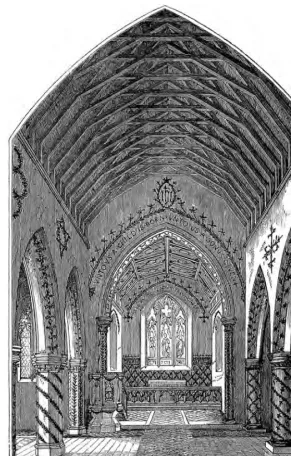
Fig. 2: A page from Church
Decoration: a practical manual of appropriate ornamentation (1874),
Belgravia’, when the Bishop of London had to decide on the legality of the flowers introduced by the Revd Robert Liddell at St Paul’s, Knightsbridge in the face of opposition from one of the churchwardens, the famously Protestant Charles Westerton. The Bishop concluded that as ‘floral decorations in a Church were not enjoined by any Canon’, they must be considered non-essential; and that ‘therefore, if a minority or even two or three persons in a Congregation objected to their use, they should not be persevered in’. A compromise was suggested: ‘some simple bunches of flowers of one colour should be put up’, but ‘the wooden Crosses, upon which, as a frame work, the flowers were fastened, should be at once removed’. This was seen as a victory for the anti-Puseyites, who would rather have a ‘few bunches of plain white flowers’ than ‘the extensive and gaudy display of former years, when the Church wore more the appearance of a hall decked out for festivity and merriment, than of a simple building set apart for devotion’.40
This smacks of dogma hiding behind aesthetics, but Jackson’s concern was definitely all to do with taste. In 1858 he found that evergreen decorations at Christmas are ‘now a regular part of ecclesiastical ornament’ (Fig. 3; and see back cover), to the detriment of the building as a whole:‘bad taste and untruth in this temporary decoration will infallibly affect the general taste in permanent wall ornament, and we cannot afford this’.41By 1860, although still condemning the use of artificial flowers, he had detected some improvement:
I cannot help congratulating you [the editor of The Ecclesiologist] upon the great improvement which is taking place in floral and evergreen decorations. I am most glad to see them at last used as an ornamental adjunct of architecture, and not as part of architecture itself...We do not now so often see vegetable arcades appearing to support stone work, or any such instances of untruth and false taste as was the case some years ago.42
But in 1864 he had cause to write to The Ecclesiologist yet again:
Are not our floral decorations going beyond all reason? – are we not in some cases entirely destroying the dignity of the church and services, by allowing our young ladies to have it rather too exclusively in their hands?
Surely such decoration should not override the architecture, Church services and furniture, as is now the case.
He queried the expense:
encourage rather the adornment of our churches permanently and worthily. Above all, let us try to revive the taste for those splendid hangings in which the mediaeval Churchman rejoiced. What a beautiful decoration can be effected by means of hangings most of your readers know well. If the church walls were properly coloured, we should not require much floral or evergreen ornament at all.43
But there was no stopping the enthusiasm for church flowers, and 1865 saw the publication of A Handbook of Floral Decoration for Churches by E.W. Godwin. Published in the year that his wife died and he moved from Bristol to London, it is a work that does not seem to fit in with other aspects of Godwin’s life and career,
Fig. 3: Frontispiece to An Essay on
the Christmas Decoration of Churches by the Revd E. L. Cutts,
which may indicate the extent to which ecclesiology was so intertwined with the practice of architecture.44 Godwin’s approach to the subject was predominantly architectural – in Chapter II he gives ‘skeleton sections of typical Churches in various styles, shewing the general arrangements of floral decoration in reference to the architectural framework’ – and he also included some very ‘Aesthetic’ designs for stands or pedestals for vases to contain flowering plants or trees.45
The emergence of doubts about colour
Godwin still felt that ‘there are few things in connection with the revival of Ecclesiastical art which have been more neglected than interior coloured decoration’ (Fig. 4).46 Some wanted to go further – the Revd Edward Lewes Cutts, in a paper to the Architectural Association in 1867, ‘ventured… to recommend young architects to take up painted decoration as a special subject of study, always remembering that if they were commissioned to adorn a church, they could never make it too beautiful for the holy uses to which it was to be dedicated’47 – but others were expressing doubts.
A series of letters from an anonymous member of the Oxford Architectural Society appeared in The Ecclesiologist in 1858–61 under the heading ‘A caution against polychrome’: the writer questioned the presumption in favour of colour, asking whether it was just a reaction against whitewash; colour can distract from the architecture, and from the grandeur of a building.48 Turning specifically to churches, he wrote that ‘Colour must, if used in much profusion, create different feelings from those which ought to exist in an edifice dedicated to the worship of God’. Excessive polychrome was utterly wanting in the effect of repose (the quality William White had thought so important) and damaged appreciation of the building:
When colour is so extensively introduced, it tends to confound the lines of demarcation which distinguish the various portions of a building.Visit the chancel of Highnam church, where everything has been done that the ‘most perfect taste’ in polychromy could achieve, and you will never for one moment busy yourself with the inquiry in what style the edifice was constructed. You are on ‘polychromatic enchanted ground’, – that is enough.49
even went so far as to criticise the decorations at Ely, calling the colouring of the choir roof ‘impertinent’. In his second letter he questioned ‘the chief reasons which those who advocate the employment of colour in our church restorations offer for the universal adoption of the practice’, namely
1. Because Gothic architects not only used colour in their Churches, but designed them to be painted.
2. Because the use of stained glass in windows, which was part only of an entire scheme of coloured decoration, necessitates the use of colour also on the walls, arches, and other parts of a building.
‘They both depend on an assumption, of the correctness of which no proofs whatever have as yet been adduced’. Moreover,
The church decorator is beginning to assert for himself a place among the handicraftsmen of the country... and it is impossible to say how much mischief Fashion, these new interests, and the combination of adequate means and misdirected zeal, may cause to our national monuments, unless this false taste, this hankering after the colour-pot and the gold leaf, be speedily corrected and suppressed, or diverted into other channels.52
In his final letter, Sharpe praised the Cistercians for banishing all decoration, colour, images, etc; by following their style of subdued
Fig. 4: ‘Wall painting’, from Walter Field, Stones of the Temple, or,
lessons from the fabric and furniture of the church, 1871
stained glass, ‘were such a fashion to become prevalent, the argument in favour of extravagantly-coloured wall-decoration, based upon the present use of deeply-stained glass in our windows, would naturally fall to the ground’.53
The starting point for the letters was as a response to a paper by E. L. Cutts, who answered Sharpe by simply asking, ‘If our modern attempts to colour Gothic churches are not very successful, is it not more likely that it is because we have not yet learnt how to do it, than because it cannot be done?’54
For a balanced view of the situation, as with so many aspects of church design, there is no one better to turn to than J. T. Micklethwaite, whose Modern Parish Churches appeared in 1874. He was very much in favour of colour, but advised caution at every stage. Colour, he wrote, ‘far from being a matter of indifference, is a most important factor in design’. But
by the ignorant use of it a good work may be entirely spoiled… The painting of a building may be postponed just as the steeple, or any other part of it, may be, but no interior should be considered finished, till all parts requiring it have been suitably coloured, and a pleasing harmony exists throughout.
The problem so often was that
even now, the true place of colour in architecture is recognised by very few; at best, it is regarded as a permissible superfluity, whilst to some it savours of false doctrine, heresy, and schism. We do, indeed, now and then hear of a church being what they call ‘polychromed’, which generally means spattered over with stencilled devices of the most violent kind of pigments, but for an architect to be allowed to complete his design with decorative painting, is a thing almost unknown. What is done is almost entirely in the hands of the tailors, and of a kindred race, who call themselves ‘ecclesiastical decorators’.55
The most familiar form of coloured decoration was painted glass, which
is not a necessary of life, so none at all is better than bad. But really good glass may now be obtained, and it costs no more than the bad, though sometimes one may have to wait a little longer for it. The stained glass manufacturers are legion, the badness of their work varying, as a rule, in direct ratio with the impudence of their advertisements; whilst the real glass painters are few, but still there are some; and, of all the arts subsidiary to architecture, glass painting, I think, presents the most hopeful aspect.56
introduce figures on ceilings were liable to result in grotesque attitudes, for example at Ely Cathedral. The positioning of paintings was important, and figures should not be placed where they might be confused with the clergy and ministers, i.e. at floor level on the walls of the sanctuary. However, there were no ‘correct’ places. Even if there were formerly a code in such matters, there was no reason for following it in the present day:
we build for ourselves and for posterity, not for our ancestors, and to bind ourselves to the observance of the half understood rules of an obsolete, as well as obscure and fanciful symbolism, is the most ridiculous of pedantries.57
But by 1874 the edifice of colour was beginning to show cracks; we have seen Micklethwaite’s reference to ‘false doctrine, heresy, and schism’.58The same year saw the publication of Far from the Madding Crowd by that well-known former church architect Thomas Hardy, in which Cain Ball returns from a visit to Bath and reports that ‘there’s two religions going on in the nation now – High Church and High Chapel… at High Church they pray singing, and believe in all the colours of the rainbow; and at High Chapel they pray preaching, and believe in drab and whitewash only’.59 1874 was also the year of the Public Worship Regulation Act, and in the growing controversy colour was firmly associated with ritualism. C. M. Davies, in his book Orthodox London (1873), found St Alban’s, Holborn (Fig. 5) ‘bright with colours, odours, flowers, and music… these were, of course, no foreign adjuncts supervening on the English system, but simply what the English ritual was and would have been had the Reformation never run riot into Puritanism’;60 it may be significant that he mentions colour first. Much of the colour in High Church services would have come from altar frontals and vestments, and there was a noticeable increase in interest among the more antiquarian ecclesiologists – men like J. Wickham Legg and Sir William St John Hope – in the matter of liturgical colours, as they attempted to show that the display of colour, far from being Romish, was authentically old English.61
Fig. 5: Illustration from G.W. E. Russell, Saint Alban the Martyr, Holborn: a history of fifty
use, especially as people were beginning to find out that a simple colour was not necessarily expensive’. The vote of thanks was proposed by William White, who referred back to a talk he had given at the Architectural Museum thirty years earlier, implying that nothing much had changed in the interim.63
H. C. Corlette made a study of ‘the use and value of colour in architecture’ for which he was awarded the RIBA’s Silver Medal in 1899, and gave his thoughts also in a paper at the Architectural Association. Although in favour of colour, he is suggesting something very much more muted than what had gone before. For floors, he favoured wood over encaustic tiles; for walls, plain brick, plaster, and stone – structural rather than applied colour. In fact for him the ceiling was the best opportunity for simple decoration in colour – ‘there is no need to make it always white’. The relationship between walls and windows was important:
With little internal decoration we can dispense with clear glass in windows to a large extent, and make the glass itself, by its colour and design, serve as an important feature in the decorative scheme. But if there is much colour and design on the walls and roof inside a church, we require plenty of light by which to see it.64
The end of the supremacy of colour
Corlette’s attitude was not far from that of Ninian Comper who, in a paper to the St Paul’s Ecclesiological Society in 1893, developed a theme of St John Hope’s, that the whitening of our churches, rather than being the work of the Puritans, was in fact medieval in origin: ‘it is a tradition of a healthy sense of beauty, viz., the love of what is clean and fresh’.65According to Anthony Symondson, Comper’s St Cyprian’s, Clarence Gate ‘came as a shock to an older generation of churchmen’ when it opened in 1903, with ‘its cool white interior, its spaciousness, restraint and the dazzling effect of the gilded screens and altar’. Colour there certainly was – for the consecration the church was filled with flowers, and clergy in glorious vestments – but it was not the colour of St Alban’s, Holborn or All Saints, Margaret Street.66
churches is dinginess’ – but likes white walls to set off the altar and dorsal and the stained glass of the east window);68and through the Warham Guild, founded by Dearmer in 1912 to supply vestments and ornaments of the type recommended in the Parson’s Handbook. The Guild’s Handbook first appeared in 1932 and promoted the ‘Primrose Hill’ look:
White is the natural colour for walls and the best foil for colour decoration...The whitening brings out the lines of the architecture, and forms a beautiful setting for hangings, ornaments, and paintings. Altar frontals, riddels, reredoses, or dorsals should be richly coloured, but the interior of the church mainly should be white. Even stencil ornamentation is not recommended, unless used with the greatest care and reserve by a fully competent artist.The walls should be completely whitened right up to the glass of the windows, as also the tracery and arches; half the beauty is lost if the stonework round the arches is left uncovered with white. The distemper should always be bright and pure, avoiding both the blue and stone tints.69
This is the precise inverse of the coloured walls and plain vestments that R. F. Littledale had been advocating in 1865,70and all that is missing from the description of the Dearmer church interior is the green binding of the English Hymnal, first published in 1906 and for which he was also responsible.
The fashion today is to dispense with many of the richly coloured elements that the white was meant to set off, and what colour there is, more often than not, is provided by patterned carpets and random hassocks – something that would have pleased neither Dearmer nor the colour-loving clergymen and architects of the nineteenth century.
Notes
1 H. P. Liddon, Life of Edward Bouverie Pusey (1893), II, 140.
2 G. A. Poole, The Appropriate Character of Church Architecture (1842), 3. 3 Poole, Appropriate Character, 104.
4 Poole, Appropriate Character, 107. 5 Poole, Appropriate Character, 109. 6 Poole, Appropriate Character, 122–24.
7 J. M. Neale, Church Enlargement and Church Arrangement (1843), 12. 8 Builder, 4 (1846), 391–92.
9 The Ecclesiologist, 7 (1847), 41–42.
10 Emma Plaskitt, ‘French, Gilbert James (1804–1866)’, Oxford Dictionary of National
Biography (2004) [www.oxforddnb.com/view/article/10163, accessed 1 Aug
2011].
11 Descriptive Catalogue of Articles of Church Decoration, designed and manufactured
exclusively by Gilbert J. French, Bolton-le-Moors, Lancashire (19th edn, 1850), 34. The Ecclesiologist made a similar observation.
12 The Ecclesiologist, 19 (1858), 112–15, 372–76; 20 (1859), 232–38; 21 (1860), 36–40, 78–82. Gambier Parry’s contributions to ecclesiastical decoration, both theoretical and practical, are outlined by Peter Burman in D. Farr (ed.),Thomas Gambier Parry
1816–1888 as Artist and Collector (1993), 9–29.
14 Durandus, Symbolism of Churches, 78.The source of the phrase ‘all its glory is from within’ is given as Psalm xlv. 6, although this does not correspond to the Authorised Version nor to the Book of Common Prayer. The closest is verse 13: ‘The king’s daughter is all glorious within’. ‘I am black but comely’ is from the Song of Solomon i. 5.
15 The Ecclesiologist, 21 (1860), 36. 16 The Ecclesiologist, 4 (1845), 200.
17 G. A. Poole, Churches; their Structure, Arrangement, and Decoration (1845), 79–80. Poole’s phrase ‘improper representation’ alludes to a problem observed also by Gambier Parry, of ‘liberal-minded protestants, whose nose sniffs popery in the smell of paint’ (The Ecclesiologist, 20 (1859), 234).
18 A. Billing, On Mural Painting and the Decoration of Churches generally (1868), 2 (pamphlet, reprinted from Civil Engineer and Architect’s Journal, 14 (1851), 195–97, 205–09; reviewed favourably in The Ecclesiologist, 13 (1852), 124).
19 R. F. Littledale, On the Application of Color to the Decoration of Churches (1857), 3. 20 Littledale, Color, 12.
21 Littledale, Color, 16. 22 Littledale, Color, 15.
23 G. J. French, Hints on the Arrangement of Colours in Ancient Decorative Art (1849), 4. 24 Littledale made a similar observation about stained glass: ‘the hues employed for this… purpose are regarded as gems, and not as pigments, and are subject to the laws of heraldic painting’ (Littledale, Color, 7).
25 French, Hints, 2nd edn (1850), 32. 26 The Ecclesiologist, 19 (1858), 114. 27 The Ecclesiologist, 19 (1858), 373. 28 The Ecclesiologist, 20 (1859), 235. 29 The Ecclesiologist, 21 (1860), 79–80. 30 The Ecclesiologist, 21 (1860), 267–80. 31 The Ecclesiologist, 19 (1858), 232–40.
32 The Ecclesiologist, 22 (1861), 141–47 (‘Colour in Sacred Art’).
33 W. Lightly, ‘On the principles to be observed and the processes observed in the decoration of churches’, RIBA Transactions, 13 (1862–63), 243–60. Lightly is less well-known possibly because of his premature death in 1865, and not necessarily because of inferior talent.
34 The Ecclesiologist, 18 (1857), 86–87. 35 The Ecclesiologist, 25 (1864), 162–64.
36 The Ecclesiologist, 22 (1861), 140. He could not foresee the zeal with which the twentieth century would paint over the vast majority of nineteenth-century decorative schemes, nor how welcome would be the German bombs that enabled Victorian windows to be replaced with clear glass.
37 The Ecclesiologist, 13 (1852), 103–04.
38 W. A. Gray, The Symbolism of Churches and their Ornaments (1857), 17. 39 The Ecclesiologist, 6 (1846), 215–17.
40 The Holy Flower Show in Belgravia: or Puseyism at a Discount (1855), 4–5. By ‘a parishioner of St Paul’s, Knightsbridge’, presumably Charles Westerton, who was the publisher.
41 The Ecclesiologist, 19 (1858), 37–38. ‘Untruth’ may refer to the practice of using temporary decorations as a substitute for permanent features, e.g. chancel screens and reredoses, as well as for permanent decorations such as wall paintings. 42 The Ecclesiologist, 21 (1860), 83.
43 The Ecclesiologist, 25 (1864), 205–06.
44 It receives only the briefest of mentions in S.W. Soros (ed.), E.W. Godwin:Aesthetic
Movement Architect and Designer (New York, 2000).
45 E.W. Godwin, A Handbook of Floral Decoration for Churches (1865), 6, 9. 46 Godwin, Handbook, 5.
47 Builder, 25 (1867), 446.
48 The Ecclesiologist, 19 (1858), 312–14.
49 The Ecclesiologist, 22 (1861), 67–69 (third letter; the second appeared in The
Ecclesiologist, 20 (1859), 9–11).
Letters on Colour in Churches, on Walls, and in Windows (1870, 2nd edn 1871),
reviewed in Builder, 28 (1870), 980–81. 51 Builder, 28 (1870), 621.
52 Builder, 28 (1870), 742–43. 53 Builder, 28 (1870), 822.
54 Builder, 28 (1870), 690–91. Cutts’ paper, ‘On the desirability of restoring churches of the Italian style of architecture’, was published in RIBA Transactions, 20 (1869–70), 130–43.
55 J.T. Micklethwaite, Modern Parish Churches: their Plan, Design, and Furniture (1874), 286–87.
56 Micklethwaite, Modern Parish Churches, 289–90. 57 Micklethwaite, Modern Parish Churches, 321. 58 Micklethwaite, Modern Parish Churches, 286. 59 T. Hardy, Far from the Madding Crowd (1874), II, 40.
60 C. M. Davies, Orthodox London: or, Phases of Religious Life in the Church of England (1873), 32–33.
61 For example, J. Wickham Legg, ‘Notes on the history of the liturgical colours’,
Transactions of the St Paul’s Ecclesiological Society, 1 (1881–85), 95–134, and Sir W. H.
St John Hope, ‘On the English liturgical colours’, Transactions of the St Paul’s
Ecclesiological Society, 2 (1886–90), 233–72.
62 Builder, 57 (1889), 407–09. 63 Builder, 57 (1889), 403–04.
64 Builder, 78 (1900), 310–16. His point about the relationship between walls and windows is the opposite of what Lightly was saying in 1862: ‘where the walls are covered with subject painting, it will be absolutely necessary to fill the windows with colored glass, or to stop them up’, or else the glare from the windows makes it hard to see the decoration (RIBA Transactions, 13 (1862), 259). Corlette’s prize-winning essay was published in RIBA Journal, 6 (1899), 461–76, 489–504, 529–36. 65 Transactions of the St Paul’s Ecclesiological Society, 3 (1891–95), 218.
66. A. Symondson, Sir Ninian Comper: an Introduction to his Life and Work (2006), 88–91.
67 Symondson, Comper, 36, 91–92, 210–11, discusses the extent to which Dearmer promoted and popularised ideas initiated by Comper.
68 H. C. King, The Chancel and the Altar (1911), 117, 161–62.
69 The Warham Guild Handbook: Historical and Descriptive Notes on ‘Ornaments of the
Church and of the Ministers thereof’ (1932), 15. The same advice, with very little
change to the wording, was given in the 2nd edition, 1963.
A talk given to the Ecclesiological Society at its Annual General Meeting, 26 May 2011
THIS IS A LECTURE of three parts. I will begin by outlining the start of Government grants for places of worship; the second part will look at the adaptation of churches for twenty-first-century liturgy and worship, and other purposes; and in the third part I will make some suggestions on how the sustainability of these buildings might be assured, that go beyond just asking Government for more money.
I should make it clear now that I am referring to Church of England parish churches and most of what I have to say relates to securing a future for rural churches. The future is rosier for the urban and certainly suburban churches, though the uncertainties surrounding the use of concrete and the often inflexible interiors of churches built after the First World War are real enough. A subject for a future autumn conference, perhaps?
Government grants for places of worship
The urgency and extent of the problem of repairs to parochial churches must not be allowed to obscure the fact that in the last 30 years, the Church has carried through a vast amount of repairs in sounder and on more conservative lines than ever before and that the total of such work is a solid achievement.The primary cause of the present state of disrepair is the enforced postponement of repairs . . . from 1939 onwards.
Not the words from a recent speech, but Ivor Bulmer Thomas’s June 1951 introduction to a Report on church repairs commissioned by the Church Assembly the previous year. It estimated that a total of £4 million ‘extra parochial cost’ was needed over the next ten years and that once in good repair, an annual expenditure of £750,000 was required. Any money from the State should be like Arts Council grants, ‘unconditional’, and new county trusts were considered ‘suitable for attracting those who are not habitual churchgoers but are well disposed toward the cause of church fabric’. That same year, the Gowers Report recommended taxpayer’s money should be given for essential repairs to outstanding historic buildings and in 1953, the Historic Buildings Council (HBC) was set up to advise ministers on the first historic building grants. The Church of England declined to become involved, fearing State control over freedom of worship – don’t forget that the 1913 Ancient Monuments Bill had proposed scheduling medieval churches as ancient monuments and taking cathedrals into State ownership.
Until his recent retirement, Richard Halsey was Policy Director for Places of Worship at English Heritage. He is now actively engaged in considering the future of historic churches through other channels, including being a Trustee of the Friends for Friendless Churches and Chairman of the Cambridgeshire Historic Churches Trust.
A beginning not the end for the parish church?
The repairs problem didn’t go away of course though the 1968 Pastoral Measure brought some relief as dioceses were now able to shed their worst (and sometimes, their most lucratively sited) buildings. In 1971, the General Synod created a Working Party, chaired by David Say, Bishop of Rochester, to examine the possibilities for ‘state aid for places of worship in use’, to include those denominations represented by the Churches Main Committee.The Government wanted facts, and archdeaconries in Lincoln and Norwich diocese were examined in a project run by Peter Burman at the Council for Care of Churches.The minister, Lord Sandford then asked that it be extended to include urban areas, so Newcastle and Cheltenham were also investigated. The result was that ‘£1 million at 1973 prices’ was considered the annual ‘additional resource’ needed to repair historic churches in England and Wales.
In January 1975, the Labour minister, Baroness Birk ‘accepted in principle the case for some measure of State aid for historic churches and other ecclesiastical buildings in use’, but not cathedrals, subject to agreement being reached on ‘conditions, methods of repair and other matters’. Aid was ‘not expected to exceed £1 million at 1973 prices’. However, ‘in the present economic circumstances’ no specific date for the start of a scheme could be given. It was only on 4 August 1977 that the Secretary of State, Peter Shore, announced the immediate start of a five year trial scheme as part of a package of works designed to stimulate the building industry. The sum of £350,000 was immediately available, with £750,000 for 1978–9 and £2 million the following year. In fact, in the remaining eight months of 1977–8, 450 applications were received, 65 offers made and just over £312,000 paid out. It was always said that on the 5 August 1977, someone from Long Melford turned up at the office in Savile Row for an application form and that Long Melford were offered the first grant.Another early recipient, Chesterfield was chosen for the front cover of the HBC report that listed those first grants.
meetings had to judge over 100 buildings, this precise point could wander. More than one uninspiring flinty pile in Suffolk got through because the chairman told us that ‘the birds rise well there’.
The works to be supported were determined by a visit from a commissioned architect, that is someone in private practice and overseen by the principal in-house Department of the Environment architect – for many years Stella Eley, a staunch United Reformed Church lay reader who had been the project architect for the extension to the Natural History Museum.
I didn’t join Richard Gem as the second churches inspector at the Department until Spring 1978, by which time there were huge piles of applications awaiting attention. Grants were initially offered at 50%, ‘pound for pound’ as the then Historic Churches Preservation Trust liked to say. But demand rapidly outstripped supply; no less than 367 of the 1977/8 applications were carried forward to 1978/9, to join the 625 new applications received in that year.With another 746 arriving in 1979–80, the scheme was suspended in November 1980, the normal offer reduced to 40% and priority given to increases needed to complete works already in hand. By 1981, 1400 grants for £8 million had been offered and £5.6 million spent.The HBC’s report to Parliament that year drew attention to the fact that the ‘need had been underestimated. The legitimate demands for help can be met fully only by a substantial increase in real terms in the funds provided for some years to come’. Part of the problem was that so many more places of worship were being declared outstanding than the Churches had predicted in 1973, including many non-conformist chapels.


![Fig. 8: James Gibbs,‘Draughts ofSteeples made for St Martin [in theArchitecture Fields, London]’](https://thumb-us.123doks.com/thumbv2/123dok_us/8370761.1675130/14.596.58.495.420.642/james-gibbs-draughts-ofsteeples-martin-thearchitecture-fields-london.webp)