https://doi.org/10.26637/MJM0801/0006
Mod difference labeling of some classes of digraphs
B Sooryanarayana
1* and Sunita Priya D Silva
2Abstract
A graph is adifference graphif there is a bijection f fromV to a set of positive integersSsuch thatxy∈E if and only if|f(x)−f(y)| ∈S. A digraphD= (V,E)is amod difference digraph if there exist a positive integermand labelingL:V→ {1,2, ...,m−1}such that(x,y)∈Eif and only ifL(y)−L(x)≡L(w)(mod m)for somew∈V.In this paper, we prove that the complete bipartite digraphs, oriented binary trees, ladder graphs and fan graphs are mod difference digraphs.
Keywords
Difference labeling, mod difference labeling, digraphs.
AMS Subject Classification
05C20, 05C78.
1Department of Mathematics, Dr. Ambedkar Institute of Technology, Bangalore-560056, India.
2Department of Mathematics, Sahyadri College of Engineering and Management, Mangalore-575009, India.
*Corresponding author:1dr [email protected];2[email protected]
Article History: Received17July2019; Accepted12December2019 c2020 MJM.
Contents
1 Introduction. . . 32 2 Mod difference labeling of some classes of digraphs
32
3 Conclusion. . . 35 References. . . 35
1. Introduction
In this paper, we consider only finite simple graphs. Let
Sbe a finite multiset of real numbers, i.e. a finite collection
of real numbers in which repetitions is permitted but order is
irrelevant. The difference graph with signatureSis a finite
digraph G with vertices labelled bijectively by f from a vertex
labelledxto a vertex labelledyexactly whenx−y∈S.In [4]
Harary introduced the concept of difference graphs similar to
sum graphs and similar works we refer [8,9]. Some classes
of difference graphs (paths, trees, cycles, special wheels, com-plete graphs, comcom-plete bipartite graphs etc.) were investigated by Bloom, Burr, Eggleton, Gervacio, Hell and Taylor in the
undirected [2,3,12] as well as in the directed case [1].
The concept of mod difference digraph was introduced by
S.M.Hegde and Vasudeva [6]. For the recent works we refer
[7,10,11].
Definition 1.1. A graph is a difference graph if there is a bijection f from V to a set of positive integers S such that
xy∈E if and only if|f(x)−f(y)| ∈S. A digraph D= (V,E) is a mod difference digraph if there exist a positive integer m and labeling L:V → {1,2, ...,m−1}such that(x,y)∈E if
and only if L(y)−L(x)≡L(w)(mod m)for some w∈V.
They have shown some of the structural properties of mod
difference digraphs in [5]. It is also proved that complete
sym-metric digraphs, unipaths and unicycles are mod difference
digraphs [6].
2. Mod difference labeling of some
classes of digraphs
In this section we present some results on mod difference labeling of some classes of digraphs.
Lemma 2.1. If S is a proper signature of ←→Kn,n then S is
partitioned into two disjoint sets V1and V2as follows:
V1={vi=3i−2,1≤i≤n}
V2={vi=3i−1,1≤i≤n}
Proof. Consider an edgex=uvin←→Kn,n.Assume that both
u,v∈V1(orV2.) Without the loss of generality, letu,v∈V1
thenu−v∈Sfor some 1≤i1,i2≤ni.e(3i1−2)−(3i2−2)∈
S, for some 1≤i1,i2≤ni.e 3(i1−i2)∈S,but 3(i1−i2)≡
0(mod3),a contradiction. HenceV1andV2form the partition
Lemma 2.2. Let V1 and V2 be the bipartite vertex sets of ←→
Kn,nas defined in the above lemma. If vi∈V1and vj∈V2
with vi<vj,1≤i,j≤n then vi−vj∈ V1.
Proof. Ifx=vivj withvi<vj is an edge in ←→
Kn,n,then by
Lemma2.1, vi=3k1−2 and vj =3k2−1, for some 1≤
k1,k2≤n.Therefore,vj−vi= (3k2−1)−(3k1−2) =3(k2−
k1) +1.Hence 0≤k1,k2≤(n−1).
Taking,
k2−k1 = 0,we get, vj−vi=1=3(1)−2∈V1
k2−k1 = 1,we get, vj−vi=4=3(2)−2∈V1
.. .
k2−k1 = n−1,we get,vj−vi=1=3(n−1) +1∈V1
Hence the proof.
Theorem 2.3. If the labeling L given by L(vi) =ai,∀i,i=
1,2, ...,2n is a mod difference labeling of←→Kn,n,then there
exits an integer a such that ai= (3ni−k)a for k=2,ni=i+21,
when i is odd and k=1, ni=2i,when i is even and m=3na.
Proof. Without the loss of generality we takea1<a2<· · ·<
a2n. Seta1=a= (3(1)−2)a.SinceLis a mod difference
labeling, considera2−a1=alfor somel.Sincea1<a2,we
must haveal=a1.Then a2=a1+a1=2a= (3(1)−1)a.
Considera3−a2=amfor some m. Againa2<a3,we must
haveam=a1ora2. Ifam=a1, thena3=a1+a2⇒a3−a1=
a2⇒there is an edgea1a3in
←→
Kn,n,a contradiction to the
Lemma2.1. Therefore,am=a2and hencea3=a2+a2=
4a= [3(2)−2]a.
We have proved the theorem is true forn=1,2,3.We
assume the theorem is true for alln<k. Without the loss of
generality considerkto be even. Considerak−al=aj for
some j, withal<ak. Alsoaj<ak We have observed that
aj=ak−l∈V1.
Ifkis even ,thenlis odd. By Lemma2.2, jis also odd.
By induction assumption, we haveal= [3li−2]aandaj=
[3ji−2]a,for some 1≤li,ji≤k. Therefore,
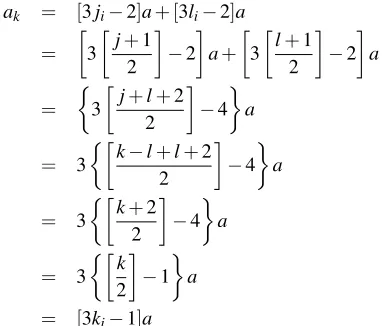
ak = [3ji−2]a+ [3li−2]a
=
3
j+1
2 −2 a+ 3 l+1
2 −2 a = 3
j+l+2
2 −4 a = 3
k−l+l+2
2 −4 a = 3 k+2
2 −4 a = 3 k 2 −1 a
= [3ki−1]a
Therefore, the result is true fork.Hence by induction it is true
for all positiven.
Also consider a1−a2n≡aj(modm)for some j, since
a1∈V1anda2n∈V2. Hence
m=
(3n−1)−1+3
j 2 −1 a=
3n−3+3
j
2
a.
In the above j6=2n−1,and 1≤ j≤n.If j>2,thenm=
3(n+1)a,which contradicts labeling condition. Therefore,
j=2 which impliesm=3na.Hence the proof.
Corollary 2.4. Any complete bipartite digraph ←→Kn,n is a
mod difference digraph.
Proof. Label the verticesv1,v2, . . . ,v2n of ←→
k n,n,using the
labelingf(vi) =ia, for 1≤i≤3n−1,withi6≡0(mod3) anda
is a positive integer. We prove thatfis mod difference labeling
of←→Kn,nwithm=3na. Now, for alli,j,i6= j,ia−ja≡ka
(modm), where
k=
i−j, if i> j
3n+ (i−j), if i< j.
In both the casesk≤2n. Therefore, there exitsk≤2nsuch
that f(vi)−f(vj)≡ f(vk)(mod m), for all i,j with i6= j.
Hence f is a mod difference digraph.
Figure 1.A mod difference labeling of the bi-directional
digraph ofK3,3withm=18 anda=2.
Definition 2.5. An m-ary tree(m≥2)is a rooted tree in which each vertex has less than or equal to m children. When m=2,the rooted tree is called the binary tree.
Definition 2.6. An oriented binary tree−→Tnwith n vertices is
said to be inspoken if all the parents in each level has indegree two.
Theorem 2.7. A oriented binary tree−→Tnwhose internal
ver-tices have indegree 2 and outdegree 1 is a mod difference digraph.
Proof. Let−→Tn= (V,E)be the oriented binary tree andvbe the
root vertex. Letv1,v2, . . . ,vpbe the end vertices in
− →
Tn. First
label all thepleaveshasl(v1) =aandl(vi) =2l(vi−1) +1,
2≤i≤p. Then label all the internal vertices in the h−1
level by adding the labels of its children. Continuing the same procedure of labeling to all the non-pendent vertices in the
previous level and so on., we finally reach the rootv.
Now, for the verticesu,vin−→T withl(u>l(v), it is easy
ofv, so l(u) =l(v) +l(w) for some childw ofu. Hence
l(u)−l(v)≡l(w)wheneveruv∈E.
Further, the label ofithpendent vertexviisl(vi) =2i(a+
1)−1 and the level of the internal vertices isl(ui) = (2i1+
2i2+· · ·+2i2k)(a+1)−2kfor somek∈Z+.
ifuiandujbe any two non-adjacent vertices of
− →
T, then
we have the following cases
CASE 1:uiandujare pendent vertices
In this casel(ui)−l(uj) =l(vi)−l(vj) = [2i(a+1)−1]−
[2j(a+1)−1] = (2i−2j)(a+1)∈/l(S)⇒u iuj∈/E.
CASE 2:uiis a pendent andujis an internal vertex.
In this casel(uj)−l(ui) = (2i1+2i2+· · ·+2i2k)(a+1)−
2k−(2i)(a+1) +1= (2i1+2i2+· · ·+2i2k +2i)(a+1)− (2k−1)∈/l(S)⇒uiuj∈/E
CASE 3:uiandujare internal vertices
In this casel(uj)−l(ui) = (2j1+2j2+· · ·+2j2k)(a+1)−
2k−(2i1+2i2+· · ·+2i2l)(a+1)−2l = (2j1+2j2+· · ·+
2j2k−2i1−2i2− · · · −2i2l)(a+1)−(2k+2l)∈/l(S)⇒uiuj∈/
Ewheneverk6=l(i.eui6=uj).
Hence−→T is a mod difference digraph.
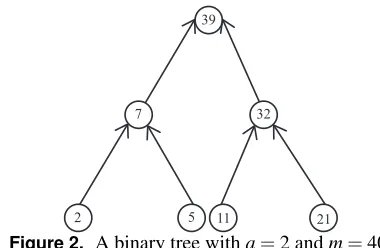
A mod difference digraph of complete oriented binary tree
− →
T7
39
7 32
2 5 11 21
Figure 2. A binary tree witha=2 andm=40.
Definition 2.8. A fan graph Fm,nis defined as the graph join
Km+Pn, where K is the empty graph on m vertices and Pnis
the path graph of n vertices. The case m=1,corresponds to
the usual fan graphs, while m=2corresponds to the double
fan graphs etc.
Definition 2.9. An oriented fan graph−→F1,nis said to be an
unipath fan, if the path of the fan is unidirectional.
Definition 2.10. An oriented fan graph−→F1,nwith n+1
ver-tices is called outspoken(inspoken), if indegree (outdegree) of the apex vertex is 0.
Theorem 2.11. An unipath fan−→F1,nwith n+1 vertices is mod
difference digraph, if indegree of the apex vertex is one.
Proof. Let−→F1,n= (V,E)be an unipath fan. LetV={v0,v1,v2,
. . .,vn}andE={v0vi: 1≤i≤n}S{vivi+1: 1≤i≤n−1},
wherev0is the apex vertex.
Label the apex vertexv0by 2 and label each vertexviof
the path by 2i−1,i=1,2, . . . ,n. With modular value m=
2(n+1), this labeling scheme generates the signature for−→F1,n.
Forvi−v0= (2i−1)−2=2(i−1)−1=vi−1, for all
i=2,3,4, . . . ,n.
Fori=1, we havev0−v1=2−1=1∈V.
Also for 1≤i,j≤n,i=j+1,
vi−vj= (2i−1)−(2j−1) =2(i−j) =2=v0.
Since for everyi,j∈ {1,2, . . . ,n}, we havevi−vjis an
even number greater than 2 and is not inV under modulo
m. Hence the labeling does not induces any additional edges.
Hence−→F1,nis mod difference digraph.
1 3 5 7 9 11
2
Figure 3.A mod difference labeling of an Unipath Fan with
m=14.
If the signature of the mod difference digraph contains
0 integer, then such a digraph is named asmod∗difference
digraph. S.M Hegde and Vasudeva [5] introducedmod∗
dif-ference digraph and defined as follows:
Definition 2.12. A simple digraph D is called a mod∗ dif-ference digraph if there exists a positive integer m and a labeling f of the vertices of D with distinct elements of f=
{0,1,2, . . . ,m−1} such that for the vertices u and v there exists an arc from u to v (denoted as u→v) if and only if there
is a vertex w such that(f(v)−f(u))≡ f(w)(modm). The
function f is called a mod∗difference labeling of digraph D.
Theorem 2.13. An unipath outspoken fan−→F1,nwith n+1
ver-tices is a mod∗difference digraph.
Proof. Consider the signatureS={0,1,2, . . . ,2n−1}and
mod-ular valuem=2n. We prove that if S is the signature of an
unipath outspoken fan. Let{v0,v1, . . . ,vn}be the vertices of
unipath outspoken fan wherev0is the apex vertex.
Letv0=0,vi=2i−1fori=1,2,3, . . . ,n. Now,vi−v0=vi
fori=1,2, . . . ,n. For the vertices on the path andi6=j, we
havevi−vj=2i−1−2j−1∈Sif and only ifi=j+1.Hence
the proof.
Definition 2.14. An oriented Ladder graph−→Ln= − →
Pn× − →
P2is
said to be oriented unipath ladder if the path Pnis
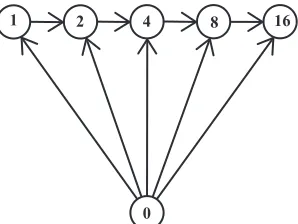
1 2 4 8 16
0
Figure 4.A mod difference labeling of an unipath outspoken
Fan withm=32.
Theorem 2.15. An oriented unipath Ladder−→Lnis a mod
dif-ference digraph.
Proof. Let−→Ln= − →
Pn× − →
P2be an oriented unipath ladder. We
label the vertices of−→Lnasv1,v2, . . . ,v2n. A ladder contains
two paths, one path contains the vertices of the formv2i−1,
1≤i≤n−1 and the other path contains the vertices of the
formv2i,1≤i≤n. The edge set contains the edges of the
form :
{v2iv2i+2,v2i−1v2i+1,v2iv2i−1,1≤i≤n}.
We define the labeling functionf as:
f(v2i) = 2i,1≤i≤n
f(v2i−1) = 2i+1−3,1≤i≤(n−1)
We prove thatf is a mod difference labeling of−→Lnwithm=
2(2n+1−3). That is, we show thatf(vi)−f(vj)≡f(vk)(mod
m), for somek,1≤k≤2nif and only ifvjviis an edge in
− →
Ln.
For an edgev2iv2i+2,1≤i≤(n−1), we have,
f(v2i+2)−f(v2i) = 2i+1−2i
= 2i(2−1)
= 2i
= f(v2i)(mod m)
For an edgev2i−1v2i+1,1≤i≤(n−1)we have,
f(v2i+1)−f(v2i−1) = [2(i+1)+1−3]−[2i+1−3]
= 2.2i+1−2i+1
= 2i+1
= f(v2(i+1))(mod m)
For an edgev2iv2i−1, fori>1,we have,
f(v2i)−f(v2i−1) = 2i−[2i+1−3]
= 2.2i−2i−3
= 2i−3
= f(v2(i−1)−1)
= f(v2i−3)(mod m)
Finally, for i=1, f(v2)−f(v1) =2−1=1 (modm). Hence
− →
Lnis a mod difference graph.
1 5 13 29 61 125
2 4 8 16 32 64
Figure 5.A mod difference labeling of an oriented unipath
Ladder withm=251.
3. Conclusion
Cayley graphs are known to be excellent model for in-terconnection network due to their various properties like vertex transitivity, regularity, connectivity etc., Cayley graph
Cayg(A,S)is connected if and only ifSgenerates the groupA.
In particular, ifS=A− {e}, whereeis the identity ofA, then
Cay(A,S)turns out to be a complete graph, which is a mod
difference graph whenever the group operation is the usual
addition. The Subgraph of a Cayley graph induced bySis a
problem of our interest. A graphGthat is a mod difference
graph is a subgraph of certain Cayley graphs of a group of
superset ofV(G).
The investigations made in this paper may enlighten a new direction for further development of a good interconnection networks which are subgraphs of Cayley Networks. The links are specific and can be identified as difference of the addresses. So, one can easily develop a routing algorithm to communicate between two nodes with the list of addresses of the nodes. .
Acknowledgment
Authors are very much thankful to the learned referees for their suggestions that helped to improve the paper.
References
[1] R.B. Eggleton and S.V. Gervacio, Some properties of
difference graphs,Ars Combinatoria, 19(A)(1985), 113–
128.
[2] S. V. Gervacio, Which wheels are proper autographs?,
Sea Bull. Math., 7 (1983), 41–50.
[3] G.S. Bloom, P.Hell and H. Taylor, Collecting autographs:
n-node that haven-integers,Annals of New York Academy
of Sciences, 314 (1979), 93-102.
[4] F. Harary, Sum graphs and difference graphs,Congressus
Numerantium, 72 (1990), 101–108.
[5] S. M. Hegde and Vasudeva, Some structural properties of
mod difference digraphs, (to appear).
[6] S. M. Hegde and Vasudeva, On mod difference labelings
of digraphs,AKCE J.Graphs Combin.,6(2009), 79–84.
[7] H.Wang, B.Yao, and M.yao, Gernalized edge-magic total
labellings of models from researching networks,Inform.
Sci., 279(2014), 460–467.
[8] B. Sooryanarayana Jayalakshmi M and P Devadas Rao,
of Information Science and Computer Mathematics, 2(2) (2010), 87–102.
[9] K. N. Meera and B. Sooryanarayana, Optimal outer sum
number of a graphs,International Journal of
Combinato-rial Graph Theory and Applications, 2(4)(2011), , 23–35.
[10] L. L. Fontanil R. and G. Panopio, Independent set
and vertex covering in a proper monograph determined
through a signature,Australasian Journal of
Combina-torics, 59(1)(2014), 64–71.
[11] M.A Seoud and E.F.Helmi, On difference graphs,
76(2016), 189–199.
[12] S.V.Gervacio, Difference graphs, Proceedings of the
Sec-ond Franco-Southeast Asian Mathematics Conferences, University of Philippines, 1982.
? ? ? ? ? ? ? ? ? ISSN(P):2319−3786 Malaya Journal of Matematik