Wazzan. World Journal of Engineering Research and Technology
ENHANCING THE BLIND PATH AT A LARGE PUBLIC UNIVERSITY
BY USING BLUETOOTH TECHNOLOGY
Dr. Wajdi Wazzan*
Department of Industrial Engineering Faculty of Engineering King Abdulaziz University PO Box 80204, Jeddah, 21589, Saudi Arabia.
Article Received on 20/09/2019 Article Revised on 10/10/2019 Article Accepted on 31/10/2019
ABSTRACT
The present study is geared toward documenting, imperially evaluating, and improving the usefulness of the newly constructed tactile paving path at King Abdulaziz University (KAU), Jeddah, Saudi Arabia. KAU is one of the oldest and largest government funded universities in Saudi; with more than 80,000 enrolled students, among them 200 students with vision impairments, the majority of them are blind. KAU has installed tactile paving to provide independence and freedom of movement around its campus for the visually impairedstudents. After using the path for few months, the Center for Students with Special Needs (CSSN) has realized a good level of students’ satisfaction using the path, thus would like to further enhance the effectiveness of the path, by adding Bluetooth technology, so users can hear voice guidance during their commute around campus. This research was aimed at empirically evaluating the effectiveness of adding Bluetooth technology to the tactile path. This research discusses the practical implication and lessons learned from adding Bluetooth technology to aid visually impaired students to move safely and independently around campus.
KEYWORDS: Accessible Built Environment, Ergonomics, Tactile Paving, Human Factors, Visually Impaired.
World Journal of Engineering Research and Technology
WJERT
www.wjert.org
SJIF Impact Factor: 5.924*Corresponding Author
Dr. Wajdi Wazzan
Department of Industrial Engineering Faculty of Engineering King Abdulaziz University PO Box 80204, Jeddah, 21589,
1. INTRODUCTION
According to the World Health Organization (WHO), Disability is a complex, multidimensional, dynamic, and contested term. It can be defined as “an umbrella term, covering impairments, activity limitations, and participation restrictions. Impairment is a problem in body function or structure; an activity limitation is a difficulty encountered by an individual in executing a task or action; while a participation restriction is a problem experienced by an individual in involvement in life situations.” (WHO, 2019). The American with Disability Act (ADA) defines disability as “physical or mental impairment that substantially limits one or more major life activities” (ADA. (2019).
Over the years, many models have been developed trying to explain disabilities and its interaction with society; which include (Bickenbach et al. 1999):
Moral Model: A very old model, which defines disability as a consequence of persons’
bad deeds.
Charity Model: Also, an outdated model, which states that people with disabilities are
often treated as objects of charity and pity.
Medical Model: People with disabilities were considered as sick and needing to be fixed, cured, and cared for with medical intervention and rehabilitation.
Social Model: disability-related problems result from an inaccessible social structure, as
contrasting to the disability itself.
The Convention of the Right of Persons with Disabilities (CRPD) was ratified by 177 countries around the globe; based on the Social Model of Disability, and calls for inclusion and equality of people with disabilities in every aspect of life (Convention on the Rights of Persons with Disabilities, 2019).
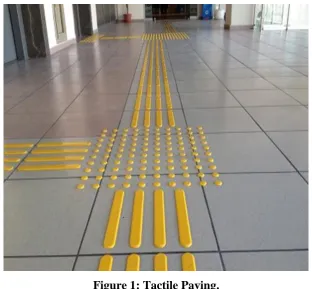
above the pavement, in their built environments as depicted in Figure 1. Tactile paving was introduced in Japan in 1967, and adapted in different ways by many nations afterwards (Tactile paving, 2019).
Figure 1: Tactile Paving.
Tactile paving blocks have two basic shapes: the long striped which means a clear way to move, and the cones or “truncated domes”, which is used as decision points; going left or right for example. Tactile paving help visually impaired persons develop their mental maps for the surrounding environment, and provide extra measure of safety, as users will have a clear path to move (Yaagoubi et al., 2012).
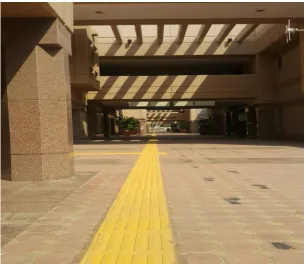
Figure (2): Tactile Paving at KAU Campus.
The University adopted the Japanese standard in installing the path, and realized much improved results in terms of comfort and independence in moving around campus for the visually impaired. The path is the first and longest of its kind in the Kingdom, and plans include to extend it to cover additional 10 km.
RESEARCH PROBLEM
Figure 3: Adding Bluetooth Beacons to the Tactile Path.
CSSN desired to test the effectiveness of adding Bluetooth technology to the tactile path before making the investment.
MATERIALS AND METHODS
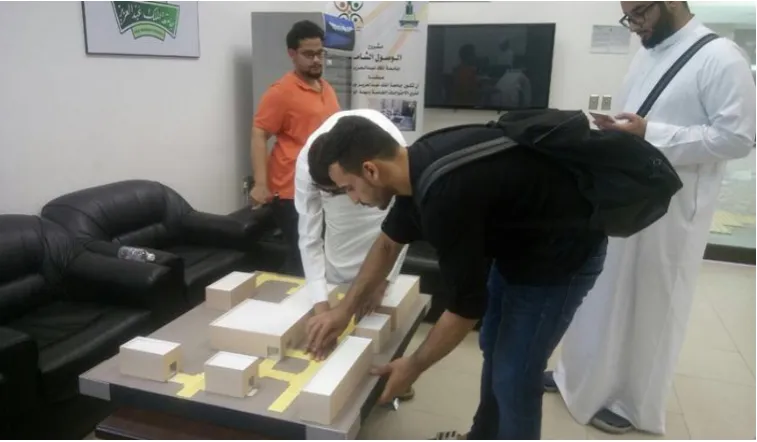
Our goal was to examine the effectiveness of the Bluetooth technology on improving wayfinding using the blind path. We have designed an experiment that simulates using the path as if it was equipped with Bluetooth technology. We used two groups, 3 students in each, as control and experimental groups. Subjects were freshly admitted students who had never used the blind path. Subjects in both groups were given training on how to use the tactile paving. Moreover, they had the opportunity to develop their mental map of the task at hand, by interacting with a 3D model of the segment of the path, in order to be able to complete the task independently (see Figure 4).
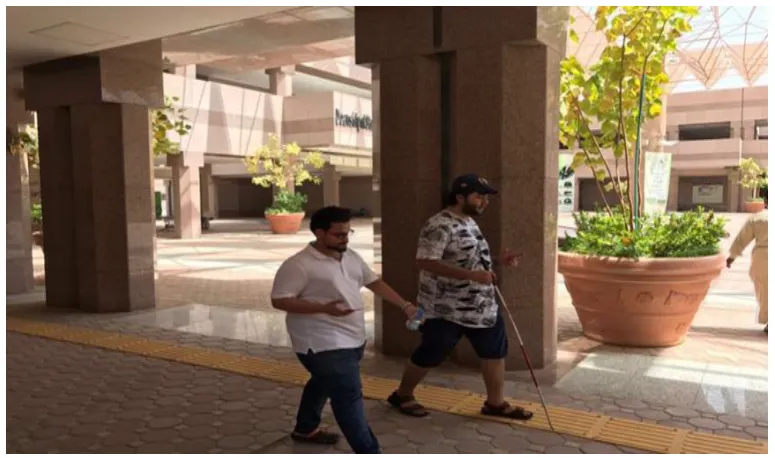
Subjects in the control group were instructed to complete the segment using their white cane without any help. For the experimental group, subjects were given voice commands using a cell phone that simulated the operation of a voice guidance application (see Figure 5).
Figure 5: Navigating the Path with Voice Guidance.
The application, which will be developed later, would give instructions about:
The whereabout of the person; like “you are in front of the restaurant”
Distance to the upcoming place; “20 meter to decision point 9”
The manual voice commands were designed to exactly simulate the commands given by the Application envisioned by the CSSN officials. Subjects in both groups were returned to correct route if they were off by two decision points. Digital stopwatch was used to measure the time.
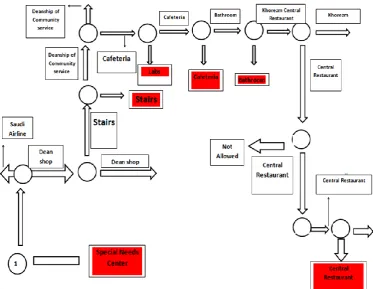
Figure 6: Segment of the Path Used for the Experiment.
RESULTS AND DISCUSSION
We have designed a two-phased experiment to test the effectiveness of adding Bluetooth technology to the blind path. Participants were six new students without any prior experience in using tactile paving. It should be noted that it was very difficult to find more subjects for the experiment with the conditions set.
Participant were randomly assigned to either the control group or the experimental group. In phase one, we have conducted a pre-test to ensure that the control and experimental groups have similar spatial abilities. The pre-test was conducted on a remote segment of the path, and the t-test showed that the means (minutes to complete the task) of the control (N=3, M=2.447, SD=0.542) and the experimental (N=3, M=2.217, SD=0.161) groups were not significantly different (t-value = 0.52, p-value = 0.631) in completing the task, at α level of 0.05. Hence, we concluded that the two groups have similar spatial abilities and proceeded with second and actual experiment.
Table 1: Time to Complete the Task.
Subject Control Group (Min.)
Experimental Group (Min.)
1 3.10 2.28 2 3.52 2.44 3 4.12 2.40
Once again, we have conducted an independent-samples t-test to figure out whether our intervention by adding voice commands were effective. Table 2 show the results of the statistical analysis.
Table 2: Testing the Means of Control vs. Experimental Groups Mean
(Control)
Mean
(experimental) t-value p-value Sig. at α (0.05)
3.58 2.37 2.7764 0.016 YES
The difference between the means was significant at α level of 0.05. Hence, we can infer that students leveraged with voice commands can move around the path faster than students that did not receive any sort of guidance.
It was clear that the average time to complete the selected segment was about 1.5 minutes more for the control group than the experimental group, which is more than 50%. This time saving is great help for blind students commuting throughout the day around the huge campus of KAU. The benefits of providing voice command was not only apparent in the time saving, but also in the accuracy of the navigation. In addition to the known security provided by the tactile paving for users, students with voice guidance made much fewer wrong turns than students without voice guidance. These fewer mistakes in completing the route may have further positive impact on the safety of students going around campus; as students will not move into unfamiliar places, and hence increased safety for path users.
CONCLUSION
the mobile phone application. We have also provided the structure for the voice commands, as well as the places and format of the instruction. The Center follows the recommendation, and has installed the Bluetooth beacons and developed the application on a trial area of the path. Initial feedback from students and visitors using the path with voice guidance were encouraging.
REFERENCES
1. ADA. (2019). “Introduction to the ADA” Retrieved 13 October 2019, from https://www.ada.gov/ada_intro.htm
2. Bickenbach, J., Chatterji, S., Badley, E., & Üstün, T. Models of disablement, universalism and the international classification of impairments, disabilities and handicaps. Social Science & Medicine, 1999; 48(9): 1173-1187. doi: 10.1016/s0277-9536(98)00441-9
3. Bourne, R., Flaxman, S., Braithwaite, T., Cicinelli, M., Das, A., & Jonas, J. et al. Magnitude, temporal trends, and projections of the global prevalence of blindness and distance and near vision impairment: a systematic review and meta-analysis. The Lancet Global Health, 2017; 5(9): e888-e897. doi: 10.1016/s2214-109x (17)30293-0.
4. Center on Technology and Disability. (2018). Assistive technology 101. Retrieved
September 28, 2018, from
https://www.ctdinstitute.org/sites/default/files/file_attachments/CTD-AT101-V4.pdf 5. Convention on the Rights of Persons with Disabilities (CRPD) | United Nations Enable.
(2019). Retrieved 13 October 2019, from https://www.un.org/development/desa/disabilities/convention-on-the-rights-of-persons-with-disabilities.html
6. Crow, K. L. Four types of disabilities: Their impact on online learning. Tech Trends, 2008; 52(1): 51-55.
7. WHO. (2019). “Disabilities” Retrieved 13 October 2019, from https://www.who.int/topics/disabilities/en/
8. Tactile paving. (2019). Retrieved 13 October 2019, from https://encyclopedia.thefreedictionary.com/tactile+paving