Pharmacophore
(An International Research Journal)
Available online at http://www.pharmacophorejournal.com/
Original Research Paper
METHOD DEVELOPMENT AND VALIDATION OF CAPROIC ACID FROM
VANILLA PLANIFOLIA PODS BY HPLC
Shruthi Menon
1*
Naira Nayeem
2and MK Ranganath
11Department of Pharmaceutical Analysis, Krupanidhi College of Pharmacy, Bangalore, India
2Department of Pharmaceutical Chemistry, College of Pharmacy,
Northern Border University, Saudi Arabia
ABSTRACT
The aim of the current study was to develop and validate a simple, reliable and fast HPLC method for the determination of caproic acid in the methanolic extract of Vanilla planifolia using reversed phase high pressure liquid chromatography (RP-HPLC). The column used for separation was Agilent C18 Zorbax 150 x 4.6 mm, 5µ particle size. The mobile phase used is phosphate buffer having pH of 2.45 with methanol in the ratio 40 : 60 v/v. Isocratic elution technique was used with a flow rate of 1.0 ml/min and the injection volume was 10µl. Detection was done using a PDA detector at a wavelength of 269 nm. The method was validated in terms of system suitability, accuracy, precision, specificity, linearity range and robustness. The method produced linear responses in the range of 50-150%. Hence a simple, reliable and rapid method was developed and validated for the estimation of caproic acid in the methanolic extract of Vanilla planifolia.
Keywords:
Caproic acid, Vanilla planifolia, Method development, Validation, HPLC.INTRODUCTION
Vanilla planifolia, is the scientific name for the plant referred to as the “vanilla vine”, “vanilla orchid” or as vanilla.1 It has several medicinal properties recorded in literature these properties have been attributed to the phytoconstituents present in it.2-5 Vanilla pods are found to contain vanillin, caproic acid, eugenol, phenol ether, vanillic acid, anisaldehyde, hydroxy benzoic acid, lactones, and carbohydrates, aliphatic, B-complex, calcium, potassium, magnesium, manganese, zinc and iron.6-7 Caproic acid is one of the constituents present in the vanilla pods. It is also known as hexanoic acid. Caproic acid is the carboxylic acid derived from hexane. It is reported to possess anti-fungal, and anti-bacterial.8-9 Review of literature has revealed that the various constituents of the plant like vanillin, vanillic acid, ethyl vanillin, 4-hydroxybenzyl alcohol, 4-droxybenzoic acid etc. have been analyzed using various techniques such as HPLC, RP LC with UV, LC (UHPLC) etc.10 There are no reported methods for the quantification of caproic acid in literature. In the present study an attempt was made to develop a method for quantification and validation of the developed method using ICH guidelines.11,12
MATERIALS AND METHODS
The pods of Vanilla planifolia were collected from Chikmagalur district, Karnataka. The dried pods of Vanilla planifolia were subjected to repeated extraction and filtered. The filtered extract was then concentrated using a rotary evaporator. The powdered extract was sifted to achieve a uniform particle size.
TLC of Caproic Acid
Caproic acid was estimated by paper partition chromatography on Whatman no 1filter paper. The solvent system used was redistilled n-butanol saturated with an equal volume of aqueous 1.5N NH3. The indicator solution used, was a solution of 0.04% (w/v) bromocresol purple in a 1: 5 (v/v) dilution of formalin in ethanol. The pH of this solution was adjusted to approximately 5.0 by the addition of 0.1 N NaOH. The Rf value of the plant extract was 0.5 which matched the Rf value of caproic acid standard.13
METHOD DEVELOPMENT Preparation of Mobile Phase
The phosphate buffer was pipetted out (2 ml) and dissolved in 1 L of HPLC grade water. It was degassed using a sonicator. The pH of the resulting buffer was 2.45. HPLC grade methanol was degassed using a sonicator and poured into the solvent reservoir.
Preparation of Stock Solution
The plant extract was accurately weighed (100 mg) and transferred into clean, dry 50 ml volumetric flask and 10 ml of water was added. This was then sonicated for 20 minutes to dissolve the extract. The volume was made up to 50 ml using water. This solution was filtered and 5ml was pipetted out from it, into a 25 ml flask and the volume was made up to 25 ml using water.
Preparation of Standard Solution
The caproic acid reference standard were weighed accurately (50 mg) and transferred into 50 ml volumetric flask and 10 ml of water was added. The volume was made up to 50 ml using water. This solution was then filtered and 5ml was pipetted out from it, into a 25 ml flask and the volume was made up to 25 ml using water.
Chromatographic Conditions
The column used for separation was Agilent C18 Zorbax 150 x 4.6 mm, 5µ particle size. The mobile phase used is phosphate buffer having pH of 2.45 with methanol in the ratio 40 : 60 v/v. Isocratic elution technique was used with a flow rate of 1.0 ml/min and the injection volume was 10µl.
Validation of Developed Method
The developed method was validated according to ICH Q2 (R1) guidelines. HPLC method of analysis for Vanilla planifolia extract was carried out to quantify caproic acid. According to the ICH description, the following parameters for method validation were considered; Specificity, System suitability, Accuracy, Linearity, Precision and Robustness.
System Suitability
The standard stock solution of caproic acid was injected five times into HPLC system. The system suitability parameters were evaluated from standard chromatograms obtained, by calculating the % RSD of retention times, tailing factor, theoretical plates and peak areas. The RSD for peak areas is obtained from five replicate injections of caproic acid.
Accuracy
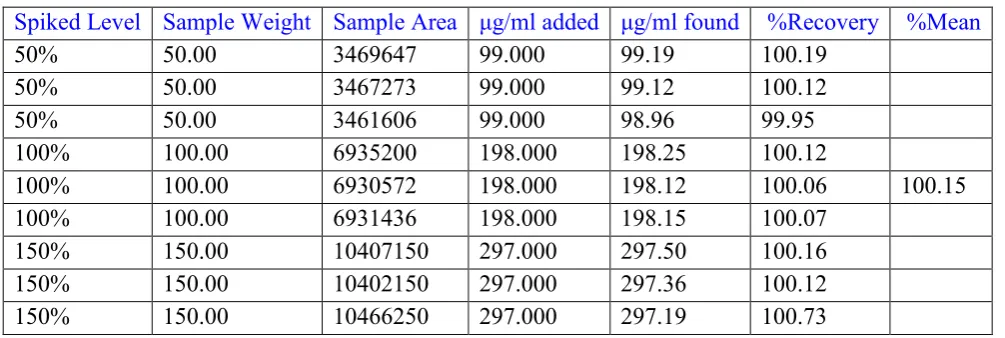
Assay was performed in triplicate for various concentrations of caproic acid. Amount equivalent to 50%, 100% and 150% of the standard amount was injected into the HPLC system. The average % recovery of caproic acid was calculated.
The precision of an analytical procedure expresses the closeness of agreement between a series of measurements obtained from multiple sampling of the same homogeneous sample under the prescribed conditions. Precision may be considered at three levels: repeatability, intermediate precision and reproducibility.
Specificity
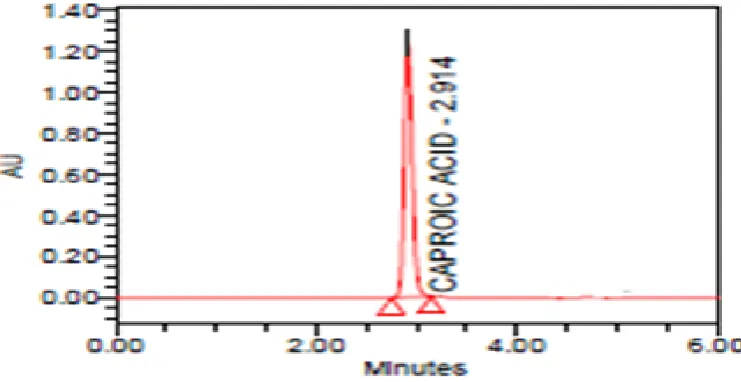
The specificity of the method was evaluated with regard to interference due to presence of blank and any other excipients. The figure shows that drug was clearly separated from blank and its excipients.
Linearity
The linearity of calibration curves in pure solution was checked over the concentration ranges of about 50%-150% for caproic acid.
Robustness
The robustness of an analytical procedure is tested by measuring its capacity to remain unaffected by small, deliberate variations in the method parameters and provides an indication of its reliability during the normal use.
Variation of Flow Rate and Column Oven Temperature
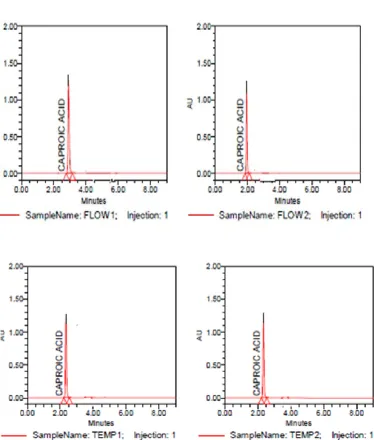
The system suitability solutions were prepared and injected into HPLC system with ±0.5 ml flow and ± 0.5 °C of the column oven temperature used during method. The HPLC system suitability is evaluated by the test method for both flow and column oven temperatures.
RESULTS AND DISCUSSION
The developed method was validated using different parameters like linearity accuracy and robustness. Best results were obtained for separation by useing Agilent C18 Zorbax 150 x 4.6 mm, 5µ particle size. The mobile phase used was phosphate buffer having pH of 2.45 with methanol in the ratio 40: 60 v/v. Isocratic elution technique was used with a flow rate of 1.0 ml/min and the injection volume was 10µl. Detection was done using a PDA detector at a wavelength of 269nm. The method was validated in terms of system suitability, accuracy, precision, specificity, linearity range and robustness. The method produced linear responses in the range of 50-150%. The retention time for caproic acid is 2.915. The developed method for the analysis of caproic acid passed all the system suitability parameters. It showed good retention time for caproic acid. The USP tailing, USP resolution, USP theoretical plates, similarity factor and %RSD were within specified limit. The developed method was found to be accurate, precise, specific, showed linearity and met the acceptance criteria in robustness studies. The results of the Method development and validation of caproic acid are as shown in the following tables and chromatograms.
Method Validation
System Suitability
System suitability test is a Pharmacopoeia requirement and is used to verify, whether the resolution and reproducibility of the chromatographic system are adequate for analysis to be done. The tests were performed by collecting data from five replicate injections of standard solution. The method developed for the analysis of caproic acid passed all the system suitability parameters. A good resolution for these compounds was seen with decreased retention time.
Accuracy
Precision
The precision of an analytical procedure expresses the closeness of agreement between a series of measurements obtained from multiple sampling of the same homogeneous sample under the prescribed conditions. The system precision was checked using caproic acid reference standard to ensure that the analytical system is precise. The retention time and area of six determinations were measured and RSD was calculated. The peak area was used to calculate the percentage assay to determine the precision of the method. The proposed method is precise as the % RSD value was within acceptance limit.
Specificity
The analytes should have no interference from other extraneous components and be well resolved from them. Specificity is the procedure to detect quantitatively, the analyte in presence of component that may be expected to be present in the sample matrix, while selectivity is the procedure to detect qualitatively, the analyte in presence of components that may be expected to be present in the sample matrix. On the basis of these chromatograms we can say that there is no interference of blank and placebo, it was also seen that there was no other interfering peak around the retention time of caproic acid so the method is specific. Linearity
The concentration, peak area and retention time for linearity of caproic acid is as given in the table. The calibration curves were linear in the studied range and equations of the regression analysis were obtained: y = 16616 x, R2 = 0.99. The correlation coefficient was in acceptable limit.
Robustness
Robustness studies were done at different column temperatures and at different flow rate conditions and all parameters meet the acceptance criteria. Slight changes in the flow rate and temperature did not have any effect on the method. It was observed that there were no significant changes in the retention time and area of the chromatograms which proved that the RP HPLC method developed was robust.
CONCLUSION
Vanilla planifolia is a plant of medicinal importance. A new HPLC method was developed and validated according to ICH guidelines for the quantitative determination of caproic acid present in vanilla pods with new solvent system. . The developed method was found to be rapid, simple, accurate and specific. Hence the developed method can be used for the estimation of caproic acid the proposed HPLC method can be applied for quality control of several traditional drugs and formulations if caproic acid is present in them.
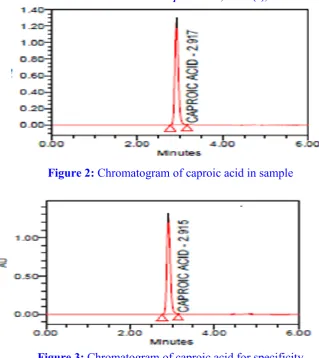
Figure 2: Chromatogram of caproic acid in sample
Figure 3: Chromatogram of caproic acid for specificity
Figure 4: Linearity graph for caproic acid
Figure 6: Limit of Quantitation
Table 1: Retention time of caproic acid
USP Plate count USP Tailing Area RT Sample 8746 16186 8998998 2.917 Caproic acid
Table 2: Data for System suitability injection for caproic acid
s/n USP Plate Count USP Tailing Area RT Inj Sample Name Trial 12866699 8278 1.178 8698998 96917 1 caproic acid 1 12716781 8714 1.187 8911111 2.917 2 caproic acid 2 11766144 8274 1.154 8918819 2.917 3 caproic acid 3 11896416 8291 1.173 8979768 2.918 4 caproic acid 4 17186822 8787 1.170 8928289 2.919 5 caproic acid 5 8911117 Mean 0.3 %RSD
Table 3: System suitability parameters
Table 4: Data for accuracy
Table 5: Linearity concentration data for caproic acid
LOQ LOD
Percentage solution Area
Concentration (μg/ml)
50 1788899 188 96687 96971 54 188 192 128 2989196 8918887 6886746 18786291 128688 988688 928 188 Results Specification Validation Parameters 96912 Not applicable Retention time 1 16186 Not more than 2
Tailing 2
8746 Not less than 2500
Theoritical plates 3 8699 8696 Similarity factor 4 0.3% Not more than 2.0%
REFERENCES
1. en.wikipedia.org/wiki/vanilla
2. Belay, MT and Poole, CF (1993), “Determination of vanillin and related flavor compounds in natural vanilla extracts and vanilla-flavored foods by thin layer chromatography and automated multiple development”, Chromatographia, 37, 365-373.
3. Robin, JM; Cesar, MC and Norman, RF (1987), “Coumarone in vanilla extracts: Its detection and significance”, Ecnomic Botany, 41,14.
4. William, GG and Patrick, GH (1978), “Some benzyl ethers present in the extract of vanilla”, J Agri Food Chem, 26, 195.
5. De Jager, LS; Perfetti, GA and Diachenko, GW (2007), “Determination of coumarin, vanillin, and ethyl vanillin in vanilla extract products: liquid chromatography mass spectrometry method development and validation studies”, J Chromatography A, 1145, 83.
6. De Jager, LS; Perfetti, GA and Diachenko, GW (2008), “Comparison of headspace-SPME-GC–MS and LC–MS for the detection and quantification of coumarin, vanillin, and ethyl vanillin in vanilla extract products”, Food Chem, 107(4),1701-9.
7. http://alternative-medicine.knoji.com/uses-and-health-benefits-of-vanilla-beans/ accessed on 6/1/2014
8. Takahashi, M; Inoue, S; Hayama, K; Ninomiya, K and Abe, S (2012), “Inhibition of Candida mycelia growth by a medium chain fatty acids, capric acid in vitro and its therapeutic efficacy in murine oral candidiasis”, Med Mycol J, 53 (4), 255-61.
9. Huang, CB; Alimova, Y; Myers, TM and Ebersole, JL (2011), “Short- and medium-chain fatty acids exhibit antimicrobial activity for oral microorganisms”, Arch Oral Biol, 56(7), 650-4.
10.Shruthi, Menon and Naira, Nayeem (2013), “Vanilla Planifolia: A Review of a Plant Commonly Used as Flavouring Agent”, Int J Pharm Sci Rev Res, 20(2), 42, 225-228.
11.Swartz, ME and Krull, IS (2009), “Analytical Method Development and Validation”, Marcel Dekker, NewYork, 53-74.
12.www.ich.org Accessed on 20 April 2013.
13.RL, Reid and M, Lederer (1951), “Separation and estimation of saturated C2-C7 fatty acids by paper partition chromatography”, Biochem J, 50,(1),60-7.
Correspondence Author:
Shruthi Menon
Department of Pharmaceutical Analysis, Krupanidhi College of Pharmacy, Bangalore, India