Volume-7 Issue-2
International Journal of Intellectual Advancements
and Research in Engineering Computations
Experimental study on partial replacement of fine aggregate by eco-sand
in concrete
G.L.Bharanitharan
1, D.Gobi
1, P.Karthik
1, G.Prabaharan
1, R.Pradheepa
21
(UG students, Civil Engineering Department, Nandha Engineering College, Erode, Tamilnadu)
2(Assistant Professor, Civil Engineering Department, Nandha Engineering College, Erode
Tamilnadu)
ABSTRACT
Now-days, all over the world, construction activities are taking place on huge scale. Due to this there is great increase in cost of construction. Natural river sand is one of the key ingredients of c oncrete, is becoming expensive due to excessive cost of transportation from sources. Also large scale depletion of sources creates environmental problems. Unfortunately, production of cement also involves large amount of carbon dioxide gas into the atmosphere, a major contributor for greenhouse effect and the global warming. To overcome these problems there is a need of cost effective, alternative and innovative materials. Industrial by products are those which is coming from different industries other than the main proposed product. It can also called as a sub product of different processes coming in manufacturing. In recent days these products are recycled and reused for other purposes to reduce cost and problems coming from disposal. These are 50% more ch eaply than the original raw materials. In cement manufacturing process, a cement plant consumes 3 to 6 GJ of fuel per ton of clinker produced, depending on the raw materials and the process used. Most cement kilns today use coal and petroleum coke as primary fuels, and to a lesser extent natural gas and fuel oil. Selected waste and by -products with recoverable calorific value can be used as fuels in a cement kiln, replacing a portion of conventional fossil fuels, like coal, if they meet strict specifications.
Selected waste and by-products containing useful minerals such as calcium, silica, alumina, and iron can be used as raw materials in the kiln, replacing raw materials such as clay, shale, and limestone. Because some materials have both useful mineral content and recoverable calorific value, the distinction between alternative fuels and raw materials is not always clear. For example, sewage sludge has a low but significant calorific value, and burns to give ash containing minerals. Eco sand (finely grade d silica) is a by-product coming from cement manufacturing process, mainly cement industries those use silica as a raw material is mainly producing eco sand as by-product.
INTRODUCTION
Concrete is acknowledged to be a relatively brittle material when subjected to normal stress and impact loads, where tensile strength is only approximately one tenth of its compressive strength. As a result for the these characteristic, concrete member could not support such load and stresses that usually take place, majority on concrete beams and slabs, Historically, concrete
member reinforced with continuous reinforcing bars to withstand tensile stresses and compensate for the lack of ductility and strength. Steel reinforcement adopted to overcome high potentially tensile stresses and shear stresses at critical location in concrete member.
Extensive research in the field of concrete technology has led to development of special types of concrete which are capable of eliminating, to a great degree these basic deficiencies.
DEVELOPMENT IN CONCRETE
TECHNOLOGY
The recent developments in construction technology have led to significant changes
resulting in improved performance, wider and more economical use. The improvements in the performance of concrete can be grouped as follows:
Better mechanical properties than that of conventional concrete such as compressive strength, tensile strength, impact and toughness, etc.
ECO SAND
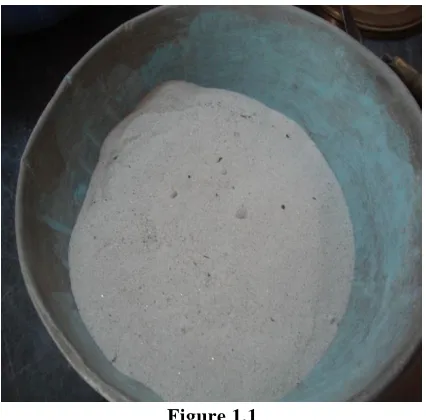
Figure 1.1
Eco sand are very fine particles, a by -product from cement manufacturing semi-wet process, a product by ACC cements (the detailed manufacturing process is withheld by the company for official reasons). It is finely powdered crystalline silica which can replace of conventional sand usage in concrete and mortars. Its micro-filing effect reduces pores in concrete and provides better moisture resistivity and thus durability
What Are Called Eco Sand?
Eco sand are very fine particles, a by-product from cement manufacture which can be used to increase efficiency in concrete. Its micro-filling effect reduces pores in concrete and provides better moisture resistivity and thus durability. It has more consistent grading than many extracted aggregates. Effective use for waste material and
naturally occurring sand. The use of eco sand rather than extracted or dredged natural sand will help designers and contractors address issues of sustainability. The present study is checking the compressive strength of concrete cube using eco sand, cement and soup flow. The eco sand has various advantages such as energy efficient, fire resistant, reduction of dead load, environmental friendly, durable, light weight, low maintenance low construction cost.
Effects on Addition of Eco Sand
moisture resistivity and thus durability. It has more consistent grading than many extracted aggregates. Effective use for waste material and thus cost effective and performs as well as naturally occurring sand. The use of eco sand rather than extracted or dredged natural sand will help designers and contractors address issues of sustainability. The present study is checking the compressive strength of concrete block using eco sand as fine aggregate. The eco sand has various advantages such as energy efficient, fire resistant, reduction of dead load, environmentally friendly, durable, light weight, low maintenance, and low construction cost.
NEED FOR STUDY
Now a days natural and manmade disaster like earthquake, wind force, terrorist attacks, etc. play an important role in the construction industry. So building and other construction work should be designed in good manner, which resist higher loads, blast loads, impact and seismic forces. Ductility and energy absorption capacity are the main requirements.
OBJECTIVES
Reduce the amount of Effluents.
To ascertain it is suitability as Economical Construction materials.
Reduce the scares of Construction Materials. Reduce the use of natural aggregates.
SCOPE OF INVESTIGATION
The scope of the project is to take alternative resource for normal cement mortar and cement mortar.
It leads in the reduction of fine aggregate free from scarcity.
MATERIALS AND PROPERTIES
The materials to be used in this research are 1. Ordinary Portland Cement (53 grade) 2. Coarse Aggregate
3. Fine Aggregate
CEMENT
Cement is a binding substance used in construction to bind other materials together. The Ordinary Portland Cement (53grade) conforming to IS: 8112-1989 is used. Many tests were conducted on cement and results are tabled.
Table No.2.1 Properties of Cement
S.No Property Results obtained
1. Specific gravity 3.14
2. Consistency 32 %
3. Initial setting time 31 min 4. Final setting time 600 min
5. Fineness 6%
FINE AGGREGATE
Fine aggregate also known as river sand is a natural granular mineral particle. This river is obtained from the accordance of Zone I as per IS
383-1970. The physical properties of river sand like specific gravity, fineness modulus and water absorption are tested with results
Table No.2.2 Properties of FA
S.No Property Results obtained
COARSE AGGREGATE
Coarse aggregate consists of natural disintegration of rock or uncrushed gravel, as per IS: 383. Coarse aggregate used in this project is of
the size 20mm.The physical properties of coarse aggregate like specific gravity, fineness modulus and water absorption are tested in accordance with IS:2386-3
Table No.2.3 Properties of CA
S.No Property Results obtained
1. Specific Gravity 2.68 2. Water absorption 0.5% 3. Fineness modulus 3.35
TESTING OF SPECIMENS
A total of 3 cubes, 3 prism and 3 cylinders were casted and tested, and there compressive strength, split tensile strength and flexural strength results have been taken for M25 grade design mix. Destructive Testing
DESTRUCTIVE TESTING
Destructive test are the one type of test in which the Strength of the specimen is find out by using complete Disturbance to the Structure (Loaded up to the failure). There are different types of destructive testing are available. They are
Compressive Strength Test Split Tensile Strength Test Flexural Strength Test
Compressive Strength Test
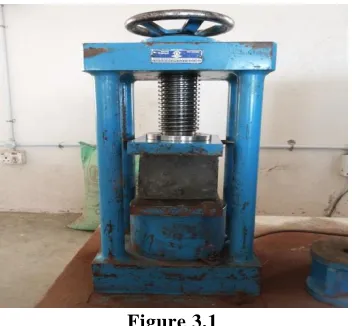
Compressive test is the most common test conducted on hardened concrete, partly it is easy because most of the desirable characteristics properties of concrete are qualitatively related to its compressive strength. The compressive tests are carried out on specimens Cubical or Cylindrical in Shape . The size of the cube specimens used for finding out the compressive strength is 150x150x150mm.
Figure 3.1
Split Tensile Strength Test
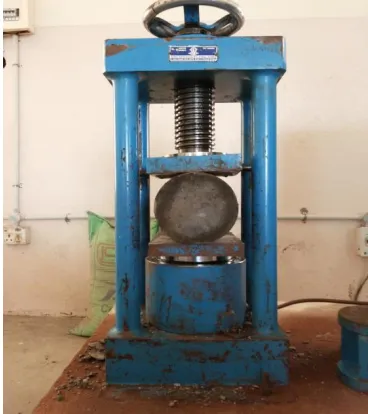
The test is carried out by placing cylinder specimen of dimension 150mm diameter and 300mm length, horizontally between the loading surface of compression testing machine and the
load is applied until failure of the cylinder along the vertical diameter. The failure load of the specimen is noted.
The failure load of tensile strength of cylinder is calculated by using formula
Figure 3.2
Flexural Strength Test
The test is carried out to find the flexural strength of the prism of dimension 100x100x500 mm. The prism is then placed in the machine in such manner that the load is applied to the
uppermost surface as cast in the mould. Two points loading adopted on an effective span of 400 mm while testing the prism. The load is applied until the failure of the prism. By using the failure load of prism
Flexural Strength = PL/bd2
RESULT ANALYSIS
Compressive strength result Split tensile strength test result Flexural strength test results
COMPRESSIVE STRENGTH RESULT
Table No 4.1: Compressive Strength for test for (60% sand, 40% eco sand)
S. No Specimen Compressive Strength for N/mm2
3 days 7 days 28 days
1 Cube 1 16.05 23.57 28.07
2 Cube 2 17.10 25.02 31.0
3 Cube 3 16.30 23.00 29.4
SPLIT TENSILE STRENGTH TEST RESULT
Table No 4.2: Split Tensile Strength for test ( 60% sand , 40% eco sand )
S. No Specimen Split Tensile Strength for N/mm2
3 days 7 days 28 days
1 Cylinder 1 0.87 1.4 2.2
2 Cylinder 2 1.10 1.39 2.1
3 Cylinder 3 0.95 1.2 2.35
FLEXURAL STRENGTH TEST RESULT
Table No 4.3: Flexural Strength test ( 60% sand , 40% eco sand )
S. No Specimen Flexural Strength for N/mm2
3 days 7 days 28 days
1 Prism 1 4.02 7.00 2.2
2 Prism 2 4.70 6.37 2.1
3 Prism 3 4.25 6.5 2.35
COMPRESSIVE STRENGTH RESULT
Table No 4.4: Compressive Strength for test for (70% sand, 30% eco sand)
S. No Specimen Compressive Strength for N/mm2
3 days 7 days 28 days
1 Cube 1 17.05 22.8 27.15
2 Cube 2 15.45 23.34 28.50
3 Cube 3 15.8 23.4 28.30
SPLIT TENSILE STRENGTH TEST RESULT
Table No 4.5: Split Tensile Strength for test (70% sand, 30% eco sand)
S. No Specimen Split Tensile Strength for N/mm2
3 days 7 days 28 days
1 Cylinder 1 1.0 1.19 2.0
2 Cylinder 2 0.8 1.25 2.15
3 Cylinder 3 0.85 1.3 2.13
FLEXURAL STRENGTH TEST RESULT
Table No 4.6: Flexural Strength for test ( 70% sand , 30% eco sand )
S. No Specimen Flexural Strength for N/mm2
3 days 7 days 28 days
1 Prism 1 4.3 6.4 18.50
2 Prism 2 4.3 6.8 16.73
3 Prism 3 4.13 6.75 17.50
CONCLUSION
In this experiment the properties of the cement, fine aggregate, and coarse aggregate are determined. In this if Eco sand comparatively
similar to the properties of fine aggregate. The usage of Eco sand for above 20%, 40% and 60% replacement of fine aggregate and the strength value that is to be determined is in process.
REFERENCESS
[1]. Chinnaraju K1, Ramkumar R2, Lineesh K3, Nithya V4 Sathish Study on Concrete using Eco sand as fine aggregate replacement 1(3), 2013, 2320 - 8791.
[2]. Keertana.B Utilization of Eco sand in Aerated Concrete for a Richest Mix Design issn: 0975 -5462 3(1), 2011.
[3]. Prabum1, Logeswarans2, Dr. Sunilaa George2 Influence of GGBS and Eco sand on green concrete an ISO 3297:2007 4(6), 2015.