Vol. 4 Issue 5, May - 2017
Mathematical Model to Quantify the Mass of
Mangroves Forest of Indus Delta to Study the
Economic Recession
Muhammad Ali Peracha1 [email protected]
Nasiruddin Khan3 [email protected]
Muhammad Shahid5 [email protected]
12345Department of Mathematics
University of Karachi, Pakistan
Mushtaq Hussain2 [email protected]
Muhammad Liaquat Ali4 [email protected]
Asif Mansoor6 [email protected]
6National University of Science and Technology
(NUST) Karachi,
Abstract— The Indus delta signifies a key example of the adverse effects of constant decrease in fresh water release over a period of many years. Historical records specify that the spreading of mangroves in the deltaic area has considerably changed during the preceding hundreds of years with changing shape of the river. Presently the river had a fairly large river controlled estuary but increased usage of river for agriculture etc. has confined the discharge to the Arabian Sea. During the summer southwest monsoon and remaining nine to ten months, the Indus has no estuary on account of river discharge. As a result mangrove ecosystem has been badly affected. The area of the mangrove forest significantly reduced and consequently the main foreign exchange earning product that is fish, shrimp etc. have been reduced accordingly. In this study efforts have been made to develop a Mathematical Model to evaluate the mass of the present mangrove forest and also acquaint the concerned authorities about the fast eradication of the valuable species and propose actions to protect and control its degradation and effects on marine inhabitants.
Keywords— Environmental degradation
Hydrographic features, Mass of Mangroves forest, Marine inhabitants, Mushroom, Neritic waters, Oceanographic features. Oxygen concentration, Sand dunes
I. INTRODUCTION
Mangroves throughout the world nurture in tropical area along tidal creeks in salt marshlands and muddy shore. In Pakistan, the mangrove forest spread over the coastal area of Sindh and Baluchistan. The mangroves forest estimated the fifth largest mangrove area in the world [1]. Mangrove is a woody plant community which is found between the sea and land areas, flooded by tides. Various types of mangroves have the ability to live in salt water.
The dense mangrove forest found in tropical and
sub-tropical region [2] where the temperature of water is more than 24oc in the hottest month and the usual rain
go above 125 mm annually in the high mountain ranges close the shoreline.
Mangroves occur in a frequently varying atmosphere, daily the salt water floods the forest while at ebbing, the plants exposed to fresh water. However, during periods of high rainfall, they may be visible to floods of fresh water. Leaving aside from suddenly changing the salinity levels, these variations also change temperatures as well. Every kind of mangroves have different needs for survival. Few are more accepting of salt than others. There are additional factors affecting their distribution, contains oxygen levels, wave energy, drainage and different nutrient levels where one class finds its desired condition or at least those, which able to accept better than other plants.
The Indus delta stretches over an area six lakhs hectares between Karachi and southwestern Indian boarder. It is typical fan shaped delta build up by huge amounts of silt eroded from Karakorum and Himalayan mountain ranges through the river Indus. Delta having the largest world mangrove ecosystem, comprising seventeen major creeks, extensive mud flats, salt marshes, sand dunes and mangroves. The deltaic mangroves is the largest arid environment mangroves forest in the world. An estimated one lakhs thirty five thousand people rely on the resources of this ecosystem for their livelihood and it also support marine inhabitant and other lives.
Vol. 4 Issue 5, May - 2017
It may be mentioned here that besides, viewing the importance of mangroves forest role to the rich marine fishery of the Indus delta, we should also consider the effects of some important oceanographic features of the continental shelf of Pakistan. The highly productive area belongs to the northern Arabian Sea due to its conducive oceanographic features of the continental shell, where as in offshore water there are hydrographic features which do not much favour the fish catch.
Baluchistan’s continental shelf is tapered (13-32Km wide), anoxic situations ensuing fish and shrimps in mortality [3]. In north, 200NM of Arabian Sea, all over a layer of tremendously low oxygen concentration spreads from above 200m down to more than 1200m depths [4].
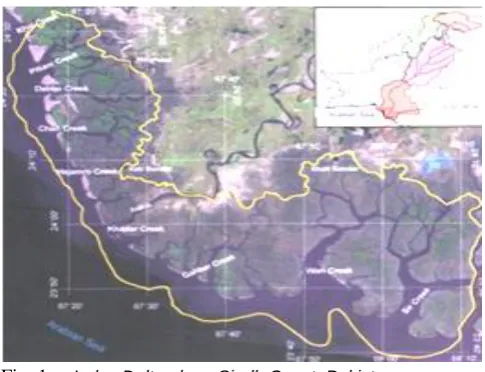
Fig. 1 Indus Delta along Sindh Coast, Pakistan
Besides, the tangible commodities, the deltaic mangroves save the shore areas from tidal, wave ions particularly during summer/ monsoon period, moreover, the mangroves forest along the creeks of Port Qasim also reduced considerable dredging charges. Different marine inhabitant of shelf uses mangroves ecosystem as ground for their breeding, feeding and nursery. The said system also gives shelter to key birds and mammals. During the winter season it housed the migrated birds from Siberia. The famous among them are kites, flamingos.
As narrated before that mangroves are the chief unseen natural factor for higher fish productivity in the coast of Sindh. Unfortunately the mangrove cover of the Indus delta faces the problem of deterioration and now the covered area is reduced to 250,000 hectares approximately. In this regard several human activities such as camel browsing, fodder collection, fire wood collection, resulted reduction of fishery resources and also facing the problem of degeneration due to environmental degradation and exploitation pressure. Thus, the safeguard strategy goals should not only include regulation pertains to management of mangroves ecosystem/resources but also contain directives to curb the present uncontrolled fishery as well, operating in various habitat regions of this ecosystem to have a sustainable
production output in future. In this paper effort has been made to develop mathematical models, which can be appropriate to determine the mass of mangroves forest. To achieve this objective, initially we require two parameters i.e volume and density of the mangroves plants. In order to calculate the volume of the upper/ exposed part, the shape of the plant may be considered like mushroom. The leaves/ branches scattered round the stem in the form of semi sphere and the exposed portion of stem is in the form of cylinder. Secondly, to estimate the mass of the whole plant, the mass of the roots are also required to be added to the mass of the upper/ exposed portion of the plants.
II. METHODOLOGY AND MODEL CONSTRUCTION
To develop the mathematical model, which will be appropriate to determine mass of upper part of mangroves plant (the model to estimate the mass of the root will be developed at later stage and the mass so determined by the model will be added accordingly) two parameters i.e volume and density are used. The shape of the plant as mentioned in Fig. 2(a) is considered as a semi sphere (for leaves/branches) and a cylinder (for exposed portion of stem).
Fig. 2 (a)
Fig. 2 (b)
h
r1Vol. 4 Issue 5, May - 2017
Fig. 3
The volumes of these shapes are obtained below as V1 and V2 respectively, which after addition is
multiplied with the density of mangroves to obtained mass of the expose part of mangroves plants.
Consider the sphere whose center is at the origin then the plane ‘px’ intersects the sphere in a circle whose radius is ‘y’ also shown in Fig-2
So Y = √(𝑟2− 𝑥2)
Therefore the cross sectional area A(x) = π 𝑦2
A(x) = π (𝑟2− 𝑥2)
Hence, volume is given by
V = ∫ A(x) dx
𝑏
a
Here a = - r and b = r or
V = ∫ A(x) dx
𝑟
−r
V = ∫ π (𝑟2− 𝑥2)dx b
a
The above integral gives the volume of entire sphere whereas we are interested in the volume of semi sphere. Then the limits for integration will be 0 and r.
Volume = π ∫(𝑟2− 𝑥2) dx 𝑟
0
= 𝜋 [𝑟2𝑥 −𝑥3
3]
= 𝜋 [𝑟3−𝑟3
3] = 𝜋 [ 2𝑟3
3 ] Volume of the semi sphere is
V1= 2πr13
3 (1)
The stem of the tree normally of cylindrical shape are as such its volume will be
V2= πr22h (2)
The total volume will be [from (1) and (2) i.e V1+ V2]
V = V1+ V2=
2πr13
3 + πr2
2h
= 𝜋 [2r1
3
3 + r2
2h]
Mass= {Volume of the semi sphere ( V1)+ volume of
the stem of tree( V2) } x density of mangroves (d) Therefore, Mass= V x d
Mass = [2πr13
3 + πr2
2h] . d (3)
As r1 =The radius of the mushroom of
leaves/branches scattered around the stem of a mangrove tree.
r2=The radius of the stem exposed.
h = height of the stem exposed. d = density of mangroves.
In order to observe the validity of the model, surveys of estuaries around coastal areas of Karachi have been carried out to obtain the required data. The different age groups/sizes of the mangroves plant were selected for the purpose; the number of plants in a specified area was also counted.
The detail of data / dimensions (on average basis) in respect of mangroves plants have been taken and is as follows:
Circumference of the stem: 77 cms, gives radius= 12.25 cms =r1
Length of the exposed portion of stem: 272cms =h Radius of canopy (leaves/branches):420 cms=r2
Number of mangroves trees per 10m x 10m =37 Density of mangroves = d= 3 Kg/m3
Substituting the values of r1, r2, h and d in (3) we get
mass of an average mangrove plant i.e: Mass = Ma=
452 Kgs
As the average number of tress in 10 x 10m area = 100m2 :N
t = 37
Therefore, the total mass of the upper/exposed part of mangroves plants in the deltaic region/area = Ma. Nt= 16724 Kgs
According to the recent information obtained through National Institute of Oceanography and different other sources that the area of mangroves along the coastal belt of Karachi has been estimated about 250,000 hectares.
Therefore, the total mass of upper part of mangroves for the mentioned area (as 1 hectare=1 x 10⁴𝑚2 and 1 metric ton = 103Kg) becomes mass= ɸ1=
41.81 x 10⁷ metric tons.
Y-axis
X-axis
r
r
P
X r
Vol. 4 Issue 5, May - 2017
TABLE I. RATIO BETWEEN THE MASS OF ROOT AND MASS OF THE UPPER PORTION OF THE MANGROVE PLANTS
Earlier mass of mangroves calculated was included only the upper portion of the plant. Roots of the plants was not considered. In order to add the mass of the roots, the hawksbay coastal area was visited and twenty seven (27) Plants of different sizes were dig out with roots. The concept of proportionality existing everywhere in universe, All Mighty Allah created mankind and every human beings will have body parts developed in certain proportion to each other, for example the size of the head is having certain proportion with the rest of the body that is, not too big and not too small. This relationship can also be observed in the rest of the body parts.
As such it appears that there must be some proportionality be existing between the mass of the root and mass of rest of the plant. To establish the fact, the said concept is used. For the purpose Mangroves plants of different sizes have been dug out, the roots of the plants were detached and mass of the each portions were noted and placed opposite to each other in table-1.
The ratio of both the masses have been calculated. The “mode” of the ratio shows that there exist a relationship between mass of the root and the
mass of the rest of the plant. The ratio between both the variable is constant and is 1:2 approximately. It is further endorsed by the graph in Fig 4, which shows that the regression line y = 2.0473x - 0.5294 between M1 and M2 is the straight line having slope equal to
2.047 ≈ 2. The negligible difference between the ratio and the slope of the line is due to human errors which can be overcomed with extra care in collection of the data. Now the mass of the roots of the mangroves forest is approximately ɸ2=20.905 x 10⁷ metric tons.
The total mass of the Mangroves forest is ɸ= ɸ1+
ɸ2=62.715 x 10⁷ metric tons approximately.
Fig. 4
III. RESULTSANDDISCUSSION
In order to get best possible results the mangroves plants/trees have been divided in to three categories
Category 1 - Fully Grown up Trees Category 2 - Middle Aged Trees Category 3 - Young Trees
The number of trees in the specified area 100m2 has been counted, different dimensions
required for the model noted and the average values of parameters taken which are used to obtain the desired objectives. To verify the estimated mass obtained through model, a small tree has been cut and its mass was found by ordinary method. The comparison of both the masses revealed that the mass calculated through model has slightly more than the mass obtained through later procedure. The reason for the small deviation is because the mathematical model gives the mass considering the mangroves tree a complete solid semi sphere having leaves / branches. Whereas the second method gives only the mass of the leaves/ branches. As the newly born and other small trees have not been taken in to account the mass of these left over baby trees shall automatically be adjusted in the difference. The mass so calculated was the mass of the upper portion of the plant leaving the
Sr. No.
Mass of Roots of Mangroves
plants (M1) in gms
Mass of upper/expose
part of Mangroves
plants ( M2) in gms
Ratio M2 /M1
1 4 7 1.75
2 8 12 1.5
3 6 12 2
4 2 4 2
5 4 6 1.5
6 6 6 1
7 4 10 2.5
9 8 11 1.375
10 4 12 3
11 4 8 2
12 6 6 1
13 3 8 2.666667
14 6 8 1.333333
15 4 8 2
16 2 4 2
17 2 6 3
18 13 28 2.153846
19 15 36 2.4
20 7 12 1.714286
21 4 6 1.5
22 2 6 3
23 4 8 2
24 6 14 2.333333
25 2 4 2
26 4 11 2.75
27 13 26 2
y = 2,0473x - 0,5294
0 5 10 15 20 25 30 35 40
0 5 10 15 20
Y= Mass
of roots
X= Mass of upper portion
Vol. 4 Issue 5, May - 2017
roots aside. In order to add the mass of the roots an effort have been made to find a relationship between the mass of the roots M1 and the mass of the upper
portion of the plants M2, the ratio M2 /M1 is taken. It is
observed that there is a strong association between both the masses. There exist a constant ratio between both the masses which is 1:2. The same is evident from table-1, subsequently endorsed by the mode of the ratios and the regression line y = 2.0473x - 0.5294 i.e slope 2.0473 ≈ 2 (graph in Fig.4 is relevant). The total mass however be estimated as ɸ= ɸ1+ ɸ2=62.715
x 107 metric tons approximately.
IV. CONCLUSION
The mass of the Indus delta mangroves forest has been obtained. Though the decades before, the forest was very healthy and scattered thousands of square miles around the coastal belt of Arabian Sea. Today it has been shrunk to approximately 250,000 hectares due to human abandon attitude. The mass of existing forest is approximately around 62.715 x 10⁷
metric tons, which is of course will be far less than the mass of the forest appeared decades earlier. The destruction of the forest with the passage of time badly affected economy of the country and also the environment of the area.
V. RECOMMENDATION
The global importance of delta needs to be highlighted by local environmental organizations at domestic and International level. In this way it would be possible to bring about some change in how the river is managed and as a result provide a more viable future for the communities of deltaic region. The deltaic Mangroves forest is being degrading
rapidly, the delta land is also reduced, and its biodiversity, ecosystem and resources are under threat. The situation needs immediate remedial measures and the stake holders should start working forthwith to save the delta.
Legal framework and practices be instituted to collect and treat wastes before discharged in to and near the delta.
Fair water policies should be developed and implemented without compromising the need of Indus delta.
Indian Govt. should be warned not to violate Sindh Taas Agreement (Indus Water Treaty) and notify them of the consequences.
Assimilate sewage water wastes and heavy metals from industrial plants.
Provide livelihood to local population living along the coastline with the provision of environmentally healthy delta.
VI. REFERENCES
[1] Mohammed I. El-Sabh, Tad S. Murty, 3–9 August, 1986. Natural and Man-Made Hazards: Proceedings of the International Symposium held at Rimouski, Quebec, Canada,
[2] KHAN TOWHID OSMAN, 2013. FOREST SOILS: PROPERTIES AND MANAGEMENT,P126
[3] Ali H. Kazmi, M. Qasim Jan, 1997, Geology and Tectonics of Pakistan
[4] IUCN, 1991.Possible Effects of the Indus Water Accord on the Indus Delta Ecosystem. Korangi Ecosystem Proj. Issues
[5] Ansari T.A., 1993. Feasibility study for Rehabilitation of Indus Delta Mangrove Forests. Government of Sindh, Forest Department, Karachi [6] Asian Development Bank and UNDP Prog. Pakistan
[7] Mirza, M.I., 1983.Mangrove of Pakistan, PARC, Islamabad, p 63
[8] Qureshi, M.T. 1993. Rehabilitation and Management of Mangrove Forests of Pakistan. [9] Qureshi, T.M and Khan, D. 1988. Experimental Plantation for a Rehabilitation of Mangrove Forest in Pakistan. First Report