Human Simulated Intelligent Controller with
Fuzzy Online Self-Tuning of Parameters and its
Application to a Cart-Double Pendulum
Zushu Li
Institute of Artificial Intelligence, Chongqing Institute of Technology, Chongqing, China Institute of Intelligent Automation, Chongqing University, Chongqing, China
Email: [email protected]
Dongwu Liang
Institute of Intelligent Automation, Chongqing University, Chongqing, China Email: [email protected]
Abstract—Using the basic concepts and design methods of Human Simulated Intelligent Control (HSIC), we have designed the master control level of an HSIC controller for the swinging-up and handstand control of a cart-double pendulum. Then, the self-tuning structure of the self-tuning level of the HSIC Controller is implemented using fuzzy logic rules. This structure has fuzzy self-tuning abilities in the swing-up control of a cart-double pendulum system and achieves online self-tuning of the control parameters of the HSIC controller efficiently with a hierarchical and multi-mode control structure. The computer simulation and real-time experiments of the swing-up control of a cart-double pendulum system show that the fuzzy online self-tuning of the control parameters markedly enhances the robustness and adaptability of the HSIC.
Index Terms—human simulated intelligent control, cart-double pendulum system, fuzzy logic rule, online parameter self-tuning
I. INTRODUCTION
here are many examples that successfully use fuzzy control in the handstand stability control of a pendulum. For controlling goals in single, double, triple, and even quadruple pendulums, the studies have concentrated on the selection of control variable dimensionality, the choice of the universe of discourse and the established fuzzy rules [1-17]. There are, however, very few examples showing how to apply fuzzy control to realize the swing-up and handstand control of a pendulum. Muskinja and Tovornik [13] have introduced the swing-up control of a single pendulum using a fuzzy adaptive control method and have compared the fuzzy algorithm to energy-based swinging strategies. The results of this
comparison show the advantages of fuzzy control. Yi et al. [14] constructed a dynamic fuzzy controller for stabilizing and swinging-up a cart-pendulum system based on a single input fuzzy rule module. This fuzzy controller has achieved complete stability in a wide range of cart-pendulum systems. This confirms that using fuzzy control can be very effective.
There are however, few reports on using fuzzy control for swinging-up a cart-double pendulum system. Human Simulated Intelligent Control (HSIC) theory using Sensory-Motor Intelligent Schemas (SMIS) [18-26] has successfully been applied in real-time experiments of swing-up and stabilization control of a cart-double pendulum system. HSIC based on SMIS is characterized by a hierarchical and multi-mode control structure. Li et al. [19] presented a design of the SMIS controller for a cart-double pendulum system. Further research on this design has been documented in [20], together with a full discussion on the relationship between the key parameters and the system’s energy and the relationship between the relative motion attitude of two rods of a pendulum and the energy distribution thereof. Also discussed in [20] is the internal law of the double pendulum system, as well as the process of designing controllers and the issue of key parameters.
Hierarchical and multi-mode control structures using the characteristic identification taken from the single mapping structure of the traditional controller, solve the feasibility problems in the control of a complex system. The complex controller, however, has numerous characteristic and control parameters, making it very difficult to design and optimize. An Improved Genetic Algorithm (IGA) has been used in the design of an HSIC [24][25][26] to address this problem. A mathematical model of the controlled plant is needed to design the controller using an off-line evolutional computation. However, there will always be differences between the model and the real system, due to events that take place in the outside environment. Consequently, the controller T
u
e 01 u
02
u
c
g f
d 0
a
b
1 m e
2 m e
A)inhibition coefficient k too large
u
e 01 u
02
u
c g
f d a
b
1 m e
2 m e em3
0
B)inhibition coefficient k too small
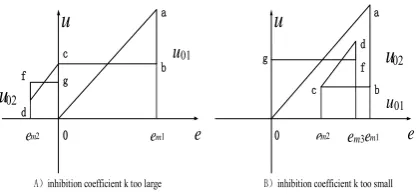
Figure 1. The static characteristics of a prototype HSIC controller
parameters, obtained from the evolution calculation, need further adjustment before they can be used effectively in the control of a real system. For a nonlinear motion process like the swing-up and stabilization control of a cart-double pendulum, the control parameters need to change with the motion attitude of the two rods of the pendulum. This means that online self-tuning of the control parameters is very important for a fast, high-quality realization of real-time control.
Parameter tuning is an important part of the control process, in that it automatically alters the values of controller parameters in the different phases of the system dynamics, to adapt to the system’s reliability, adjustment accuracy and needs of the design specifications.
An HSIC controller has a hierarchical structure for the information process and decision making, namely an operation control level, a parameter self tuning level and a task adaptive level. In Ref. [18], the operation control level and parameter tuning level of the HSIC are introduced in detail, and a design method for the tuning of parameters is presented. But the parameter self-turning strategy is a very simple delta modulation, with low efficiency and adaptability.
In this paper we present a fuzzy online self-tuning method for parameters of the HSIC controller. Based on the principle of increasing precision with decreasing intelligence (IPDI) of an intelligent system [29], by introducing fuzzy logic into the parameter tuning level of the HSIC controller to realize online parameter self-tuning, the request for control precision will be further improved and the control system will be more adaptable.
II. BASIC THEORY OF HSIC
A. Basic Concepts
An algorithm for a prototype Human Simulated Intelligent Controller was proposed by Professor Zhou in 1979, and formally published internationally in 1983 [28]. After more than 20 years of unremitting effort by the authors and others, the basic theory of and a systematical design method for an HSIC has been formalised, and it has been used successfully in many practical systems [18-26]. The algorithm for a prototype Human Simulated Intelligent Controller is:
⎪ ⎪ ⎩ ⎪⎪ ⎨ ⎧
= ∪ < ⋅
≠ ∩ = ∪ > ⋅ +
=
∑
∑
= −
=
) 0 0 (
0 0 0
1 ,
1
1 ,
e e e e
kK
e e e e e kK e K
u n
i i m P
n i
i m P P
& &
& &
(1)
In the formula u is the output of the control, Kpis the scale coefficient,
e
is the error,e
&
is the rate of error,i m
e , is the i-th peak value of the error, and k is an
inhibition coefficient. The static characteristic of a prototype HSIC controller is shown in Fig. 1.
This prototype has many intelligent properties that traditional control algorithms do not have. Generally speaking, the relationship between input and output in traditional control is a simple mapping, whereas in the
prototype HSIC controller it is a double mapping. In other words, the prototype HSIC has a double control mode with open and closed loop alternatives, where the choice and decision of control mode and control strategy, is based on the characteristic model which consists of states and error change trends.
The choice of control mode according to the characteristic model, is made by an inference chooser and information processor with double mapping, which in a process very similar to human intuition reasoning, acts like human behavior, going “from cognitive to judgment” and “from judgment to operation”. Many of the basic concepts used to describe an intelligent controller were proposed in the HSIC theory, such as Characteristic Model, Characteristic Identification, Characteristic Memory, Multi-Mode Control (Decision), Intuitive Inference and Hierarchical Information Process Mechanism and so on.
Definition 1: A Characteristic Model Φ∈Σr is a
model that combines the qualitative and quantitative description of the dynamic characteristics of an Intelligent Control System. It’s a division of the system’s dynamic information space Σ, according to the solution goal of the control problem and the difference in control specifications. Each divided area represents a characteristic state ϕi. The characteristic model is the set
of all characteristic states:
φ =
{
ϕ1,ϕ2,⋅⋅⋅,ϕr}
, ϕ i ∈ Σ r In the characteristic model, a characteristic state comprises various characteristic elements qi, where their relationship is determined by the following formula:Φ=P⊙Q (2)
( ) ( ) ( )
[ i i im m ]
i = p 1∗q1 ∧ p 2∗q2 ∧ ⋅⋅⋅∧ p ∗q
ϕ
Definition 2: Characteristic identification is the
process whereby, according to the characteristic model
r
Σ
∈
Φ
, the intelligent controller processes the sampling information and pattern recognition online, and perceives and determines to which characteristic state the system belongs.e e
1 φ
φ
q φ 2 φ
e
U
Information processing with double mapping
characterastic identification
1 φ
co
nt
ro
l
ou
tp
ut
in
fo
rma
tio
n of
e
rro
r
characterestic
memory multi-mode control
e λ
Ω Ψ
2
ω
q
ω
1
ω
q u
2 u
1 u
A
R
f1
fq
f2
Figure 2. The Two-Order Mapping Relation of HSIC in Control and Decision-Making
CDB RB DB
MC
CI IE CI IE RB CI IE
FM K G RB
ST TA
d
R E Y
R E Y R E Y
Figure 1. Hierarchical structure of HSIC controller
variables contained in them and to describe the system’s behavior features through this schema of characteristic states. In other words, to intuit to this pattern perception to characteristic state of the system and to reflect the operation status of the dynamic process provides the basis of the decision-making of the intelligent control.
Definition 3: Characteristic Memory is the controller’s
memory of some characteristic variable that reflects the effect of the prophase decision and control, the request of the task of the control and the physical property of the controlled object. The set of characteristic memory is denoted as
Λ
∈
Σ
p:Λ=
{
λ1,λ2,⋅⋅⋅,λp}
,λi∈Σp (3)The human control strategy is flexible and different for different targets. Even for the same object, the control mode will be different under a different dynamic response status or different request for control.
Definition 4: Multi-mode Control (Decision-Making)
is a set of some qualitative or quantitative mapping relation between the output of control U, control input E
and characteristic memory ∧, that is, the set of control (decision-making) modesΨ.
Ψ ={ψ1,ψ2,L,ψr} (4)
ψi:ui = f/i(e,e&,L,λj)
or →
i f i :
ψ IF (conditions) THEN (operation or conclusion). The act of continuously changing strategy in the process of intelligent control is called Multi-mode Control (Decision-making).
In the control mode set Ψ, each control mode consists of many mode elements, the most common of which are:
e k
m1: p proportion; m2:kde& differential;
∫
edt km3: d integration;
H
u
m
4:
keep of output ;∑
=
n
i mi
e k m
1
5 : sum of peak error memory;
m
u
kt
m
6:
±
0 bang-bang output;a u
m7: ± output pre-compensation.
The relationship between a set of control modes Ψj and a mode element vector is
Ψ j :U j = LjM j (5)
where Uj is the vector of output, Mj is the vector of mode element, and Lj is the relation matrix which only has three elements 1, 0 and -1.
Definition 5: Set of Heuristic and Intuitive Inference
q
Σ ∈
Ω is a kind of imitation of the human (expert)
decision-making process, which, depending on the results of feature identification, makes a decision and decides the control strategy, and can be described as the production rule “IF … THEN …”
This information processing with double mapping relations is shown in Fig. 2, and can be expressed as:
Ωj:Φj→Ψj Ωj∈Σq (6)
where Ω j =
{
ω j1, ω j2,L, ω jr}
ji ji
ji IF ϕ THEN ψ
ω : (qualitative mapping)
j j j R →U
Ψ: Ψ1=
{
ψj1,ψj2,L,ψjr}
(
,&, ,L)
: = λ
ψji uji fji e e (quantitative mapping) or
IF
fji→ conditions THEN operation (qualitative mapping).
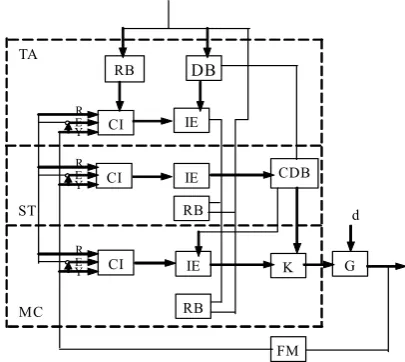
The HSIC controller with hierarchical information processing and decision-making structure consists of a task self-adaptive level TA, parameter self-tuning level ST, and master control level MC. Fig.3 shows that each of the MC, ST and TA has its own distinguishing database (DB), rule base (RB), characteristic identifier (CI), and inference engine (IE). The MC, ST and TA exchange information through the common database (CDB). This concurrent operation mechanism with compact coupling is convenient for the fast self-adaptive process of the HSIC controller.
B. Design of HSIC Controller
e&
e
( )a
4 e& 3 e& 2 e& 1 e& 1 e 2 e
( )ee fd ,& 3
e
4
e
( )b
( )a
ΙΙ
ΙΙΙ Ι
5
e
Figure 4. Error phase locus in the HSIC design
Figure5. Four phases of swing-up and handstand control process of cart-double pendulum
(a) To establish an ideal error target trajectory in the error phase plane of control system. According to the control specifications of the system, an ideal unit-step response process is established, and mapped onto the
e
e
−
&
phase plane, as an error phase trajectory. This isthe target trajectory for designing the HSIC controller. Every point on the trajectory can be seen as a transient control specification of the HSIC controller.
(b) To design the characteristic model of the HSIC controller. According to the position of the target trajectories in the e−e& phase, determine characteristic elements, divide characteristic states, and then compose the characteristic model of the different levels of the HSIC controller. Figure 4 describes the typical design process of a characteristic model. The curve (a) + (b) show an ideal constant value control process, and the curve (b) show an ideal dynamic process of servo control. If we make this trajectory the target to design the controller, the ideal situation is: the controller forces the system’s dynamic response to slip onto this trajectory. But because of the uncertainty of the system, the moving trajectories can only be in one belt around the ideal trajectory. So the design task is altered to, according to the position of this belt on the error plane, divide the regions of the characteristic states.
(c) To design the control rules and the set of control modes. Once the characteristic model has been established, the design task becomes that of, according to the moving tendency of the target trajectory and the errors between the system’s dynamic response and the transient control specifications (the ideal target trajectory) emulating the human control and decision-making behavior, design the control and decision-making mode of the controller and confirm the parameters of these control modes (Fig. 4).
III. DESIGN OF SWING-UP AND HANDSTAND CONTROLLER FOR THE HSIC OF A CART-DOUBLE PENDULUM SYSTEM
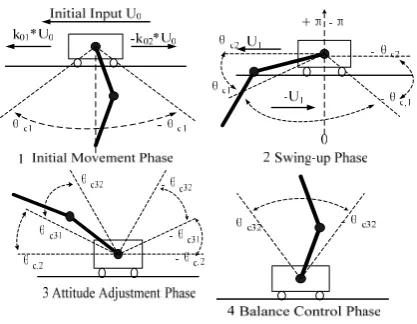
By dynamically analyzing a cart-double pendulum system, the motion involved in the swing-up and handstand of the pendulum can be divided into four phases. These are the initial movement phase, the swinging-up phase, an attitude adjusting phase, and the balance control phase (see Fig. 5) [20].
(a) Initial movement phase: With the two rods of the pendulum in a freely pendulous state, the cart is made to move to one side by applying a small force. The inertia of the cart initially makes the two rods move. Then, according to the velocity and position of the inner rod, the controller drives the cart and the two rods of the pendulum using positive feedback control. This increases the swinging amplitude of both rods.
(b) Swinging-up phase: When the inner rod swings close to the horizontal position, the dynamics of the system change. In response to this change, the controller exerts a stronger positive feedback force on the cart, causing the rods to cross the horizontal, and after reaching a certain level of motion, the attitude adjustment phase is entered.
(c) Attitude adjustment phase: Depending on the relative motion and dynamic features of the cart and the inner rod, a proportional derivative (PD) controller, using different parameters, can be designed by a well-phased linearization of the mathematical model of the system. The control objective of this phase is to align the two rods vertically in a straight line.
(d) Balance control phase: This starts when the two rods are both in a vertical upright position. The controller achieves handstand balance control of the two rods of the pendulum using PD control with three rotational degrees of freedom for both modes.
The control laws of the four phases in the multi-mode HSIC controller, together with the total control law, are given in (7).
2
e′ −&
2
e& −
3
e&
−
1
e&
−
′
−
e
11
e
−
e
4e
3e
2e
1e
e
&
4
e&
−
1
1 2 3 4
1
5
1 6
1 7
1 8
1 9
1 10
1 11
1 12
1 13
1 13
1
15 1
16
1
17 1
18
1
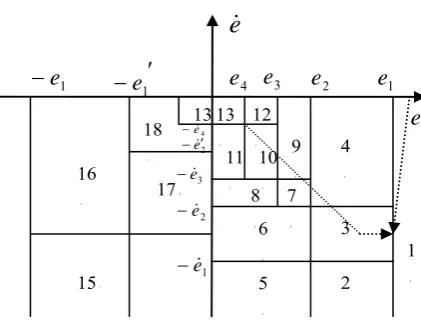
Figure 6. Characteristic model of Self-Tuning Level for HSIC (Note: first and second quadrants have parallels to third and fourth.)
In (7), the attitude adjustment phase incorporates two different linear optimum control modes for the different objectives [20]. The LQR optimum method is used to determine the initial control parameters when the rods reach two different positions above the horizontal. Using a well-phased linearization design and incorporating the improved genetic algorithm, superior control parameters are evolved off-line. The control mode of the balance controller also makes use of a genetic algorithm to determine the 3 rotational degrees of freedom in the balance position, for the related PD parameters. In order to overcome the problems with the off-line calculation, and to further raise the robustness and adaptive ability of the system, this paper discusses a means whereby the parameters can employ online self-tuning in the swing-up and handstand control of the cart-double pendulum. This means that the pendulum can successfully swing-up and handstand even when the control object’s physical parameters or the environment has changed.
According to the error and error ratio of the system, HSIC theory plots the characteristic state regions and designs a characteristic model of the adjusting level of the parameters of a typical servo controller. This is shown in Fig. 6 [18].
Using the characteristic model of the tuning level of the parameters, HSIC theory gives both the effective tuning structure of the control parameters, and a detailed qualitative description of the rules for adjusting the parameters. As the characteristic state is naturally uncertain, we can formalize this using fuzzy logic.
The data in Table I are the relevant characteristic states in the presence of the error and the change in velocity errors.
The qualitative adjusting rules, used by the characteristic model, are as follows:
Area 1: Bang-bang control: No need to revise the parameters.
Area 2: Beyond the limits of deflection velocity; increase PD control.
Area 4: Deflections reduce velocities to less than setting range; increase the proportional operation.
Areas 5 and 6: Deviation is very small, while velocity remains large; enhance both PD and positive feedback control.
Area 8: Deflection is small, but velocity is not; decrease PD operation.
Area 9: Deflection’s velocity lower than that requested; increase the proportional operation slightly.
Area 11: Deflection has reached the controller’s request, but velocity has not; decrease the proportional operation slightly.
Area 12: Deflection’s velocity is too low; increase proportional operation slightly through parameter adjustment.
Area 14: Overshoot has occurred but deflection’s velocity still high; enhance differential control, and decrease proportional operation slightly.
Area 15: Overshoot has occurred but deflection and velocity still high; increase differential and proportional operation.
TABLE I
FUZZY QUERY OF ERROR PHASE PLANE
e
φ
e
&
nb nm ns 0 ps pm pb
nb nm ns 0 ps pm pb
15 14 14 6 5 5 2 15 17 17 8 6 6 3 16 17 18 11 10 7 4 16 18 13 13 12 9 4 5 6 10 12 18 17 14 5 6 7 9 17 17 14 2 3 4 4 16 15 15
Area 16: Overshoot has occurred, deflection is high but velocity is not so high; enhance the proportional operation slightly and decrease differential operation.
Area 17: Overshoot is small, as is velocity; increase differential operation slightly.
Area 18: Deflection and velocity are small, but they have not reached the requested level; increase proportional operation slightly.
Figure 7. Structure of fuzzy, online self-tuning of parameters for HSIC
Input1
e
x Input2e
θ1Input3
e
Input4e
&
Output1
k
1 Output2k
2Output3
k
3 Output4d
1Output5
d
2 Output6d
3Figure 8. Membership functions for input and output variables
{
⎪ ⎪ ⎪ ⎪ ⎪ ⎩ ⎪⎪ ⎪ ⎪ ⎪ ⎨ ⎧ < ⋅ + ⋅ − ⋅ + ⋅ + ⋅ − ⋅ = > ⋅ > < < < < < < ⎩ ⎨ ⎧ − = = > > < < < < < < = = = ⎪ ⎩ ⎪ ⎨ ⎧ ⋅ − = ⋅ = = = 1 2 1 1 2 1 1 2 1 1 2 1 1 1 2 1 2 2 3 1 2 1 2 3 1 2 1 2 1 2 1 1 1 1 1 0 02 0 01 0 0 ,0 , 0 ,0 , 0 ,0 , 0 0 ,0 , 0 0 ,0 k θ θ θ θ θ θ θ θ θ θ θ θ θ θ θ θ θ θ θ θ θ θ θ θ θ θ θ e e d e d e d e k e k e k u e e e e e e U u U u e e e e e e e e e U k u U u U u S c x x c c c c c c KG & & & & & & & & & & & & (8)In the third component of Fig. 7, the input processing module changes the error information into four signals, namely the position error of car
e
x(input1); the angleerror of the inner-rod
e
θ1(input2); the error of the innerand outer rods’ angle error e=eθ1 −eθ2(input3); and the
angle velocity error between the inner and outer rod
2 1 θ
θ e
e
e&= & − & (input4). These inputs enter the fuzzy
calculation module, which uses the pre-established fuzzy rules to self-tune the six output parameters online, namely
3 2 1 3 2
1,k ,k ,d ,d ,d
k (output1,2,3,4,5,6). Finally the
output parameters are used by the PD control during the pose adjusting and handstand balance phase.
The sets of the four input variables in the fuzzy calculation module are:
e
x is {nb,0,pb}; eθ1 is{nb,nm,0,pm,pb};
e
ande
&
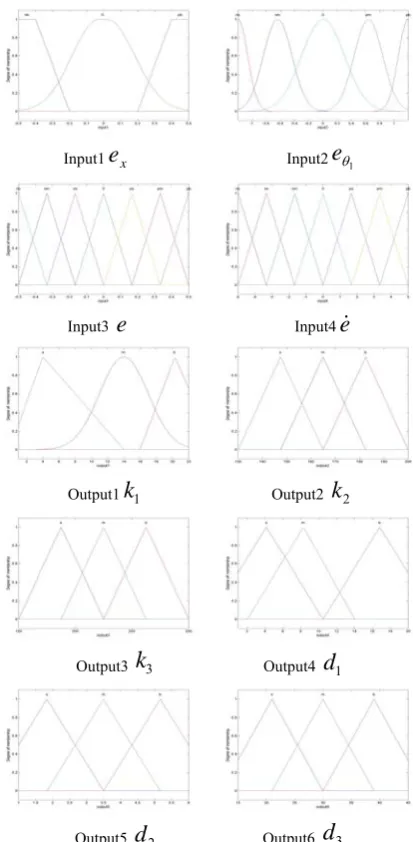
are {nb,nm,ns,0,ps,pm,pb}. Similarly, in order to simplify the rules but not affect the system behavior, the fuzzy sets of the six output variables (k1,k2,k3,d1,d2,d3) are all sets of {s, m, b}.All the membership functions of the variables are shown in Fig. 8. Input1
e
x uses a membership functionwith overlapped, symmetrical and asymmetrical distribution. Its distribution is given as follows: at the two ends, a trapmf type membership function is used for a small area, while in the large middle area a gaussmf type membership function is used. Input2
e
θ1 uses a gaussmftype membership function with overlapped, symmetrical and asymmetrical distribution. Input3 and input4,
e
ande
&
respectively, use trimf type membershipfunctions with overlapped, symmetrical and equable distribution. Because of its simplicity and uniform
distribution, this function makes it easy to design the rules. The output parameter ,k1 uses a membership function with overlapped and asymmetrical, but without uniform distribution. In addition, s and b use a trimf type while m uses a gaussmf type. Output parameter
d
1 uses a trimf type membership function with overlapped and asymmetrical, but without uniform distribution. The remaining parameters k2,k3,d2,d3 use a trimf typemembership function with overlapped, symmetrical and uniform distribution.
The universes of all the fuzzy variables are determined from the parameters of the cart-double pendulum model. Their concrete values are then given in the simulation experiment.
These three phases are then combined to determine the values of the parameters.
(a) The error of angle error of the inner and outer rods
e
, and the angle velocity error between the angle error of the inner and outer rodse
&
:The emphasis of the design rests here. In the swing-up and handstand control of the cart-double pendulum, this phase is very important for the relative posture control of the two rods. We can properly design the self-tuning level of the preceding parameters for an HSIC based on fuzzy logic.
Therefore, we introduce
e
ande
&
into the online control to adjust parametersk2,k3,d2,d3. Based on the fuzzy query table of error phase planese
ande
&
, we design the set of rules which are shown in Table II.In the swing-up and handstand control of a cart-double pendulum, the control objective, with posture adjustment of the two rods and balance control, is that the error of the two rods is satisfied with the ideal movement track as given in Fig. 6. In other words, control does not enter the first and third quadrants of the error phase plane, with the result that no entries exist in Table II. The adjusting rules for the parameters
k
2,k3,d2, d3are given in Table II. These rules are defined as follows. If (Input3 (e
) and Input4 (e
&
)) exist in a certain fuzzy state, Then (Output2 (k
2), Output3 (k3), Output5 (d2) and Output6 (d
3)) aregiven corresponding values. (b) The error of inner angleeθ1:
Depending on the deflection between the angle of the inner rod and its corresponding target, the HSIC is divided into many control phases, which are controlled by the corresponding control module. We make use of this tendency to change control of each parameter in a large area. The corresponding rules are shown in Table III.
The adjusting rules can be expressed as follows: If (Input2 (
e
θ1)) exists in a certain fuzzy state, Then(Output1 (
k
1), Output2 (k2), Output3 (k
3), Output4 ( d1), Output5 ( d2 ) and Output6 ( d3 )) are given corresponding values.(c) The displacement error of the cart
e
x:In the swing-up and handstand control of a cart-double pendulum, the most difficult part is the posture control of the two rods. While our demands on the cart are not high, we need to be aware of any deviation of the cart from the target position. Otherwise we keep the values of the corresponding two parameters. This also affects the selection of membership function. The appropriate rules are:
If
e
xis nb, thenk
1 is b andd
1 is b.If
e
xis 0, thenk
1 is m andd
1 is b.If
e
xis pb, thenk
1 is b andd
1 is b.This means that the input
e
x only affects the PDparameters of the cart.
TABLE II
SELF-TUNING RULES FOR INPUT
e
ORe
&
e
3 2
3 2
, ,
d d
k k
e
&
nb nm ns 0 pm pb ps nb … … … s,b m,m m,b m,s m,bm,s s,m m,b nm … … … m,m m,b s,b m,m s,b m,m 3 ns … … … b,b m,m 10 7 m,mb,s 0 m,m m,b b,mm,b 13 13 b,b m,b m,ms,s m,mb,s ps m,b m,s s,b m,m 10 b,b m,b … … … pm m,b m,s s,b m,m 7 m,m s,s … … … pb s,m m,b 3 m,m b,s m,m b,s … … …
TABLE III
ANGLE ERROR OF INNER ROD TO PARAMETERS’ SELF-TUNING RULES
Parameter
error k1 k2 k3 d1 d2 d3
nb(pb) s s s s b S nm(pm) m m m m m m 0 b b b b s b
In this section, we have illustrated the design of a self-tuning parameter module for an HSIC. The fuzzy reasoning uses the max-min method, while defuzzification uses the centroid method. By combining the first 2 independent rules (A and B) with the rule that limits the displacement of the cart (C), we obtain the control parameters required for the swinging-up and handstand balance of the cart-double pendulum system.
IV. VERIFICATION OF SIMULATION AND REAL TIME
CONTROL EXPERIMENTS
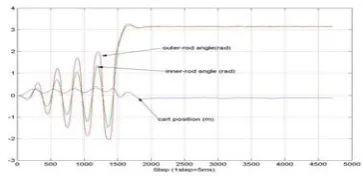
In order to verify the validity of this controller, we compare using simulation, the fuzzy rules algorithm to the multi-mode linearization design for constructing an HSIC. The results are shown in Fig. 9. In this experiment, the universes ofex,eθ1
e
ande
&
are (-0.5, 0.5), (-1.2, 1.2),(-0.5, 0.5) and (-5, 5), respectively. The universes of the 6 control parametersk1,k2,k3,d1,d2,d3 are given below.
self-(a) HSIC with fuzzy online self-tuning parameters
(b) HSIC using well-phased linearization design Figure 9. Results of simulation experiments for swing-up control
(a) Control Parameters:k1,d1,d2,d3
(b) Control Parameters:k2,k3
Figure 11. Fuzzy online self-tuning process of control parameters
Figure 12. The real time control process of swinging-up and handstand control
(a) HSIC with fuzzy online self-tuning parameters
(b) HSIC using well-phased linearization design Figure 10. Results of simulation experiments for swing-up control
after changing outer rod’s size by 10%.
tuning parameters uses about half the time for the posture adjustment and balance control phase.
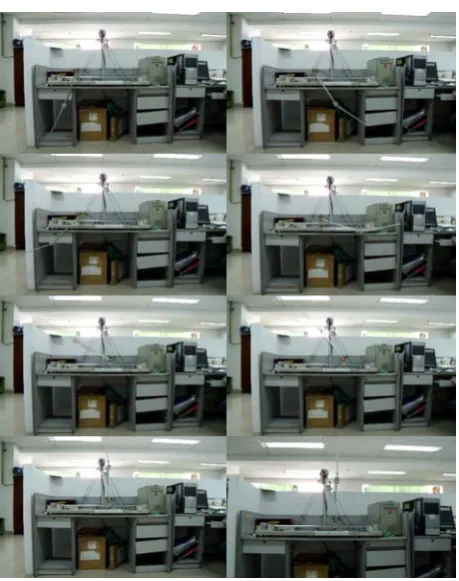
At the same time, in order to prove that the controller is robust and adaptive, we change the physical characteristics of the cart-double pendulum and in so doing, simulate uncertainty. After changing the mass of the outer rod, the distance from mass center to the corresponding axis, and the length of rods by between 10% and 25%, we then repeat the simulation using both the fuzzy self-tuning parameter model and the well-phased linearization design. The results are shown in Fig. 10. From Fig. 10(a) it is obvious that the HSIC with fuzzy online self-tuning parameters has adapted more to the change of the pendulum’s physical characteristics and could successfully swing-up. In Fig. 10(b) it can be seen that if the cart exceeds the trail in the HSIC based on a well-phased linearization design, real-time control of the limitation switch of the cart will fail. In real-time control experiments, a clip is put on the outer rod to verify that the controller is robust and adaptive. In the swing-up and handstand control of a cart-double pendulum, the HSIC controller with fuzzy online self-tuning parameters has continuous changing parameters, and parameters change with the posture of the pendulum (Fig. 11). This surely makes the real-time control more successful.
The equipment used was provided by the Googol (Shenzhen) company. The available length of track for the cart is 60cm, and the length of the two rods is 40cm. Control of the swing-up and handstand of the double pendulum is very difficult because the length of the moving track of the cart is limited. Using the HSIC with fuzzy online self-tuning parameters to control it, we have achieved a higher success rate and certain robustness. The control process of the swing-up and handstand stability of a double pendulum in a real-time control experiment is shown in Figs. 12 and 13.
Determining the universe of the fuzzy variables is very important in the process of real-time control, because it influences the precision of control. The fitness universes make it easy to find optimal control parameters. In the
experiment, we measure the change range of
e
,e
&
e
xand
e
θ1, and then decide the universe for each. Theuniverses of
e
x ande
θ1 are (-7,-6) and (-9.6,-2),Figure 13. The control process of a double pendulum’s swing-up and handstand stability in the real-time control experiment
Figure 16. Fuzzy region 0’s membership of inner and outer rod’s angle difference in the swing-up and handstand process
Figure 17. Fuzzy region pm’s membership of inner and outer rod’s angular difference in the swing-up and handstand process
Figure 14. Fuzzy region m’s membership of cart’s displacement in the swing-up and handstand process
Figure 15. Fuzzy region nm’s membership of inner rod’s angle in the swing-up and handstand process
26), (130,210), (170,300), (3, 19), (1, 5), and (20, 40), respectively. Figure 13 shows the results of real-time control.
According to the information from the sensor, the controller calculates the cart’s displacement, the angle and angle velocity of the inner and outer rods, and then excites the corresponding fuzzy area. Some statistic figures of membership as given in Figs. 14, 15, 16, and 17.
V. CONCLUSIONS
We have introduced the basic concepts and controller design method for an HSIC controller simply and completely, and given a formal description of parameter tuning of the controller. A parameter self-tuning level for the HSIC controller has been designed using fuzzy logic. Thereafter, we introduced fuzzy online self-tuning into the HSIC controller of a pendulum, and designed a swing-up and handstand controller for a cart-double pendulum. The simulation and real time experiments of the swing-up and handstand control of the cart-double pendulum have proven that fuzzy online self-tuning of parameters can greatly improve the adaptive ability of an HSIC.
ACKNOWLEDGMENT
This project is supported by National Natural Science Foundation of P. R. China (No. 60274022, 60574076)
REFERENCES
[1] P. He, and H. Wang, “Design and application of fuzzy
controller,” The Science Press, 1997.
[2] X. Shi, P. Li, Y. Sun, and X. Chen, “Dynamic weighting
fuzzy control for double inverted pendulum,” Journal of Petrochemical Universalities, vol. 18(2), pp.:83-86, 2005.
[3] C. Dong, and F. Zhou, “Fuzzy control for a double inverted
pendulum,” Machine Tool and Hydraulic, vol. 14, pp. 177-178 and 216, 2006.
[4] R. Guo, X. Hong, and W. Su, “The control arithmetic for
the double inverted pendulum based on the fuzzy control theory,” Journal of Xi Dian University (natural science version), vol. 33(1), pp. 111-115, 2006.
[5] L. Li, Y. Zhao, and S. Hu, “Analysis and comparison of
[6] H. Li, Z. Miao, and J. Wang, “Variable universe adaptive fuzzy control on the quadruple inverted pendulum,” Science in China (Series E), vol. 32(1), pp. 65-75, 2002.
[7] D. Li, “The Cloud Control Method and Balancing Patterns
of Triple Link Inverted Pendulum Systems,” China Engineering Science, vol. 1(1), pp.41-46, 1999.
[8] Y. Yang, and M. Zhang, “Stabilizing Triple Inverted
Pendulum Using Computer,” Journal of Beijing University of Aeronautics and Astronautics, vol. 26(3), pp.311-314, 2000.
[9] J. Xu, and Y. Fang, “Fuzzy Interference and Self-tuning
PID Control and its Application in PROFIBUS Controller,” Instrument Technique and Sensor, pp.35-36, 2006.
[10]G. Gao, “The theoretical and applicable development of
fuzzy control,” Journal of Shanghai Dianji University, vol. 8(5), pp.62-64., 2005.
[11]I. Fantoni, R. Lozano, and M.W, “Spong, Energy based
control of the Pendubot,” IEEE Transactions on Automatic Control, vol. 45(4), pp.725-729, 2000.
[12]A.L. Elshafei, “Output feedback control of a class of
non-linear systems using fuzzy systems,” In Proc. IEEE Int. Symp. Intel. Contr, pp.620–625, 2004.
[13]N. Muskinja, and B. Tovornik, “Swinging-up and
stabilization of a real inverted pendulum,” IEEE Transactions on Industrial Electronics, vol. 53(2), pp.631-639, 2006.
[14]J. Yi, N. Yubazaki, and K. Hirota, “SIRMS dynamically
connected fuzzy inference model applied to stabilization control of inverted pendulum and cart systems,” Fuzzy Information Processing Society, NAFIPS. 18th International Conference of the North American, pp.771-775, 1999.
[15]J. Rubi, A. Rubio, and A. Avello, “Swing-up control
problem for a self-erecting double inverted pendulum,” IEE Proc. Control Theory, vol. 149(2), pp.169-175, 2002.
[16]E. Kim, “A fuzzy disturbance observer and its application
to control,” IEEE Trans. Fuzzy Syst, vol.10 (1), pp.77–82, 2002.
[17]T. Yu, Adaptive Robust Fuzzy Control for Output
Tracking. Proceedings of the 2004 American Control Conference, Boston, Massachusetts, 2004, 2: 1788-1793.
[18]Z. Li, and Y. Tu, “Human-Simulated Intelligent Control,”
The National Defense Industrial Press, 2003.
[19]Z. Li, H. Zhang, Y. Wen, and G. Wang, “Human
Simulated Intelligent Control Based on Sensory-Motor Intelligent Schemas,” Proceedings of 5th Global Intelligent Control and Automation Conference (WCICA2004), Hang-zhou, China, pp. 232-238, 2004.
[20]Z. Li, Y. Dan, and Y. Wen, “Structural Design and
Discussion of Key Parameters in Swing-Up and Handstand Control of a Cart-Double Pendulum System,” Proceedings of 2005 National Conference on Artificial Intelligence, Beijing, China, pp. 1203-1208, 2005.
[21]Z. Li, Y. Dan, Y. Wen, and H. Zhang, “Swing-up and
Handstand Control of Cart-Triple-Pendulum System Based on Human Simulated Intelligent Control Theory,” Journal of Huazhong University of Science and Technology, vol. 32(insert), pp. 38-41, 2004.
[22]Z. Li, Y. Wang, Z. Tan, and H. Zhang, “Swing-up and
handstand-control and practice of cart-two pendulum system,” Proceedings of 5th Global Intelligent Control and Automation Conference (WCICA2004), Hang-zhou, China, pp.2360-2364, 2004.
[23]Z. Li, Z. Tan, and Y. Wang,, “Real time control of
swing-up and handstand–control of cart-double pendulum in declined rail,” Proceedings of 23rd Chinese Control Conference (CCC04), Wu-xi, China, pp.1645-1649, 2004.
[24]H. Zhang, Z. Li, J. Gu, and G. Chen, “Parameters
optimization method for human-simulated intelligent controller of cart-double pendulum system based on improved genetic algorithm.,” Journal of Harbin Institute of Technology, Vol. 38, pp.1083-1087,2006.
[25]H. Zhang, Z. Li, J. Gu, G. Chen, and Y. Dan, “A general
parameters optimization method for human-simulated intelligent controller and its application research,” Proceedings of the 6th World Congress on Intelligent Control and Automation, Dalian, China, pp.9089-9093., 2006.
[26]Z. Li, Human Simulated Intelligent Control Theory &
Swing-up and Handstand-control of Multi-pendulum. Artificial Intelligence: Review & prospect, Science Press, pp.174-207, 2006.
[27]B. Yang, Z. Zhang., “Dynamic Characteristic Parameter
Setting Method for Human-simulated Intelligent Controller,” Information and Control, vol. 33(6), pp.670-673., 2004.
[28]Q. Zhou, and J. Bai, “An Intelligent Controller of Novel
Design,” Proceedings of a Multinational Instrument Conference, shanghai. China, pp.137-149, 1983.
[29]G.N. Saridis, “Toward the Realization of Intelligent
Controls,” Proceedings of the IEEE, vol. 67, pp.1115-1133, August 1979.
Zushu Li received a B.S degree in Physics from Sichuan
University in 1967, and an M.S degree in automation from Chongqing University in 1981. Since 1990, he has been the director of the Institute of Intelligent Automation, and Professor of Chongqing University. Since 2002, he has also held the directorship of the Institute of Artificial and Intelligent System, and acted as Professor of Chongqing Institute of Technology. His main research fields are intelligent control theory and applications, intelligent robots, artificial intelligence, artificial life and so on.
Dongwu Liang born in 1982, received a B.S degree in