Original Research Article
Health education role in promoting mothers’ beliefs, knowledge
and practice of exclusive breastfeeding among King Fahd
Armed Forces Hospital population
Hanin A. Shalaby
1*, Rawan A. Obaid
2, Ruaa H. Alharthi
2, Malak M. Barayan
2,
Noura S. Bagabas
2, Raghdh M. Battarjee
2, Noura A. Baroom
2, Mie A. Tallab
2INTRODUCTION
Breastfeeding is considered an optimal feeding method, as it fulfills all of a baby’s nutritional needs. Furthermore, breastfeeding is essential for the health and well-being of both babies and mothers, as breast milk is loaded with immunological and anti-inflammatory properties that protect children from illnesses and mothers from chronic
and critical diseases.1 Most healthcare workers and professionals also point out that this feeding method serves as an important communication method between mother and baby.2
The World Health Organization (WHO) defines exclusive breastfeeding (EBF) as being the best form of nourishment for newborns. In EBF, an infant receives
ABSTRACT
Background: Breastfeeding is considered an optimal feeding method, as it fulfills the infants' nutritional needs. Exclusive breastfeeding (EBF), which means to feed an infant solely (with some exceptions) on breast milk, is important for the health and well-being of both infant and mother. However, implementing an effective health education program is essential for promoting EBF and improving health awareness. Therefore, the purpose of this study is to measure mothers’ beliefs, knowledge and practice of exclusive breastfeeding before and after implementing the breastfeeding health education program at King Fahd Armed Forces Hospital (KFAFH).
Methods: This study employs a quantitative research method and uses a cross-sectional study design. All in-patient and out-patient postnatal women who received information about EBF in their third trimester were evaluated post-delivery. In the period from December 2018 to March 2019, the total number of participants is (n=234).
Results: The study indicates a statistically significant positive association between EBF knowledge and practice evaluation scores. Higher levels of breastfeeding (BF) knowledge were found to translate into better BF practice. Knowledge scores also had a significant association with beliefs, with higher knowledge being linked to more positive beliefs in relation to BF.
Conclusions: The conducted study reports the major effect of health education intervention on EBF practice among the KFAFH population. As a result, some managerial, and clinical recommendations were addressed. Other recommendations focused on working mothers, as KFAFH may employ some strategies and polices to maximize the use of EBF.
Keywords: Exclusive breastfeeding, Health education, Knowledge, Beliefs, Practice
1
Department of Research Centre, 2Department of Health Education, King Fahd Armed Forces Hospital, Jeddah, Saudi Arabia
Received: 02 April 2019
Revised: 17 April 2019
Accepted: 18 April 2019
*Correspondence:
Dr. Hanin A. Shalaby,
E-mail: [email protected]
Copyright: © the author(s), publisher and licensee Medip Academy. This is an open-access article distributed under the terms of the Creative Commons Attribution Non-Commercial License, which permits unrestricted non-commercial use, distribution, and reproduction in any medium, provided the original work is properly cited.
only breast milk from his or her mother or a wet nurse, or expressed breast milk, and no other liquids or solids, with the exception of oral rehydration solution, drops or syrups consisting of vitamins, minerals supplements or medicines.3,4 Due to the well-known advantages of breastfeeding, several major organizations such as WHO, the United Nations International Children’s Emergency Fund (UNICEF) and the American Academy of Pediatrics (AAP) have recommended that infants be exclusively breastfed during the first six months of their life to obtain optimal growth and development. Infants can then start to receive complementary food while continuing to be breastfed for up to two years.1,5
According to the WHO, around 220,000 children could be saved every year through EBF.4 The survival rate of Infants who were breastfed within the first hour of birth is three times more than those who were breastfed one day after birth. Therefore, for the health and survival of their baby, it is essential that mothers are advised and motivated to initiate EBF.6 Nevertheless, despite the strong evidence that supports the importance of EBF for the first six months of an infants' life, its prevalence has remained low all over the world.7 For example, in Southern Asia, EBF is estimated to be at around 45%; in Brazil, EBF is 24.2%; and in Nigeria and the United States, it is 16.4% and 16%, respectively. However, the lowest prevalence for EBF (13.7%) is in South Africa.8
It is worth mentioning that Islamic culture respects and promotes breastfeeding and even has religious instructions to breastfeed infants for up to two years.9 Although, the cultural impact of Saudi Arabia is encouraging this practice due to religion and manners which support breastfeeding, EBF in Saudi Arabia is low.9 A recent study showed that EBF typically drops from 90% to 30% by the age of 3 months, and that the rate of maintaining breastfeeding for up to 2 years was 32% in 1987 but just 3.2% in 2000.9
A number of studies have identified some of the factors that influence a woman's decision to engage in breastfeeding. These factors can be classified as non-modifiable or non-modifiable. Examples of non-non-modifiable factors include a mother’s age, marital status and family income, while modifiable factors are aspects such as timing of breastfeeding, the time of the first feeding, and knowledge about breastfeeding. Modifiable factors can be addressed by initiating health education programs.10
Since promoting EBF practice is crucial for successful adoption of EBF, implementing an effective health education program to promote health awareness is essential. In some developing countries, health education programs provide EBF-related activities which focus on promoting overall women’s and children’s health. These programs encourage mothers to practice and be compliant to EBF for six months, as is recommended by various world health bodies.9 Recent studies of exclusive breastfeeding in Saudi Arabia have shown that the rate of exclusive breastfeeding among Saudi women is low.11,12
In addition, some limited studies have been conducted to address EBF among Saudi population, identify the factors that influence mothers to practice it, and determine the most advantageous breastfeeding education for Saudi women to improve breastfeeding practice within society.13,14
Aim of the study
The purpose of this study is to measure the mothers’
beliefs, knowledge and practice of exclusive
breastfeeding before and after implementing the breastfeeding health education program at King Fahd Armed Forces Hospital (KFAFH).
METHODS
Research design
Using a quantitative research method, the present study conducts a cross-sectional study design at King Fahd Armed Forces Hospital (KFAFH), which is one of the Medical Services Division (MSD) institutes of the Ministry of Defense and Aviation located in Jeddah. KFAFH provides primary, secondary and tertiary medical services for military members and their families. This study was conducted in the Obstetrics and Gynaecology (OB/Gyn) department at KFAFH, which offers a multidisciplinary approach to promoting women’s health and well-being, including pre-natal and post-natal care. Population
All in-patient and out-patient post-natal women who received information about exclusive breastfeeding (EBF) in their third trimester were evaluated post-delivery. In the period from December 2018 to March 2019, the total number of participants was (n=234).
Data collection
The questionnaire includes a set of 41 questions consisting of seven main parts with sub-sections, aimed at gathering information from mothers about EBF. The first part of the questionnaire focuses on demographic variables; the second part was formulated to retrieve information from mothers about their current practice of BF; the third part concerns the mothers’ knowledge of EBF; the fourth part concerns the mothers’ beliefs towards EBF; the fifth part concerns their source of information; the sixth part measures the impact of health education program towards EBF; and the seventh part looks at barriers to EBF.
Data analysis
p-values presented are two-tailed and were considered statistically significant if p was less than 0.05.
Limitations of the study
Missing from the study is information on the duration of data collection as well as information on weekend patient admissions and discharges.
Inclusion criteria
The main inclusion criteria are women of reproductive age from 16-55 years who delivered a healthy full-term newborn, with no complications during delivery for the mother or the infant.
Exclusion criteria
Exclusion criteria were mothers who delivered infants with birth defects; maternal conditions where breastfeeding is contraindicated e.g., transmitted disease; mothers with post-partum complications.
RESULTS
A sample of 234 Saudi mothers who delivered a full-term infant were surveyed for this study. Table 1 contains demographic characteristics of the study participants. Majority of women (59%) are 29 years of age or older, have high school (30%) or graduate (50%) education, working (54%), live with their husband (97%) and do not have help at home (61%).
Table 1: Demographic characteristics of study participants (n=234).
Demographic characteristic N (%)
Age (years)
Below 19 4 (2)
19–23 24 (10)
24–28 68 (29
29 and above 138 (59)
Level of education
Illiterate 1 (1)
Primary & Intermediate 36 (15)
High school 71 (30)
Graduate 116 (50)
Other 10 (4)
Occupation
Working or student 126 (54)
Not working (housewife) 108 (46)
Living arrangements
Husband 226 (97)
Children 1 (0.5)
Parents 6 (2)
Alone 1 (0.5)
In-laws -
Help at home
No 143 (61)
Yes 91 (39)
Table 2: Exclusive breastfeeding practice with newborn child.
Breastfeeding practice N (%) or Mean±SD [range]
Breastfeeding practice evaluation score 8.34±2.62 [0-14]
Breastfeeding practice evaluation category
Negative 167 (71)
Neutral 49 (21)
Positive exclusive breastfeeding 18 (8)
First breastfeeding after delivery
During the first hour after delivery 82 (37)
After the first hour but within the 6 hours 34 (15)
After the 6 hours but within the first 24 hours 30 (14)
Next day after delivery 45 (20)
I cannot remember 10 (4)
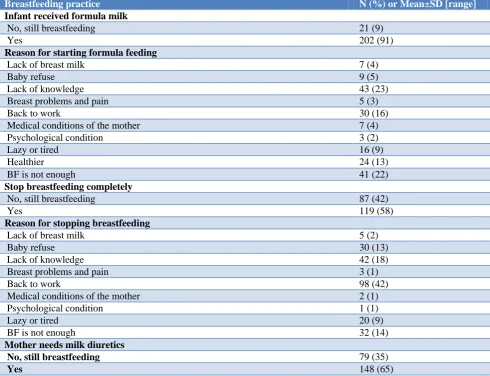
Breastfeeding practice N (%) or Mean±SD [range] Infant received formula milk
No, still breastfeeding 21 (9)
Yes 202 (91)
Reason for starting formula feeding
Lack of breast milk 7 (4)
Baby refuse 9 (5)
Lack of knowledge 43 (23)
Breast problems and pain 5 (3)
Back to work 30 (16)
Medical conditions of the mother 7 (4)
Psychological condition 3 (2)
Lazy or tired 16 (9)
Healthier 24 (13)
BF is not enough 41 (22)
Stop breastfeeding completely
No, still breastfeeding 87 (42)
Yes 119 (58)
Reason for stopping breastfeeding
Lack of breast milk 5 (2)
Baby refuse 30 (13)
Lack of knowledge 42 (18)
Breast problems and pain 3 (1)
Back to work 98 (42)
Medical conditions of the mother 2 (1)
Psychological condition 1 (1)
Lazy or tired 20 (9)
BF is not enough 32 (14)
Mother needs milk diuretics
No, still breastfeeding 79 (35)
Yes 148 (65)
Table 3: Breastfeeding knowledge score.
Breastfeeding knowledge N (%) or Mean ± SD [range]
Breastfeeding knowledge score 20.78 ± 3.28 [9-26]
Breastfeeding knowledge level
Poor (score <16) 15 (6)
Adequate (score 16-19) 47 (20)
Good (score 20-27) 172 (74)
Table 4: Exclusive breastfeeding beliefs score.
Exclusive breastfeeding beliefs N (%) or Mean ± SD [range]
Exclusive breastfeeding beliefs score 20.78 ± 3.28 [9-26]
Exclusive breastfeeding beliefs level
Negative (score 30 and above) 64 (27)
Neutral (score 26-29) 69 (29)
Positive (score 25 or less) 101 (43)
Mothers were asked about their breastfeeding practice with newborn child. Their responses were evaluated to have a composite score 0-14 indicating whether exclusive breastfeeding practice was utilized and to what degree. Table 2 summarizes the breastfeeding practices. We observed that only (8%) of mothers had positive
Table 5: Source of breastfeeding knowledge and role of health educators.
N (%) Source of breastfeeding knowledge
Doctor 3 (1)
Health educators 48 (21)
Books, journals or magazines 6 (3)
Family and friends 113 (48)
Media 64 (27)
Health educator role towards breastfeeding knowledge1
Proper preparation for breastfeeding during antepartum period 222 (97)
Proper preparation for breastfeeding during postpartum period 219 (96)
Enough knowledge about the exclusive breastfeeding 222 (97)
Enough knowledge about breast pumps and milk storage 213 (94)
Breastfeeding reduces the risk of breast & ovarian cancer for the mother 218 (96)
Breastfeeding reduces the risk of obesity for the mother 208 (91)
Note: 1sum of percentages exceeds 100% as participants allowed to choose multiple categories.
Table 6: Barriers of exclusive breastfeeding.
Barriers of exclusive breastfeeding N (%)
New pregnancy 70 (30)
Inadequate breast milk 126 (55)
Changes that would happen to the breast size and shape 29 (13)
Breast problems 71 (31)
Lack of knowledge 52 (23)
Medical conditions of the mother 62 (36)
Back to work 128 (55)
Lack of family support 111 (49)
Pain during breastfeeding 38 (17)
Post caesarean section 34 (17)
Taking of oral contraceptive 52 (23)
Infant refusal of breast-milk 82 (36)
Breastfeeding problem due to mother/infant separation 75 (33)
Mother psychological condition 67 (29)
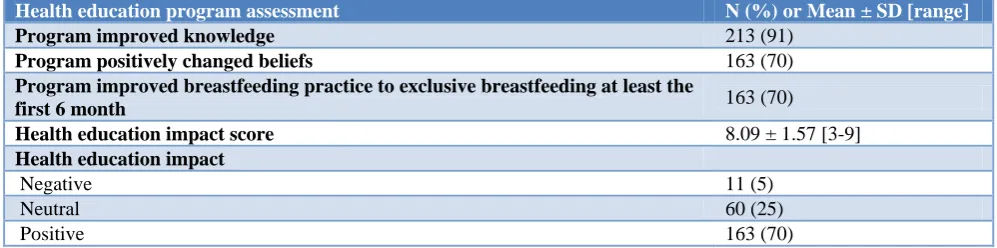
Table 7: Health education program impact in improve the EBF.
Health education program assessment N (%) or Mean ± SD [range]
Program improved knowledge 213 (91)
Program positively changed beliefs 163 (70)
Program improved breastfeeding practice to exclusive breastfeeding at least the
first 6 month 163 (70)
Health education impact score 8.09 ± 1.57 [3-9]
Health education impact
Negative 11 (5)
Neutral 60 (25)
Positive 163 (70)
Breastfeeding related knowledge has been accessed by asking participants a series of questions and then scoring their responses. A total of 9 questions were asked and participants can get a score between 0 and 27, with higher score indicating better knowledge. Based on the score, breastfeeding knowledge was also categorized into poor (score below 16), adequate (score 16-19) and good (score
20 and above). Table 3 below summarizes the knowledge score and level for all participants. We observed that participants overall have a good knowledge with vast majority (74%) having score 20 and above.
11 questions, a composite beliefs score was calculated ranging from 0 to 44, with higher score indicating more negative believes. Score was also categorized into three levels: negative (score 30 and above), neutral (score 26-29), and positive (score 25 or less). Table 4 below summarizes believes towards exclusive breastfeeding (score and categories) for all participants. Believes appear to be positive among almost half (43%) of participants, however a quarter (27%) still display negative attitudes.
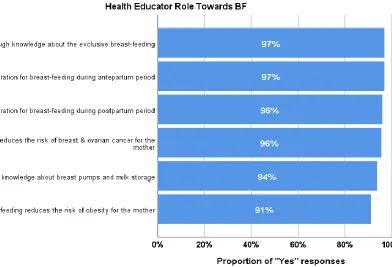
Health educators play an important role in promoting breastfeeding among mothers. As summarized in Table 5,
almost half of participants (48%) mentioned family and friends as the source of breastfeeding knowledge. Media was mentioned as the second largest category (27%) followed by health educators (21%). Over 90% of participants agree that Health Educators provided patients with breastfeeding knowledge in all 6 categories.
Participants identified several barriers preventing them to practice exclusive breastfeeding. As demonstrated in Table 6, the most frequently mentioned barriers are back to work (55%), inadequate breast milk (55%) and lack of family support (49%).
Table 8: Correlation analysis to examine the association between health education program and the mothers’ beliefs, knowledge, and practice towards breastfeeding.
BF practice evaluation score
BF knowledge score
Beliefs towards exclusive BF score
Health education impact score
Primigravida -0.085 0.017 -0.083 0.067
Age 0.066 0.058 0.026 -0.093
Level of education -0.059 0.320*** -0.266*** 0.061
Not working (housewife) 0.034 -0.012 -0.099 0.064
Note: *p<0.05, **p<0.01, ***p<0.001. reported values are Pearson correlation coefficients.
Table 9: Correlation analysis to examine the association between breastfeeding scores.
BF practice evaluation score
BF knowledge score
Beliefs towards exclusive BF score BF practice evaluation score
BF knowledge score 0.223***
Beliefs towards exclusive BF score -0.013 -0.195***
Health education impact score 0.066 0.030 -0.117
Note: * p < 0.05, ** p < 0.01, *** p < 0.001; reported values are Pearson correlation coefficients.
Table 10: The impact of health education on primigravida and multigravida.
Primigravida (n=41)
Multigravida (n=193)
Independent samples t-test for comparison
BF practice evaluation score 7.85±2.07 8.44±2.71 t(72.53)=1.56, p=0.12
BF knowledge score 20.90±3.28 20.76±3.29 t(232)=0.26, p=0.80
Beliefs towards exclusive BF score 26.71±3.44 27.53±3.82 t(232)=1.27, p=0.21
Health education impact score 8.32±1.11 8.04±1.66 t(83.21)=1.31, p=0.19
Note: reported values are Mean±SD.
After the health education program, participants were asked to rate the impact of this program on their knowledge, believes, and breastfeeding practice. Results of this assessment are presented in Table 7. The health education program improved 213 (91%) of the mothers’ knowledge. 163 (70%) of the participants beliefs, and the EBF practice at least the first 6 month were positively changed after receiving the health education. The mean±SD of health education impact score was 8.09±1.57.
Correlation analysis was performed to examine the association between some demographic characteristics and breastfeeding. Results are shown in Table 8.
Level of education has statistically significant positive association with EBF knowledge and negative association with beliefs score. This suggests that mothers with higher education level are more knowledgeable regarding EBF practices and have more positive attitude towards exclusive EBF.
Figure 1: Role of health educator towards EBF.
Comparison between primigravida and multigravida was performed to explore differences in knowledge, practice, beliefs and impact scores. The results are presented in table 10. No significant difference was found between primigravida and multigravida in health education impact score, although primigravida on average showed slightly higher impact score (8.32 vs. 8.04). There appears to be slightly better BF practice among multigravida (average evaluation score 8.44 vs. 7.85), however the difference is not statistically significant.
DISCUSSION
Various health organizations conducted studies to show the benefits of EBF. Based on the study outcomes, it is evident that EBF should be developed to acquire the desired health benefits for both babies and the mothers. Therefore, it is crucial to create a health education intervention program to ensure and increase the
awareness of EBF. KFAFH has successfully
implemented health education programs in the past based on evidence-based criteria, so this cross-sectional study aims to measure the healthcare education role in promoting mothers’ knowledge, beliefs and practice regarding EBF.
Similar to other studies, it was found that all of the participants were well-educated (i.e., the majority had a graduate degree).9,12 Furthermore, the high level of education has a statistically significant positive association with EBF knowledge, and this suggests that mothers with higher education level are more
knowledgeable regarding EBF practices and also have a more positive attitude towards EBF.9 Conversely, according to Elyas et al, a study conducted in rural China reported that mothers with an education level above senior middle school were less likely to breastfeed their infants exclusively.15 Also, the findings showed that most of those mothers were working and living with their husbands.
Findings from the present research showed that the participants who were knowledgeable about EBF referred to the typical duration for EBF, which is six months. Also, most of the participants had breastfed their newborn within the first hour after birth. These findings are similar to those in Motee et al study, which found that mothers’ have good knowledge of EBF duration as per WHO recommendations.16 However, another study conducted in Saudi Arabia found that the rate of breastfeeding within the first hour was low.12 The present study found that while only 18 (8%) out of 234 participants were practicing EBF, this rate is still higher than the reported percentage (13.7%) in Alyousef et al study.12 The findings here also suggest that the surveyed mothers had undesirable EBF practice before receiving health education, but indicated that their EBF practice was improved after receiving health education intervention, which has a positive impact on the mothers’ practice.17
Factors that were found to be associated with the practice of EBF included the belief that mothers’ milk alone is not enough, and that infants need formula milk to be full. Moreover, the obvious factor that was affecting EBF practice and led some mothers to quit was going back to work or school. Most of the working mothers complained of the difficulty of counting on breast milk to feed their babies for several reasons, such as long work hours, working different shifts, or lack of nursery rooms at the workplace to feed their children or pump and store breast milk for later use. Another important reason is that some jobs lack the flexibility to allow a mother to use the governmental lactation hours to feed her child.18
Regarding the mothers’ source of knowledge, 21% of mothers stated that health education plays a vital role in promoting breastfeeding knowledge. Nevertheless, 48% of the mothers obtained their knowledge about EBF from their families, friends, and the media. On the other hand, Gyampoh et al study indicated that the main source of breastfeeding information was obtained from healthcare workers, while a little over a quarter of mothers consider family and friends as a secondary source.19
Furthermore, the lack of knowledge about the importance of breastfeeding infants exclusively without water or herbal tea is considered an important barrier.20,21 Some mothers were also unaware that adding water to their babies’ diet can, in rare cases, cause hyponatremic seizures.20
In our sample, we noticed that 172 (74%) participants had good knowledge of EBF, 47 (20%) had moderate knowledge, and 15 (6%) had poor knowledge. This result was expected, as most of the mothers, as stated above, are well-educated. Also, it was noticed that participants with correct knowledge and awareness of EBF are more likely to practice EBF. However, Laanterä et al study indicated that the highest breastfeeding knowledge scores were classified into three categories: (0-8 points) low breastfeeding knowledge, (9-16 points) moderate breastfeeding knowledge and (17-22 points) high breastfeeding knowledge. Accordingly, they found that the highest breastfeeding knowledge was 53.5% for the participants who have moderate breastfeeding knowl.22
The findings of the present study indicate that the most significant barriers of EBF discussed by mothers were work-related, along with inadequate breast-milk production. The consensus was that working mothers would not have enough time to breastfeed their infants exclusively either because of the short maternity leave or the inability to find a convenient feeding location. Therefore, the current study indicates that, for most of the mothers, returning to work or school was one of the barriers to continuing with EBF.20 In fact, mothers going back to work or school was a critical barrier to breastfeeding altogether. However, another study stated that there is no relation between EBF nd going back to work.23
Family support was considered in the present study as well. In Saudi culture, the extended family is considered as the most important social institution for individuals. Family members share common interests, happiness, sadness, and lifestyles, and individuals tend to socialize within the circle of these family alliances. Therefore, family members affect their relatives’ beliefs and practices. In some cases, the missed practice of EBF was caused by relatives’ opinion that mothers’ breast milk is not enough nourishment for a baby and that the infant needs fortified formula milk instead, or that infants need herbal tea, water, or formula milk in addition to breast milk.20,21
At the same time, lack of family support toward adherence to EBF was another barrier that was noted in the present study. Some of the previous research reported that the majority of the selected sample had support from their partner and/or family members when facing challenges related to breastfeeding, and that most of them also had contact information for help when facing such challenges. However, if a mother lacked support from the infant’s father, this could hinder EBF.23,24
A lack of support led to inadequate breast milk production, which then resulted in making the mothers using tea and water to supplement the breast milk.
Our study indicates that health education is an effective intervention for promoting EBF behavior and improving the knowledge, beliefs and practice of breastfeeding among lactating mothers. Consistent with many previous studies, this study found that health education programs resulted in increased rates of women practicing EBF after improving their knowledge by receiving the health education intervention.7,17 Health educators and healthcare workers also play an important role in improving knowledge and motivating women to breastfeed. The health education program should be improved to include breastfeeding concepts such as the meaning of weaning, feeding on demand, and day and night feeding. In the continuous health education program, the performance of health educators in the breastfeeding program must be updated to include problem-solving in order to overcome barriers to proper breastfeeding, as recommended by health authorities. However, the percentage of women who initiate early breastfeeding and/or intend to continue breastfeeding must still be improved. Further studies focusing on the promotion of breastfeeding are needed.7,17
Recommendations
On the management side:
KKFAFH needs to have a strategic plan to be a baby-friendly hospital and encourage mothers to breastfeed their infants exclusively.
KFAFH should apply the International Code of
Marketing of breast milk substitutes as
issue a policy plan to be delivered and commonly communicated to staff and parents.
Sufficient training programs need to be provided for staff to ensure their effectiveness in managing change and development, which will aid in generating and analyzing data from EBF practice.
On the clinical side:
Healthcare providers can play a role in assisting mothers regarding direct contact between mothers and newborn babies, and the process of maintaining and overcoming any difficulties they may face.
Newborns should be allowed to remain in their mothers’ rooms 24 hours a day to enable EBF.
Attempts to encourage breastfeeding in the workplace can be promoted by:
Providing educational materials to employers to support employees who are breastfeeding.
Creating a lactation support program for working moms.
Promoting legislation to support worksite lactation programs.
Creating worksite recognition programs to honor
employers who support their breastfeeding
employees.
Scheduling flexible work hours to provide time for milk expression and pumping.
Establishing accessible private locations for milk expression
CONCLUSION
The present research has examined the impact of mother’s knowledge, practice and beliefs in measuring their tendency to practice EBF. It also addressed the factors that affect breastfeeding practice and the sources that mothers use to acquire knowledge about breastfeeding among the KFAFH population. As well, the role of implementing health education programs in promoting EBF practice was explored. The conducted study showed that the majority of mothers have adequate knowledge of EBF but still fall short of implementing EBF practice in large numbers. However, implementing health education programs has a positive impact on promoting EBF. Some recommendations in this work targeted the managerial side, some targeted the clinical side, and others focused on working mothers, as KFAFH may employ some strategies and polices to maximize the use of EBF. Therefore, increasing common awareness of EBF in the hospital environment could contribute to enabling these strategies. Indeed, monitoring and controlling the process could be accomplished by assigning a hospital committee to ensure the quality and sustainability of BF and EBF practices.
ACKNOWLEDGEMENTS
First and foremost, praises and thanks to the Allah, the Almighty, for His showers of blessings throughout our research work to complete the research successfully. Then we would like to express special thanks to King Fahd Armed Forces Hospital and the Research Center for their proffessinal and logistical support. Finally, we want to thank all the mothers who participated in this research and everybody who helped us and gave us advice directly or indirectly.
Funding: No funding sources Conflict of interest: None declared
Ethical approval: The study was approved by the Institutional Review Board (IBR) Committee King Fahd Armed Forces Hospital
REFERENCES
1. Ugurlu M, Yavan T. The Effectiveness of
Breastfeeding Education: An Integrative Review. J Behav Heal. 2016;5(4):182.
2. Cai X, Wardlaw T, Brown DW. Global trends in exclusive breastfeeding. Int Breastfeed J. 2012;7(1):12.
3. Campos AM, Chaoul Cde O, Carmona EV, Higa R,
do Vale IN. Exclusive breastfeeding practices reported by mothers and the introduction of additional liquids. Rev Lat Am Enfermagem. 2015;23(2):283-90.
4. World Health Organization (WHO). Infant and young child feeding: model chapter for textbooks for medical students and allied health professionals, Geneva. 2009 Available at https://apps.who. int/iris/bitstream/handle/10665/44117/97892415974 94_eng.pdf?ua=1. Accessed on 15 January 2019 5. McQueen K, Sieswerda L, Montelpare W, Dennis
C. Prevalence and Factors Affecting Breastfeeding among Aboriginal Women in Northwestern Ontario. JOGNN. 2015;44:51–68.
6. Olagunju L. The importance of Exclusive
Breastfeeding. 2013. Available at:
https://www.healthynewbornnetwork.org/blog/the-importance-of-exclusive-breastfeeding/. Accessed on 30 January 2019.
7. Okyere P, Woodall J, Appiah E. Effectiveness of Health Education in Increasing the Duration of Exclusive Breastfeeding in Low Income Countries:
A Systematic Review. J Clin Toxicol.
2014;04(02):1-9.
8. Tariku A, Alemu K, Gizaw Z, Muchie KF, Derso T, Abebe SM, et al. Mothers’ education and ANC visit improved exclusive breastfeeding in Dabat Health and Demographic Surveillance System Site,
northwest Ethiopia. PLoS One.
2017;12(6):e0179056.
Jeddah City, Saudi Arabia. IOSR J Nurs Heal Sci Ver VIII. 2017;6(6):2320-940.
10. Yi CM, Man HS. The effectiveness of breastfeeding education on maternal breastfeeding self-efficacy and breastfeeding duration: a systematic review. JBI Database Systematic Rev Implementation Reports. 2016;9(64):1-24.
11. Tampah-Naah AM, Kumi-Kyereme A.
Determinants of exclusive breastfeeding among mothers in Ghana: a cross-sectional study. Int Breastfeed J. 2013;8(1):13.
12. Alyousefi NA, Alharbi AA, Almugheerah BA, Alajmi NA, Alaiyashi SM, Alharbi SS et al. Factors Influencing Saudi Mothers’ Success in Exclusive Breastfeeding for the First Six Months of Infant Life: A Cross-Sectional Observational Study. Int J Med Res Heal Sci. 2017;6(2):68-78.
13. Al-Jassir M, Moizuddin SK, Al-Bashir B. A review of some statistics on breastfeeding in Saudi Arabia. Nutr Health. 2003;17(2):123-30.
14. El-Mouzan, MI, Al Omar, AA, Al Salloum, AA, Al Herbish, AS & Qurachi, MM Trends in infant nutrition in Saudi Arabia: compliance with WHO recommendations. Ann Saudi Med. 2009;29:20–3. 15. Elyas L, Mekasha A, Admasie A, Assefa E.
Exclusive Breastfeeding Practice and Associated Factors among Mothers Attending Private Pediatric and Child Clinics, Addis Ababa, Ethiopia: A Cross-Sectional Study. Int J Pediatr. 2017;2017:8546192. 16. Motee A, Jeewon R. Importance of Exclusive
Breastfeeding and Complementary Feeding among Infants. Curr Res Nutr Food Sci J. 2014;2(2):56-72.
17. Shanthakumari K, Tamrakar A, Kotian MS.
Effectiveness of Planned Health Education on Ideal Breastfeeding among Primigravidae in a Selected
Hospital at Mangalore, South Karnataka. IOSR J Nurs Heal Sci. 2014;3(2):54-8.
18. Murtagh L, Moulton AD. Strategies to Protect Vulnerable Populations. 2011;101(2):217-23. 19. Gyampoh S, Otoo GE, Nii R, Aryeetey O. Child
feeding knowledge and practices among women participating in growth monitoring and promotion in Accra, Ghana. 2014;14(1):1-7.
20. Wojcicki JM, Holbrook K, Lustig RH, Caughey AB, Muñoz RF, Heyman MB. Infant formula, tea, and water supplementation of latino infants at 4-6 weeks postpartum. J Hum Lact. 2011;27(2):122–30. 21. Giugliani ER, do Espírito Santo LC, de Oliveira LD, Aerts D. Intake of water, herbal teas and non-breast milks during the first month of life: associated factors and impact on breastfeeding duration. Early Hum Dev. 2008;84(5):305-10.
22. Laanterä S, Pölkki T, Ekström A, Pietilä AM. Breastfeeding attitudes of Finnish parents during pregnancy. BMC Pregnancy Childbirth. 2010;10:79. 23. Thomas J. Barriers to Exclusive Breastfeeding
Among Mothers During the First Four Weeks Postpartum. 2016:1-108.
24. Ratnasari D, Paramashanti BA, Hadi H,
Yugistyowati A, Astiti D, Nurhayati E. Family support and exclusive breastfeeding among Yogyakarta mothers in employment. Asia Pac J Clin Nutr. 2017;26:31-5.