Asian J. Med. Biol. Res. 2017, 3 (3), 317-322; doi: 10.3329/ajmbr.v3i3.34519
Asian Journal of
Medical and Biological Research
ISSN 2411-4472 (Print) 2412-5571 (Online)www.ebupress.com/journal/ajmbr
Article
Effect of garlic extract on growth performances and hematological parameters of
broilers
Md Shafiqul Islam Khan1*, Md Shoaib Prodhan2, Md Shahidul Islam3, Md Nazmul Hasan4 and Md. Shajadul Islam5
1
Department of Food Microbiology, Faculty of Nutrition and Food Science, Patuakhali Science and Technology University, Dumki, Patuakhali, Bangladesh
2
Assistant Manager, Aman Feed Limited, Dhaka, Bangladesh 3
Department of Post- harvest Technology and Marketing, Faculty of Nutrition and Food Science, Patuakhali Science and Technology University, Dumki, Patuakhali, Bangladesh
4
Department of Environmental Sanitation, Faculty of Nutrition and Food Science, Patuakhali Science and Technology University, Dumki, Patuakhali, Bangladesh
5
MS Student, Department of Food Microbiology, Faculty of Nutrition and Food Science, Patuakhali Science and Technology University, Dumki, Patuakhali, Bangladesh
*
Corresponding author: Md. Shafiqul Islam Khan, Associate Professor, Department of Food Microbiology,
Faculty of Nutrition and Food Science, Patuakhali Science and Technology University, Dumki, Patuakhali, Bangladesh. Phone: +8801712115973; E- mail: [email protected]
Received: 13 August 2017/Accepted: 06 September 2017/ Published: 28 September 2017
Abstract: This experiment was conducted to evaluate the efficacy of garlic (Allium sativum) extracts supplementation in drinking water as a growth promoter of broiler chicken. A total of 60 one-day-old male Lohman meat broiler chicks were distributed over two groups of 30 chicks with three replicates of 10 birds. Group B was supplemented with garlic extract from water and Group A kept as a control. Weekly observations were recorded for live body weight gain up to 4th weeks and hematological tests were performed at 30th days. Live weight and weight gain of the treatment group were significantly (p<0.05) higher than that of the control group. Significant (p<0.05) higher values also observed in terms of weight of heart, liver, spleen, and pancreas for the treatment group. The value of TEC and PVC of treatment group showed significant (p<0.05) differences. The results suggest that better growth performance could be achieved in broilers with feed supplemented with garlic extract.
Keywords: garlic extracts; growth; hematological parameters; broiler
1. Introduction
gain (Rehman and Munir, 2015), the immune and digestive systems in birds (Horton et al., 1991; Gardzielewska
et al., 2003; Al-Yahya, 1986) and low dose of garlic leave extract have an inhibitory action on wide spectrum of microorganisms (Qureshi, 1998) and immunomodulation actions that induce cellular immune reaction (Mishra and Singh, 2000; Agarwal, 1996; Chesson et al., 1982). It has a great impact on haematological parameters, which affect the physiological, pathological and nutritional status of poultry (Oleforuh-okoleh et al., 2015). Growing population and rising household income has led to rapid increasing demand for poultry in Bangladesh. At the same time, poultry meat products became a serious issue as some hazardous material like antibiotic residues come from the meat. The herbal extract can be the alternative to antibiotic and growth promoters and ensure increased and healthy production of poultry meat. Moreover, garlic is a widely available cheap cooking spice in this region. Considering the facts, this study was designed to evaluate garlic extracts as a safe growth promoting agent in broiler chickens.
2. Materials and Methods 2.1. Experimental design
The experiment was conducted at Sonarbangla Poultry Farm, Kashipur, Barisal during the period from 01 April to 30 April 2016. A total of 60 one-day-old male Lohman meat broiler chicks were distributed among two groups of 30 chicks with three replications of 10 birds. Birds were kept on the floor in isolated pens and fed commercial ration and adlibitum water. Chicks of group A were fed basal diet, while group B was fed basal diet supplemented with garlic extract during five weeks experimental periods. Weekly feed consumption of each group was determined. Mean initial and weekly body weight of birds for each group was determined and then body weight gain was calculated. By the end of experimental periods, 3 birds from each replicate were weighed, numbered and then slaughtered. The weight of breast and thigh were recorded along with heart, liver and gizzard and other organs.
2.2. Management of broiler
Floor of shed and other surroundings of the shed were properly cleaned with disinfectant. Day old broiler chickens were brought in the experimental shed. Immediately after unloading from the chick boxes the chicks were given vitamin-C and glucose to prevent the stress of transport. Temperature and litter management maintained very carefully. The starter, grower, and finisher broiler rations were supplied to the broiler chicken appropriately. Chicks of group „B‟ were treated with garlic extracts from drinking water for next four weeks.
2.3. Preparation of garlic extract
The Superficial bulk of garlic was removed and then washed with distilled water properly. After washing 10 gm garlic was ground with mortar and pestle. After grinding 1000 ml distilled water was added to make 1 liter stock solution and properly filtered. Finally, it was stored in a refrigerator at 4°C to maintain the active ingredients.
2.4. Hematological parameters
Hematological experiment was conducted at “Quality poultry disease and diagnostic laboratory (QPDDL)” Miarhat, Nesarabad, Pirojpur. Blood samples were collected from wing vein of chicken of both control and treated groups at the 30thday to observe the effect of the garlic extract. Total Erythrocyte Count (TEC), Hemoglobin Estimation (Hb), Packed Cell Volume (PCV) a n d Erythrocyte Sedimentation Rate (ESR) tests were performed as described by Lamberg and Rothstein (1977).
2.5. Statistical analysis
The data were analyzed statistically between control and treated groups of chicken by paired student‟s “t” test. Least significant difference (LSD) was used to determine the significance between means and the differences were considered statistically significant at P<0.05. SPSS program 16 was used for statistical analysis.
3. Results
3.1. Live weight gain of broiler
and 1.41 respectively. A significant increased (16.46%) live body weight was recorded for group B than that of the control group.
Table 1. Live weight gain of broiler.
Variables Treatments Average weight P value
Initial live weight (g) on 1th day Control 42.70±10.21 0.59
Garlic extract 42.83±6.88
Final live weight (g) on 30th day Control 1750.89±43.71 0.040*
Garlic extract 1800.94±45.73
Weight gain from 7th day (g) Control 1671.32± 52.26 0.0310*
Garlic extract 1762.51± 41.25
Feed consumption (g) Control 2572.50 ± 35.49 0.070
Garlic extract 52.29
3.2. Dressing percentages and relative giblet weight
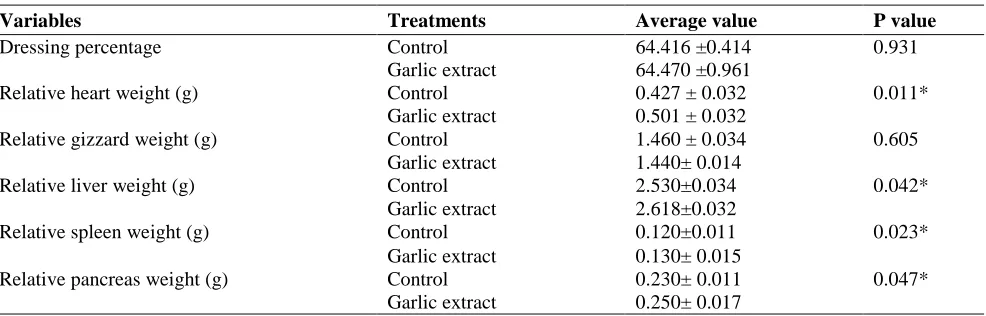
Table 2 shows differences between two groups regarding the dressing percentages and relative giblet weight where the weight of heart, liver, spleen and pancreas significantly higher for garlic extract treated group but no significant difference observed in dressing percentage and gizzard weight.
Table 2. Dressing percentages and relative giblet weight.
Variables Treatments Average value P value
Dressing percentage Control 64.416 ±0.414 0.931
Garlic extract 64.470 ±0.961
Relative heart weight (g) Control 0.427 ± 0.032 0.011*
Garlic extract 0.501 ± 0.032
Relative gizzard weight (g) Control 1.460 ± 0.034 0.605
Garlic extract 1.440± 0.014
Relative liver weight (g) Control 2.530±0.034 0.042*
Garlic extract 2.618±0.032
Relative spleen weight (g) Control 0.120±0.011 0.023*
Garlic extract 0.130± 0.015
Relative pancreas weight (g) Control 0.230± 0.011 0.047*
Garlic extract 0.250± 0.017
3.3. Hematological parameters of broiler
Table 3 shows the changes of the hematological parameter (TEC, Hb, PCV and ESR) on 30th day where there was significantly higher TEC and PCV, in garlic extract treated groups than the control. The level of Hb also higher but no significant.
Table 3. Hematological parameters of broiler on 30th day.
Blood parameters Treatments Average blood parameters value P value
TEC (mm3) Control 247.67 ± 1.028 0.021*
Garlic extract 298.39 ± 0.751
Hb (gm/dl) Control 6.92 ± 0.491 0.063
Garlic extract 7.79 ± 0.111
PCV (%) Control 18.00 ± 0.134 0.031*
Garlic extract 19.95 ± 0.022
ESR mm in 1st hour
Control 7.40 ± 0.268
0.064
Garlic extract 5.24 0.554
4. Discussion
In this study, inclusion of garlic had a strong effect on the growth performance and carcass characteristics of broiler. This result was in agreements with Raeesi et al. (2010), Mansoub and Nezhad (2011). Kumar et al.
2013) where positive effects of garlic supplementation on broiler performance was observed. But, Onibi et al.
(2009) found no significant differences between treatments of different levels of garlic and control. In our research, live weight and weight gain of treatment were significantly higher than that of control group. Similarly, weight gain (g/bird) was found to be significantly higher in garlic (Varmaghany et al., 2015; Noman
et al., 2015). More so, garlic extract improve productive performance of broiler chicks (Cardozo et al., 2004; Akilandeswari et al., 2003). It is suggested that the antibacterial compound dialkylpolysulphide present in garlic extract is playing a pivotal role in weight gain of broilers (Meraj, 1998; Ross et al., 2001). In our investigation, FCR of treatment group was higher but not significant. Few studies also showed better FCR with garlic extract treatment (Rehman et al., 2012; Senthikumar et al., 2015; Sharma et al., 1979; Horton et al., 1991; Canogullar
et al., 2009). Some authors reported that feed intake was not affected by the supplementation of garlic in broiler chicks (Varmaghany et al., 2015; Noman et al., 2015; Yalcın et al., 2006). Lower FCR means better the performance. Lower FCR which indicates that taking lower feed intake and their body weight gain is higher (Hossain et al., 2014). A significant difference between two groups in terms of weight of heart, liver, spleen and pancreas in this study but not in dressing percentages. Gralic extract has no significant effect on offal‟s weight (Noman et al 2015; Samresh et al., 2003). There was a significant difference between the average dressing percentages (Samresh et al., 2003). Significantly higher TEC and PCV in garlic extract treated groups than the control which is in agreement with the results of Dar et al. (2014) but PCV decreased significantly with increasing level of garlic extract (Varmaghany et al., 2015). Garlic extract has not significant effect on blood parameters (Noman et al., 2015).
5. Conclusions
In the study, better growth performances, carcass characteristics, and blood parameters showed in the treatment group of broiler supplemented with garlic extract. It enhancing the production potential, improve feed conversion ratio, increases weight gain, maximizes economic returns and protects the birds from different diseases. It also has beneficial effects on consumer‟s immunity. So, it can be effectively used to replace the antibiotic growth promoter in the poultry industry.
Conflict of interest None to declare.
Acknowledgements
The authors expressed deep gratitude to the farm owner for makes unrestricted opportunity and logistic support to set a study in his farm and collect the necessary data.
References
Afsharmanesh M, B SadeghiRonizi and M Mehrabadi, 2008. The comparison of natural feed additives (garlic and yogurt) with antibiotic growth promoters on broiler performance.1st national conference livestock and poultry industry of Golestan province. Des. 208: 25-36.
Agarwal KC, 1996. Therapeutic actions of garlic constituents. Med. Res. Rev., 16: 111-124.
Al-Yahya MA, 1986. Phytochemical studies of the plants used in traditional medicine of Saudi Arabia. Fitoterapia, 57: 179-182.
Armstrong DG, 1998. Gut active growth promoters. Control and manipulation of animal growth. pp. 21-37. Canogullar S, M Karaman, Z Erdogan, M Baylan, A Kucukgul, VV Duzguner and AK Ozugur, 2009. Effect of
garlic powder on egg yolk and serum cholesterol and performance of laying hens. Bull. Vet. Inst. Pulawy, 53: 515-519.
Carrijo AS, LA Madeira, JR Sartori, AC Pezzato, JC Goncalves, VC-da Cruz, KV Kuibida and DF Pinheiro, 2005. Powdered garlic in the alternative feeding of broiler chickens. Pesquisa Agropecuaria Brasileira, 40: 673-679.
Cherian A, S Seena, RK Bullock and AC Antony, 2005. Incidence of neural tube effects in the least-developed areas in India: a population base study. Lancet, 366: 930– 931.
Chesson A, CS Stewart and RJ Wallace, 1982. Influence of plant phenolic acids on growth and cellulytic activity of rumen bacteria. Applied Envir. Microbiol., 44: 597-603.
Dar SA, P Verma, M Ashfaque, AA Zargar, IA Mir, 2014. Effect of Garlic Extract on Haematobiochemical Changes in Eimeria tenella Infected Broiler Chicken, Natl. Acad. Sci. Lett., 37: 311-316.
Demir E, S Sarica, MA Ozcan and M Suicmez, 2003. The use of natural feed additives as alternatives for an antibiotic growth Promoter in broiler diets. Br. J. Poultry Sci., 44: 44-45.
Dibner JJ and JD Richards, 2005. Antibiotic growth promoters in agriculture: History and mode of action. Poult. Sci., 84: 634-643.
Elagib HAA, WIA El-Amin, KM Elamin, HEE Malik, 2013. Effect of dietary garlic (Allium sativum) supplementation as feed additive on broiler performance and blood profile. Journal of Animal Science Advances, 3: 58–64.
Freitas R, JB Fonseca, RTRN Soares, HS Rostango and PR Soares, 2001. Utilization of garlic (Allium sativum L.) as growth promoter of broilers. Rev Bras Zootecn, 30: 761-765.
Gardzielewska J, K Pudyszak, T Majewska, M Jakubowska and J Promianowski, 2003. Effect of plantsupplemented feeding on fresh and frozen storage quality of broiler chicken meat. Animal husbandry series of electronic, J. Polish Agric-Univ., 6.
Horton GMJ, MJ Fennel, BM Prasad, 1991. Effect of dietary garlic (Allium sativum) on performance, carcass composition and blood chemistry changes in broiler chicken. J. Clin. Nutr., 28: 684-685.
Hossain MM, AJ Howlader, MN Islam and MAH Beg, 2014. Evaluation of locally available herbs and spices on physical, biochemical and economical parameters on broiler production, International Journal of Plant, Animal and Environmental Sciences, 4: 317-323.
Javed M, F Durrani, A Hafeez, RU Khan and I Ahmad, 2009. Effect of aqueous extract of plant mixture on carcass quality of broiler chicks. ARPN Journal of Agricultural and Biological Science, 4: 37–40.
Kumar M, RS Choudhary and JK Vaishnav, 2005. Effect of supplemental prebiotic, probiotic and turmeric in diet on the performance of broiler chicks during summer. Indian Journal of Poultry Science, 40:137-141. Lewis MR, SP Rose, AM Mackenzie and LA Tucker, 2003. Effects of dietary inclusion of plant extracts on the
growth performance of male broiler chickens. Br. Poult. Sci., 44: 43-44.
Lamberg SL and R Rothstein, 1977. Laboratory Manual of Hematology and Urinalysis. AVi. Publishing Company, Inc, Westport Connecticut, USA.
Mahmood S, MM Hassan, M Alam and F Ahmad, 2009. Comparative efficacy of Nigella sativa and Allium sativumas growth promoters in broilers. International Journal of Agricultural and Biological Science 11: 775–778.
Mansoub HN and MAM Nezhad, 2011. The effects of using Thyme, Garlic and Nettle on performance, carcass quality and blood parameters. Annals of Biological Research, 2: 315-320.
Meraj ICA, 1998. Effect of garlic and neem leaves supplementation on the performance of broiler chickens. MSc Thesis, Department of Poultry Science, University of Agriculture, Faisalabad, Pakistan.
Mishra SJ and DS Singh, 2000. Effect of feeding root powder of Withaniasomnifera (L.)Dunal (aswagandha) on growth, feed consumption, efficiency of feed conversion and mortality rate in broiler chicks. Bioved. Annual, 11: 79-83.
Noman ZA, MM Hasan, S Talukder, YA Sarker, TK Paul and MH Sikder, 2015 . Effects of garlic extract on growth, carcass characteristics and haematological parameters in broilers. The Bangladesh Veterinarian 32: 1-6.
Oleforuh-Okoleh VU, HM Ndofor-Foleng, SO Olorunleke and JO Uguru, 2015. Evaluation of growth performance, haematological and serum biochemical response of broiler chickens to aqueous extract of ginger and garlic. Journal of Agricultural Science,7: 167–174.
Onibi EG, EO Adebisi, NA Fajemisin and VA Adetunji, 2009. Response of broiler chickens in terms of performance and meat quality to garlic (Allium sativum) supplementation. African Journal of Agricultural Research, 4: 511-517.
Qureshi AA, 1998. Incidence of some important diseases in Karachi and Lahore areas of poultry production. Pakistan Poultry Industry Year Book, 10: 11- 13.
Raeesi M, SA Hoeini-Aliabad, A Roofchaee, A ZareShahneh and S Pirali, 2010. Effect of periodically use of garlic (allium sativum) powder on performance and carcass characteristics in broiler chickens. World Academy of Science, Engine.Techno., 68: 1213-1219.
Rehman Z and MT Munir, 2015. Effect of garlic on the health and performance of broilers, 3:32-39.
Rehman ZU, S Khan, N Chand, AJ Tanweer, A Sultan, A Akhtar and AM Tauqeer, 2012. Effect of water based mixture infusion of Allium sativum and Withania somnifera on performance of broiler chicks. Pakistan Journal of Science,64: 180–183.
Senthilkumar S, N Madesh, MR Purushothaman, P Vasanthakumar, G Thirumalaisamy and P Sasikumar, 2015. Effect of garlic supplementation on performance in broilers – a Review. International Journal of Science, Environment and Technology, 4: 980–983.
Samresh D, A Srivastava, V Singh and A Sharma, 2003. An overview of Ocimum chemistry and pharmacological profile. Hamdard Medicus, 46: 43.
Sharma RK, RA Singh, RN Pal, and CK Aggarwal, 1979. Cholesterol content of chicken egg as affected by feeding garlic (Allium sativum). Indian J. Exp. Biol., 30: 523-526.
Varmaghany S, M Amir, K Torshizi, S Rahimi, H Lotfollahian and M Hassanzadeh, 2015. The effects of increasing levels of dietary garlic bulb on growth performance, systolic blood pressure, hematology, and ascites syndrome in broiler chickens. Poultry Science, 94: 1812–1820,
Vohra SB and M Khan, 1981. Diuretic study on plant principles. Ind. Drugs Pharma., 16: 39-40.