Explaining Successful Implementation of Logistics Information Technology (LIT):
An empirical study
Suhana Mohezar (Corresponding Author)
University of Malaya, Kuala Lumpur, Malaysia [email protected]
Azmin Azliza Aziz
University of Malaya, Kuala Lumpur, Malaysia [email protected]
Mohd Aidil Riduan Awang Kader
University Technology Mara, Pahang, Malaysia [email protected]
ABSTRACT
This paper aims to examine the factors influencing successful logistics information technology (LIT) among third-party logistics (3PL) service providers. Cross-sectional data from 136 Malaysian 3PL service providers were collected. Our findings indicate that the existence of technological capability, top management support, effective enterprise-wide communication and business process reengineering are pertinent. Nonetheless, the result demonstrate that firm size do not play a role in such initiative.
Keywords: Logistics, Operations Management, Information Technology
INTRODUCTION
Relaxation of trade barriers has led to greater global exchange of material flows, in which organisations are expanding their sourcing of materials, equipment and finished products. These changes have created huge challenges in logistics and distribution activities. Businesses are confronted with difficulties in exerting comprehensive controls of material movement over the entire supply chain. Some of the typical problems arising from poor logistics and distribution processes include delayed product and service delivery, high product damage rate and supply disruptions (Sum et al. 2001). While logistics serve as important business processes, firms are often lack the competence to control and administer their logistics activities internally, and tend to outsource this function to third-party logistics (3PL) providers (Lai et al. 2008).
Within the logistics management literature, information technology (IT) capability through the use of logistics information technology (LIT) is suggested to be one of the most critical criterions in selecting 3PL providers (Sohal 2002; Bhatnagar et al. 1999). Logistics information technology (LIT) refers to the software and hardware that facilitates logistics activities which include order, inventory, warehousing and transportation management (Closs et al. 1997). The integration of LIT in 3PL providers’ operation enable them to communicate effectively with suppliers, shippers and consumers. Many benefits of interfacing technology in logistics operations also relate to the implementation of cross-docking strategy. The assimilation of Radio Frequency Identification (RFID), Warehouse Management System (WMS) and Transportation Management System could facilitate firms in reducing the material handling process by decreasing the receiving time, loading/unloading time and waiting time at warehouse (Radko and Schumacher 2004). Despite the potentials of IT in the logistics industry, the challenges faced during the implementation remain a growing concern. Prior empirical researches on this issue mainly are drawn from the perspectives of logistics users, rather than 3PL providers (Vlachos 2004; Karkkainens 2003). Yet, given the growing importance of logistics outsourcing (Hum 2000; Bhatnagar et al. 1999; Sohal 2002), it is imperative to investigate this issue from the view of 3PL providers. A more elementary issue is the lack of underpinned theory to guide the empirical studies (Maloni and Carter 2006; Selviaridis and Spring 2007).
importance of logistics sector in the country. Malaysia has the opportunity to create an additional value of about RM9-11 billion over the next decade, contributing 12.1 per cent to the national GDP, with a more efficient distribution and logistics services (Ali et al. 2008). Despite the positive outlook, Malaysia recorded highest logistics cost among the Asian countries, with insufficient support of facilities and technological infrastructure as critical barriers. In order to reduce the impact of these issues, the Malaysian government through the Malaysia Productivity Corporation Report (2012) has emphasised on the investment of latest technology and equipment which could facilitate movement of goods and services in international trade. While the adoption of LIT has emerged as important tool that could lessen the burden of logistics operations, these potentials have not always been realised, resulting in increasing calls for more empirical justification of LIT investment. Furthermore, the lower diffusion rates of LIT in the logistics industry, suggesting that the implementation may involve challenges. An analysis of various factors affecting successful LIT implementation therefore may be useful in providing insights and suggesting strategies to overcome.
Conceptual Framework and Hypotheses Development
In this study, we adopt the Esteves and Pastor’s critical success model (CSF) (2000) in predicting the factors influencing the successfulness of LIT implementation among 3PL providers. This model argues that organisational characteristics and technological capabilities may affect the IT implementation success.
The technological context refers to availability of IT infrastructure that provides a basis for telecommunication linkages in logistics operations and technical knowledge as well as managerial skills. The literature supports that firms which are well equipped with network technologies are more likely to integrate ICT applications conducive for logistics operations as they are familiar to such approach (Lin 2008; Zhu et al. 2003). 3PL providers that are well-versed in ICT applications may be aware of technology advances and opportunities emerged in the marketplace, and hence would be more likely to continuously updating their hardware and software as well as training employees (Zhou et al. 2005).
H1: Technological capability is positively related to LIT successful implementation
The organisational context describes the nature of organisational characteristics that may facilitate or inhibit the successfulness of IT implementation, which include structures, processes and resources. A successful IT implementation within an organisation lies on the management commitment towards the technology. Vigorous participation from top management enhances the strategic importance of the technology adoption and the willingness of organisation to invest resources for particular innovation or idea (Johnson and Albert 2010; Ranganathan et al. 2004). A firm’s strategic orientation on ICT developments cannot be manifested across the firm if the top managers do not support and become involve in the planning and management of IT (Reich and Benbasat 2000). Based on this argument, the following hypothesis is proposed:
H2: Top management support is positively related to LIT successful implementation
There are various empirical studies justifying the importance of enterprise-wide communication for technology adoption (Kraemmerand et al. 2003). Without effective communication, employees will be ill-informed on the firm’s LIT implementation activities. The employees may not understand the purpose and benefits of implementing such technology as they may concern on their benefits and position in the organisation. They may also feel apprehension how the LIT would affect them. Therefore, this study argues that:
H3: Enterprise-wide communication is positively related to LIT successful implementation
Previous literature highlights that one of the biggest problems faced by organisations in implementing technology especially if it involves packaged software is the incompatibility of the features with the organisation’s information needs and business processes (Bingi et al. 1999; Willcocks and Sykes 2000). Since some of the technology or software packages are built around best practices in the industry, there are possibilities that the technology employed is not fit with the operating practices of the adopting firms. Hence, the businesses processes need to be aligned closely with the technology to maximise the benefits gain from such innovative efforts. Based on this argument, this study postulates that
H4: Business process reengineering is positively related to LIT successful implementation
technology is susceptible to imitation and the first-mover advantage tends to diminish quickly with rapid technological changes (Bharadwaj 2000). Firms, therefore require substantial resources to continuously invest in more advanced technologies for sustainable competitive advantage. Following this trait, this study therefore asserts the following hypotheses
H5: Firm size has a positive moderating effect between technological capability and successful LIT implementation.
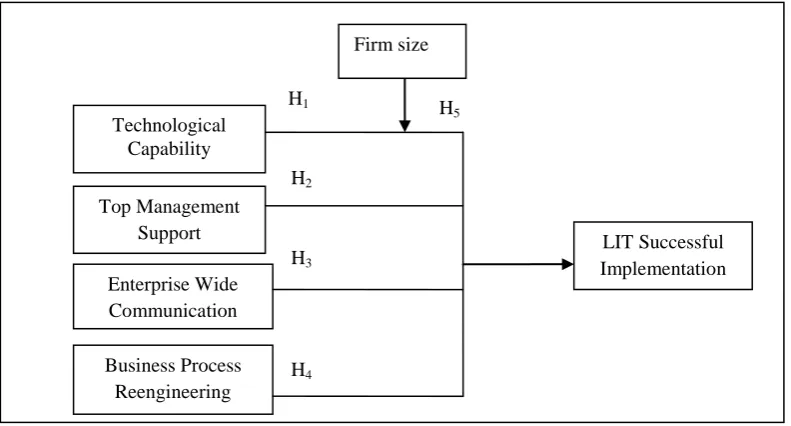
Following the extant literature on organisational technology adoption and logistics management, a research framework was developed (Figure 1). The framework identifies a set of three factors that determine 3PL providers’ successful of LIT adoption. They comprise technological capability, top management support, enterprise wide communication and business process reengineering. Secondly, the framework also suggests that firm size may moderate the relationship between the technological capability and successful LIT implementation.
Figure 1: Research Framework
RESEARCH METHODOLOGY
This study utilised a survey questionnaire to test the model developed. Sample was drawn from the Malaysian Logistics Industry Directory. Only firms that have adopted logistics information technology (LIT) (i.e. RFID, EDI, etc) were included in the sampling frame. Questionnaires, including a cover letter, self-addressed and stamped envelope, were mailed to the logistics managers. Of the 500 questionnaires mailed out, 136 were returned. This resulted in a 27 per cent response rate. Table 1 presents the sample characteristics.
Table 1: Sample characteristics
Frequency Percentage (%)
Service types
Warehousing 18 13.2
Sea freight 13 9.6
Land freight 13 9.6
Distribution 25 18.4
Packaging/repackaging 22 16.2
Intermodal transportation 19 14
Integrated logistics 26 19.1
Number of employees
5-50 1 0.7
51-150 52 38.2
more than 150 83 61
Technological Capability
Top Management Support
Enterprise Wide Communication
Business Process Reengineering
LIT Successful Implementation
Successfulness
H1
H2
H4
Firm size
H3
Most of the constructs are established measures from previous studies and they have been adapted to the context of this study. All items were measured using a 7-point Likert scale, ranging from 1 (strongly disagree) to 7 (strongly agree) or similar. Technological capability comprises four items adapted from Muscatello and Chen (2008). These items examined respondents’ perceptions of the availability of IT infrastructure, hardware and software expertise as well as the willingness of the management in acquiring external IT consultants and the capability of internal IT staff to support LIT implementation. Top management support was assessed using three items derived from Bradford and Florin (2003). These items measured the extent to which senior management perceive LIT adoption as a strategic approach to competitive advantage, as well as their level of funding support and willingness to take the associated financial risk. Enterprise-wide communication measures were adopted from Nah et al. (2007). These items measure the levels of communication in the organisation. Business process reengineering construct was measured using four items adapted from Muscatello and Chen (2008). LIT technology successfulness was measured using six items adapted from Ifinedo (2006). Respondents were asked to indicate the impact of using LIT on business operations and customer satisfaction.
ANALYSIS AND RESULT
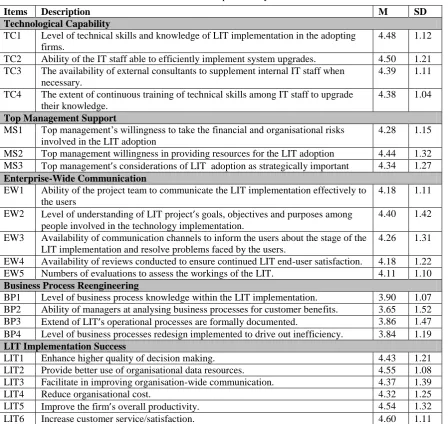
Table 2 shows the mean and standard deviations of each item. Majority of responding firms perceived that LIT implementation in their organisation received considerable support from top management. In general, firms in the sample have moderate levels of technological capability, yet poor levels of business process reengineering. Firms studied also perceived that LIT implementation has improved their business processes and increase their customer satisfaction.
Table 2: Descriptive Analysis
Items Description M SD
Technological Capability
TC1 Level of technical skills and knowledge of LIT implementation in the adopting firms.
4.48 1.12
TC2 Ability of the IT staff able to efficiently implement system upgrades. 4.50 1.21
TC3 The availability of external consultants to supplement internal IT staff when necessary.
4.39 1.11
TC4 The extent of continuous training of technical skills among IT staff to upgrade their knowledge.
4.38 1.04
Top Management Support
MS1 Top management’s willingness to take the financial and organisational risks involved in the LIT adoption
4.28 1.15
MS2 Top management willingness in providing resources for the LIT adoption 4.44 1.32
MS3 Top management’s considerations of LIT adoption as strategically important 4.34 1.27
Enterprise-Wide Communication
EW1 Ability of the project team to communicate the LIT implementation effectively to the users
4.18 1.11
EW2 Level of understanding of LIT project’s goals, objectives and purposes among people involved in the technology implementation.
4.40 1.42
EW3 Availability of communication channels to inform the users about the stage of the LIT implementation and resolve problems faced by the users.
4.26 1.31
EW4 Availability of reviews conducted to ensure continued LIT end-user satisfaction. 4.18 1.22
EW5 Numbers of evaluations to assess the workings of the LIT. 4.11 1.10
Business Process Reengineering
BP1 Level of business process knowledge within the LIT implementation. 3.90 1.07
BP2 Ability of managers at analysing business processes for customer benefits. 3.65 1.52
BP3 Extend of LIT’s operational processes are formally documented. 3.86 1.47
BP4 Level of business processes redesign implemented to drive out inefficiency. 3.84 1.19
LIT Implementation Success
LIT1 Enhance higher quality of decision making. 4.43 1.21
LIT2 Provide better use of organisational data resources. 4.55 1.08
LIT3 Facilitate in improving organisation-wide communication. 4.37 1.39
LIT4 Reduce organisational cost. 4.32 1.25
LIT5 Improve the firm’s overall productivity. 4.54 1.32
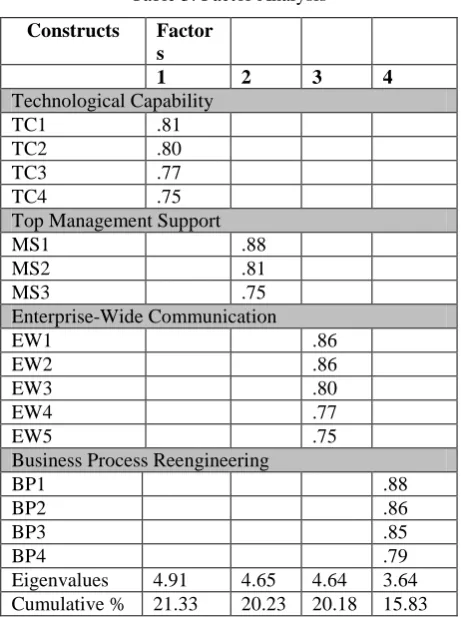
The constructs used in this study were tested for content validity and construct validity. Content validity was established through careful selection of items based on a comprehensive literature review, consultation with experts and a pilot test. Construct validity was examined through both convergent and discriminant validity, which was conducted using factor analysis. A principal Axis Factoring with Oblique rotation was performed. Prior to performing this, the suitability of the data for factor analysis was assessed. The Kaiser-Meyer-Oklin (KMO) value was 0.877, exceeding the recommended value of 0.6 (Kaiser 1974).Three acceptance decisions rules: eigenvalue ≥ 1; factor loading ≥ 0.7; and no cross-loading ≥ 0.5 were employed for identification of the factors (Hair et al. 1998). A set of 22 items was factor analysed. As shown in Table 3, all items loadings were high (0.7 or higher), adequately demonstrating convergent validity. Four factors were identified – technological capability, top management support, enterprise-wide communication and business process reengineering. These factors confirmed the study’s theoretical constructs. The resulting scales were then assessed for reliability, using Cronbach’s alpha. All the constructs had acceptable alpha values of over 0.7, which are above the minimum recommended value (Nunnally 1978) (Table 4). Therefore, all the constructs were considered to exhibit sufficient reliability. One-tailed Pearson correlation was employed to assess predictive validity of the variables. One-tailed is used as all hypotheses in the study are one-directional (Hinton 2004; Morgan 2004). As shown in Table 4, all the independent variables were found to be significantly correlated with the dependent variable; and all the independent variables were not highly correlated. This is important in order to ensure that strong multicollinearity effects are not present (Ho 2006).
Table 3: Factor Analysis
Table 4: Reliability and Intercorrelation between variables
1 2 3 4 5 α
1 Technological Capability - .93
2 Top Management Support .05 - .93
3 Enterprise-Wide Communication
.05 .05 - .95
4 Business Process Reengineering
.06 .05 .04 - 94
5 LIT Implementation Success .69 ** .63** .49** .47** - .82
** Correlation is significant at 0.001 level Constructs Factor
s
1 2 3 4
Technological Capability
TC1 .81
TC2 .80
TC3 .77
TC4 .75
Top Management Support
MS1 .88
MS2 .81
MS3 .75
Enterprise-Wide Communication
EW1 .86
EW2 .86
EW3 .80
EW4 .77
EW5 .75
Business Process Reengineering
BP1 .88
BP2 .86
BP3 .85
BP4 .79
Eigenvalues 4.91 4.65 4.64 3.64
Multiple regression analysis was performed to examine the direct relationships between variables in this study. Measures of technological capability, top management support, enterprise-wide communication and business process reengineering were entered as predictor variables for LIT implementation success. In summary, these four predictors accounted for 51 per cent of the variance in LIT implementation success (R2=0.51, F=34.21, p<0.001).The results suggested that the group of variables technological capability, top management support, enterprise-wide communication and business process reengineering can be used to reliably predict the LIT implementation success. The results showed that p values for each of the construct tested were below 0.05. Therefore, H1, H2, H3 and H4 are supported. Table 5 also depicts the variables explaining the IOS adoption in
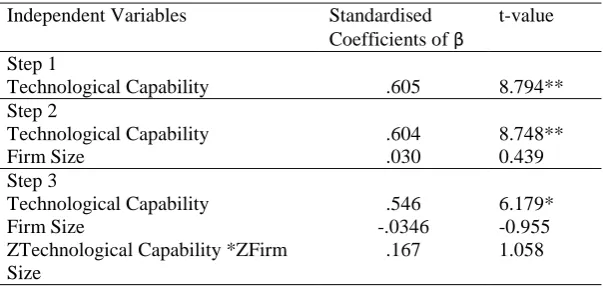
order of their importance, based on the standardised beta coefficient (β) values. The results revealed that the most influential factor of LIT implementation success was top management support (β=0.312, p<0.001), followed by technological capability (β=0.257, p<0.001), enterprise-wide communication (β=0.209, p<0.05) and business process reengineering (β=0.176, p<0.05). Additionally, this study also performed hierarchical multiple regression approach to test the moderating effect of firm size on technological capability and LIT implementation success. Nevertheless, firm size appeared to have no moderating effect, hence rejecting H5.
Table 5: Regression result for direct relationship
Independent Variables
Dependent Variables
Standardised Coefficients of β
t-value hypotheses result
Technological Capability
LIT Implementatio
n Success
.257 3.056*
*
H1 Accepted
Top Management Support
.312 3.629*
*
H2 Accepted
Enterprise-Wide Communication
.209 2.409* H3 Accepted
Business Process Reengineering
.176 1.96* H4 Accepted
Table 6: Regression result for moderating relationship
DISCUSSION
This study provides support for the usefulness of Esteves and Pastor’s model in examining the factors affecting successful implementation of LIT among logistics firms in Malaysia. Consistent with prior studies (Abdelghaffar et al. 2012; Muscatello and Chen 2008), we found that technological capability plays a role in ensuring successful technology implementation. This implies that technical expertise and technological infrastructure play a vital role. Inadequate internal and external capability may contribute to escalating time and cost overruns thus may cause project abandonment. (Al-Mashari et al.,2003; Nah et al., 2007; Somers & Nelson, 2004). Yet, similar with Sawah et al. (2008), the implementation of technological innovation in this industry is not only determined by technological capability, but mandates effort and involvement from their top management, particularly in LIT planning. This is owing to the fact that such technology adoption has the potential to significantly modify the nature of business transactions, inter-organisational relationships and balance of power (Ramamurthy et al., 1999). Management involvement is also viewed as a powerful signal of the technology orientation in firms’ operational activities and the importance that LIT is accorded (Lai et al. 2008).
Independent Variables Standardised
Coefficients of β
t-value
Step 1
Technological Capability .605 8.794**
Step 2
Technological Capability Firm Size
.604 8.748**
.030 0.439
Step 3
Technological Capability Firm Size
ZTechnological Capability *ZFirm Size
.546 6.179*
-.0346 -0.955
In our study, the successful LIT implementation could also be credited to effective enterprise-wide communication and business process reengineering. With effective communication, employees from the organisation, external suppliers and customers would understand the goals and the benefits of LIT project, which enable them to comprehend their roles, contributions and implications of their actions. This is in line with prior empirical studies conducted on the ERP implementation (Bingi et al. 1999; Willcocks and Sykes 2000). Since LIT implementation requires compatibility with organisational business processes and operations, there is a need for firms to be able to employ technology with maximum flexibility to accommodate markets, technological and industrial change. Apart from considering the factors influencing a successful LIT implementation, this study also aimed to analyse the role of organisation size in moderating the effect of technological capability to LIT implementation success. The findings of this study however reflected that organisation size has no moderating effect between IT resources and LIT implementation success. This contradicts with the study of Ifinedo (2006). One of the possible reason organisation size failed as a moderator in this study is because the competitiveness of this industry impelled third party logistics to implement LIT regardless of size and capability. The Malaysian 3PL would have to implement technology, albeit being reluctant to do so, for the sake of a collaborative partnership between the customers and the suppliers in the supply chain activities. On the other hand, 60 percent of the respondents comprised of large organisations. Thus, these large organisations have the capacity to ensure a successful LIT implementation.
CONCLUSION
This study offers pertinent theoretical implications to the information technology literature. Our research extends the knowledge on the issues relating to LIT adoption from the perspective of 3PL providers rather than logistics users. Since the adoption of such system can easily be duplicated by competitors, it is important for firms to consider adopting cutting-edge LIT, which have not yet diffused widely. This is pertinent since technology capability emerged as one of the important criteria for logistics users in making outsource decisions (Lai et al. 2008), causing this strategic move pivotal for the local industry to move forward. While resources such as IT infrastructure is a key input into a firm’s business processes, rare and imperfectly imitable assets are needed to achieve competitive advantage. While increased breadth, depth and scope of LIT adoption could enhance the local industry’s growth, successful implementation of technology warrants support and commitment from top management since this strategy involves considerable resource allocation and investments over a long term horizon. Furthermore, logistics firms need to establish training programmes to ensure effective use of such technologies. Such steps are vital since the LIT adoption would affect their business processes, inter-organisational relationships and balance of power (Lambert et al. 1998). As the reengineering process alters all aspects of a business, the job scope of the affected employees also undergoes transformation. As such, in this context, the employee may need to acquire new skills to adapt to the ever-changing economic landscape. In addition, the employees’ resistance to change and their fears about job displacement need to be addressed accordingly. The management must empower their employees in order to increase their morale and collaborative ream spirit. Therefore, effective communication between the management and employees is crucial to ensure such changes take place.
REFERENCES
1. Abdelghaffar, H., Hamdy, R., & Azim, A. (2012). Significant Factors Influencing ERP Implementation in Large Organizations: Evidence from Egypt. In European, Mediterranean & Middle Eastern Conference on Information Systems
2. Ali, R.M., Jaafar, H.S. and Mohamad, S. (2008). Logistics and supply chain in Malaysia: Issues and challenges’, Proceedings of the EASTS International Symposium on Sustainable Transportation incorporating Malaysian Universities Transport Research Forum Conference Johore,, 1-11, 2008,. 3. Al-Mashari, M., Al-Mudimigh, A., & Zairi, M. (2003). Enterprise resource planning: A taxonomy of
critical factors. European journal of operational research, 146(2), 352-364.
4. Bharadwaj, A (2000). A resource-based perspective on information technology capability and firm performance: An empirical investigation. MIS Quarterly, 24(1), 169-196.
5. Bingi, P., Sharma, M. K., & Godla, J. K. (1999). Critical issues affecting an ERP implementation. Information systems management, 16(3), 7-14.
6. Bradford, M. & Florin, J. (2003). Examining the role of innovation diffusion factors on the implementation success of enterprise resource planning systems. International Journal of Accounting Information Systems, 4, 205-25.
7. Closs,D.J., Goldsby,T.J. and Clinton,S. R.(1997). Information technology influences on world class logistics capability. International Journal of Physical Distribution and Logistics Management, 27(1), 4-17.
8. Ein-Dor, P and Segev, E (1978). Organizational context and the success of management information systems’, Management Science, 24(10), 1064-1077.
9. Esteves, J., & Pastor, J. (2000). Enterprise resource planning systems research: an annotated bibliography. Communications of AIS, 7(8), 1-51.
10. Hair, J., Anderson, R., Tatham, R. and Black, W. (1998). Multivariate data analysis. Upper Saddle River, NJ: Prentice Hall.
11. Ifinedo, P. (2006). Extending the Gable et al. enterprise systems success measurement model: a preliminary study. Journal of Information Technology Management, 17(1), 14-33.
12. Johnson, A. M., and Albert, L. L. (2010). CEO/CIO mutual understanding, strategic alignment, and the contribution of IS to the organization. Information & Management, .47, 138-149.
13. Kaiser, H (1974). An index of factorial simplicity, Psychometrika, 39(1), 31-36.
14. Karkkainens, M. (2003). Increasing efficiency in the supply chain for short shelf life goods International Journal of Retail and Distribution Management, 31, 529-536.
15. Kraemmerand, P., Møller, C., & Boer, H. (2003). ERP implementation: an integrated process of radical change and continuous learning. Production Planning & Control, 14(4), 338-348.
16. Lai,F. Li,D. Wang,Q.Zhoa,X. (2008). The information technology capability of third-party logistics providers: A resource-based view and empirical evidence from China, Journal of Supply Chain Management, 44 (3), 22-37.
17. Lambert, D.M., Stock, J.R. and Ellram, L.M. (1998). Fundamentals of logistics management, McGraw Hill, New York. 1998
18. Lin, C. Y. ‚ (2008). Determinants of the adoption of technological innovations by logistics service providers in China. International Journal of Technology Management and Sustainable Development , 7(1),19-38.
19. Lin, H. and Lin, S. (2008). Determinants of e-business diffusion: A test of the technology diffusion perspective. Technovation, 28(3), 135-145.
20. Maloni,M.J. and Carter,C.R.(2006). Opportunities for research in third-party logistics. Transportation Journal, 45(2). 23-38.
21. Muscatello, J. R., & Chen, I. J. (2008). Enterprise resource planning (ERP) implementations: theory and practice. International Journal of Enterprise Information Systems (IJEIS), 4(1), 63-83.
22. Nah, F. F. H., Islam, Z., & Tan, M. (2007). Empirical assessment of factors influencing success of enterprise resource planning implementations. Journal of Database Management (JDM), 18(4), 26-50. 23. Nunnally, JC (1978), Psychometric Theory 2nd Edn, McGraw Hill, New York.
24. Pinsonneault, A. and Kraemer, K.L. (1993). Survey research methodology in management information systems: An assessment’, Journal of Management Information Systems, 10(2), 75-105.
25. Radko, J & Schumacher, A. (2004). Electronic product code: RFID drives the next revolution in adaptive retail supply chain execution’, in Global Exchange Services, Gaithersburg MD.
27. Ranganathan, C., Dhaliwal, J.S. and Teo, T.S.H. (2004). Assimilation and diffusion of web technologies in supply-chain management: An examination of key drivers and performance impacts’, International Journal of Electronic Commerce, 9(1), 127-161.
28. Reich, B.H. and Benbasat,I. (2000). Factors that influence the social dimension of alignment between business and information technology objectives. MIS Quarterly, 24(1), 81-111.
29. Selviaridis,K. and Spring,M. (2007). Third-party logistics: A literature review and research agenda. International Journal of Logistics Management. 18(1), 125-150.
30. Sawah, S., Tharwat, A. A. E. F., & Rasmy, M. H. (2008). A quantitative model to predict the Egyptian ERP implementation success index. Business Process Management Journal, 14(3), 288-306.
31. Sohal,A.S. (2002). A comparison of the use of third-party logistics services by Australian Firms between 1995 and 1999’, International Journal of Physical Distribution and Logistics Management, 32(1), 59-68.
32. Somers, T. M., and Nelson, K. G. (2004). A taxonomy of players and activities across the ERP project life cycle. Information & Management, 41(3), 257-278.
33. Sum, CC, Teo, CB and Ng, KK (2001). Strategic logistics management in Singapore, International Journal of Operations and Production Management, 21(9), 1239-1260.
34. Willcocks, L. P., and Sykes, R. (2000). Enterprise resource planning: the role of the CIO and it function in ERP. Communications of the ACM, 43(4), 32-38.
35. Zhou,K.Yim,C.K. and Tse,D.K. (2005). The effects of strategic orientations on technology and market-based breakthrough innovations’, Journal of Marketing, 69(2), 42-60,