Original Research Article
Predictors of modern contraceptive use and fertility preferences among
men in Myanmar: further analysis of the 2015-16
demographic and health survey
May S. Aung
1*, Pa P. Soe
2, Myo M. Moh
1INTRODUCTION
Demographic change is one of the major challenges facing developing and underdeveloped countries. While fertility rates have been decreasing throughout the world, the age of first sexual exposure for both men and women is under age 25.1-3 Although in many countries, the majority of men are willing to participate in family planning, there are few male contraceptive methods,
limited male-focused family planning services, and a lack of attention to men in reproductive health policies.4 In most regions of the world, an estimated 1 in 10 married or in-union women who wanted no more children fail to use contraception to fulfill their husbands’ desire for additional children and opposition to contraception.5 In controlling the reproductive process, the unmet contraceptive needs among couples result in millions of unwanted pregnancies.6 Therefore, not only women but
ABSTRACT
Background: Men’s opposition to contraception and men’s fertility preferences can affect women’s unmet need for family planning. In Myanmar, there is limited research on men's reproductive health while women’s fertility, fertility preferences, and use of reproductive health services were well understood. A better understanding of men’s perceptions and preferences can support evidence-based male sexual and reproductive health programs and improve their effectiveness. This study focused on predictors of modern contraceptive use and fertility preferences among men age 15-49 years in Myanmar.
Methods: A secondary data analysis was conducted using the 2015-16 Myanmar Demographic and Health Survey. Among 4,737 men age 15-49 years in the selected households, 3,248 men who ever had sex and 2,831 currently married men were selected as the sample for contraceptive use and fertility preferences respectively. Multiple logistic regression analysis was used with two separate models.
Results: Among men who ever had sex, 39% were currently using modern contraception and 60% married men said they would like to have more than two children. Men from the coastal, and plain regions were more likely to use modern contraception and had higher fertility preferences compared with men living in the hilly region. The working men had higher levels of modern contraceptive use than jobless men and men from middle wealth index were significant current contraceptive users.
Conclusions: The geographic region was a predictor of both current contraceptive use and fertility preferences, while occupation showed a significant correlation with contraceptive use.
Keywords: Modern contraception, Fertility preferences, Men, Myanmar
Department of Preventive and Social Medicine, 1University of Medicine 1, 2University of Medicine 2, Yangon, Myanmar
Received: 12 August 2019 Accepted: 13 September 2019
*Correspondence: Dr. May S. Aung,
E-mail: [email protected]
Copyright: © the author(s), publisher and licensee Medip Academy. This is an open-access article distributed under the terms of the Creative Commons Attribution Non-Commercial License, which permits unrestricted non-commercial use, distribution, and reproduction in any medium, provided the original work is properly cited.
also men play an important role in women’s reproductive health.7
The contraceptive use and fertility preferences of men influence the ideal number of children desired within the family in most societies. In most of the study countries, current modern method contraceptive use was higher among sexually active men who were not in-union than among men in union.3 A study of men and contraception in 18 countries in Africa, Asia, and Latin America and the Caribbean found that men preferred to have more than two children, and it was the highest in West and Central Africa. Contraceptive use was higher among currently married men than among never-married men in most of the countries. A majority of men used a modern method, and use of male contraceptive methods was higher than female methods in most countries.2
Compared with other countries in the Southeast Asia region, the TFR for all Myanmar women age 15-49 is slightly lower at 2.5 children per woman.8 There may be more decrease in the fertility rate in recent years, because the 2015-16 Myanmar DHS revealed a total wanted fertility rate of 2.0 children per woman.9 On the other hand, the maternal mortality ratio (MMR) in Myanmar is 282 deaths per 100,000 live births, which was the second highest among ASEAN countries. Approximately 2,800 Myanmar women die during pregnancy or childbirth every year and almost 5% of all pregnancies end in abortion.10,11 Moreover, men’s status is still superior to women’s in Myanmar because of cultural norms, affecting access to sexual and reproductive health and rights.12 Current use of modern contraception among married women in Myanmar was 51% in 2016, which is lower than the 58% in Indonesia, 57% in Vietnam, and 54% in Bangladesh.13 Overall contraceptive prevalence among women age 15-49 years in Myanmar was 31% in 2016, far below the prevalence of 51% among married women—a level that needs to reach 60% in 2020.14,15 A study in Mandalay City concluded that the unmet need for reproductive health services was significantly influenced by exposure to mass media, peer exposure, and knowledge of services.16 Service availability and health worker support were significant factors influencing family planning practices, according a study in Yangon.17 In rural areas of Myanmar, use of contraception was higher among wives who discussed contraception with their spouse argued that men’s active involvement in reproductive health is positively associated with maternal and child health outcomes.18,19 Greene and Barker advised researchers, policymakers, and program managers to give attention to male involvement in family health decision-making.20 Therefore, shared responsibility of both men and women in reproductive health is an increasingly important issue.
Recognizing changing demography, fertility patterns, cultural norms, and current health status, reproductive health is a crucial component for prioritized areas of
health in Myanmar. These situations highlight the need to understand fertility preferences and contraceptive use among men in Myanmar in order to develop programs that can help to meet the overall goal for the nation’s health. While sustaining essential maternal and child health care and ensuring family planning access are critical, men’s role for contraceptive adoption is important to include in sexual and reproductive health. Moreover, evidence-based male sexual and reproductive health programs could be provided efficiently and effectively by understanding men’s perceptions and preferences. Surveys of male populations provide useful information on how men perceive, define, or act out their roles in matters of family planning and fertility.
In Myanmar, research on men and reproductive health is less frequently conducted compared with the many studies on women’s sexual and reproductive health and service utilization. There is a need to explore current use of modern contraception and fertility preferences among Myanmar men and also their predictors. This study addresses the gap in the literature by assessing predictors of modern contraceptive use and fertility preferences among currently married men age 15-49 years in Myanmar.
METHODS
This study was based on data from the nationwide 2015-16 Myanmar Demographic and Health Survey (DHS), conducted by the Ministry of Health and Sports and ICF.9 It followed a stratified two-stage sample design at the national level and for each of the seven States and eight Regions of Myanmar. For each sampling stage, separate sampling weight was calculated based on sampling probabilities. The first stage involved selecting clusters consisting of EAs (Enumeration areas) or ward/village tracts. The second stage was selection of households from each selected cluster using equal probability systematic sampling. The survey interviewed a total of 4,737 men age 15-49 years in the selected households. From this group, 3,248 men who ever had sexual intercourse were selected as the sample for contraceptive use. Data on ideal number of children is analyzed for fertility preferences among 2,831 men.
Descriptive statistics were applied for sociodemographic characteristics, source of information, knowledge on modern contraception, current use of modern contraception, and fertility preferences. For representativeness of the estimates and nonresponse, sampling weights were taken into account. For analyzing predictors on outcome variables, multiple logistic regression analysis was used by adjusting for the covariates. Two separate models were fitted for two outcome variables, current use of modern contraception and fertility preferences. Multicollinearity between different covariates was also assessed with cut-off value 0.6. Because of collinearity with age, marital status was excluded from the adjusted model for current use of modern contraception. The results were presented using adjusted odds ratios (OR) with 95% confidence interval (CI), and p value <0.05 was set as level of statistical significance. STATA version 15.1 was used for analysis of this study. For ethical consideration, the primary survey was collected according to international and national ethical guidelines and secondary analysis was done with permission of ICF.
RESULTS
Background characteristics
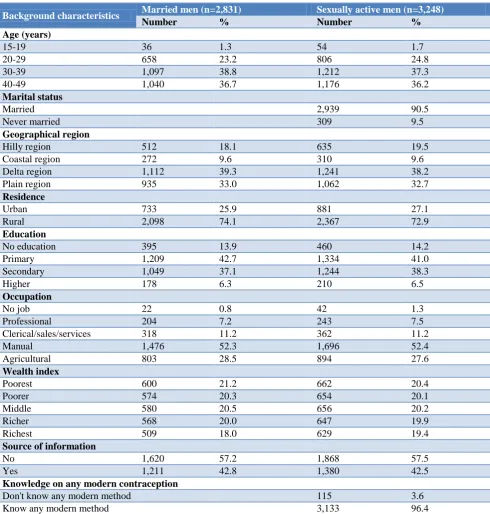
The study sample included 3,248 sexually active men and 2,831 married men age 15-49. Most of the sexually active men (91%) were married. For both groups, sociodemographic characteristics of age, geographical region, residence, education, occupation, wealth index, and source of information are described. Marital status and knowledge on any modern contraception are described for sexually active men.
As Table 1 shows, about one-third of married men (33%) lived in the plain region, while only 19% lived in the coastal region. About three-quarters of married men (74%) were rural. Only 6% had attended higher education, while 14% had no education. About half of married men (52%) worked in manual occupations, while only 0.8% of married men were jobless. There was an equal distribution of respondents by wealth quintiles. Only 43% of married men had received information about contraception from the media or a health worker. As might be expected—since only about 1 in 10 sexually active men were never married—the percent distribution by background characteristics of sexually active men resembled the distribution for married men. For sexually active men, almost all (96%) had knowledge of contraception.
Current use of modern contraception and fertility preferences
Figure 1 shows the use of modern contraceptive methods among the 3,248 men who ever had sex and shows fertility preferences among the 2,831 married men. Less than half of sexually active men (39%) were currently
using modern contraception. The fertility preference data focus on men’s desire to have more children, regardless of timing. A majority of married men (60%) desire more than two children, while 40% want two or fewer.
Figure 1: Current use of modern contraception among sexually active men and fertility preferences
among married men age 15-49 years.
Differences in fertility preferences and current use of modern contraception
Men’s use of modern contraception and men’s fertility preferences were dependent variables considered for their association with sociodemographic characteristics including age, marital status, geographical region, residence, education, occupation, wealth index, and source of information on contraception. The variable on fertility preferences was also considered for association with current use of modern contraception.
Table 2 shows which variables of sociodemographic characteristics were associated with ideal number of children, more than two as fertility preferences, and current use of modern contraception among men age 15-49 in Myanmar. Men age 30 and older were most likely to want to have more than two children, at 60% among men age 30-39 and 64% among men 40-49. Among the regions, the delta region showed the lowest proportion of men with a preference for more than two children, at 45%. There was a significant difference according to residence, at 50% in urban areas versus 64% in rural areas. Men’s preference for more than two children decreased as their level of education increased, from 66% among men with no education to 42% for those with higher education. Similarly, men in the richest quintile had significantly lower desire to have more than two children, at 47% versus 60% or higher for the other four wealth quintiles. Different types of occupation were also significantly associated with fertility preferences; among men with no job, 74% wanted to have more than two children, versus 50% of men with professional and clerical/sales/services occupations. Regarding current use of modern contraceptive methods, there was a significant association with age of respondents.
38.8
60.4
0 10 20 30 40 50 60 70
Current use of modern contraception method
Prefer >2 children
Pe
rc
en
ta
g
e(
9
5
%
C
Table 1: Percentage distribution of men age 15-49 years by selected socio-demographic characteristics.
Background characteristics Married men (n=2,831) Sexually active men (n=3,248)
Number % Number %
Age (years)
15-19 36 1.3 54 1.7
20-29 658 23.2 806 24.8
30-39 1,097 38.8 1,212 37.3
40-49 1,040 36.7 1,176 36.2
Marital status
Married 2,939 90.5
Never married 309 9.5
Geographical region
Hilly region 512 18.1 635 19.5
Coastal region 272 9.6 310 9.6
Delta region 1,112 39.3 1,241 38.2
Plain region 935 33.0 1,062 32.7
Residence
Urban 733 25.9 881 27.1
Rural 2,098 74.1 2,367 72.9
Education
No education 395 13.9 460 14.2
Primary 1,209 42.7 1,334 41.0
Secondary 1,049 37.1 1,244 38.3
Higher 178 6.3 210 6.5
Occupation
No job 22 0.8 42 1.3
Professional 204 7.2 243 7.5
Clerical/sales/services 318 11.2 362 11.2
Manual 1,476 52.3 1,696 52.4
Agricultural 803 28.5 894 27.6
Wealth index
Poorest 600 21.2 662 20.4
Poorer 574 20.3 654 20.1
Middle 580 20.5 656 20.2
Richer 568 20.0 647 19.9
Richest 509 18.0 629 19.4
Source of information
No 1,620 57.2 1,868 57.5
Yes 1,211 42.8 1,380 42.5
Knowledge on any modern contraception
Don't know any modern method 115 3.6
Know any modern method 3,133 96.4
Eleven men in contraceptive uses and eight men in fertility preference had missing information on occupation.
Table 2: Fertility preferences and current use of modern contraception by socio-demographic characteristics among men age 15-49.
Fertility preferences (Ideal number of children >2) Current use of modern contraception
Variables % CI P value % CI P value
Age (in years) <0.01 <0.001
15-19 58.1 (38.2,75.6) 28.0 (16.6,43.0)
20-29 54.3 (49.2,59.4) 44.7 (40.5,49.0)
30-39 60.3 (55.7,64.6) 43.5 (40.0,47.1)
40-49 64.4 (60.6,68.1) 30.8 (36.5,41.4)
Fertility preferences (Ideal number of children >2) Current use of modern contraception
Variables % CI P value % CI Variables
Marital status <0.001
Married 41.5 (39.0,44.1)
Never married 14.3 (10.0,19.8)
Region <0.001 <0.001
Hilly region 60.8 (54.6,66.7) 20.1 (14.7,26.8)
Coastal region 76.0 (69.1,81.8) 31.5 (26.9,36.5)
Delta region 45.4 (39.4,51.6) 51.4 (47.2,55.5)
Plain region 73.4 (69.2,77.3) 37.8 (34.0,41.8)
Residence <0.001 0.69
Urban 50.3 (45.2,55.4) 39.7 (35.4,44.2)
Rural 63.9 (60.1,67.5) 38.6 (35.8,41.6)
Education <0.001 <0.01
No education 66.2 (58.5,73.2) 27.4 (21.2,34.5)
Primary 65.3 (60.8,69.6) 39.7 (36.2,43.4)
Secondary 55.7 (51.7,59.6) 42.1 (38.6,45.7)
Higher 42.0 (33.7,50.7) 40.6 (33.2,48.3)
Occupation <0.001 <0.01
No job 73.8 (51.6,88.2) 16.5 (7.3,33.2)
Professional 49.5 (40.3,58.7) 38.7 (29.3,48.9)
Clerical/sales/
services 49.9 (42.4,57.4) 48.8 (42.9,54.8)
Manual 61.3 (57.4,65.0) 38.2 (35.1,41.4)
Agricultural 65.2 (60.0,70.1) 37.4 (32.9,42.2)
Wealth index <0.001 0.09
Poorest 62.5 (55.4,69.1) 35.6 (30.9,40.6)
Poorer 64.6 (59.3,69.6) 36.3 (31.6,41.3)
Middle 65.9 (60.6,70.9) 42.6 (38.1,47.2)
Richer 60.4 (55.7,64.9) 42.3 (37.2,47.6)
Richest 46.8 (41.5,52.3) 37.9 (33.8,42.2)
Source of information 0.26 <0.001
No 61.7 (57.5,65.6) 35.6 (32.6,38.7)
Yes 58.7 (54.7,62.5) 43.5 (40.0,47.0)
Ideal number of children <0.01
≤2 44.5 (40.3,48.7)
>2 36.5 (33.7,39.4)
Total 60.4 (57.3,63.4) 38.9 (36.5,41.4)
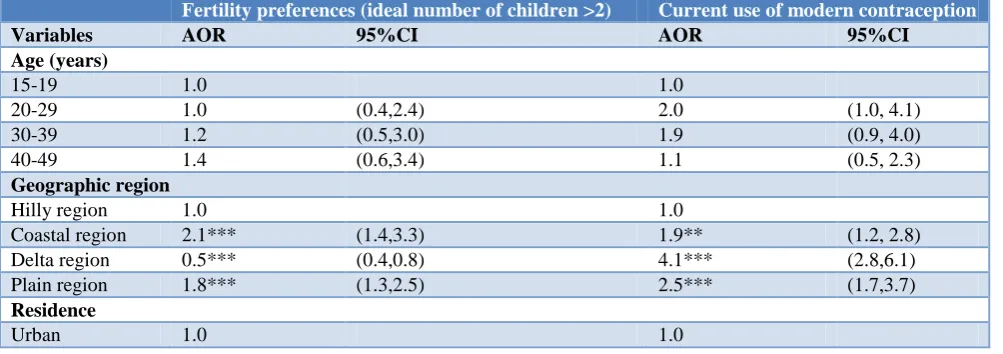
Table 3: Predictors on fertility preferences and current use of modern contraception after adjusting for covariates among men age 15-49.
Fertility preferences (ideal number of children >2) Current use of modern contraception
Variables AOR 95%CI AOR 95%CI
Age (years)
15-19 1.0 1.0
20-29 1.0 (0.4,2.4) 2.0 (1.0, 4.1)
30-39 1.2 (0.5,3.0) 1.9 (0.9, 4.0)
40-49 1.4 (0.6,3.4) 1.1 (0.5, 2.3)
Geographic region
Hilly region 1.0 1.0
Coastal region 2.1*** (1.4,3.3) 1.9** (1.2, 2.8)
Delta region 0.5*** (0.4,0.8) 4.1*** (2.8,6.1)
Plain region 1.8*** (1.3,2.5) 2.5*** (1.7,3.7)
Residence
Fertility preferences (ideal number of children >2) Current use of modern contraception
Variables AOR 95%CI AOR 95%CI
Rural 1.0 (0.7,1.4) 1.2 (0.9,1.6)
Educational level
No education 1.0 1.0
Primary 1.0 (0.7,1.4) 1.3 (0.9,1.8)
Secondary 0.8 (0.5,1.1) 1.2 (0.8,1.8)
Higher 0.6* (0.3,1.0) 1.0 (0.5,1.8)
Occupation
No job 1.0 1.0
Professional 0.5 (0.1,1.6) 4.1** (1.5,11.4)
Clerical/sales/
services 0.6 (0.2,1.8) 4.0** (1.6,10.0)
Manual 0.6 (0.2,1.9) 2.8* (1.1,7.1)
Agricultural 0.7 (0.2,2.4) 2.7* (1.0,6.7)
Wealth index
Poorest 1.0 1.0
Poorer 1.0 (0.7,1.4) 1.1 (0.8,1.5)
Middle 1.1 (0.8,1.5) 1.4* (1.1,1.9)
Richer 0.9 (0.6,1.3) 1.4 (0.9,2.0)
Richest 0.7 (0.4,1.0) 1.0 (0.7,1.6)
Source of information
No 1.0 1.0
Yes 1.2 (1.0,1.5) 1.2 (1.0,1.5)
Number of children preferred
≤2 1.0
>2 1.2 (1.0,1.5)
Constant 2.4 (0.5,10.9) 0.0*** (0.0,0.1)
N 2,775 3,041
AOR=adjusted odds ratio; ***p<0.001, **p<0.01, *p<0.05.
Men age 20-39 had the highest prevalence, at 45%, followed by men age 30-39 years, at 44%. Among young men age 15-19years, contraceptive prevalence was 28%. Married men used modern contraception significantly more than men not married, at 42% versus 14%. Geographical distribution had a significant association with modern contraceptive prevalence, at 38% in the plain region and 51% in the delta region. Around 40% of men with primary, secondary, and higher education used modern methods versus 28% of men with no education. A significant association was found between source of information on contraception and the use of modern contraceptive methods, among men who ever had sex. The ideal number of children was significantly associated with the use of modern contraception; among men who wanted to have no more than two children, prevalence was 45%, versus 37% among men who preferred to have more than two children. Residence and wealth index were not associated with use of modern contraception.
Adjusted multiple logistic regression: fertility preferences and current use of modern contraception
Table 3 shows results of the adjusted multiple logistic regressions for men’s fertility preferences and current use of modern contraception. A preference for having more than two children was statistically higher among men
from the coastal and plain regions compared with the hilly region. Men with a higher level of education were less likely to desire more than two children compared with men with no education. Working men had lower odds of wanting more than two children compared with jobless men. Wealth quintile did not have an association with fertility preference, nor did exposure to information about contraception on the media or from a health worker.
contraception was higher among men who wanted more than two children, it was not statistically significant.
DISCUSSION
Men together with their partners can protect reproductive health by ensuring effective contraception, avoiding sexually transmitted diseases, and preserving fertility. For improvement of health status of the community, reproductive health has been in place as an inclusive and coherent approach in Myanmar since 1996.21
Less than half of men studied (39%) were currently using a modern contraception method at the time of the survey, which was lower than the nationwide contraceptive prevalence among currently married women in Myanmar, at 51%.9,22 Our study focused only on contraceptive use among sexually active men with their partners which was lower compared with the majority of contraceptive users—currently married women. The finding pointed out the need to increase the prevalence of contraceptive use to meet the commitment of the national family planning program, up to 60% prevalence in 2020.14 Because of geographical variation in attitudes and norms, differentials in employment, and differences in household wealth, which reflect on affordability and accessibility to health care, education and source of information on contraception were not found as significant predictors of contraceptive use.2,4 In Myanmar, the regional groupings reflect geographic disparities in access to modern contraception or accessibility and quality of family planning services. Because of physical distance to the health care facilities, people in the hilly areas face difficulty accessing health services.23 Lack of health professionals, poverty, low education, and language differentials are major challenges in availability and accessibility of health services, especially in hard-to-reach areas including the hilly region in Myanmar.24,25 Based on our study, men residing in the coastal, delta, and plain regions were more likely to use modern contraception than men residing in the hilly region, net of other factors. Therefore, it revealed an emphasis on geographical regions as a considerable predictor for modern contraceptive use among men in Myanmar.
The analysis showed that working men had higher odds of using modern contraception than nonworkers, which was similar to the findings of other studies in Myanmar and Nepal.16,26 Regarding wealth index and contraceptive use, our finding was similar to findings in DHS surveys in 18 countries in Asia, Africa, and Latin America and the Caribbean.2 There was variation of adherence to modern contraceptive use in different wealth quintiles according to the type of modern methods. Moreover, affordability of travel and service costs had been shown as contributing factors for use of reproductive health services.16 According to our study, the wealth index was one of the predictors on modern contraceptive use among men in Myanmar, indicating the need to improve family incomes
and economic condition for promoting adherence on contraception.
Although source of information was not a significant predictor, the use of modern contraception among men who have access to information was 20% higher than for men without access, which was consistent with another Myanmar study.27 In our study, age, residence, education, source of information on contraception, and the number of children preferred were not significant predictors for use of modern contraception. These findings differ from a Bangladesh study of male involvement in reproductive health care, which showed that residence, education, and source of information were significant predictors on maternal health issues.19 On the other hand, our finding of geographical zone and wealth quintile as significant predictors for modern contraceptive use was consistent with a finding of a Nepal study.28
Men’s involvement in women’s sexual and reproductive health was a significant predictor of a positive health outcome for their partners and children.29 Men’s influence on desired number of children within the family was also essential for family planning. In our study, over half of married men stated that they wanted to have more than two children. These fertility preferences among Myanmar men were higher than found in the studies conducted in Nepal and Rwanda.28,30 Previous studies had found that the number of children preferred within families was influenced by education, residence, economic status, and exposure to media.31-36 However, our study pointed out regional variation in fertility preferences in Myanmar, which was consistent with a study among currently married men in Kenya.37 Because of differences in acceptability and accessibility within different cultures and customs in Myanmar, geographical area was one of the factors to be considered for providing reproductive health services according to people’s needs.
CONCLUSION
Based on the findings, key predictors of modern contraceptive use and fertility preferences among men that could be considered for service prioritization included the country’s geographic regions and men’s occupation. Specifically, future policies and programs are suggested to focus on addressing regional disparities in accessibility and availability of modern contraception by maintaining the quality of family planning services, especially for men living in the hilly region and men without jobs. Future interventions for promoting men’s use of contraception should be considered to bundle with occupational health services by improving awareness of family planning among men. Finally, because reproductive health research prioritizing men’s issues had been limited in Myanmar, further studies for policy implications and interventions are recommended.
ACKNOWLEDGEMENTS
With great respect, we would like to express our gratitude to the United States Agency for International Development and ICF International for access to data and technical assistance. With great respect, we would like to express our sincere appreciation to Wenjuan Wang and Shireen Assaf, 2019 DHS Fellows Program facilitators. We also would like to express our sincere thanks to Dr. Kyaw Swa Mya and Dr. Gadefaw Abeje Fekadu, cofacilitators of the 2019 DHS Fellows Program, for their helpful discussion, analysis of the data, guidance, and sharing of knowledge.
Funding: No funding sources Conflict of interest: None declared
Ethical approval: The datasets of the Myanmar DHS (2015–2016) were accessed with permission from ICF International. The primary demographic and health survey data were collected in accordance with international and national ethical guidelines
REFERENCES
1. United Nations Secretariat. Fertility levels and trends in countries with intermediate levels of fertility. Population Division, Department of Economic and Social Affairs. New York City USA. Available at: http://www.un.org/completing-fertility. Accessed on 15 March 2019.
2. MacQuarrie, KLD, Edmeades J, Steinhaus M, Head SK. Men and Contraception: Trends in Attitudes and Use. DHS Analytical Studies No.49. Rockville, Maryland, USA: ICF; 2015. Available at: https://www.popline.org/node/641293. Accessed on 10 May 2019.
3. Johnson K, Gu Y Men’s Reproductive Health: Findings from Demographic and Health Surveys,
1995-2004. DHS Comparative Reports
No.17.Rockville, Maryland, USA: ICF. Available
at: https://dhsprogram.com/pubs/pdf/JK17/JK17. pdf. Accessed on 17 March 2019.
4. United States Agency for International Development. Essential Considerations for Engaging Men and Boys for Improved Family Planning Outcomes. Office of Population and Reproductive Health, Bureau for Global Health. Washington, D.C. USA; 2018. Available at: https://www.usaid.gov/.../files/documents/1864/Eng aging-men-boys-family-planning-508.pdf. Accessed on 10 May 2019.
5. United Nations. Trends in Contraceptive Use Worldwide. New York, United Nations, Economic and Social Affairs, New York, USA; 2015. Available at: www.un.org/.../population/publica tions/pdf/family/trendsContraceptiveUse2015Report .pdf. Accessed on 10 May 2019.
6. The United Nations Population Fund. Cultural Programming: Reproductive Health Challenges and Strategies in East and South-East Asia Country. Technical Services Team for East and South-East Asia, Bangkok, Thailand; 2005. Available at: https://unfpa.org/sites/default/files/pub-pdf/culture _programming.pdf. Accessed on 10 April 2019. 7. Davis J, Vyankandondera J, Luchters S, Simon D,
Holmes W. Male involvement in reproductive, maternal and child health: a qualitative study of policymaker and practitioner perspectives in the Pacific. BMC Reproductive Health. 2016;13:81. 8. United Nations. United Nations Demographic Year
book. Department of Economic and Social Affairs, New York, USA; 2013.
9. Ministry of Health and Sports and ICF. Myanmar Demographic and Health Survey 2015-16. Nay Pyi Taw, Myanmar and Rockville, Maryland USA; 2017.
10. Johns Hopkins University, Ministry of Health and Sports and The United Nations Population Fund. Myanmar Family Planning Landscape Analysis. Baltimore USA, Nay Pyi Taw Myanmar and New York City USA; 2017.
11. The United Nations Population Fund. Country report on 2007 Fertility and Reproductive Health Survey. Union of Myanmar, Ministry of Immigration and Population, Department of Population. New York City USA; 2009.
12. Thein Pansy Tun. Gender Equality and Cultural Norms in Myanmar. In International Conference on Burma/Myanmar Studies, Burma/Myanmar in Transition: Connectivity, Changes and Challenges, University Academic Service Centre (UNISERV), Chiang Mai University, Thailand, July 24-25 2015. Executive Director of the Local Resource Centre (LRC), Yangon, Myanmar. Available at: https://www.scribd.com/document/274170310/ Gender-Equality-and-Cultural-Norms-in-Myanmar. Accessed on 10 April 2019.
14. Einda H, Thway M. FP 2020: Commitments and Progress in Myanmar. In High level meeting on FP 2020 Nay Pyi Taw, Myanmar, May 31 2016. Nay Pyi Taw, Director, Maternal and Reproductive Health, Department of Public Health, Ministry of Health and Sports. Available at: https://www.myan marhrc.com/wp-content/uploads/2019/01/P-3.pptx. Accessed on 10 April 2019.
15. The United Nations Population Fund. UNFPA Myanmar annual report 2016. New York City USA; 2016.
16. Thin Zaw PP, Liabsuetrakul T, Htay TT, McNeil E. Equity of access to reproductive health services among youths in resource-limited suburban communities of Mandalay City, Myanmar. BMC Health Services Res. 2012;12:458.
17. Lwin MM, Munsawaengsu C, Nanthamongkokchai S. Factors Influencing Family Planning Practice among Reproductive Age Married Women in Hlaing Township, Myanmar. J Med Assoc Thai. 2013;96:S98-106.
18. Mon MM, Liabsuetrakul T. Predictors of contraceptive use among married youths and their husbands in a rural area of Myanmar. Asia Pacific Journal of Public Health. 2012;24:151-60.
19. Bishwajit G, Tang S, Yaya S, Ide S, Fu H, Wang M, et al. Factors associated with male involvement in reproductive care in Bangladesh. BMC Public Health. 2017;17:3.
20. Greene ME, Barker G. Masculinity and its public health implications for sexual and reproductive health and HIV prevention. In Routledge handbook of global public health. Parker R, Sommer M (eds). London: Routledge; 2010: 199-207.
21. WHO. Myanmar and Birth Spacing: An overview: CIA World Factbook; World Health Statistics, 2014. Geneva: World Health Organization; 2014. Available at: http://www.searo.who.int/documents/ mmr-fp.Accessed 10 April 2019.
22. Myanmar Prioritized Actions: 2018-2020. Family planning 2020. Available at: https://www.family planning2020.org/myanmar/.Accessed 10 April 2019.
23. Tang K , Zhao Y, Li B, Zhang S, Lee SH. ―Health inequity on access to services in the ethic minority regions of Northestern Myanmar: a cross-sectional study.‖ BMJ. 2017;7:e017770.
24. Latt NN, Cho SM, Htun NMM, Saw YM. Myint MNHA, Aoki F, et al. Healthcare in Myanmar. Nagoya J Med Sci. 2016;78:123-34.
25. Wangmo S, Patcharanarumol W, New ML, Tangcharoensathien V. Hard-to-Reach Villages in Myanmar: Challenges in Access to Health Services and Interim Solutions. Quality in Primary Care; 2017;25(4):187-92.
26. Chaudhary TK, Dangol BK, Rai L, Rai MK. Predictors of Use of Contraception among Married Women of Reproductive Age in a Rural Area of Nepal. JAAR. 2016;3:89–99.
27. Thin Zaw PP, Liabsuetrakul T, McNeil E, Htay TT. Gender differences in exposure to SRH information and risky sexual debut among poor Myanmar youths. BMC Public Health. 2013;13:11-22. 28. Paudel YR, Acharya K. Fertility Limiting Intention
and Contraceptive Use among Currently Married Men in Nepal: Evidence from Nepal Demographic and Health Survey 2016. Biomed Res Int. 2018;59:707-15.
29. Assaf S, Davis LM. Does Men’s Involvement Improve the Health Outcomes of Their Partners and Children? DHS Analytical Studies No. 64 Rockville, Maryland, USA: ICF; 2018.
30. Westoff CF. Trends in Reproductive Behavior in Rwanda: Further Analysis of the 2014-15 Rwanda Demographic and Health Survey, DHS Further Analysis Reports No.107. Republic of Rwanda and Rockville, Maryland, USA: ICF; 2018.
31. Adhikari R. Demographic, socio-economic, and cultural factors affecting fertility differentials in Nepal. BMC Pregnancy and Childbirth. 2010;10:19. 32. David CC, Atun JML. Factors Affecting Fertility Desires in the Philippines. Social Science Diliman. 2014;10:110-9.
33. Raymo J, Park H, Xie Y, Yeung WJJ. Marriage and Family in East Asia: Continuity and Change. Annual Review of Sociology. 2015;41:471-92. 34. UNFPA 2015. Features of Thai Families in the Era
of Low Fertility and Longevity. The State of Thailand’s Population 2015. The United Nations Population Fund Thailand and the Office of the National Economic and Social Development Board. Available at: https://thailand.unfpa.org/sites/ default/files/pub-pdf/State of Thailand Population. Accessed on 22 June 2019.
35. Roy S, Hossain SMI. Fertility differential of women in Bangladesh demographic and health survey 2014. BMC Fertility and Research Practice 2017;3:16. 36. Sarvestani KA, Khoo SL, Malek NM, Yasin SM,
Ahmadi A. Factors Influencing the Desired Number of Children Among Married Women in the Reproductive Age and its Implications for Policy Making. Women’s Health Bull. 2017;4:e38928. 37. Mashara JN. Factors influencing fertility
preferences of currently married men in Kenya. Afr Population Studies. 2016;30:2431-43.