THE WORLD-CLASS SCM MANAGER
Ali Reza Shahraki
Department of Industrial Engineering University of Sistan and Baluchestan, Zahedan, Iran
Email: [email protected]
Morteza Jamali Paghaleh(Corresponding Author) Department of Industrial Engineering, Young Researchers Club,
Islamic Azad University, Zahedan Branch, Iran Email: [email protected]
ABSTRACT
Supply Chain Management is the optimized operation of the supply chain. It requires someone who can optimize the resources while at the same time interacting with the forces that cause pressures against the supply chain. It requires someone who can develop a strategic plan for continuous optimization and improvement. It requires a supply chain manager. So what is a supply chain manager? This individual is someone who can identify the critical resources that move through the supply chain; someone who can identify the forces that come into play and that affect the performance of these resources; and someone who can use this information to develop goals, objectives, and a strategy around which to optimize the flow of the supply chain. This sounds like a big task, and it is. But numerous tools are available to help you with this task, and as we move forward we will learn more about these tools. There are several types of managers, and they can be categorized in numerous ways. One type is the sunrise manager who has a view toward the future, as opposed to the sunset manager who fights fires in the here and now. Another way to classify managers is to consider their attitudes toward their subordinates. The two extremes are the authoritarian manager and the participative manager.
Keywords: Supply Chain Management, Manager, Supply Chain Manager
1. INTRODUCTION
Supply Chain Management Skills As a result, today‘s supply chain manager owes his success or failure purely to the possession or lack of certain key skills. In a company ecosystem the supply chain manager is seen as an operational expert. He is tasked with duties and objectives primarily aimed at controlling and reducing costs, while optimizing the material flows. In his duties, the supply chain manager usually has opposing targets and objectives to sales and marketing managers, which can cause tensions. While sales and marketing tend to privilege customer satisfaction by offering new solutions to be delivered in quick turnarounds at almost no cost, the supply chain manager has to make ends meet between time-to-delivery and cost-to-serve. In his continuous effort to keep inventory levels low to contain costs, the supply chain manager becomes ‗the problem‘ to the eyes of sales and marketing executives.
Moreover, it is an uncomfortable role to say no to the Board ‗stars‘. That is, those who are the usual candidates for future Board-level positions. Cost-saving efficiencies are not the major process benefits that stimulate the interest of C-level executives either, especially CEOs and CFOs. It is, rather, the prospect of gaining a complete and unified perspective of all the financial and business activities, even those that take place outside the borders of the company. In such a context, the supply chain manager has one way to elevate his position in the organizational hierarchy. He must communicate the results of his work and the impact of his decisions in the language of business. The language aligned with the one spoken by company decision makers. That is, the language of finance.
2. LITERATURE REVIEW: 2.1. Types of managers
these managers is to consider the sunrise manager as a progressive, leading-edge, technology-minded manager. This type of manager is brought into an organization when it is looking for growth or change, whereas a sunset manager is hired when an organization is trying to stabilize a current situation. For example, trying to revive or sustain existing programs that are starting to falter would be a good reason to hire a sunset manager. Another way to classify managers is to consider their attitudes toward their subordinates. The two extremes are the authoritarian manager and the participative manager. Authoritarian managers are characterized by their secretiveness; Introducing Lean Management into the Supply Chain has the final word, and they tell rather than ask. This type of manager is often referred to as the Theory-X manager.
Participative managers value employee opinions, and so they spend more time listening than talking during a meeting. They look for ideas from the bottom level of the organization, realizing that employees have the best understanding of day-to-day operations. These managers use these bottom-up ideas for top-down management and implementation of the ideas for change. They are concerned about employee job satisfaction and rewards. This type of manager is often known as a Theory-Y manager.
There is a second type of participative manager. This manager tends to empower employees to make their own decisions and to implement their own ideas. This form of participative manager is known to as the Theory-Z manager.
In this management style, the top-down decision-making process characteristic of the Theory-X or Theory-Y management style is switched to a bottom-up, decision-making process characteristic of the Japanese management style. The Theory-Z style is heavily involved in teaming, much like the quality circles of old, and the teams develop, approve, and implement ideas.6 Managers take on the role of facilitator, being responsible for implementing the approved ideas correctly and in a timely manner. These managers are no longer the decision makers and drivers of forward progress. Theory-Z managers keep their teams focused and present them with areas that need consideration and evaluation, but they let the team make their own improvement decisions. So are you a Theory-X, Theory-Y, or Theory-Z manager?
A third way to classify managers uses the Five C‘s: Cash, Crisis, Conflict, Cool, and Change Managers.
i. Cash Manager
Cash managers focus on costs and budgets and often come through the accounting or finance ranks. This type of manager tends to be risk-averse and looks toward stability rather than opportunity. Cash managers find it advisable to patch-and-repair old technology, as opposed to replacing it with new technology, because of the high expense of purchasing the new technology and the difficulty of absorbing all this cost in one or two fiscal years. This management style is why we still have so many outdated factories in the United States, when we know they cannot be competitive in the long run. However, since the old factories are still demonstrating some minor profit levels, they are kept and maintained until they are totally unprofitable. Then the plants are transferred overseas, where labor costs are cheaper. The cash manager looks for short-term profitability rather than long-term competitiveness.
ii. Crisis (or Crash) Manager
Crisis managers believe you should not fix anything that is not broken. This style of manager, like the cash manager, strives for stability, regarding problems as disruptions that need to be conquered rather than as opportunities for future improvements. These managers attack problems without considering the roots of the problems, thereby fixing only a symptom and not the cause. The fix often includes the installation of another ―system‖ to monitor the problem and catch it if it happens again.
iii. Conflict Manager
Conflict managers view the workplace as a battlefield of competing players. They always feel compelled to maintain the upper hand through whatever means necessary. Control is the primary tool of power, and intimidation is the primary motivating force. This type of manager is the reason unions were formed.
iv. Cool Manager
v. Change Manager
Change managers search for challenges in competitiveness. They thrive on positive, goal-focused changes, seeing them as the opportunities that make work exciting. Specifically, they regard a larger number of changes as more opportunities for growth and problems as opportunities for change. Rather than trying to fix problems, change managers spend time looking for the roots of the problems and attempt to generate the necessary changes that will make them disappear.
Using the five C‘s to define a management style requires integration with the other classifications. For example, you could have a manager who is sunrise, cool, and Theory-X; this would be a happy, smiley, bossy dreamer. Have you identified yourself yet? Let‘s add one more classification category before we integrate the management styles.
A last but important method for classifying a manager is to compare the ―boss‖ to the ―leader.‖ A boss directs employee traffic, whereas a leader shows the way by using appropriate examples and by stepping out into the traffic in front of the employees. Bosses manage, but leaders tend to lead out and search for a difference. Bosses see themselves as ―King of the Hill‖ and want to keep the hill for themselves, whereas leaders show and help everyone, by example, how to get to the top of the hill themselves. Bosses strive with a ―Do as I Say‖ philosophy, whereas leaders use the ―Do as I Do‖ technique. With leaders, employees tend to have a clear definition of what is expected of them because the example set by the leader has shown them their objective. Simply put, bosses provide stability and governance, whereas leaders open the door for innovation. The boss is someone who has to be there for the business to run correctly.
Without the boss, the employees lose their decision-making ability. It is often a situation where ―while the cat‘s away, the mice will play.‖ Alternatively, leaders are people who, if they did not show up to work for a few days, would not be missed. All the employees would know how to keep the business functioning, and the leader‘s absence would hardly be noticed. Good leaders are people who manage themselves into obsolescence.
Now it‘s time for you to classify yourself. You need to integrate the different types of management style in order to define your own personal style. What type of manager do you think you are? Are you a Theory−X = Sunset = Cash Manager, which would be a bean-counting, bossy, fire-fighter telling everyone what to do, how to do it, and when to do it, and insisting that no one do anything until directed? Or are you a Theory−Y = Sunrise = Cool Leader who loves everyone, likes to show rather than tell everyone how to do their job, and shares your schemes of grandeur with your employees? Figure out what type of manager you are. Remember;
Before You Can Figure Out How to get where you’re going, You Have to Know
Where You’re Starting From
Use Chart 1 to evaluate yourself. Mark with an N, O, or Y next to each of the management types in order to get a clear picture of where you are now. Now that you have classified yourself, have your peers evaluate you. Use Chart 1 as a grading sheet to help them evaluate you. Next, have your employees evaluate you using some form of blind vote. You may be surprised to find out what kind of manager others think you are.
Now that you know what your management style is you know a little more about yourself. The next step to becoming a world-class SCM manager is to define your management style goal. After that, we need to devise a travel plan that will take you from where you are and get you to where you are going. We will spend the rest of the chapter doing that. But for now, let us take a close look at our target. The road to world-class leadership is not a journey, it‘s a race!
3. CHOOSING A METHODOLOGY
Another chart has been created in order to help you both to classify yourself in your present state and to help you clearly define your target. With four different methods for classifying management styles, a diagram representing all of the management options would require four dimensions. Unfortunately, a sheet of paper limits us to two dimensions.
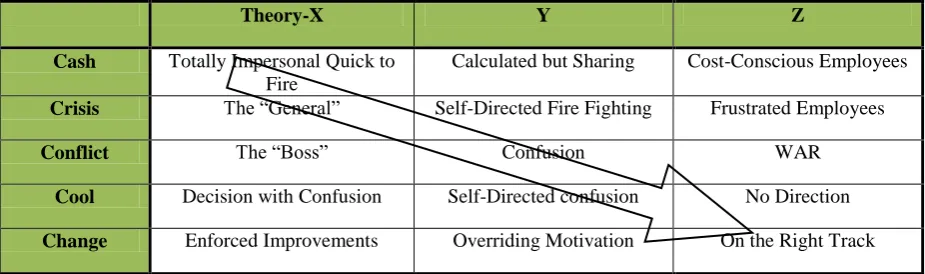
Chart 2 breaks down the two most complex management style classifications and presents all sorts of mixes and matches of management styles. These mixtures of styles are detailed and explained in Chart 3.World Class is being a Theory-Z Change Manager. Looking at Chart 2, we conclude that it doesn‘t matter where we find ourselves now; instead, we should strive toward Theory-Z change manager status. Now let us examine the last remaining two classification categories. As a world-class SCM manager, you would want to be a sunrise rather than a sunset manager, always looking for alternatives and options for improvement, but realizing that many of these options will fail. Also, as a world-class SCM manager you would want to be a leader rather than a boss, motivating and guiding your employees by your hard work and farsighted examples.
Insert table 2 here
Finally, we know what a world-class SCM manager should look like. Such a manager should be a Sunrise Manager—possessing a long-term orientation looking for the ―better way‖, Theory-Z Manager—having employees involved with and guiding the business process through participative and empowered team efforts Change Manager—guiding a dynamic, evolving business organism that capitalizes on change opportunities Leader—being a character-building, motivational example Having categorized world-class SCM managers and having determined how to categorize them, let us now decide why we want to fit into this slot. A world class competitive stance will not allow us to be anything but world-class SCM managers. World-class SCM managers look to the future, a highly competitive future, a future full of changes. World-class SCM managers realize that their employees are the key to motivating successful change and that employees are led not bossed.
Numerous organizations are attempting to move themselves toward world class management status. For example, Tridon-Oakdale placed its management team in a hotel to get them away from the everyday bustle of fire Root cause identification is a theme of the book Breakthrough Thinking. This book helps Total Quality Management (TQM) teams identify opportunities for improvements—changes! A second, followup book expands on this theme. See Nadler, Gerald, and Shozo Hibino, Breakthrough Thinking, Prima Publishing & Communications, Rocklin, CA, 1990; and Nadler, Gerald, Shozo Hibino, and John Farrell, Creative Solution Finding, Prima Publishing & Communications, Rocklin, CA, 1995.
Insert table 3 here
The goal given to these managers was to ―work out a new vision for Tridon.‖ The result was a complete turnaround in both management style and output performance. Some of the changes that occurred included the following:
An organization chart turned upside down with employee teams on the top A new quality standard that far exceeded the standards of Tridon’s competitors “Legendary Customer Service”
Competitive pricing
Reduced inventory and lead times A $6 million turnaround
Some of the keys to success included these efforts:
A new mission statement with a commitment to change
An improved focus on building relationships between all employees Employee participation—“the goal is to have everyone speak” Total Quality Control
Kanban—Just-in-Time Manufacturing
“Smart Change” management focused on doing the right things Group technology focused on technology improvements
Tridon has demonstrated that world-class management works, but it considers itself as just getting ready for the next wave of improvements.
A world-class SCM manager views the future as an opportunity. For this manager the here-and-now is adequate for the past but not good enough for the future. He or she views all aspects of the enterprise systems, production philosophies, and even management styles that were in existence 20 to 30 years ago—as wholly deficient for today and especially inadequate for the future.
World-class managers enjoy the excitement of being leading-edge innovators, despite the occasional failures they will suffer on this risky management road.
World-class management is the ability to change yourself faster than the changes that are trying to affect you. World-class SCM managers are in control of change rather than letting change control them. They are innovators and adventurers. They have the ability to listen when listening is wiser than talking, which is almost always.
World-class management is managing and motivating positive, goal-directed change. It is being in control of change, and it is using change to your advantage. But being in control of change is not a simple task. Many facets need to change, or it would not take this entire book to discuss them. To be effective users of change, we need to consider all these facets, plan for them, strategize their usage, and utilize them to our advantage.
Not all change is positive. Changing just for the sake of changing is foolish. Thinking through the consequences and effects of changes is therefore as important as implementing the changes. Changes need to make a positive contribution toward goal achievement, without sacrificing the value system (ethics and integrity) of the enterprise. However, not changing for fear of making a mistake is the same as deciding not to be world class.
To manage change, we need to be innovators and creators. An innovator searches for opportunities to change. An innovator sees opportunity in every problem and looks for ways to take advantage of opportunities. Innovators work with others, as team players, because they understand the synergistic ideas created by teamwork. The creator takes newly found opportunities and turns them into defined projects, activities, or programs that will take advantage of the recent discoveries.
The management of change also requires an adventurer and a general. The adventurer is not afraid to take a chance on change and looks for the opportunity to do battle, to take an idea and to drive forcefully forward. An adventurer despises the routine and mundane, and looks for opportunities to break away, always searching for new areas to discover. Generals know that they cannot win the battle alone. Even Michael Jordan, who was probably one of the greatest basketball players of his time, could not have won one basketball game without four other players on the court.
At this point, having a somewhat clearer view of the characteristics of a world-class SCM manager, we are ready to examine why change is such an important part of the lifestyle of this manager.
A Discussion of Change
Let us contemplate the two sources of changes: 1. The changes that come from us
2. The changes that happen to us
Treating the second source of change first, we need to be prepared for changes that will happen to us. We need to watch for these changes and manage them into opportunities. We need to become world-class SCM managers that watch for and use growth and development opportunities. This brings us to another thought:
It doesn’t matter how far In front of the pack you are, If you’re not moving fast enough, You’ll get run over.
Change is innovation; it is developing leading-edge competitive strategies; it is moving forward. Remember (this goes along with the previous thought):
It doesn’t matter how fast you’re moving, If you’re not moving in the right direction, You’ll never achieve your goal!
often punish change. We need measurement systems that motivate the discovery of change. The search for change opportunities can mean a structural reorganization as well as a mental reorganization of your enterprise.
REFERENCES
1. Burt, D., Dobler, D. & Starling, S. (2003). World Class Supply Managementsm, New York:
McGraw-Hill Irwin, 7th ed.
2. Irwin, (2003). Boston, 7th edition.
3. Nadler, Gerald, & Hibino, Sh. (1994). Breakthrough Thinking; The Seven Principles of Creative
Problem Solving, Prima Publishing, Rocklin, CA.
4. Plenert, G. (2002). International Operations Management, Copenhagen, Denmark, Reprinted in India
by Ane Books, New Delhi, Copenhagen Business School Press.
5. Plenert, G. (1993). Plant Operations desk book, Homewood, IL: Business 1 Irwin.
6. Plenert, G. (2001). The SCM Manager: Value Chain Management in an eCommerce World, Los
Angeles, CA: Blackhall Publishing.
7. Plenert, G. (2001). The eManager: Value Chain Management in an eCommerce World, Blackhall
Publishing, Los Angeles, CA.
8. Plenert, G. & Hibino, Sh. (1997). Making Innovation Happen: Concept Management Through
Integration, St. Lucie Press, Del Ray Beach, FL.
9. Plenert, G. & Kirchmier, B. (2000). Finite Capacity Scheduling, John Wiley & Sons, New York.
10. Ross, A., The challenges of Supply Chain Management, Managing Director of Supply Chain Analytics.
11. Semler, R. (1993). Maverick; The Success Story Behind the World’s Most Unusual Workplace, Warner
Books, New York.
12. Semler, R. (1993). Maverick; the Success Story behind the World’s Most Unusual Workplace, New
York: Warner Books.
13. William, V. F. & Everaert, P. The New Supply Chain Executive,Using the Integrated Supply Chain as a
Competitive Weapon.
In front of each management style indicate whether you (or the person you are evaluating) fit this description:
N – not really one of these
O – occasionally one of these
Y – definitely one of these
Sunrise Manager Has a view toward the future, a dreamer full of wild ideas, progressive, leading edge, technology minded
Sunset Manager Spends time fighting day-to-day fires, workaholic who is great at getting things done
Theory-X Manager Secretive, has his or her fingers in everything that happens, always has the final word, tells rather than asks questions
Theory-Y Manager Values the opinion of the employees, spends more time listening than talking, looks for ideas from the bottom-up but makes the final decision
Theory-Z Manager Tends to empower the employees to make their own decisions and lets them implement their own ideas
Cash Manager Cost and budget obsessive, looks toward stability rather than opportunity, prefers to patch and repair rather than replace because it is cheaper
Crisis (or Crash) Manager Believes that you shouldn‘t fix anything that isn‘t broken looks at problems as a disruption that needs to be conquered, attacks problems
Conflict Manager Looks at the workplace as a battlefield of competing players, feels the need to take and maintain the upper hand
Cool Manager Feels the workforce is best motivated by giving them whatever they want, wants to bribe their way into the hearts of their employees, wants to be everybody‘s best friend
Change Manager Searches for challenges in competitiveness, thrives on changes, innovations, improvements, technology
Boss Directs employee traffic, has self-image as ―King of the Hill‖ and wants to have sole ownership of the hill, ‖Do as I Say‖ philosophy
Leader Shows the way by using example and by stepping out into the traffic in front of the employees, not afraid to show everyone how to get to the top of the hill, ―Do as I Do‖ philosophy
Theory-X Y Z
Cash Totally Impersonal Quick to Fire
Calculated but Sharing Cost-Conscious Employees
Crisis The ―General‖ Self-Directed Fire Fighting Frustrated Employees
Conflict The ―Boss‖ Confusion WAR
Cool Decision with Confusion Self-Directed confusion No Direction
Change Enforced Improvements Overriding Motivation On the Right Track
table2: here What Type of Manager Are You?
This chart explains and defines the categories listed in Chart 2. Here we see all sorts of mixes and matches of management styles.
Theory-X Manager-Cash Manager
This manager is impersonal and quick to fire and bases all decisions on short-time financial reports.
Theory-X Manager-Crisis Manager
The ―general‖ charges his or her troops against the coming enemy, which is often a variety of problems, including the biggest problem of all, change. Theory-X Manager-Conflict
Manager
The ―boss‖ expects the respect of employees and demands immediate response to his or her whims and wishes.
Theory-X Manager-Cool Manager
The manager makes the final decisions, but in an attempt to keep everyone happy, many of the decisions are political and therefore contradictory. The result is more confusion than progress.
Theory-X Manager-Change Manager
This manager forces change on employees, leaving them rebellious and resistant.
Theory-Y Manager-Cash Manager
This manager wants the employees‘ ideas but will make the final decision in all cases based on short-term financial viability.
Theory-Y Manager-Crisis Manager
This manager expects employees to be self-directed fire-fighter, maintaining the status quo.
Theory-Y Manager-Conflict Manager
This manager listens to employees just to satisfy their egos and basically sees employees as a necessary evil requiring toleration.
Theory-Y Manager-Cool Manager
This manager solicits the employees‘ idea and says ―yes‖ to everyone, leaving employees without any real guidance from the top.
Theory-Y Manager-Change Manager
This manager wants employees to search for opportunities for change but reserves the right to override any suggestions, since the manager has the broader insight needed for all decisions made in the enterprise.
Theory-Z Manager-Cash Manager
This management style has teams analyzing all changes on a financial basis.
Theory-Z Manager-Crisis Manager
Here teams work on solving problems with a short-term perspective aimed at getting the problem fixed quickly.
Theory-Z Manager-Conflict Manager
Here teams continually find themselves having to defend against a management that considers them ignorant.
Theory-Z Manager-Cool Manager
This manager is completely employees oriented, but in the effort to keep everyone happy, ends up being an ineffective facilitator, causing frustration and a lack of direction.
Theory-Z Manager-Change Manager
This manager facilitates change and motivates employee teams to search for opportunities for change. The teams see themselves as owners of the change, and they therefore attempt to implement the change and take pride in the results. Fire fighting is kept to a minimum, and fires are looked at as being caused by some ―Root Problem‖ that needs to be identified and changed with a long-term perspective. This is the management style of a world-class SCM manager.