RESEARCH ARTICLE
PERCEPTION ON FEDERAL GOVERNMENT OF NIGERIA WHISTLE BLOWING POLICY ON THE
IMPLEMENTATION OF TECHNICAL AND VOCATIONAL EDUCATION AND TRAINING
PROGRAMMES IN TERTIARY INSTITUTIONS IN RIVERS STATE, NIGERIA
Nnodim, A.U. and
*Ochogba, C.O.
Department of Vocational and Technology Education, Rivers State University, Nkpolu, Oroworukwo,
Port-Harcourt
ARTICLE INFO
ABSTRACT
The study investigated the perception on Federal Government of Nigeria (FGN) whistle blowing policy on implementation of Technical and Vocational Education and Training Programmes in tertiary institutions in Rivers State. A descriptive survey design guided the study. The population of the study comprised 42 Technical and Vocational Education and Training lecturers of Rivers State University and Ignatius Ajuru University of Education. Three research questions were answered. The instrument of the study was a survey questionnaire that was partitioned into three sections, structured in the pattern of 5 point Likert rating scale of agreement. The reliability coefficient of the rating scale was 0.83. Percentage, Mean and Standard Deviation were used to answer the research questions, while t-test statistical tool was used to test the hypotheses at 0.05 level of significance. The study found the current status of Technical and Vocational Education and Training to include: poor funding, inadequate learning facilities, lack of in-service training for teachers, discrimination of TVET degree and exodus of teachers. The current situation was as a result of embezzlement, corruption, mismanagement of fund, theft and bribery, among others. More so, with the introduction of whistle blowing policy, there will be reduction of impunity and embezzlement of funds, hence, more money will be made available for the provision of adequate facilities, in-service training of teachers, training allowance, and many more. The study also found that there was no significant difference in the mean responses of respondents on the perception of Federal Government of Nigeria whistle blowing policy on implementation of TVET in tertiary institutions in Rivers State, Nigeria. Therefore, it was recommended that there should be adequate awareness on Federal Government of Nigeria whistle blowing policy and that Technical and Vocational Education and Training students and lecturers should report every corrupt practice in the school in order to mitigate corruption.
Copyright © 2018,Nnodim and Ochogba. This is an open access article distributed under the Creative Commons Attribution License, which permits unrestricted
use, distribution, and reproduction in any medium, provided the original work is properly cited.
INTRODUCTION
In the pre-colonial era, there was a common practice of transferring skill from one generation to another through a non-formal educational system, known as “apprenticeship”. Through this practice, it was possible for people of the world to preserve skills that were necessary for development. Due to the non-formal nature of apprenticeship training, and considering the fact that the World was becoming global, there was need for relevant skills to be harnessed, refined and transferred through a more organized instruction delivery, thus, a special type of education known as “Technical and Vocational Education and Training” (TVET) was introduced into the school curriculum to cater for this purpose. According to Anaele, Adelakun, Dem-Isaiah and Barfa (2014), TVET is a type of education that provides trainees with relevant skills, knowledge and attitudes that is necessary for employment. Also, United Nations Educational, Scientific and Cultural
*Corresponding author: Ochogba, C.O.
Department of Vocational and Technology Education, Rivers State University, Nkpolu, Oroworukwo, Port-Harcourt.
Organization (UNESCO) in Nwachukwu (2014) described TVET as a comprehensive term referring to those aspects of the educational process including, in addition to general education, the study of technologies and related sciences, and the acquisition of practical skills, attitudes, understanding and knowledge relating to occupations in various sectors of economic and social life. In this context, TVET could be described as that type of education that is systematically organized to train individuals to be practically oriented for paid or self-employment. TVET programme comprises very relevant courses like electrical, mechanical, woodwork, automobile, building and other vocational courses like home economics, entrepreneurship and even agricultural science that is fast becoming a very important sector in Nigeria, owing to the fact that oil that was hitherto considered as the hub of Nigeria’s economy, is becoming irrelevant. Through TVET programme, agriculturists are trained for them to be able to train future agriculturist that will help in developing the grassroots. Hence, with a well implemented TVET programme, Nigeria could solve some of its agricultural challenges. However, like every other type of education,
ISSN: 0976-3376
Asian Journal of Science and Technology Vol. 09, Issue, 06, pp.8272-8276, June,2018SCIENCE AND TECHNOLOGY
Article History:
Received 20th March, 2018
Received in revised form 10th April, 2018
Accepted 19th May, 2018
Published online 30th June, 2018
Key words:
TVET has being over the years constrained by several factors that affects its full implementation. According to Okoli, Wejinya, Agam and Asufi (2016), education suffers neglect at the post independence era because of in-adequate funding, but that of TVET has been worse. Okoli et.al (2016) further stated that the inadequate funding is based on the fact that the political class played ethnic and party politics and diverted funds meant for education to party and personal accounts stacked away in foreign banks. In line with this, Nwachukwu (2014) lamented that TVET programmes are not properly funded and this has resulted to; inadequate infrastructure, societal neglect of skills training, inappropriate training of TVET teachers and limited institutional and personnel capacity. Consequently, these factors have been noted to have affected the competence of TVET graduates. Abariko and Olabiyi (2015) opined that majority of craftsmen and graduates of TVET are not competent in handling skilled jobs in industries. Also, Nnodim and Johnwest (2016) found that inadequate funding of TVET has affected not only learners, but teachers as management lack the vocational skills to impact to the learners. All these are easily linked to corruption. PricewaterhouseCoopers (2016) described corruption as a spectrum of illegal payments and transactions such as bribes, embezzlement and money laundering among others. In Nigeria today, there is a public perception of corruption as a destructive agent that has crippled the economy of the country and has also affected the transparent operation of some sectors.
This is not only found among the elites and those in leadership positions, but it is also found among the medium and lower class workers. Corruption is the cankerworm that has destroyed the fabrics of our educational policy resulting to infrastructural decay and wrongful appropriation of fund meant for educational development in all its ramifications. Meanwhile, with stark realities of the destructive tendencies of corruption in all aspects of the nation’s life starring on our faces, coupled with the recessed economy, the present government in a bid to expose corrupt practices recently introduced the “whistle blowing policy”. Ralph Nader coined the phrase in the early 1970’s to avoid the negative connotations found in other words such as “informers’’ and “snitches” (Nader, Petkas and Blackwell in Taiwo, 2015). The term “whistle blowing” is described as a deliberate and obligatory act of disclosure, which gets on public records and is made by a person who has privileged access to information of an organization about the illegality, fraudulent practices or other wrongdoing of a person or organization to an external entity having power to rectify the wrongdoing (Jubb, 1999). Also, Rehg, Miceli, Near and Van Scotter (2008) described whistle blowing as an act of disclosure by members of an organization of illegal and immoral acts perpetrated by the organization and organization members to persons or organizations that may bring about a change. According to Federal Government of Nigeria (2016), the information to be exposed through the whistle blowing policy include among others; Mismanagement or misappropriation of public funds and assets (e.g. properties and vehicles). Also, information on stolen public funds, concealed public funds, financial malpractice or fraud, theft, collecting or soliciting bribes, diversion of revenues, underreporting of revenues, conversion of funds for personal use, fraudulent and unapproved payments and splitting of contracts will be exposed. Onakoya and Moses (2016) asserted that whistle blowing policy as an anti-corruption tool could be beneficial to Nigeria and Nigerians by
ensuring efficient allocation of resources, preservation of national wealth and improved well-being. The underlying principle is: “see something say something” and an expectation that with this policy, fraudulent practices that have led to under-development of the country in all aspects could be mitigated. It is against this backdrop that this study which intends to ascertain how the FGN whistle blowing policy could enhance the implementation of TVET in tertiary institutions in Rivers State was developed.
Purpose of the study
This study investigated the perception on FGN whistle-blowing policy on implementation of Technical and Vocational Education and Training programmes in tertiary institutions in Rivers State.
Specifically, this study sought to
Ascertain the current status of Technical and Vocational Education and Training programme in tertiary institutions in Rivers State.
Ascertain the possible causes of current situation in Technical and Vocational Education and Training programme in tertiary institutions in Rivers State. Examine the role of FGN whistle blowing policy on
TVET implementation.
Research questions
What is the current status of Technical and Vocational Education and Training programme in tertiary institutions in Rivers State?
What are the possible causes of current situation in Technical and Vocational Education and Training programme in tertiary institutions in Rivers State? What is the role of FGN whistle blowing policy on
TVET implementation?
Hypotheses
The following null hypotheses were tested at 0.05 level of significance for two tailed test
There is no significant difference in the mean responses of Technical and Vocational Education and Training lecturers in Rivers State University and Ignatius Ajuru University of Education on the current status of Technical and Vocational Education and Training programme in tertiary institutions in Rivers State. There is no significant difference in the mean responses
of Technical and Vocational Education and Training lecturers in Rivers State University and Ignatius Ajuru University of Education on the possible causes of current situation in Technical and Vocational Education and Training programme in tertiary institutions in Rivers State
MATERIALS AND METHODS
Descriptive survey design was used for the study. The area of the study was Rivers State, which is a state in Southern part of Nigeria with three tertiary institutions (two universities and one college of education) offering TVET programmes. The population of the study comprised 42 TVET lecturers, which comprised 16 Rivers State University, Port-Harcourt lecturers and 26 Ignatius Ajuru University of Education lecturers. It was a census as the entire population were studied. Structured survey questionnaire titled “Perception of Federal Government of Nigeria Whistle-blowing Policy on Implementation of TVET” (PFGNWPTVET) served as the instrument for data collection. The instrument was partitioned into three sections (A, B and C) that were structured in the pattern of Likert 5 point rating scale of agreement. The face validity of the instrument was ascertained by two experts. More so, the instrument was subjected to test of reliability using Cronbach Alpha reliability Coefficient method. The reliability coefficients established was 0.82. Copies of the instrument were administered and retrieved by the researchers at the spot. Percentage, Mean and Standard Deviation were used to answer the research questions while t-test statistical tool was used to test the hypotheses. Percentage ˂50% was rejected while percentage ≥50% was accepted. More so, mean scores ˂ 3.00 were rejected while mean scores ≥3.00 were accepted.
RESULTS AND DISCUSSION
Table 1 showed responses on current status of TVET in tertiary institutions. The percentage and Grand Mean responses of RSU Lecturers showed that the following are current status of TVET in tertiary institutions: poor funding (75.0% and 3.83), inadequate learning facilities (81.2% and 4.27), lack of in-service training for TVET teachers (93.8% and 4.21), inadequate TVET teachers (68.8% and 3.93), discrimination of TVET degree (68.8% and 3.93), lack of training allowance for TVET teachers (93.8% and 4.32), ill-equipped workshops for practical (68.8% and 3.85), low enrolment due to lack of confidence in TVET programmes (100% and 4.35), exodus of TVET teachers for lucrative ventures (62.6% 4.13), TVET teachers not promoted as at when due (93.8% 4.26) and TVET teachers salary not commensurate when compared to other careers (81.3% and 4.11). Also, the responses of IAUE Lecturers showed that the following are current status of TVET in tertiary institutions: poor funding (69.2% and 3.83), inadequate learning facilities (80.7% and 4.27), lack of in-service training for TVET teachers (73.1% and 4.21), inadequate TVET teachers (80.8% and 3.93), discrimination of TVET degree (77.0% and 3.93), lack of training allowance for TVET teachers (73.0% and 4.32), to ill-equipped workshops for practical (69.2% and 3.85), low enrolment due to lack of confidence in TVET programmes (76.9% and 4.35), exodus of TVET teachers for lucrative ventures (84.6% 4.13), TVET teachers not promoted as at when due (73.1% 4.26) and TVET teachers salary not commensurate when compared to other careers (84.6% and 4.11). Furthermore, the t-cal for each of the variables was ˂ the t-crit of 2.02. Therefore, all the variables were accepted, which means that there was no significant difference in the mean responses of RSU and IAEU Lecturers on the current status of TVET in tertiary institutions in Rivers State for all the items. This present work is in conformity with Nwachukwu (2014) which lamented that TVET programme is not properly
funded and this has resulted in: inadequate infrastructure, societal neglect of skills training, inappropriate training of TVET teachers, limited institutional and personnel capacity. Consequently, these factors militating against TVET have been noted to have affected the competence of TVET graduates. Table 2 showed responses on the possible causes of current situation in TVET in tertiary institutions. The percentage and Grand Mean responses of RSU Lecturers showed that the following are possible causes of current situation in TVET in tertiary institutions: embezzlement and fraudulent act (62.5% and 3.75), corruption (68.8% and 3.54), mismanagement of fund (56.2% and 3.66), diversion of budgeted fund for TVET projects (62.6% and 3.79), misappropriation of fund (62.5% and 3.81), theft (93.7% and 4.14), bribery (93.7% and 3.94), under-reporting of revenue slated for projects (62.6% and 3.85), splitting of contracts (81.2% 4.22), poor supervision of TVET projects (75.0% 3.97), lack of awareness on the exposure of corrupt practices (87.6% 4.06), insufficient fund for TVET schools as a result of embezzlement (75.0% 3.84), impunity on the side of contractors and administrators (81.2% and 3.71), lack of mechanism for exposure of fraudulent act (81.3% and 3.95) and deliberate delay of contract execution to attract upward variations (62.6% and 3.65). Also, the responses of IAUE Lecturers showed that the following are possible causes of current situation in TVET in tertiary institutions: embezzlement and fraudulent act (68.0% and 3.75), corruption (65.4% and 3.54), mismanagement of fund (77.0% and 3.66), diversion of budgeted fund TVET projects (69.3% and 3.79), misappropriation of fund (61.5% and 3.81), theft (76.9% and 4.14), bribery (69.3% and 3.94), under-reporting of revenue slated for projects (65.4% and 3.85), splitting of contracts (80.8% 4.22), poor supervision of TVET projects (61.8% 3.97), lack of awareness on the exposure of corrupt practices (76.9%4.06), insufficient fund for TVET schools as a result of embezzlement (69.3% 3.84), impunity on the side of contractors and administrators (69.2% and 3.71), lack of mechanism for exposure of fraudulent act (69.2% and 3.95) and deliberate delay of contract execution to attract upward variation (61.6% and 3.65).
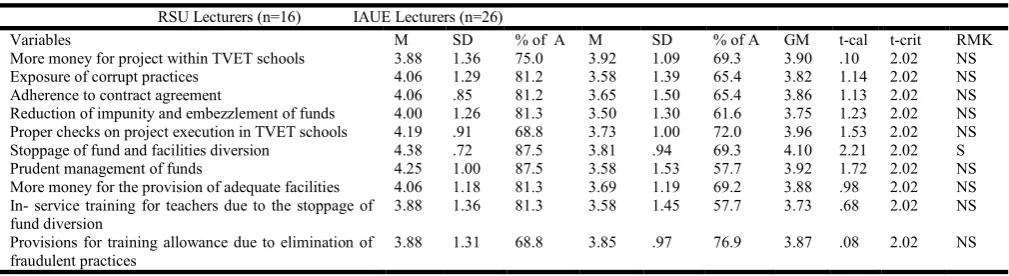
diversion (81.3% 3.73) and provision of training allowance for TVET teachers due to the elimination of fraudulent practices (68.8% 3.87). Also, the responses of IAUE Lecturers showed that the following are possible solutions to the current situation using FGN whistle blowing policy: more money for project within TVET schools (69.3% and 3.90), exposure of corrupt practices (65.4% and 3.82), adherence to contract agreement (65.4% and 3.86), reduction of impunity and embezzlement of funds (61.6% and 3.75), proper checks on project execution in TVET schools (72.0% and 3.96), stoppage of fund diversion
(69.3% and 4.10), prudent management of funds (57.7% and 3.92), more money for the provision of adequate facilities (69.2% and 3.88), in-service training for teachers due to the stoppage of fund diversion (57.7% 3.73) and provision of training allowance for TVET teachers due to the elimination of fraudulent practices (76.9% 3.87). Furthermore, the t-cal for each of the variables was ˂ the t-crit of 2.02, except for item 6. Therefore, all the variables were considered accepted, which means that there was no significant difference in the mean responses of RSU and IAEU Lecturers on the possible Table 1. Respondent’s opinion and result of hypothesis on current status of TVET in tertiary institutions
RSU Lecturers (n=16) IAUE Lecturers (n=26) DF=40
Current status of TVET M1 SD1 % of A M2 SD2 % of A GM t-cal t-crit RMK
Poor funding 3.81 1.32 75.0 3.85 1.32 69.2 3.83 .10 2.02 NS
Inadequate learning facilities 4.38 .81 81.2 4.15 1.16 80.7 4.27 .76 2.02 NS
Lack of in-service training for TVET teachers 4.50 1.03 93.8 3.92 .93 73.1 4.21 1.84 2.02 NS
Inadequate TVET teachers 3.81 .98 68.8 4.04 1.11 80.8 3.93 .70 2.02 NS
Discrimination of TVET degree 3.94 1.24 68.8 3.92 1.26 77.0 3.93 .05 2.02 NS
Lack of training allowance for TVET teachers 4.63 .81 93.8 4.00 1.30 73.0 4.32 1.93 2.02 NS
Ill-equipped workshops for practical 3.81 .98 68.8 3.88 .95 69.2 3.85 .23 2.02 NS
Low enrolment due to lack of confidence in TVET programmes
4.50 .52 100 4.19 1.13 76.9 4.35 1.21 2.02 NS
Exodus of TVET teachers for lucrative ventures 3.80 1.39 62.6 4.46 .76 84.6 4.13 1.75 2.02 NS
TVET teachers not promoted as at when due 4.13 .50 93.8 4.38 1.06 73.1 4.26 1.03 2.02 NS
TVET teachers salary not commensurate with other professions
4.06 1.12 81.3 4.15 1.35 84.6 4.11 .23 2.02 NS
Source: Field Survey, 2017. Mean score < 3.00, rejected, otherwise, accepted . A- Acceptance, GM- Grand Mean, RMK (Remark), NS- Not Significant, S- Significant.
Table 2. Respondent’s opinion and result of hypothesis on possible causes of current situation in TVET programme in tertiary institutions
RSU Lecturers (n=16) IAUE Lecturers (n=26) DF=40
Causes of current situation in TVET M1 SD1 % of A M2 SD2 % of A GM t-cal t-crit RMK
Embezzlement and fraudulent act 3.69 1.35 62.5 3.80 1.38 68.0 3.75 .25 2.02 NS
Corruption 3.69 1.25 68.8 3.38 1.47 65.4 3.54 .45 2.02 NS
Mismanagement of fund 3.31 1.54 56.2 4.00 .94 77.0 3.66 1.62 2.02 NS
Diversion of budgeted fund for TVET 3.88 1.20 62.6 3.69 1.23 69.3 3.79 .49 2.02 NS
Misappropriation of fund 3.88 1.09 62.5 3.73 1.40 61.5 3.81 .39 2.02 NS
Theft 4.31 .60 93.7 3.96 .87 76.9 4.14 1.54 2.02 NS
Bribery 4.25 .58 93.7 3.62 1.53 69.3 3.94 1.89 2.02 NS
Under-reporting of revenue slated for projects 3.88 1.20 62.6 3.81 1.33 65.4 3.85 .18 2.02 NS
Splitting of contracts 4.31 .79 81.2 4.12 1.14 80.8 4.22 .30 2.02 NS
Poor supervision of TVET projects 4.25 1.34 75.0 3.69 1.38 61.8 3.97 1.30 2.02 NS
Lack of awareness on the exposure of corrupt practices 3.81 1.17 87.6 4.30 1.00 76.9 4.06 1.39 2.02 NS
Insufficient fund for TVET schools as a result of embezzlement
4.06 .77 75.0 3.62 1.53 69.3 3.84 1.23 2.02 NS
Impunity on the side of contractors and administrators 3.69 1.40 81.2 3.73 1.04 69.2 3.71 .10 2.02 NS
Lack of mechanism for exposure of fraudulent act 4.13 .88 81.3 3.77 .91 69.2 3.95 1.27 2.02 NS
Deliberate delay of contract execution to attract upward variations
3.80 1.39 62.6 3.50 1.30 61.6 3.65 .70 2.02 NS
Source: Field Survey, 2017. Mean score < 3.00, rejected, otherwise, accepted. A- Acceptance, GM- Grand Mean, RMK (Remark), NS- Not Significant, S- Significant.
Table 3. respondent’s opinion and result of hypothesis on the role of FGN whistle blowing policy on TVET implementation
RSU Lecturers (n=16) IAUE Lecturers (n=26)
Variables M SD % of A M SD % of A GM t-cal t-crit RMK
More money for project within TVET schools 3.88 1.36 75.0 3.92 1.09 69.3 3.90 .10 2.02 NS
Exposure of corrupt practices 4.06 1.29 81.2 3.58 1.39 65.4 3.82 1.14 2.02 NS
Adherence to contract agreement 4.06 .85 81.2 3.65 1.50 65.4 3.86 1.13 2.02 NS
Reduction of impunity and embezzlement of funds 4.00 1.26 81.3 3.50 1.30 61.6 3.75 1.23 2.02 NS
Proper checks on project execution in TVET schools 4.19 .91 68.8 3.73 1.00 72.0 3.96 1.53 2.02 NS
Stoppage of fund and facilities diversion 4.38 .72 87.5 3.81 .94 69.3 4.10 2.21 2.02 S
Prudent management of funds 4.25 1.00 87.5 3.58 1.53 57.7 3.92 1.72 2.02 NS
More money for the provision of adequate facilities 4.06 1.18 81.3 3.69 1.19 69.2 3.88 .98 2.02 NS
In- service training for teachers due to the stoppage of fund diversion
3.88 1.36 81.3 3.58 1.45 57.7 3.73 .68 2.02 NS
Provisions for training allowance due to elimination of fraudulent practices
3.88 1.31 68.8 3.85 .97 76.9 3.87 .08 2.02 NS
solutions to the current situation using whistle blowing policy, except for item 6. This study is in consonance with Federal Government of Nigeria (2016), which opined that the information to be exposed through the whistle blowing policy include among others: Mismanagement or misappropriation of public funds and assets (e.g. properties and vehicles), information on stolen public funds, information on concealed public funds, financial malpractice or fraud, theft, collecting / soliciting bribes, corruption, diversion of revenues, underreporting of revenues, conversion of funds for personal use, fraudulent and unapproved payments and splitting of contracts. Also, the study is in agreement with Onakoya and Moses (2016) that Nigeria as a country stands to benefit from FGN whistle-blowing as an anti-corruption tool through efficient allocation of resources, preservation of national wealth, and improved well-being of the citizenry.
Conclusion
The study concluded that poor funding, inadequate learning facilities, lack of in-service training for TVET teachers, inadequate TVET teachers are some of the current status of TVET programme in Rivers State, Nigeria. These factors have resulted in the production of ill-equipped TVET graduates, low enrolment of students and negative perception of TVET programmes. However, it was deduced that the militating factors are due to corruption which ranges from diversion of fund, mismanagement of fund, embezzlement, theft, bribery, impunity in the side of contractors, lack of mechanism for exposure of fraudulent act and the likes. Furthermore, the study concluded that, with the introduction of whistle blowing policy, corrupt practices within TVET will be exposed, contractors handling projects in TVET schools will adhere strictly to the terms of agreement, fund allotted for TVET will not be diverted, impunity and embezzlement of funds will be reduced and there will be proper checks on projects execution in TVET schools. Based on this, more money will be made available for: project execution in TVET schools, provision of adequate facilities, in-service training of TVET teacher and many more. Therefore, adequate number of agriculturists will be trained for grass root development.
Recommendations
The following recommendations were made in this study
There should be adequate fund allotted for TVET programme to enable it fulfil its aims and objectives that is centred on training individuals that will help in developing the country.
The FGN whistle-blowing policy should be sustained and proper awareness should be made to educate the populace on how to report every corrupt practice.
Technical and Vocational Education and Training students and lecturers should report every corrupt practice in the school in order to mitigate corruption.
REFERENCES
Abariko, A. and Olabiyi, O.S. 2015. The influence of technical vocational education and training (tvet) on skill acquisition and development of craftsmen in the construction industry. International Journal of Technical Research and
Applications, 35, 32-38
Anaele, E.O., Adelakun, O.A., Dem-Isaiah, I. and Barfa, G.I. 2014. Strategies for revitalizing the implementation of entrepreneurship education in technical, vocational education and training to enhance self-employment in Nigeria. British Journal of Education, 2(4), 50-62.
Federal Ministry of Finance, 2016. Whistle blowing. Retrieved 25th July, 2017 from https://www.proshareng.co m/news/Frauds.../Whistle-Blowing-Policy...--/33720
Jubb, P. 1999. Whistleblowing: A restrictive definition and interpretation. Journal of Business Ethics, 21(2), 77–94.
Nnodim, A.U and Johnwest, E.K. 2015. Vocational skill competence of agricultural science teachers and youth empowerment in Rivers State. International Journal of Education and Evaluation, 2(3), 51-58.
Nwachukwu, P.O. 2014. Poverty reduction through technical and vocational education and training (TVET) in Nigeria. Developing Country Studies, 4(14), 10-13.
Okoli, N.J., Wejinya, S.A., Agam, P.O. and Asufi, M.R. 2016. Funding of technical and vocational education and training in Nigeria: Issues and challenges. Merit Research Journal of Education and Review, 4(6), 75-78.
Onakoya, O.A. and Moses, C.L. 2016. Effect of system factors on whistleblowing attitude of Nigerian banks employees: A conceptual perspective. 3rd International Conference on African Development Issues, Covenant University Press.
PricewaterhouseCoopers, (2016). Impact of corruption on Nigeria's economy. Retrieved 15th June, 2017 from http://www.pwc.com/ng.
Rehg, M. T., Miceli, M. P., Near, J. P. and Van-Scotter, J. R. 2008. Antecedents and outcomes of retaliation against whistleblowers: Gender differences and power relationships. Organization Science, 19(2), 221–240.
Taiwo, S.F. 2015. Effects of whistle blowing practices on organizational performance in the Nigerian public sector: Empirical facts from selected Local Government in Lagos and Ogun State. Journal of Marketing and Management, 6
(1), 41-61.