Original Research Article
Assessment of infrastructure of first referral unit facilities in Surguja
division: a responsibility of providing emergency obstetric care
Abha Ekka
1*, Shubra A. Gupta
2, Divya Sahu
1, Anmol Madhur Minj
3, G. P. Soni
4INTRODUCTION
A pregnant woman is a dyad of a unit of two individuals consisting of the mother and the foetus. The unity of the dyad which starts after conception continues through the antenatal and postnatal periods. The dyad shares the critical birth experience jointly. Maternal health refers to the state of complete physical, mental, and social well-being of women during pregnancy, childbirth, and postpartum period.1,2 Maternal death according to WHO refers to “the death of woman while pregnant or within 42 days of termination of pregnancy, irrespective to the duration and site of pregnancy, from any cause related to or aggravated by the pregnancy or its management but not from accidental or incidental causes.3
Regarding the magnitude, every minute, one maternal death occurs somewhere in the developing countries. Maternal mortality is the tip of the iceberg.4 According to the estimates, in 2016 maternal mortality ratio (MMR) was recorded as 130 per 10,0000 live births,down from 167 in 2011-2013 but did not achieved the Millennium Development Goals (MDG) target for India of 109 maternal death per 100,000 live birth by the year 2015.5,6 On a national level with Empowered Action Group (EAG) states and Assam achieving a reduction of 188 from 246 which is significant.5 It is worth noting that Kerala (81) along with Tamil Nadu (91) and Maharashtra (104) have already achieved MDG target in 2007-2009.7 But Chhattisgarh being a new state with high burden of MMRstill lag behind these states with MMR 244 and
ABSTRACT
Background: Availability of emergency obstetric care (EmOC) is one of interventions to reduce maternal and newborn deaths. The health system fails when effective and affordable health interventions do not reach the population, when Poor infrastructure, drugs and equipment are lacking, and qualified human resources are scarce. The objective of the present study was to assess the availability of EmOC infrastructure in first referral units (FRUs) of Surguja division, Chhattisgarh.
Methods: A cross sectional studywasdesignated with 13 FRUs of Surguja division. A semi structured, closed-ended questionnaires was observed on the basis of check list, reviewing record, and interview by available staff.
Results: FRUs of Surguja division for physical infrastructure scored 68.5%, for essential medicine 69.2%, for equipments 50.7%, for instruments 45.3% and for availability of blood 34.6%, for health man power category of specialist score was 25.7% but for supportive staff 65.4%.
Conclusions: Our study revealed three existing bottlenecks in the healthcare delivery system as inadequate civil infrastructure, short fall of specialists as well as inadequate supplies of drugs and equipment, hampering the function of facility.
Keywords: Health facility infrastructure, First referral unit, EmOC
Department of Community Medicine, 1Government Medical College, Ambikapur, Surguja, 2Pt. Jawahar Lal Nehru Memorial Medical College, Raipur, 3Government Lakhiram Medical College, Raigargh, 4Government Medical College Rajnandgaon, Chhattisgarh, India
Received: 21 September 2019
Accepted: 11 November 2019
*Correspondence:
Dr. Abha Ekka,
E-mail: [email protected]
Copyright: © the author(s), publisher and licensee Medip Academy. This is an open-access article distributed under the terms of the Creative Commons Attribution Non-Commercial License, which permits unrestricted non-commercial use, distribution, and reproduction in any medium, provided the original work is properly cited.
Surguja division with 271 MMR is second most contributory division in the state due to causes related to pregnancy and childbirth.8
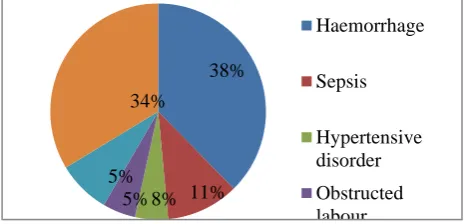
Majority (80%) maternal death is due to direct causes (Figure 1).9 These causes are preventable and reduce 80% of maternal death only if women access to essential obstetric services through health system. 9
Figure 1: Causes of maternal mortality.10
Over the past decade, national plans and programmes in India have stressed the need for universal screening for high-risk pregnancies and for operationalizing essential and emergency obstetric care (EmOC). Therefore, provision of EmOC as close to the community as possible was taken up under the Child Survival and Safe Motherhood Programme of India launched in 1992 and supported by the World Bank and United Nations Children’s Fund which emphasized the importance of access to EmOC by setting up first referral units (FRUs) at the community health centres or sub-district level hospitals in 1992.10 These FRUs are the first link to which a woman at high risk is referred prenatally or sent for EmOC and where the following critical services should be available 24-hour round the clock at fully functional FRUs as services including EmOC including surgical interventions like caesarean sections; new-born care; blood storage facility.10,11
The health system fails, when effective and affordable health interventions do not reach the population. This occurs when provider skills are inadequate, drugs and
equipment are lacking, poor infrastructure and qualified human resources are scarce.12
It should be noted that the critical interventions may currently not be available even in some district headquarter hospitals, particularly in the newly created districts in the EAG states and Chhattisgarh state being one of them. Therefore, operationalization effort must be carefully sequenced, and should start by making district hospital fully operational as a FRU.
The term ‘infrastructure’ is used to describe the elements of health care delivery system. In context to health care delivery system it refers to physical infrastructure, manpower, drugs, equipments and blood availability which are the prerequisite for health care delivery. That’s why the study has been conducted to assess the status of FRUs facility for providing EmOC in order to prevent maternal mortality in Surguja division of Chhattisgarh.
METHODS
A descriptive, cross sectional, observational hospital based study was conducted in the government health facilities, designated as FRUs of Surguja division (Chhattisgarh), India from February 2015 to April 2016. Simple random sampling used for selection of study setting i.e., Surguja division and the study area included all 13 govt. designated FRU’s. They were 5 district hospitals and 9 community health centres (CHC’s).Study tool used was semi structured, closed-ended questionnaires designed by using the Indian Public Health Standards Guideline of Govt. of India (GoI) 2012 and guideline for operationalizing FRUs GoI 2004. Assessment categories were physical infrastructure, manpower, equipments, essential drugs, blood availability with many sub categories (Table 1). Study technique used was observational using check list, reviewing record, and interview of available nursing staff at respective ward, labour room, drug store keeper, in charge of maternity ward. Pilot study was done in 2 centres (i.e., designated FRU’s 1 CHC and 1 district hospital) out of Surguja division using the above mentioned tool.
Table 1: Distribution of score of categories according to number of sub categories assessed in 13 FRUS.
S. No. Main categories No. of sub
categories
Max. score of main categories
Min. score of main categories
1 Physical infrastructure 09 234 0
2 Manpower
a) specialist 03 78 0
b) Medical officer 03 78 0
c) Supportive staff 04 104 0
3 Essential Medicine 05 130 0
4 Instrument 05 130 0
5 Equipment 06 156 0
6 Blood 01 26 0
Haemorrhage
Sepsis
Hypertensive disorder
Obstructed labour 38%
34%
11% 5%
The compilation of study done by using excel and analysis was done on the basis of scoring system for each facility. Score 0, 1 and 2 was used for subcategories only. Score ‘0’ mean not available at all, score ‘1’ mean available but not according to norm, score ‘2’ mean available according to norm. So the maximum score of each sub category is 26 and minimum score is ‘0’. Total score of main categories depended upon number of sub categories. Later sub categories score was compiled to find out score of main categories. Each score was also interpreted as percentage.
Ethical statement
Ethical approval for the study was obtained from institutional ethics review committee of Pt. J.N.M. Medical College Raipur, AYUSH University and National Health Mission (NHM) director of the Chhattisgarh state and in charge of the respective.
RESULTS
Physical infrastructure
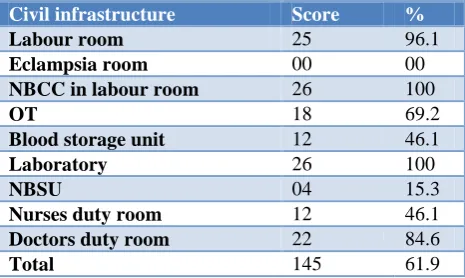
In assessment of physical infrastructure subcategories included were labour room, eclampsia room, newborn care corner (NBCC) in labour room, operation theatre (OT) blood storage unit, laboratory, Newborn Stabilisation Units (NBSU), nurses duty room, doctors duty room. Status of labour room score was 25 (96.1%) and NBCC in labour room score was 26 (100%) which indicates good preparedness for expecting mother and new born. But OT room score with 18 (69.2%) hampered the provision of comprehensive EmOC. Assessment of duty room, doctor’s duty room score was 22 (84.6%), while nurse’s duty room score was only 12 (46.1%). Bad preparedness of NBSU and eclampsia room was interested with scoring of 04 (15.3%) and 0 (0%) respectively. While blood storage unit score was 12 (46.1%). Laboratory score with 26 (100%) indicated status of good preparedness for lab services. Overall score for physical infrastructure of FRU’s was 145 (61.9%) reflecting presence of poor infrastructure (Table 2).
Table 2: Status of physical infrastructure of FRUs of Surguja division.
Civil infrastructure Score %
Labour room 25 96.1
Eclampsia room 00 00
NBCC in labour room 26 100
OT 18 69.2
Blood storage unit 12 46.1
Laboratory 26 100
NBSU 04 15.3
Nurses duty room 12 46.1
Doctors duty room 22 84.6
Total 145 61.9
Essential medicines, equipment’s, instruments, blood
Category of essential medicine included 4 antibiotics (Inj. Gentamycin, inj. metronidazole, inj. ceftrixone, inj. ciprofloxacin); 2 analgesic (inj. paracetamol, inj diclofenac); 3 IV fluid (NS, RL, 5% dextrose); 23 emergency drugs included all life-saving drugs and for management of obstetric complication (adrenaline, atropine, ergometrin, salbutamol, derriphylline, hydrocortisone, inj. insulin, promethazine, digoxin, frusemide, aminophylline, methyldopa, sodium inj. bicarbonate, Ca gluconate, misoprostol, oxytocin inj, capsule nifedipine, inj. duvadilan, inj magnesium sulphate, inj. ritodrine, inj dexa, inj. diazepam, inj. phenytoin.); 3 anaesthetic drugs (halothane, ketamine, lignocaine 2%).
Score on availability of essential drugs in FRUs of Surguja division was 90 (69.23%). Maximum lacking was found in availability of emergency drugs with score 13(50%) followed by analgesic and anaesthetic drugs with score 14 (53.9%) and 15 (57.67%) respectively. On the contrary, availability of IV fluid was 100% (Table 3).
Table 3: Status of essential medicine, equipment’s, instruments and blood availability of FRUs of Surguja
division.
Scores %
Essential medicine
Antibiotics 22 84.6
Analgesic or
anti-inflammatory 14 53.9
IVF 26 100
Emergency drugs 13 50 Anaesthetic drugs 15 57.69
Total 90 69.2
Equipments availability
Equipment of labour room 13 50
NBCC 13 50
Operation theatre 16 61.5
NBSU 3 11.5
Blood storage unit 14 53.8
Laboratory 20 83.3
Total 79 50.7
Instruments
Instruments of labour room 13 50
NBCC 11 47.8
Operation theatre 18 69.23
NBSU 4 15.38
Laboratory 13 50
Total 59 45.3
Availability of blood 9 34.6
score was only 79 (50.7%). Poor or non-availability of equipments at various areas like NBSU and NBCC, labour room was observed with score 3 (11.5%) and 13 (50%) each respectively. Blood storage unit scored 14 (53.8%); OT 16 (61.5%) and laboratory 20 (83.2%) (Table 3).
In another main category instruments, its availability score in FRUs of Surguja division was 59 (45.38%). Maximum score in its subcategory was found in OT 18 (69.23%) followed by labour room and laboratory scored 13 (50%).While score in NBSU and NBCC was 4 (15.38%) and 11 (47.8%) respectively. This finding was due to non-availability of physical infrastructure for NBSU (Table 3).
Category of blood availability observed presence of blood group A, B, AB, O Rh positive in FRUs. Score of 9 (34.61%) was obtained(Table 3).
Healthworkforce
On assessment of human manpower; where in specialist group included obstetrician, anaesthetic and pediatrician. Medical officer category included trained EmOC, lower segment caesarean section (LSAS), NBCC. Supportive staff included staff nurse, pharmacist, lab technician, OT assistant. Study shows that pertaining to specialist workforce score was 20 (25.7%). In specialist subcategory obstetrician scored 8 (30.7%). Situation of pediatrician and anaesthetic was worse with each score 6 (23.1%). Analysis of training status of medical officer scored only 34 (43.5%). Its subcategory trained in EmOC scored 14 (53.8%). Situation was worse with poor score in training in LSAS and Navjaat Shishu, Suraksha Karyakram (NSSK) with 8 (30.7%) and 12 (36.75%) respectively.
Table 4: Health manpower in FRUs of Surguja division.
Health workforce Score %
Specialist
Obstetricians 8 30.7 Anaesthetics 6 23.1 Paediatricians 6 23.1
Total 20 25.7
Medical officers
Trained in EmoC 14 53.8 Trained in LSAS 8 30.7 Trained in NSSK 12 46.1
Total 34 43.5
Supportive staff
Staff nurse 15 57.6
pharmacist 20 77
Lab technician 22 85.6 OT assistant 11 42.3
Total 68 65.4
Pertaining to supportive manpower, Surguja division scored only 68 (65.4%). Score of lab technician was 22 (85.6%), followed by pharmacist 20 (77%), staff nurse 15 (57.6%) and OT assistant 11 (42.3%) (Table 4).
DISCUSSION
The study covered all the designated FRU’s of Surguja division which has hilly terrain, inhabited by tribal population who depend on the government facility to get health related services. This is probably first study in this region that has assessed the status of infrastructure of FRU’s.Soan effort has been made to throw light on the key issues which might be affecting the functionality of FRUs for providing optimal level of care.
Access to quality public healthcare remains a pressing need amongst rural and remote populations of India. The NHM has been promoting institutional delivery to reduce maternal and neonatal deaths. But present study found that there are constraints of physical infrastructure, human resources, equipments, drugs and blood. If there is lacking of physical infrastructure, there is also lack of other resources. Similar finding was observed in many studies [Anwar et al, Sahu et al, Service Availability and Readiness Assessment (SARA) index Uganda].13-15 A study conducted by State institute of health and family welfare, Rajasthan in CHC found labour room availability was 90.3%, OT availability according to norm was only 49.7%. 90.3% had laboratory room. Blood storage unit was available at 58.1%.16 These findings are not consistent with present study which scored labour room 96.1%, OT 69.2%, laboratory room 100%, blood storage unit 46.1%. This difference in finding may be due to different data analysis method. But both studies show presence of poor physical infrastructure.
Good EmOC is most critical for reducing MMR, and C-section is the central issue in EmOC as it requires a trained surgeon and anaesthetist. An obstetric and anaesthetic specialist is necessary in FRUs for EmOC. But in this study main barrier in delivering was least availability of specialist (25.7%). A study done by Gaidhane in 2 CHCs of Maharashtra observed that one of the mostly providing emergency services due to non-availability of 24×7 specialist other CHCs don’t have any specialist available.17 Similarly a study done by Raman availability of gynaecologist and anaesthetic is a problem and observed that obstetrician only in 6 facilities out of 12 and anaesthetic only in 3 out of 6 while only 1 FRU out of 12 had pediatrician.18 In another study done by Dasgupta in different districts of Uttar Pradesh found that skilled human resource continued to be scarce. Only 10 (19.23%) obstetricians were available for the 52 CHCs in spite of the fact that CHCs were meant to serve as first referral centers.19 Also in one of the editorial paper Pundev et al showed that current position of specialist manpower at CHC reveal that as on March, out of sanctioned posts, 40.7% of obstetricians, 43.1% of paediatricians were vacant and in comparison to existing infrastructure, there was shortfall of 65.1% of obstetricians, 79.8% of pediatricians.20
In order to reduce the maternal and newborn mortality, reforms related to human resources are critical to improving health systems.13,18 The government is focusing on overcoming the constrain of specialist by introducing successful initiatives i.e., training of MBBS doctor in LSAS, EmOC, Chhattisgarh rural medical course incentive, training of staff nurses (skill birth attended, NSSK for performing resuscitation).21-24 But in our study there was lacking of trained medical officer pertaining to EmOC services. A trend can be seen of better quality of care at the FRUs where these EmOC doctors are posted as the number of referrals from these FRUs to higher centres has decreased by around 70% over a period of time.25 This is due toFRU preparedness in Maharashtra and Gujarat was good (except blood storage in Gujarat).26 This is good initiative as study from Gujarat and Maharashtra facilities showing, where EmOC doctors were doing well at all the FRUs and are independently handling emergencies and also performing LSCS operations.25 So we should learn from Gujarat and Maharashtra government that to minimize the lack of specialist firstly we require to train medical officer in EmOC, LSAS, NSSK and secondly before posting to the FRUs these facilities should be prepared in terms of other resources as per norm.
The result of assessment of FRUs of Surguja division suggests that maximum FRUs not in position to provide EmOC and NCC. Even with lack of infrastructure, report by NITI AAYOG shows Chhattisgarh state under the category of moderately improved in overall performance in 2014-15 base year rank.26 But report June 2019 shows Chhattisgarh state under the category of least improved with 23.53% of FRUs functioning.27 This might be due to
infrastructure constraints already mentioned in this study. As a consequence, limited healthcare efforts reaching to remote areas and thus state is unable to sustain its performance.
CONCLUSION
Our study revealed three existing bottlenecks in the healthcare system: poor physical infrastructure, short fall of specialists as well as inadequate supplies of drugs and equipment, leading to non-operationalization of facility. By using this data on facility infrastructure, health authorities will be able to take decision regarding prioritization of constrain hampering operationalization of the health facilities and before posting of trained faculties, availability of at least physical infrastructure shall be done, so that they can line up required equipments, instruments and drugs etc. to make facilities functional for saving maternal and child life. However health policy decision making cannot be based on snap shot research.
ACKNOWLEDGEMENTS
We acknowledge the support of National Rural Health Mission director of Chhattisgarh in conduction of this study. We are also thankful to the facility in charge medical officers and staff nurses of the facility for their cooperation during data collection.
Funding: No funding sources Conflict of interest: None declared
Ethical approval: The study was approved by the Institutional Ethics Committee
REFERENCES
1. Arora SVP. Maternal mortality-Indian scenario. Med J Armed Forces India. 2005;61(3):214-5. 2. Singh A, Mavalankar DV, Bhat R, Desai A, Patel
SR, Singh PV, et al. Providing skilled birth attendants and emergency obstetric care to the poor through partnership with private sector obstetricians in Gujarat, India. Bull World Health Organ. 2009;87(12):960-4.
3. WHO 2005 improving maternal, newborn and child health in the south east Asia region, New Delhi, 10th revision (ICD-10). Trends in maternal mortality 1990 to 2013 estimated by WHO, UNICEF, UNFA, World Bank and the United Nation Division.
4. Hailu S, Enqueselassie F, Berhane Y. Health facility-based maternal death audit in Tigray, Ethiopia. Ethiop J Health Dev. 2009;23(2):115-9. 5. Special bulletin on maternal mortality in India 2014-
2016, SRS Office of registrar General India May; 2018.
7. SRS 13 Office of Registrar General India. Special bulletin on maternal mortality in India 2013. Available at: http://www.censusindia.gov.in/vital statistics /SRS. Accessed on 16 August 2019. 8. Annual Health Survey Bulletin 2012-2013.
Chhattisgarh Office of the Registrar, India.
9. Say L, Chou D, Gemmill A, Tuncalp O, Moller AB, Daniels J, et al. Global causes of maternal death: a WHO systematic analysis; 2014.
10. Government of India. Guideline for operationalising FRUs MoHFW; 2004.
11. World Health Organizations. The World Health Report: Improving Performance. Geneva, Switzerland: World Health Organization; 2000. 12. Hulton LA, Matthews Z, Stones RW. Applying a
framework for assessing the quality of maternal health services in urban India. Soc Sci Med. 2007;64: 2083-95.
13. Anwar I, Khan N, Koblisky M. Quality of obstetric care in public sectors facilities and constraints to implementing emergency obstetric care services: evidence from high and low performing districts of Bangladesh. Dhaka, Bangladesh: Public Health Science Division; ICCDR, B, GPO Box 128. 14. Sahu KK, Manar MK Singh SK. Assessment of
health care facilities for maternal and child health care at Bal Mahila Chikitsalyas in Lucknow district, India. Intl J Biomed Advance Res. 2014;5(1):26-8. 15. Uganda Services Availability and readiness
assessment. Summary Report: Key findings in figures; 2013.
16. Analysis of CHCs in Rajasthan, SIHWF (State institute of health and family welfare at Jaipur, ISO 9001: 2008.
17. Gaidhane A, Quazi ZR. Reaching the unreached. Rapid Assessment Studies of Health Programmes Implementation in India, Assessing the Readiness of CHCs to deliver emergency obstetric care a study in Wardha District, Maharashtra.
18. Raman PS, Sharma B, Mavalankar D, Upadhyaya M. Assessing the regional and district capacity for
operationalizing emergency obstetric care through first referral units in Gujarat; 2009. Ahmedabad, India: Indian Institute of Management: W.P. No.2009-04-01.
19. Hagopian A, House P, Das A. Reaching the unreached. Rapid Assessment Studies of Health Programmes Implementation in India. Assessing the readiness of the health system to address maternal mortality: a study in Uttar Pradesh. Gazipur, Delhi: Nidhi Books; 2009.
20. Pandve HT, Giri PA. First referral unit (FRU): needs focus in India. Int J Community Med Public Health. 2015;2(2):75-6.
21. UN Millennium Project 2005. Who's got the power? Transforming health system for women and children. Task force on child health and maternal health. Earthscan, London; 2005.
22. Scholz S, Ngoli B, Flessa S. World Health Organization. Working together for health. World Health Report. Geneva: WHO; 2006.
23. Project Implementation plan 2012-2013, Chhattisgarh. Available at: cg web.nic.in/ health / programme. Accessed on 16 August 2019.
24. NRHM in the Eleventh Five Year Plan (2007-2012); National Health Systems Resource Centre, New Delhi.
25. National Institute of Health and Family Welfare. Programme Advisory Committee Meeting. New Delhi, India: NIHFW-PAC 2011.
26. Health Index Transforming states to transform India, 2018. Available at: pibphoto.nic.in.>p20182901. Accessed on 16 August 2019.
27. Healthy state, progressive India: Health Index June 2019 NITI Aayog’s.
Cite this article as: Ekka A, Gupta SA, Sahu D, Minj AM, Soni GP.Assessment of infrastructure of first referral unit facilities in Surguja division- a